Cerca:abstract concrete

Generi
Tutto
Abstract Concrete - Abstract Concrete

Eight decades in and Charles Hayward (This Heat, Camberwell Now) isn’t slowing down, he’s picking up the pace. Following on from a sensational string of gigs and festival performances, his latest endeavour - Abstract Concrete - is now primed to release this astounding self-titled debut via state51 Conspiracy.

The band features the luminous cast of Agathe Max (Mésange, UKAEA) on viola, Otto Willberg (Yes Indeed, Historically Fucked) on bass, Roberto Sassi (Snorkel, Glenn Branca) on guitar, Yoni Silver (Hyperion Ensemble, Steve Noble) on keyboards and, of course, Charles himself on drums and vocals. With this undeniable experimental pedigree, it’ll likely come as one hell of a surprise that this group are now responsible for one of the most persuasive and hook-laden avant pop albums of the year.

pre-ordina ora17.11.2023

dovrebbe essere pubblicato su 17.11.2023

Alwin Nikolais - Electronic Dance Music, 1966-1989 (Tape)
  • 01: Revels: Dance III (1986)
  • 02: Ten Legs: Dance I (1989)
  • 03: Mechanical Organ: Dance II (1980)
  • 04: Mechanical Organ: Dance IV (1980)
  • 05: Frail Demons: Dance I (1984)
  • 06: Tribe: Dance I (1975)
  • 07: Pierrot: Dance II (1986)
  • 08: Blank on Blank: Excerpt I (1987)
  • 09: Pierrot: Dance III (1986)
  • 10: Aviary: Dance I (1978)
  • 11: Aviary: Dance II (1978)
  • 12: Graph: Overture (1984)
  • 13: Chimera: Dance I (1966)
  • 14: Styx: Excerpt (1976)
  • 15: Gallery: Overture (1978)
  • 16: Frail Demons: Dance II (1984)
  • 17: Aviary: Dance III (1978)
  • 18: Graph: Dance III (1984)
  • 19: Contact: Excerpt (85)
  • 20: Blank on Blank: Excerpt II (1987)
  • 21: Crucible: Excerpt (1985)
disponibile anche

2x12"


Often credited as the father of multi-media theatre, Alwin Nikolais (1910-1993) took complete creative control over his productions - including cutting-edge approaches to lighting and costume that transformed human bodies into shifting sculptural shapes, while also composing wildly innovative electro-acoustic and synth-based audio as accompaniment.

After initially experimenting with musique concrète and tape manipulation (as demonstrated on the 1959 LP Choreosonic Music of the New Dance Theatre of Alwin Nikolais) Nikolais became the first owner of Robert Moog's synthesizer at the Audio Engineering Society convention in New York in late 1964. Relying heavily on the Moog and later the Synclavier synth/sampler, these 21 tracks document Nikolais' highly-prescient compositions across the mid 1960s through to the late 1980s - existing not only as extensions of his other-worldly choreographic productions, but standalone pieces of foundational mid-century American electronic and experimental music.

"Born in Southington, Connecticut in 1910, Nikolais’s early years and early career were in acting, music and puppetry. It was not until the late 1930s that he began his work as dancer/choreographer in Hartford, Connecticut, where he was commissioned by the Avery Memorial Theatre, a part of the Wadsworth Atheneum, to create an evening-length work to the music of Ernst Krenek. Previously his work and study as a pianist-organist found him accompanying silent films. This sort of accompaniment required from the musician not only a playing skill but also a versatility in improvisation, matching movement to sound, and evoking mood to situation.

Nik was drawn initially to dance by his involvement with the percussion scores used by the illustrious early twentieth century German dancer Mary Wigman. In trying to learn more about percussion, he was lured into dance class and thus his career began. His development of music and dance occurred simultaneously. His introduction to the twelve-tone technique opened his mind to the expanding areas of atonal music, and his dealing with music as sound per se. In 1948, after being appointed director of the Henry Street Playhouse in New York, Nikolais formed the Playhouse Dance Company, later known as the Nikolais Dance Theater, and began his aesthetic orientation toward dance as a study of motion. By the 1950s, he had ceased creating literal dances and began his explorations and eventual milieu as an abstractionist.

Sound became an important part of his abstract theatre. For his first dances, which involved his new thinking of dance as both a visual and kinetic art, he used live percussion scores in which he directed his dancers to play instruments of all nature. There was a combination of children’s toy instruments as well as harsh and resonant automobile brake drums, and other pitched auto parts which he also used to accompany classes. Once he installed his own tape recording machines, he quickly used the limited range these instruments provided in a new way, slowing and increasing speed and reversing sound. He also made the sounds adhere to the choreographic structure (not the other way around), thereby giving the dance its independence from the musical phrasing. But the real need remained: the search for new sound. Nik made a sound library, recording noises and percussion and vocal sounds, which the French aptly called musique concrète. Needless to say, he became a master at splicing bits and pieces.

From 1956 to 1962 Nikolais composed eleven major scores for his theatre pieces using such techniques. In 1963, James Seawright, who at the time was assisting Nik in his productions and also working at the Columbia-Princeton Center for Electronic Music, recorded a sound bank for the production Imago (1963). With this material, Nikolais created his first synthesizer score. Imago won the Paris Grand Prix in 1968 and launched the Nikolais Dance Theatre towards its national and primarily international acclaim.

During the same period, Seawright came to Nik and told him of a young man who had invented and constructed a simplified synthesizer and insisted that Nik visit the electronic fair currently being held in New York. Nik did so and met Robert Moog. He was completely taken by the new machine and after making some suggestions to Moog, (which Moog made), Nik bought the inventor’s first machine with the aid of a Guggenheim Fellowship. Moog himself was astonished by what his machine could produce for Nik. This machine was later acquired by the Museum of Musical Instruments at the University of Michigan at Ann Arbor as the first Moog synthesizer. The Synclavier was Nik’s next source of sound and since the mid-1970s remained the major instrument in the Nikolais soundroom.

Alwin Nikolais has been honored and awarded throughout the world. He has received the French Legion of Honor, the Kennedy Center Honors, National Medal of the Arts, two Guggenheim Fellowships, as well as Mellon, Ford, and Rockefeller grants. He has been a recipient of NEA grants since 1966, been awarded five honorary doctorates, all for his remarkable achievements in Dance Theater. His genius has influenced several generations of artists."
—Murray Louis

pre-ordina ora05.10.2026

dovrebbe essere pubblicato su 05.10.2026

TOTAL WIFE - COME BACK DOWN

Come Back Down, the new album by Nashville experimental-pop duo Total Wife, was born from the edge of sleep. When composer and producer Luna Kupper would begin to fall asleep during late-night mixing sessions, the songs would follow her into the halfway place between dream and lucidity. Like Dale Cooper in Twin Peaks, she'd wake with a new perspective on the puzzle she was piecing together. "I'm a psychological mixer - I'm trying to think of how someone's experiencing the sound, versus getting stuck in trying to make all these different tones and using all this gear to make something sound a certain way," Kupper says. And like a spiral from waking life into dream, the songs on Come Back Down are endlessly self-referential, building whole universes from a single point. Kupper sold all of her synths to make rent before she started working on the album, and so every inorganic sound is instead built from samples of the band's own work. A guitar on one song may be reprocessed and used as a synth on the next, while everywhere on the album vocal samples are taken from a single unreleased cover of Elliott Smith's 'Between the Bars.' In tribute to this process, the album was almost named The Julia Set after the mathematical equation which feeds into itself again and again, creating beautiful fractal images. The intention was to create something complex but accessible; experimental, yet precise and without abstraction. In her lyrics, too, lyricist and vocalist Ash Richter is as straightforward as she's ever been. She drew on her experience of pandemic isolation to write about connection and disconnection, using her lyrics as a tool for the communication that was missing in everyday life. On the soaring, shoegazey track 'peaches,' a storm that forced the cancellation of a recording session became a metaphor for emotional distance. 'still asleep' chronicles Richter's euphoria after Total Wife's first tour, and watches it begin to curdle into paranoia. "Thank the full moon, my heart is overflowing," she sings, before: "Is there such a thing as too happy?" The experience of isolation was prompting Richter to think back to her childhood, a time marked for her by solitude and natural play - climbing trees, making mud pies, getting lost in the woods. On tracks like 'in my head' and 'second spring,' she uses the imagery of nature to recall that time and forge a connection with her lonely inner child. "I feel connected with transcendentalist writing and magical realism - trying to convey things in a concrete way, but with that element of psychology and mystery," she says. Richter and Kupper, friends from high school, formed Total Wife in 2016, relocating from Boston to Nashville in 2020. Both are visual artists as well as musicians, which they incorporate into their work with Total Wife via layered and purposeful visuals. A DIY streak underpins everything that they do - from handling their own artwork and music videos to recording their own music, releasing tapes through their label Ivy Eat Home, and hosting house shows in the basement they've christened Ryman 2. In Nashville they've settled into a weirdo scene living under the record industry's floorboards, a hive of collaborative and creative energy that has made them excited to call the city home. They also assembled a live band for the first time shortly after moving to Nashville, consisting of Ryan Bigelow, Sean Booz and Billy Campbell - injecting their creative process with a jolt of spontaneity and aliveness that has fed back into Come Back Down.

pre-ordina ora09.10.2026

dovrebbe essere pubblicato su 09.10.2026

TOTAL WIFE - COME BACK DOWN
  • 1: IN MY HEAD
  • 2: PEACHES
  • 3: INTERNETSUPERMAGAZINE
  • 4: NAOISA
  • 5: SECOND SPRING
  • 6: SILL ASLEEP
  • 7: CHLOE
  • 8: (DEAD B)
  • 9: OFERSI3
  • 10: MAKE IT LAST
disponibile anche

LTD. ELECTRIC BLUE VINYL


Come Back Down, the new album by Nashville experimental-pop duo Total Wife, was born from the edge of sleep. When composer and producer Luna Kupper would begin to fall asleep during late-night mixing sessions, the songs would follow her into the halfway place between dream and lucidity. Like Dale Cooper in Twin Peaks, she'd wake with a new perspective on the puzzle she was piecing together. "I'm a psychological mixer - I'm trying to think of how someone's experiencing the sound, versus getting stuck in trying to make all these different tones and using all this gear to make something sound a certain way," Kupper says. And like a spiral from waking life into dream, the songs on Come Back Down are endlessly self-referential, building whole universes from a single point. Kupper sold all of her synths to make rent before she started working on the album, and so every inorganic sound is instead built from samples of the band's own work. A guitar on one song may be reprocessed and used as a synth on the next, while everywhere on the album vocal samples are taken from a single unreleased cover of Elliott Smith's 'Between the Bars.' In tribute to this process, the album was almost named The Julia Set after the mathematical equation which feeds into itself again and again, creating beautiful fractal images. The intention was to create something complex but accessible; experimental, yet precise and without abstraction. In her lyrics, too, lyricist and vocalist Ash Richter is as straightforward as she's ever been. She drew on her experience of pandemic isolation to write about connection and disconnection, using her lyrics as a tool for the communication that was missing in everyday life. On the soaring, shoegazey track 'peaches,' a storm that forced the cancellation of a recording session became a metaphor for emotional distance. 'still asleep' chronicles Richter's euphoria after Total Wife's first tour, and watches it begin to curdle into paranoia. "Thank the full moon, my heart is overflowing," she sings, before: "Is there such a thing as too happy?" The experience of isolation was prompting Richter to think back to her childhood, a time marked for her by solitude and natural play - climbing trees, making mud pies, getting lost in the woods. On tracks like 'in my head' and 'second spring,' she uses the imagery of nature to recall that time and forge a connection with her lonely inner child. "I feel connected with transcendentalist writing and magical realism - trying to convey things in a concrete way, but with that element of psychology and mystery," she says. Richter and Kupper, friends from high school, formed Total Wife in 2016, relocating from Boston to Nashville in 2020. Both are visual artists as well as musicians, which they incorporate into their work with Total Wife via layered and purposeful visuals. A DIY streak underpins everything that they do - from handling their own artwork and music videos to recording their own music, releasing tapes through their label Ivy Eat Home, and hosting house shows in the basement they've christened Ryman 2. In Nashville they've settled into a weirdo scene living under the record industry's floorboards, a hive of collaborative and creative energy that has made them excited to call the city home. They also assembled a live band for the first time shortly after moving to Nashville, consisting of Ryan Bigelow, Sean Booz and Billy Campbell - injecting their creative process with a jolt of spontaneity and aliveness that has fed back into Come Back Down.

pre-ordina ora09.10.2026

dovrebbe essere pubblicato su 09.10.2026

Chrome Chasm - Interpreter

This is the sound of dream Texas, the cinematic Texas conjured in film and 20th century literary and art myth… big dark blueing horizons swallowing the infinite distance, a lonely poetry of sound, but also a stock taker of the iconoclastic, psychedelic, art rebel side of Texas… the cracked rock music side of Texas, the avant-garde in concrete cracks, the recklessly used, mind expanding drugs Texas, the dripping eastern swamps, the Houston house parties with the sounds of records blasting down the block and becoming musique concrète in the hot summer night.

Chrome Chasm’s debut album Interpreter is ambient, minimal in feel, maximal in texture, beautifully disorienting, vastly spacious— until it isn’t. It's a naturalistic shapeshifter, taking majestic form in the aforementioned elements and then dissolving back to raw genetic material to form anew. Spiritual jazz overtones, pedal steel moans and buzzing, noisy ambient visions are upended by grey-folded psychedelic unveilings. Interpreter’s three expansive tracks present a most detailed performance by its three deft musicians and the outcome often feels like a gorgeous collage in real-time.

Chrome Chasm was formed in 2024 by three of Houston’s brightest underground stars: Mlee Marie (Hearts Of Animals) on alto saxophone, flute and voice (whose long-form experimental sax performances helped inspire the formation of the band), Will Adams (Lower Dens/ Ka-Nives) on pedal steel, synth, percussion and voice, and Tom Carter on guitar. Carter has been casting a long shadow over Texas psychedelia and American underground music for over 3 decades, most notably with the Houston based Charalambides, a powerful creative force of the pre-new weird America era of experimental and avant psychedelic music, and most notably since with his solo guitar magnum opus Long Time Underground (which was deemed among the best experimental albums of 2015 by Pitchfork).

Interpreter’s opening track “The Star,” recorded almost completely live in one room and one take, is a 16-minute manifesto on ‘Dream Noir.’ An astute scholar of cross-genre connectivity and the through-lines of kosmische and spiritual-leaning sonic realms can hear echoes of Cluster, the skronk and beauty of Rahsaan Roland Kirk, and the architectural ambient flow of Harold Budd and Philip Glass in the tidal lapping of distorted guitar, mantra-like saxophone and pedal steel flow. From its deconstructed, pastoral opening moments to its proto-electronic center that crests into a bombastic polytonal climax, Chrome Chasm never neglect narrative arc for experimentation and avant technique. In fact, as a group, they effortlessly control, open, fill and contract space in abeyance to emotional vibration. “The Star,” and indeed the album as a whole, feels more like a communion or extended poem, in direct communication with the listener, than it does a ‘captured experience.’

Across the three longform tracks of Interpreter, Chrome Chasm conducts a masterclass in fusing real time performance energy with an abstract, cut-up master’s reimagining of the literal. They demand the listener meet their music with dream logic and then, like the best dream peddlers, they present a labyrinth to fall into and experience, a place where explanation and conclusion become obsolete, and engagement and immersion become sublime.

pre-ordina ora30.10.2026

dovrebbe essere pubblicato su 30.10.2026

Alwin Nikolais - Electronic Dance Music, 1966-1989 (2x12")

Often credited as the father of multi-media theatre, Alwin Nikolais (1910-1993) took complete creative control over his productions - including cutting-edge approaches to lighting and costume that transformed human bodies into shifting sculptural shapes, while also composing wildly innovative electro-acoustic and synth-based audio as accompaniment.

After initially experimenting with musique concrète and tape manipulation (as demonstrated on the 1959 LP Choreosonic Music of the New Dance Theatre of Alwin Nikolais) Nikolais became the first owner of Robert Moog's synthesizer at the Audio Engineering Society convention in New York in late 1964. Relying heavily on the Moog and later the Synclavier synth/sampler, these 21 tracks document Nikolais' highly-prescient compositions across the mid 1960s through to the late 1980s - existing not only as extensions of his other-worldly choreographic productions, but standalone pieces of foundational mid-century American electronic and experimental music.

"Born in Southington, Connecticut in 1910, Nikolais’s early years and early career were in acting, music and puppetry. It was not until the late 1930s that he began his work as dancer/choreographer in Hartford, Connecticut, where he was commissioned by the Avery Memorial Theatre, a part of the Wadsworth Atheneum, to create an evening-length work to the music of Ernst Krenek. Previously his work and study as a pianist-organist found him accompanying silent films. This sort of accompaniment required from the musician not only a playing skill but also a versatility in improvisation, matching movement to sound, and evoking mood to situation.

Nik was drawn initially to dance by his involvement with the percussion scores used by the illustrious early twentieth century German dancer Mary Wigman. In trying to learn more about percussion, he was lured into dance class and thus his career began. His development of music and dance occurred simultaneously. His introduction to the twelve-tone technique opened his mind to the expanding areas of atonal music, and his dealing with music as sound per se. In 1948, after being appointed director of the Henry Street Playhouse in New York, Nikolais formed the Playhouse Dance Company, later known as the Nikolais Dance Theater, and began his aesthetic orientation toward dance as a study of motion. By the 1950s, he had ceased creating literal dances and began his explorations and eventual milieu as an abstractionist.

Sound became an important part of his abstract theatre. For his first dances, which involved his new thinking of dance as both a visual and kinetic art, he used live percussion scores in which he directed his dancers to play instruments of all nature. There was a combination of children’s toy instruments as well as harsh and resonant automobile brake drums, and other pitched auto parts which he also used to accompany classes. Once he installed his own tape recording machines, he quickly used the limited range these instruments provided in a new way, slowing and increasing speed and reversing sound. He also made the sounds adhere to the choreographic structure (not the other way around), thereby giving the dance its independence from the musical phrasing. But the real need remained: the search for new sound. Nik made a sound library, recording noises and percussion and vocal sounds, which the French aptly called musique concrète. Needless to say, he became a master at splicing bits and pieces.

From 1956 to 1962 Nikolais composed eleven major scores for his theatre pieces using such techniques. In 1963, James Seawright, who at the time was assisting Nik in his productions and also working at the Columbia-Princeton Center for Electronic Music, recorded a sound bank for the production Imago (1963). With this material, Nikolais created his first synthesizer score. Imago won the Paris Grand Prix in 1968 and launched the Nikolais Dance Theatre towards its national and primarily international acclaim.

During the same period, Seawright came to Nik and told him of a young man who had invented and constructed a simplified synthesizer and insisted that Nik visit the electronic fair currently being held in New York. Nik did so and met Robert Moog. He was completely taken by the new machine and after making some suggestions to Moog, (which Moog made), Nik bought the inventor’s first machine with the aid of a Guggenheim Fellowship. Moog himself was astonished by what his machine could produce for Nik. This machine was later acquired by the Museum of Musical Instruments at the University of Michigan at Ann Arbor as the first Moog synthesizer. The Synclavier was Nik’s next source of sound and since the mid-1970s remained the major instrument in the Nikolais soundroom.

Alwin Nikolais has been honored and awarded throughout the world. He has received the French Legion of Honor, the Kennedy Center Honors, National Medal of the Arts, two Guggenheim Fellowships, as well as Mellon, Ford, and Rockefeller grants. He has been a recipient of NEA grants since 1966, been awarded five honorary doctorates, all for his remarkable achievements in Dance Theater. His genius has influenced several generations of artists."
—Murray Louis

In Stock

Disponibile in Stock e pronto per la spedizione

Last In: 33 days ago
claire rousay & MARTYNA BASTA - hotel room LP

claire rousay & MARTYNA BASTA

hotel room LP

12inchUNS010
Unsound
Release unknown
  • 1: zoom
  • 2: the single pure thing left
  • 3: lost and found
  • 4: denim
  • 5: where are you now
  • 6: cool girls go to heaven

In 2023, Kraków-based composer Martyna Basta and Los Angeles-based sound artist claire rousay were invited to Poland by Unsound for a short residency, where they spent a few days trading ideas and concepts, and brainstorming their first collaboration. Initially motivated to create lengthy, expansive pieces together, they also ended up experimenting with shorter vignettes, and ‘hotel room’ expresses these two extremes, featuring three long-form tracks and three brief, euphoric songs. “It wasn’t something we specifically planned,” explains Basta. “It just unfolded that way.” The most important stage of the process, however, was the period that followed the residency, when rousay and Basta began working on their sketches in isolation, trading drafts and sculpting the sounds independently before rousay handled the final mixdown. In the comfort of their own bedrooms, they were better able to reflect their individual creative routines, organically reaching a junction where their music felt truly unified. Even while they were in Poland, the duo joked that it might have been easier if they’d been holed up in separate rooms emailing each other.

Both artists have had an energetic few years: after steadily building a reputation for her diaristic and candid concrète experiments, rousay signed to Thrill Jockey in 2023, releasing the acclaimed ‘sentiment’, ‘a little death’ and the more eaze collaboration ‘no floor’; Basta, meanwhile, followed up 2023’s hallucinatory ‘Slowly Forgetting, Barely Remembering’ and her debut for Belgium’s Stroom imprint, ‘Diaries Beneath Fragile Glass’ with a studio album on !K7’s 7K sublabel: ‘Winged in Collapse’. The title of their collaboration reflects rousay and Basta’s hectic touring schedules in the wake of these releases, the constant feeling of displacement and the emotions that emerge when the environment is in flux. “I know we aren’t the only musicians traveling and creating work at the same time,” says rousay, “but being able to speak about that experience and all the things that come with it was comforting.” And the music itself, assembled from hypnagogic field recordings, spectral voices, electronics and filtered instrumental improvisations, sounds bewitchingly unmoored, not tied to a specific location but hovering around the uncanny space in-between.

Scratchy ASMR sounds introduce us to the opening track ‘zoom’, initially obscuring the duo’s elegiac harmonies. They are careful to let the various elements evolve at their own pace, with the fictile guitar drones melting into the foreground while Basta’s dissociated whispers and rousay’s illusory synths pick out the subtlest subliminal shades. It all builds to the piece’s dramatic third act, when layered chords ring out like organ blasts, enveloping the negative space. The shorter, more anxiety-provoking ‘denim’ is remarkably divergent, a dismantled folk memory pieced together from skeletal piano notes, vaporous choral echoes, haunting string plucks and pulsating feedback. Where the music aligns is in the mood itself, capturing a feeling that’s neither completely abstract nor fully referential. Not ambient exactly, ‘hotel room’ is a suite of soundscapes that gesture towards structure while repeatedly folding in on themselves.

On ‘Lost and Found’, wordless Autotuned ad-libs spiral around delicate guitar plucks and washing waves, coalescing into a faded Polaroid of opiated Americana, and on ‘Where Are You Now’, operatic squeals and corroded orchestral scrapes are juxtaposed with nauseous low-end tones. Evaporating until only industrial whirrs and music box chimes remain, the latter encapsulates the entire album’s chilling liminality, smudging saturated voices with casual electro-acoustic interjections before it erupts abruptly, transforming into a dense, pitch-skewed hymn. ‘hotel room’ plays like a surreal travelogue, teasing listeners with airy familiarities as it humidifies dry, awkward spaces. More a labyrinth of catacombs than a single, fixed chamber, it’s Escher-like – cryptic and seductive – and decked out with personal asides and intimate details that reward the most patient, curious listeners.

pre-ordina ora

Questo articolo non è stato ancora rilasciato. È possibile pre-ordinare il prodotto ora.

Alan & Jan - Take me, I’m yours LP

Alan & Jan

Take me, I’m yours LP

12inchFAIT-42LP
Faitiche
18.06.2026

Take Me, I’m Yours is the first collaboration album between Alan Abrahams and Jan Jelinek. Released through the latter’s faitiche, it builds upon multi-layered vocal sketches by the former. The Paris-based artist, primarily known for his work as Portable and Bodycode, supplied Jelinek with multi-layered song sketches that the German artist subjected to a rigorous process of manipulation, excavating the ambiguities of the original material and transforming its rhythms into subtle pulses. Take Me, I’m Yours is neither a typical Abrahams record nor a classic Jelinek album—it is something third, mediating between the physicality of the voice and the abstraction of electronic sound design.

The two had crossed paths before really getting to know each other after Abrahams invited Jelinek to play at one of his Süd Electronic parties. The idea of a collaboration emerged slowly. “It started as an experiment, and over the past few years grew from a few tracks into this album,” says Abrahams. He describes recording the basic material as a “tantalizing” process, not knowing how Jelinek would transform his material, some of which was based on wordless chanting, while other tracks were working with lyrical content. However, their mutual trust allowed Jelinek to remove the harmonies, radically reduce the rhythms, and concentrate on Abrahams’ voice.

Jelinek heard something “fragile” in this voice, “moments of doubt and dark premonitions.” He points to Forever as an example. “Alan’s original song reminded me of classic vocal house, but his voice seemed to almost break,” he says. “This contradiction made the piece even bigger, because we hear a singer in the moment of an awakening.” He further accentuated such tensions through arrhythmic synth modulations and time-stretching algorithms, while also adding concrete sounds from a variety of sources. With its dedication to both transforming and amplifying the emotional qualities hidden within Abrahams’ pieces, Take Me, I’m Yours functions as a dialogue between those two singular artists.

In Stock

Disponibile in Stock e pronto per la spedizione

Last In: 53 days ago
Luke Lund - Peel The Scab

Luke Lund

Peel The Scab

12inchEXR0002
Explorations
27.05.2026

Luke Lund is a self-taught producer and sound artist from Finland. Over the past eighteen years, his work has absorbed influences ranging from the darkest fringes of club culture and the most caustic strains of industrial noise, to the subtlety of musique concrète and the rawness of rock.

It all started when he discovered that abstract sound design could stand as music in its own right, a revelation that ignited his enduring commitment to noise, sound art, dub techniques, and experimentation.

“Peel the Scab” emerges from this premise as a visceral and frenetic immersion into his “lo tech” facet, a term the artist himself employs to define the album’s style.

Allergic to programming, these are pure dub-blooded sessions pushed straight to tape, twisted until they yield under their own weight. It is a work constructed upon dense, disjointed rhythms: brutalist grime infused with a suffocating mutation of dub.

In Stock

Disponibile in Stock e pronto per la spedizione

Last In: 4 months ago
Lomi / Dornen - A Sudden Burst Of Noise

Lomi / Dornen

A Sudden Burst Of Noise

12inchBRUTALISM002
BRUTALISM
27.03.2026

A Sudden Burst of Noise is a study in equivalence between rotational frequency, material structure and sonic form. The album is based on sonified pulsar data and field recordings captured at a concrete radiotelescope located in the Eifel region of West Germany.

Following the core concept of BRUTALISM, architecture and infrastructure are not treated as backdrop but as structural agents. The radiotelescope – its reinforced concrete body, rotational mechanics and scientific function – serves as compositional framework. Rotational movement becomes rhythm. Structural tension becomes texture.
Measured cosmic data becomes sound.

The source material consists of astronomical measurement data translated into sound, combined with field recordings from the site itself: interacting with exposed concrete, mechanical resonance and electromagnetic presence. Dornen and Lomi process these elements into compositions that oscillate between abstraction and physical density.

The result is not a documentary representation of the site but a sonic architecture derived from it. Each track reflects a structural component: axis, mirror, descent, radiation. The record unfolds as a sequence of material states – from reduction and
erosion to rotation and amplification.

With A Sudden Burst of Noise, BRUTALISM continues its transformation of material, texture and structure into sonic forms. The vinyl format captures our site-specific research process as a physical object.

In Stock

Disponibile in Stock e pronto per la spedizione

Last In: 6 months ago
Gak Sato and Tadahiko Yokogawa - Renga LP

Gak Sato and Tadahiko Yokogawa

Renga LP

12inchWRWTFWW124
WRWTFWW Records
27.03.2026

WRWTFWW Records is very happy to announce the release of Renga, the new collaborative album from Gak Sato and Tadahiko Yokogawa - available on limited edition LP (300 copies worldwide !) housed in a heavyweight sleeve with inside out print of a beautiful artwork by Aoi Huber Kono.
Renga (??, linked poem) is a genre of Japanese collaborative poetry in which alternating stanzas, or ku (?), of 5-7-5 and 7-7 morae (sound units or syllables per line) are linked in succession by multiple poets.
Inspired by the traditional Japanese poetic form of linked verses, Renga unfolds as a fluid 10-track journey spanning ambient, jazz, breakbeats, electronica, environmental music, techno, cinematic, library music, and musique concrète. Much like its literary namesake, the album is built on intuition and shared momentum, each piece emerging from what came before while opening new paths forward. Beats appear, disappear, then reassemble, while textures shift between organic warmth and electronic abstraction. The result is music that resists fixed categorization, existing somewhere between known subgenres and free-form exploration.
The album's visual counterpart, created by Aoi Huber Kono, mirrors the sensibility of the music. It's elegant, modern, and quietly expressive, extending the idea of linked forms from sound into image.
Points of interest
- For fans of ambient, experimental electronic music, jazz-inflected compositions, breakbeats, techno, cinematic soundtracks, library music, musique concrète, genre-blurring sonic exploration, linked verses, and dark blue.
- A unique collaboration between Gak Sato and Tadahiko Yokogawa, inspired by the Japanese poetic form of linked verses.
- Presented on limited edition LP housed in a heavyweight sleeve, edition of 300 copies.
- Artwork by acclaimed visual artist Aoi Huber Kono, extending the album's concept of interconnection across disciplines.

In Stock

Disponibile in Stock e pronto per la spedizione

Last In: 6 months ago
TAKEO - THE END OF THE BRIM LP

TAKEO

THE END OF THE BRIM LP

12inchEM1220LP
Em Records
04.11.2025

Comes with DL card & 2P insert / wrapped in shrink + a sticker

At long last, Takao is back with his long-awaited second album, seven years in the making. His 2018 "Stealth" was (and still is) a much-loved set, mixing elements of ambient and environmental music; with this new release Takao breaks free of the gravitational pull of these earlier influences and strides confidently forward. "The End of the Brim" jettisons some of the more abstract elements of his previous work, embracing a “universal listenability” and a more concrete intensity, with a focus on supple rhythms and strengthened senses of melodic development and harmonic sophistication. This musical growth can be linked with Takao’s admiration of composers Ken Muramatsu and Toshifumi Hinata, who are generally associated with commercial “production music” and easy listening. Another contributing factor is his private study with veteran keyboardist Ichiko Hashimoto of Colored Music. The ten tracks here include three vocal tracks, with three different singers (Yumea Horiike, Cristel Bere, Atsuo Fujimoto of Colored Music) and seven keyboard-led pieces. The vocal pieces are integral parts of the album’s flow, rather than typical “songs” driven by the name and personality of the singer. All of these factors, plus the veteran presence of engineer Hiroshi Haraguchi, known for his work with Haruomi Hosono, who mixed half of the album's tracks, along with the use of excellent old-school synths, aligned with Takao’s forward-looking vision, have combined to give us an album with a unique sense of timelessness. A spotlight illuminating future paths for pop music, available on CD/Vinyl LP/Digital, with English/Japanese lyrics, and liner notes by Yuji Shibasaki.

In Stock

Disponibile in Stock e pronto per la spedizione

Last In: 10 months ago
Sun Genam - Not For Your Ears LP 2x12"

I turned the page and will never forget what I then saw.

The fountain pen scratched against the paper, whistling like fur on an abandoned tire in the
middle of the night at the centre of the universe in the core of whatever it is I’m trying to believe.
I am a patient human and I live and breathe. I know this for sure.

I read about a whispering stillness of the Stadsnacht as my blood levels gradually even out again. Beneath the ink, the words take shape. This is a secret correspondence with the Book of Change – a dialogue not meant for eyes or ears, but for the soul. Are you still with me?

The Snake Rope tightens, its Coils Dive into the deep well of patience, where waiting is an art, a
dance with the unseen. The Scientists Say we should measure, predict, contain—but here, in
the shadow of the deepest of nights, the only truth is the Celebration of Ignorance. Love is the
force that binds as it untangles the invisible thread that refuses to sever. The next page quotes the mystical figure Daim: “Never Dissever Us.”

There, in the dawning light, the Dageraad reveals the Icequeen in her frigid throne, the Topiary Man standing guard in his sculpted silence. In this quiet landscape, I wait. I continue to wait, for I have good fortune on my very hands.

If You Won’t, I Will.

Can we exhibit the power to possess conformity? Can we redeem the benefits of crossing the water? Yes. The choice, the act of breaking through the barrier of convenience, is both a burden and a liberation.The words swirl, abstract and concrete, like action and inaction. The Book of Change is a paradox to puzzle over.

The evening cool rests its shoulders on my fluffy neck. I inhale as my pen lifts itself from the
paper once more, shedding ink as though it were tears of joy. I know that I have touched the
edge of something vast, something that moves beyond the grasp of reason into the heart of the
I Ching, the ever-turning wheel of change. This is the correct orientation. This is the vivid
imagery of clouds falling from the heavens and into our laps. This was never meant for your
ears. This was meant for you to feast on as the seasons bestow upon us

In Stock

Disponibile in Stock e pronto per la spedizione

Last In: 13 months ago
PURPURNIY DYA DYA - LA HO

Born out of a summer (and time) most sadly lost forever - this new release on Souvenirs From Imaginary Cities will break your skull open most tenderly, so it's fine particles of audio-dust can mingle with the last rays of sunshine and the bitter storm of this autumn. Track after track, this LP draws you in with a natural flow and a deep-felt pulse - reminiscent of classic slices of raw and sample- based ambient like Susumu Yakota's 'Sakura' and 'Everyone Alive Wants Answers' by Colleen. These tunes are heartfelt and channelling tons of real emotions and other melancholia.

It's a very personal and unique blend of almost nineties chill out zoning with a dubby undertone, rich textured loops, mixing a whole range of crazy acoustic and electronic flavours - stuff that shouldn't work together but are dancing all the way to heaven anyways - with slow burning dusty slabs of melody and yes those deep choral pads ( some Rachmaninov vesper magic in the air ), everything rough around the edges and low slung but so damn precise. A subtle mélange between abstract and more concrete sonic territories, but delivered in an upfront, improvised manner with great intuition and a quite ruff but poetic touch.

Name of this piece of swampy, chopped up but most nicely selected ambient work is La Ho, by Purpurny Dyadya aka Purple Uncle aka Sergey Demitriev, originally residing in St-Petersburg but living now for obvious reasons in Armenia. Sergey has been busy on labels like Echotourist, Hair Del, Nazlo and most recently with fellow traveler Nikita Chepurnoi as Amkarahoi on Patience/Impatience. Using a bunch of old tapes from his childhood times, filled with all kinds of sonic memories and Russian underground hip-hop as sample ground, he loaded up his MPC with magic dust and jammed out the basis of this LP during a summer fest near St-Petersburg before current hell broke loose.

It's the kind of a record that needs some time to really let loose his inherent power, give it some air, let it hop along a bit and those sounds will bloom wide open.

In Stock

Disponibile in Stock e pronto per la spedizione

Last In: 19 months ago
Phooka - The Merge

Phooka

The Merge

12inchCLTD019
Concrete Records LTD
07.11.2024

Phooka also known as Francesco Maddalena, is the co-founder of Concrete with Maurizio Cascella and is a respected producer who has released on his own label as well as listing appearances on Diffuse Reality, Warok Music and Blackwater

Remix duty welcomes Sweden's Anthony Linell, the renowned Northern Electronics label boss that features most of his original music, but he can also be found collaborating with Adiel on Danza Tribale, or remixing Tensal to Amotik for example. Under the significant Abdulla Rashim moniker, his tracks have also been released on top projects such as Prologue to Svreca's Semantica.

The second remixer included in the release is Plants Army Revolver, a notable duo from Italy who have released on Shifted's Avian, Mental Modern, Sense Code and HomeMadeZucchero.

The first track is Anthony Linell's remix of "False Flag" that uses a stuttering kick drum to create an abstract vibe and is met haunting tones and metallic percussion.

The "False Flag" original has a patient yet regimented rhythm from a thundering kick and warm, pulsing sub bass to showcase an interesting dystopian aesthetic.

Remixing "The Rug Pull," Plants Army Revolver harness a throwback, looping, tribal sound with dub techno influences and mesmerising hypnotic elements.

Track four sees "The Rug Pull" and its original abstract idea. Using sparse beats with congas and shakers amidst harmonic drones and other shimmering effects, it creates a unique sound tapestry experience.

In Stock

Disponibile in Stock e pronto per la spedizione

Last In: 22 months ago
You Said Strange - Trade Your Soul EP

Hailing from Normandy (France), YOU SAID STRANGE offer an indie rock sound made up of psych pop-rock, shoegaze and proto-grunge. The band's music is the work of passionate musicians, combining the dazzling power of their instruments and the union of their voices to create a fusion of melancholy and energy. The band recorded their 1st album, Salvation Prayer, in 2018 in Portland (USA), with Peter G. Holmstrom from The Dandy Warhols. Seduced, the iconic Kevin Cole invites them to perform live in the studios of the prestigious KEXP radio, where their next project will emerge. At the end of 2021, Thousand Shadows Vol.1 is released. Then, after defending it on European and American stages, comes its sequel Thousand Shadows Vol.2 in 2023.

"TRADE YOUR SOUL" plunges us into the complex exploration of human relationships, love, trust and disillusionment, addressing several universal themes in an introspective way. This post-rock tale unfolds as a metaphorical journey of spirituality through life's most intense and intimate emotions and experiences.

YOU SAID STRANGE continues to combine abstract and concrete indie rock with psych-rock, post-punk, shoegaze and indus, inviting listeners to reflect ever more deeply. Nevertheless, "TRADE YOUR SOUL" marks a significant milestone for the band, with a more striking musical approach and a number of innovations, while remaining the work of passionate musicians who combine the dazzle of instruments and the union of voices to fuse melancholy and energy.

In Stock

Disponibile in Stock e pronto per la spedizione

Last In: 2 years ago
Jimmy Edgar - Liquids Heaven LP

JIMMY EDGAR's latest release for Innovative Leisure, LIQUIDS HEAVEN, is a psychedelic canvas of future R&B, euphoric bass, mutant tear-theclub-up rap, foundation-splintering noise, and gossamer soul.
On a surface level, it is a starburst of avant-garde fusion, collecting a diverse cast of eccentric geniuses and re- configured into an anthology of n - musique concrete.

As with all of his work, there is a deeper and subversive intent.
Do not mistakenly believe that LIQUIDS HEAVEN is merely a technicolor dream of ethereal abstractions. It bangs as hard as anything to ever bump from a subwoofer.

Over a polychromatic blast of crunk, bounce on Everybody like a rap
rave inside a 31st century space station. Bite That 2 finds Trinidad James spitting flames over booty- shaking, wall- crumbling bass. On Ya, 645AR chirps over a metallic chassis of booming industrial funk.For all the high energy propulsion, there is a counter-balance of melancholic beauty.

The album's opener, Euphoria features a Liz Y2K vocal that levitates with plaintive longing. The Milk- aided Dreams 1000000 sounds like the chimerical soundtrack to a manga utopia that needs to be imagined. Milk also appears on the finale, Never Leave, which
captures a bittersweet sadness, the wistful emotion of the tide slipping away.


Jimmy's career has been a series of fascinating left- turns. Signed to Warp Records as a teenage electronic music prodigy, his work needs a scholarly bibliography to properly assess. He's recorded for the world's most respected imprints (Warp, K7, Hotflush, Innovative Leisure and his own New Reality Now).

Raised in Detroit, there have been stints soaking up inspiration in Berlin, Atlanta, LA, and New York. His list of close collaborators includes the most innovative musicians of the millennium, including Hudson Mohawke, Danny Brown, SOPHIE, DAWN, Mykki Blanco, Vince Staples, and several full projects with Machinedrum
as J-E-T-S.

In Stock

Disponibile in Stock e pronto per la spedizione

Last In: 3 years ago
Accou - Rhyme Nor Reason

Accou

Rhyme Nor Reason

CassettePMTAPE11
Possible Motive
22.11.2022

There was a time when a person would pick up an instrument to compose yet another song for a loved one. A sad figure humming into a microphone, pronouncing the most basic words and forms to convey quantity, quality, fact, statistics and similar sounds describing pain, loss and sorrow. The human brain would perceive the melody sad and perhaps within herself feel a sense of melancholia.

In another parallel world a new composition would then appear. But not one composed on a wooden built instrument, no, sounds made into structures and tables that would assists the listener into providing an additional context and meaning through digital synthesis and quantised harmonies. But who could really tell if these sounds were real? Or where they just sounds impersonating an idea of something?

Rhyme nor reason is as abstract in its shapes and ideas as it is concrete and elegant in its narratives. A carefully crafted wooden cabinet with an over-whelming amount of different drawers and hidden compartments. Each box storing blissful arrangement; a fluorescent stone, a paper note saying something about lunch, some collectible objects, a forgotten token or perhaps an autograph, all so very vibrant and joyful for its possessor.

Deleted files stored on rapidly rotating platters coated with magnetic material. Small, easy to loose SSD memory cards of recorded corrupt files and digital artefacts. Software engineered compositions trying to grasp the shared belief of an upcoming future, vivid and uncertain; birds, waters and long lost recollections. A release unconcerned with the literal depiction of things from the visible world. At least not for now.

In Stock

Disponibile in Stock e pronto per la spedizione

Last In: 3 years ago
Martina Bertoni - Electroacoustic Works for Halldorophone LP 2x12"

For her new and most radical album »Electroacoustic Works for Halldorophone«, Martina Bertoni used the electronic instrument at EMS Stockholm to create four pieces that are massive in scale and incredibly intimate, sonically restrained and emotionally overwhelming—almost ambient and always demanding your full attention.

Martina Bertoni returns to Karlrecords with »Electroacoustic Works for Halldorophone,« her most radical album yet. The foundation for the four electroacoustic pieces was laid during a residency at Stockholm’s legendary Elektronmusikstudion (EMS) that the Berlin-based cellist and composer used to explore the curious instrument, originally designed by Halldór Úlfarsson in 2008, as an algorithmic system in order to examine tunings and the mathematical relationships between Aiming to analyse and understand their interaction beyond the composer’s control, Bertoni sought to engage more deeply with the concepts of time, tuning, and, most importantly, control. Accordingly, her four »Electroacoustic Works for Halldorophone« seem both massive in scale and incredibly intimate, sonically restrained and emotionally overwhelming— almost ambient and always demanding your full attention.

While the halldorophone—famously used by Hildur Guðnadóttir for her »Joker« score—roughly resembles a cello and can be played like one, it is an electronic instrument. The vibration of its strings is being picked up, amplified, and then routed through a speaker. This creates a feedback loop that becomes increasingly complex depending on how much gain is added to individual strings. Úlfarsson gave Bertoni a carte blanche for how to handle the instrument, but she stresses that she relied on »minimal interventions—some string strumming and plucking« that set the interactions of different sounds and frequencies into motion. »I decided to not approach it like a cellist would,« she explains. »Instead I used it as a kind of generative organ by turning it into a feedback machine, with tuned feedback triggering more feedback depending on the tuning, which was based on tetraphonic scales that I could apply on the four main strings as well as the sympathetic group of strings.«

Bertoni recorded the material in the EMS studio, later composing and arranging the four complex pieces in her home in Berlin, after which they were mixed and mastered by Ciaran O’Shea. While this can be considered a compositional abstraction process, traces of her concrete work as a performer are firmly ingrained in the music. »The halldorophone doesn’t have a line output, just a double set of speakers, which is why I recorded all sounds with two microphones in the EMS studio,« she explains. »That’s why there’s plenty of breathing sounds here and there—label owner Thomas Herbst and I jokingly refer to the album as my ›chamber music record‹.« And indeed, there is a striking sense of intimacy to these four pieces throughout which individual sounds, harmonic frequencies, and even subtle rhythmic figures seem to move both on their own accord but also according to a underlying vision that steers their interplay.

Indeed, »Electroacoustic Works for Halldorophone« is an album built on and marked by contrasts. The soothing polylogue of single sounds in the higher register on opener »Omen in G« is counterpointed by massive bass drones, while the second piece, »Nominal in D,« plays a cunning game of repetition and difference by combining thick textures with all kinds of rhythmic elements. »Fades in C«—the longest of the four pieces, clocking in at 17 minutes—unlocks the emotional potentials of the sonic qualities of the halldorophone, sounding at once serene and anthemic, and »Organon in D« closes the album by underscoring how Bertoni’s unconventional approach allows her to seamlessly transform simple, quiet tones into complex, towering walls of sound.

pre-ordina ora21.09.2026

dovrebbe essere pubblicato su 21.09.2026

D.zúk - Ishkhan LP

D.zúk

Ishkhan LP

12inchCRTQ004LP
Critique
29.05.2026

Born Hovhannes Sargsyan, D.zúk (”dzook” = fish) is a Yerevan-based producer influenced by the delicate qualities of nature, juxtaposed against the concrete imprint of human existence. His debut, Ishkhan (“eesh-khan” = prince; also refers to an endemic trout found in Lake Sevan) is a pensive journey through ethereal, underwater landscapes. He calls his music “fishwave”; a swinging mélange of dub, house, bass and ambient sounds. “Ishkhan to me is at its strongest when it gets deepest into its reveries and abstractions... Wobbly electronic weirdness collides with duduks and whatnot - and maybe reach maximum fish-ness with ”Poghpatits Sarer”. Reserved grooves strolling astride plenty of great musicianship. As a debut, it shows great promise of things to come, too, and I hope creator D.zúk continues to plumb to watery depths soon.” - Peter Kirn for CDM.link

TRACKLIST: 1. Mutq 2. Impulse 3. Punge 4. Reverse 5. Anush 6. Nane 7. Tses 8. Sa 9. Poghpatits Sarer 10. Elq

non in magazzino

Ordina ora e ordineremo l'articolo per te presso il nostro fornitore.

Last In: 3 years ago
Lawrence English / Werner Dafeldecker - Fathom Tides

The collaborative project of Lawrence English and Werner Dafeldecker has consistently been concerned with processes of transformation. This is all the more true for »Fathom Tides,« the duo’s second album for Hallow Ground following up on »Tropic of Capricorn« from 2023. Using field recordings collected from diverse coastal environments made by English and later treated extensively by Dafeldecker, the two sound artists explore cyclical changes in nature across these seven pieces. Through its abstracted soundscapes, »Fathom Tides« poses concrete questions: What impact do we have on the world we inhabit?

»Tropic of Capricorn« was based on material English had recorded around Australia to highlight the country’s colonial past. On »Fathom Tides,« water and tides provided a conceptual framework for the duo’s remote working process—notions of states of action and tidal dynamics becoming guiding principles in their work with the source material. English and Dafeldecker were led by the question how the morphing of solid forms into more liquid states might be captured and used as compositional guides for their respective preparations treatments and the addition of electronics to the source material.

While eroding coastlines, river systems, and glacial transformation served as inspiration, the seven pieces resulted out of the two sound artists paying close attention to seemingly minute details through which immediate and distant histories peek through often in the most unexpected and rewarding ways. Hence, »Fathom Tides« does not provide a macro view on the catastrophic changes humans have facilitated on Earth. It is its own sound world guided by both the pace of its subjects and a recognition that time is fluid—a reminder that our clocks are not those of the world around us.

pre-ordina ora15.05.2026

dovrebbe essere pubblicato su 15.05.2026

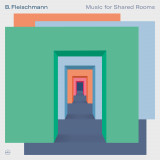
B. Fleischmann - Music for Shared Rooms LP 2x12"

»Music for Shared Rooms« is B. Fleischmann’s eleventh solo album and his first since 2018. It is also not an album, or at least not in the conventional sense of the word. These 16 instrumental pieces provide a kaleidoscopic glimpse of a forward-thinking musician at home in many different musical worlds, including experimental and abstract music, pop and more classically-minded compositional forms. These pieces were culled from an archive of roughly 600 compositions for theatre pieces and films written throughout the past twelve years. The Österreichischer Filmpreis-awarded composer, however, aimed for more than simply documenting his extensive work in and with different media. To do so, he edited and re-mixed the individual recordings for this release, taking them out of their contexts and reworking them for an audience who can experience them in a different setting. »Music for Shared Rooms« makes it possible for its listeners to engage with the sounds and to fill the spaces they open up with their own imagination.

Roughly speaking, music for theatre or film can serve two functions: it either takes the lead, or underscores what is happening on stage or screen. The marvelous thing about these pieces is that they manage to do both. Fleischmann’s work as a prolific producer has always drawn on contrasts, at times combining pop sentiment with rigid experimentation, the seemingly naive with the intricate and complex. This approach also marks the tracks collected here: bringing together acoustic elements and electronic sounds, at times working with conventional structures but always de- and re-contextualising them, Fleischmann constructs a vivid dramaturgy out of discrete singular compositions, letting them interact across the record.

Take, for example, the opener »Träumerei« and the following »Brenne«: after the soothing acoustic sounds of the former, the latter quickly picks up speed with hard-hitting drum machine rhythms. It’s a stark contrast sonically and stylistically, however both tracks are tied together by a certain harmonic sensibility. This sort of dramaturgical interconnectedness of varied musical materials is the thread that runs through »Music for Shared Rooms«. A droney piece for string instruments like »Sehnsucht« is followed by a trip-hop beat, before »Schock« lives up to its title with skittering beats and piercing high frequencies. The differences between the pieces may be striking, but the progression from one to the other is subtle. It goes on like this through different moods and tempos. There’s soothing-yet-eerie piano pieces like the »Für Elise«-inspired »Der Lärmkrieg«, gentle house grooves, joyful synthesizer excursions and, finally, »Die Erde ist mir fremd geworden«, a collage of abstract textures and concrete sounds.

All these pieces create distinct situations through the juxtaposition of diverse musical elements, but are also bound together by a single vision. Writing music for theatre pieces or film requires a composer and his pieces to engage with people and their movements in space, which is exactly what Fleischmann offers on this record. He breaks down the fourth wall and invites his listeners into his world, a wide-ranging musical panorama. »Music for Shared Rooms« is indeed not an album in the conventional sense of the word, but more like a photo album in which each page opens up a new space to get lost in; recreates different scenes in which you can immerse yourself. These are shared rooms indeed.

non in magazzino

Ordina ora e ordineremo l'articolo per te presso il nostro fornitore.

Last In: 5 months ago
Lenxi - Did you get the dream I sent you? (Polygonia, oma totem, Human Space Machine, Daisy Moon Remixes)

Lenxi's debut album on Nous'klaer Audio receives a well-deserved remix treatment, breathing new life into its original dream world. Kindred spirits Polygonia, oma totem, Human Space Machine, and Daisy Moon each reimagine the material through their own distinct sound. A powerful and diverse collection of reinterpretations: From intricate, hypnotic textures to driving, dancefloor-ready energy, each remix opens a new pathway towards a vibrant second life primed for club systems and festival stages alike.

non in magazzino

Ordina ora e ordineremo l'articolo per te presso il nostro fornitore.

Last In: 6 days ago
KMRU - Kin LP 2x12"

KMRU

Kin LP 2x12"

2x12inchEMEGO319V
Editions Mego
18.02.2026

Editions Mego welcomes KMRU back to the fold. Kin is Kenyan born, Berlin based, sonic wizard Joseph Kamaru’s second release on Editions Mego, following on from the classic 2020 release Peel. Since the release and subsequent praise for Peel, the artist has been a staple on the electronic scene performing on numerous stages and festivals worldwide in tandem with a flood of media recognition. Kin could be construed as the second child following Peel. The project came out of initial discussions with Peter Rehberg about what a Peel sequel would sound like. Kamaru is quick to clarify that Kin is not that record; “I'll know when that record will come and when I'll make it. It's already happening... or maybe it lives within both of these Mego records”.

It is this deft ambiguity and vague tiptoeing around the concrete that encapsulates the ambiguous sound world of Kamaru’s vision.

Kin was started early 2021 in Nairobi with Kamaru exploring his noisier palette of sounds encompassing distortions reminiscent of the sounds he would muster from in his youth when playing guitar. He paused making this record for a year as soon as Peter died, then slowly returned to it through 2022 resulting in the immense new work we have here.

The charms within Kin lay as Easter eggs revealing the true identity behind the colourful sonics only after multiple deep listens. With Trees Where We Can See sets the tone by way of a warm swaying melody inviting the listener in for further investigation. In 2022 KMRU and Mego stalwart Fennesz toured the USA together resulting in a strong friendship and also, the second track here, Blurred. A neat Mego/Editions Mego loop as such. Blurred arranges twangy guitar strums alongside glistening glaciers of shimmering drones. They Are Here represents a darker hue as melancholic clouds of shadowy noir tap directly into the listener's nerve stream. Maybe takes a detour into a bristling euphoric electronic storm whilst We Are screeches in a pattern formation not unlike a highly abstracted Aphex Twin forcing its way out of a hard drive. By Absence concludes proceedings, operating as both exit music and a portal to further sonic investigation with acoustic bellowing residing amongst a kaleidoscopic backdrop.

Kin is a trip that rewards close repeated listens as all the colours and textures, nuance and narratives unveil themselves. This isn’t a record to be glossed over, magic rewards concentration.

Kin is a record to be Played slow and LOUD.

For Pita.

All tracks written, produced, mixed by Joseph Kamaru
Blurred co-written & produced with Christian Fennesz
Mastered by Stephan Mathieu at Schwebung Mastering
Photography: Joseph Kamaru
Layout & Design: Nik Void
Cut by Andreas Kauffelt at Schnittstelle, Berlin

non in magazzino

Ordina ora e ordineremo l'articolo per te presso il nostro fornitore.

Last In: 7 months ago
CC Sorensen - Phantom Rooms

CC Sorensen

Phantom Rooms

CassetteMAP035CS
Mappa Editions
18.02.2026

A house is something that is so deeply temporary, yet it can hold so much energy. How do we carry or leave behind those energies while transitioning into new spaces? How does each space we occupy for some time shape us and how do we tear ourselves away from it and its influence once it’s time to go? These are some of the core questions behind CC Sorensen’s new album for mappa, ‘Phantom Rooms’ – it’s a record about movement, change, transformation, family, juxtapositions… but most of all, home.

CC Sorensen was reflecting a lot on their childhood home in rural Kansas, USA while working on this music. The album could be characterised by a familial, chamber feel and both of CC Sorensen’s brothers, Ryan and Nyal Ruehlen, make an appearance on ‘Phantom Rooms’, among other instrumentalists. Using a wide palette of sounds – CC Sorensen alone in charge of keyboards, software instruments, voice, electronics, percussion, trumpet, guitar and field recordings, in addition to guests on pedal steel, voice, chimes, saxophone and drumset – the American musician crafts music as mysterious as it is inviting. The idea behind it would be almost surrealist – ghostly rooms in houses where we live – if we all didn’t know exactly what CC Sorensen means. Home isn’t something concrete, but it’s also not just an abstract concept. It’s a space beyond space; home in itself is a phantom room we enter. And what enables us to enter is the object of exploration here.

CC Sorensen’s approach is playful – tracks like “Beat Bot” and “Plastic Portals” are almost fun – but also contemplative. They make thoughtful, meandering chamber music intertwined with field recordings and electronics. Reeds, strings and percussion often set the atmosphere – sometimes airy, gentle, at other points more insistent – as the music grapples with departure, instability, deep reflection and imagined future spaces. Especially in the closing “Bexar” there’s a tangible yearning for a stable home, a longing to rekindle and keep ablaze this beautiful familial connection to a physical place. It’s both music that invites to reflect and music that in itself reflects; desires, hopes and dreams.

non in magazzino

Ordina ora e ordineremo l'articolo per te presso il nostro fornitore.

Last In: 7 months ago
Mighty Joseph, Vast Aire & Karniege - Empire State (2x12")
  • 01: The Uprising
  • 02: Beast (feat. Poison Pen)
  • 03: Out The Gate (feat. Genesis of LXG)
  • 04: Kids (N.Y.C.)
  • 05: Blurr
  • 06: Anything Can Happen?
  • 07: Legend (feat. Madlib)
  • 08: Blood Sport (feat. Vordul Mega & Camu Tao)
  • 09: The Dark Ages (feat. Murs)
  • 10: Criminal Tales
  • 11: Pandora's Box (feat. Access Immortal, Double A.B. & Swave Sevah)
  • 12: Night Life
  • 13: General Stripes
  • 14: Rock-It-Science (feat. J-Zone)

Mighty Joseph is the combination of emcees Vast Aire (Cannibal Ox) with his long-time rhyme ally Karniege. The duo's sole album, Empire State (2008) was released during the tail-end of the last great non-commercial Hip-Hop period.

Never released on vinyl before, the album will be available soon on a double LP edition.

Rooted in the concrete streets but lyrically abstract, features and beats are provided by equal musical foils including Madlib, Camu Tao, Murs, J-Zone, Poison Pen and Vordul Mega (Cannibal Ox) among others.

Fan and critical attention were positive with All Hip Hop summing the album as "solid post-millennium product that bridges the gap between gritty street tales and a paranoid view of the future."

Plug One Magazine added that "Empire State" "unravels a unique perspective, documenting not only much personal change between the two emcees but also the changes in the streets of New York City. From poverty, to the September 11 attacks, to the abuse of Hip Hop culture in general, "Empire State" stands strong as a snapshot of the city."

pre-ordina ora16.01.2026

dovrebbe essere pubblicato su 16.01.2026

Francis Plagne - Asleep in a beached boat

blickwinkel welcomes composer and multi-instrumentalist Francis Plagne to the label with a reissue of Asleep in a beached boat, an album that was initially released on his own Mould/Mouse Museum label in 2021 on cassette. The album was mostly given away to friends but now gets a wider release through a limited vinyl and digital edition.

Gentle melodies set an airy atmosphere and are intertwined with tensive dialogs between rhythms and textures coming from a wide array of acoustic and electronic instruments. Stylistically somewhere in between his Rural Objects (Black Truffle) and Udge (Horn of Plenty), on the eleven tracks on this album we hear Plagne in his most playful way to date.

Francis Plagne is a musician from Melbourne, Australia whose work swings between songwriting and a variety of other approaches, including group improvisation, instrumental abstraction, and domestic musique concrète. He performed live regularly since 2005 and has released recordings on labels such as Black Truffle, Horn of Plenty, Kye Records, Penultimate Press and his own Mould/Mouse Museum micro-label. In addition to performing his own work either solo or with a band, he has performed and recorded in improvised and other arrangements with Tetuzi Akiyama, Oren Ambarchi, Andrew Chalk, Crys Cole, James Rushford, and Joe Talia, among others.

non in magazzino

Ordina ora e ordineremo l'articolo per te presso il nostro fornitore.

Last In: 8 months ago
PIOTR MUSIAL - THE ALTERS (ORIGINAL GAME SOUNDTRACK)

Clear Vinyl. Luxurious jacket with embossed logo and details plus cut-out on the side. Explore an emotional sci-fi game with a unique blend of survival, adventure, and base-building elements. Help the sole survivor of an ill-fated space expedition create alternative versions of himself to escape a hostile planet and tackle personal turmoils with this unconventional crew. 11 bit studios, the creators of the award-winning games This War of Mine and Frostpunk, present The Alters, an ambitious sci-fi survival game with a unique twist. You play as Jan Dolski, the lone survivor of a crash-landed expedition on a hostile planet. To survive, you must form a new crew for your mobile base. Using a substance called Rapidium, you create alternative versions of Jan -The Alters- each one shaped by a different crucial decision from the protagonist's past. The one-of-a-kind soundtrack for The Alters was created by Piotr Musial best known for his compositions for games like The Witcher, Frostpunk and This War of Mine. For The Alters, Musial chose to stray from the obvious path when it comes to this genre of games and head for something more original: "While many sci-fi soundtracks these days favor the sound of analog synths, the idea behind the music of The Alters was a bit different. We wanted the music to feel more untraditional and mix digital, glitchy elements, unstable reverb with organic sounds, all of which together could support this unique story." With this approach, Musial dove deep into the world of The Alters to turn abstract ideas and atmospheres in very concrete music: "We aimed for the planet to feel overwhelmingly strange and hostile at first. The music starts as more abstract and based on dense atmospheric sound design. Our circular base, a place of safety and comfort inspired to create a theme that 'goes round' by a repeating leitfmotif. You will always feel at home there, unless there's something bad happening, and that's where the theme will get changed, broken." Musial further explains: "One of the key elements we get to discover in the game is the Rapidium crystal. A strange mineral, with yet unexplored properties. We felt like it could have its own theme too, and therefore, wherever you find it, it 'sings' to you with it's strange, bassy voice, supported by a trace of live recorded strings, that were digitally destroyed to create this translucent texture, that sound unlike the real thing. A glitch crystal, is what they call it after all. But the more we explore the planet, the more the story we uncover. We wanted the music to gradually gain momentum and show the leitfmotifs more often, guiding you through emotional moments, fun moments, tough ones, reaching a grand finale. I hope you'll enjoy this ride." Enjoy playing and listening to The Alters!

non in magazzino

Ordina ora e ordineremo l'articolo per te presso il nostro fornitore.

Last In: 6 months ago
Aksak Maboul - Before Aksak Maboul (documents & experiments 1969-1977)
  • Here and Now, a Free Rock Tentet (1969)
  • Riot in the Solbosch (1970)
  • Abstract and Concrete (1972)
  • Five Sketches for a Short Film (1972)
  • Lost in the Farmhouse (1973)
  • Modular Excursions at John’s (1975)
  • Kosmischer Afternoon (1975)
  • The Big Slide (1976)
  • Gyrovagations (1976)
  • Imaginary Travels with Chris (1976)
  • Proto-Kefak (1976)
  • Didn’t Make It 1: Balinoid (1977)
  • Didn’t Make It 2: Angeloid (1977)
  • Java Ney (1977)
  • Didn’t Make It 3: The Missing Dance (1977)
pre-ordina ora21.11.2025

dovrebbe essere pubblicato su 21.11.2025

Sergio Armaroli & David Toop - Decay Music n.10: And I Entered Into Sleep

Returning with its final instalments, Die Schachtel's Decay Music series extends its explorations of inspired contemporary experimental efforts of the ambient, ethereal, and emotively abstract with Luigi Turra and Elio Martusciello’s “Liminale” and Sergio Armaroli and David Toop’s “And I Entered Into Sleep”, two astounding electroacoustic gestures of blurred space and time, plumbing complexity of meaning bound to sonority. Creatively groundbreaking and inspired, radically rethinking the terms of what ambient music can be perceived to be, they stand among the most striking efforts to appear within the series to date.

Reconfiguring the notion of bridge building on a multitude of terms, it feels fitting that the tenth and final installment of Die Schachtel’s Decay Music series, Sergio Armaroli and David Toop’s “And I Entered Into Sleep”, was co-created by an artist whose work featured in the first suite of LPs issued by Brian Eno’s Obscure Records in 1975, the groundwork toward which Decay Music’s own efforts nod. Since that auspicious debut, “New and Rediscovered Musical Instruments” — his split with Max Eastley — David Toop has been regarded as a pioneer in British experimental and improvised music: a sonic voyager who has continuously challenged the sources and materiality of sound through rigorously thoughtful performances, a vast catalog of recordings, and a steady flow of highly influential texts. Be it as a member of Alterations, his group breaking group with Peter Cusack, Terry Day, and Steve Beresford that ran between 1977 to 1986, or through is noteworthy work with artists like Rie Nakajima, Thurston Moore, Paul Burwell, Rhodri Davies, Lee Patterson, Ryuichi Sakamoto, Akio Suzuki, Elaine Mitchener, and numerous others, collaboration has always played a central role within Toop’s singular practice, but few can claim the sprawling sense of beauty and intimacy that’s achieved by “And I Entered Into Sleep”, his first recorded outing with Sergio Armaroli.

A composer, percussionist, vibraphonist, and multidisciplinary artist, Armaroli has been issuing radical and forward-thinking musical gestures for decades, working as one of Italy’s most noteworthy interpreters of composer’s like Giacinto Scelsi, John Cage, Franco Evangelisti, Giancarlo Schiaffini, and Walter Branchi, as both a solo performer and member of the highly regarded Rib Trio, as well as forging a singular practice as a composer, intertwining his efforts as a painter, concrete percussionist, fragmentary poet and sound artist, within a total art, rooted “within the language of jazz and improvisation” as an “extension of the concept of art”. Like Toop, Armaroli’s career has been populated by many collaborators, notably with Riccardo Sinigaglia, Alvin Curran, and Walter Prati, among others, setting the stage for a remarkable meeting between the pair.

Featuring Armaroli on vibraphone and prepared vibraphone and Toop on electronics, “And I Entered Into Sleep” is “a sonic journey, a Proustian suggestion à la Recherche, into the unconscious between electronic and acoustic sounds”. Using a bell that sounds at the beginning of Proust’s “À la Recherché du Temps Perdu”, which reappears more than 3,000 pages later — signaling a transition of phases, as well an auditory trigger of memory — as a departure point, as an association to the percussive vibraphone pulses that thread the album’s two sides, the pair weave a striking interior world of immersive psychological depth. Feeling almost subaquatic at times, like captured glimpses of rumbling, shadowy ecosystems lost within murky ambiences, before washing ashore in a series of pointillistic, highly detailed alien landscapes of the mind, each artist’s markedly different sound-sources, and treatment of the subsequent material elements, dance in abstract grace, incorporating subtle nods to minimalism, free jazz, and musique concrète within its seamless total form of sparse texture and tone.

Easily one of the most striking and memorable releases by either artist to appear in recent years, Sergio Armaroli and David Toop’s “And I Entered Into Sleep” traverses uncharted realms at the borders of literary reference, sound art, ambience and abstraction through delicately musical sounds, revealing new depths at every turn. Issued as the tenth and final album in Die Schachtel’s Decay Music series, highlighting inspired contemporary experimental efforts of the ambient, ethereal, and emotively abstract.

non in magazzino

Ordina ora e ordineremo l'articolo per te presso il nostro fornitore.

Last In: 11 months ago
Luigi Turra & Elio Martusciello - Decay Music n.9: Liminale

Returning with its final instalments, Die Schachtel's Decay Music series extends its explorations of inspired contemporary experimental efforts of the ambient, ethereal, and emotively abstract with Luigi Turra and Elio Martusciello’s “Liminale” and Sergio Armaroli and David Toop’s “And I Entered Into Sleep”, two astounding electroacoustic gestures of blurred space and time, plumbing complexity of meaning bound to sonority. Creatively groundbreaking and inspired, radically rethinking the terms of what ambient music can be perceived to be, they stand among the most striking efforts to appear within the series to date.

An aural bridge between two distinct generations of Italian experimental musicians, “Liminale” is the debut collaborative outing from the creative partnership of Luigi Turra and Elio Martusciello. Active within the context for roughly two decades, Turra (b. 1975) is a reductionist/electroacoustic composer, noted from his tense deployment of concrete and acoustic sources — particularly small sounds and noises — whose work threads the balance between silence, tactile auditory perception, and aleatoric music. Martusciello (b. 1959), on the other hand, is a musician and composer working across the fields of acousmatic and electroacoustic composition, sound installation, multi-media and audiovisual art, and computer music improvisation, who is widely celebrated for both his solo efforts and his collaborations with Eugene Chadbourne, Mike Cooper, Alvin Curran, Chris Cutler, Rhodri Davies, Iancu Dumitrescu, Michel Godard, Tim Hodgkinson, Lawrence D. "Butch" Morris, Jérôme Noetinger, Tony Oxley, Evan Parker, Z'EV, and others.

A single, nearly 40 minute work, extending across the two sides of the LP, “Liminale” — as its title eludes — is an exploration of the liminal through sonic means: “places that exist on the threshold, transitional spaces suspended between a before and an after, between the real and the evanescent” conceiving the soundscape as “a liminal place, a space to be inhabited without the certainty of where it leads.” Unfurling like a labyrinth navigated in darkness, the piece’s first half is marked by sparseness and restraint, as slow-paced guitar tones and harmonics thread silences and resonant ambience within a sprawling sense of space, delicately populated by tiny sounds, fleeting punctuations drawn from undeterminable sources, vocal utterances, and the unexpected appearance of intoxicating piano tones.

As “Liminale” progresses into its second half, Turra and Martusciello enter a more densely populated notion of the in between. No less defined by the presence of space and mystery, discreet textures rustle and writhe within passages of pure concrete abstraction and a fragmented, stretched sense of musicality: long-tones, metallic pulses, minimal vibrations, processed vocalizations, guitar harmonics, and deconstructed piano melodies, buried in spectral, gauzy hazes drifting from beyond arm’s reach within an imagistic and immersive landscape of profoundly meditative scope, where each sonic element flirts the line between emergence and disappearance.

Intimate, fragile, and achingly beautiful, “Liminale”, Luigi Turra and Elio Martusciello’s debut collaboration, is a masterstroke in sound-craft and composition, revealing the potency of meaning locked within transitional spaces and the undefined, and imbuing silence with monumental gravity and weight. Mastered for vinyl by Giuseppe Ielasi, and taking electroacoustic minimalism to an etherial extreme, “Liminale” is issued as the ninth entry in Die Schachtel’s Decay Music series, highlighting inspired contemporary experimental efforts of the ambient, ethereal, and emotively abstract.

non in magazzino

Ordina ora e ordineremo l'articolo per te presso il nostro fornitore.

Last In: 11 months ago
Alessandra Novaga - The Artistic Image Is Always a Miracle

Furthering the passionate exploration of cinema that has guided her two previous LPs - 2017’s ‘Fassbinder Wunderkammer’ and 2020’s ‘I Should Have Been a Gardener’ - the Milanese guitarist/composer, Alessandra Novaga, returns to Die Schachtel with ‘The Artistic Image Is Always a Miracle’, two sides off shimmering, tense compositions – culminating as one of her most creatively ambitious and conceptually rich outings to date – freely inspired by the life and work of the Russian director Andrej Tarkovsky and the music of Johann Sebastian Bach.

Classically trained at the Musik Akademie in Basel, Switzerland, over the last decade Alessandra Novaga has emerged as one of the leading figures within northern Italy’s thriving new, experimental, and improvised music scene, rendering striking solo efforts, in addition to collaborations with Loren Connors, Stefano Pilia, Elliott Sharp, Nicola Ratti, Paula Matthusen, Sandro Mussida, Kid Millions, Travis Just, Francesco Gagliardi, and others. Remarkably ambitious and forward thinking, her approach to the guitar embarks upon a relentless deconstruction and rethinking of her instrument’s unique properties through distinct applications of structure, resonance, space, and tone, creating in a deeply personal and emotive music, seeking narrative and meaning within the abstractions of sound.

In 2017, with the LP, ‘Fassbinder Wunderkammer’, issued by Setola Di Maiale, Novaga embarked upon the exploration of her love of film. Having begun with Rainer Werner Fassbinder, this was followed in 2020 by Die Schachtel’s release of ‘I Should Have Been a Gardener’, a deeply intimate mediation on the life and work of Derek Jarman. Rather than focusing on a fixed point of inspiration or a single film to work from, these pieces achieve a form of abstract portraiture, distilling elements drawn from these filmmaker’s life and work into ambient networks of texture and tonality. ‘The Artistic Image Is Always a Miracle”’ freely inspired by the Russian director Andrej Tarkovsky and the music of Johann Sebastian Bach, finds Novaga radically expanding her sonic palette within this approach.

The seeds of ‘The Artistic Image Is Always a Miracle’ can be traced to a conversation that Novaga had with Alan Licht (contained in the highly regarded Common Tones: Selected interviews with artists and musicians 1995–2020, Blank Forms, 2021), relating to the connections between music and cinema, which led her to consider Andrej Tarkovsky’s use of Bach's music within a symbiotic framework: how the music illuminates the imagism of the films, and the film illuminates new dimensions of the music. Slowly developing over the subsequent years, the resulting album comprises six individual works, some of which draw directly upon pieces of Bach’s music that Tarkovsky used in his films – specifically 'Erbarme dich, Mein Gott', 'Das alte Jahr vergangen ist', and 'Ich ruf zu dir, Herr Jesu Christ' - while others draw upon the sensibilities and moods evoked in the imagination by the director’s films.

As a point of departure and illumination into the process and spirit that underscored the creation of the album, Novaga points toward a passage in Tarkovsky’s "Sculpting in Time”:

“Art is born and takes hold wherever there is a timeless and insatiable longing for the spiritual, for the ideal: that longing which draws people to art. Modern art has taken a wrong turn in abandoning the search for the meaning of existence in order to affirm the value of the individual for its own sake. What purports to be art begins to look like an eccentric occupation for suspect characters who maintain that any personalized action is of intrinsic value simply as a display of self-will. But in artistic creation the personality does not assert itself, it serves another, higher and communal idea.”

‘The Artistic Image Is Always a Miracle’ can be understood as a realisation of the collectivism of which Tarkovsky speaks, in the service of something far beyond the expression of self. Encountering Novaga moving into fairly uncharted waters, three of the album’s pieces incorporate the human voice we encounter the voices of others: that of the poet Arsenij Tarkovsky, the director’s father; a singer from Bach’s ‘Erbarme dich, Mein Gott’, capturing a broadcast in an underground parking lot, and Novaga’s own, rendering the melody from Bach’s “Ich ruf zu dir, Herr Jesu Christ”. Roughly alternating between solo excursions on guitar and bristling electroacoustic pieces, over the course of the album’s two sides Novaga weaves one of her most abstract and ambitious bodies of recordings to date, shifting between the complex tonal mediations generated by the six strings of her instrument, and phycological densities activated by the expanded pallet of sonority made possible by the tactics and approaches of musique concrète.

An immersive, deeply engaging meeting of beauty and melancholy within a labyrinth of voices and ideas, ‘The Artistic Image Is Always a Miracle’ transfigures the life and work of Andrej Tarkovski – one of the greatest auteurs in the history of cinema – into a singular, experimental statement of collective truth. Belonging to recent, ambitious stream of contemporary new music releases on Die Schachtel that’s already included Novaga’s ‘I Should Have Been a Gardener’, Stefano Pilia’s ‘Spiralis Aurea’, Jim O'Rourke & Giovanni Di Domenico’ ‘Immanent In Nervous Activity’, Claudio Rocchetti’s ‘Labirinto Verticale’, and Damāvand’s ‘As Long As You Come To My Garden’, among others, ‘The Artistic Image Is Always a Miracle’ is available on as a limited edition of 300 dark turquoise vinyl LPs released on June 21, 2024. The LP, designed by Bruno Stucchi / dinamomilano, comes with an 8-pages insert illuminated by Alessandra’s text as well as the lovely and intense photographs of Matilde Piazzi.

non in magazzino

Ordina ora e ordineremo l'articolo per te presso il nostro fornitore.

Last In: 11 months ago
Universal Comfort - Flags are Walls

Flags Are Walls is the latest release from an enigmatic electronic duo based in Barcelona. "Universal Comfort"

The album explores the boundaries of contemporary electronic music, blending synthetic and organic sounds, layering analogue and digital sources, where abstract and concrete elements shift in and out of focus.

Boundaries are not only physical-shaping how we experience time and space-but also emotional, framing the sense of place we attach to them. The tracks play with these flimsy, and uncertain intersections, exploring expression and perception through evolving, haunting and diffused sonic landscapes.

non in magazzino

Ordina ora e ordineremo l'articolo per te presso il nostro fornitore.

Last In: 12 months ago
Robyn Rocket - Robyn Rocket And  People You May Have Heard Of LP
  • 1: Intro
  • 2: I Was Disconnected feat Sam Castell Ward
  • 3: Mystery Man feat Sebastian Golgiri
  • 4: Intense Love
  • 5: credits side A
  • 6: On Connection
  • 7: We Are All Human
  • 8: Are you a lost sock? part 3 ( K Edit)
  • 9: Credits side B
  • 10: All Aboard (digital only)
  • 11: The Aliens Have Arrived (digital only)
  • 12: New York Shuffle (digital only)
  • 13: We Are Connected (digital only)

Robyn is doing brilliant and important work - the world needs more music like this. Just one word: listen!" Giles Peterson “Even aside from her skills on her instruments and unique approach to music, Robyn devoted an immense quantity of emotional resources to the delivery of this record, and seemed to take its challenges on as a chance for personal growth. It was consistently clear that the personal input of the players was welcome in a fundamental way, and we all responded to Robyn’s efforts that went to the limits of her capacity and her love for bringing her project to you, the listener” Alabaster DePlume “It has been such a joy to work with Robyn, especially when entering the fascinating world of Robyn’s Rocket and Avant Garde jazz. We had our fun moments, like when the fire alarm went off during our recording session of Mystery Man, and we just rolled with it and kept it in. It’s like nothing matters. It’s such an honour to be part of the world of Robyn’s Rocket and to listen to the many stories, expressions and colours that shine throughout the album.”Sebastian Golgiri What happens when you bring together familiar faces at London experimental music venue Café OTO, Charles Hayward (drummer Abstract Concrete, This Heat) and John Edwards (double bass), and the Total Refreshment Centre (hub of new london jazz scene recording studio ) like Alabaster DePlume (singer and saxophonist) and Danalogue (synths from Soccer96, The Comet is Coming), and the learning disability autism art scene like singers/spoken word artists Sebastian Golgiri and Dean Rodney Jnr (Fish Police), on a magic carpet with space trumpeter Robyn Rocket? The answer materialises in the groundbreaking collaboration 'Robyn Rocket and People You May of Heard of'. Recorded across three days in three different studios connected to the three communities Robyn Rocket calls home, each session brought together musicians from these diverse backgrounds—many meeting for the first time. Together, they improvised and created a musical journey that transcends conventional boundaries.

This cosmic voyage features more than 20 musicians and a dog ( Taz from lost socks), gliding through free jazz, danceable tunes, loopy vistas and spoken word doors into different ways of seeing the world. At its heart lies a profound message about community as a vital part of existence and difference as something to embrace and value. The project culminates in the final single and focus track 'We Are All Human', featuring a poignant speech by Rocket from her night 'Robyn's Rocket - a residency at cafe OTO featuring experimental music and live visuals by artists with and without Learning Disabilities/ autistic and non autistic artists ' in the speech rocket talks about supporting each other—words she actively lives by and encourages others to embrace. Like many autistic people, Rocket has experienced abuse, bullying, isolation and feeling unwelcome in the world. “This project is like my nights but you can carry it around with you”, she explains. “I started my own night to share my work. I also recognised, it was a privilege to have my own night, I wanted to help other artists share their work too, and create an environment where people with and without learning Disabilities/Autistic and non autistic people as audience and performers could come together and get to know each other”. Historical Context

pre-ordina ora31.05.2025

dovrebbe essere pubblicato su 31.05.2025

Ash Fure - Animal LP

Ash Fure

Animal LP

12inchSTSLJN442
SMALLTOWN SUPERSOUND
09.05.2025

On ‘Animal’, Ash Fure appeals to “animal intelligence” by using sounds that are inherently physical and driven by perception, athleticism and interaction. Placing polycarbonate sheeting over an inverted subwoofer she built alongside her partner Xavi Aguirre and brother Adam, Fure isolates the physical impact of sound by focusing on psychoacoustic sub-bass pulses, semi-perceptible micro-rhythms and discomfiting white noise bursts, linking the process to her experiences in Berlin and Detroit’s techno dungeons where the sound has to adapt to the space it’s performed in. When she performed ‘Animal’ for the first time, Fure fabricated a “listening gym”, allowing the audience to interact in real-time by circuit training in response to the sound. The sweat is almost audible across the record, a run-on selection of rhythms, resonances and abstractions that sound like interlocking heartbeats on a series of treadmills. Her fascination with techno’s cavernous cathedrals is clear from the beginning, but Fure doesn’t worship at the altar: we’re hit with the feeling, not the aesthetic. The beats themselves, made from unstable vibrations and waterlogged, reverberating clicks, echo the brain’s unconscious reaction to repetition in a vast concrete box, the feeling you get when each percussive snag ricochets from every surface in the building. Coddling these whirring, criss-crossing polyrhythms with harsh, distorted low-end retches, Fure accurately recreates the energy and fatigue of the endless weekend sesh. We never once encounter techno in its expected shell, just its residue - the outline of humans figuring out their relationship with technology, architecture and each other. Fure’s use of dynamics is also deviously smart, marking out an overall rhythm that’s not tied to the strength of the sounds themselves, but just volume and physical impact. Often her most brutal sounds - ear-splitting squeals and overdriven mechanical whirrs - are reduced to an almost inaudible level, a bit like the bandy legged trip to the bathroom, or the escape to some dimly lit nook, the part of the night where you can still detect the sound on your skin without being battered by it. When the undulating rhythm returns in earnest, Fure masks acidic sequences in jet engine expulsions, still refusing to objectify anything that an AI model might be able to pick up on.

pre-ordina ora09.05.2025

dovrebbe essere pubblicato su 09.05.2025

Merzbow - Collection 001-010 (LP 10x1" Box + Book)
  • Collection 001 - 001 A 23:46
  • Collection 001 - 001 B 23:48
  • Collection 002 - 002 A 18:12
  • Collection 002 - 002 B 20:54
  • Collection 003 - 003 A 22:14
  • Collection 003 - 003 B1 09:33
  • Collection 003 - 003 B2 05:25
  • Collection 004 - 004 A 16:11
  • Collection 004 - 004 B1 07:08
  • Collection 004 - 004 B2 09:52
  • Collection 005 - 005 A1 08:38
  • Collection 005 - 005 A2 08:54
  • Collection 005 - 005 B1 07:14
  • Collection 005 - 005 B2 03:53
  • Collection 005 - 005 B3 03:57
  • Collection 005 - 005 B4 04:03
  • Collection 006 - 006 A1 17:35
  • Collection 006 - 006 A2 05:12
  • Collection 006 - 006 B 23:12
  • Collection 007 - Merzrock B1 + Dubbing 5 11:21
  • Collection 007 - Merzrock A1 + Anemic Pop 1 02:00
  • Collection 007 - Merzrock A1 + Anemic Pop 2 08:32
  • Collection 007 - E-Study #3-1 + Merzsolo 1 15:49
  • Collection 007 - E-Study #3-1 + Merzsolo 2 05:58
  • Collection 008 - Concrete Tape PH#1~ 05:19
  • Collection 008 - E8 A1 + 006 A1 06:03
  • Collection 008 - Merzsolo 10/6.81 A1 10:36
  • Collection 008 - E8 B2/Concrete Tape PH#1~ 06:28
  • Collection 008 - Sans Titre Merz 1 + Tape Loops 04:54
  • Collection 008 E6 A3 + Concrete Tape PH#1~ 06:46
  • Collection 008 - Merzsolo 10/6.81 A5 + Violin 03:21
  • Collection 009 - N.A.M.4 + E-8 06:11
  • Collection 009 - Telecom 1/3 + N.A.M.5 17:32
  • Collection 009 - E-3-1-1 11:24
  • Collection 009 - E-3-1-2 01:50
  • Collection 009 - Tape Loop + Noise 1 (Concrete Tapes) 02:39
  • Collection 009 - Tape Loop + Noise 2 (Concrete Tapes) 04:25
  • Collection 010 - 007 B1 + Ah Corps 11:47
  • Collection 010 - E3 B2 + Ah Corps 11:28
  • Collection 010 - N.A.M.6 With Radio & Tapes 22:47

Carrying on their longstanding dedication to the seminal output of Merzbow, Urashima returns with what is unquestionably their most ambitious release to date: “Collection 001-010”, a deluxe, 10 LP vinyl box set limited to 299 copies, gathering together the entirety of the project’s first ten releases, originally released in 1981. Encountering the band in its early incarnation of the duo of Masami Akita and Kiyoshi Mizutani, raw, exposed and bristling with energy, foreshadowing numerous trajectories they would follow over the coming years, these astounding full lengths - the majority of which have never been released on vinyl - come housed in a beautifully produced, deluxe wooden box, with each LP in its own individual sleeve reproducing the original artwork, and a LP-sized 32-page book containing reproductions of artworls and collages by Masami Akita, an interview conducted by Jim O'Rourke, and liner notes penned by Lasse Marhaug, Thurston Moore, and Akita himself, amounting to what is unquestionably one of the most historically significant releases we’re likely to encounter in 2025.

Deluxe Edition of 299 copies, remastered from the original analog tapes by Masami Akita, each LP comes in its individual sleeve reproducing the original artwork, also includes a LP-sized 32-page book. ** Since its founding during the late 2000s, the Italian imprint, Urashima, has become a definitive voice in the landscape of noise. Bringing forth beautiful limited edition releases, they’ve sculpted a singular vision of one of the most vibrant and revolutionary bodies of experimental sound to have graced the globe. Among the many projects that they have supported over the decades, there has been an undeniable dedication to the output of the seminal Japanese noise outfit, Merzbow, making a significant amount of the project’s out of print back catalog available across a range of formats. Now they return with what is arguably their most stunning and ambitious release dedicated to the project to date: “Collection 001-010”, gathering the entirety of Merzbow’s first ten releases, largely privately released by the band on cassette across 1981, in a deluxe, 10 LP vinyl box set. Representing what is effectively ground zero in Japanese noise and collectively amounting to some of the most sought after releases ever produced within that movement, Urashima’s truly beautiful collection comes fully remastered by Masami Akita himself from the original tapes, presenting all but a small number in their first ever vinyl pressings, with each LP housed in its own individual sleeve reproducing the original artwork, alongside a LP-sized 32-page book containing reproductions of artworks and collages by Masami Akita, an interview conducted by Jim O'Rourke, and liner notes penned by Lasse Marhaug, Thurston Moore and Akita himself. Towering with energy and groundbreaking creative vision, within the realms of noise and experimental music, releases don’t get more monumental or historically important than this!

Merzbow came roaring onto the Tokyo scene in 1979, and remains, to this day, one of the most prolific and aggressively forward-thinking projects in experimental music. Eventually becoming the solo vehicle for the efforts of Masami Akita, in its earliest incarnation the project was the duo of Akita and Kiyoshi Mizutani, taking their name from German artist Kurt Schwitters' pre-war architectural assemblage, The Cathedral of Erotic Misery or Merzbau, and quickly set out to challenge entrenched notions of what music could be. Embracing technology and the machine, even in its earliest iterations, Merzbow pushed toward new territories of the extreme, arriving at a space of pure, unadulterated sonic onslaught that has continued, for over 40 years, to set the pace for the entire genre of noise, and has remained one of the movement’s most important, definitive voices, continuously laying the groundwork for countless artists who have followed in its wake.

When dealing with historical gestures, there’s an invertible aura surrounding original line-ups and early statements, and rightfully so. It is often within a band’s debut that we catch the purest glimpse of the raw energy and creative ferment that made them what they are. This is certainly the case when regarding the coveted early releases of Merzbow, capturing the emergence of the project in its form as the duo of Masami Akita and Kiyoshi Mizutani as they helped set the blue print from the then emerging movement of Japanese noise. Over the course of its nearly five decades of activity, Merzbow has always been noted for how prolific and ambitious the project is. This was no less the case in the very beginning. While they were active for roughly two years prior, in 1981 alone they issued ten self-released cassettes numerically titled “Collection 001-010”, albums which have both individually and collectively become holy grails in the realms of noise, with only two - “Collection 007” and “Collection 009” - ever receiving vinyl reissues prior to now.

As Lasse Marhaug deftly articulates in the newly commissioned liner notes for “Collection 001-010”, despite having been recorded in different location across a span of time, the sum total of Merzbow’s first ten releases might be best regarded as a single release to be listened to in the same, durational sitting, with the material standing well apart from what most came to expect from Merzbow, while foreshadowing numerous trajectories the project would take over the coming years. Not only do these recordings feature a vast array of instrumentation - tapes, acoustic and electric guitar, violin, drums, voice, recorder, organ, found sounds, clarinet, homemade and prepared instruments, a vast arsenal of effects and electronics, and piano, to only begin to scratch the surface - the majority of which would disappear from the project’s active sources of sound generation over the subsequent years, but there is a slow pacing and raw sense of openness and exposure that reveals strong connections to the avant-garde improvisations of groups like AMM, Musica Elettronica Viva, and Gruppo di Improvvisazione Nuova Consonanza, the psychedelia of groups like Taj Mahal Travellers and Flower Traveling band (both of whom Akita mentions having seen in youth within his interview with Jim O’Rourke), and rock in general - albeit in fully abstracted forms - unspooling as brittle, pointillistic, textural, raw and abrasive forms, that occasionally flirts with unexpected tonal sensibilities. As Marhaug describes it in his excellent liner notes: «Sonically, “Collection” sounds more sparse and stripped. It’s dry sounding, up-front, no reverb, and there’s less heavy low-end grime and thin on the signature frequency sweeps. Viewed in a 1981 context, musically, it’s more akin to what the LAFMS (Los Angeles Free Music Society) pool of artists were doing at that time than what was happening in industrial music... There’s a strong playfulness throughout, like the sound objects are being explored for the first time, without neither restraint nor hurry. Events are allowed to be fully examined before the music moves on, or simply cuts off. To a large degree, the music on “Collection” feels acoustic in nature, although a Electro-Harmonix ring-modulator features prominently throughout.»

Easily described as a rarely encountered revelation into the original and earlier documented studio sound of Merzbow, “Collection 001-010” collectively amounts to an engrossing sonic journey in its own right, while also allowing for important, often overlooked connections drawn from numerous other creative wellsprings, notably free jazz, underground rock, the output of European and Japanese avant-garde music, as well as Dada, Fluxus, and Mail Art, much of which, beyond the illumination made possible by the sounds, Jim O’Rourke’s fantastic interview with Akita, published in the booklet, further explores, offering great insights into the origins of Merzbow and the thinking behind the project, as well as aspects of the earliest days of Japanese noise.

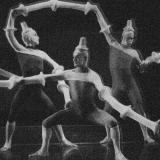
pre-ordina ora18.04.2025

dovrebbe essere pubblicato su 18.04.2025

SISSY SPACEK - ENTRANCE LP 2x12"
  • WEB OF UNFOLDING APPEARANCE
  • FIGURE OF REFLECTED LIGHT
  • TRANCHER AND THE INHERITORS
  • TRUE DIMENSION (FROM THE OPAQUE-SPIKE)

Entering its 26th year of activity, the morphing, Los Angeles based experimental outfit, Sissy Spacek, joins Shelter Press with Entrance, among the project's most captivating outings to date. Encountering the duo of John Wiese and Charlie Mumma joined in various configurations by an incredible cast of collaborators - Tim Barnes, Marco Fusinato, Aaron Hemphill, Brad Laner, Katsura Mouri, Ralf Wehowsky, and C Spencer Yeh - collectively transformed into a series a deeply intimate and delicate gestures of musique concrète, Entrance radically repositions the possibilities presented by group improvisation outside of time and place. Founded at the end of the last millennium, the Los Angeles based project, Sissy Spacek, initially emerged from the knotted, fiery context 1990s American noise and grindcore, producing sheets of visceral sonority that quickly set the scene on its head. Going through numerous evolutions, before eventually settling as a duo of John Wiese and Charlie Mumma - joined by a rotating and often recurring cast collaborators - over the last 25 years the band has continuously entered states of evolution that have defied the expectations of its own context, seeding the sonic extremes noise with subtle and sophisticated approaches to free improvisation and musique concrète. Fiercely positioning its efforts within the outer reaches of contemporary experimental music, while resisting the constraints of a singular sound or proximity, Wiese regards Sissy Spacek as being primarily centred around the practice of musique concrète and the pursuit of extremes. From its earliest releases - collage treatments of material gathered from the band's full throttle practice sessions - the project's conceptual framework has continuously evolved within a deeply engaged process of experimentation, not only reworking tactical approaches, but also definitions and perception regarding the location and action of their work. In recent years, this has led to an increasingly varied and diverse output. Percolating within, is a thread marked by a striking sense of delicacy and intimacy, driving forward while doubling as an unexpected challenge, in real time, to perceptions connected to the band's past. Entrance is the most recent of these. Embarking upon the four compositions that comprise the finalized four sides of Entrance, Wiese and Mumma enlisted longstanding collaborators, Tim Barnes, Marco Fusinato, Aaron Hemphill, Brad Laner, Katsura Mouri, and C Spencer Yeh, as well as new initiate, Ralf Wehowsky (of the seminal German electronic noise collective P16.D4), requesting a contribution of sounds from each, determined by a general set guidelines that dictated certain qualities the given sonorities, while allowing for the expression of each player's distinct creative voice. The sets of resulting recordings were then chopped, harvested, manipulated, and reassembled as the four tape compositions that make up the album - Web Of Unfolding Appearance, Figure Of Reflected Light, Trancher And The Inheritors, True Dimension (From The Opaque - Spike) - each blurring the lines of authorship and clear creative proximity in remarkable ways. Where historical gestures of musique concrète tend to draw upon non-instrumental sound sources - regarding its sonorous material as raw elements, unburdened by inherent meaning or association, to be transformed and imbued with musicality - Sissy Spacek turns this position on its head. Entrance comprises works of musique concrète that not only draw upon instrumental sound sources, with all their possible meanings or associations, but also individual characters and personalities of their players, crediting each resulting piece to its respective configuration of contributors. As such, Entrance is an effort of sound collage defined by a rare sense of intimacy and humanity: four pieces that often take on the resemblance of group improvisation, but have, in fact, been assembled outside of time and place. Bent under the ever-present hand of Wiese's tape treatments and manipulation, each of the album's four compositions unfurl startling states of sonic abstraction and percolating texture, marked by a striking sense of hard-shifting structure, that culminate as tense, driven manifestations of ambient music: scrapes, squeals, rattles feedback, rolling drums, bouncing tones, whispers, bent electronics, electric artefacts, and seemingly everything else under the sun, configured into immersive, sublime mediations in sound from the most improbable events.
pre-ordina ora04.04.2025

dovrebbe essere pubblicato su 04.04.2025

Actress - Grey Interiors

An imperial phase Actress commits a lushly amorphous installation piece made for the Berliner Festspiele to vinyl, rendering a post-industrial symphony full of iridescent shifts in gyring, OOBE-like spatial coordinates landing somewhere between nutopian ambient, kankyō ongaku and sawn-off bass science.

‘Grey Interiors’ was made in collaboration with Actual Objects and is an absorbing animation and navigation of those post-human ideals that have prompted Darren J. Cunningham to his best work across the preceding two decades. In its hypnagogic symphony of the elements, he short-circuits distinctions of classical music’s metric freedoms and the hyperspatial sensuality of concrète/electro-acoustic and ambient musics with an artistic license that has come to distinguish his work in the contemporary field, and arguably identified him as this generation’s most vital electronic abstractionist.

The first half of the album is bewitchingly airless, materialised in a twinkling vacuum. Naturalistic environmental recordings and a half-heard piano swirl around nauseous airlock whooshes and eerie bass drones. It's all pulverised to a powdery, shimmering residue; if Actress's music is defined by its character and texture - that sweet spot between the bedroom and the soundsystem - then this one advances the narrative without losing its backbone. And like a lot of his best work, it comes into its own on the back of zonked eyelids, conjuring a play of shifting geometric patterns within its imaginary physics and nuanced narration of ephemeral melodic phrasing and vaporous textures.

At about the halfway point, that dissociated piano finds its groove, coalescing into a jerky drum machine rhythm popping like bubbles in the stifling atmosphere. We can draw some intersecting lines here thru electronic music lore - traces of vintage AE, Push Button Objects, UR - but Actress always leaves an indelible fingerprint on anything he touches. Even when he's rubbing against the gallery-industrial complex, he manages to fill a stagnant space with electricity and wit; look at the title itself: is it a reference to the "landscape beyond man" as the installation's press release might have us believe, or the institutions themselves?

non in magazzino

Ordina ora e ordineremo l'articolo per te presso il nostro fornitore.

Last In: 53 days ago
Tózé Ferreira - Música de Baixa Fidelidade

Two records came out in 1988 that forever changed the perception of "experimental" or "serious" music produced in Portugal. These were "Plux Quba" by Nuno Canavarro and "Música de Baixa Fidelidade" by Tózé (António) Ferreira. Both were released by the same label - Ama Romanta -, an influential independent imprint closely linked to avantgarde pop band Pop Dell'Arte. Because those records appeared in what could be perceived as an "alternative pop" framework, they rescued this difficult music from Academia. It helps that Canavarro played in a successful new wave pop band (Street Kids) during the period 1980-83. By association, being a friend since 1976, António was in close contact with many of the musicians and bands that were part of the equally celebrated and detested Portuguese Rock Boom (roughly 79-82).

He was not a musician then but through his friendship with Canavarro, who had the means to acquire electronic equipment, António became involved with that equipment and shared Canavarro's passion for experimentation and curiosity for knowledge. They tried to get hold of as many technical magazines as possible and learn while testing ideas. In 1983, Street Kids were about to break up, young lives drafted into the Army and maybe, in Canavarro's case, a whole new passion for challenging music similar to his bandmate Nuno Rebelo, by then in the process of discovering a wide range of "other" music mainly through Jorge Lima Barreto. Barreto, who had started Telectu with Vítor Rua, possessed a huge book and record collection and, like Rua before them, Canavarro, Rebelo and Ferreira became fascinated by the pool of knowledge they now had access to by frequenting Barreto's house in Lisbon. He was roughly a decade older, had published several books and other writings throughout the 1970s, cultivated an anarchic stance and a penchant for cultural indoctrination. Rebelo was the first to be introduced via his contact with Rua (who had invited him to play in his other band GNR).

Overwhelmed, he felt the need to share his enthusiasm with friends and eventually took a few to the house in true pilgrimage fashion. To see the Light. Among the few he led there was even João Peste, founder of Ama Romanta. Canavarro and Ferreira preceded him.

Ferreira recalls an exciting learning process added to his experiments with Canavarro's array of synths such as the Korg Ms 20, Korg polysix, ARP Axxe, Roland SH-01, the Ensoniq Mirage sampler... He read in a magazine article about someone who had studied at the Institute of Sonology (then in Utrecht, Netherlands) and went there during a vacation trip in the Summer of 1983. He became excited by the prospect of studying at the Institute but money was a problem. Canavarro, on the other hand, was admitted there in the following year. Back in Portugal, Ferreira eventually abandoned his Chemical Engineering studies in Lisbon's Technical Institute in favour of a more focused music practice. He collaborated with Telectu during 1984 and 85 as a sort of technical engineer, implementing some recording solutions and background tapes and went to work at a thermoelectric power plant in Sines, hoping to make enough money to fund his musical studies. He did and proceeded with the paperwork for admission at the Institute of Sonology, now based in The Hague. António studied there in 1986-87 and the present album includes two compositions developed at the Institute: "More Adult Music" and "This Is Music, As It Was Expected", both featuring the voice of Rodney Waschka II. Among other activities and talents, Rodney is an expert in computer music and to António his voice sounded similar to Robert Ashley's, whose work he admired.

What happened at the Institute was a systematization of António's self-taught practice. Computer software, Musique Concrète, noise and silence, organisation of abstract ideas and sounds. The original notes on the back sleeve of the LP give some indication of process and thinking, but a more detailed account was given by António in the liner notes of the CD reissue in 2002, which are also included in this 2025 LP reissue.

The music sounds deep and detailed, despite the fact of António calling it low-fi ("Baixa Fidelidade"). It flows like an improvised performance where several musicians might be responding to each other, respectful of their mutual space. Drama occurs, as a natural emotional connection is sought by the listener. Piano, bells, drone, processed voices, even the clear narrative of Rodney Waschka II, contribute to create a sort of alternative perceptual reality. The sounds are almost tangible, more a part of the physical world than ethereal manifestations and thus it would not be correct to invoke "ambient music" as a selling point. But although "physical" and distinct, this music is still alien, more so in Portugal's 1988 environment. In March, helped by Canavarro, António set up a home studio and there he recorded the remaining material for this album: "Algumas Pessoas Olharam O Sul E Viram Deserto", "Um Som, Seguido De Uma Cena Negra E Malva" and "O Verão Nasceu Da Paixão De 1921".

"Música de Baixa Fidelidade" stands not only as a proof of great resilience but as one of those magnificent works of art coming from someone who balanced technical inclination and emotional sensibility. Because of that, Tózé Ferreira is able to decode the phantom world of sound for anyone who cares to experience the sensation of inhabiting a version of the Future. First ever vinyl reissue, reproduction of the original artwork with an additional insert. Made in collaboration with the artist and the support of Paulo Menezes (Plancton Music), who provided valuable assistance. Remastered by Taylor Deupree.

pre-ordina ora21.02.2025

dovrebbe essere pubblicato su 21.02.2025

Roger & Brian Eno - Mixing Colours LP 2x12"
  • A1: Spring Frost
  • A2: Burnt Umber
  • A3: Celeste
  • A4: Wintergreen
  • B1: Obsidian
  • B2: Blonde
  • B3: Dark Sienna
  • B4: Verdigris
  • C1: Snow
  • C2: Rose Quartz
  • C3: Quicksilver
  • C4: Ultramarine
  • C5: Iris
  • D1: Cinnabar
  • D2: Desert Sand
  • D3: Deep Saffron
  • D4: Cerulean Blue
  • D5: Slow Movement: Sand

Roger & Brian Eno have revolutionized many concepts of music production and performance, from Brian Eno's groundbreaking treatment of pop music to younger brother Roger Eno's Erik Satie-esque ambient synth/piano recordings. These qualities resonate on this release. Each brings their unerring sense of place and mood to the album. The timbre in each track deepens and opens up with each listen. Concrete yet abstract tracks guide the listener through the collection, which was created over several years in a unique collaboration between the two artists.

pre-ordina ora10.01.2025

dovrebbe essere pubblicato su 10.01.2025

Articoli per pagina:

Language

N/ABPM
Vinyl