Cerca:claude francois

Generi
Tutto
  • 1
Claude Francois - Les Annees Yeye

After a stay on the Côte d'Azur, Claude François moved to Paris in 1961. Determined to take the Capital, the young performer recorded new songs for the Fontana label. A few months later, the stunning success of “Belles! Belles! Belles! is soon followed by that of “Si j’avais un marteau”, an adaptation by folk songwriter Pete Seeger. At the dawn of the 1960s, Claude François joined the closed circle of yé-yés idols. Appeared under the pen of the sociologist Edgar Morin, the name "yéyé" designated a generational movement inspired by Anglo-Saxon pop culture. Adored by post-war baby boomers, his protagonists caused a veritable popular tidal wave and shake up the charts. Here starts the yé-yé revolution, and the legend of Claude Francois Ads –London Macadam Reviews –London Macadam, R2

pre-ordina ora10.03.2023

dovrebbe essere pubblicato su 10.03.2023


Last In: 2026 years ago
Claude Francois - Soul Songs

Claude Francois

Soul Songs

12inch5503885
Blue Wrasse
10.03.2023

Coming straight from the United States, soul music became an essential genre in the mid-1960s. In France, Claude François, marked by the discovery of serial hits from the legendary Tamla-Motown label of Detroit, became one of its first promoters. Proposed in their French adaptations, the pulsating rhythms and irresistible melodies from the Four Tops, the Supremes and other champions of soul music spread across France. On stage, Claude François also adopted the spectacular performances of his models from across the Atlantic and surrounded himself with the Claudettes, dancers-choristers echoing the famous Ikettes of Ike & Tina Turner. An exceptional showman and performer! Ads –London Macadam Reviews –London Macadam, R2

pre-ordina ora10.03.2023

dovrebbe essere pubblicato su 10.03.2023


Last In: 2026 years ago
Various - Tchic Tchic: French Bossa Nova 1963-1974  Colored Edition LP 2x12"
  • A1: Les Masques - Il Faut Tenir (1969)
  • A2: Isabelle Aubret - Casa Forte (1971)
  • A3: Christianne Legrand - Hlm Et Ciné Roman (1972)
  • A4: Jean Constantin - Pas Tant D'chichi Ponpon (1972)
  • A5: Billy Nencioli & Baden Powell - Si Rien Ne Va (1969)
  • B1-: Marpessa Dawn - Le Petit Cuica (1963)
  • B2: Jean-Pierre Sabar - Vai Vai (1974)
  • B3: Sophia Loren - De Jour En Jour (1963)
  • B4: Isabelle - Jusqu’à La Tombée Du Jour (1969)
  • B5: Sylvia Fels - Corto Maltesse (1974)
  • C1: Frank Gérard - Comme Une Samba (1972)
  • C2: Ann Sorel - La Poupée Des Favellas (1971)
  • C3: Charles Level - Un Enfant Café Au Lait (1971)
  • C4: Andrea Parisy - Les Mains Qui Font Du Bien (1970)
  • C5: Audrey Arno - Quand Jean-Paul Rentrera (1969)
  • C6: Aldo Frank - T’as Vu Ce Printemps (1970)
  • D1: Christianne Legrand - Cent Mille Poissons Dans Ton Filet (1972)
  • D2: Clarinha - Lemenja (1970)
  • D3: Hit Parade Des Enfants - Aquarela (1976)
  • D4: Jean-Pierre Lang - Tendresse (1965)
  • D5: Magalie Noël - Une Énorme Samba (1970)
  • D6: Françoise Legrand - La Lune

Ever since the late 1950s bossa-nova revolution, Brazil’s influence on French music has been undeniable. Pierre Barouh, Georges Moustaki and a vast array of lesser known artists, all made the Musica Popular Brasileira (MPB) an axis of promotion at the service of a cool and metaphysical, modern and mixed Brazilian lifestyle. Some were seduced by the poetic languors of the bossa, some were looking for fun, and others just loved the American hybridization of jazz-bossa, jazz-samba.


What is bossa nova? One of its creators, Joao Gilberto said: "Its style, cadence, everything is samba. At the very start, we didn't call it bossa nova, we sang a little samba made up of a single note - Samba de uma nota so .... The discussion around the origins of bossa nova is therefore useless”. It is nevertheless useful to remember that these magnificent Brazilian songs, which the guitarist describes as samba, were shifted and balanced around improbable chords. "I like things that lean, the in-betweens that limp with grace," said Pierre Barrouh, quoting Jean Cocteau.


With emotion, arrangements for violin and supple guitar licks, bossa nova rapidly changed. A transformation that can be heard in the Tchic, tchic, French Bossa Nova 1963-1974 compilation, the result of a cultural reappropriation, which traveled through the United States and supplemented itself in France.

A musical revolution that has remained significant, bossa nova was born in Rio. From 1956 to 1961, Brazil lived through its golden years. In five years, the country had invented its modernist style. Elected president in 1956, Juscelino Kubitschek de Oliveira, an elegant man with a broad forehead, brandished a promising slogan: "Fifty years of progress in five years". He quickly got to work. Not worried about increasing debt, he launched the project for a new federal capital, Brasilia, designed by the communist architect Oscar Niemeyer. Volkswagen opened state-of-the-art factories and created the “fusquinha”, the Beetle. In Rio, the Vespa made its first appearance. The Arpoador Surf Club crew run into the “girl” from Ipanema, Helô Pinheiro - the tanned garota ("chick"), between a flower and mermaid, who at 17 walked by the Veloso bar, where the fiery author and composer, Tom Jobim and Vinicius de Moraes, were getting drunk on whiskey. From then on, bossa symbolized cool.

In 1958, Joao Gilberto recorded Chega de Saudade, which the directors of Philips denied, calling it "music for fagots". The marketing director, who believed in it, secretly pressed 3000 78-inch vinyls and distributed them at schools around Rio, creating a tidal wave.

American jazzmen then took over. In particular, trumpeter Dizzy Gillespie and guitarist Charlie Byrd. In November 1962, the Brazilian Ministry of Foreign Affairs funded a "Bossa-Nova" concert at Carnegie Hall in New York, inviting the genre’s pioneers. Unprepared, the show soon turned to disaster. But the troupe was invited to the White House by Jackie Kennedy. The first lady loved "the new beat" and in particular Maria Ninguem, a song by Carlos Lyra, later covered by Brigitte Bardot.

In Brazil, the 1964 military coup quickly ended this euphoria. The destructive atmosphere that ensued pushed many Brazilian musicians to leave, if not to exile. Thus, Tom Jobim, Sergio Mendes and Joao Gilberto arrived to the United States. In New York, Joao Gilberto met saxophonist Stan Getz. At the time, he was married to the Bahianese Astrud Weinert Gilberto, who had a German father. She had never sung before, but she knew how to speak English. Getz therefore asked her to replace her husband on The Girl From Ipanema. The Getz/Gilberto record with Tom Jobim on piano, was released in March 1964. Phil Ramone, the "pope of pop" was in charge of sound.

Bossa nova arrived in Paris through the classic “guitar-voice” channel (Pierre Barouh, Baden Powell, Moustaki…) But France loved jazz and Paris had already welcomed its American contributors. All these good people were to pass through Saint-Germain-des-Prés. The cabaret l'Escale became the Mecca of Latin American sound where one could find Pierre Barrouh and his friends, such as the Camara Trio, samba-jazz aces, whose only record was published by the Saravah label. With a band strangely called Les Masques (a band that included Nicole Croisille and Pierre Vassiliu, among others), the Camara Trio recorded an interesting Brazilian Sound, including the track Il faut tenir which is present on this tasty compilation of rarities.

Other enlightened musicians can also be found on the compilation, such as Jean-Pierre Sabar (songwriter for Hardy, Auffray, Leforestier ...) and the French pop rock organist Balthazar. In 1975, Sabar recorded Aurinkoinen Musiikkimatka on a Finnish label, which featured the crazy Vai, Vai, included on this record. We are now following the footsteps of Brazilian electronic musicians such as Sergio Mendes, Eumir Deodato or Marcos Valle who created funk and disco sounds on their keyboards and synthesizers. A style that influenced Véronique Sanson when she wrote Jusqu’à la Tombée de la nuit in 1969 for Isabelle de Funès, the niece of Louis and a great friend of Michel Berger - Sanson did end up singing this track on her 1992 Sans Regret record.


The pinnacle of exoticism and travel, Sylvia Fels’ Corto Maltese includes bongos, sea mist and ocean sounds. The title was taken from Jacky Chalard’s concept album written in 1974, Je suis vivant, mais j’ai peur (I am alive, but I am scared), based on Gilbert Deflez’s science fiction novel.


However, bossa nova extended the scope of popularity. "In the 1970s, I was a fan of Sergio Mendes, Getz / Gilberto. I fell in love with this music that I knew because I had been an orchestral singer, " explained Isabelle Aubret, who in 1971 delivered a composite record of covers by the very funky Jorge Ben, Orfeu Negro, Tom Jobim, Vinicius de Morais and Jean Ferrat. "I recorded this album for Meys Records in Paris, far from Brazil, with wonderful musicians, François Raubert, Roland Vincent, Alain Goraguer...". The latter wrote the arrangements for Casa Forte, a very percussive title borrowed from Edu Lobo, one of the initiators of the bossa who spent time in California. "Jazz and bossa came together and produced very rhythmic music. I love singing, it allows me to dream, to have fun, to feel a high on stage, and these songs brought me joy, made me swing, my singing felt like a dance.”


The world tours of French singers and their desire for the tropics, often brought them to Rio with its hills, forests, caipirinhas and tanned bodies. There are surprises though, like this Iemenja (Iemenja is the goddess of the sea in the Afro-Brazilian candomblé religion). Not unlike the composer and musician Jean-Pierre Lang, based in Sao Paulo, Claire Chevalier taught Brazil to Brazil. In 1970, the singer and painter published a 45-inch vinyl, Mon mari et mes amants (My husband and my lovers), under the improbable pseudonym of Clarinha (little Claire). She was then living in Rio, with her husband, Joël Leibovitz, who founded a band called Azimuth, and who owned a record label specialized in "sambas enredos" songs for samba school parades.


For its B side, she asked Pierre Perret to come up with lyrics for a song composed by Carlos Imperial: "Oh goddess of the sea, o goddess Iemenja, I bring a white rose to adorn your long hair ..." . "Perret came to see us, and we had fun, remembers Joël Leibovitz. We wrote Lemenja for fun, we recorded it at the Havaí studio, behind the Central do Brasil the central station. Erlon Chaves, the arranger who worked with Elis Regina, joined us" adding his share of Afro-Brazilian percussions and funky brass to the mix.

There is a common misunderstanding in Franco-Brazilian history: that bossa, admittedly hedonistic, is perceived as funny, even though the poets who wrote the texts are often philosophizing on the human condition. Its French interpreters pull it towards a carnival inspired universe, far removed from its fundamental essence. Thus, Jean Constantin covered the famous Samba da minha terra, an ode to the art of samba written by the classic Bahian composer Dorival Caymmi, renaming it with the enticing title of Pas tant de tchi tchi pompon: "On your pier there is no tchi tchi / when you arch your back, you know everything is alright ”(lyrics by Gérard Calvi). This expedited bossa aims for the absurd, but retains a certain elegance.

Indeed, Jean Constantin was not an idiot, the rather large man had a huge mustache and liked fantasy, (Les pantoufles à papa, Le pacha, inspired by cha-cha-cha-cha, salsa and jazz) but he was also the lyricist of Mon manège à moi interpreted by Edith Piaf, the composer of Mon Truc en plume by Zizi Jeanmaire and the soundtrack of François Truffaut’s 400 Blows. Le Poulpe, published in 1970, from which this bossa is extract, was arranged by Jean-Claude Vannier, an accomplice of Serge Gainsbourg’s Melody Nelson. In short: "There is enough of samba / By looking at the parasol / Because my poor cabeza / Is going to die in the sun".

Even the American actress Marpessa Down, who was at the heart of the bossa nova revolution with her role as Euridyce in Marcel Camus’ film Orfeu Negro, winner of the 1959 Cannes Palme d'or, fed the clichée with Je voudrais parler au petit cuica - "Tell me how you manage to always make people want to dance / It's true, I must admit that I cannot resist your magic" - in consequence, once can hear the cuica, a little drum inherited from the Bantu.


But bossa nova had many angles. Societal, of course, pushing actresses who were symbols of women's liberation like Brigitte Bardot, Jeanne Moreau, or Sophia Loren to engage in the exercise of accelerated bossa. In February of 1963, Sophia Loren made a record in French in Rome, Je ne t'aime plus, featuring the song De jour en jour, a bossa written by two Italians, Armando Trovajoli and Tino Fornai, which was released a little later by Barclay. Bossa accompanied the 1960s, a decade of moral liberation. Ann Sorel, who interpreted La Poupée des favellas, caused a sensation with L’amour à plusieurs, a provocative song written by Frédéric Bottom and Jean-Claude Vannier. As for the actress Andrea Parisy, she displayed her bourgeois cheekiness in Marcel Carné's Les Tricheurs before interpreting Les mains qui font du bien. And Magalie Noël, the friend of Boris Vian, who sung Johnny fais-moi mal, was hired to sing Une énorme Samba, composed by Alain Goraguer (arranger to Gainsbourg, Bobby Lapointe and Jean Ferrat) with lyrics by Frédéric Botton.

But in the end, of what wood is bossa nova made of? The answer is given by Christianne Legrand, daughter of Raymond the conductor, and sister to Michel the composer: "With me, with jà" - jà means "immediately" in Portuguese. In 1972, the singer, an expert in vocal jazz and a member of the Double Six, published Le Brésil de Christianne Legrand. Two songs included on the Tchic Tchic compilation that demonstrate how bossa, jazz, funk, rock, etc. work like a swiss army knife: the music is used to denounce broken systems, or miracles, HLM et ciné roman, Cent mille poissons dans ton filet, two songs from the O Cafona soundtrack, a successful telenovela broadcast, at the time in black and white, on TV Globo. The first was adapted in French by the fighter and friend of the Legrand tribe, Agnès Varda. The second is content with a play on words, jostling them into a summer fun.


Véronique Mortaigne

pre-ordina ora17.04.2026

dovrebbe essere pubblicato su 17.04.2026


Last In: 2026 years ago
Various - Endless (Universal Cosmic Sounds) (LP)

Endless – Universal Cosmic Sounds

Endless is a journey through cosmic soundscapes, where jazz-funk, early electronics, and ambient experimentation meet.
Carefully curated by Charles Maurice from his personal collection, this compilation brings together 10 rare recordings from 1969 to 1985, revealing an era of fearless creativity and sonic exploration.

Marking 10 years since Charles Maurice’s first compilation in 2015, Endless also celebrates a milestone — his 13th release in a decade of unearthing rare and beautiful music from forgotten archives.

From Beaver & Krause and their pioneering Moog experiments to the lush electronic symphonies of Jean-Claude Petit, the dreamy synth work of Ector Davis, and the cinematic beauty of Bernard Larquet, each track opens a window into a different musical galaxy.
Highlights include Patrick Marcel’s privately pressed 1985 recording “Bagnols”, an atmospheric fusion of ambient textures and ECM-inspired jazz, and Wlodek Gulgowski’s Scandinavian jazz-funk masterpiece that bridges groove and cosmic elegance.

Unearthed from obscurity, Endless – Universal Cosmic Sounds celebrates a timeless vision of music without boundaries — a rediscovery of the rare, the beautiful, and the endlessly imaginative.

In Stock

Disponibile in Stock e pronto per la spedizione

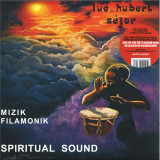
LUC-HUBERT SEJOR - MIZIK FILAMONIK: SPIRITUAL SOUND

180 G. BLACK VINYL WITH LINER NOTES IN CREOLE, FRENCH, ENGLISH

Originally released in 1979, "Spiritual Sound" lives up to its name, a soaring, triumphant album, six tracks of spirit magic from Guadeloupe.

Telluric, intense, terribly alive, the gwoka drums of Guadeloupe carry the identity of a painful and fervent island. Marked forever by the crime of slavery, Guadeloupe's créolité cherishes the ka drums and their natural environment: the low-pitched boula drum with male goatskin, the high-pitched soloist makè drum with female goatskin, the chacha, ti bwa, triangle, calabash and other percussion instruments that surround them, and the voices - the fiery, proud, timbred, urgent voices of the gwoka.


This album is also a legend for its voices: in his then dazzling youth, singer Lukuber Séjor was one of the first gwoka artists to largely feminize the chorus of répondè, who converse with his text delivered in a straight and powerful voice.

And everything here sets new standards. In 1979, Mizik Filamonik - Spiritual Sound proclaimed a spiritual patriotism of ferocious intensity. The album by Lukuber Séjor - whose spelling alone is a battle - sets out to give Guadeloupe the intangible weapons of self-respect and self-knowledge, through a singular practice of traditional music.

The genesis of gwoka music is less straightforward than one might imagine... The drums performed the servile task of accompanying the work of slaves in the fields and during the “corvées” imposed by the administration, before being freely practiced by the common people after the abolition of 1848. At the heart of the conviviality of the Guadeloupeans furthest from the cities - geographically and socially - the gwoka drums come out for carnival, funeral wakes and neighborhood celebrations, but also during strikes, fits of anger and armed vigils of the riots and revolts that have punctuated the island's history. For generations, governors of the colony and then the prefects of the overseas department of Guadeloupe have been viewing the gwoka as a potential for turbulence and a threat to public order.

But as the Beatlesmania, “chanson engagée” and rock revolutions unfolded in Europe, young people turned to the drums of mizik a vié nèg (“bad negro music”, in Creole), which Guadeloupeans had learned to despise by following the “assimilation” process advocated by the school system and most of the political class. At the end of the sixties, in a Guadeloupe mourning the deadly repression of the May 1967 social movement, they played traditional music, refusing to wrap it up in tourist prettiness and madras folk costumes. Instinctively, they played a rough and contemporary gwoka, led by the incendiary Guy Konkèt. This was the era of decisive 45 rpm records such as Robert Loyson's Kann a la richès, which brought to light the fieriest words of union rallies.

At his home in Sainte-Anne, Lukuber Séjor played with flautist Olivier Vamur and his brother Claude Vamur, who cobbled together a drum kit from tin crockery and became, a few years later, the most influential drummer in Kassav'.

These were the years of the Bumidom program, when young Guadeloupeans were encouraged to emigrate to mainland France. At the age of twenty, Lukuber Séjor embarked on the liner Irpinia, disembarking at Le Havre and taking the train to the Gare Saint-Lazare - the route taken by thousands of young West Indians who went on to study or looked for work, all the while trying to maintain a link with their homeland. In this case, it's at the Antony university residence, where Lukuber played the drum and participated in a thousand gwoka updates and aggiornamentos, while exile reinforced the need for a spiritual link with the native land.

In 1978, Guy Konkèt played at the Salle Wagram, a historic event for West Indian music. After serving as répondè - i.e. backing vocalist - on one of his home-recorded albums, Lukuber joined his live band. Little by little, he became one of the key artists on a circuit parallel to French show business. At a student party in Caen, he met a young woman from Martinique who, at the time, was more motivated by her ambitions as a visual artist than by her vocation as a musician. Her name was Jocelyne Béroard and, a few years before she plunged into the Kassav' adventure and became the greatest West Indian singer of her generation, she designed the cover of Lukuber Séjor's LP.

This ambition was obvious and imposed its will. A more or less regular band was formed, with Roger Raspail, Rudy Mompière and Éric Danquin on ka drums, Claude Vamur on ti bwa, Olivier Vamur and Françoise Lancréot on flutes and Annick Noël on keyboards. Lukuber Séjor is set on wanting to extend the gwoka palette to other instruments, as the jazz-rock revolution opens a thousand new doors. Annick Noël will play a wide range of timbres and textures on electric piano and synthesizer. Another novelty: the répondè are two men and two women, Roger Raspail, Olivier Vamur, Françoise Lancréot and Maryann Mathéus ...

Mizik Filamonik - Spiritual Sound is a self-production in which the singer and leader sank all his savings, allowing him no more than a single day in the studio. The first side is more of a musical manifesto, with the first two tracks, Éritage and Penn é plézi, being instrumentals. The third, Son, forcefully celebrates the need for Guadeloupeans to connect with the gwoka. In fact, Jocelyne Béroard's cover shows a tambouyé in the shadow of a cloudy sky, against which a radiant sun is rising and whose light will soon flood the entire landscape. The silhouette and face of this man strongly evoke the immense Vélo, master of the ka, rejected at the time on the fringes of society.

The second side of the LP is surprising. Formally, three tracks are explicitly linked like the three parts of a triptych. Primyé voyaj evokes the appalling tribulation of Africans deported as slaves to Guadeloupe; dézyèm voyaj speaks of the Bumidom program and the economic, political and social forces driving young Guadeloupeans towards the mirage of prosperity in France; twazyèm voyaj closes the cycle with the emigrants' return from Europe after years away from their island...

This gwoka, obsessed with the need to save Guadeloupe spiritually, appeals far beyond the politicized audience. Mizik Filamonik - Spiritual Sound instantly became a classic, although Lukuber Séjor never really made a career for himself as a musician.

After all, the album was released in 1980, with no promotional resources in France or Guadeloupe - and therefore no concerts. The thirty-two-year-old author, composer and performer made his own third trip back to Guadeloupe. He set up a small woodworking business, which he lost in Hurricane Hugo in 1989. His other activity, teaching in a medical-educational institute, became the core of his professional life. He continued to be an active campaigner - a campaigner for the Creole language, a campaigner for the reawakening of identity, a campaigner for special education, a campaigner for a thousand causes that he ignited with his generous and perceptive enthusiasm, such as the defense of breadfruit fries...

The echoes of his 1979 album have not died down. Of course, the use of Penn é plézi as the theme tune for Radio Guadeloupe's funeral notices from 1980 to 1992 kept him in the collective memory, but he continues to sing and compose sporadically, as with his all-female

vocal group Vwapoulouéka... Still convinced that music is a means of liberating the spirit, he continues the journey of a young man eager to deploy the power of Creole music and language.

Bertrand Dicale

In Stock

Disponibile in Stock e pronto per la spedizione

Forever Pavot - Babysitter OST LP

We're delighted to welcome Émile Sornin's solo project, Forever Pavot, to the BMM family, with this heavily retro soundtrack for the French-Canadian motion picture Babysitter directed by Monia Chokri. As a fan of Jean-Claude Vannier and François de Roubaix, Émile illustrates this light and poetic movie with 18 melodic loops and short ambient pieces, faithful to the 60's and 70's French soundtrack style.

In Stock

Disponibile in Stock e pronto per la spedizione

Various - Wizzz! French Psychorama Volume 5 (67-75)

The journey through French-speaking pop archives continues with this fifth volume, packed with fuzz, gimmicks, and dissent. Far from the charts, the selected tracks display a great creative freedom, often backed by corrosive humor. Welcome to the surprising, kaleidoscopic, and colorful world of the late sixties and early seventies, Wizzz!
Born in Montauban, Robert Pico stumbled into music by chance when he met René Vaneste, then artistic director at Pathé-Marconi. René brought him to Paris to record his first 45 RPM EP in 1964. A year later, Pierre Perret introduced him to Vogue, where he recorded his second album with Claude Nougaro’s orchestra. Sylvie Vartan then introduced him to RCA, where he recorded four singles, including the astonishing "Chien Fidèle," a track backed by a hair-rising fuzz guitar. Alongside his solo career, he also composed for other artists like Alain Delon (the song was recorded but remains unreleased), Magali Noël, Bourvil, and Georges Guétary. In the Paris of the sixties, he mingled with Mireille Darc, Elsa Martinelli, Marie Laforêt, France Gall, Françoise Hardy, Petula Clark, Régine, Dani, Serge Gainsbourg, Joe Dassin, Franck Fernandel, Charles Level, and Roland Vincent. Despite his efforts and winning a Grand Prix Sacem for his final record, Robert Pico didn’t achieve the expected success in show business and decided to leave Paris and return to the Southwest, where he devoted himself to writing. He is the author of 23 books (including Delon et Compagnie, Jean-Marc Savary Editions 2025, a memoir about his youth and his many encounters). Today, he is relieved to never have become a celebrity and devotes himself to his work with passion.
In 1969, the Franco-Italian movie Erotissimo was released, directed by Gérard Pirès (who later directed Taxi in 1998, written and produced by Luc Besson). This pop comedy features Annie Girardot, Jean Yanne, Francis Blanche, Serge Gainsbourg, Nicole Croisille, Jacques Martin, and Patrick Topaloff. The soundtrack was written by Michel Polnareff and William Sheller, with lyrics by Jean-Lou Dabadie. "La Femme Faux-cils," performed by Annie Girardot. It recounts the feelings of a rich CEO's wife who seeks to develop her sex appeal under the influence of advertisement and magazines. Groovy, sparkling and light, this track, with ITS lush arrangements humorously critiques consumer society and feminine beauty standards.
“Je suis l’Etat” (1967) is the flagship track of the first EP by singer-songwriter Spauv Georges, aka Georges Larriaga, better known as Jim Larriaga (1941-2022). Born into a family of bakers, the young man was initially planning to become a hairdresser when he discovered English-speaking music through Elvis Presley and the Beatles. After this revelation, he decided he would become a songwriter and gave himself five years to succeed. He recorded his first two EP’s independently for RCA under the pseudonym Spauv Georges; meaning “that poor George”, a nickname given to him by the mother of her friend Jean-Pierre Prévotat (future drummer of the Players, Triangle, or Johnny Hallyday). Portraying a depressed and eccentric young man, Spauv Georges created corrosive and amusing songs that didn’t reach a wide audience, despite a TV appearance with Jean-Christophe Averty.
Supported by his loyal friend and fellow songwriter Jean-Max Rivière, Georges Larriaga met the future singer Carlos in the early '70s, then Sylvie Vartan’s assistant. He wrote songs for Carlos, including the popular "La vie est belle," "Y’a des indiens partout," and "La cantine", which went onto become a huge hit in 1972. He also composed for Claude François (“Anne-Marie”, 1971), Charlotte Julian (“Fleur de province”, 1972), helped launch child singer Roméo (who sold 4 million records), and later wrote the hit "Pas besoin d’éducation sexuelle" (1975) for the young Julie Bataille. In 1971, Jim recorded an album for Disc'Az: “L’univers étrange et fou de Jim Larriaga”, which featured pop gems like “La maison de mon père”.
The story of the song "Zoé" began when Pierre Dorsay, artistic director at Vogue Records, asked Swiss singer and musician Pierre Alain to write a song for a new female singer. The inspiration came when he realized that Zoé (the artist's name) was also the name of France's first atomic battery, created in 1948, which consisted of uranium oxide immersed in heavy water! The lyrics reflect a bubbling energy that must be handled with caution, while the instrumentation echoes this atomic theme, notably with the use of a theremin.
Zoé’s career lasted only as long as a single 45 RPM, but it seems Christine Fontane was the vocalist behind this pseudonym, who is known for several EPs, a good "popcorn" album in 1964, and a handful of children’s singles in the '70s. Regardless, the photograph on the cover is of a different girl entirely.
Later, Pierre Alain continued his career, writing songs for himself, Marie Laforêt, Danièle Licari, Alice Dona, Arlette Zola (3rd place in Eurovision 1982), and achieving multiple gold and platinum records in Canada. Also an inventor with several patents, president of the Romande Academy, and head of the French Alliance in Geneva, he now composes atonal music, books, and poetry. Moreover, he is also the host of "Les Mardis de Pierre Alain" at "Le P'tit Music'Hohl" in Geneva.
Filled with oriental choruses and fuzz guitar, "Fou" is from Jacques Da Sylva's only EP released by Vogue in 1967. Despite the quality of this recording, all traces of this singer disappear after this first effort.
Valentin is a baroque pop singer born in Belgium. He is the songwriter and composer of most of the tracks on his three singles released in the late 60s in Canada. A legend says that he reincarnated himself as Jacky Valentin during the 1970s for a rock'n'roll revival career in Belgium, but his older brother sadly debunked this story. Valentin's first two singles were arranged by Claude Rogen, a Parisian session pianist who had come to Canada to promote the song “Mister A Gogo”, a cover of David Bowie’s “Laughing Gnome”, adapted by singer Delphine, his wife at the time. Far from his usual network, Claude Rogen arranged music for Polydor, including the arrangements for “Je suis un vagabond” in 1969, a jerk tune with string arrangements and a furious optimism.
Jacques Malia wrote, composed, and recorded his only 45 EP for Festival in 1966. “Histoire de gitan” is an incredible beat track with bohemian scat that tells the story of a gypsy musician who came to Paris to make it in the Music-Hall, to no avail. The hero of the song and its author probably shared a similar fate, as Jacques Malia faded into anonymity after this remarkable attempt.
Bernard Jamet recorded two EPs for Barclay in the late sixties and co-wrote several songs with Christine Pilzer, Pascal Danel, and prolific songwriters Michel Delancray and Mya Simile. The track “Raison Légale” (1968), his masterpiece, immerses the listener in a courtroom right when a murderer is being judged, with jerk rhythm and free arrangements. A unique, paranoid, judicial, and psychedelic oddity.
Jean-Pierre Lebrot-Millers started his career in show business in 1967 as a singer and songwriter for the Philips label. After three singles, he wrote several songs of a new kind with his friend Pierre Halioche, in the midst of the sexual liberation movement and the democratization of drugs. With provocative lyrics, “Les filles du hasard” and “Barbara au Chapeau Rose” were released on a Philips singles in 1968. The character of Barbara was inspired by a queen of Parisian nightlife during the psychedelic years: model Charlotte Martin, who dated Eric Clapton from 1965 to 1968, then Jimmy Page from 1970 to 1983. Jean-Claude Petit’s arrangements, with a table-filled intro, soul brass, and Hendrixian guitar, emphasize the flamboyance of a hedonistic and sexy character, whose dog is named Junkie because “Junkie est un nom exquis”! The track was recorded live in three takes with a full orchestra.
Upon its release, the record was censored by Europe 1 and RTL due to its references to drug use. Jean-Pierre Lebrot was then banned from the airwaves and later dismissed by his record label. He changed his artist name to Jean-Pierre Millers, while his companion Pierre Halioche became D. Dolby for a new dreamy composition, “Chilla”, which Jean-Pierre produced himself with arrangements by Jean Musy. Once again, the song was immediately censored everywhere. After this setback, he decided to stop singing and started taking on odd jobs to support his Swedish wife and their son until the day he met Jean-Pierre Martin, then production manager at Decca, who had worked with Manu Dibango. Martin offered Jean-Pierre Lebrot-Millers, then employed at Rank Xerox, the position of artistic director at Decca. He accepted and became, a year later, promotion director (radio, press, TV). He worked on Julio Iglesias’s first album for Decca, which became a massive hit and allowed him to meet Claude Carrère. The latter asked him to write new songs and find their performers, much like a “talent scout.” It’s through him that Jean-Pierre discovered Julie Pietri and Corinne Hermès. He composed “Ma Pompadour” for Ringo, Sheila’s husband, and took the microphone again for the syncope hit “Rendez-Vous” in 1982.
That same year, Jean-Pierre Lebrot-Millers tried to release a track for which he had heavily gone into debt: “Si la vie est un cadeau”. Having recorded it in London, he presented it to numerous professionals, all of whom refused to get involved. The same thing happened with Antenne 2 and the Sacem when he proposed the song as France’s entry for Eurovision. He then met Haïm Saban, who was producing cartoon soundtracks and had just launched the Goldorak theme song. Saban, having listened to the song, declared it had the potential to become a hit. He sent Jean-Pierre and Corinne Hermès to meet the CEO of the Luxembourg radio and television network. The latter received them, asked to hear a verse and chorus a cappella in his office, and immediately hired them to represent Luxembourg at Eurovision 1983. They reworked the arrangements and recorded a new version with Haïm Saban as co-producer. The song ended up winning Eurovision 1983, a great comeback for our hero. He continued producing and hung out with the band Nacash in Belgium when a couple came to introduce their daughter for an impromptu audition in a hotel room. The girl sang “Les démons de minuit” while dancing to a radio cassette. Impressed, he had her take singing lessons for a year and composed a song for her (for which he had the melody and title, but no lyrics). This required him to go on the hunt for a lyricist, who ended up being Guy Carlier. They recorded the song, which was initially a ballad, at Bernard Estardy’s CBE studio, and gave the singer a new name: Melody. They showed the song around their industry network without success. Later, Estardy called Jean-Pierre to suggest changing the rhythm and making it pop-rock. Orlando, Dalida’s brother, liked the result and decided to co-produce the track. “Y’a pas que les grands qui rêvent » became a classic hit. The song has since been covered by Juliette Armanet (as a ballad, like the original) and Valentina.

Born into an aristocratic Breton family, Hervé Mettais-Cartier worked as a DJ at Queen Kiss, a nightclub in Poitiers, where he formed the band Les Concentrés with Michel (an actor) and Christian (a radio technician). Together, they created a repertoire of whimsical songs (“Ma bique est morte”, “J’suis un salaud”, “Fils de dégénéré”...) that they performed on stage dressed in white (in homage to “concentrated milk”). They performed at Bliboquet and Olympia in 1968 for the 10th edition of the “Relais de la chanson Française” organized by L’Humanité-Dimanche and Nous les Garçons et les Filles, sponsored by Pepsi Cola. Winners in the author-composer category, alongside Danish singer Dorte, their visibility allowed them to record a 45, and appear on television in Jean-Christophe Averty’s show. The A-side of the disc features Bruno le ravageur, a casatchok dedicated to Bruno Caquatrix, the director of Olympia, nicknamed in the song “Coq Atroce” or “croque-actrices”. The B-side is dedicated to “Fils de dégénéré”, a quirky tribute to Hervé's aristocratic roots, mixing absurdity with sophisticated vocal harmonies.
After Les Concentrés, Hervé Mettais-Cartier formed the duo La Paire et sa Bêtise with his friend Olivier Robert. They performed in Parisian cabarets and toured with Pierre Vassiliu. In the late 1970s, Hervé began a solo career. He recorded two albums for the Motors label in 1978 and 1979, which did not achieve their anticipated success due to lack of promotion. In 1980, he met Bernadette, with whom he started a family and created a “Chansons à voir” (songs to see) show that he performed until his death at the end of 2024.

Publicité comes from the final EP by the Missiles (Ducretet Thomson, 1966), a disc that also includes “La (nouvelle) guerre de cent ans”, featured on Volume 4 of our Wizzz! series. Please refer to the booklet for the story of the band.

“He’s 1.82 meters tall, 28 years old, weighs 135 kg, is black and Belgian”: this is the description of singer Hegesippe on the back of his sole single (Decca, 1967). He appears on the album cover wearing a Greek toga, like a hippie gag – we are at the end of the year 1967. In “Le crédo d’Hegesippe”, this former bodyguard of Antoine and the Charlots plays the delightful card of the thick brute converted to Flower-Power and non-violence, with arrangements by Jean-Daniel Mercier, aka Paul Mille.
“Ethéro-disco” was released on a promotional record for clients of the Maréchal company (Liège, Belgium) for the New Year 1979. Over a funky rhythm, celebrity impersonations (Brigitte Bardot, Jacques Dutronc, Fernandel…) deliver an enigmatic text about pharmaceutical products like ether, bismuth, and aspartate. The track was composed by Dan Sarravah (responsible for Joanna's “Hold-up inusité” featured on Wizzz! Volume 3) and Tony Talado, who was also a singer (one 45 in 1967), songwriter (with over a dozen credits between 1964 and 1985 in various styles from surf music to disco), author (Devenez Végétarien, Dricot Editions, 1985), ad designer, and psychologist.

Décollez-les is on the A-side of Mamlouk's only single, a pseudonym for Marsel Hurten, who is known for his work on several EPs in the late sixties, as well as composing music for Hervé Vilard’s “Capri, c’est fini”, Claude Channes' “La Haine”, Annie Philippe’s “On m’a toujours dit”, and Nancy Holloway’s “Panne de Cœur”.
This strange song, with Afrobeat horns and absurd dialogues between a chef and his kitchen staff, is the result of a collaboration between Marsel Hurten and one of his neighbors, a photographer from Pavillon-sous-Bois (93), where the musician settled after returning from the Algerian War. A music video was shot to promote the record.
Marsel Hurten was born in Tourcoing (59) into a musical family. At a young age, he joined the brass band founded by his grandfather, playing the piston before studying trumpet at the conservatory, as well as teaching himself how to play the guitar. As an orchestra musician, he toured in France, Belgium, Germany, and England. He released a series of solo 45’s between 1965 and 1968 for the DMF and Az labels before stopping recording to focus on working for other artists (Gilles Olivier, Noëlle Cordier…).
“L’amour nu” (Vogue, 1971) is the work of the short-lived Belgian band Mozaïque. The track, written by singer Jacques Albin, closely resembles another of his compositions, “Carré Blanc”, which he recorded in 1969 for Disc’AZ.
Represented by the Lumi Son micro-label based in Marignane (Côte d'Azur), Jean-Marc Garrigues released two 45 RPMs in the late sixties, defending the French jerk sound. The song “Je dis Non” is a short, joyful ode to youth, pop music, and rebellion.
Songwriter and performer Jacques Penuel released three singles. The first one, “Astronef 328” (Fontana, 1969), features a dizzying series of chords punctuated by sound effects, a sci-fi story, and arrangements by Jean-Claude Vannier.

We would like to sincerely thank Pierre Alain, Moon Blaha, Marsel Hurten, Bastien Larriaga, Jean-Pierre Lebrot-Millers, Bernadette Mettais-Cartier, Robert Pico, Olivier Robert, Claude Rogen, Micky Segura.


non in magazzino

Ordina ora e ordineremo l'articolo per te presso il nostro fornitore.


Last In: 54 days ago
Justin Moore - The Radio Phonics Laboratory - Telecommunications, Speech Synthesis, and the Birth of Electronic Mus

The Radio Phonics Laboratory by Justin Patrick Moore is the story of how electronic music came to be, told through the lens of the telecommunications scientists and composers who helped give birth to the bleeps and blips that have captured the imagination of musicians and dedicated listeners around the world.

Featuring the likes of Leon Theremin, Hedy Lamarr, Max Matthews, Hal 9000, Robert Moog, Wendy Carlos, Claude Shannon, Halim El-Dabh, Pierre Schaeffer, Pierre Henry, Francois Bayle, Karlheinz Stockhausen, Vladimir Ussachevsky, Milton Babbitt, Daphne Oram, Delia Derbyshire, Edgar Varese & Laurie Spiegel.

Quotes
“From telegraphy to the airwaves, by way of Hedy Lamarr and Doctor Who, listening to Hal 9000 sing to us whilst a Clockwork Orange unravels the past and present, Moore spirits us on an expansive trip across the twentieth century of sonic discovery. The joys of electrical discovery are unravelled page by page.”
Robin Rimbaud aka Scanner

“Embark on an odyssey through the harmonious realms of Justin Patrick Moore’s Radio Phonics Laboratory echoing the resonances of innovation and discovery. Witness the mesmerising fusion of telecommunications and musical evolution as it weaves a sonic tapestry, a testament to the boundless creativity within the electronic realm. A compelling pilgrimage for those attuned to the avant-garde rhythms of technological alchemy.”
Nigel Ayers (Nocturnal Emissions)

“In this captivating exploration of electronic music, Justin Patrick Moore unveils its evolution as guided by telecommunication technology, spotlighting the enigmatic laboratories of early experimenters who shaped the sound of 20th century music. A must-read for electronic musicians & sound artists alike—this book will undoubtedly find a prominent place on their bookshelves.”
Kim Cascone

non in magazzino

Ordina ora e ordineremo l'articolo per te presso il nostro fornitore.


Last In: 10 months ago
Claude Fontaine - La Mer

"With their dulcet fusion of ‘60s French ye-ye pop, slinky Studio One reggae, and liminal Brazilian tropicalia, Claude Fontaine’s songs embody the best kept dreams of a globally connected world. The second album from the Los Angeles artist reflects the dream of creating the soundtrack for this utopia by the sea.

Released on Innovative Leisure, La Mer is a mesmerizing portal. It’s impossible for it to exist outside of the modern moment, but it floats on the gilded dust of the past. At times, Fontaine channels Jane Birkin as backed by Jorge Ben. Francois Hardy locked into sonic reverie with Mulatu Astatke, or Margo Guryan making lovers rock.

None of this is a happy accident. For her second opus, Fontaine assembled some of the most gifted musicians of the last five decades. First and foremost is her co-writer and producer, the multi-platinum Grammy-Award winning Lester Mendez, whose resume includes everyone from Grace Jones and Baaba Maal to Shakira and Nelly Furtado.

As with Fontaine’s self-titled first album, the legendary Tony Chin appears on guitar, bringing the orphic tones expected from someone who has played with some of the greatest reggae musicians of all-time (King Tubby, Dennis Brown, Lee Perry, Jackie Mittoo, Max Romeo, Sly & Robbie). On bass, there’s Ronnie McQueen, one of the co-founders of Steel Pulse. Sergio Mendes’ percussionist, Gibi Dos Santos, supplies propulsive locomotion. So does Ziggy Marley’s drummer, Rock Deadrick. And that’s just the abridged list of storied instrumentalists who appear on La Mer."

non in magazzino

Ordina ora e ordineremo l'articolo per te presso il nostro fornitore.


Last In: 13 months ago
Camille Avec The Le Chiffre Organ-ization - Rodin

She loves jazz, art and fashion and last summer she wrote her very first song. If you are an undeniable fan of Jaqueline Taeib, Cleo, Suzanne Gabriello, Gillian Hills, Catherine Spaak, Sylvie Vartan, Francoise Hardy, Sheila, "Rodin" will most certainly take you right back in time. Camille sings about love, life and loneliness, an original composition about the love affair between Auguste Rodin and his student Camille Claudel and also includes a fantastic cover song from an artiste we all adore, NINO FERRER's "Alexandre"

pre-ordina ora15.06.2024

dovrebbe essere pubblicato su 15.06.2024


Last In: 2026 years ago
Michel Magne - Les Tontons Flingueu

The music from LES TONTONS FLINGUEURS (aka Crooks in Clover aka Monsieur Gangster) is as instantaneously recognizable as the James Bond theme thanks to a short and recurring melodic motif that can still stick in the heads of 21th century kids. Monothematism is a word used by musicologists to refer to the use of stylistic variations based on a single musical theme as can be heard in the Tontons : on the banjo, during the nose punch sequences, played jazz, blues, gloria or Hully Gally style. Though the Tontons music may on first listen sound nothing different than a straightforward yet catchy soundtrack, it turns out to be a real exercise in style. When reading Michel Magne's autobiography " L'amour de vivre " it clearly appears that mixing folk music and sound experiments was a mindful artistic choice. In the movie, Antoine Delafoy (Claude Rich) who is engaged to Patricia (the Mexican's daughter) is merely a Michel Magne caricature. He embodies a contemporary music composer in search of the " absolute anti-chord " by using a water tap. " We don't really know what it is but it's amusing ". In reality and despite his classical musical education, Michel Magne has indeed had a venture into avant-garde music, going as far as organizing an infrasounds concert at the Salle Gaveau venue (Paris) on July 15th, 1954. Infrasonic frequencies which quickly made the audience run for the toilets. On December 3rd,² 1956 his low-frequency sounds contributed to an " empirique " show at the Théâtre des Trois Baudets (Paris) with Alexandro Jodorowsky, Jean Michel Rankovitch and Tinguely. At the same time he wrote music on words by Françoise Sagan for Mouloudji. Again with this desire to cross the boundaries of musical genres. He recorded in 1959 an album of " musiques tachistes " from which a show with dances was staged by Michel Descombey. His taste for provocation and avant-garde did not prevent Michel Magne from composing and arranging popular music. He hence wrote the music for six Georges Lautner movies including the famous Tontons Flingueurs in 1963.Being part of the avant-garde long-haired world what could Michel Magne think of Michel Audiard ? A most kind character who had nevertheless been burned by supporters of the " nouvelle vague " including journalist Henry Chapier who described Les Tontons Flingueurs as being " chansonnier " cinema (in Combat 1963), meant for disenchanted quinquagenarians. Audiard had responded to Truffaut, another of his dispisers : " Dad's movies filled theaters, son's movies empty them. We should have been warned : with its seaside sounding name the Nouvelle Vague (new wave) drove millions of viewers out on the countryside ". In between melodic effectiveness and daring arrangements and tonality, Michel Magne's work is worth being listened to with fresh ears, cleared of clichés !

pre-ordina ora26.04.2024

dovrebbe essere pubblicato su 26.04.2024


Last In: 2026 years ago
VARIOUS - HARCOURT EDITION - CHANCON FRANCAISE
pre-ordina ora15.12.2023

dovrebbe essere pubblicato su 15.12.2023


Last In: 2026 years ago
Andrzej Korzyński - Third Part Of The Night

As one of the most triumphant and beguiling directorial debut features to emerge from the fruitful Polish New Wave, Andrzej Zulawski’s 1971 film Third Part Of The Night not only earned the thirty-year-old filmmaker a place next to other radical Polish directors such as Polanski, Skolimowski and Has, but also galvanised a creative bond with long running collaborator and composer Andrzej Korzyński, providing fans of foreign abstract/suspense cinema with a potent creative fusion to match those of Polanki/Komeda, Fellini/Rota and Argento/Goblin, amongst others.

Quite simply one of the heaviest psych rock film soundtracks of all time Andrzej Korzyński’s short and unreleased score matched the blueprint that adorned the drawing boards of conceptual French jazz orch rock composers like Jean-Claude Vannier, Francois De Roubaix and Alain Gourageur, creating a soundtrack that unknowingly begs comparison to Masahiko Satô’s Belladonna Of Sadness and Billy Green’s Stone. As one of the first progressive pop writers to come out of the vibrant (but carefully scrutinised) Polish beat scene with his bands Ricecar 64 and later Arp Life (and composing for national heroes such as Czeslaw Niemen, Niebiesko-Czarni and Test) Korzyński’s growing passion for conceptual rock and jazz music soon lead to instrumental composition and soundtrack scores.

His cinematic debuts scoring two consecutive transitional new wave films for Andrzej Wajda (in collaboration with the radical Polski pop groups Trubadurzy and Grupa ABC) also provided Korzyński with another significant cinematic muse in that of the stunning actress Malgorzata Braunek with whom they would both eventually achieve their finest performances under the direction of the ravenous first-timer Żuławski. Third Part Of The Night (1971) perhaps epitomises that triangular on-screen unison in its vibrant youth and feeds it through a hallucinogenic mangle finding astonishing beauty (within a repulsive synopsis) against a bleak and shattered backdrop and accompanied by progressive, psychedelic orchestral rock music – elements which would intensify for all three creatives with the next film, Diabel, which was banned by the Polish government the following year until 1988.

Third Part Of The Night also marks the public unison of Żuławski and Braunek whose later private romantic relationship is said to form the basis for another defining Żuławski/Korzyński defining endeavour with the 1981 film Possession exactly a decade later, encapsulating a period that bequeaths a previously unopened vault of some of the composers finest and most inspired sonic adventures.

pre-ordina ora29.09.2023

dovrebbe essere pubblicato su 29.09.2023


Last In: 2026 years ago
Les Masques - Brasilian Sound LP

At the end of the 60s and early 70s Brazil was a dream. It was fashionable everywhere in Europe and therefore in France too. One thinks of 'Samba Saravah' from the Un homme et une femme OST, Françoise Hardy and her record produced by Tuca, Isabelle Aubret and her 'Casa Forte' or France Gall with 'Zozoi'. Three Brazilian musicians exiled in France, Edson Lobo (bass), Fernando Martins (piano) and Nelson Serra (drums) form the Trio Camara. They met a group of friends who loved Brazilian music, all professional musicians, but who wanted to remain anonymous, hence the name of the band : Les Masques (The Masks)…

Claude Germain (Les double six), José Bartel, Marie Vassiliu, Pierre Vassiliu … Indeed the singers forming Les Masques are from being unknown. In 1969 they entered Studio Davout with le Trio Camara to record "Brasilian Sound". Composed of 11 tracks, it is a superb album, masterfully produced and recorded, a gripping record to listen in one go and transports us in atmospheres both dreamy and naïve which belong to that period. Produced in 500 copies on CBS, 'Brazilian Sound' was not, unfortunately, a success and it is today impossible to find the original French pressing (which sounds much better than the Canadian pressing released at the same time). This reissue on Le Très Groove Club is welcome, so that 50 years after its release, a larger audience can discover this beautiful record, echo of a once and for all past era.

pre-ordina ora08.09.2023

dovrebbe essere pubblicato su 08.09.2023


Last In: 2026 years ago
Various - Tele Music, 26 Classics French Music Library, Vol. 3
 
26

Welcome to the third part of the TELE MUSIC saga, the label founded by Roger Tokarz. He deeply marked the era with his audacity and his vision of music on film. This irresistible new selection tells the story from 1968 to 1985 of a prolific label that sometimes produced ten albums a year, and which delighted many French and foreign film directors who, to 'flavour' their films, drew on this sumptuous catalogue.
In this volume 3 TELE MUSIC, we have highlighted legendary artists who have left an indelible mark on the history of the music bookshop and on the history of music in general:

• Janko Nilovic (also known as Yanko Nilovic, Anady Loore, E. Orti or Alan Blackwell),
• Jean-Jacques Debout with his irresistible “Mitsuko” released in 1967 and re-released in 1969 on “Music Bazaar”, • Bernard Lubat, the impressive percussionist, vibraphonist, multi-instrumentalist and very good “scator” (Bernard played in the Doubles Six with Quincy Jones and Eddy Louiss),
• Gabriel Yared, the man with a hundred film scores. Arranger and composer for Johnny Hallyday and Charles Aznavour, among others!
• Hervé Roy conductor and writer for Nancy Holloway,
• George Chatelain, pianist, guitarist, clarinettist, founder of the famous studio “CBE” created in 1966 with his sister Janine Bisson and his high school friend Bernard Estardy.

All these composers were renowned for their acute sense of composition, arrangement, conducting and inter- pretation, and in their own way left their mark on many sound recordings of musical illustration "made in France!
CBE, the Chatelain, Bisson and Estardy studio is located in the 18th arrondissement of Paris. Still in operation and run by Julie Estardy, it has been receiving major artists for over half a century. It is a place of reference. At the time: Johnny Hallyday, Claude François, Sheila, Carlos, Françoise Hardy, Nino Ferrer recorded their hits there.
Now it's the turn of Sebastien Tellier, Bertrand Burgalat, Keziah Jones, Tony Allen, Jeff Miles to name but a few. CBE and its giant Bernard Estardy put TELE MUSIC in the best conditions to produce an atypical and powerful sound.
Bernard Estardy had a custom- built mixing console built by his German friend Gunther Loof, offering the perfect tool for recording 4 and then 32-track Arp 2000, Moog, Korg, Prophet synthesizers and all acoustic instruments. The field of experi- mentation was limitless.
Until now, the titles of this collection were only available in vinyl format, via rare and expensive prints that collectors sell for a high price on dedicated websites. This volume 3 gives you access to the "crème de la crème" of the legendary repertoire made in France!

non in magazzino

Ordina ora e ordineremo l'articolo per te presso il nostro fornitore.


Last In: 3 years ago
Tonio Rubio - Rhythms LP

Tonio Rubio

Rhythms LP

12inchBEWITH119LP
Be With Records
20.01.2023

2023 re-issue, 140g vinyl, reproduction of the classic Tele Music sleeve, full colour insert with liner notes and archive photographs

Wow! Tonio Rubio's Rhythms is a stone-cold killer, a heavyweight library breaks LP and the inaugural release in Be With's new partnership with legendary French library label Tele Music. Yes, you lucky people, there's lots to come. For this extremely special 50 year anniversary re-issue, we've reproduced the classic Tele Music sleeve with a full colour insert featuring rare photographs, fresh liner notes and personal memories of Tonio from the likes of Jean-Claude Vannier, Jean-Claude Petit and Janko Nilovic.

Sumptuous opener “Latin Leitmotiv” is all funky phasing effects and a killer montuno, with what sounds like piano and bass in tandem, stoking straight up Latin fire. The gritty hard funk of blaxploitation groove "Red Medium" is dripping in wah-wah attitude and head-nod oddness. The atmospheric, exotica-tinged "Dead Slow" emulates the languid, sensual afro groove of Quincy Jones’ wild masterpiece “Gula Matari” whilst the proggy, electric jazz fusion epic "Rock 73" is 9+ minutes of moody, rolling menace.

But the *real* highlight of this cult classic - and why it has long been *so* desirable - is the devastating, deep, hypnotic minimalist groove of "Bass In Action N°1". Very much in conversation with Quincy's rendition of "Hummin'", the loping, rumbling bassline and sweet electric piano over clean, crisp drums making it one of those tracks that sounds like a hip-hop beat 20 years ahead of time. Sensational. “Bass In Action N°2“ features Tonio's own vocal scat performance. Remarkable.

Antonio "Tonio" Rubio Garcia got his start playing the double bass in jazz clubs. In 1962, Tonio joined the Golden Stars, the first backing band of France’s teenage idol Johnny Hallyday. A genius musician with a unique guitar sound, he played on standards of French chanson including Serge Gainsbourg and Brigitte Bardot’s "Bonnie and Clyde", Françoise Hardy’s "Tous les Garçons et les Filles", Gainsbourg and Jane Birkin’s "Je T’aime, Moi Non Plus" and Serge and Charlotte Gainsbourg’s infamous "Lemon Incest". Tonio also lent his brilliance to such legendary figures as Janko Nilovic, Jean-Claude Petit, Hervé Roy, and Jean-Claude Vannier. The latter remembers Tonio as “a secretive, mysterious man, with an endearing personality, albeit difficult to reach out to. His virtuosity as a bass player allowed me to write very innovative basslines, because he was able to play any of my eccentricities!”

The audio for Rhythms has been remastered by Be With regular Simon Francis whilst Christopher Stevenson has brought the original and iconic Tele Music sleeve back to life in all its striking glory as the finishing touch to this long overdue re-issue.

non in magazzino

Ordina ora e ordineremo l'articolo per te presso il nostro fornitore.


Last In: 3 years ago
Daniel Vangarde - Daniel Vangarde The Vaults - The Vaults Of Zagora Mastermind (1971 - 1984) 2x12"
 
20

Born Bangalter in 1947, Daniel Vangarde is a French songwriter and producer. In 1967, he met Jean Kluger who became his publisher. In the 1970s, their tandem stood out in those fields, for a plethora of popular French artists such as Petula Clark, Claude François, Joe Dassin, Dalida, Régine, Sheila and Ringo. 1975 saw the birth of Vangarde’s label, Zagora, and his first and only solo LP. Later on, Vangarde and Kluger were responsible for a number of hit songs by The Gibson Brothers, Ottawan and La Compagnie Créole. With or without Kluger, Vangarde also wrote and produced songs that remained underground, under several monikers (Starbow, Who’s Who, Soul Iberica Band, Yamasuki, Rocky & Vandella…) and for various artists. Let’s open these incredible cosmic disco funk vaults! Available on Double Vinyl (featuring 2 exclusive tracks) & CD .

pre-ordina ora25.11.2022

dovrebbe essere pubblicato su 25.11.2022


Last In: 2026 years ago
Maurice Lecoeur - Musiques Pour l'Image

Maurice Lecoeur could be considered as France’s best kept secret composer. Although hardly known outside of « digging-nerds » circles, he produced an incredible number of themes for movies, TV programs and commercials. Inspired by his friend and mentor François de Roubaix, he managed to create his own print, juggling freely with genres, harmonies, tonalities and string arrangements.

This fine compilation gathers together the cream of his 70s-to-mid-80s work ; a journey overflowing with pop fantasies, crazy drum-breaks and beautiful orchestral themes.

Most of these magnetic tapes are totally unrealeased and could have burned in the terrible fire that devastated Lecoeur’s home studio in the early 90’s. For fans of Jean Claude Vannier, Michel Colombier, François De Roubaix and Janco Nilovic…

non in magazzino

Ordina ora e ordineremo l'articolo per te presso il nostro fornitore.


Last In: 3 years ago
Serge Gainsbourg - OST Madame Claude

Directed by Just Jaeckin, the creator of Emmanuelle, starring Françoise Fabian, Madame Claude is inspired by the fictionalized memories of Fernande Grudet, the sulphurous instigator of the most famous luxury prostitution network in Pompidolian France. The totally disco-funk Original soundtrack of this film released on screens in 1977 from Serge Gainsbourg is sublimated by the immense arranger- Jean-Pierre Sabar". Without forgetting the generic song of Madame Claude “Yesterday, Yes a Day” interpreted by Jane Birkin. Reviews in London Macadam, and L’Echo Ads London Macadam and L’Echo

pre-ordina ora26.02.2021

dovrebbe essere pubblicato su 26.02.2021


Last In: 2026 years ago
Various - From Brussels With Love

The cassette (TWI 007) is a faithful reproduction of the 1980 original, complete with PVC wallet, 16 page booklet and tracklist insert.

Les Disques du Crepuscule is proud to present newly remastered vinyl and cassette editions of iconic compilation album From Brussels With Love, which was the very first release on the Crepuscule label back in November 1980 – and is now celebrating its 40th anniversary.
Originally released as a deluxe cassette/book package in a PVC wallet, From Brussels With Love featured 21 exclusive tracks from the international avant-garde and new wave, as well as contributions from the celebrated Factory Records roster. Then, as now, the featured artists include A Certain Ratio, Gavin Bryars, Harold Budd, Thomas Dolby, Dome, The Durutti Column, John Foxx, Martin Hannett, Richard Jobson, The Names, Bill Nelson, Kevin Hewick + New Order, Michael Nyman and Der Plan.
Running for 78 minutes, the cosmopolitan ‘cassette journal’ was curated by Michel Duval, Annik Honore and Wim Mertens, and also includes extended interviews with Brian Eno and legendary French film actress Jeanne Moreau. The cover art by Jean-Francois Octave, with additional graphics by Benoit Hennebert, Marc Borgers and Claude Stassart in the booklet.
From Brussels With Love quickly sold 6000 copies around Europe, earning rapturous reviews in the UK music press. “This is a reminder – without really trying, without being obvious – that pop is modern poetry. Is the sharpest, shiniest collection of experiences. Is always something new” (Paul Morley, NME). More recently, Dan Fox of art magazine Frieze described TWI 007 as “a masterpiece of distinctly northern European post-punk eclecticism.”
To mark the 40th anniversary of From Brussels With Love, Crepuscule will issue 3 remastered editions.
There is also a deluxe 2xCD ‘earbook’ edition (TWI 007 CD) presented as a 10-inch square hardback book, with two full length audio CDs and 60 page book including rare images, posters, sleeve designs and period ephemera, plus a detailed history of the Crepuscule label between 1979 and 1984.

pre-ordina ora06.11.2020

dovrebbe essere pubblicato su 06.11.2020


Last In: 2026 years ago
HARLEM POP TROTTERS - HARLEM POP TROTTERS

Harlem Pop Trotters is one of the best jazzfunk albums in the French library, and one of the grooviest too. Written & produced by Jean Claude Pierric & François Rolland for Les Tréteaux in the mid ‘70s, this real masterpiece is now reissued on Underdog Records (Janko Nilovic, Martial Solal) in a rare colored edition!

non in magazzino

Ordina ora e ordineremo l'articolo per te presso il nostro fornitore.


Last In: 5 years ago
Boillat Thérace Quintet - Boillat Thérace Quintet

Swiss jazz bliss! We Release Jazz is very, very, VERY happy to present its sixth release (following Ryo Fukui’s Scenery and Mellow Dream, Le Cercle Rouge’s soundtrack by Eric Demarsan, Stuff Combe 5 + Percussion, and Marc Moulin’s Placebo Live 1971) coming straight from its beloved hometown of Geneva. Boillat Thérace Quintet’s self-titled album is available for the first time since its original limited private pressing in 1974 and comes as a vinyl LP as well as a digipack CD* (with 3 never-heard bonus songs). Full of prolific and inspired local clusters and boosted by the recently launched Montreux Jazz Festival, the Swiss jazz scene was vibrant and inventive in the 1970s, notably in the region surrounding Lake Geneva. This is precisely where jazz activist and brilliant pianist Jean-François Boillat and wind instrument master Raymond Thérace formed their quintet whose dazzling debut album was recorded in 1974. An absolute Lemanic gem of the soul-jazz/modal kind, the self-titled album includes superb covers of Freddie Hubbard’s “Straight Life”, Keith Jarrett’s “In Your Quiet Place”, and Rahsaan Roland Kirk’s “Sweet Fire”, plus groovy original compositions from the Boillat-Thérace crew. Helvetian fun facts: the velvety “1224” is dedicated to Geneva’s public transport line Tram 12, and one exquisitely funky track on the album is named after the famed yet elusive (and locally legendary) Swiss Marmite: “Cenovis”! This is reissued in conjunction with Boillat Thérace Quintet’s My Greatest Love featuring Benny Bailey (1975), also available via We Release Jazz. *The CD version includes 3 bonus tracks (Herbie Hancock, Wayne Shorter, and Claude Engel covers), never released before.

non in magazzino

Ordina ora e ordineremo l'articolo per te presso il nostro fornitore.


Last In: 4 years ago
TWINKLE - Golden Lights

The teen girl falling in love with greasy biker melodrama that set The Shangri-Las on the scene was beaten to the core when English high society child Lynn Ripley -better known as Twinkle- took it to the next level on her own composition "Terry". Penned at the tender age of sixteen, Twinkle's lyrics were found so twisted and bad tasty that the song got the honour of being banned at the BBC thirteen years before the Sex Pistols ran the same luck with "God Save The Queen." A ban that, as you would have guessed, instead of hiding the song from the era's teenage record hunters made it even more coveted. Thus "Terry", Twinkle's first 45 issued on Decca in October 1964, became an instant top 5 hit in the UK and was released successfully worldwide as well as covered by many bands (like Claude François French version or Los Extraños cover sung in Spanish).


The success of "Terry" encouraged Decca to release other comositions by Twinkle, along with her recordings of songs by other songwriters, in 6 singles and one EP published between 1964 and 1966. Another of Twinkle great tunes, "Golden Lights", was covered by big Twinkle fan Morrissey and The Smiths in their 1986 "Ask" 12" EP.


The 14 songs from the Decca 45s are collected in this fatastic LP, housed in an amazing period style sleeve w/backflaps and including a gatefold insert with photos and first hand told liner notes by Twinkle's own sister Dawn James, a music journalist working for New Musical Express back in the 1960s.


It comes in a limited edition of only 500 copies : if you like sixties girl-pop sounds like those of The Shangri-Las, pop stars like France Gall, singer-songwriters like Margo Guryan and Phil Spector-ish productions you must get your copy of Twinkle's "Golden Lights" before it sells-out!

non in magazzino

Ordina ora e ordineremo l'articolo per te presso il nostro fornitore.


Last In: 6 years ago
Bernard Estardy - Space Oddities: 1970 - 1982

Oddball space disco/fnk tracks, composed between 1970 and 1985. Big tip!
.
A master of the mixing board, from the late 60s until the 90s Bernard Estardy was the wizard of French musical recordings. As head of CBE studios, he shaped everything from Gérard Manset's concept albums to Claude François' hit singles, Françoise Hardy's delicate tear-jerkers and Michel Sardou's soul-stirrers. This giant' had his hand in the whole range of mainstream French music by making his studio a veritable playground for experimentation. His legendary album La Formule du Baron,' released in 1969, and the eight LPs of production music he made between 1974 and 1978 for Tele Music are vivid proof. In the CBE studio, which she runs today, his daughter Julie Estardy discussed his singular career.

non in magazzino

Ordina ora e ordineremo l'articolo per te presso il nostro fornitore.


Last In: 7 years ago
Soundwalk Collective - What We Leave Behind THE JEAN-LUC GODARD ARCHIVES

Audio-visual artists Soundwalk Collective were granted exclusive access to the personal archive of the groundbreaking filmmaker and present their ambitious New Album and Remix EP: What We Leave Behind released on 18th & 25th May 2018.

The NYC and Berlin based group were invited to aurally explore the archive of the seminal French director Jean-Luc Godard and release their interpretations in an innovative new album What We Leave Behind. Drawing on Godard's personal collection of shot film, reel- to-reels and historical ephemera, the recordings reveal the moments before and after the camera rolls, from stage directions and on-set asides to rehearsals, false stars and outtakes.

'There are boxes filled with sounds, words, chaos, and also silence. For Godard sound is a musical composition and when I began listening to the tapes and heard his voice between takes, it was like little bits of life...each sound has its own value. It has always been part of our working practice to venture into untapped sonic territories, discover the poetics behind them, and explore how we (as humans) relate to it, it is part of a larger discourse.' - Stephan Crasneancki, Soundwalk Collective

Revealing much insight to the director's process and personality, the 6-track album will be followed by a remix EP, featuring unique reworks from Ricardo Villalobos, Jan Jelinek and Petre Inspirescu.

What We Leave Behind, and the subsequent remix EP, arrive 50 years to the day that the the Cannes Film Festival, 1968, was closed after Jean-Luc Godard, Francois Truffaut and Claude Lelouche, publicly announced their closing of the festival in solidarity with workers and students protesting across the country.

The LP features a conversation between Stephan Crasneanscki, of Soundwalk Collective, and Franc¸ois Musy, Jean-Luc Godard's sound engineer, printed on a translucent paper insert. The LP and Remix EP both contain imagery taken by Stephan Crasneanscki of the archives, which he has also filmed to create a series of mesmeric short music videos of original and remix tracks.

An international genre-bending group of artist-musicians with studios in New York City and Berlin, the three members of Soundwalk Collective (Stephan Crasneanscki, Simone Merli, and Kamran Sadeghi) formed in Manhattan to produce concept albums, sound installations, and live performances, and have worked with a diverse range of collaborators, from Nan Goldin and Patti Smith to Berghain and Zaha Hadid.

non in magazzino

Ordina ora e ordineremo l'articolo per te presso il nostro fornitore.


Last In: 7 years ago
Chebran - French Boogie 1981-1985
 
6

This is France in the Mitterrand years: fashions fleet as fast as governments. In the early eighties, the happy-go-lucky gather the nectar of each and every new release.
Believing in a bright future for videotex, and loosened up by the sexy talks broadcasted on the budding pirate radios, the new generation dreams of dance floors and holiday clubs. French Boogie, which preserves the spirit of these years of boodle and bunkum, is the ideal soundtrack to their dreams.

What the web now refers to as French Boogie is some synthetic funk reflecting the spirit of those days when nothing was impossible, or so it seemed. Its syncopated flow heralded the dawning of French rap. Often considered as some kind of post-disco, inspired as much by black music as by new wave, this carefree pop music with bawdy lyrics indulged in simple pleasures: holidays, swank and sun were recurrent themes. Totally in tune with its time, it incidentally glorified luxury, success, and a certain consumerism embodied, for instance, in Bernard Tapie.

In popular clubs such as La Main Bleue in Montreuil, or L'Echappatoire in Clichy-sous-Bois - where Micky Milan could be seen behind the decks - an enthusiastic audience discovered this new sonic wave, influenced as much by French pop as by Sugar Hill Gang or Kurtis Blow. The artists who first launched the movement engaged in it wholeheartedly, but as often the case with new music trends in France, humour and casualness quickly became a decoy to impose a new style. This explosive mixture, in which startling and typically Frenchy French lyrics go along New-York-style tunes, is sometimes reminiscent of the kinky comedies directed by Max Pécas or Claude Zidi. On this prolific scene, partly originating from the Jewish community, everybody was looking for success, trying to hit the jackpot with what was to hand. Famous media personalities, one-hit wonders or John Does in quest of fame, all had a go at French Boogie - more or less successfully. Apart from « Vacances j'oublie tout » by Elégance, « Un fait divers et rien de plus » by Le Club, or « Chacun fait ce qui lui plaît » by Chagrin d'amour (produced by Patrick Bruel), very few songs became hits: the story of funk in France is that of a half-baked robbery.

In this myriad of new musicians, the very young François Feldman and Phil Barney pioneered a fresh and hybrid style. Other well-known artists like Gérard Blanc from Martin Circus (Attaché Case), Richard de Bordeaux (Ich), or Jean-Pierre Massiera (Anisette, Pirate Scratch Band, Mandrake, Scratch Man...) added an eccentric touch to this sound-wave, making it often entertaining, and sometimes showy.

Capture d'écran 2015-10-26 à 12.55.43Singers like Agathe (the author of 'La Fourmi' and of the hit song 'Je ne veux pas rentrer chez moi seule') were far more than just window dressing. They even tried to give an ironic and subversive twist to this rather harmless genre. The very vindictive rebel Gérard Vincent shared in this spirit, but as a whole, French Boogie became associated with nonchalance and sauciness. Thus, Stéphane Collaro, Gérard Jugnot, Alain Gillot Pétré and other TV clowns would clumsily contribute to this French variation on funky sounds. In a few but intense years, French Boogie gave all the tips to party with style.

If some hits made it possible for the happy few to get a real house under truly exotic palm trees, the wave actually ebbed away very quickly, leaving quite a few musicians stranded on the shore. Whether they were sincerely motivated, or simply opportunistic, they had failed. In 1984, French Boogie was already breathless, and got merged with other genres: on the one hand, rap and breakdance adapted its flow to a more urban world, especially with Sydney's show, H.I.P.H.O.P, and Dee Nasty's broadcasts on Radio Nova; on the other, italo, new beat and house began to rule over dance floors, even more strongly asserting the will to develop music for clubs.

Squeezed in between the age of disco and that of modern electronic music, French Boogie was a transitional phase, but it remains an amazingly refreshing testimony to the intermingling of pop and underground cultures. The genre was hastily categorized as anecdotal in spite of its pioneering synthetic groove and matchless bass lines. An attentive ear will discover the poetry of the ephemeral beyond the eccentricities of the genre, as well as a certain unexpected avant-gardism. At the origin of major music trends, always cheerful and catchy, French Boogie is what you need to party.

non in magazzino

Ordina ora e ordineremo l'articolo per te presso il nostro fornitore.


Last In: 10 years ago
  • 1
Articoli per pagina:
N/ABPM
Vinyl