Поиск:no religion

Стили
Все
BAD RELIGION - NO CONTROL

BAD RELIGION

NO CONTROL

12inch264065
Epitaph Europe
12.11.2025

"No Control" is one of the albums that helped bridge the band"s more reckless earlier direction with their more focused (but just as pissed-off) "90s-era. The strength of such cuts as "Big Bang," "Automatic Man," the title track, and "I Want to Conquer the World." No Control is one of the bands best all-time albums and an archetypal blueprint for the genre.

В наличии на складе

Есть у нас в наличии и готов к отправке

BAD RELIGION - NO CONTROL

"No Control" is one of the albums that helped bridge the band"s more reckless earlier direction with their more focused (but just as pissed-off) "90s-era. The strength of such cuts as "Big Bang," "Automatic Man," the title track, and "I Want to Conquer the World." No Control is one of the bands best all-time albums and an archetypal blueprint for the genre.

Сделать предзаказ16.06.2023

он должен быть опубликован на 16.06.2023

Blind Gary Davis - Harlem Street Singer LP

Reverend Gary Davis aus Laurens, South Carolina war Singer-Songwriter, Gitarrist
und ein wahrer Virtuose des Piemont-Blues-Fingerpicking-Stils. Jack White
erwähnte ihn als einen seiner Gitarrenhelden in der Dokumentation It Might Get Loud
und zeigte darin den Videoclip von Death Don't Have No Mercy (He'll come to your
house and he won't stay long).
Blind Gary Davies spielte Gitarre mit Daumen und Zeigefinger auf eine Weise, die nur
ein blinder Mann spielen kann. Viele seiner Songs wurden im Laufe der Zeit von
internationalen Künstlern gecovert; unter anderem gehören The Grateful Dead und Bob
Dylan zu den Interpreten, die durch ihre Davis-Interpretationen dem blinden Virtuosen
Ehre erwiesen. Harlem Street Singer beinhaltet seine größten Hits, die bis heute
populär sind.

нет на складе

Закажите сейчас, и мы закажем товар для вас у нашего поставщика.


Последний логин: 10 мес. назад
MARI CRUZ SORIANO Y LOS QUE AFINAN SU PIANO - EL VATICANO VA A ARDER
  • 1: El Vaticano Va A Arder
  • 2: Matar Jipis En Las Cies
  • 3: Las Tetas De Mi Novia

At the genesis of one of the most essential bands in Spanish pop-rock of the 1980s, this rarity presents early versions of what would later become some of the most chanted songs in Siniestro Total's repertoire: 'Matar jipis en las Cíes' and 'Las tetas de mi novia,' along with Germán Coppini's original composition 'El Vaticano va a arder.' With limited resources but plenty of energy and humor, a three-song demo was recorded in August 1981, now available here on vinyl for the first time. The songs came first, and only later did the band take a name-initially Mari Cruz Soriano y los que afinan su piano, and shortly after, Siniestro Total. 'Matar jipis en las Cíes' is an original composition by the band's founding members Alberto Torrado, Julián Hernández, and Miguel Costas, while 'Las tetas de mi novia' is a loose version of the song 'I'm a Rocket' by the Dutch band Gruppo Sportivo. 'El Vaticano va a arder' was contributed by Germán Coppini, the mysterious fourth member of this singular lineup, inspired by 'Religion,' the anti-religious rant included on Public Image Limited's debut album. This single is an essential document for both Siniestro Total fans and Spanish-language punk enthusiasts. First-ever vinyl edition.

Сделать предзаказ17.04.2026

он должен быть опубликован на 17.04.2026

Various - Tchic Tchic: French Bossa Nova 1963-1974  Colored Edition LP 2x12"
  • A1: Les Masques - Il Faut Tenir (1969)
  • A2: Isabelle Aubret - Casa Forte (1971)
  • A3: Christianne Legrand - Hlm Et Ciné Roman (1972)
  • A4: Jean Constantin - Pas Tant D'chichi Ponpon (1972)
  • A5: Billy Nencioli & Baden Powell - Si Rien Ne Va (1969)
  • B1-: Marpessa Dawn - Le Petit Cuica (1963)
  • B2: Jean-Pierre Sabar - Vai Vai (1974)
  • B3: Sophia Loren - De Jour En Jour (1963)
  • B4: Isabelle - Jusqu’à La Tombée Du Jour (1969)
  • B5: Sylvia Fels - Corto Maltesse (1974)
  • C1: Frank Gérard - Comme Une Samba (1972)
  • C2: Ann Sorel - La Poupée Des Favellas (1971)
  • C3: Charles Level - Un Enfant Café Au Lait (1971)
  • C4: Andrea Parisy - Les Mains Qui Font Du Bien (1970)
  • C5: Audrey Arno - Quand Jean-Paul Rentrera (1969)
  • C6: Aldo Frank - T’as Vu Ce Printemps (1970)
  • D1: Christianne Legrand - Cent Mille Poissons Dans Ton Filet (1972)
  • D2: Clarinha - Lemenja (1970)
  • D3: Hit Parade Des Enfants - Aquarela (1976)
  • D4: Jean-Pierre Lang - Tendresse (1965)
  • D5: Magalie Noël - Une Énorme Samba (1970)
  • D6: Françoise Legrand - La Lune

Ever since the late 1950s bossa-nova revolution, Brazil’s influence on French music has been undeniable. Pierre Barouh, Georges Moustaki and a vast array of lesser known artists, all made the Musica Popular Brasileira (MPB) an axis of promotion at the service of a cool and metaphysical, modern and mixed Brazilian lifestyle. Some were seduced by the poetic languors of the bossa, some were looking for fun, and others just loved the American hybridization of jazz-bossa, jazz-samba.


What is bossa nova? One of its creators, Joao Gilberto said: "Its style, cadence, everything is samba. At the very start, we didn't call it bossa nova, we sang a little samba made up of a single note - Samba de uma nota so .... The discussion around the origins of bossa nova is therefore useless”. It is nevertheless useful to remember that these magnificent Brazilian songs, which the guitarist describes as samba, were shifted and balanced around improbable chords. "I like things that lean, the in-betweens that limp with grace," said Pierre Barrouh, quoting Jean Cocteau.


With emotion, arrangements for violin and supple guitar licks, bossa nova rapidly changed. A transformation that can be heard in the Tchic, tchic, French Bossa Nova 1963-1974 compilation, the result of a cultural reappropriation, which traveled through the United States and supplemented itself in France.

A musical revolution that has remained significant, bossa nova was born in Rio. From 1956 to 1961, Brazil lived through its golden years. In five years, the country had invented its modernist style. Elected president in 1956, Juscelino Kubitschek de Oliveira, an elegant man with a broad forehead, brandished a promising slogan: "Fifty years of progress in five years". He quickly got to work. Not worried about increasing debt, he launched the project for a new federal capital, Brasilia, designed by the communist architect Oscar Niemeyer. Volkswagen opened state-of-the-art factories and created the “fusquinha”, the Beetle. In Rio, the Vespa made its first appearance. The Arpoador Surf Club crew run into the “girl” from Ipanema, Helô Pinheiro - the tanned garota ("chick"), between a flower and mermaid, who at 17 walked by the Veloso bar, where the fiery author and composer, Tom Jobim and Vinicius de Moraes, were getting drunk on whiskey. From then on, bossa symbolized cool.

In 1958, Joao Gilberto recorded Chega de Saudade, which the directors of Philips denied, calling it "music for fagots". The marketing director, who believed in it, secretly pressed 3000 78-inch vinyls and distributed them at schools around Rio, creating a tidal wave.

American jazzmen then took over. In particular, trumpeter Dizzy Gillespie and guitarist Charlie Byrd. In November 1962, the Brazilian Ministry of Foreign Affairs funded a "Bossa-Nova" concert at Carnegie Hall in New York, inviting the genre’s pioneers. Unprepared, the show soon turned to disaster. But the troupe was invited to the White House by Jackie Kennedy. The first lady loved "the new beat" and in particular Maria Ninguem, a song by Carlos Lyra, later covered by Brigitte Bardot.

In Brazil, the 1964 military coup quickly ended this euphoria. The destructive atmosphere that ensued pushed many Brazilian musicians to leave, if not to exile. Thus, Tom Jobim, Sergio Mendes and Joao Gilberto arrived to the United States. In New York, Joao Gilberto met saxophonist Stan Getz. At the time, he was married to the Bahianese Astrud Weinert Gilberto, who had a German father. She had never sung before, but she knew how to speak English. Getz therefore asked her to replace her husband on The Girl From Ipanema. The Getz/Gilberto record with Tom Jobim on piano, was released in March 1964. Phil Ramone, the "pope of pop" was in charge of sound.

Bossa nova arrived in Paris through the classic “guitar-voice” channel (Pierre Barouh, Baden Powell, Moustaki…) But France loved jazz and Paris had already welcomed its American contributors. All these good people were to pass through Saint-Germain-des-Prés. The cabaret l'Escale became the Mecca of Latin American sound where one could find Pierre Barrouh and his friends, such as the Camara Trio, samba-jazz aces, whose only record was published by the Saravah label. With a band strangely called Les Masques (a band that included Nicole Croisille and Pierre Vassiliu, among others), the Camara Trio recorded an interesting Brazilian Sound, including the track Il faut tenir which is present on this tasty compilation of rarities.

Other enlightened musicians can also be found on the compilation, such as Jean-Pierre Sabar (songwriter for Hardy, Auffray, Leforestier ...) and the French pop rock organist Balthazar. In 1975, Sabar recorded Aurinkoinen Musiikkimatka on a Finnish label, which featured the crazy Vai, Vai, included on this record. We are now following the footsteps of Brazilian electronic musicians such as Sergio Mendes, Eumir Deodato or Marcos Valle who created funk and disco sounds on their keyboards and synthesizers. A style that influenced Véronique Sanson when she wrote Jusqu’à la Tombée de la nuit in 1969 for Isabelle de Funès, the niece of Louis and a great friend of Michel Berger - Sanson did end up singing this track on her 1992 Sans Regret record.


The pinnacle of exoticism and travel, Sylvia Fels’ Corto Maltese includes bongos, sea mist and ocean sounds. The title was taken from Jacky Chalard’s concept album written in 1974, Je suis vivant, mais j’ai peur (I am alive, but I am scared), based on Gilbert Deflez’s science fiction novel.


However, bossa nova extended the scope of popularity. "In the 1970s, I was a fan of Sergio Mendes, Getz / Gilberto. I fell in love with this music that I knew because I had been an orchestral singer, " explained Isabelle Aubret, who in 1971 delivered a composite record of covers by the very funky Jorge Ben, Orfeu Negro, Tom Jobim, Vinicius de Morais and Jean Ferrat. "I recorded this album for Meys Records in Paris, far from Brazil, with wonderful musicians, François Raubert, Roland Vincent, Alain Goraguer...". The latter wrote the arrangements for Casa Forte, a very percussive title borrowed from Edu Lobo, one of the initiators of the bossa who spent time in California. "Jazz and bossa came together and produced very rhythmic music. I love singing, it allows me to dream, to have fun, to feel a high on stage, and these songs brought me joy, made me swing, my singing felt like a dance.”


The world tours of French singers and their desire for the tropics, often brought them to Rio with its hills, forests, caipirinhas and tanned bodies. There are surprises though, like this Iemenja (Iemenja is the goddess of the sea in the Afro-Brazilian candomblé religion). Not unlike the composer and musician Jean-Pierre Lang, based in Sao Paulo, Claire Chevalier taught Brazil to Brazil. In 1970, the singer and painter published a 45-inch vinyl, Mon mari et mes amants (My husband and my lovers), under the improbable pseudonym of Clarinha (little Claire). She was then living in Rio, with her husband, Joël Leibovitz, who founded a band called Azimuth, and who owned a record label specialized in "sambas enredos" songs for samba school parades.


For its B side, she asked Pierre Perret to come up with lyrics for a song composed by Carlos Imperial: "Oh goddess of the sea, o goddess Iemenja, I bring a white rose to adorn your long hair ..." . "Perret came to see us, and we had fun, remembers Joël Leibovitz. We wrote Lemenja for fun, we recorded it at the Havaí studio, behind the Central do Brasil the central station. Erlon Chaves, the arranger who worked with Elis Regina, joined us" adding his share of Afro-Brazilian percussions and funky brass to the mix.

There is a common misunderstanding in Franco-Brazilian history: that bossa, admittedly hedonistic, is perceived as funny, even though the poets who wrote the texts are often philosophizing on the human condition. Its French interpreters pull it towards a carnival inspired universe, far removed from its fundamental essence. Thus, Jean Constantin covered the famous Samba da minha terra, an ode to the art of samba written by the classic Bahian composer Dorival Caymmi, renaming it with the enticing title of Pas tant de tchi tchi pompon: "On your pier there is no tchi tchi / when you arch your back, you know everything is alright ”(lyrics by Gérard Calvi). This expedited bossa aims for the absurd, but retains a certain elegance.

Indeed, Jean Constantin was not an idiot, the rather large man had a huge mustache and liked fantasy, (Les pantoufles à papa, Le pacha, inspired by cha-cha-cha-cha, salsa and jazz) but he was also the lyricist of Mon manège à moi interpreted by Edith Piaf, the composer of Mon Truc en plume by Zizi Jeanmaire and the soundtrack of François Truffaut’s 400 Blows. Le Poulpe, published in 1970, from which this bossa is extract, was arranged by Jean-Claude Vannier, an accomplice of Serge Gainsbourg’s Melody Nelson. In short: "There is enough of samba / By looking at the parasol / Because my poor cabeza / Is going to die in the sun".

Even the American actress Marpessa Down, who was at the heart of the bossa nova revolution with her role as Euridyce in Marcel Camus’ film Orfeu Negro, winner of the 1959 Cannes Palme d'or, fed the clichée with Je voudrais parler au petit cuica - "Tell me how you manage to always make people want to dance / It's true, I must admit that I cannot resist your magic" - in consequence, once can hear the cuica, a little drum inherited from the Bantu.


But bossa nova had many angles. Societal, of course, pushing actresses who were symbols of women's liberation like Brigitte Bardot, Jeanne Moreau, or Sophia Loren to engage in the exercise of accelerated bossa. In February of 1963, Sophia Loren made a record in French in Rome, Je ne t'aime plus, featuring the song De jour en jour, a bossa written by two Italians, Armando Trovajoli and Tino Fornai, which was released a little later by Barclay. Bossa accompanied the 1960s, a decade of moral liberation. Ann Sorel, who interpreted La Poupée des favellas, caused a sensation with L’amour à plusieurs, a provocative song written by Frédéric Bottom and Jean-Claude Vannier. As for the actress Andrea Parisy, she displayed her bourgeois cheekiness in Marcel Carné's Les Tricheurs before interpreting Les mains qui font du bien. And Magalie Noël, the friend of Boris Vian, who sung Johnny fais-moi mal, was hired to sing Une énorme Samba, composed by Alain Goraguer (arranger to Gainsbourg, Bobby Lapointe and Jean Ferrat) with lyrics by Frédéric Botton.

But in the end, of what wood is bossa nova made of? The answer is given by Christianne Legrand, daughter of Raymond the conductor, and sister to Michel the composer: "With me, with jà" - jà means "immediately" in Portuguese. In 1972, the singer, an expert in vocal jazz and a member of the Double Six, published Le Brésil de Christianne Legrand. Two songs included on the Tchic Tchic compilation that demonstrate how bossa, jazz, funk, rock, etc. work like a swiss army knife: the music is used to denounce broken systems, or miracles, HLM et ciné roman, Cent mille poissons dans ton filet, two songs from the O Cafona soundtrack, a successful telenovela broadcast, at the time in black and white, on TV Globo. The first was adapted in French by the fighter and friend of the Legrand tribe, Agnès Varda. The second is content with a play on words, jostling them into a summer fun.


Véronique Mortaigne

Сделать предзаказ17.04.2026

он должен быть опубликован на 17.04.2026

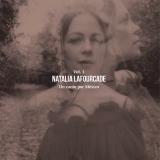
Natalia Lafourcade - Un Canto Por Mexico Vol.1 (2x12")
  • A1: El Balajú / Serenata Huasteca
  • A2: Mexicana Hermosa
  • A3: Veracruz
  • B1: Una Vida
  • B2: Hasta La Raíz
  • B3: Ya No Vivo Por Vivir
  • C1: Mi Religión
  • C2: Para Qué Sufrir
  • C3: Nunca Es Suficiente
  • C4: Sembrando Flores
  • D1: Lo Que Construimos
  • D2: Un Derecho De Nacimiento
  • D3: Mi Tierra Veracruzana
также имеющийся в продаже

VOL. 1 black vinyl


Un Canto por México, Vol. 1 is the eighth studio album by Natalia Lafourcade. The album was part of a project destined for the reconstruction of the Centro de Documentatión del Son Jarocho at Jáltipan de Morelos, a cultural building that was damaged after 2017 Puebla earthquake on 19 September 2017.

The album was a great success and gave Lafourcade three Latin Grammy Awards and the album also won the Best Regional Mexican Music Album at the 63rd Annual Grammy Awards.

Un Canto por México, Vol. 1 is available as a limited edition of 2000 individually numbered copies on yellow vinyl, packaged in a gatefold sleeve, with printed inner sleeves

Сделать предзаказ17.04.2026

он должен быть опубликован на 17.04.2026

Natalia Lafourcade - Un Canto Por Mexico Vol.1 (2x12")

Un Canto por México, Vol. 1 is the eighth studio album by Natalia Lafourcade. The album was part of a project destined for the reconstruction of the Centro de Documentatión del Son Jarocho at Jáltipan de Morelos, a cultural building that was damaged after 2017 Puebla earthquake on 19 September 2017.

The album was a great success and gave Lafourcade three Latin Grammy Awards and the album also won the Best Regional Mexican Music Album at the 63rd Annual Grammy Awards.

Un Canto por México, Vol. 1 is available as a limited edition of 2000 individually numbered copies on yellow vinyl, packaged in a gatefold sleeve, with printed inner sleeves

Сделать предзаказ17.04.2026

он должен быть опубликован на 17.04.2026

Francesco Fabris - Displaces LP

DISPLACES represents Fabris' most personal musical journey to date, inspired by the concept of hyperobjects and cartographic practices. The album sculpts a high-dimensional phased time-space composed of concrete materials and digital archetypes in a state of constant displacement. It delves into the symbolic and philosophical realms of mapping as one of the greatest sense-making mechanisms for life, in dialogue with object-oriented environments, superimposition and non-locality applied to cosmic, temporal, and emotional memory.

The sonic ecosystem expands on the image of navigating a path through a set of places, from the microcosm of quanta to the macro force of dark matter, from underwater depths to overland terrains, encapsulating the cyclical flow between birth and death, both in ecological and anthropological sense. The intersection of these shifting states is explored through the extensive processing of the langspil, Iceland's only traditional instrument, intertwined with manipulated field recordings of biophonies and geophonies captured across Icelandic and Venetian territories. These recordings form the backdrop for a meditative process that relocate familiar objects into unfamiliar realms, reflecting on the transformative power of self-reflection while encapsulating the fragmentation and entanglement found in nature and the human state. The record plunges the listener into a disconcerting and physical soundscape, as a “ghostly spectrality that comes in and out of phase with normalized human spacetime,” evoking sensations of suffocation and release as each layer continuously unfolds the palimpsest of the enclosed labyrinth.

“Extraction of the I” embodies a subatomic reaction—erupting as a molecular force that rises, only to re-submerge with a solitary exhale underwater. In this mutated dark space, beluga whales breathe into "Xanadu Phasing," creating a pulsating tension that releases only to unveil a frozen landscape.

In “Barricading the Ice Sheets” the glacial material morphs into a liquid tunnel of digital artifacts, building a wall of noise that shatters into scattered fragments of ice, resembling bird calls from another world.

A moment of stasis is offered with the appearance of an asymmetrical loop in Monolith I, evoking a primitive rite before an unknown force emerges.

The physical intensity of subsonic material in "A Quake in Being" interrupts the hieratic tone, detuning into polluted sonic matter sourced from relics of the First World War in the Venetian Prealps. The geography of this place reconciles with the original homeland in "The Map is the Territory," blending negative space with anthropogenic elements and exploited sounds of the langspil.

The burning density of "Wolf-Rayet" projects into the void, echoing the residual sounds of a local church as relics of fossilized religions. Wolf tones are the remains in Monolith II, introducing the final track, "Topography of Extinction," where evolving psilocin textures invite the listener to uncover deeper layers of meaning and dislocation.

В наличии на складе

Есть у нас в наличии и готов к отправке

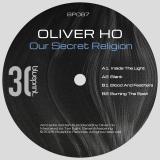
OLIVER HO - OUR SECRET RELIGION

Continuing Blueprint's 30th anniversary celebrations, James Ruskin welcomes the return of Oliver Ho, whose relationship with the label is deep-rooted.

Oliver Ho has spent the last 30 years devoting his life to creating some of the most intense and compelling electronic music out there. Debuting his signature raw sound in 1996 on Blueprint Records, he cemented himself in the underground of the '90s UK techno scene. With a plethora of aliases, he has navigated his way through many different genres. From the frenetic tribal sounds of his own Meta imprint, the off the wall house music made as Birdland and Raudive, the grinding industrial of Broken English Club and the heavily textured ambient of his Slow White Fall and Zov Zov projects. While pushing and pulling at the fringes of electronic music, at the very centre has always been the beating heart of hypnotic techno, an art form that is both brutal and bewitching; techno as ritual magic. Oliver's live shows and DJ sets showcase this expression of music as shamanic experience, metallic and relentless, pure and direct.

An integral figure in shaping Blueprint's early sound, Oliver Ho returned in 2016 for their 20th anniversary with the "Burning Heretics EP", which was followed by a remastered reissue of 1999's "Awakening The Sentient". So it's fitting that he's now back for this latest milestone with a new EP, "Our Secret Religion" dropping in May.

Сделать предзаказ08.05.2026

он должен быть опубликован на 08.05.2026

BAD RELIGION - AGAINST THE GRAIN

BAD RELIGION

AGAINST THE GRAIN

12inch264094
Epitaph Europe
12.11.2025

"Against The Grain" is screechingly released hot on the heels of the previous years punk hit `No Control" which sold so many copies, why not keep the formula untouched? The exuberance of this release is kinda tuff ta" blow off. Contains the superior original version of "21st Century Digital Boy" plus 16 more crucial cuts. A barrage of melodic, hyper-overdrive.

В наличии на складе

Есть у нас в наличии и готов к отправке

UHF (Hieroglyphic Being & Jerzy Maczynski) - Tune IN LP 2x12"

Since 2019, Amsterdam-based curator Pieter Jansen has used his yeyeh label as a vehicle for carefully considered (and sometimes unlikely) ‘first time’ collaborations between different experimental and avant-garde artists including Eversines, Carolina Eyck, Greetje Bijma and Oceanic. After pairing saxophonist/composer/producer Jerzy Maczyński with fellow Polish experimentalist Waclaw Zimpel on 2021 collaborative release Sariani (which was credited to Jerry&ThePelicanSystem in a nod to the former’s earlier album for Warner Music’s Polish Free Jazz series), yeyeh founder Pieter Jansen had an idea. That simple idea – getting Maczyński in the studio with Chicagoan DJ/producer Hieroglyphic Being – was the genesis of this record, the debut album by Universal Harmonies & Frequencies. In June 2022, Hieroglyphic Being flew to Amsterdam to spend five days improvising with Maczyński in a rented studio beneath Volkshotel, under the watchful eye of recording and mix engineer Rein De Sauvage Nolting, better known in electronic music circles for his work as RDS. During those sessions, 26 long, improvised compositions were recorded, with Maczyński contributing saxophones and electronic tools, and Hieroglyphic Being laying down synthesizer parts and vocals. These sessions were captured on film by VLF (Katarzyna Debska), who later created the artwork and visual language for this record release. Some days after the recording sessions, Sauvage Nolting – who had delivered artistic input during the improvisations – sat down with Jansen to select 13 pieces to put forward for the album and a loose conceptual framework. It was then that the hard work began. While a decision was taken to present some improvisations in full, most of what you will hear on Tune IN, as the album is titled, is based on fragments of improvisation. The resultant pieces were reconfigured, re-worked and re-produced by Maczyński and Sauvage Nolting over many months, and in discussion with Hieroglyphic Being. Maczyński added more layers of instrumentation, creating a “whole digital band of reed instruments” – a method he previously utilized on Sariani. What you hear when you play the record defies categorization. It is rooted in a specific moment in time and the spontaneity of musical improvisation – both Maczyński and Hieroglyphic Being are experienced improvisers, albeit with different musical instruments and tools – but also the product of extensive post-production and reflective re-shaping. It is not free-jazz, ambient, electronica, rhythmic cubism (as Hieroglyphic Being’s distinctive sound has previously been called), or avant-garde experimentalism, but something that combines all these musical approaches and more, with a sprinkling of far-sighted futurism mixed in. It is a magical and mystical meeting of musical minds that will pass the test of time in decades to come.

Сделать предзаказ

Этот продукт еще не вышел. Ты можешь сделать предзаказ, как только он появится на складе, продукт будет подготовлен к пересылке.

Richard Rozen - Dialogue for Desires

Richard Rozen - Dialogue for Desires (w/ Tommy Vicari Jnr Remix)
Following the inaugural BF00, Based Faith continues its journey into the religion of the dancefloor
with BF01, Dialogue for Desires, a four-track exploration of energy, groove, and emotion from Richard Rozen, featuring a remix from Tommy Vicari Jnr.
On the A-side, Dialogue with You in My Dreams is an electrifying cut, driven by classic house stabs, rolling vocal chops, and a relentless 909 groove, blending playful energy with forward momentum. Tommy Vicari Jnr strips it back for a transformative, hypnotic remix, carefully deconstructing the original before building into an explosive moment sure to please the discerning dancefloor.
The B-side intensifies with We Are Our Desires, a serious workout drenched in tension and groove, subtly asking: "Is this forever?" Closing out, That Time pulls things inward, offering a deep, minimalistic journey through layered textures, introspective movement - and of course - plenty of cowbell.
This release is a Vinyl only, limited pressing, and there will be no repress-for the believers.

В наличии на складе

Есть у нас в наличии и готов к отправке

Various - A Cellarful Of Motown!… A Northern Soul Love Affair LP
 
16

The title says it all - A Cellarful Of Motown! ..A Northern Soul Love Affair.

West Grand has been set up to mine the deep vaults of mighty Motown courtesy of a licence deal with Universal Music.

The first West Grand LP fuses two musical religions, Motown and Northern Soul.

In some ways they are unlikely bedfellows. Motown became known as Hitsville by churning out hit after hit, while Northern Soul passion is fired by a constant search for the unknown and the obscure.
The 16 tracks here - on incredibly the first Motown various artists vinyl album released worldwide for 40 years - join the dots. All of them were recorded in the 1960s. None of them were released at the time, despite being prime examples of the sublime magic conjured up by Berry Gordy’s genius-like team of singers, writers, producers, arrangers and musicians at that tiny little snakepit of a recording studio on West Grand Boulevard in Detroit.

Motown authority Adam White’s album sleeve notes confirm just how productive that studio was. It often ran 24 hours a day, 7 days a week.
As a result, lots of the most sublime music ever made was somehow rejected for release. It would have stayed unknown and unloved in tape boxes if it had not been for detective work by Soul aficionados turned detectives. That’s Northern Soul power. Many were DJs and collectors tracking down cassette copies or acetates (some of them found in rubbish skips and about to be destroyed). Others, notably Paul Nixon, the founder of the CD series A Cellarful Of Motown! which inspired this album, badgered the Motown gatekeepers so much they were eventually granted access to the forbidden kingdom.

Over recent years all the tracks contained here have been released—some bootlegged, some on legitimate seven-inch issues, some on CD, one download-only. The album proudly boasts debut vinyl release for some in the collection. All have been remastered and have never sounded better.

As a homage to Motown music makers + Rare Soul fanaticism, WEST GRAND believe we have come up with a classic.

В наличии на складе

Есть у нас в наличии и готов к отправке

Minuit Machine - Queendom

Minuit Machine

Queendom

12inchSR0026LPCLR
Synth Religion
24.03.2025

QUEENDOM is an album that marks a new era for the project while staying true to the essence of Minuit Machine. Produced under the SYNTH RELIGION label, this opus immerses us in Amandine's introspective realm, oscillating between darkness and light, between doubt and self-conquest. While retaining the emotional DNA of previous productions, QUEENDOM stands out with a more pop-oriented touch, featuring tracks where Amandine sings in French for the first time.

The first single, "HOLD ME," is a powerful pop anthem addressed to the queer community, celebrating the freedom to be oneself and breaking free from societal and patriarchal norms. This track is a true empowerment statement, with striking electro beats supporting a strong message of emancipation and pride.

"Créatures," a collaboration between RAUMM and Minuit Machine, is a modern fairy tale—a timeless love story that could take place in any era. This salvific love, rarely seen today, embodies a poignant depth and beauty.

Continuing the journey, "Cent Fois"—a French-written track—takes us into a techno-pop universe with nostalgic yet hopeful undertones. This song perfectly reflects Minuit Machine's evolution toward a more radiant approach while staying faithful to its dark heritage.

"Party People," on the other hand, is a return to roots with dark wave/italo sounds. This hypnotic and haunting track questions identity in an increasingly robotic society, where individuals are forced to conform to imposed norms. This exploration of the individual versus the collective lies at the core of Minuit Machine's DNA.

"Mes Souvenirs," created in collaboration with Rebeka Warrior, dives intimately into the memories of Amandine and Rebeka. Together, they reveal fragments of their past—precious and vibrant memories that resonate through powerful and melancholic electro sounds.

Finally, the eponymous track "Queendom" invites us to plunge into the depths of Amandine's world—a universe that is both tormented and icy, yet resilient. Supported by a slow and captivating rhythm, this track is designed to grip and haunt the listener, like an incantation.

QUEENDOM is a bold and hybrid work where each track reflects a pursuit of sincerity and artistic reinvention while maintaining the ability to express emotions through rhythms that are both danceable and introspective. The album showcases Minuit Machine's artistic maturity, establishing itself as a must-listen in the darkwave and electronic pop scene.

Amandine entrusted the artistic direction of this album to Manon Dupeyrat, a brilliant young artist who crafted a bespoke universe perfectly aligned with the produced tracks. The album cover, both intimate and anachronistic, invites listeners into Amandine's private world through her bedroom, revealing what she wishes to share.

В наличии на складе

Есть у нас в наличии и готов к отправке

Roberto Musci - Goodbye Monsters

Roberto Musci

Goodbye Monsters

12inchSOAVE32
SOAVE
29.11.2024

Roberto Musci, born in Milan in 1956, studied guitar, music and electronic instruments. From 1974 to 1985 he traveled the world studying African, Indian, Arabic and Oriental music, recording ethnic music “in the field,” studying and collecting ethnic musical instruments from all over the world. His self-produced debut album, “The Loa of Music,” is a seminal work of staggering originality and extraordinary beauty in which field recordings, musique concrète, electronics, synthesis and instrumentation are interwoven, drawing on the countless musics from around the world that he has recorded. The subsequent “Water messages on desert sand,” composed with Giovanni Venosta, was nominated for a Grammy in the UK in 1987. In the 1980s and 1990s he broadcast ethnic and electronic-experimental music from Rai and Radio Popolare radio stations. He has also composed and played music for videos, commercials, dance, poetry, theater, composed soundtracks and accompanied silent films live. From 1980 to the present, he has played with many Italian and European musicians: Giovanni Venosta, Claudio Gabbiani, Walter Prati, Giorgio Magnanensi, Massimo Cavallaro, Massimo Mariani, Moni Ovadia, Roberto Zorzi, Chris Cutler, Jon Rose David Moss, Steve Piccolo, Elliott Sharp, Keith Tippett and the Third Ear Band.

The theme of travel, ethnicities and mysticism are a pivotal point in this new album of his as well, demonstrating once again how music needs absolutely no sharp lines of demarcation. The music is one.

It goes from the search for deep meanings in a time spent in a Hindu monastery (Ashram) listening to mantras and studying Buddhist philosophy (The Principle Of Things) to space explorations and human settlements on the Moon or Mars wondering how man will live and what he will bring to the new worlds imagining that Sufism, an Islamic mystical religion, will accompany him in the discovery of new worlds (Derviches On Mars). In Goodbye Monsters, harmony and peace are sought. Memories Of A Piano Player is a tribute to Keith Tippett, a great pianist (King Crimson , Centipede, Mujician) with whom he played in several concerts and with whom I spent evenings talking about music, food and Italian wine. Quantum State focuses on how quantum mechanics is creating a revolution in the way of thinking and dividing reality into infinite Parallel Worlds. Panthalassa is the vast ocean that surrounded Pangea and blends South American marimba music and traditional Chinese music. Burn The Shadows is a tribute to the fascinating Indonesian shadow theater, from the stories told and the atmosphere created during the long plays told in the sacred Indian texts of Ramayana or Mahabharata. Shadows are also more or less pleasant memories to which one is attached, and to burn them is still to move on with one's life.

Torajan Funeral Chant: The Toraja are a people living in Sulawesi (Indonesia) who have a special worship of the dead. Funerals are festivals that last several days, the corpses are protected by Tau-Tau (small dolls that watch over cemeteries), and over the years, they exhume the corpses of their relatives and keep them in their homes with them for a time to remember them.

The experimentation goes all the way to modern Artificial Intelligence that 'interrogated' to create something new by inserting conflicting inputs joins them together but nonsensically creating interesting insights; hence A.I. In Confusion. Pangea, named after the continent that contained all the land that emerged between 540 and 200 million years ago, in the Paleozoic and Mesozoic periods, imagined as inhabited by man without divisions created by borders, wars, religions or ethnic groups, is also a tribute to Steve Reich, one of the fathers and a great musician of minimal music. Prophecies, a reading of sacred texts and religious songs from evangelical sects in the United States filtered into granular synthesis with percussion music from South India, closes.

В наличии на складе

Есть у нас в наличии и готов к отправке

Eden Ahbez - Wild Boy: The Lost Songs Of Eden Ahbez LP

“Wild Boy …” is a reissue of the well-known 2016 release curated by Brian Chidester, renowned researcher and biographer of Eden Ahbez. Especially for this album, Brian wrote an interesting text about Abi’s life, which definitely became the decoration of the release.
With the new 2020 re-release, we went a little further and kept what is commonly referred to as studio cuts. It’s a few more minutes in the studio with ahbez himself, full of emotion and life. In addition, to the delight of fans, the edition includes an additional composition Nature Boy (Mantovani Orchestra).
Especially, it is worth noting the outstanding mastering prepared from practically decomposed tapes by the Grammy-nominated Jessica Thompson, which guarantees the deepest and warmth possible sound. Jessica a huge ahbez fan and we’re highly appreciated for what she has done to save his music for the future.
Eden Ahbez is definitely at the origin of psychedelic music and this release can be taken as further proof. Over the past twenty years, the iconic figure of the world’s first hippie Eden ahbez has become famous primarily for his 1948 song “Nature Boy”, praising universal love, and his amazingly solo album from the 1960s called “Eden’s Island” – one from the first concept albums in the history of music and probably the first psychedelic music album. “Wild Boy: The Lost Songs Of Eden Ahbez” deepens understanding of the origins of the psychedelic movement in the 1950s.
The disc contains a musical selection of works by Eden ahbez himself, written by him in the period after Nature Boy. The inclusion of songs such as “Palm Springs” – Ray Anthony Orchestra and “Hey Jacques” by Erta Kitt gives the listener the chance to discover for the first time the little-known recordings of world-famous artists composed by Eden ahbez. Through “Wild Boy” and “Surfer John” you can hear the author’s handling of absurd rock and exotic experimentation, as well as sweet psychedelic pop like Monterey (with Paul Horn on flute). Overall, Wild Boy: The Lost Songs Of Eden Ahbez offers an overview of the lost works of 1949-1971 with seven unpublished recordings and eight rare singles.
If in 2020 you are missing the hallucinogenic content in Eden Ahbez, it amazingly makes up for that deficiency with simple chords, expansive arrangements, and lyrics about travel, relaxation, free love, and spirituality. Thus creating the standard of psychedelic music. Eden Ahbez’s songs weren’t only fantasy and his personal philosophy was the real thing that he lived.

reviews:

“This carefully and extensively researched compilation culls covers by top notch mainstream artists juxtaposed with unreleased Eden recordings. What might sound like a mixed bag is actually more like a chronological, musical non-fiction novel about Eden Ahbez. While Eden was writing hundreds of songs and performing live and making recordings in various styles, his songs were also being picked up by popular artists like Nat King Cole and Eartha Kitt who recorded with a more polished mainstream style. There are also some early rock n roll style recordings here. Eden’s professionally recordings often end up as Novelty Pop records such as “Child of Nature” and “The Clam Man” but if you read between the lines and listen to the lyrics it is pretty eye-opening that he is singing about Eastern-religion-style and pre-hippie philosophies about being at one with the planet Earth.
All of this is explained in the lengthy liner notes inside the lp along with a few choice photos that establish Eden as a founding father of Southern California mystic/psychedelic music.” – Tiki_News
“Eden Ahbez’s life philosophy was summed up in the lyrics of his most famous song, “Nature Boy,” a 1948 hit for Nat King Cole: the song describes a “strange enchanted boy” who wanders the world in search of truth. “The greatest thing you’ll ever learn,” he concludes, “is to love and be loved in return.” Ahbez was a pre-cursor of California’s beatniks and hippies, and an exalted icon of ex-otica via his rare 1960 album Eden’s Island. Beyond “Nature Boy” and Eden’s Island, though, there were nu-merous lesser-known Ahbez record-ings. Ahbez biographer Brian Chidester has been doing an exemplary job of archiving and documenting that catalog of work. The Exotic World of Eden Ahbez (reviewed in UT#38) appeared a few years ago, gathering together 14 Ahbez-related rarities” – Ugly Things

В наличии на складе

Есть у нас в наличии и готов к отправке

Sorrow - Sleep Now Forever 2x12"

Sleep Now Forever is the second and final album released by Sorrow, the post-Strawberry Switchblade group fronted by singer Rose McDowall. Originally released in 1999 and long since deleted it is a cornucopia of pastoral, elegiac folk music, swirling atmospherics, hymnal compositions and above it all the alternating towering and fragile vocal performances of McDowall. Recorded in the late 90s with fellow band member and co-songwriter Robert Lee, Sleep Now Forever is the definitive statement by the now defunct group and Rose McDowall’s most complete long-form work to date.
Released through the group’s own Piski Disk Records, Sleep Now Forever was distributed by World Serpent which struggled through the early 2000s with financial woes, eventually folding due to bankruptcy in 2004. Due to the company’s troubles, Sleep Now Forever was never distributed widely and was a victim of the company’s failure. Released on CD only, original copies are now rare and only traded on second hand channels. Remastered by Mikey Young for a limited vinyl release, Sleep Now Forever will be released on April 20th on double vinyl format, with one side an exclusive etching by Glasgow artist Holly Allan.
Despite its rarity, Sleep Now Forever enjoys a firm cult following. The album’s textures are expansive, lush, deliciously detailed and celestial. Recorded in home study Velvet Hole by Rose McDowall and then-husband Robert Lee, the album enlists an array of players from the underground Neo-folk / industrial scene: Nigel McKernaghan (Uilleann pipes, Whistles), Susan Franknel (Bassoon), John Contreras (Cello) and Lawrence Frankel (Oboe, Cor Anglais). The eleven songs here revolve around McDowall’s instantly recognisable voice. Brought up singing in the Catholic Church, McDowall’s vocals are impeccable and angelic, particularly on tracks like Turn Off The Light where her experiences with religion are canted over soaring oboe and guitar backing. By far the most evolved and realised version of Sorrow’s vision, it feels somewhat criminal that music this beautiful could be lost to time until now.
McDowall’s lyrics throughout Sleep Now Forever deal frankly with mental health, depression, altered states, death and redemption. Wave upon wave of harmony drench each song, McDowal’s vocal multi-tracked and imperious. Opener Soldier benefits from Robert Lee’s use of the studio as instrument, summoning forth a lilting group performance of sparkling guitar and percussion that recalls the Velvet Underground. Mikey Love’s master treats the compositions to brand new frequency dynamics and space. Harmonium and string drones form the counter to McDowall’s vocal on Love Dies, a slow, lurching lament that feels transcendent. On Haunting, the arrangement is orchestral and aching, bleeding into Fear Becomes You, with chord and harmony structure that recalls the baroque sixties pop of West Coast Pop Experimental Art Band or the 60s psychedelic folk movement. A towering, beautiful statement, this elegy for times lost and moonlit-illumination is finally resurfacing from the darkness.

В наличии на складе

Есть у нас в наличии и готов к отправке

Ammar 808 - Super Stambeli

Ammar 808

Super Stambeli

12inchSHK021
Shouka
02.10.2023

At times where technology inexorably infuses into humankind, Ammar808’s next adventures lays within the realms of Stambeli’s invisible creatures, an old genuine Tunisian tradition that has roots spreading out within the depths of the African continent.

Stambeli is a Tunisian musical therapeutic ritual that was implanted by afro-descendant communities. During the ceremonies, music, dance and chants are blended so as for some participants to reach the alternate state of trance while they are possessed by super natural entities. It is a syncretism between Islam and animist Yorisha religion’s voodoo beliefs, that has been disseminated during slave trade by Yoruba populations originating from current Benin’s gulf. Stambeli is a precious legacy the symbolizes the outstanding diversity and complexity of the North-African identity.

Using drum machines and analog synthesizers, he summons super natural creatures to visit our material world and taste human incarnations, form the audience’s collective experience. The album features vocals and gumbri from Bellassan Mihoub, who inherited his father’s knowledge and mastery, and currently embodies the avant-guarde of Stambeli’s revival. Two additional choristers round off the stage band, also playing the krekebs: these are pairs of large castagnet-like instruments oscillating in the limbo between binary and ternary rhythmic patterns. They breathe life and motion into this pagan communion, blessed by VJ Sia original visuals synchronized to the thundering music.

Super Stambeli is a contemporary interpretation of the Stambeli traditional repertoire, processed through a time-travel washing-machine, a parallel-dimension earthquake portal, that aims to echoes ancestral ceremonies through sub-harmonic speakers. It’s a dialogue between the wailing of the gombri, known to call for the spirits to descend into the bodies of the participants, but this time AMMAR808 directs them straight into the digital circuits of his clockwork-crafted machineries.

В наличии на складе

Есть у нас в наличии и готов к отправке

Antonio Neves - A Pegada Agora É Essa (The Sway Now)

repressed !

From samba and bossa nova through to baile funk, with carioca expressions of jazz, rock and hip hop in between, the sound of Rio de Janeiro, while continually evolving, has always held an unnameable quality which reflects the magic and mystique of the city itself. Multi-instrumentalist and arranger Antonio Neves is the city’s newest trailblazer: the enfant-terrible of Rio’s music scene, leading a vital and diverse constellation of both emerging and well-known artists advancing the city’s musical legacy.

“It all started one sleepless night, after watching a Quincy Jones documentary”. Inspired by the legendary music magnate, Neves began writing a list of artists residing in Rio de Janeiro “people that I admire, that I consider geniuses of their instruments, who share with me affinities, anxieties and projects.” The list included some of Brazil’s most revered living musicians who Neves has worked with in recent years: Hamilton de Holanda, Leo Gandelman and Dorival Caymmi. Neves also called on some of Brazil's most exciting emerging talents including Alice Cayymii and Ana Frango Eletrico.

A Pegada Agora É Essa (The Sway Now) is Neves’ second album: a vibrant portrait of the current Brazilian music scene. From the regional to universal, popular to erudite, samba to rap, Latin rhythms to jazz, MPB and pop to good old rock'n'roll, Neves walks with fluency and mastery amongst all the musical genres that Brazil has to offer.

“My offer to the musicians was complete freedom to express themselves through the songs I proposed – classics like “Summertime”, “Luz Negra” and “Noite de Temporal”, and compositions of my own – creating a space of authorship for the band and the guests. A space for inventions, purges, delusions, laughter. The idea was to bring the freedom of jazz crossed by Brazilian rhythms, such as the traditionals Partido Alto (A Pegada Agora É Essa) and Jongo (Jongo no Feudo and Luz Negra); rhythms of African-Brazilian religions like Candomblé (Noite de Temporal) and Umbanda (Forte Apache); and a tribute to newest Rio de Janeiro’s contribution to Brazilian music, the Funk Carioca (Simba)”.

Coming from a musical family, Antonio’s father, Eduardo Neves, was a renowned conductor and a professor at Juilliard School of Music and the California Jazz Conservatory. In the bohemian neighbourhood of Lapa, aged 14, Antonio began his career as a drummer, before experimenting with brass. He would soon become a skilled trombonist and arranger achieving the recognition of his teachers and peers. It wasn’t long before he would be playing with some of the biggest names in Brazilian music, such as Hamilton de Holanda, Leo Gandelman, Moreno Veloso, Kassin and Elza Soares.

His debut album as a trombonist was PA7 (2017, Rock It), released at the same time he was travelling the world playing with artists like Moreno Veloso, Kassin and Leo Gandelman, and recording the albums Jobim, Orquestra e Convidados (2017, Biscoito Fino), with Mário Adnet and Paulo Jobim; and Elza Soares Canta e Chora Lupi (2017, Coqueiro Verde Records). More recently, Neves was the arranger for the acclaimed Little Electric Chicken Heart album, by Ana Frango Elétrico, which has been nominated for a Latin Grammy and voted 2019’s ‘Brazilian Music Revelation’ by The Art Critics Association of São Paulo.

В наличии на складе

Есть у нас в наличии и готов к отправке

Mohammed After Hussain & PAQ - Matir Gaan: Songs From The Earth LP

Matir Gaan is a collaboration between young Bengali migrant, Mohammed After Hussain and Italian electronic artist, Andrea Rusconi (aka Paq). The resulting album delightfully combines the ancient folk songs of Md After's homeland with Paq's cosmic synth exotica.

Mohammed After Hussain escaped Bangladesh in 2015 and arrived in Italy in 2017 after a long and dangerous journey across the Mediterranean from the violence he found in Libya. In Italy he found safety and hospitality as an asylum seeker in Rimini's Associazione Ardea, where Andrea is involved with 'Ardea Recordings' - a project aiming to create an archive of songs, stories and sounds by some of the people who spent some time with Ardea's refugee programme.

Md After was invited to sing and play the folk and village songs he knew on the harmonium and pakhawaj (two headed drum) while Andrea immersed himself in the songs providing a bed of warm Crumar synth and Veena drones to create a finished album of totally uniquela renditions of the mystic Baul folk songs known so well by people across the Bangla speaking regions of India.

The Bauls are a famous group of wandering minstrels from the region of Bengal whose culture is derived from the teachings of the early Sufi mystics and Hindu Fakhirs. The Baul devotees are considered to be mad, or possessed, with the love of God. While transcending religion the Baul compositions celebrate celestial and earthly love and expound the key philosophy of “Deha tatta” or truth in the body, epitomised by the aphorism “whatever is in the universe is in the body”. They reach for divinity here in this world and they seek to access it through music and dance. They seek spirituality in the music, they live fo r the music, wandering from village to village offering ecstatic sound waves in exchange for sustenance. Their presence remains an important part of village life in Bangladesh, and this is why Md After knows the songs despite the fact he would not consider himself part of the Baul ascetic tradition.

We hope you'll enjoy this wonderfully psychedelic album, with its unique interpretations of these ancient mystic songs from the earth.

Comes with a printed inner sleeve featuring sleeve notes and lyric translations by Brian P. Heilman

В наличии на складе

Есть у нас в наличии и готов к отправке

Shkoon - Rima 2x12"

Shkoon

Rima 2x12"

2x12inchSHKOONLP001
> Germany
09.12.2019

German-Syrian band Shkoon will release their long-awaited debut album “Rima”, sending out a message of cultural diversity to the world. Shkoon’s concerts have attracted a diverse audience for many years, bringing together people of all religions, colors and backgrounds. For their album-tour through Germany and Switzerland, stops in Berlin, Hamburg, Cologne, Munich and Zurich are planned.

Musically, the album is situated between influences of electronic downbeat, deep house, dub and hip-hop. The band members come from a variety of different musical backgrounds and have created their very own sound with a mix of influences between the Arabic and Western world. Piano, violin, synthesizers, percussion and vocals merge oriental melodies with western electronic beats, taking the listener on a journey that blurs the boundaries of cultures.

Shkoon is more than a German-Syrian live act with Arabic lyrics. In addition to their own lyrics, the band uses traditional musical folklore elements of the Arab community, which today appear more relevant than ever. The title song of the debut album is inspired by a story from Arabic folklore, in which a mother tells peaceful tales to her child as the world sinks into chaos. This song is accompanied by the singer and rapper Tareq Abu Kwaik, also known as "El Far3i", by the band
47Soul.

After the war in their home country drove the two Syrians to relocate to Germany, Ameen, Thorben and Maher met in the hanseatic city of Hamburg in 2015. During a spontaneous jam session, an unexpected energy and thus the project Shkoon emerged, which was soon followed by the release of the band’s very first EP a few months later.

During the first performances of Shkoon, a spark quickly jumped over to the audience, which soon allowed the group to play major festival stages all over Europe. Even as Shkoon’s musical expression knows no boundaries, it is not easy for the band to travel other countries, as Ameen (the vocalist) and Maher (the violinist) consistently face difficulties of getting visa documents due to their refugee status.

This is particularly lamented in Arab countries, where the band has long been celebrated as stars, for example when they played a sold-out show in Beirut for an audience of more than 3,000 people. But also in Europe, especially in Germany, there is immense enthusiasm in their fans-base is huge.

В наличии на складе

Есть у нас в наличии и готов к отправке

Powerwolf - Wildlive (Live at Olympiahalle) LP 2x12"

POWERWOLF strenghten their exceptional position at the forefront of heavy metal with Wildlive (Live at Olympiahalle), out February 27, 2026, via Napalm Records. Recorded
during the breathtaking sold out show of their Wolfsnächte Tour 2024 in Munich, this is not just a live album – it is a grandiose cinematic experience. Wildlive documents POWERWOLF’s unrelenting rise to the top, showcasing a performance that goes far beyond a metal concert. A cult-like celebration of art, with each song visually reimagined with a changing digital stage set, timed effects, and theatrical elements, Wildlive proves that what POWERWOLF create is beyond music – it is religion.

Сделать предзаказ06.03.2026

он должен быть опубликован на 06.03.2026

Story of the Year - A.R.S.O.N. LP
  • Gasoline (All Rage Still Only Numb)
  • Disconnected
  • See Through
  • Fall Away
  • 3: Am
  • Into The Dark
  • My Religion
  • Halos
  • Good For Me/Feel So Bad
  • Better Than High
  • I Don't Wanna Feel Like This Anymore

Story Of The Year haben seit ihrem Debütalbum »Page Avenue« – einem der ersten Alben dieser Art, das sich 2003 eine Million Mal verkaufte – die Post-Hardcore-Szene maßgeblich geprägt, und das Quartett aus St. Louis ist im Laufe der Jahre nur noch beeindruckender geworden. Fans haben die Band auf Tour mit Linkin Park, My Chemical Romance und Deftones gesehen, sowie bei ihren Auftritten auf der Warped Tour und beim Festival When We Were Young und vielen anderen.

Сделать предзаказ13.02.2026

он должен быть опубликован на 13.02.2026

NOFX - LIBERAL ANIMATION

The classic 1988 NOFX album, available on vinyl. First time pressed in Europe on black and colored vinyl. Recorded in 88 by Brett Gurewitz in 3 days at west beach recorders. We we"re all stoked cause we got to meet Brett from bad religion. He asked us if we wanted to put the record out on epitaph, but we wanted to put it out ourselves. What a mistake. It took almost a year to sell 1500 copies at 4 bucks a piece, and we only got paid for half. We ended up giving the record to epitaph like 5 years later with a new cover. I wouldn"t say this record sucks, but it"s still pretty hard to listen to.

Сделать предзаказ06.02.2026

он должен быть опубликован на 06.02.2026

NOFX - LIBERAL ANIMATION
  • Shutup Already
  • Freedumb
  • Here Comes The Neighborhood
  • A 200: Club
  • Sloppy English
  • You Put Your Chocolate In My Peanut Butter
  • Mr. Jonesside B
  • Vegetarian Mumbo Jumbo
  • Beer Bong
  • Piece
  • I Live In A Cake
  • No Problems
  • On The Rag
  • Truck Stop Blues
также имеющийся в продаже

GREEN COLOURED Vinyl


The classic 1988 NOFX album, available on vinyl. First time pressed in Europe on black and colored vinyl. Recorded in 88 by Brett Gurewitz in 3 days at west beach recorders. We we"re all stoked cause we got to meet Brett from bad religion. He asked us if we wanted to put the record out on epitaph, but we wanted to put it out ourselves. What a mistake. It took almost a year to sell 1500 copies at 4 bucks a piece, and we only got paid for half. We ended up giving the record to epitaph like 5 years later with a new cover. I wouldn"t say this record sucks, but it"s still pretty hard to listen to.

Сделать предзаказ06.02.2026

он должен быть опубликован на 06.02.2026

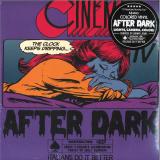
Various Artists - After Dark 4
  • A1: Wolfram Feat Desire – Sad Ibiza Song
  • A2: Orion – Call A Psychic
  • A3: Mothermary – Coming For You (Nicolaas Remix)
  • A4: Double Mixte – Chateau D'eau
  • B1: Love Object – Epicurus
  • B2: The Operator – Danser
  • B3: Talvi - The Day We Met Never Ended For Me
  • B4: Kid Moxie & Nina* – Waiting For Tonight
  • C1: Farah – Losing My Religion
  • C2: Sally Shapiro – Moonlight Dance (Tommy '86 Remix)
  • C3: Glüme – Dangerous Blue
  • C4: Cigar Cigarette – Come Correct
  • D1: Desire – Silver Machine
  • D2: Causeway – I'm Falling Apart
  • D3: Esper Star – Boys Of Summer
  • D4: Juno Francis – Romantica
  • E1: Sally Shapiro – Purple Colored Sky
  • E2: Club Intl Feat Logan Avidan – Hazel Eyes
  • E3: Mesh Kimono – Afterburn
  • E4: Dlina Volny – Saturday
  • F1: Annie-Claude Deschênes – Electric Light
  • F2: Cameron Romance – Meet You On The Other Side
  • F3: Joon – I Think They Call It Love
  • F4: Lovelock Feat Orion – Riders On Dark Horses
  • F6: Pynkie & Social Media – Zoom
  • F7: Body Double – Telescope
  • F5: Double Mixte – Am I A Fool To Love You

15 years since their fantasy disco scene-defining 1st volume, Johnny Jewel’s IDIB lasso Sally Shapiro, Desire, Farah, Lovelock and the kreme of their field for a 27-song, 2-hour re-up


Where previous volumes took their sweet time to arrive, ‘Volume 4’ graces the ‘floor only two years since the last, and nobody’s complaining. From its slo-mo, dry-iced covers of Jennifer Lopez’ ‘Waiting For Tonight’, Don Henley’s ’Boys of Summer’ and even flipping R.E.M.’s ‘Losing My Religion’, thru to exclusive pearls by our disco queen crush, Sally Shapiro, and Johnny Jewel as Desire, it’s the ideal soundtrack for late summer into silly season.

нет на складе

Закажите сейчас, и мы закажем товар для вас у нашего поставщика.


Последний логин: 4 мес. назад
A.O.A / Oi Polloi - Unlimited Genocide LP
  • 1: A.o.a - Murder In The Woods
  • 2: A.o.a - For Those Who Suffered
  • 3: A.o.a - All Our Anger
  • 4: A.o.a - Death On A Plate
  • 5: A.o.a - Holy Hypocrisy
  • 6: A.o.a - O.s.a
  • 7: A.o.a - Aftermath
  • 8: Oi Polloi - Go Green
  • 9: Oi Polloi - You Cough/They Profit
  • 10: Oi Polloi - Punx Or Mice
  • 11: Oi Polloi - Nuclear Waste
  • 12: Oi Polloi - The Only Release
  • 13: Oi Polloi - Apartheid Stinx

Nearly 40 years ago A.O.A. and OI POLLOI joined forces to condemn what they saw as an Unlimited Genocide. Fast forward to 2025 and nothing has changed for the better, with everybody witnessing a genocide unfolding in front of our eyes daily, while humanity hits rocks bottom. So Sealed Record decided it was the right time to bring back this classic slice of Scottish punks and skins protest music.
Originally released on the ever impressive Children of the Revolution Records Unlimited Genocide features the hardest side of the OI POLLOI vast catalogue. Full of rage and anger, tensely tuneful with earnest anarcho conviction. With A.O.A. On the flip side delivering seven tracks of full in your face hardcore punk, carrying the torch of the DISCHARGE influenced thrash of the era.
The record has a strong 80’s production and touches on green and environmental issues, apartheid, nuclear power, religion, vegetarianism and much more. It’s raw, direct and a great snapshot of an era that is often mimicked but never bettered.
This reissue has been remastered and includes a printed inner sleeve as well as a slightly altered artwork.

Сделать предзаказ16.01.2026

он должен быть опубликован на 16.01.2026

CHRIS BACON - HERETIC (ORIGINAL SOUNDTRACK) LP 2x12"
  • Opening
  • Sisters
  • Polygamy
  • One True Religion
  • Trapped
  • Two Doors
  • Stairs
  • Lesson In Theology
  • Dis/Belief
  • Choosing Belief
  • The Prophet
  • 2: Doorbell
  • I Can Show You God
  • Not A Miracle
  • Hatch
  • Control
  • Run!
  • Pray For Us
  • Butterfly
  • The Air That I Breathe (The Hollies)
  • Creep (Radiohead)
  • Knockin On Heaven's Door (Sophie Thatcher)
Сделать предзаказ09.01.2026

он должен быть опубликован на 09.01.2026

ROME - The Hierophant LP

ROME

The Hierophant LP

12inchTRI843LP
TRISOL MUSIC GROUP
Release unknown
  • A1: Secret Harbour
  • A2: The Harvest Is Not Here
  • A3: Days Of Assembly
  • A4: On Sorrow’s Embankment
  • A5: The Chalice And The Blade
  • B1: When Light Be Gone
  • B2: The Great White Hopeless
  • B3: My Frail Ambassador
  • B4: The Gods Are Slow To Forgive
  • B2: Apollo Of Hyperborea

At the end of the project’s 20th anniversary celebrations, ROME tolls in the next era of the band with two fresh and visionary albums: ‘The Hierophant’ and ‘The Tower’. Whatever the great poets have affirmed in their finest moments is the nearest we can come to an authoritative religion or truth. It is in this spirit that ROME welcomes the listener into the temple of ‘The Hierophant’, ROME’s final album of its second decade of existence.

‘The Hierophant’ represents the enigmatic accompanying piece to the more introspective and seclusive recent work (of ‘The Tower’). Starting its journey during ‘Days of Assembly’, from the opening ‘Secret Harbour’ along ‘On Sorrow's Embankment’ to its logical finale in the mythical North with ‘Apollo of Hyperborea’, ‘The Hierophant’ is a spiritual travelogue seeking out the word and world of this ‘My Frail Ambassador’, the proclaimer of the sacred truce, interpreter of the ancestral laws and our guiding light through these darkened times.

Сделать предзаказ

Этот продукт еще не вышел. Ты можешь сделать предзаказ, как только он появится на складе, продукт будет подготовлен к пересылке.

Johnny Flynn - A Larum (2x12")
  • 1: The Box
  • 2: The Wrote & The Writ
  • 3: Tickle Me Pink
  • 4: Brown Trout Blues
  • 5: Eyeless
  • 6: In Holloway
  • 7: Shore To Shore
  • 8: Cold Bread
  • 9: Wayne Rooney
  • 10: Leftovers
  • 11: Sally
  • Hong
  • Kong Cemetry
  • Tunnels
  • All The Dogs Are Lying Down
  • Shore To Shore (Reprise)

A Larum, the debut album by singer and actor Johnny Flynn, was recorded in Seattle and is one of those rare albums that immediately creates its own world - Originally released on Vertigo Records in May 2008, this re-issue faithfully replicates the original 2LP release's pop up gatefold sleeve and is pressed on 180g vinyl Backed by his band The Sussex Wit, the album's songs were likened to the work of Fairport Convention and Bert Jansch by Rolling Stone.

Flynn has been described as "a musical prodigy turned Shakespearean actor, with the soul of a poet," and his songs offer a sweet gentility in an increasingly loud time. Close mic'ed and intimate, Flynn cast his eye over romance, religion and celebrity. A Larum became something of a beacon for the burgeoning folk scene at the time, with fellow travellers such as Mumford & Sons, Laura Marling and Noah and the Whale. Since A Larum, Flynn has carved out a singular path as both a critically acclaimed musician and award- winning actor. He has released a string of celebrated albums including Been Listening, Country Mile, and Sillion, continually evolving his sound while maintaining his signature storytelling. As an actor, he's earned accolades for roles on stage and screen, notably portraying David Bowie in Stardust and starring in films like Emma (2020) and Netflix's The Dig. He also composed and performed the beloved theme song for the BAFTA-winning series Detectorists, where his evocative music became inseparable from the show's gentle, melancholic charm. ...

Сделать предзаказ19.12.2025

он должен быть опубликован на 19.12.2025

FRACTION - MOON BLOOD LP

FRACTION

MOON BLOOD LP

12inchEZRDR169LP
Riding Easy
05.12.2025

US Black Friday 2025 Release. There are very few albums in the psych/punk/hard rock/private presses strata that garner the sort of universal awe and accolades that Fraction’s almighty Moonblood LP does, and even fewer records in the world that could be dubbed ‘Christian Rock’ incur such fierce devotion. Indeed some records just meteorically lift themselves out any genre tag with brilliance and sheer defiance--and Moonblood is surely one of them. Based in LA, Fraction was a ragged collection of working-class musicians--the line-up was ringleader Jim Beach--vocals; Don Swanson--lead guitar, Curt Swanson--drums, Victor Hemme--bass, and Robert Meinel--rhythm guitar. Beach himself describes those early days: “The guys met through various acquaintances that we had in LA. All of us had been in bands before, but were seeking something with more teeth. We had a small studio in an industrial complex in North Hollywood and started practicing sometimes as early as 4:30 AM. We all had day jobs, so we did what we could.”

Amazingly the recording sessions for the album were recorded similarly on the fly, as Beach further states: “The Moonblood recording took place at Whitney’s Studio in Glendale, CA, early in 1971. On a strict budget, these songs were recorded in less than three hours—all of them “one takes.” We played, all 5 of us, simultaneously-- there were no studio effects, no overdubbing or any additional sound effects added. Basically what you hear is considered ‘old school’ recording.”

This workmanlike description in no way prepares one for the pure tortured genius the session wrought. Particularly noteworthy is Beach’s vocals—as commonly stated, the spirit of Jim Morrison is conjured in his deep baritone, which gives way to unparalleled pained howls, at times bathed in delay which trails into the abyss. Fascinatingly enough, Beach cites the much punker Love as his fave LA band over the Doors, and also gives influence-nods to proto-everything rockers The Yardbirds and to Dylan, whose dark word tapestries surely inspired Beach’s lyrics (though lines from The Doors’ “L’America” pop up on the LP) Whatever the case, the man clearly has a vision, as even the stark sleeve concept is Beach’s own. Equally as integral to the Fraction sound is lead guitarist Don Swanson—his blown-out fuzz riffs set a template for what is now commonly known as “stoner rock” or “acid punk,” and his solos consist of jagged, wah-wah-ed shards of notes, with his amplifier clearly pushed to the limit.

Beach says: “Don’s guitar was always my driving force and he did everything he could to keep it over the top. You’d never know that (his sound) was coming from an old, broken down Esquire. Don kept it alive!” The other members contributions shouldn’t be underappreciated though-- drummer Curt Swanson keeps things at a constant simmer, and then boils over when the whole band launches into snarling glory. The band and LP as a whole equals something indescribably intense from start to finish—comparisons to the Detroit late 60s high-energy bands like The Stooges and MC5 abound, as well as the sort of late 60s damaged spirit lurking in biker clubs and disgruntled Vietnam vets. The song cycle on side 1 of the LP in particular cuts to the emotional core, with severely charged dark lyrics like “Extend your thumbs and burn the darkness out of her.” Which brings us to the Christian aspect--it often can confuse listeners. The Fraction/Beach world of religion is complex and perhaps a bit pagan/sinister than most---fire and brimstone, temptation, and the truth-seeker being burned by this hell on earth—or perhaps as Beach himself best put it: “Speaking for myself, as a believer, it’s been a progressive experience since my childhood.

I think we’re all basically driven to live more than religion.” The album was pressed in a run of but a few hundred to little attention in the day, but now inferior bootlegs flood the marketplace, and originals of Moonblood command thousands of dollars. So enjoy this all-inclusive reissue, which also features for the first time on vinyl, 3 lost tracks-- like the more acoustic-minded “prisms” and “dawning light,” as well as the proto-metal choogle of “Intercessor’s Blues.”

Сделать предзаказ05.12.2025

он должен быть опубликован на 05.12.2025

BAD RELIGION - SUFFER

Bad Religion

SUFFER

12inch64041
Epitaph Europe
14.11.2025
  • You Are(The Government)
  • 1000: More Fools
  • How Much Is Enough?
  • When?
  • Give You Nothing
  • Land Of Competition
  • Forbidden Beat
  • Best For You
  • Suffer
  • Delirium Of Disorder
  • Part Ii(The Numbers Game)
  • What Can You Do?
  • Do What You Want
  • Part Iv(The Index Fossil)
  • Pessimistic Lines

Obwohl "Suffer" lediglich eine Laufzeit von 26 Minuten hat, war die Platte für Fat Mike, den Sänger und Bassisten von NoFX, in Bezug auf das amerikanische Punk-Revival der Neunziger "das Album, das alles veränderte". Tatsächlich bedeutete der dritte Langspieler der Band 1988 nicht nur den internationalen Szenedurchbruch für Bad Religion, er schuf auch die Grundlage für den massiven Erfolg des Epitaph-Labels, das mit The Offspring, NoFX, Rancid und Pennywise just jene Gruppen unter Vertrag nahm, die in den Neunzigern mit Melodic Hardcore, Pop-Punk und Skatepunk für Furore sorgten. "Suffer" bot für die damalige Zeit etwas völlig Neues: Schnelle, aber sehr melodische Songs mit mehrstimmigen Gesängen und Hintergrundchören sowie abrupte Rhythmuswechsel; hinzu kamen der klare Gesang Greg Graffins, der durch eine exakte Aussprache und Metrik gekennzeichnet ist, sowie intellektuell inspirierte Lyrics. Bad Religion spielten die 15 Songs von "Suffer" in der Originalbesetzung - Greg Graffin (Gesang), Brett Gurewitz (Gitarre), Greg Hetson (Gitarre), Jay Bentley (Bass), Pete Finestone (Schlagzeug) - im April 1988 im Westbeach Recorders-Studio in Hollywood ein. Das Album wurde von Brett Gurewitz und Donnell Cameron in acht Tagen aufgenommen und gemixt.

Сделать предзаказ14.11.2025

он должен быть опубликован на 14.11.2025

BAD RELIGION - CHRISTMAS SONGS

BAD RELIGION

CHRISTMAS SONGS

12inchCCS872761
Epitaph Europe
14.11.2025
  • Hark! The Herald Angels Sing
  • O Come All Ye Faithful
  • O Come, O Come Emmanuel
  • White Christmas
  • Little Drummer Boy
  • God Rest Ye Merry Gentlemen
  • What Child Is This?
  • Angels We Have Heard On High
  • American Jesus (Andy Wallace Mix)
также имеющийся в продаже

BLACK VINYL WITH ETCHED B-SIDE


Who better to help you celebrate that most wonderful time of the year than holiday favorites Bad Religion? Tackling eight chestnuts in their classic punk rock style. From "White Christmas" with its nod to pioneers The Ramones, to the glorious choirboy intro to "Hark! The Herald Angels Sing," Christmas Songs is the record you need to get your holiday household"s toes tapping. First time ever double sided, 45 RPM.

Сделать предзаказ14.11.2025

он должен быть опубликован на 14.11.2025

SISTER IRENE O'CONNOR - FIRE OF GOD'S LOV
  • Fire (Luke 12:49)
  • Nature Is A Song
  • Springtime (In Australia)
  • Mass-Emmanuel
  • Messe Du Saint Esprit
  • Light (John 8:12)
  • O Brother (Matt. 7:1-5)
  • Mary Was Here
  • Teenager's Chorus
  • O Great Mystery (John 6)
  • Christ Our King (Col. 1:13)
  • Keshukoran
также имеющийся в продаже

FIRE VINYL


Fire of God's Love ist das legendäre Album der australischen Nonne Schwester Irene O'Connor aus dem Jahr 1973 - eine aufrichtige, gefühlvolle und unbewusst psychedelische Songfolge, die der Selbstreflexion und dem Erwachen des inneren Geistes gewidmet ist. Das Album ist eine Sammlung von originellen spirituellen Folksongs, die von O'Connor geschrieben und mit Gitarre, E-Orgel, Drumcomputer und ihrer engelsgleichen Stimme interpretiert wurden. Es wurde von ihrer Mitschwester und Toningenieurin Sister Marimil Lobregat auf erstaunlich futuristische Weise aufgenommen und abgemischt. Freedom To Spend bietet die erste autorisierte Neuauflage dieses heiligen Grals seit 1976; das Album wurde mit Sorgfalt und Bedacht aus den besten verfügbaren Quellen restauriert und remastered. Als junge römisch-katholische Nonne im Orden der Franziskanerinnen von Maria begann Schwester Irene 1953 ihre musikalischen Aktivitäten, als sie von Sydney in ein Kloster in Singapur zog und begann, Kinder mit Lernschwierigkeiten zu unterrichten. Nachdem sie sich eine Akustikgitarre zugelegt und drei einfache Akkorde gelernt hatte, blühten Irenes Lieder dank der Begeisterung der Kinder auf. Durch einen glücklichen Zufall arbeitete ein Elternteil eines Schülers bei einem kommerziellen Radiosender in Singapur, und Irene wurde eingeladen, im Studio des Senders aufzutreten und aufzunehmen. Sie ging hin, trug ihre Ordenstracht und hatte ihre Gitarre dabei, und nahm dort 1965 ihren ersten eigenen Song auf. Unter dem Pseudonym Myiriam Frances, um innerhalb ihres Ordens anonym zu bleiben (,Nonnen machten so etwas nicht", bemerkte O'Connor), veröffentlichte Phillips Ende der 1960er Jahre eine Reihe von Platten von Schwester Irene. Im Kloster in Singapur lernte Schwester Irene Schwester Marimil Lobregat kennen, eine Mitbrüderin aus dem Franziskanerorden, die Anfang der 1960er Jahre von den Philippinen auf die Insel gezogen war. Mehr als ein Jahrzehnt später trafen sie sich, wie durch göttliche Fügung, in einem anderen Kloster in Point Piper in Sydney wieder. Marimil, ebenfalls Musikerin und Klangenthusiastin, arbeitete als Audio- und Videotechnikerin beim Catholic Radio and Television Centre in Homebush im Westen Sydneys. Schwester Irene, die treu an ihren musikalischen Fähigkeiten feilte, und Schwester Marimil schmiedeten den Plan, sich an mehreren Sonntagnachmittagen im Zentrum zu treffen und die Lieder zu komponieren, die später auf ,Fire of God's Love" erscheinen sollten. Die Lieder von ,Fire of God's Love" werden von Schwester Irene mit ihrer engelsgleichen Sopranstimme gesungen (mit Texten in Englisch, Latein und Malaiisch) und von Schwester Marimil produziert und auf einem Teac 3340S 4-Spur-Tonbandgerät aufgenommen. Marimil trug maßgeblich dazu bei, die unheimliche Jenseitigkeit zu zaubern, die das Album durchzieht. Die kristallklare Stimme von Schwester Irene wird exquisit von einem schimmernden Mosaik aus Hall und analogen Synthesizer-Klängen umhüllt, während sie wie eine Glocke in der Dunkelheit erklingt und so lange nachhallt, bis die Wahrheit oder das Göttliche erscheint. Themen wie Barmherzigkeit, Gnade, Licht und Geheimnis werden von sanften Akustikgitarrenklängen und ewigen Pianotönen untermalt, die sich langsam auf vibrierenden Fäden drehen. Bei den Songs mit Keyboards spielte Schwester Irene alle Parts live in Echtzeit, einschließlich der Basspedale. Die Drum Machine wurde von derselben Orgel erzeugt, die sie spielte, und gleichzeitig ausgeführt. All dies trägt zu einer Atmosphäre erhöhter Präsenz bei, einem organischen Blitz, der tief aus dem Unterbewusstsein kommt. Entstanden aus Ideen, die in einem ruhigen Kloster und abgeschieden von weltlichen Einflüssen entstanden sind, wird der liturgische Rahmen des Albums durch die innige Hingabe zweier Schwestern gefiltert - ihre eigene Interpretation von Popmusik, befreit von Anmaßung und oberflächlichem Glamour. Der Titel des Albums stammt, wie viele seiner Songs, aus einem Bibelvers, in diesem Fall Lukas 12:49. Aber Schwester Irene und Schwester Marimil haben ihn in einen Raum gebracht, in dem alle spirituell Suchenden die Übertragung oder: ungewöhnliche Hermeneutik schätzen können. Die Texte sprechen universelle Bedürfnisse, Wünsche und Sehnsüchte an: ewige Liebe und Zuneigung, ein Ende der Einsamkeit, eine neue Form der Erleichterung, Befreiung von der Angst vor dem Tod. Anstelle von Hymnenformeln bedient sich Schwester Irene, vielleicht unbeabsichtigt, der damals modischen Folk- und Psychedelic-Musik, um eine Predigt zu halten, die sich wie Liebesbriefe an eine göttliche Präsenz liest und über jede formale Religion hinaus zur Seele spricht. ,Fire of God's Love" ist ein inspirierendes Archiv früher elektronischer Experimente zwischen zwei befreundeten Frauen und Mystikerinnen, eine Dokumentation ihrer göttlichen Energie, die auf disziplinierte Weise kanalisiert wurde. Bei seiner Erstveröffentlichung war es weder ein durchschlagender Erfolg noch ein Misserfolg, sondern wurde vor allem mit Neugierde aufgenommen. Die beiden haben nie wieder gemeinsam Musik gemacht, und in den 50 Jahren seitdem zieht ihre einmalige Zusammenarbeit weiterhin Zuhörer an, die sie in Plattenläden entdecken (sei es die Originalpressung von Phillips oder die klanglich überlegene Neuauflage von 1976 bei Alba House Communications) oder eher über YouTube, als zufällig entdeckter und heiß diskutierter Kultklassiker. Heute lebt Schwester Irene in Sydney, Australien, und freut sich, dass ein neues Publikum in ihrer Musik mit Schwester Marimil einen Sinn findet. Ihre Geschichte ist ein Beweis dafür, dass man nicht viel braucht, um ein visionäres, zeitloses Album zu schaffen: ein Tonbandgerät, Freundschaft und ,The Fire of God's Love", um den Weg in die Zukunft zu ebnen. Das kann ein spiritueller Freund sein oder ein irdischer Begleiter direkt neben einem. Sister Irene O'Connors ,Fire of God's Love" wird am 14. November über Freedom To Spend auf Vinyl, CD und als digitale Ausgabe veröffentlicht.

Сделать предзаказ14.11.2025

он должен быть опубликован на 14.11.2025

SISTER IRENE O'CONNOR - FIRE OF GOD'S LOV

SISTER IRENE O'CONNOR

FIRE OF GOD'S LOV

12inchFTSLPC134
Freedom to Spend
14.11.2025

Fire of God's Love ist das legendäre Album der australischen Nonne Schwester Irene O'Connor aus dem Jahr 1973 - eine aufrichtige, gefühlvolle und unbewusst psychedelische Songfolge, die der Selbstreflexion und dem Erwachen des inneren Geistes gewidmet ist. Das Album ist eine Sammlung von originellen spirituellen Folksongs, die von O'Connor geschrieben und mit Gitarre, E-Orgel, Drumcomputer und ihrer engelsgleichen Stimme interpretiert wurden. Es wurde von ihrer Mitschwester und Toningenieurin Sister Marimil Lobregat auf erstaunlich futuristische Weise aufgenommen und abgemischt. Freedom To Spend bietet die erste autorisierte Neuauflage dieses heiligen Grals seit 1976; das Album wurde mit Sorgfalt und Bedacht aus den besten verfügbaren Quellen restauriert und remastered. Als junge römisch-katholische Nonne im Orden der Franziskanerinnen von Maria begann Schwester Irene 1953 ihre musikalischen Aktivitäten, als sie von Sydney in ein Kloster in Singapur zog und begann, Kinder mit Lernschwierigkeiten zu unterrichten. Nachdem sie sich eine Akustikgitarre zugelegt und drei einfache Akkorde gelernt hatte, blühten Irenes Lieder dank der Begeisterung der Kinder auf. Durch einen glücklichen Zufall arbeitete ein Elternteil eines Schülers bei einem kommerziellen Radiosender in Singapur, und Irene wurde eingeladen, im Studio des Senders aufzutreten und aufzunehmen. Sie ging hin, trug ihre Ordenstracht und hatte ihre Gitarre dabei, und nahm dort 1965 ihren ersten eigenen Song auf. Unter dem Pseudonym Myiriam Frances, um innerhalb ihres Ordens anonym zu bleiben (,Nonnen machten so etwas nicht", bemerkte O'Connor), veröffentlichte Phillips Ende der 1960er Jahre eine Reihe von Platten von Schwester Irene. Im Kloster in Singapur lernte Schwester Irene Schwester Marimil Lobregat kennen, eine Mitbrüderin aus dem Franziskanerorden, die Anfang der 1960er Jahre von den Philippinen auf die Insel gezogen war. Mehr als ein Jahrzehnt später trafen sie sich, wie durch göttliche Fügung, in einem anderen Kloster in Point Piper in Sydney wieder. Marimil, ebenfalls Musikerin und Klangenthusiastin, arbeitete als Audio- und Videotechnikerin beim Catholic Radio and Television Centre in Homebush im Westen Sydneys. Schwester Irene, die treu an ihren musikalischen Fähigkeiten feilte, und Schwester Marimil schmiedeten den Plan, sich an mehreren Sonntagnachmittagen im Zentrum zu treffen und die Lieder zu komponieren, die später auf ,Fire of God's Love" erscheinen sollten. Die Lieder von ,Fire of God's Love" werden von Schwester Irene mit ihrer engelsgleichen Sopranstimme gesungen (mit Texten in Englisch, Latein und Malaiisch) und von Schwester Marimil produziert und auf einem Teac 3340S 4-Spur-Tonbandgerät aufgenommen. Marimil trug maßgeblich dazu bei, die unheimliche Jenseitigkeit zu zaubern, die das Album durchzieht. Die kristallklare Stimme von Schwester Irene wird exquisit von einem schimmernden Mosaik aus Hall und analogen Synthesizer-Klängen umhüllt, während sie wie eine Glocke in der Dunkelheit erklingt und so lange nachhallt, bis die Wahrheit oder das Göttliche erscheint. Themen wie Barmherzigkeit, Gnade, Licht und Geheimnis werden von sanften Akustikgitarrenklängen und ewigen Pianotönen untermalt, die sich langsam auf vibrierenden Fäden drehen. Bei den Songs mit Keyboards spielte Schwester Irene alle Parts live in Echtzeit, einschließlich der Basspedale. Die Drum Machine wurde von derselben Orgel erzeugt, die sie spielte, und gleichzeitig ausgeführt. All dies trägt zu einer Atmosphäre erhöhter Präsenz bei, einem organischen Blitz, der tief aus dem Unterbewusstsein kommt. Entstanden aus Ideen, die in einem ruhigen Kloster und abgeschieden von weltlichen Einflüssen entstanden sind, wird der liturgische Rahmen des Albums durch die innige Hingabe zweier Schwestern gefiltert - ihre eigene Interpretation von Popmusik, befreit von Anmaßung und oberflächlichem Glamour. Der Titel des Albums stammt, wie viele seiner Songs, aus einem Bibelvers, in diesem Fall Lukas 12:49. Aber Schwester Irene und Schwester Marimil haben ihn in einen Raum gebracht, in dem alle spirituell Suchenden die Übertragung oder: ungewöhnliche Hermeneutik schätzen können. Die Texte sprechen universelle Bedürfnisse, Wünsche und Sehnsüchte an: ewige Liebe und Zuneigung, ein Ende der Einsamkeit, eine neue Form der Erleichterung, Befreiung von der Angst vor dem Tod. Anstelle von Hymnenformeln bedient sich Schwester Irene, vielleicht unbeabsichtigt, der damals modischen Folk- und Psychedelic-Musik, um eine Predigt zu halten, die sich wie Liebesbriefe an eine göttliche Präsenz liest und über jede formale Religion hinaus zur Seele spricht. ,Fire of God's Love" ist ein inspirierendes Archiv früher elektronischer Experimente zwischen zwei befreundeten Frauen und Mystikerinnen, eine Dokumentation ihrer göttlichen Energie, die auf disziplinierte Weise kanalisiert wurde. Bei seiner Erstveröffentlichung war es weder ein durchschlagender Erfolg noch ein Misserfolg, sondern wurde vor allem mit Neugierde aufgenommen. Die beiden haben nie wieder gemeinsam Musik gemacht, und in den 50 Jahren seitdem zieht ihre einmalige Zusammenarbeit weiterhin Zuhörer an, die sie in Plattenläden entdecken (sei es die Originalpressung von Phillips oder die klanglich überlegene Neuauflage von 1976 bei Alba House Communications) oder eher über YouTube, als zufällig entdeckter und heiß diskutierter Kultklassiker. Heute lebt Schwester Irene in Sydney, Australien, und freut sich, dass ein neues Publikum in ihrer Musik mit Schwester Marimil einen Sinn findet. Ihre Geschichte ist ein Beweis dafür, dass man nicht viel braucht, um ein visionäres, zeitloses Album zu schaffen: ein Tonbandgerät, Freundschaft und ,The Fire of God's Love", um den Weg in die Zukunft zu ebnen. Das kann ein spiritueller Freund sein oder ein irdischer Begleiter direkt neben einem. Sister Irene O'Connors ,Fire of God's Love" wird am 14. November über Freedom To Spend auf Vinyl, CD und als digitale Ausgabe veröffentlicht.

Сделать предзаказ14.11.2025

он должен быть опубликован на 14.11.2025

Deicide - Serpents of the Light
также имеющийся в продаже

Deathly Blue Vinyl


Calling a Deicide album “more accessible” is kind of like calling a velociraptor less lethal than a T-Rex…you’re gonna die either way. But on 1997’s Serpents of the Light, the fourth album from the Tampa death metal quartet, Glen Benton’s rage-filled imprecations are a little more intelligible and songs like “Slave to the Cross” and “Blame It on God” do sport choruses that verge upon being hooky (if you have a meathook in mind). The anti-religion invective remains unabated, however… this remains music in extremis despite the stripped-down production. For its first-ever standalone U.S. LP release, we’ve remastered Serpents of the Light for vinyl and given it an Orange Smoke pressing complete with an inner sleeve featuring lyrics and a 12” x 24” poster of the cover image. Not for even the faintly faint of heart

Сделать предзаказ07.11.2025

он должен быть опубликован на 07.11.2025

Deicide - Serpents of the Light

Deicide

Serpents of the Light

12inchRGM1983
REAL GONE MUSIC
07.11.2025
также имеющийся в продаже

Orange Smoke Vinyl


Calling a Deicide album “more accessible” is kind of like calling a velociraptor less lethal than a T-Rex…you’re gonna die either way. But on 1997’s Serpents of the Light, the fourth album from the Tampa death metal quartet, Glen Benton’s rage-filled imprecations are a little more intelligible and songs like “Slave to the Cross” and “Blame It on God” do sport choruses that verge upon being hooky (if you have a meathook in mind). The anti-religion invective remains unabated, however… this remains music in extremis despite the stripped-down production. For its first-ever standalone U.S. LP release, we’ve remastered Serpents of the Light for vinyl and given it an Orange Smoke pressing complete with an inner sleeve featuring lyrics and a 12” x 24” poster of the cover image. Not for even the faintly faint of heart

Сделать предзаказ07.11.2025

он должен быть опубликован на 07.11.2025

PHYLIPE NUNES ARAUJO - Phylipe Nunes Araujo  LP

Phylipe Nunes Araújo's songs are as rich and varied as the diverse landscapes they were written in. The hills of Pernambuco, the lagoons of Alagoas, and the beaches of Bahia are all woven into his stripped-back, folk-inspired Brazilian songwriting. As part of a wider movement of musicians originating from Brazil's Northeast, Phylipe sees the process of music-making as the search for beauty itself.

Collaborating with fellow Northeastern artists Bruno Berle, Batata Boy and Nyron Higor among others, Phylipe's debut album represents the latest flowering of this exceptionally talented community's creative search.

The Northeast holds an almost sacred importance in Brazil's collective cultural imagination. The region bore witness to the brutal histories of Portuguese colonization and the African slave trade, while simultaneously amalgamating the diverse cultures, religions and traditions of those who have called it home. Countless Brazilian music greats - Gilberto Gil, Caetano Veloso, Hermeto Pascoal, Djavan and Luiz Gonzaga - have emerged from this vast cultural melting pot.

Born in Caruaru, Pernambuco state, and raised in the city of Santa Cruz do Capibaribe (famed for its textiles industry), Phylipe describes his music simply as "Brazilian music from the Agreste of Pernambuco". His masterful compositions thread together regional rhythm, folk poetry and sophisticated harmony.

Phylipe's musical foundations were laid in youth, listening to the local elders rehearsing their forrós, attending São João street parties in front of his house and watching the Junina Quadrilhas dance through his neighborhood. At street fairs he would read the Literatura de Cordel (handcrafted pamphlets of Brazilian folk literature), and watch the rhyme battles between cantadores, violeiros, and repentistas, who improvise verses on daily life, social commentary and philosophy. This tradition of Northeastern folk poetry proved particularly formative for Phylipe as a lyricist. "I always try to write things as simply as possible. I believe that beauty must be easily understood. If I can facilitate the path to the message, there's no reason not to. It's something I learned from the traditional poetry here: it's more beautiful if everyone understands."

At the age of 11, Phylipe first got access to the internet. As he explains: "Still in adolescence I was also able to discover things like The Beatles and Nick Drake - I started to get to know music from the rest of the world and later to correlate that with my local musical experiences." Rich with extended chords and artful dissonances, it's clear from his compositions that jazz and bossa nova also took hold, but he's quick to eschew stereotypes. "Inevitably, people associate a Brazilian musician playing a nylon-string guitar with bossa nova..." "But the foundation is another story," he asserts, "It's the Northeast."

On the guitar Phylipe experiments with the binary rhythms inherent in traditional Northeastern music. Coco, frevo, maracatu and baião are recontextualised, placed alongside Brazilian popular music (MPB), gentle lullabies and stunning ballads. "In these 10 songs, I am experimenting with making pop music on a nylon-string guitar with my foundation in the Northeastern songbook."

The contemporary musical community which Phylipe belongs to developed initially in Pernambuco's neighbouring state Alagoas. Phylipe lived in its capital Maceió for three years, where he built friendships and musical bonds with Bruno Berle and Batata Boy who together produced his album. Bruno also sings in unison with Phylipe on the duet "Valise", a song Phylipe wrote aged just 15.

In recent years, Phylipe, Bruno and Batata have migrated south to São Paulo, where the majority of the album was recorded. Other collaborators on the album include Alici, who provides vocals for the ebb and flow of "Temperim", Nyron Higor who plays drums on lead single "Asa" and the sweet indie moment "Ziz"", bassist Meno Del Picchia who plays on the mystical baião "Bixin" and the propulsive "Subindo a Ladeira", and Raphael Coelho who joins Bruno and Batata on percussion for "Santa Cruz", Phylipe's hypnotically powerful portrait of his hometown.

нет на складе

Закажите сейчас, и мы закажем товар для вас у нашего поставщика.


Последний логин: 5 мес. назад
Продуктов на странице:
N/ABPM
Vinyl