Order now and we will order the item for you at our supplier.
Last In: 10 months ago
Order now and we will order the item for you at our supplier.
With Dispersion, Loom & Thread return to the volatile architecture of the expanded piano trio - and quietly fracture it from within.
Daniel Klein (drums), Tobias Fröhlich (double bass) and Tom Schneider (keys, sampler) remain the sole agents on stage and in the final recording. The triangle holds. And yet, the field has expanded. For their second studio album, the trio fed their improvisations with the timbral signatures of guest saxophone and vibraphone players - not just as additional voices to be featured, but also as material to be absorbed, atomized and redistributed. The result is not augmentation but thorough refraction.
Where the debut album explored the recursive labyrinth of Schneider's live sampling of his own piano, Dispersion introduces an external grain into the feedback system. Breath and metal. Reed turbulence and struck resonance. The trio sampled extended improvisations by saxophone and vibes players: Victor Fox, Asger Nissen, Volker Heuken, and L&T's own Daniel Klein; dissected their attacks, overtones and decay curves, and integrated these fragments into the trio's internal circuitry. What emerges is a play of presences without bodies - instrumental ghosts circulating through the dense weave of rhythm and keys.
At first, one might hear the familiar relational tension: Klein's polyrhythmic elasticity interlocking with Fröhlich's tensile double bass figurations, Schneider poised at the hinge between tonal field and percussive impulse. But soon, the surface splinters - again. A vibraphone shimmer appears, yet no mallets are visible. A reed multiphonic surges through the texture, bending space between bass and drums. These events are neither quotations nor overlays; they are redistributed energies, dispersed across the trio's grammar. A digital multidimensional interplay ensues.
If the first album unfolded as a two-tiered game - live phrase and sampled reflection - Dispersion adds a further axis. The sampled materials from other improvisers are stripped of their erstwhile two-way interaction and reconstituted as malleable particles. Signifier detached from origin, resonance detached from gesture. The trio navigates a constantly shifting topology in which acoustic memory and electronic manipulation are indistinguishable.
Crucially, the album never abandons the physical urgency of three musicians reacting in real time. The additional timbral layers do not thicken the texture into opacity; rather, they introduce stark points and arrows of diffraction. Density opens into prismatic clarity. Lines splinter and regroup. What seems like a quartet or quintet collapses back into three bodies negotiating an expanded field.
Dispersion is not about addition but about distribution - of agency, of timbre, of temporal perspective. It is an album in which the trio setting becomes a site of multiplicity without surrendering its immediacy. A dissolution not only of the divide between present experience and memory, but between inside and outside, self and other.
Three musicians. Countless vectors. A music that fractures in order to cohere.
CREDITS:
Tom Schneider: piano & sampler
Tobi Fröhlich: double bass
Daniel Klein: drums & percussion
sample sources:
Victor Fox: tenor saxophone
Asger Nissen: alto saxophone
Volker Heuken: vibes
Daniel Klein: vibes
Recorded by Martin Dressler at Bauer Studios, Ludwigsburg.
Mixed & mastered by Martin Ruch.
Artwork by Viet Hoa Le.
expected to be published on 17.04.2026
Once upon a time, a Romanian man named Bogdan crossed the mountains into Switzerland in search of something, though even he couldn’t quite name it. By chance, he settled near a young record store, Legram Vinyl Garden, where he stumbled upon exactly what he never knew he was missing.
Between long digs and countless unforgettable gatherings, the Bogdan sound began to take shape, growing into an almost untameable yet undeniably magnificent beast.
This EP gathers our favourite Bogdan tunes from a lost but never forgotten time, now preserved both in plastic and in our memories. A timeless collection of raw, flavourful creatures, each one alive in its own way.
Order now and we will order the item for you at our supplier.
Sediment is an assemblage of field recordings made in the Swiss canton of Jura on a single day in August 2022. Jura's rock and limestone formations create a complex topology which hosts a diversity of sound spaces; human, more-than-human, geophonic, subterranean and extra-terrestrial. By walking and driving through this landscape curious pockets of activity are revealed to the listener. The layers of strata that make up Jura; earth, rock, forest, cables, pipes, factories, planes and radio towers inform the sound strata. These recordings incorporate and embrace these many layerings; the acoustic, radio, magnetic, vibrational, tectonic, resonant.
Over the course of a day Tim Shaw and Laurent Güdel followed their ears, they visited forests, mountains, rivers, hydroelectric plants, caves, radio broadcast towers, wind turbines, train tracks, sacred wells, man made tunnels and abandoned factories, harvesting sounds from this tangled and ever-changing soundscape. Using various listening devices they attempted to listen into the full spectrum of activity, hydrophonic, geophonic, air-pressure, electromagnetic and radio.
Sounds harvested include pieces of limestone being submerged into water, electromagnetic fall out from cell towers, the resonance of a limestone processing factory, VLF radio, the mechanisms of infrastructure, radio controlled airplanes and acoustic signals. These files are mixed and blended together to create a new stratification.
The final compositions were separately pieced together in each of the artist's studios using the collective corpus of recordings. The result is two different sonic interpretations of this layered, ancient and complex landscape.
Tim Shaw works with sound, light, and communication media to create performances, installations, and site-responsive interventions. His practice spans environmental sound art, digital media, media archaeology and walking. He frequently presents his work at festivals, in forests, caves, warehouses, up mountains, and in museums and art galleries all over the world.
Laurent Güdel explores analogue synthesis, phonography, and sound archives through multi-channel electroacoustic compositions, live performances, installations, and audio publications. His work explores the politics of sound, the means of production of early electronic music, and the archaeology of audio technologies, their infrastructures and institutions. He is also co-curator of Kopfhörer, a series dedicated to live experimental music.
expected to be published on 02.05.2025
“There are lots of outstanding Joe McPhee LPs. Nation Time being chief among them, but there’s also Pieces Of Light, Oleo and Topology. The Poughkeepsie, New York-based multi-instrumentalist, by now an international star of free music, has amassed a daunting discography, no doubt. If you want to peer deeply into the soul of Joe McPhee, however, there’s no way around it, you need to spend some quality time with Tenor. “Tenor is McPhee’s first solo record. He did not set out to make it. It was an afterthought, quite literally, born of a gathering of friends at the Swiss farmhouse of cellist Michael Overhage. A beautiful meal, some drinks, warm conversation, and ... why not, an impromptu recital. Hat Hut producer Werner X. Uehlinger was there and a year later issued it as McPhee’s third LP for the label (Hat Hut C in their famed letter series). “The existential blues ‘Knox’ sets the stage, indicating that this will not just be a toss-off postprandial singalong. ‘Good-Bye Tom B.’ carries on with aching melancholy, through burred notes and hushed harmonics. The relatively jaunty ‘Sweet Dragon’ is also emotionally loaded with Ayler-esque vibrato, slurs, wipes, and blasts of tone. The side-long title track comes without a theme, as a kind of pure investigation of the horn, its potential, its limits, its expressive capacity. There have been few solo sessions as comprehensive and devastating as this spontaneous after-dinner diversion in rural Switzerland in 1976. We’re very lucky someone pressed record.” —John Corbett (excerpt from the liner notes)
expected to be published on 28.06.2024
On her sophomore album "Germ in a Population of Buildings", upsammy moves through her surroundings with the curiosity of a place-bending landscape architect. The album is rooted in her interest for ambiguous environments in constant shift, and the feeling of discovering strange patterns in different ecosystems. Often, the Amsterdam-based artist finds herself zooming in and out beyond a place's most recognizable surface features to inhabit the microscopic and gigantic. Gathering field recordings and evocative environmental sounds, she shapes this source material into vibrating electro-acoustic rhythms and unstable, psychedelic textures. upsammy's debut album, 2020's critically-acclaimed "Zoom", was praised for its careful reimagining of IDM, evolving vignettes that nodded towards the dancefloor without being shackled to its rigid set of rules. On "Germ in a Population of Buildings" her process has evolved considerably; the skeletal trace of IDM is still present but it's been trapped in amber, allowing her unique sonic landscape to develop organically. 'Being is a Stone' is a proof of concept in many ways, layering upsammy's contorted voice in rickety patterns beneath a lattice of fragile rhythms and faintly melancholy synths. It's never immediately obvious where the sounds are coming from - a hiccuping beat might be glass cracking underfoot, and larger pulses could be wet concrete, rusted iron or bent plastic. As the sounds develop they morph into each other, demolishing what came before and building on top of the ornamental wreckage. On the dynamic 'Constructing', upsammy's sound design fluxes through hyperactive bass music structures, abstracting expectations at every turn. Often her sounds are whisper quiet, rattling and vibrating until heavier masonry drops and disrupts the structure. And when discernible rhythms subside into the background, like on the album's eerie title track, they become almost illusory, morphing between the real world and the electronic. upsammy's processed voice works like a bridge between these realms, snaking between stark, whimsical melodies on 'Patterning', arching from AutoTuned detachment into cooing, dreamy intimacy. By considering the harmonies between each location she's visited, upsammy has been able to build a unique topology that's an uncanny digital amalgam of her lived experience. It's a thoughtful alternative in an era more concerned with flatting the landscape than crumpling it and examining its peaks and troughs.
Order now and we will order the item for you at our supplier.
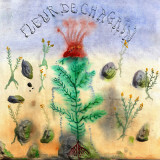
Pauline Marx, formerly of the fantastic duo La Fureur de Vouivre, seems like a being from another time and place; namely, an escaped marauder lurking in the forests of a Bruegel painting and integrating the surreal flora and fauna of a Boschian creation into the scenery and lore of deep Brittany. Her invented mythology is loaded with murky rituals and contorted mantras, backed by the surprising sounds and textures of terrains so earthly and so unreal.
The Devil at the Crossroads
Where do you think you come from? Where do you think you're going? Lasciate ogni speranza, voi ch’entrate: you, with the noodle to the four winds, who pass the threshold of this disc, you better leave all hope there, and glide in the poisonous footstep of the devil your guide.
Where do you think you come from? The mountain is no longer just the mountain; after your passage, it will no longer even be a mountain. Like the whole landscape, it will have been eaten, sauced by invisible leeches. Your nostalgia for the ground and your thirst to find the source will have only discovered a forest of vain words and foul water. Where do you think you're going? At the crossroads, the world is consumed in the previous future. Only the devil will know how to make you overcome the disgust of traditions, and only the love for the devil will give you enough vim to reach your goal: a village, perhaps, but which belongs to no one, a haven to your excessiveness .
The dark tradition to which this game of ternary trampling belongs, like the rhythm of a heart in tune with the inverted world, has no country and no assigned time. Rather a topology of Eve awakened after a thousand-year sleep, an idiosyncratic and possessed reading of our common humus, made up of stories composted in the limbo of the past, of songs captured in extremis vitae and rebus in the privatized antechambers of death.
What does she tell us about? Of our automobile and in love roamings, of the porosity of the membranes that separate beings and things, of the constant inversion of signs. The seventeen stages of this short journey, where intertwine the throbbing of objects, blown horns and rubbed horsehair, form the map of a country never to be found, ours, where only the voice of an old child and the disgusting devil's poisonous charm can guide us.
expected to be published on 10.02.2023
- generic sleeve repress -
It has been a little over a year since the release of 747's debut album, in which the Canadian masterfully drew notes of inspiration from the 90s to create an enchanting hour-long dream. In his first EP since, 747 returns from a temporal leap, bringing with him a blend of sounds and expressions to forge a timeless trip which hinges on the sounds of the 303.
Opening the release, "you,you" unfolds with a gentle and shimmery padded ambiance of anticipation. Gentle and light-footed percussion is soon interrupted by a dramatic siren, a warning beacon. Frenetic energy ensues, a frantic rush to the floor met with a cloudy head. Encompassed in an envelope of disorienting wailing and intermittent buzzing, but finally grounded by the familiarity of a 4/4 bass drum.
"Does Anybody Remember Laughter?" steps in to relinquish the force of gravity. The animated arpeggio and gleaming singing acid line rise up, uncovering the kaleidoscopic nature of the structural surroundings.
"While My 303 Gently Weeps" divulges further, exposing an underlying grid of dark geometry - binary and robotic. The topology of surfaces becomes increasingly fractalized, until the solo overtakes with a somber sadness. The 303 notes guide the mind on a melancholic and meditative walk along the grand staff, met after the break with a sense of hope and serenity.
Order now and we will order the item for you at our supplier.
Echocord sub-label Echo Echo returns with its first release of 2019 this May, coming courtesy of son.sine with his ‘Variable States’ EP. Leyton Glen aka son.sine is a relatively new name to most having only released a handlful of EP’s to date, initially in 2000 he released ‘Upekah’ via the Nurture imprint before Delsin recognized its timeless quality and re-issued it in 2013, a testament to Glen’s sole work. Here though we see Echo Echo mark a return for son.sine with a new EP of original material, his first in four years. The thirteen minute ‘Uncertainty’ opens, driven by hazy atmospherics, pulsing acid bass tones and murky sub bass while glitched out percussion subtly carries the cinematic groove. ‘Evident Topology’ follows, taking a more robust approach with jittery low-end chops, expansive dub chords and an amalgamation of emotive strings and jazzy bass licks ebbing and flowing within. ‘Three Linear Decay’ then rounds out the package via skippy organic drums, ethereal pad swells and metallic bleeps.
Order now and we will order the item for you at our supplier.
Top tip for Boards Of Canada fans! Gorgeous isolation wrapped in electric memories. 8-track electronica for homesick time travelers. 'Nothing Left To Abandon' is a slow rendering of brooding introspections and imaginary spaces. Memories, visions, eroded philosophies, tragedies in a few words. A childhood of livid skies, barren escarpments, homeless wastes. An absorbing contemplation of unlikely beauty and dusty melancholy that intersects with the creative territories of Vangelis, Boards Of Canada, Klaus Schulze, and Ulrich Schnauss, and the musings of Joe Frank and Robert Ashley. Clocolan is South African-born composer Emlyn Ellis Addison. A long formal training in music, his work centers on original writings and the found sounds of abandoned ideologies--generations of radicals and skeptics searching for meaning. From his childhood in South Africa--a landscape of neglected hinterlands, eroded topology, unconquered vastness--emerged clocolan's homesick, lo-fidelity electronica, expansive themes lost in the background noise of human affairs.
Order now and we will order the item for you at our supplier.