Search:used

Styles
All
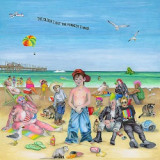
WHITMER THOMAS - THE OLDER I GET, THE FUNNIER I WAS

The Older I Get, the Funnier I Was, which follows Thomas’ brilliant 2020 HBO special The Golden One and his Can't Believe You're Happy Here EP released earlier this year, surveys a range of emotion and offers a broad sonic palette, moving between pop punk, electro, and the obvious influence of the singer-songwriters he grew up listening to in early childhood. It conjures the ennui of Bright Eyes alongside the barefaced storytelling of John Prine, the overstuffed lists of Fred Thomas with the lackadaisical humor of Colleen Green, among many others.

Thomas attributes the dexterity of the record to Duterte, who recorded and engineered most of it in addition to serving up plenty of encouragement when Thomas got down on the process. “As a comic, I used to test out new songs during sets to see if the funny bits were hitting, but since I wrote this in isolation I ended up writing lyrics and worrying less about making jokes,” Thomas says. That said, the album’s plenty funny. Stand-out and lead single “Rigamarole” opens with a Thomas-voiced infomercial that recalls his oft-cited lookalike Jim Carrey as the Grinch, before launching into a buoyant pop song about being depressed.

Whitmer Thomas will admit that when he traveled home to small town Gulf Shores, Alabama to record his HBO stand-up special, The Golden One, he expected to be greeted as a returning hero, a conquering king, or at minimum, a guy with a moderately successful career as an entertainer in Los Angeles. “I expected a big welcome home, open arms, but when I went back I realized: nobody fucking knows me. Nobody remembers me,” Thomas says. “In the years I’d been performing that show, I’d been romanticizing my childhood in this mythologized place, but the visit made me see that I’m not really from there anymore.”

The sense of alienation compounded when Thomas recognized how few people in town remembered his mom, to whom The Golden One is dedicated and largely about. Thomas grew up watching her perform with her twin sister at the legendary Flora-Bama Lounge, where he set the special, and still counts her as one of his musical influences. His new album, The Older I Get, the Funnier I Was, isn’t overtly about his mom, her presence is deeply felt throughout. While in Gulf Shores, Thomas discovered dozens of her old recordings, all of which had been wrecked by Katrina, but upon returning to LA, Thomas paid “a fancy place in Hollywood” to fix the tapes and hired Melina Duterte (Jay Som, Bachelor, Routine) to mix them. The two struck up a collaborative friendship, and Thomas had the sound of his mom’s voice back. “I was listening to songs she recorded when she was about my age, just these heartfelt, sweet Americana songs,” he says. “I decided then that I wanted to lose the Ian Curtis voice I always sing with; I wanted to do what came naturally, because my mom always sounded like herself, even when she was singing some cheesy reggae song about, like, Jamaica.”

Thus he went into The Older I Get, the Funnier I Was knowing it was time to retire his darkwave persona, and leaning into his natural, chirpier voice, which he says sounds “like a 12-year-old’s.” It makes sense: much of the album chronicles what Thomas calls “being a kid and feeling like you have no control and overcompensating by being annoying.” “So much of the album is about witnessing drug and alcohol addiction as a kid and seeing what it does to people, but also realizing that there's nothing you can do about it,” Thomas says. It’s familiar territory (see: “Partied to Death”) but the methodology is different this time around; true to its title, The Older I Get, the Funnier I Was isn’t always looking for laughs. Thomas might’ve left his hometown behind, but his kid self is still tagging along, a Peter Pan shadow he can’t untether himself from. The first line he sings on The Older I Get, the Funnier I Was is: “There should be a room at every party where you can just sit and watch a movie.” Find a 12-year-old who wouldn’t say the same.

pre-order now21.10.2022

expected to be published on 21.10.2022

Massimiliano Pagliara - See You In Paradise LP 2x12"

Massimiliano Pagliara returns to Permanent Vacation with his fourth studio album "See You In Paradise". After the highly acclaimed "Nothing Stays In One Place For Long" EP from 2020, this is the first full-length from the Italian-raised and Berlin-based producer for the label. Albums in the dance music genre can often be a challenge in terms of finding the right balance between the dancefloor and listening at home. Massimiliano, however, mastered this craftmanship perfectly while reviving the art of the album format.
Mostly written and produced in the lockdown period of spring 2020 these 10 tracks offer the whole sonic spectrum from the "Massi universe". The hardware enthusiast blends analogue-heavy and bright synthesizer melodies, pop hooks, Chicago house groove with more technoid tracks and atmospheric soundscapes. Taking you on a journey through his mind, body and soul: From his underground disco passion and pulsating dancefloor moments to ethereal and meditative ambience.

Inspired, both musically and aesthetically - one of his favourite carnal catchphrases titles the album - by Disco hero Patrick Cowley, Massimiliano channelled past, present and future in searching for new adventures within his music. For the first time working with live musicians (saxophone and piano) to bring a new facet on the table, that flows with the production seamlessly.

Communication and getting into a dialogue is a crucial part for Massimiliano as an artist. Whether it used to be as a ballet dancer, as a DJ, most prominently as a resident of the legendary Berghain / Panorama Bar, a producer and in collaboration with other artists and musicians: Maestro Massi has gathered an illustrious group of friends and like minded artist such as Snax, Fort Romeau and Init (with whom he has worked before), as well as new collaborators including Curses, Coloray and Vanessa. Under the artistic direction of Massimiliano each artist was able to bring his own unique talent into the album's coherent production and together with Massimiliano they created something that is more than the sum of its parts: A refuge full of beauty and harmony and free from worries in an upside down world. In other words: "See You In Paradise”

out of Stock

Order now and we will order the item for you at our supplier.


Last In: 9 months ago
UJI - TIMEBEING LP

Uji

TIMEBEING LP

12inchZZKLPC149
ZZK Records
21.10.2022

A prehistoric tribe dances around the fire. Young revelers lose themselves on a packed dancefloor. Explorers fly a rocket toward another galaxy. In the TIMEBEING universe, these things are all connected. From the earliest days of humanity, people have strived to expand their reality beyond the limitations of the here and now_and have used technology to make it happen. Their methods and machines may have changed across the centuries, but the drive remains constant, vibrating through history and occupying a space where time loses all meaning. "The art of making music is the art of manipulating time," says Uji. "I have had experiences where time shifts dramatically; sometimes it slows down to a halt, while moments seemingly become infinite. This is where the magic happens. This is when the fabric of what we call reality begins to show its seams." An Argentintian electronic producer and ethnomusicologist, Uji has been navigating those seams for more than two decades, initially as one half of the pioneering duo Lulacruza, but more recently with his own solo work. TIMEBEING continues that lineage, but also elevates it, taking shape as a interdisciplinary multimedia journey that includes a new album, an accompanying short film, an immersive live show and the birth of a new decentralized community of like-minded artists, creators, seekers, and dreamers. Mesmerizing and deeply psychedelic, the TIMEBEING LP certainly reflects the rich sound palette of Latin America_and its intersection with various strains of electronic music_but Uji taps into traditions_both musical and spiritual_that can't be hemmed in by borders and boundaries. Transcendence is the goal, and the album moves through fantastical spaces that may or may not exist: a metallic jungle, a Balkan spaceship, a cloud that morphs into a tumultuous whirlpool. All the while, Uji criss-crosses history, consulting elders and futurists alike as he throws open the doors of perception and pens a new mythology about what it means to be human. FOR FANS OF: Floating Points, Four Tet, Oneohtrix Point Never, Actress, Nicola Cruz, Dengue Dengue Dengue, Nicolas Jaar, Mount Kimbie, Mucho Indio.

pre-order now21.10.2022

expected to be published on 21.10.2022

Kelly Clarkson - When Christmas Comes Around LP
  • 1: Merry Christmas Baby
  • 2: It’s Beginning To Look A Lot Like Christmas
  • 3: Christmas Isn’t Canceled (Just You)
  • 4: Merry Christmas (To The One I Used To Know)
  • 5: Rockin’ Around The Christmas Tree
  • 6: Glow (Feat. Chris Stapleton)
  • 7: Santa Baby
  • 8: Santa, Can’t You Hear Me (Feat. Ariana Grande)
  • 9: Last Christmas
  • 10: Jingle Bell Rock
  • 11: Blessed
  • 12: Christmas Come Early
  • 13: Under The Mistletoe (Feat. Brett Eldredge)
  • 14: All I Want For Christmas Is You
  • 15: Christmas Eve

GRAMMY-winning global superstar Kelly Clarkson has released When Christmas Comes Around…, her ninth studio album via Atlantic Records. The 15-track collection sees Clarkson reunite with long time collaborators Jason Halbert, Jesse Shatkin and more for a mix of new original songs and Christmas classics.

The album features a mix of new original songs and Christmas classics, alongside show-stopping collaborations with Ariana Grande (“Santa, Can’t You Hear Me”), Chris Stapleton (“Glow”) & Brett Eldredge (2020’s hit single “Under The Mistletoe”). When Christmas Comes Around… marks the latest album from Clarkson since 2017’s Meaning of Life and her second holiday offering following 2013’s Wrapped In Red.

Kelly Clarkson is among the most popular artists of this era with total worldwide sales of more than 25 million albums and 40 million singles. The Texas-born singer-songwriter first came to fame in 2002 as the winner of the inaugural season of American Idol. Clarkson’s debut single, “A Moment Like This,” followed and quickly went to #1 on Billboard’s Hot 100, ultimately ranking as the year’s best-selling single in the U.S. Further, Clarkson is one of pop’s top singles artists, with 19 singles boasting multi-platinum, platinum and gold certifications around the world, including such global favourites as “Miss Independent” and “Because of You.” Clarkson has released eight studio albums (Thankful, Breakaway, My December, All I Ever Wanted, Stronger, Wrapped In Red, Piece By Piece, Meaning of Life), one greatest hits album, and two children’s books (New York Times Top 10 best seller River Rose and the Magical Lullaby and the follow up River Rose and the Magical Christmas). She is the recipient of an array of awards including three GRAMMY Awards, four American Music Awards, three MTV Video Music Awards, two Academy of Country Music Awards, two American Country Awards, one Country Music Association Award, and two Daytime Emmy Awards. She is also the first artist to top each of Billboard’s pop, adult contemporary, country and dance charts.

pre-order now21.10.2022

expected to be published on 21.10.2022

Colin Potter - Ago

Colin Potter

Ago

12inchBFE072
B.F.E Records
21.10.2022

An original and particular approach to rhythmic electronics, with an incredible sound, like in all of Potter's works. Six hypnotic tracks from Colin's archive of rarities, for the first time on vinyl, perfect to play really loud.

These six pieces were recorded between the late 80s & mid-90s at IC Studio, which was then located in Tollerton, North Yorkshire.

“I wanted to make some tracks which were much more rhythmic. By then the studio was a 16-track and I had acquired more equipment for making sounds and changing sounds. There was an Akai S950 sampler, an Emulator II, Roland TR727 and Yamaha RX11 digital drum machines, a Roland Juno 60, and some new effects processors. I even, briefly, used an Atari for MIDI sequencing, but using a computer in the studio felt a bit weird in those days. Ironic really, given the situation now. There were a lot of new methods to learn and the tracks on this album were the result of some of these experiments, during which I also found ways of integrating the old analog synths with the newer machines. Mixing was still done hands-on, in real-time, with alternative and often radically different takes being made of the same multitrack. Very different to the way things are done now. Better or worse? Who knows? But different.” - Colin Potter, IC Studio, London 2022.

Colin Potter is a sound engineer and musician currently based in London. He has worked within the fields of electronic and experimental music for over 40 years, collaborating with the likes of Current 93, The Hafler Trio, Organum, Andrew Chalk, and most notably as a key part of Nurse With Wound alongside Steven Stapleton. He started the esteemed ICR (Integrated Circuit Records – still active today) label in 1981 releasing a several wonderful home studio recordings of his own, as small run cassette releases.

pre-order now21.10.2022

expected to be published on 21.10.2022

Isokratisses - Cry With Tears: Greek-Albanian Songs of Many Voices

Isokratisses (Greek for "women who sing the "iso" or "drone") is a vocal ensemble comprised of eight women who carry the ancient tradition of polyphonic songs from Epirus: a region in northern Greece and southern Albania. Born and reared in the Greek speaking villages around Deropoli and Politsani in Albania, the women of Isokratisses have sung these songs since childhood. The group ranges in age from 19 to 56 with some sisters in the group as well as an aunt. They were nurtured by this archaic music, listening and singing it with their family and friends. The songs were passed down from generation to generation. The group started its artistic activity in 2015, after the singer Anna Katsi took the initiative to encourage the younger members to perform regularly. The communal nature of polyphonic singing is a way of revitalizing an art that has declined in recent years and to reassert the primacy of female voices in the southern Balkans. Singing these songs builds an invisible bridge that connects the present with the past, the memories of childhood travel with the immediacy of daily life. On Oct 14, 2022, Third Man Records will release a full album of these solo polyphonic songs, with Grammy-winning producer Christopher King. "It is social music, woven into the fabric of poor, marginalized, and disenfranchised communities. Many of the songs are variations of mirologia (songs of fate, songs of morning) that used to be sung throughout the southern Balkans but have largely disappeared on an informal cultural level except for Epirus. Structurally, the songs are pentatonic (five notes with no semitones) and are composed of three or four distinct melodic voices that weave together in an organic yet unexpected way. The remaining members of the group provide the iso or “drone” that is the low tonic note of the melody." - Chris King.

out of Stock

Order now and we will order the item for you at our supplier.


Last In: 3 years ago
Giorgia Angiuli - Quantum Love LP

Giorgia Angiuli

Quantum Love LP

12inchUNITED013
UNITED
19.10.2022

Giorgia Angiuli’s 13 track album ‘Quantum Love’ on her UNITED label combines and contrasts fast, insistent dance beats with her signature melodic synths and dreamy lyrics; ‘an eclectic work including piano downtempo tracks and techno melodic tracks with ethereal vocals’ (Angiuli).

The multi-talented live artist/DJ/producer/vocalist/lyricist and studio-building tech wizard used lockdown as a creative nexus. Einstein’s ‘Imagination is more important than knowledge’ led her to explore quantum physics, while her first India tour inspired ongoing interest in sound meditation and philosophy, culminating in the LP.

‘Quantum Love’ has many moods and speeds; physics and philosophy, contemplative and full-on fast, sweet vocals, meaningful lyrics or purely instrumental, it’s all there. ‘’Quantum Love’ is my inner soundtrack to my recent transformation, summarized in the following sentences: we are made of energy, everything is vibration. We are each our own placebo, happiness can be a choice, we have all the elements inside us for the right path. Nature can teach us everything.’ (Giorgia Angiuli)


Press:

DJ Mag Feature

Flow Music Interview

DJ Mag Post

Four Four Magazine News Piece


DJ Feedback:

Sasha (Last Night On Earth) - solid!

Guy Mantzur (Kompakt, Bedrock, Lost & Found, Sudbeat) - love them all

Anthony Pappa (Selador) - The Timo Maas Remix is excellent.

AFFKT (Sincopat) - Superb remixes!

Fur Coat (Oddity / Delete) - Nice Armonica and Glowal remixes

Israel Sunshine (Fur Coat / Oddity) - Great job! digging all tracks specially Timo and Glowal

Animal Trainer (Mobilee / Stil Vor Talent) - fab remix by Armonica!

Dee Montero (Knee Deep in Sound, Selador Recordings, Anjunadeep) - Timo Maas mix for me

Siavash (You Plus One) - Glowal mix takes the cake in this ep

Chris Fortier (Thoughtless / Sullivan Room / Balance) - super super

Pisetzky (JUST THIS / Last Night On Earth / Oddity) - amazing giu

Sinca (Anjunadeep) - Great remix ep

James Trystan (Suara / Bedrock) - Feeling this!!! Timo Maas for me

Henri Bergmann (Automatik) - armonica always!

Cesar Romero (Simply City) nice!

juSt b (Bedrock / Configurations of Self) nice release, love the key work and vox.

Nhii (No Human Is Illegal) (Sounds of Khemit / Stil Vor / Kindisch) - Timo Maas remix right up my alley!

out of Stock

Order now and we will order the item for you at our supplier.


Last In: 3 months ago
Lee Tracy & Isaac Manning - Is it What You Want

As the sun sets on a quaint East Nashville house, a young man bares a piece of his soul. Facing the camera, sporting a silky suit jacket/shirt/slacks/fingerless gloves ensemble that announces "singer" before he's even opened his mouth, Lee Tracy Johnson settles onto his stage, the front yard. He sways to the dirge-like drum machine pulse of a synth-soaked slow jam, extends his arms as if gaining his balance, and croons in affecting, fragile earnest, "I need your love… oh baby…"

Dogs in the yard next door begin barking. A mysterious cardboard robot figure, beamed in from galaxies unknown and affixed to a tree, is less vocal. Lee doesn't acknowledge either's presence. He's busy feeling it, arms and hands gesticulating. His voice rises in falsetto over the now-quiet dogs, over the ambient noise from the street that seeps into the handheld camcorder's microphone, over the recording of his own voice played back from a boombox off-camera. After six minutes the single, continuous shot ends. In this intimate creative universe there are no re-takes. There are many more music videos to shoot, and as Lee later puts it, "The first time you do it is actually the best. Because you can never get that again. You expressing yourself from within."

"I Need Your Love" dates from a lost heyday. From some time in the '80s or early '90s, when Lee Tracy (as he was known in performance) and his music partner/producer/manager Isaac Manning committed hours upon hours of their sonic and visual ideas to tape. Embracing drum machines and synthesizers – electronics that made their personal futurism palpable – they recorded exclusively at home, live in a room into a simple cassette deck. Soul, funk, electro and new wave informed their songs, yet Lee and Isaac eschewed the confinement of conventional categories and genres, preferring to let experimentation guide them.

"Anytime somebody put out a new record they had the same instruments or the same sound," explains Isaac. "So I basically wanted to find something that's really gonna stand out away from all of the rest of 'em." Their ethos meant that every idea they came up with was at least worth trying: echoed out half-rapped exhortations over frantic techno-style beats, gospel synth soul, modal electro-funk, oddball pop reinterpretations, emo AOR balladry, nods to Prince and the Fat Boys, or arrangements that might collapse mid-song into a mess of arcade game-ish blips before rallying to reach the finish line. All of it conjoined by consistent tape hiss, and most vitally, Lee's chameleonic voice, which managed to wildly shape shift and still evoke something sincere – whether toggling between falsetto and tenor exalting Jesus's return, or punctuating a melismatic romantic adlib with a succinct, "We all know how it feels to be alone."

"People think we went to a studio," says Isaac derisively. "We never went to no studio. We didn't have the money to go to no studio! We did this stuff at home. I shot videos in my front yard with whatever we could to get things together." Sometimes Isaac would just put on an instrumental record, be it "Planet Rock" or "Don't Cry For Me Argentina" (from Evita), press "record," and let Lee improvise over it, yielding peculiar love songs, would-be patriotic anthems, or Elvis Presley or Marilyn Monroe tributes. Technical limitations and a lack of professional polish never dissuaded them. They believed they were onto something.

"That struggle," Isaac says, "made that sound sound good to me."

In the parlance of modern music criticism Lee and Isaac's dizzying DIY efforts would inevitably be described as "outsider." But "outsider" carries the burden of untold additional layers of meaning if you're Black and from the South, creating on a budget, and trying to get someone, anyone within the country music capital of the world to take your vision seriously. "What category should we put it in?" Isaac asks rhetorically. "I don't know. All I know is feeling. I ain't gonna name it nothing. It's music. If it grabs your soul and touch your heart that's what it basically is supposed to do."

=

Born in 1963, the baby boy of nine siblings, Lee Tracy spent his earliest years living amidst the shotgun houses on Nashville's south side. "We was poor, man!" he says, recalling the outhouse his family used for a bathroom and the blocks of ice they kept in the kitchen to chill perishables. "But I actually don't think I really realized I was in poverty until I got grown and started thinking about it." Lee's mom worked at the Holiday Inn; his dad did whatever he had to do, from selling fruit from a horse drawn cart to bootlegging. "We didn't have much," Lee continues, "but my mother and my father got us the things we needed, the clothes on our back." By the end of the decade with the city's urban renewal programs razing entire neighborhoods to accommodate construction of the Interstate, the family moved to Edgehill Projects. Lee remembers music and art as a constant source of inspiration for he and his brothers and sisters – especially after seeing the Jackson 5 perform on Ed Sullivan. "As a small child I just knew that was what I wanted to do."

His older brother Don began musically mentoring him, introducing Lee to a variety of instruments and sounds. "He would never play one particular type of music, like R&B," says Lee. "I was surrounded by jazz, hard rock and roll, easy listening, gospel, reggae, country music; I mean I was a sponge absorbing all of that." Lee taught himself to play drums by beating on cardboard boxes, gaining a rep around the way for his timekeeping, and his singing voice. Emulating his favorites, Earth Wind & Fire and Cameo, he formed groups with other kids with era-evocative band names like Concept and TNT Connection, and emerged as the leader of disciplined rehearsals. "I made them practice," says Lee. "We practiced and practiced and practiced. Because I wanted that perfection." By high school the most accomplished of these bands would take top prize in a prominent local talent show. It was a big moment for Lee, and he felt ready to take things to the next level. But his band-mates had other ideas.

"I don't know what happened," he says, still miffed at the memory. "It must have blew they mind after we won and people started showing notice, because it's like everybody quit! I was like, where the hell did everybody go?" Lee had always made a point of interrogating prospective musicians about their intentions before joining his groups: were they really serious or just looking for a way to pick up girls? Now he understood even more the importance of finding a collaborator just as committed to the music as he was.

=

Isaac Manning had spent much of his life immersed in music and the arts – singing in the church choir with his family on Nashville's north side, writing, painting, dancing, and working various gigs within the entertainment industry. After serving in the armed forces, in the early '70s he ran The Teenage Place, a music and performance venue that catered to the local youth. But he was forced out of town when word of one of his recreational routines created a stir beyond the safe haven of his bohemian circles.

"I was growing marijuana," Isaac explains. "It wasn't no business, I was smoking it myself… I would put marijuana in scrambled eggs, cornbread and stuff." His weed use originated as a form of self-medication to combat severe tooth pain. But when he began sharing it with some of the other young people he hung out with, some of who just so happened to be the kids of Nashville politicians, the cops came calling. "When I got busted," he remembers, "they were talking about how they were gonna get rid of me because they didn't want me saying nothing about they children because of the politics and stuff. So I got my family, took two raggedy cars, and left Nashville and went to Vegas."

Out in the desert, Isaac happened to meet Chubby Checker of "The Twist" fame while the singer was gigging at The Flamingo. Impressed by Isaac's zeal, Checker invited him to go on the road with him as his tour manager/roadie/valet. The experience gave Isaac a window into a part of the entertainment world he'd never encountered – a glimpse of what a true pop act's audience looked like. "Chubby Checker, none of his shows were played for Black folks," he remembers. "All his gigs were done at high-class white people areas." Returning home after a few years with Chubby, Isaac was properly motivated to make it in Music City. He began writing songs and scouting around Nashville for local talent anywhere he could find it with an expressed goal: "Find someone who can deliver your songs the way you want 'em delivered and make people feel what you want them to feel."

One day while walking through Edgehill Projects Isaac heard someone playing the drums in a way that made him stop and take notice. "The music was so tight, just the drums made me feel like, oh I'm-a find this person," he recalls. "So I circled through the projects until I found who it was.

"That's how I met him – Lee Tracy. When I found him and he started singing and stuff, I said, ohhh, this is somebody different."

=

Theirs was a true complementary partnership: young Lee possessed the raw talent, the older Isaac the belief. "He's really the only one besides my brother and my family that really seen the potential in me," says Lee. "He made me see that I could do it."

Isaac long being a night owl, his house also made for a fertile collaborative environment – a space where there always seemed to be a new piece of his visual art on display: paintings, illustrations, and dolls and figures (including an enigmatic cardboard robot). Lee and Issac would hang out together and talk, listen to music, conjure ideas, and smoke the herb Isaac had resumed growing in his yard. "It got to where I could trust him, he could trust me," Isaac says of their bond. They also worked together for hours on drawings, spreading larges rolls of paper on the walls and sketching faces with abstract patterns and imagery: alien-like beings, tri-horned horse heads, inverted Janus-like characters where one visage blurred into the other.

Soon it became apparent that they didn't need other collaborators; self-sufficiency was the natural way forward. At Isaac's behest Lee, already fed up with dealing with band musicians, began playing around with a poly-sonic Yamaha keyboard at the local music store. "It had everything on it – trumpet, bass, drums, organ," remembers Lee. "And that's when I started recording my own stuff."

The technology afforded Lee the flexibility and independence he craved, setting him on a path other bedroom musicians and producers around the world were simultaneously following through the '80s into the early '90s. Saving up money from day jobs, he eventually supplemented the Yamaha Isaac had gotten him with Roland and Casio drum machines and a Moog. Lee was living in an apartment in Hillside at that point caring for his dad, who'd been partially paralyzed since early in life. In the evenings up in his second floor room, the music put him in a zone where he could tune out everything and lose himself in his ideas.

"Oh I loved it," he recalls. "I would really experiment with the instruments and use a lot of different sound effects. I was looking for something nobody else had. I wanted something totally different. And once I found the sound I was looking for, I would just smoke me a good joint and just let it go, hit the record button." More potent a creative stimulant than even Isaac's weed was the holistic flow and spontaneity of recording. Between sessions at Isaac's place and Lee's apartment, their volume of output quickly ballooned.

"We was always recording," says Lee. "That's why we have so much music. Even when I went to Isaac's and we start creating, I get home, my mind is racing, I gotta start creating, creating, creating. I remember there were times when I took a 90-minute tape from front to back and just filled it up."

"We never practiced," says Isaac. "See, that was just so odd about the whole thing. I could relate to him, and tell him about the songs I had ideas for and everything and stuff. And then he would bring it back or whatever, and we'd get together and put it down." Once the taskmaster hell bent on rehearsing, Lee had flipped a full 180. Perfection was no longer an aspiration, but the enemy of inspiration.

"I seen where practicing and practicing got me," says Lee. "A lot of musicians you get to playing and they gotta stop, they have to analyze the music. But while you analyzing you losing a lot of the greatness of what you creating. Stop analyzing what you play, just play! And it'll all take shape."

=

"I hope you understood the beginning of the record because this was invented from a dream I had today… (You tell me, I'll tell you, we'll figure it out together)" – Lee Tracy and Isaac Manning, "Hope You Understand"

Lee lets loose a maniacal cackle when he acknowledges that the material that he and Isaac recorded was by anyone's estimation pretty out there. It's the same laugh that commences "Hope You Understand" – a chaotic transmission that encapsulates the duality at the heart of their music: a stated desire to reach people and a compulsion to go as leftfield as they saw fit.

"We just did it," says Lee. "We cut the music on and cut loose. I don't sit around and write. I do it by listening, get a feeling, play the music, and the lyrics and stuff just come out of me."

The approach proved adaptable to interpreting other artists' material. While recording a cover of Whitney Houston's pop ballad "Saving All My Love For You," Lee played Whitney's version in his headphones as he laid down his own vocals – partially following the lyrics, partially using them as a departure point. The end result is barely recognizable compared with the original, Lee and Isaac having switched up the time signature and reinvented the melody along the way towards morphing a slick mainstream radio standard into something that sounds solely their own.

"I really used that song to get me started," says Lee. "Then I said, well I need something else, something is missing. Something just came over me. That's when I came up with 'Is It What You Want.'"

The song would become the centerpiece of Lee and Isaac's repertoire. Pushed along by a percolating metronomic Rhythm King style beat somewhere between a military march and a samba, "Is It What You Want" finds Lee pleading the sincerity of his commitment to a potential love interest embellished by vocal tics and hiccups subtlely reminiscent of his childhood hero MJ. Absent chord changes, only synth riffs gliding in and out like apparitions, the song achieves a lingering lo-fi power that leaves you feeling like it's still playing, somewhere, even after the fade out.

"I don't know, it's like a real spiritual song," Lee reflects. "But it's not just spiritual. To me the more I listen to it it's like about everything that you do in your everyday life, period. Is it what you want? Do you want a car or you don't want a car? Do you want Jesus or do you want the Devil? It's basically asking you the question. Can't nobody answer the question but you yourself."

In 1989 Lee won a lawsuit stemming from injuries sustained from a fight he'd gotten into. He took part of the settlement money and with Isaac pressed up "Saving All My Love For You" b/w "Is It What You Want" as a 45 single. Isaac christened the label One Chance Records. "Because that's all we wanted," he says with a laugh, "one chance."

Isaac sent the record out to radio stations and major labels, hoping for it to make enough noise to get picked up nationally. But the response he and Lee were hoping for never materialized. According to Isaac the closest the single got to getting played on the radio is when a disk jock from a local station made a highly unusual announcement on air: "The dude said on the radio, 107.5 – 'We are not gonna play 'Is It What You Want.' We cracked up! Wow, that's deep.

"It was a whole racist thing that was going on," he reflects. "So we just looked over and kept on going. That was it. That was about the way it goes… If you were Black and you were living in Nashville and stuff, that's the way you got treated." Isaac already knew as much from all the times he'd brought he and Lee's tapes (even their cache of country music tunes) over to Music Row to try to drum up interest to no avail.

"Isaac, he really worked his ass off," says Lee. "He probably been to every record place down on Music Row." Nashville's famed recording and music business corridor wasn't but a few blocks from where Lee grew up. Close enough, he remembers, for him to ride his bike along its back alleys and stumble upon the occasional random treasure, like a discarded box of harmonicas. Getting in through the front door, however, still felt a world away.

"I just don't think at the time our music fell into a category for them," he concedes. "It was before its time."

=

Lee stopped making music some time in the latter part of the '90s, around the time his mom passed away and life became increasingly tough to manage. "When my mother died I had a nervous breakdown," he says, "So I shut down for a long time. I was in such a sadness frame of mind. That's why nobody seen me. I had just disappeared off the map." He fell out of touch with Isaac, and in an indication of just how bad things had gotten for him, lost track of all the recordings they'd made together. Music became a distant memory.

Fortunately, Isaac kept the faith. In a self-published collection of his poetry – paeans to some of his favorite entertainment and public figures entitled Friends and Dick Clark – he'd written that he believed "music has a life of its own." But his prescience and presence of mind were truly manifested in the fact that he kept an archive of he and Lee's work. As perfectly imperfect as "Is It What You Want" now sounds in a post-Personal Space world, Lee and Isaac's lone official release was in fact just a taste. The bulk of the Is It What You Want album is culled from the pair's essentially unheard home recordings – complete songs, half-realized experiments, Isaac's blue monologues and pronouncements et al – compiled, mixed and programmed in the loose and impulsive creative spirit of their regular get-togethers from decades ago. The rest of us, it seems, may have finally caught up to them.

On the prospect of at long last reaching a wider audience, Isaac says simply, "I been trying for a long time, it feels good." Ever the survivor, he adds, "The only way I know how to make it to the top is to keep climbing. If one leg break on the ladder, hey, you gotta fix it and keep on going… That's where I be at. I'll kill death to make it out there."

For Lee it all feels akin to a personal resurrection: "It's like I was in a tomb and the tomb was opened and I'm back… Man, it feels so great. I feel like I'm gonna jump out of my skin." Success at this stage of his life, he realizes, probably means something different than what it did back when he was singing and dancing in Isaac's front yard. "What I really mean by 'making it,'" he explains isn't just the music being heard but, "the story being told."

Occasionally Lee will pull up "Is It What You Want" on YouTube on his phone, put on his headphones, and listen. He remembers the first time he heard his recorded voice. How surreal it was, how he thought to himself, "Is that really me?" What would he say to that younger version of himself now?

"I would probably tell myself, hang in there, don't give up. Keep striving for the goal. And everything will work out."

Despite what's printed on the record label, sometimes you do get more than one chance.
out of Stock

Order now and we will order the item for you at our supplier.


Last In: 3 years ago
Lack Of Afro - Press On LP

A colossus of the funk & soul world, Adam Gibbons (aka Lack of Afro) has been releasing music for 15 years and continues to go from strength to strength. Previously signed to Freestyle Records in London and running his own label The Bastion Music Group since 2015, he has been responsible for some of the genre’s most important releases, not least his debut album Press On described by iDJ as “one of the most important albums of the modern funk era” and more recently given ‘classic’ status by Future Music Magazine.

An accomplished multi-instrumentalist, producer, DJ and composer, his music has won worldwide critical acclaim and to date has gained 115 million streams on Spotify. It has been featured on films, TV shows and adverts all over the globe, on networks including HBO, ABC, Sony Pictures, BBC, ITV, Sky TV, Fox Pictures & Warner Brothers Television, and used in multi million ad campaigns by the likes of Google, Spotify, Miller Lite and Adidas.

As a DJ and live performer, he has performed in over 20 countries worldwide and undertaken countless live sessions for radio and TV including two for the BBC at the highly revered Maida Vale Studios.

To date, he has released seven albums under the Lack of Afro moniker (most recently I’m Here Now in 2020), three as The Unity Sextet, one under LUSTRE, one under his own name, an EP with Herbal T as The Damn Straights, albums for other artists, music for several TV shows and over 60 remixes. He has also produced 13 award winning, sample packs for Loopmasters.

out of Stock

Order now and we will order the item for you at our supplier.


Last In: 3 years ago
Kuedo - Severant (10th Anniversary Edition) LP 2x12"

We are excited to reissue Kuedo's classic 2011 album 'Severant' on double vinyl for the first time, and with a bonus track 'Work, Live & Sleep In Collapsing Space'. The cover artwork has been redesigned by Raf Rennie (Who also designed Kuedo's recent album on Brainfeeder, Infinite Window). In terms of feeling, ‘Severant’ explores the space between the detached world of the imagination and the real-time world; that feeling of coming out of a daydream, on the edge of the drift from the day-to-day grind. Jamie says of this moment ”As reality shapes imagination and escapism affects your choices in the real world, there is a strange relational loop between the two and the space in between the two. There’s a bitter sweetness in that gap, it has a certain emotive quality, kind of in between being and non-being”. Again, musically ‘Severant’ is inspired by related themes. It sounds as if it’s in a sweet spot between the emotive, innately futurist synth soundtracks of Tangerine Dream and Vangelis, borne from a time when the very idea of futurism was more prevalent, in combination with musical ideas and inspiration from the emotionally ambivalent, materialist fantasies of ‘coke rap‘ such as The Clipse. Rhythmically the record is influenced by what Jamie calls ”the two ultra modernmusics of modern times”, footwork from Chicago, which Planet Mu has explored in depth on its recent releases, and again the drum machine grids of coke rap. Jamie says ”I wanted to capture a really futurist sentiment, kind of melancholy and grand luminescent, so I used the instrument that most evokes that for me - that sweeping Vangelis brass sound.” And on coke rap he talks about the emotional ‘half being’ of the music, the energetically charged, detached ambivalence of the MCs, and the admission that the MCs could be ”fantasising without admitting to doing so.”

out of Stock

Order now and we will order the item for you at our supplier.


Last In: 3 years ago
Various - MIDNIGHT TO SIX...FIRST TIME FROM JAMAICA

2022 Repress

The legendary gig that Joe Strummer, singer from the Punk Rock band 'The Clash' attended and inspired his writing their classic 'White Man In Hammersmith Palais' took place on the 05th June 1977.
At the Hammersmith Palais venue on Shepherd's Bush Road W6, London during the height of Punk Mania. The full line up for the show were all Jamaican artists Dillinger, Leroy Smart, Delroy Wilson (all the first time from Jamaica) and Ken Boothe.
'Ken Boothe for UK pop reggae' who had already scored some hits with 'Everything I own' and 'Crying Over You' in 1974. Joe Strummer was expecting Roots, Rock, Reggae but the Sound System this evening 'Admiral Ken Sound' was playing 'Four Tops all night' as in soul and northern soul that were staple crowd pleasers at the time to warm up the audience, but in Joe's eyes the music should have reflected more Jamaican roots based music. The song also deals with bigger issues of black and white unity, but some people including the Punk Rockers.
'They're all too busy fighting, for a good place under the lighting'. Joe Strummer himself was looking for fun. 'I'm the Whiteman in the Palais....Just Looking for Fun'

The artwork supplied by Punk Artist MAL-ONE has used the two posters that were made for this gig, the reggae promoters 'Star Promotions' poster, that contained a picture of Ken Boothe and the venue's own poster that used text to announce it's line up for that evenings performance. Alongside these lost relics he has also combined the groups own poster for the 'White Man In Hammersmith Palais' single that incorporated the use of rifle target sights, perhaps enhancing the air of violence contained in the songs message.
MAL-ONE has collaged these together joining the two stories as indeed the song lyrics reflected. People often forget that the songs release was in fact as year after the actual gig, we have tied this release to the 40th anniversary of the song's release. Joe Strummer was one of the few voices from the Punk Era that used his lyrics as a weapon to tell the events that were happening around him and their relevance to those times.
The song itsel a Clash Classic and also a Punk Anthem, released on the 16th June 1978. We have compiled this album with songs by these artists, most of which you would have heard that night. As a post script to this story when the Hammersmith Palais sadly closed its doors for the last time after 82 years' service in 1999, the owners thought it fitting to present Joe Strummer with a sign from the venue's entrance. Mr Strummer's understated reply 'I guess I'll have to send a man with a van round to pick it up'.
Hope you Enjoy the set....

out of Stock

Order now and we will order the item for you at our supplier.


Last In: 3 years ago
Agents Of Time - Universo 2x12"

Agents Of Time

Universo 2x12"

2x12inchKOM453
Kompakt
14.10.2022

Italian duo Agents Of Time have been incredibly busy over the past few years, from releasing a string of classic singles – including their recent single for Afterlife, “The Mirage”, which earned more than five million views on Instagram – to remixing The Weeknd’s “Take My Breath”, which appeared on his recent Dawn FM (Alternative World). But the biggest news is here now – their second album, Universo, is ready. Elevating their trademark melodic techno with an exquisite pop-ness, Universo has found its ideal home with Kompakt, following their Music Made Paradise 2020 debut EP for the label. It’s a meeting of minds that makes perfect sense.

Andrea Di Ceglie and Luigi Tutolo, the two members of Agents Of Time, used their time during the pandemic to work on Universo, an album loosely conceptualised around their ‘personal universo’, a manifestation of the world Di Ceglie and Tutolo built both within and around their studio. This accounts for the sparkle and brightness of Universo – it’s full of personality, vim and vigour, the duo experimenting with their music, exploring its furthest corners. If you come to Universo expecting just another album of melodic techno, get ready to be pleasantly surprised – there’s a whole lot more going on here, and it’s all equally compelling.

After a typically poetic opening gesture – the swirling, synaesthetic, self-titled intro track – expectations are immediately blindsided with the two-step pop of “Fallin’”, sung with gentle clarity by guest Audrey Janssens, a dream of a song that harks back to the glory days of early ‘00s UK garage. “Interstellar Cowboy” is a confident, lithe, disco-fied strut; the gentle minor-key piano of “Liquid Fantasy” spirals into a gorgeously melancholy techno-pop epic, Vicky Who?’s voice rich with yearning. Janssens also reappears on the electro-swirl of “Poison”; “Dream Vision” revisits their single “The Mirage”, soft with sweeping strings, loaded with drama; “Part Of Life” sashays into view with a schaffel-stomp.

This rich variety throws the more dancefloor-focused tracks, like “Ciao”, into even starker relief – they’re more decisive, streamlined, yet rich with detail, chugging, Moroder-esque bass meeting strobe-lit synths that fire melodies out into the firmament. Universo feels texturally dense, but it still breathes, its sounds so tactile you want to reach out and grab them, its tunes so seductive you can’t get them out of your head. Universo is a fiercely beautiful album, brave in its spirit, a perfectly poised meeting-point of pop melody and stylish, lush techno: Agents Of Time in excelsis.

Das italienische Duo Agents Of Time war in den letzten Jahren unglaublich fleißig, von der Veröffentlichung einer Reihe klassischer Singles - darunter ihre jüngster Beitrag für Afterlife, "The Mirage", der mehr als fünf Millionen Aufrufe auf Instagram erhielt - bis hin zum Remix von The Weeknds "Take My Breath", der auf dessen aktuellen Album “Dawn FM (Alternative World)” erschien. Aber die bahnbrechendeste Neuigkeit ist erst jetzt endlich da - ihr zweites Album "Universo" ist fertig! “Universo" verbindet ihr Markenzeichen, melodischen Techno, mit einer besonderen Pop-Haltung und findet nach der EP "Music Made Paradise 2020" sein ideales Zuhause bei Kompakt. Eine Seelenverwandtschaft, die absolut Sinn macht.

Andrea Di Ceglie und Luigi Tutolo, die beiden Mitglieder von Agents Of Time, nutzten die Zeit während der Pandemie, um an "Universo" zu arbeiten, einem Album, das lose um ihr "persönliches Universum" herum konzipiert ist, eine Manifestation der Welt, die Di Ceglie und Tutolo in und um ihr Studio herum aufgebaut haben. Das macht den besonderen Glanz und die strahlende Helligkeit von "Universo" aus - es strotzt nur so von Persönlichkeit, Elan und Kraft, das Duo experimentiert mit Musik und erkundet auch noch deren entfernteste Ecken. Wer bei "Universo" nur ein weiteres Album mit melodischem Techno erwartet, wird angenehm überrascht sein - hier ist viel mehr los, und alles ist gleichermaßen spannend.

Nach einer poetischen Eröffnungsgeste - dem wirbelnden, synästhetischen, selbstbetitelten Intro-Track - werden mit dem 2-Step-Pop von “Fallin” alle Erwartungen sofort über den Haufen geworfen. Mit sanfter Klarheit von Gastsängerin Audrey Janssens gesungen, ist “Fallin” ein Traum von einem Song, der an die großen Zeiten von UK-Garage in den frühen 00er Jahre erinnert. "Interstellar Cowboy" ist ein selbstbewusstes, geschmeidig über den Laufsteg stolzierender Disco-Track; das sanfte Moll-Klavier von "Liquid Fantasy" entwickelt sich zu einem wunderbar melancholischen Techno-Pop-Epos, mit Vicky Who?’s Stimme voller Sehnsucht . Danach taucht auch Janssens Gesang auf dem Elektro-Wirbel von "Poison" wieder auf; "Dream Vision" greift die Single "The Mirage" auf, sanft und mit schwungvollen Streichern, voller Dramatik; "Part Of Life" dagegen ist ein echter Schaffel-Stomp.

All der Abwechslungsreichtum lässt eher tanzflächenorientierte Tracks wie "Ciao" noch deutlicher hervortreten - sie wirken noch entschlossener, stromlinienförmiger und dennoch reich an Details, pluckernde, Moroder-eske Bässe treffen auf stroboskopisch blitzende Synths, von denen aus die Melodien ins Firmament schießen. “Universo” fühlt sich textlich dicht an, aber es atmet trotzdem, seine Klänge sind so greifbar, dass man sie anfassen möchte, seine Melodien so verführerisch, dass man sie nicht mehr aus dem Kopf bekommt. “Universo” ist ein wunderschönes, mutiges Album, ein perfekter Treffpunkt von Pop-Melodien und stilvollem Techno: Agents Of Time in excelsis.

out of Stock

Order now and we will order the item for you at our supplier.


Last In: 2 years ago
Imagination - I'm Always Right - The WDR Tapes 1977

We are proud to present "I'm Always Right" by Imagination, an unreleased jazz rock LP from 1977. Comprised of five tracks with a playtime of roughly 30 minutes, you will hear one of the finest German late-70s rock-tinged electric jazz albums of the era. The recording is a delightful stand-out with unique compositions, aspiring solo work, and a soulful spirit throughout. Additionally, the album veritably glows with exceptional sound quality, as it has been remastered from original tapes that were cut more than four decades ago at the WDR Funkhaus, Cologne.

Here is the story of how label founder John Raincoatman became aware of these lost tapes:
"I first got in touch with members of Imagination from Düsseldorf (not to be confused with the UK disco band under the same name) in 2017 for licensing the track "Strawberry Wine" from their collectible "Shake It" album from 1980. A couple of months later, when I was speaking with Willi Hövelmann, the guitarist for Imagination, he told me about some recordings the band had made a couple of years before, when they had been invited to to the studio of the WDR, a major German broadcaster. A couple of weeks later, when Hövelmann finally sent me the files that he had requested from the WDR, I could not believe what I heard - not only that the songs were totally different from what I expected, but that they were also very very good! The music wasn't comparable to any other kind of fusion release that I knew of. These five songs were straight forward, tight and soulful electric jazz rock, a combination rarely heard from Germany from that time period."

How come Imagination - at that time a young newcomer band consisting of musicians between 19 and 22 years of age - was able to record at the well-equipped Funkhaus studio of German radio and television? Hövelmann explains: "The WDR got to know us from a newcomer band competition called "Pop am Rhein" (Pop at the Rhine) which was set up to support local bands and was promoted by several bigger newspapers. Imagination was one of the 5 contestants which were picked from 59 bands by a jury of music journalists and our band was invited to play a concert at the Philipshalle in front of about 3500 guests. Although a band called "Accept" won the contest (yes, the heavy metal band that gained international success in the following years!) and Imagination only made 3rd place, we were invited by music host and journalist Wolfgang Neumann to record in a professional studio."

Neumann's broadcasting show at the WDR was called "Rock Studio", and one of his special goals was to help push newcomer bands by giving them airplay. As a side note, Neumann actually compiled a series of three LPs on the Harvest label from 1979-1982, each of them featuring four bands. However, the earlier recordings of Imagination had only been used for broadcasting reasons, they were aired a couple of times but never made it to a vinyl or CD release.
So, on October 10th, 1977, it was time for the band to show up and prove themselves in the studio. The tracks were all recorded in one afternoon, mainly as one takes. In some cases flute, saxophone were overdubbed, as well as the vocals on "Love is Genesis", as Hövelmann remembers.

The first song, "Jazzgang" can probably be seen as Imagination's most characteristic composition out of their early period: heavy bass, saxophone leads and speedy solos by the band members. A genuine, rough, yet funky uptempo jazz rock tune. But it's "I'm Always Right", the second track on the album, that raises the bar as the key track of the release with its 10-minute length. The song starts with a great piano solo by Mario F. Demonte. In fact, "Demonte" was a pseudonym of Ratko Delorko, a classically trained piano virtuoso who is still active today as conductor, composer and performer. At that time, it was simply impossible for him to officially be part in a band like Imagination and hence the alias was invented. Anyway, the speedy intro leads to a very soulful mid-tempo jazz funk groove that offers space and time for the band members to perform a solo. First off is Uwe Ziss with sax and flute combined. The second solo belongs to Willi "Sultan" Hövelmann on electric guitar. For the furious ending the pace is set back to high speed. Delorko serves us with one of the most brilliant uptempo piano solos you may have heard in a while on a jazz record.

The next song stylistically stands out from the rest. "Biting My Time" incorporates a rhythm and blues feel with a 60s soul jazz attitude. The track was composed by Uwe Ziss who leads through the track with aspiring flute solos which feel like an easy summer breeze after the first two rock tinged tunes.

"Himalaya" sees Imagination move away from jazz quite a bit, rather approaching the psychedelic rock genre with a vibe reminiscent of the sound of the early 70s. Again starting with a piano solo by Ratko Delorko the pace is quickly at 150 bpm with the full band laying down an energetic jazz rock sound. Just after a little over one-and-a-half minutes there is a breakdown to a slower tempo with overdubbed mysterious vocals and psyche-y screams which may remind more of the legendary krautrock band Can than what is typically known as "jazz". The mood continues with tense saxophone and guitar solos, just to speed up again towards the end with furious drumming by Andreas Oelschläger.

"Love Is Genesis" concludes the release. It was composed and sung by former bassist Robert Schlickmann. Though most of the band members didn't really like the song at that time it still is a one-of-a-kind soft rock pop ballad which partly reminds of some of the vocal song tracks later to be found on the "Shake It" LP from 1980. The track manifested that Imagination were never really supposed to be solely an instrumental band.

We are now happy to have cleared the exclusive rights for this recording from the WDR and are proud to re-present this amazing collection of songs. It should appeal to fusion, jazz rock and jazz funk aficionados but also to late krautrock collectors. We are also certain that it will also please fans of the "Shake It" album, simply in terms of being such a bright and soulful debut with great music overall.

out of Stock

Order now and we will order the item for you at our supplier.


Last In: 3 years ago
The Staves - Dead & Born & Grown (10th Anniversary Edition)

Revered indie trio The Staves' debut album 'Dead & Born & Grown' is celebrating its 10th Anniversary on the 12th November 2022. To celebrate 10 years of their debut album the band will be re-pressing Dead & Born & Grown on recycled colour vinyl.

The album was produced with Glyn and Ethan Johns, who have worked with a plethora of huge artists from past and present between them, including The Beatles, The Rolling Stones and Led Zeppelin, as well as the likes of The Vaccines, Kings of Leon and Kaiser Chiefs. The Staves are three sisters from Watford who share vocal duties in addition to some contributions on guitar and ukelele.

This special-edition recycled vinyl is made from 100% PVC recycled material, using waste material and clippings from previous pressings and are re-used. The result is that each vinyl is unique with its own colour combination therefore the colour you receive will be randomized.

pre-order now14.10.2022

expected to be published on 14.10.2022

Bedouin Soundclash - We Will Meet in a Hurricane

As this album represents a spiritual return to a foundational past, sonically this record is likewise about going back to our fundamentals and our roots; when Eon and I were two kids with guitars in a bedroom figuring out some songs. Our last album, Mass, featured so many parts. We recorded it in New Orleans at Preservation Hall with a thirteen-piece horn section, percussionists, strings, etc. For the most part, it’s tough to find any guitar on the record. So we decided to simplify and reconnect with what inspired us. We kept the ingredients limited, the palate simple. We went back to our beginnings and rediscovered the joy of just playing on an acoustic, and a bass through a small amp, with a vocal. We spent our days like we used to when we were younger. We hung out and talked about music. If it was sunny we went to the beach. We played some tennis. Then in the afternoon we might play through some ideas. If it sounded good in the front room of the house, we took it to the studio.

pre-order now14.10.2022

expected to be published on 14.10.2022

Lincoln - A Constant State of Ohio

Hailing from Cincinnati, Ohio, Lincoln's music is equal parts pretentious and angsty. One day Sam Means (previously of The Format) tweeted a link to one of Lincoln’s Youtube covers, catching the attention of I Surrender Records. In a moment of sheer enthusiasm, the label couldn’t resist reaching out and signing him. Lincoln released his debut EP A Constant State of Ohio on I Surrender Records in early 2017. The single Saint Bernard is a TikTok smash having been used in over 100k user generated videos. The song went on to stream over 200,000,000 times between YouTube, Spotify, and Apple Music.

pre-order now14.10.2022

expected to be published on 14.10.2022

UGLY DUCKLING - MOVING AT BREAKNECK SPEED LP (2x12")

"Party people hold onto your hats!" Ugly Duckling presents their fifth full-length album Moving at Breakneck Speed. After more than a decade in the music business, Young Einstein, Andy Cooper and Dizzy Dustin are well accustomed to the recording process. For their latest LP, the boys dug deep into their bag of tricks to create what they feel is their most dynamic and complete release to date. Moving at Breakneck Speed is an exciting and musically exotic adventure story that has our desperate heroes circling the globe to outrun an evil gang of super-criminals determined to put an end to UD once and for all. The record is made up of 14 power packed tracks that showcase Ugly Duckling's classic production sound as well as the flavorful and humorously soulful vocal styles of Dizzy and Andy. "By the time you work on your fifth record, you ought to know how to do it, right?" asks Andy, "I think we put all of the pieces together to make a really, really good album".

out of Stock

Order now and we will order the item for you at our supplier.


Last In: 3 years ago
Web Web - Oracle LP

Web Web

Oracle LP

12inchCPT499-1
Compost Records
07.10.2022

The first album of Web Web is very uncut, raw, live and direct. Oracle is the first output of a German Supergroup. Check the musician credits below and you'll get the score. The initial idea was to record a spiritual-jazz type of album, with all its imperfection as far as intonation, sound, influences of tunes... just like from their big jazz-heroes in the 70ies (e.g. Strata East, Black Jazz).

Web Web's idea was to record a jazz jam session while to found and proclaim being a fictive band, a formation, which did not exist, while telling people, it would be a secret jam session recording of the Seventies. The prompt problem they were facing: Oh, we never would be able to play concerts, doing interviews, or placing photos on sleeves or post likeness images online. So they decided to reveal their real identities:

Web Web are: Roberto Di Gioia (Piano, Synth, Percussion), Tony Lakatos (Tenor- and Sopranosaxophone), Christian von Kaphengst (Upright Bass) and Peter Gall (Drums).

Roberto Di Gioia (Mastermind of Web Web): - The four of us set up very close in a big room, so we could hear and feel each other the best way. The music became more intensive, improvisations became more dynamic and it was impulsive .

The album Oracle' was recorded on one day, only first takes were used!

We want to keep the burning spirit and the loose vibe we had during the recording session. And we play concerts the wild and free way we recorded this album. Web Web will be on tour 2018, but playing a few concerts in 2017.
Furthermore, one main decision to blab their real identities was: The second Web Web album is recorded in June (with guests like the famous and unique Gembri-player and multiinstrumentalist and singer Majid Bekkas from Morocco).
Both albums were engineered, recorded and mixed by Jan Krause (Beanfield, Poets Of Rhythm).

Roberto Di Gioia: - Tony was tuning his Soprano too high, and his (overdubbed) tenor way too flat!
My synthesizers were somewhere in between...HA! We exactly had the sound we had in our minds, we had it exactly there were we wanted it: a bit of Sun Ra here, a bit of Horace Tapscott there. On some tunes Tony's soprano just sounds like a trumpet, since due to his weird tuning the soprano develops different frequencies in relation to other instruments.

Oracle' is the first live jazz release on Compost. Produced by Roberto Di Gioia and Michael Reinboth.

Roberto Di Gioia has been working with numerous jazz-legends, such as Woody Shaw, Art Farmer, James Moody, Johnny Griffin, Charlie Rouse, Clifford Jordan, Clark Terry, Roy Ayers, Gregory Porter and many more.

From 1990 to 2008: member Klaus Doldingers Passport. As a pianist he made recordings with Udo Lindenberg (MTV-Unplugged, 2011), Charlie Watts ( Music Of The Rolling Stones , 2005), Console ( Reset The Preset , 2003), The Notwist ( Shrink 1998, Neon Golden , 2002). Since 2007 he is working together with Samon Kawamura and Max Herre as KAHEDI: Max Herre ( Hallo Welt , 2012), Joy Denalane ( Gleisdreieck , 2017), u.v.m...His own group MARSMOBIL (produced by Peter Kruder) will release his fourth studioalbum in winter 2017.

Tony Lakatos originates from the world famous Lakatos-familiy from Budapest, Hungary. His father was a famous violinist, as well as his younger brother Roby. He started playing saxophone when he was 15 years old. Tony studied at the Bela-Bartok-Conservatory in Budapest, and made his degree in 1979. Since then he played on over 350 jazz albums (!!), to name a few: Al Foster, Kirk Lightsey, Randy Brecker, George Mraz, David Witham, Terri Lyne Carrington, Anthony Jackson. Tony was a member of Jasper Van´t Hofs PILI PILI. Since 1993 he is working with the HR Radio-Bigband as a soloist.

Christian von Kaphengst learned the piano at the Peter-Cornelius-Conservatory in Mainz when he was 6 years old. From 1988 to 1995 he studied upright-bass at the - Musikhochschule in Cologne. He was touring with his own Jazzquartett - Cafe du Sport to Pakistan, India, Turkey and West-Africa. Since 1999 he regularly plays with Patti Austin and The New York Voices in Europe. Von Kaphengst played with the greatest musicians, such as Randy Brecker, Nat Adderley, Roy Hargrove, Joe Sample, Charlie Mariano, Katja Ebstein, Xavier Naidoo, Roachford, Yvonne Catterfeld.

Peter Gall won some important German awards already when he was a youngster, like - Jugend Jazzt . He was touring with the famous - Bundesjazzorchester conducted by German jazz legend Peter Herbholzheimer. He studied at the Berlin University Of Fine Arts and at the Jazz Institute Berlin with John Hollenbeck. Gall made a masterclass at the Manhattan School Of Music with John Riley. He has been working with Seamus Blake, Ben Street, Gabriel Rios, Jasmin Tabatabai, Thomas Quasthoff, Peter Fessler.

out of Stock

Order now and we will order the item for you at our supplier.


Last In: 8 years ago
LA LUNA SOTTO IL PONTE - L`Alchimia Dell Svanimento (1983-1988)

2022 Repress

1x12" Maxi (ILG003X)
2x12" LP (ILG003)

For it's third release Infoline showcases never heard compositions
of Marco Repetto (former Grauzone). La Luna Sotto Il Ponte is a 2x12' compilation and a never used alias of Marco Repetto. The compilation features tracks written between 1983-1989.

Some years after his break up with Grauzone (1981), Marco went on
a darker and more industrial path, which was a common route for experimental composers at that time. Expect a solid mixture of unreleased Industrial/EBM cuts. The bonus EP replaces La Luna Sotto Il Pontes grim and dark compositions for a much more utopian mind-set and movement in it's heyday. It's 1988/1989 - Acid House is everywhere.

out of Stock

Order now and we will order the item for you at our supplier.


Last In: 19 months ago
Flunk - Morning Star Expanded LP 2x12"

In the autumn of 2003, Flunk - then consisting of producer/vocalist Ulf Nygaard, singer Anja Øyen Vister, guitarist Jo Bakke and drummer Erik Ruud - booked in at the Hotel de Roubaix in Paris. The framework for their second album "Morning Star" was recorded during a busy week in the Paris hotel room, before being worked out and finished in their Oslo studio early 2004.

The album was licensed to Kriztal Recordings in the USA the following year, and their version of the album included five tracks not on the original Beatservice Records versions, and omitting the Kinks cover "All Day and All Of The Night".

On this expanded edition of the album, all of the US bonus tracks are included to the original Beatservice Records tracklisting, making it a 14 track album.

Two cover song are included: The Kinks' "All Day and All Of The Night", performed as a duet by Anja and Ulf. The cover is the most up-tempo track on the album, capturing the energy of the original Kinks' classic in Flunk's slightly odd way. There is also an acoustic live-in-studio version of New Order's "True Faith". But most of all "Morning Star" includes very strong original material. Both the title track "Morning Star", and the singles "On My Balcony" and "Blind My Mind" showcases the songwriting talents of Flunk.

The track "Play" didn't make it on the original release of the album. But the band did a total makeover of it for the US release, and the track ended up as the feature song in an episode of the show "The O.C.", and on the fourth "The O.C." compilation album.

Other tracks included from the US version of "Morning Star" are the beautiful "Probably" (originally recorded for the debut album "For Sleepyheads Only"), the New Order classic, "True Faith" (a different version than the b-side to "On My Balcony"), the poppy "Skysong" and the lush "All My Dreams On Hold".

"Folk electronica" has been used by a.o. american press to describe Flunk, and on the "Morning Star" album, they have evolved this further. The album is pure indie pop, less electronica - all tracks built around Jo's trademark guitar sound and the voice of Anja Øyen Vister.

"Morning Star" is an instantly tuneful pop injection, now further expanded and with a new superb sounding 2022 24-bit re-master.

pre-order now07.10.2022

expected to be published on 07.10.2022

The Sandman - Psychosis EP

The Sandman ‘Psychosis’ EP is one of the most original and unusual records ever to grace the early rave scene. Indeed, when listening to it now, you can hear that this is almost a template for what trance music would become, even though this EP is full on breakbeat madness. An underground classic and favourite of many producers, this repress changes hands for serious money even when used, and is, quite simply, a lovingly remastered and unmissable slice of rave history!

Club / DJ Support
Jay Cunning, Billy Bunter, the Fat Controller, Liquid, Hyper On Experience, Glowkid, Slipmatt, Dj Jedi, Dj Luna-C, Dj Brisk, Paul Bradley, Jimni Cricket, Bustin, Jimmy J, Doughboy, Lowercase, Dave Skywalker, Ponder and many others

out of Stock

Order now and we will order the item for you at our supplier.


Last In: 2 years ago
Courtney Marie Andrews - Loose Future

New studio album from CMA, due out October 7th, 2022. Produced by Sam Evian. Following Old Flowers' 2020 Grammy nomination, and due to Covid restrictions, Courtney, for the first time in her young nomadic life, was forced off the road and to remain at home. What resulted was the publishing of her first book of poetry, the first gallery showings of her paintings, and a period of self-discovery leading to the new album, Loose Future. Whereas Old Flowers was a beautiful and emotional break-up record, CMA's return with Loose Future is a bright, dynamic, falling-in-love record. Courtney's got a new story to tell, backed by a strong new musical direction, and a show-stopping collection of songs. Loose Future was recorded at Sam Owen's upstate New York Flying Cloud Studios, with musicians Josh Kaufman (Bonny Lighthorseman), Chris Bear (Grizzly Bear), and Sam Owens (Sam Evian). On the honey shores of Cape Cod in a beach shack, Courtney Marie Andrews found self-love and her voice. Every morning, she’d walk 6-8 miles around the back trails of an island and meditate on her life, perusing old memories and patterns like browsing a used bookshop. After more than a decade on the road, the Phoenix-born songwriter, poet, and painter finally had the space to process all the highs and lows of a life of constants. She was finally ready to make a record of triumph, while not completely forgetting the years that made her. That record is the Sam Evian produced Loose Future.

pre-order now07.10.2022

expected to be published on 07.10.2022

Nathan Fake - Providence

Nathan Fake

Providence

12inchZEN240
Ninja Tune
05.10.2022

Nathan Fake's fourth album, Providence, crafted in the wake of a crippling two year spell of writer's block. Is his most personal and profoundly emotional work to date.
.
Providence sees the British producer collaborate with vocalists for the first time, joining forces with Prurient (aka Vatican Shadow / founder of Hospital Productions) and Raphaelle Standell-Preston from Braids. Both arose from chance meetings in Geneva and Osaka as their tour schedules crossed. Prurient contributed the heavily distorted vocal to 'DEGREELESSNESS' - I was a huge fan of Dominic's (Prurient) music before we met and I love the way he situates his vocals in his productions. I really like how you can't make out what he's saying at all...' - whilst Raphaelle, who lends her voice to 'RVK', was introduced to Nathan by their mutual friend Jon Hopkins. I deliberately kept the first half of the track instrumental and I love the way her vocal lands,' he says. It's quite unexpected when she starts singing.'

It's the quickest album I've written and because of that it's got a close thread running throughout,' says Nathan of his creative process. It also has a distinct sonic signature as a result of the producer refreshing his set-up. I was feeling nostalgic and bought a cheap Korg Prophecy on a whim and it ended up being the backbone of the album,' he explains. I remember reading an article in Sound On Sound back in 1995-96 and I didn't really know much about music production then, but I remember thinking that it must be AMAZING. As it turns out, it's actually quite crap really... It's very hard to program, looks unimpressive, doesn't sound great (laughs), but I recorded it through loads of different pre-amps and tape and mixers and roughed it up. I'm always intrigued by low-end gear, I like the challenge and the limitations it poses.'

Norfolk born and bred, Nathan's first encounters with electronic music came via the radio (hearing the likes of Aphex Twin and Orbital) and reading about the equipment that they used in magazines. This was the stimulus for him to buy some gear and begin his own sonic experiments and, linking with James Holden in 2003, Nathan's early output came via his fledgling Border Community label. His debut album Drowning In A Sea Of Love' (2006) was a triumphant record, drawing a rapturous reception from the likes of Pitchfork, The Guardian and Mixmag (who hailed it among the best of the year). Recording two further albums for Border Community, Hard Islands' (2009) and Steam Days' (2012), Nathan found himself in frantic touring mode for two years and, in this nomadic state, found it impossible to write any new music. On his return, events in his personal life intertwined with, and exacerbated, this creative block. I didn't write any music at all for about two years,' Nathan explains. Overall there was roughly a three year break from writing.'

Emerging from this extended period of inactivity with renewed vigour and lust for life, Providence was recorded during the first six months of 2016 in Nathan's home studio / living room. The meaning behind the title is two-pronged: on the one hand it's a nod to the aforementioned Korg Prophecy synth that features so heavily on the record. But on a deeper level it means guidance or divine guidance' - not necessarily in a religious sense but more to be guided by a higher power - or more specifically to Nathan, music as therapy and a path out of a dark period in his life.

out of Stock

Order now and we will order the item for you at our supplier.


Last In: 3 years ago
baze.djunkiii - In Macrospace

Tape

In Macrospace“. The monolithic album debut by Hamburg-based DJ x producer x electronic music activist baze.djunkiii, the essence of 25+ years on the scene and continuous research in sonic fields reaching far beyond your regular club music.
A dark and threatening journey through the realms of brooding DeathAmbient, cold, hostile sci-fi atmospheres and an innate feel of darkness, doom, desolation and industrial wastelands covered in toxic fumes and the aftermath of a nuclear apocalypse.
Generated solely and exclusively by a process of extensive vocal synthesis the ten tracks on
„In Macrospace“ represent a sonic manifestation of vantablack dystopia and mind threatening, braincell eroding claustrophobia, an ode to both minimalist sound structures as well as a
maximized psycho-acoustic impact that might overwhelm even those used to stare into and listen to their innermost void for extended periods of time.
Not for the faint-hearted. Listener discretion is advised.

pre-order now30.09.2022

expected to be published on 30.09.2022

LOS SPEAKERS - EN EL MARAVILLOSO MUNDO DE INGESON LP

Last album recorded by Colombian rock pioneers Los Speakers in 1968 after leaving behind its affinity with yéyé and go-go music. One of the most brilliantly whacked-out psych LPs to emerge from South America. Originally self-released on their own Producciones Kris label, this is an almost impossible to find cult record. Officially reissued for the first time. By 1968, Colombian rock had left behind its affinity with yéyé and go-go music. In Medellín, Discos Fuentes had terminated its contract with Los Yetis, whose farewell record "Olvídate" set a strong anti-establishment tone. While the fire of protest that had spread rapidly among students in Paris was dying out, young people in Bogotá voiced their discontent. Aware of the effervescent political climate across the world, Los Speakers wrote their last record between June and September of the convulsive year of 1968. In order to give shape to these new songs they needed a space where they could experiment freely with sound. The music historian and critic and sound engineer, Manuel Drezner, made a providential appearance and offered the innovative Ingeson studios to the trio under one condition: that his company's name was included in the title of the record. For four months, Rodrigo, Manuel and Roberto created a record that was completely different to anything on the Colombian rock scene at that time. Los Speakers used cutting-edge equipment to record and mix "El maravilloso mundo de Ingeson", It was the first time local musicians had access to a multichannel mixing desk where they could experiment with all kinds of bold sound effects. The silences between songs were replaced with brief intervals of sound including the noise of a train running over a passer-by, a bomb exploding_ Although it's often labelled a conceptual record, the four compositions that each of the band members contribute reveal different aesthetic personalities. From the strong influence of Renaissance and Baroque poetry and music to the virulent social critique and pacifist statements, suffused with religiosity and mysticism. Armed with the demo tape, Los Speakers presented the project to CBS, Philips, Sonolux and Bambuco. The labels' verdict was unanimous: not very commercial and very costly. The group reacted to this negative response by pooling their personal savings, inventing a fictious record label called Kris and released the record just as they had imagined it. This led to the creation of a graphic concept unheard of in Colombia: the record included a booklet containing photos, texts and illustrations. Although there was a big media roll out, which included TV appearances and features in newspapers and magazines, as predicted the album was a commercial failure_ "El maravilloso mundo de Ingesón" is one of the most brilliantly whacked-out psych LPs to emerge from South America.

pre-order now30.09.2022

expected to be published on 30.09.2022

Master - on the seventh day god created... master LP

Master’s second album recorded by Scott Burns at Morrissound Studios! Classic 1990’s Death Metal! One of the problems with looking back on a musical genre from a perspective years or decades removed from the core of the movement itself is that subsequent developments tend to obscure both a genres origins and threads within a tradition that died out without offspring. As a result, interesting and deserving albums often get lost in the shuffle as reviewers reflect on those albums most “influential” upon later achievements. Death metal pioneers Master are among those who have been shortchanged as a result of that phenomenon, and their 1990 masterpiece “On the Seventh Day, God Created... Master” remains a fascinating exploration both of the genre’s roots and of spaces it might have occupied had different paths been taken. There are a couple of things that leap out immediately to even the casual listener. The first is the seeming primitivism of the music, with songs consisting of relatively brief, bludgeoning pieces driven by relentless rhythms, cyclic riffs and simple melodic hooks. The second is the realization that someone is playing some seriously insane, brilliantly constructed leads. In this case, that someone is Paul Masvidal, far exceeding anything he ever achieved with Cynic. Beneath the surface simplicity, lies a creative spirit that at once recalls the primal birth of death metal (which Master was both present for and very much a driving force behind) and points the way to what the genre might have become. Very apparent are the genre’s hardcore roots, Master here eschewing the Slayer-derived technical architecture that came to dominate most “modern” death metal in favor of structures that would not have been out of place on Discharge’s landmark “Hear Nothing See Nothing Say Nothing” release (there are even a few appearances of the infamous D-beat). Within the unrelenting storm of brutal repetition, the music’s core meaning is encoded, a sheer primal rage dripping from thunderous cycles of power chords and the open throated roar (again the hardcore influence) of vocalist and chief songwriter Paul Speckman.

pre-order now30.09.2022

expected to be published on 30.09.2022

Nyokabi Kariuki - peace places: kenyan memories LP

Nyokabi Kari?ki wrote her upcoming EP, peace places: kenyan memories out next year on SA Recordings, while away from home, Kenya, in the United States, during the pandemic. She found that imagining peaceful, gentle, memories from her 18 years of a childhood in Kenya became an antidote to remedy homesickness and emotional fatigue — and almost naturally, these imaginings evoked a very visceral and creative response within her. From Nyokabi’s childhood home in Nairobi, where her piano, gifted to her at age 8, still sits; to her father’s hometown of K?r?nyaga (‘Ngurumo, or Feeding Goats Mangoes’) and her grandmother’s farm in Kiambu (A Walk Through My C?c?’s Farm); from holidays by the Kenyan coast (‘Galu’ and ‘Naila’s Peace Place’) to a few in Laikipia (‘Equator song’); these places find themselves crystallised in each track of the EP, most apparent through the inclusion of field recordings taken in each respective place; but also in the music and lyricism of the pieces. As she worked on this record, she realised that her mind was not only taking solace in imagining ‘home’ as physical spaces, but also in seeing that ‘home’ was in ancestry, in language and words, in family and friends, in the palpability of her instruments, in harmony but also dissonance, and of course, in music. My album artwork was painted by a dear childhood friend, Naila Aroni, and so I decided to give back in a similar way: by creating a track around her own ‘peace place’. She chose Lamu on the Kenyan coast, a place I’d never been, so I used the video to guide me. In it, she walks along the beach with her best friend, having a conversation that — in the track, we first hear as a unrecognisable ‘yells’, which are actually timestretches of the conversation; framed alongside hyperreal flurries on the vibraphone (played by Chris O’Leary). Then, in the final moments of the song, the conversation is revealed: “Naila, how happy are you?” her best friend asks. “It doesn’t even feel real, It’s surreal,” Naila responds. When I’d heard the audio, the emotion of pure joy & euphoria seemed distilled into the sounds of their voices. And so Naila’s Peace Place is an effort to freeze that moment in time, so we can marinate in the sound of that joy for just a little longer. - Nyokabi on Naila’s Peace Place.

pre-order now30.09.2022

expected to be published on 30.09.2022

Doug Paisley - Starter Home

Doug Paisley

Starter Home

12inchLPDGP9196
Doug Paisley
30.09.2022

Starter Home was originally released November 2, 2018 on US-based
label, No Quarter
From Pitchfork, at the time: "For a decade, Canadian singer/ songwriter Doug
Paisley has turned quiet, specific moments into inquiries on life's larger struggles.
On his 2010 breakthrough, Constant Companion, Paisley used the inevitability of
endings to explore understanding oneself, the only possible constant companion.
For 2014's Strong Feelings, he mulled death and its uneasy relationship with life,
or how their juxtaposition ripples into every wave of existence. And now, on his
fourth album, Starter Home, Paisley details the chasm that separates what poet
Seamus Heaney described as getting started and getting started again. These
songs examine how the person you are never truly aligns with the person you
want to be, especially when you stumble upon a sticking point that's hard to move
past."

pre-order now30.09.2022

expected to be published on 30.09.2022

Marxist Love Disco Ensemble - MLDE LP

Sounding simultaneously from the past, the present, and the future, the debut album 'MLDE' by Marxist Love Disco Ensemble seeks to eradicate both the trite from disco and the sobriety from political music. Half poetic, half tongue-in-cheek, this stunning compact eight-track album is influenced by Eastern European and Mediterranean 70s disco records. In the words of band member Paolo, ''it was written in response to hearing 'I love America' by Patrick Juvet. The song prompted the question: why does disco, a genre originally created by oppressed minorities, eventually become synonymous with American capitalist excess?" MLDE seeks to break this connection.

Merging disco, post-disco 80s pop, and boogie into the fold, 'MLDE' was recorded using only analogue instruments, giving it warmth and space. Recorded on cassette, ¼ and ½ inch tape, this gives moments of lo-fi abstraction between the beats of an aggressive, tight drum kit. Instruments used for this recording range from saxophone, trumpet, harpsichord, guitar, and rare analogue synthesisers. The bass sound is shaped by early 80s boogie records, whilst the influence of artists such as Hamlet Minassian can be heard in some of MLDE's more driving-disco outings, such as 'Hues of Red'. In the tradition of Soviet vocal group records, which the band has studied, some songs are sung by a vocal quartet in homage to this tradition.

Tracks such as '1905' and 'Brumaire' have a greater pop aesthetic, with Paolo's vocal style on these more pop-driven songs evoking early 80s bands such as Orange Juice and Chas Jankel.

The format and message of pop and disco are commonly viewed just to entertain and move bodies around a dancefloor; however, lyrically, the subjects range from dialectical and historical materialism, class struggle, Marxist theory and praxis, as well as the concept of Marxist disco music.

Adding the icing to the cake, mastering don Joker aka Liam McLean dusted the album with his magic, giving the songs space where the room is needed, as well as the kick and punch demanded by the modern dancefloor.

Yes, this is a press release, and they are always full of hype, but we were blown away when we heard this album, and we hope it enriches you too.

out of Stock

Order now and we will order the item for you at our supplier.


Last In: 3 years ago
Noveliss & Dixon Hill - Book of Changes

The first collaboration album between Noveliss and Dixon Hill comes in the form of a concept album based on the I Ching or Book of Changes. The track list was constructed using the ancient text and its overall theme stems from the wisdom therein. Conceived, written, and recorded in isolation, Book of Changes sets Noveliss as a hermetic sage seeking balance and enlightenment over Dixon Hill's ethereal musical backdrops. Dixon Hill used samples, live instruments, and field recordings to create the sonic template for this record. Each song transition smoothly from one to another using melodic elements and natural sounds to tether the songs together for a cohesive listening experience. TRACKLIST: 1. Empty 2. Feng Shui 3. Loss for Words 4. Sincerity and Reverence 5. Scheminonameanin' 6. Truthsayer 7. Escaping 8. Spirit Bomb 9. Cold Mountain 10. Permanent Waves

pre-order now28.09.2022

expected to be published on 28.09.2022

Mariusz Duda - Claustrophobic Universe

SECOND TITLE IN THE LOCKDOWN TRILOGY 'CLAUSTROPHOBIC
UNIVERSE' NOW AVAILABLE ON VINYL.In 2020, Polish Prog multiinstrumentalist Mariusz Duda (Riverside, Lunatic Soul) decided to
conduct an experiment
He set out to create a third music world, independent of his band 'Riverside' &
solo project, Lunatic Soul. A world which would differ stylistically from the
previous two & underline the first steps he took in music.
30 years ago, a certain shy boy fascinated by the works of Jean Michel Jarre,
Vangelis & Tangerine Dream, locked himself up in his room & started to think up
his original music stories. He recorded them on cassette tapes, created covers
for them & arranged them on the shelf next to those of his masters. 30 years
later, when the world was taken over by a pandemic & an international lockdown,
Mariusz was beamed back to his childhood bedroom, where he was reading &
drawing comic books, playing games, listening to lots of music from cassette
tapes... & recording his own electronic sounds. "Why not do it again?" he thought
to himself, feeling inspired. "Why not create a new project where I will play only
the keyboards? And why not sing it just like I used to when I was a kid? Simply
'Mariusz Duda'".
And that's exactly what he did. Between 2020 & 2021, he recorded & released
online three electronic albums that make up the "Lockdown Trilogy".
'Claustrophobic Universe' is not an album inspired by books about astronomy &
astrophysics. It's an album about a journey into our mind. The universe here is a
metaphor for our escape from reality, escape to the place where we soothe our
response to stimuli.
MARIUSZ DUDA'S SECOND IN THE TRILOGY IS OUT VIA KSCOPE

pre-order now28.09.2022

expected to be published on 28.09.2022

Lee Tracy & Isaac Manning - Is it What You Want LP

As the sun sets on a quaint East Nashville house, a young man bares a piece of his soul. Facing the camera, sporting a silky suit jacket/shirt/slacks/fingerless gloves ensemble that announces "singer" before he's even opened his mouth, Lee Tracy Johnson settles onto his stage, the front yard. He sways to the dirge-like drum machine pulse of a synth-soaked slow jam, extends his arms as if gaining his balance, and croons in affecting, fragile earnest, "I need your love… oh baby…"

Dogs in the yard next door begin barking. A mysterious cardboard robot figure, beamed in from galaxies unknown and affixed to a tree, is less vocal. Lee doesn't acknowledge either's presence. He's busy feeling it, arms and hands gesticulating. His voice rises in falsetto over the now-quiet dogs, over the ambient noise from the street that seeps into the handheld camcorder's microphone, over the recording of his own voice played back from a boombox off-camera. After six minutes the single, continuous shot ends. In this intimate creative universe there are no re-takes. There are many more music videos to shoot, and as Lee later puts it, "The first time you do it is actually the best. Because you can never get that again. You expressing yourself from within."

"I Need Your Love" dates from a lost heyday. From some time in the '80s or early '90s, when Lee Tracy (as he was known in performance) and his music partner/producer/manager Isaac Manning committed hours upon hours of their sonic and visual ideas to tape. Embracing drum machines and synthesizers – electronics that made their personal futurism palpable – they recorded exclusively at home, live in a room into a simple cassette deck. Soul, funk, electro and new wave informed their songs, yet Lee and Isaac eschewed the confinement of conventional categories and genres, preferring to let experimentation guide them.

"Anytime somebody put out a new record they had the same instruments or the same sound," explains Isaac. "So I basically wanted to find something that's really gonna stand out away from all of the rest of 'em." Their ethos meant that every idea they came up with was at least worth trying: echoed out half-rapped exhortations over frantic techno-style beats, gospel synth soul, modal electro-funk, oddball pop reinterpretations, emo AOR balladry, nods to Prince and the Fat Boys, or arrangements that might collapse mid-song into a mess of arcade game-ish blips before rallying to reach the finish line. All of it conjoined by consistent tape hiss, and most vitally, Lee's chameleonic voice, which managed to wildly shape shift and still evoke something sincere – whether toggling between falsetto and tenor exalting Jesus's return, or punctuating a melismatic romantic adlib with a succinct, "We all know how it feels to be alone."

"People think we went to a studio," says Isaac derisively. "We never went to no studio. We didn't have the money to go to no studio! We did this stuff at home. I shot videos in my front yard with whatever we could to get things together." Sometimes Isaac would just put on an instrumental record, be it "Planet Rock" or "Don't Cry For Me Argentina" (from Evita), press "record," and let Lee improvise over it, yielding peculiar love songs, would-be patriotic anthems, or Elvis Presley or Marilyn Monroe tributes. Technical limitations and a lack of professional polish never dissuaded them. They believed they were onto something.

"That struggle," Isaac says, "made that sound sound good to me."

In the parlance of modern music criticism Lee and Isaac's dizzying DIY efforts would inevitably be described as "outsider." But "outsider" carries the burden of untold additional layers of meaning if you're Black and from the South, creating on a budget, and trying to get someone, anyone within the country music capital of the world to take your vision seriously. "What category should we put it in?" Isaac asks rhetorically. "I don't know. All I know is feeling. I ain't gonna name it nothing. It's music. If it grabs your soul and touch your heart that's what it basically is supposed to do."

=

Born in 1963, the baby boy of nine siblings, Lee Tracy spent his earliest years living amidst the shotgun houses on Nashville's south side. "We was poor, man!" he says, recalling the outhouse his family used for a bathroom and the blocks of ice they kept in the kitchen to chill perishables. "But I actually don't think I really realized I was in poverty until I got grown and started thinking about it." Lee's mom worked at the Holiday Inn; his dad did whatever he had to do, from selling fruit from a horse drawn cart to bootlegging. "We didn't have much," Lee continues, "but my mother and my father got us the things we needed, the clothes on our back." By the end of the decade with the city's urban renewal programs razing entire neighborhoods to accommodate construction of the Interstate, the family moved to Edgehill Projects. Lee remembers music and art as a constant source of inspiration for he and his brothers and sisters – especially after seeing the Jackson 5 perform on Ed Sullivan. "As a small child I just knew that was what I wanted to do."

His older brother Don began musically mentoring him, introducing Lee to a variety of instruments and sounds. "He would never play one particular type of music, like R&B," says Lee. "I was surrounded by jazz, hard rock and roll, easy listening, gospel, reggae, country music; I mean I was a sponge absorbing all of that." Lee taught himself to play drums by beating on cardboard boxes, gaining a rep around the way for his timekeeping, and his singing voice. Emulating his favorites, Earth Wind & Fire and Cameo, he formed groups with other kids with era-evocative band names like Concept and TNT Connection, and emerged as the leader of disciplined rehearsals. "I made them practice," says Lee. "We practiced and practiced and practiced. Because I wanted that perfection." By high school the most accomplished of these bands would take top prize in a prominent local talent show. It was a big moment for Lee, and he felt ready to take things to the next level. But his band-mates had other ideas.

"I don't know what happened," he says, still miffed at the memory. "It must have blew they mind after we won and people started showing notice, because it's like everybody quit! I was like, where the hell did everybody go?" Lee had always made a point of interrogating prospective musicians about their intentions before joining his groups: were they really serious or just looking for a way to pick up girls? Now he understood even more the importance of finding a collaborator just as committed to the music as he was.

=

Isaac Manning had spent much of his life immersed in music and the arts – singing in the church choir with his family on Nashville's north side, writing, painting, dancing, and working various gigs within the entertainment industry. After serving in the armed forces, in the early '70s he ran The Teenage Place, a music and performance venue that catered to the local youth. But he was forced out of town when word of one of his recreational routines created a stir beyond the safe haven of his bohemian circles.

"I was growing marijuana," Isaac explains. "It wasn't no business, I was smoking it myself… I would put marijuana in scrambled eggs, cornbread and stuff." His weed use originated as a form of self-medication to combat severe tooth pain. But when he began sharing it with some of the other young people he hung out with, some of who just so happened to be the kids of Nashville politicians, the cops came calling. "When I got busted," he remembers, "they were talking about how they were gonna get rid of me because they didn't want me saying nothing about they children because of the politics and stuff. So I got my family, took two raggedy cars, and left Nashville and went to Vegas."

Out in the desert, Isaac happened to meet Chubby Checker of "The Twist" fame while the singer was gigging at The Flamingo. Impressed by Isaac's zeal, Checker invited him to go on the road with him as his tour manager/roadie/valet. The experience gave Isaac a window into a part of the entertainment world he'd never encountered – a glimpse of what a true pop act's audience looked like. "Chubby Checker, none of his shows were played for Black folks," he remembers. "All his gigs were done at high-class white people areas." Returning home after a few years with Chubby, Isaac was properly motivated to make it in Music City. He began writing songs and scouting around Nashville for local talent anywhere he could find it with an expressed goal: "Find someone who can deliver your songs the way you want 'em delivered and make people feel what you want them to feel."

One day while walking through Edgehill Projects Isaac heard someone playing the drums in a way that made him stop and take notice. "The music was so tight, just the drums made me feel like, oh I'm-a find this person," he recalls. "So I circled through the projects until I found who it was.

"That's how I met him – Lee Tracy. When I found him and he started singing and stuff, I said, ohhh, this is somebody different."

=

Theirs was a true complementary partnership: young Lee possessed the raw talent, the older Isaac the belief. "He's really the only one besides my brother and my family that really seen the potential in me," says Lee. "He made me see that I could do it."

Isaac long being a night owl, his house also made for a fertile collaborative environment – a space where there always seemed to be a new piece of his visual art on display: paintings, illustrations, and dolls and figures (including an enigmatic cardboard robot). Lee and Issac would hang out together and talk, listen to music, conjure ideas, and smoke the herb Isaac had resumed growing in his yard. "It got to where I could trust him, he could trust me," Isaac says of their bond. They also worked together for hours on drawings, spreading larges rolls of paper on the walls and sketching faces with abstract patterns and imagery: alien-like beings, tri-horned horse heads, inverted Janus-like characters where one visage blurred into the other.

Soon it became apparent that they didn't need other collaborators; self-sufficiency was the natural way forward. At Isaac's behest Lee, already fed up with dealing with band musicians, began playing around with a poly-sonic Yamaha keyboard at the local music store. "It had everything on it – trumpet, bass, drums, organ," remembers Lee. "And that's when I started recording my own stuff."

The technology afforded Lee the flexibility and independence he craved, setting him on a path other bedroom musicians and producers around the world were simultaneously following through the '80s into the early '90s. Saving up money from day jobs, he eventually supplemented the Yamaha Isaac had gotten him with Roland and Casio drum machines and a Moog. Lee was living in an apartment in Hillside at that point caring for his dad, who'd been partially paralyzed since early in life. In the evenings up in his second floor room, the music put him in a zone where he could tune out everything and lose himself in his ideas.

"Oh I loved it," he recalls. "I would really experiment with the instruments and use a lot of different sound effects. I was looking for something nobody else had. I wanted something totally different. And once I found the sound I was looking for, I would just smoke me a good joint and just let it go, hit the record button." More potent a creative stimulant than even Isaac's weed was the holistic flow and spontaneity of recording. Between sessions at Isaac's place and Lee's apartment, their volume of output quickly ballooned.

"We was always recording," says Lee. "That's why we have so much music. Even when I went to Isaac's and we start creating, I get home, my mind is racing, I gotta start creating, creating, creating. I remember there were times when I took a 90-minute tape from front to back and just filled it up."

"We never practiced," says Isaac. "See, that was just so odd about the whole thing. I could relate to him, and tell him about the songs I had ideas for and everything and stuff. And then he would bring it back or whatever, and we'd get together and put it down." Once the taskmaster hell bent on rehearsing, Lee had flipped a full 180. Perfection was no longer an aspiration, but the enemy of inspiration.

"I seen where practicing and practicing got me," says Lee. "A lot of musicians you get to playing and they gotta stop, they have to analyze the music. But while you analyzing you losing a lot of the greatness of what you creating. Stop analyzing what you play, just play! And it'll all take shape."

=

"I hope you understood the beginning of the record because this was invented from a dream I had today… (You tell me, I'll tell you, we'll figure it out together)" – Lee Tracy and Isaac Manning, "Hope You Understand"

Lee lets loose a maniacal cackle when he acknowledges that the material that he and Isaac recorded was by anyone's estimation pretty out there. It's the same laugh that commences "Hope You Understand" – a chaotic transmission that encapsulates the duality at the heart of their music: a stated desire to reach people and a compulsion to go as leftfield as they saw fit.

"We just did it," says Lee. "We cut the music on and cut loose. I don't sit around and write. I do it by listening, get a feeling, play the music, and the lyrics and stuff just come out of me."

The approach proved adaptable to interpreting other artists' material. While recording a cover of Whitney Houston's pop ballad "Saving All My Love For You," Lee played Whitney's version in his headphones as he laid down his own vocals – partially following the lyrics, partially using them as a departure point. The end result is barely recognizable compared with the original, Lee and Isaac having switched up the time signature and reinvented the melody along the way towards morphing a slick mainstream radio standard into something that sounds solely their own.

"I really used that song to get me started," says Lee. "Then I said, well I need something else, something is missing. Something just came over me. That's when I came up with 'Is It What You Want.'"

The song would become the centerpiece of Lee and Isaac's repertoire. Pushed along by a percolating metronomic Rhythm King style beat somewhere between a military march and a samba, "Is It What You Want" finds Lee pleading the sincerity of his commitment to a potential love interest embellished by vocal tics and hiccups subtlely reminiscent of his childhood hero MJ. Absent chord changes, only synth riffs gliding in and out like apparitions, the song achieves a lingering lo-fi power that leaves you feeling like it's still playing, somewhere, even after the fade out.

"I don't know, it's like a real spiritual song," Lee reflects. "But it's not just spiritual. To me the more I listen to it it's like about everything that you do in your everyday life, period. Is it what you want? Do you want a car or you don't want a car? Do you want Jesus or do you want the Devil? It's basically asking you the question. Can't nobody answer the question but you yourself."

In 1989 Lee won a lawsuit stemming from injuries sustained from a fight he'd gotten into. He took part of the settlement money and with Isaac pressed up "Saving All My Love For You" b/w "Is It What You Want" as a 45 single. Isaac christened the label One Chance Records. "Because that's all we wanted," he says with a laugh, "one chance."

Isaac sent the record out to radio stations and major labels, hoping for it to make enough noise to get picked up nationally. But the response he and Lee were hoping for never materialized. According to Isaac the closest the single got to getting played on the radio is when a disk jock from a local station made a highly unusual announcement on air: "The dude said on the radio, 107.5 – 'We are not gonna play 'Is It What You Want.' We cracked up! Wow, that's deep.

"It was a whole racist thing that was going on," he reflects. "So we just looked over and kept on going. That was it. That was about the way it goes… If you were Black and you were living in Nashville and stuff, that's the way you got treated." Isaac already knew as much from all the times he'd brought he and Lee's tapes (even their cache of country music tunes) over to Music Row to try to drum up interest to no avail.

"Isaac, he really worked his ass off," says Lee. "He probably been to every record place down on Music Row." Nashville's famed recording and music business corridor wasn't but a few blocks from where Lee grew up. Close enough, he remembers, for him to ride his bike along its back alleys and stumble upon the occasional random treasure, like a discarded box of harmonicas. Getting in through the front door, however, still felt a world away.

"I just don't think at the time our music fell into a category for them," he concedes. "It was before its time."

=

Lee stopped making music some time in the latter part of the '90s, around the time his mom passed away and life became increasingly tough to manage. "When my mother died I had a nervous breakdown," he says, "So I shut down for a long time. I was in such a sadness frame of mind. That's why nobody seen me. I had just disappeared off the map." He fell out of touch with Isaac, and in an indication of just how bad things had gotten for him, lost track of all the recordings they'd made together. Music became a distant memory.

Fortunately, Isaac kept the faith. In a self-published collection of his poetry – paeans to some of his favorite entertainment and public figures entitled Friends and Dick Clark – he'd written that he believed "music has a life of its own." But his prescience and presence of mind were truly manifested in the fact that he kept an archive of he and Lee's work. As perfectly imperfect as "Is It What You Want" now sounds in a post-Personal Space world, Lee and Isaac's lone official release was in fact just a taste. The bulk of the Is It What You Want album is culled from the pair's essentially unheard home recordings – complete songs, half-realized experiments, Isaac's blue monologues and pronouncements et al – compiled, mixed and programmed in the loose and impulsive creative spirit of their regular get-togethers from decades ago. The rest of us, it seems, may have finally caught up to them.

On the prospect of at long last reaching a wider audience, Isaac says simply, "I been trying for a long time, it feels good." Ever the survivor, he adds, "The only way I know how to make it to the top is to keep climbing. If one leg break on the ladder, hey, you gotta fix it and keep on going… That's where I be at. I'll kill death to make it out there."

For Lee it all feels akin to a personal resurrection: "It's like I was in a tomb and the tomb was opened and I'm back… Man, it feels so great. I feel like I'm gonna jump out of my skin." Success at this stage of his life, he realizes, probably means something different than what it did back when he was singing and dancing in Isaac's front yard. "What I really mean by 'making it,'" he explains isn't just the music being heard but, "the story being told."

Occasionally Lee will pull up "Is It What You Want" on YouTube on his phone, put on his headphones, and listen. He remembers the first time he heard his recorded voice. How surreal it was, how he thought to himself, "Is that really me?" What would he say to that younger version of himself now?

"I would probably tell myself, hang in there, don't give up. Keep striving for the goal. And everything will work out."

Despite what's printed on the record label, sometimes you do get more than one chance.

out of Stock

Order now and we will order the item for you at our supplier.


Last In: 3 years ago
Charles Stepney - Step on Step LP 2x12"

International Anthem proudly presents Step on Step, a double LP collection of newly unearthed solo home recordings created by enigmatic producer, arranger, and composer Charles Stepney in the basement of his home on the Southside of Chicago during the years before his untimely death in 1976. Stepney’s signature “baroque soul” sound is known to many as it’s heard in his prismatic orchestral arrangements for Rotary Connection, Minnie Riperton, Howlin Wolf, Terry Callier, Earth, Wind & Fire, and many more. His sound has been used by countless samplers in the hip-hop world including Kanye West, The Fugees, and MF Doom. But in comparison to the post-mortem renown of his sound, or the artists he supported while he was alive, Stepney is a greatly underappreciated figure… a genius relegated to the shadows.

Step on Step is Stepney’s eponymous debut album, featuring 23 bare-bones, demo-style home recordings, most of which are Stepney originals that were never again recorded by him or any other artist. Highlights from those original works include “Denim Groove,” which hears Stepney on piano and congas alongside his first instrument (the vibraphone), and “Look B4U Leap,” one of several kinetic lo-fi dance numbers that feature Stepney having fun with an early-gen Moog synthesizer. It also features prototypical, seedling-style demos of Stepney compositions for Earth, Wind & Fire, including “That’s The Way of The World,” “Imagination,” and “On Your Face,” as well as the original version of “Black Gold,” which would eventually be recorded by Rotary Connection (as “I Am The Black Gold of The Sun”).

A collection of home recordings Charles Stepney -- the late composer/producer who worked with Earth Wind & Fire, Deniece Williams, Rotary Connection, Minnie Ripperton, Muddy Waters, Howlin Wolf, Terry Callier, and more, and was sampled by Kanye West, Madlib, MF Doom, A Tribe Called Quest, The Fugees, and more -- called Step On Step is coming out September 9 via International Anthem.

out of Stock

Order now and we will order the item for you at our supplier.


Last In: 3 years ago
DEATHPROD - SOW YOUR GOLD IN THE WHITE FOLIATED EARTH LP

Oslo's Ultima Festival for contemporary music in 2014. The idea was to give revered Norwegian experimental electronic musician Helge Sten, aka Deathprod, access to seminal avant-garde composer Harry Partch's self-designed, custom-made, specialized, invented instruments - an orchestra tuned to just intonation, using up to 43 intervals instead of the standard 12 for the most commonly used Western equal temperament. An artist with a 30+ year career and an uncompromising reputation that reflects the emotional specificity of his uneasy, yet compelling sound, maintained throughout his expansive discography, Sten was an intriguing choice for such a project. Although he attended art school, training in electronic music and sound art, he had little experience with acoustic instruments and can neither read nor write music notation. Yet he's been engaged with Partch's music, and outsider art more generally, since he was a teenager. His resulting piece/composition for the project was originally intended only for performance by Cologne-based Ensemble Musikfabrik, for a series of concerts in five European cities between 2015 and 2018. It's Musikfabrik that undertook the painstaking, expensive process of building an entire set of the composer's creations - the second only to the originals built by Partch himself. They are the professional musicians and virtuosic instrumentalists that had to re-train and re-educate on these unknown and experimental sound sculptures in non-standard tunings. And they house this large, gorgeous physical instrumentarium and deal with the enormous logistics of working with it, sometimes shipping the fragile pieces to other locales via semi-trucks or ships. Because of such monumental efforts, Musikfabrik are notoriously guarded with recordings of the instruments. And rightly so. They're the only ones allowed to perform on them, too. But Sow Your Gold isn't Musikfabrik playing. Instead, Sten spent days and nights alone with the instrumentarium in Cologne. He played the instruments himself while recording, layering the recordings and editing without effects to compose an `audio score' for Musikfabrik to work from in order for the ensemble to perform the piece. (Partch also regularly worked this way, although he would transcribe afterwards. Likewise, Sten worked with a professional arranger to create a detailed score, too.) So, that makes Sow Your Gold an even less likely rarity - partly why its release comes seven years after its creation. If you ask Sten about the album's title, he'll point you to the text he borrowed it from - Michael Maier's Atalanta Fugiens by H.M.E. De Jong, a 1969 study of a 1617 book of alchemical emblems - and notable passages dealing with alchemy, chemistry, and agriculture, all transformative processes. And while that may sound complicated, his takeaway is simple: "You have to break something down to create something new," - a lesson he felt related strongly to his own musical process, especially in this project. So, while Sow Your Gold in the White Foliated Earth is a piece written for specific, oddly tuned, extremely rare and unusual instruments, and for a certain ensemble - namely, some of the finest contemporary musicians in Europe - Sten grew fond of the audio score, recognizing it as coming directly from the creative process in its purest, most natural form. And so from a foliated earth, where obscure tradition, treasured scarcity, immense effort, and patient certainty layer and criss-cross, comes rugged gold, polished to shining by one outsider for another.

pre-order now23.09.2022

expected to be published on 23.09.2022

VARIOUS - SINTOMAS DE TECHNO: UNDERGROUND ELECTR. WAVES FROM PERU LP

This compilation presents for the first time various underground techno groups and projects that emerged in Lima in the mid-1980s. Projects such as Disidentes, Paisaje Electrónico, T de Cobre, Meine Katze Und Ich, El Sueño de Alí, Cuerpos del Deseo, Círculo Interior, Ensamble and Reacción. Disidentes and T de Cobre brought extreme sounds to local electronics, and which has made them an unavoidable reference for any historical account of techno and industrial music in Latin America. This compilation presents for the first time various underground techno groups and projects that emerged in Lima in the mid-1980s. Projects such as Disidentes, Paisaje Electrónico, T de Cobre, Meine Katze Und Ich, El Sueño de Alí, Cuerpos del Deseo, Círculo Interior, Ensamble and Reacción were responsible for introducing styles such as techno-pop, EBM, industrial and minimal synth in Peru. Coinciding with the explosion of punk in Lima and the appearance of the so-called Rock Subterráneo underground rock, these techno groups shared the same DIY spirit, performing in many punk concerts and even creating their own fanzines, and, above all, opening a space for other types of sonic experiences. Meine Katze Und Ich, El Sueño de Alí and Paisaje Electrónico were also the parallel projects of the members of Narcosis, the iconic punk band, one of the founders of Rock Subterráneo. Disidentes and T de Cobre brought extreme sounds to local electronics: viscerality, mechanical rhythms and the use of Casiotones or synthesizers, which resulted in an atypical sound that, in turn, portrayed a critical time in Peru, and which has made them an unavoidable reference for any historical account of techno and industrial music in Latin America. The title of this compilation is inspired by the name of a concert held in Lima in 1991, considered to be the first techno concert to have taken place in Peru. Even though not all intervening groups were doing techno at that time, they did share the fact that they all used keyboards. Four of them, however (Cuerpos del Deseo, Ensamble, Círculo Interior and Reacción), were in fact affiliated to an electronic sound (techno-pop, EBM). The concert was a sign of the diversification of musical styles in Lima's alternative scene, and in particular of the emergence of a micro scene, for which the concert Síntomas de techno [Symptoms of Techno] represented an important step towards the development of a local culture of electronic music during the 90s. Many of the recordings included here are extracted from demos with limited circulation, practically impossible to find. Other tracks are unpublished pieces which come from the private archives of the artists themselves. The compilation has been made by Luis Alvarado and is part of the Essential Sounds Collection, with which Buh Records is making available a vast archive of avant-garde Peruvian music. This compilation is published in vinyl format in a limited edition of 300 copies, with extensive information and visual documentation. Mastered by Alberto Cendra. Art by René Sánchez. Cover photography by Rogelio Martell. This project was awarded with funding from the Economic Stimuli program of the Peruvian Ministry of Culture.

pre-order now23.09.2022

expected to be published on 23.09.2022

Venom - Black Metal (40th Anniversary) LP

Venom are an English extreme metal band formed in 1979 in Newcastle upon Tyne. Coming to prominence towards the end of the new wave of British heavy metal, Venom's first two albums—Welcome to Hell (1981) and Black Metal (1982)—are considered a major influence on thrash metal and extreme metal in general. Venom's second album proved influential enough that its title was used as the name of the extreme metal subgenre of black metal. The band classic line-up trio of Cronos, Mantas and Abaddon recorded two further studio albums At War With Satan (1984) and Possessed (1985) and live album Eine Kleine Nachtmusik (1986). Often cited by bands such as Metallica, Behemoth, Celtic Frost and Mayhem as major influences, they are one of the most revered bands of their generation. Venom are still fronted by original singer/bassist Cronos and headline festivals all over the globe and continue to release new music.

This silver and black splatter vinyl is to celebrate the 40th Anniversary of Black Metal. LIMITED TO 1500 COPIES IN THE UK.

pre-order now23.09.2022

expected to be published on 23.09.2022

Gylden - Island Friend

Gylden

Island Friend

CassetteSEIL040CS
Seil Records
23.09.2022

Gylden on the album: "Tuned to the bells, buoys, and ocean sounds surrounding a small island off the coast of Maine where I spend most of my time. Contra alto clarinet, Elektron Digitone, and cassette tape were used to convey the feeling of loneliness and comfort it provides me. »Island Friend« is dedicated to my father who passed away at this time last year."

pre-order now23.09.2022

expected to be published on 23.09.2022

Dionysos Now! - Adriano 3

Dionysos Now!

Adriano 3

12inchEPRC0047
EPR-CLASSIC
23.09.2022

A rediscovered untitled Mass by Adriaen Willaert "Missa Ippolito", a
hidden ode to the Cardinal of Ferrara, Willaert's patron.Adriaen Willaert
must have already been a prolific composer before he assumed the
position of kapellmeister at the Basilica of San Marco in Venice
After all, a second Mass of his was included in a large, illuminated choral
manuscript that was produced for the Illustrious Brotherhood of Our Blessed
Lady in 's- Hertogenbosch, the Netherlands (the first Mass in this manuscript,
Missa sex vocum super "Benedicta," can be found on the LP Adriano 2). The title
page of the Mass does not mention the name of the composition, only that of the
composer, Adrianus Willart. It was catalogued as a Missa sine nomine, a Mass
without a name. It is assumed that the work was composed between 1522 and
1527, at a time when Willaert was a member of the music chapel of Cardinal
Ippolito d'Este in Ferrara, Italy. At first glance, what's striking about this
composition is that one of the tenor voices sings a cantus firmus (a "given, fixed,
foundational voice" that provides the basis for each movement of the Mass, to
which the other voices are added) that always consists of the same 13 notes: mi
ut mi sol mi ut fa mi fa mi re mi.
In an article about the Mass, the musicologist Joshua Rifkin claims to have
discovered a sogetto cavato delle parole in this sequence of notes. This is a
compositional technique common for the time in which the notes of a melody, in
this case the cantus firmus, are derived from the vowels of certain words. The
notes used for the tone poetry are those of the Guidonian hexachord, a series of
the 6 notes ut-re-mi-fa-sol-la.
For example, the word Maria (Ma-ri-a) can be "translated" into the notes la mi la.
The cantus firmus of the Mass, according to Rifkin, fits the words "Primus
Ippolitus Cardinalis Estensis" (Ippolito I, Cardinal d'Este) perfectly. The Mass is
thus almost certainly (via a hidden message in the music) an ode to the Cardinal
of Ferrara who was Willaert's patron. This rediscovered untitled Mass by Adriaen
Willaert, which we have now sung as a world premiere, can therefore rightly bear
the name Missa Ippolito.

pre-order now23.09.2022

expected to be published on 23.09.2022

Marxist Love Disco Ensemble - MLDE LP

Sounding simultaneously from the past, the present, and the future, the debut album 'MLDE' by Marxist Love Disco Ensemble seeks to eradicate both the trite from disco and the sobriety from political music. Half poetic, half tongue-in-cheek, this stunning compact eight-track album is influenced by Eastern European and Mediterranean 70s disco records. In the words of band member Paolo, ''it was written in response to hearing 'I love America' by Patrick Juvet. The song prompted the question: why does disco, a genre originally created by oppressed minorities, eventually become synonymous with American capitalist excess?" MLDE seeks to break this connection.

Merging disco, post-disco 80s pop, and boogie into the fold, 'MLDE' was recorded using only analogue instruments, giving it warmth and space. Recorded on cassette, ¼ and ½ inch tape, this gives moments of lo-fi abstraction between the beats of an aggressive, tight drum kit. Instruments used for this recording range from saxophone, trumpet, harpsichord, guitar, and rare analogue synthesisers. The bass sound is shaped by early 80s boogie records, whilst the influence of artists such as Hamlet Minassian can be heard in some of MLDE's more driving-disco outings, such as 'Hues of Red'. In the tradition of Soviet vocal group records, which the band has studied, some songs are sung by a vocal quartet in homage to this tradition.

Tracks such as '1905' and 'Brumaire' have a greater pop aesthetic, with Paolo's vocal style on these more pop-driven songs evoking early 80s bands such as Orange Juice and Chas Jankel.

The format and message of pop and disco are commonly viewed just to entertain and move bodies around a dancefloor; however, lyrically, the subjects range from dialectical and historical materialism, class struggle, Marxist theory and praxis, as well as the concept of Marxist disco music.

Adding the icing to the cake, mastering don Joker aka Liam McLean dusted the album with his magic, giving the songs space where the room is needed, as well as the kick and punch demanded by the modern dancefloor.

Yes, this is a press release, and they are always full of hype, but we were blown away when we heard this album, and we hope it enriches you too.

out of Stock

Order now and we will order the item for you at our supplier.


Last In: 3 years ago
Corey FULLER / RICHARD SKELTON - Isolarii LP

Japan's Fuller and UK-based Skelton collaborated on this album during lockdown, and as both were confined to their respective islands they used Judith Schalansky's 'Atlas of Remote Islands' as an inspirational text throughout the project. Exchanging cello, accordion and piano parts, they gradually created three slow moving, beautiful pieces of ambient that mix organic and synthetic studio textures and create a space for thought and reflection in the mind of the listener. Or, if that doesn't appeal, a chance to simply lose yourself and luxuriate in some deeply chilled tones.

pre-order now19.09.2022

expected to be published on 19.09.2022

Items per Page:
N/ABPM
Vinyl

