quête:two man sound

Genres
Tout
Eating Snow - Eating Snow LP

From a festival to a feature to friendship, from techno to electronica to a band. In this manner towards twitter compatibility, one may describe eating snow's previous path, which has really just begun for Douglas Greed and Mooryc, with only few characters. The two of them met in 2010 at a festival in Poland, only shortly afterwards the joint tracks - Pain and - Morning Gloria developed, which can be listened to on Douglas Greed's debut album - KRL .

However, - Dougi and Mooryc weren't just in tune with each other quickly, they also automatically arrived at a common sound despite their different musical roots, which ranges from sensual indietronica to powerful house right up to perfectly grooving pop moments.

En stock

Disponible en stock et prêt pour l'expédition

Reelow - Leave Me Alone

Having been a fan of Reelow for, well, as long as we care to remember, we are really proud to present you his new outstanding EP on Cellaa Music. Now residing on Ibiza, Reelow has enjoyed yet another successful year. With the talent taking a back seat, its the music hogging the spotlight and rightly so. Two new Tracks and two massive Remixes that look to the past whilst sitting firmly in the present.

- Leave Me Alone' riding on massive percussion and a tough house beat, with this tough Drums and drunken, wubby Sounds it is running right through its core. Plenty of sonic details flesh out the languorous but slightly groove and you'd imagine this Track is to be the sort of many Artits will love.

- Your Crowd' is again about little tiny details and how they evolve with time. This one take you on a voyage of natural rhythms and big Drums. Developing from harmonic FX Sounds and a infectious groove, the track is full of surprises as it twists and turns into different sounds that come and go to take it further than the dancefloor.

The first of the remixes comes from the in form, Massimo Cassini. He team up with a hypnotic rework of - Leave Me Alone' that demonstrates just why he is one to keep a close eye on as he gears up on the production front. Massimo is delivering a muscular house bomb, carefully placed FXs and a nice and catchy line to make this a dancefloor mover.

Next we have Cellaa Music Co Founder Martin Heyder providing a soulful tech house surrogate to the original of - Your Crowd'. His remix has a deeper houseier twist with a smooth 303 pad sound and a concrete percussive arrangement to convey a fantastic production.

We'll meet you on the Dance Floor!!!

collecting

Order now. Collecting orders for repress.


Last In: 11 years ago
Matt Gold & Dustin Laurenzi - Devotional Fade LP
  • 01: Devotional Fade
  • 02: Clown Car
  • 03: Morocco
  • 04: Cool Whip
  • 05: Soft Hold
  • 06: Seven On The Floor
  • 07: Arpeggio
  • 08: End Of The Horn

Matt Gold and Dustin Laurenzi present Devotional Fade, a collaborative record of electroacoustic rhythmic improvisations – equal parts meditation and dance, released on We Jazz Records, 24th April. Laurenzi and Gold, key collaborators in the Chicago creative scene and with genre spanning artists such as Bill Callahan and Makaya McCraven, step forward here with a major artistic statement, a product of extended improv sessions capturing the duo's hypnotic interplay. This is the sound of two of Chicago's most vibrant instrumental voices listening deeply, communing in sound.

Recorded in Laurenzi's attic studio, Devotional Fade emerged from a series of weekly sessions over the course of a single month. The duo kept the tape rolling continuously each day and selected a number of immersive sonic worlds to present, oscillating between patient, sacred minimalism and wild, dancefloor-worthy combustion.

The pair set two parameters to heighten the sessions' stakes: editing would be kept to a minimum, and a rule of "no pitched overdubs" was put in place – ensuring that all melodic and harmonic gestures would have to be committed in real time. Laurenzi and Gold held true, only sparingly adding a stray shaker or brush to these already largely complete improvisations. Devotional Fade is imbued with quiet propulsion and ecstatic repetition.

Matt Gold is a guitarist, multi-instrumentalist, songwriter, and producer based in Chicago, IL. His work pulls from diverse traditions of electric and acoustic music. Matt has performed across six continents and contributed to over fifty recordings as a collaborator and instrumentalist, garnering critical praise from Pitchfork for playing "one of the most exhilarating guitar solos of recent memory, in any genre." Gold has several long-running collaborative bands spanning jazz, folk, experimental, and chamber music including Sun Speak, Storm Jameson, and Tin. He performs and records with an array of creative artists including Makaya McCraven, Marquis Hill, Jamila Woods, Natalie Merchant, and Greg Ward. Gold co-curates the record label and concert series Flood Music.

Chicago saxophonist/multi-instrumentalist Dustin Laurenzi has developed a personal approach to improvisation and composition that has garnered the attention of the city's creative music community. Laurenzi's music is inspired and informed by jazz, folk, and improvised music. His inventive improvisational sensibilities have made him a sought-after musician in many circles of Chicago's vibrant music scene and beyond. Laurenzi has toured extensively with songwriter Bill Callahan and is featured on Callahan's 2024 release Resuscitate! He has toured with Grammy award-winning artist Bon Iver and appears on the band's critically lauded 2016 release 22, A Million. Laurenzi has also performed with Jeff Parker & The New Breed, Marquis Hill, Makaya McCraven, Matt Ulery, Japanese Breakfast, and This Is The Kit.

pré-commande01.05.2026

il devrait être publié sur 01.05.2026

Hit-Boy & The Alchemist - GOLDFISH mc

Hit-Boy & The Alchemist

GOLDFISH mc

CassetteERE1214
EMPIRE
01.05.2026out soon
  • Doing My Best
  • Business Merger
  • Show Me The Way
  • Mick & Cooley (Feat. Conway The Machine)
  • Ask For Me
  • Ricky
  • Groupie Love
  • Celebration Moments (Feat. Havoc)
  • Home Improvement
  • Recent Memory
  • Walk In Faith
  • Not Much (Feat. Boldy James)
  • Drawing Bridges (Feat. Johnathan Hulett)
  • All Gas No Breaks (Feat. Jay Worthy & Big Hit)
  • God Is Great

The highly anticipated collaborative album, GOLDFISH, sees two of contemporary hip-hop's most revered and distinct production minds, Hit-Boy and The Alchemist, finally join forces for a full-length statement. Far from a simple beat-swap, this project is a masterclass in sonic cohesion, blurring the lines between their signature sounds to forge a new, golden-hued identity. Beyond production, the duo step from behind the boards to behind the mic to trade verses throughout the project, adding a personal layer to their creative vision.

GOLDFISH is a deeply immersive listen, perfectly balancing the West Coast muscle and polished, anthemic quality of Hit-Boy's work with the dusty, abstract texture and cinematic suspense that defines The Alchemist's aesthetic.

The result is a sound that feels both street-tested and museum-worthy. A collaborative manifesto, showcasing the infinite possibilities when two generational talents decide to link up, creating an instant classic in the canon of producer/MC albums.

pré-commande

Cet article n'a pas encore été publié. Vous pouvez pré-commander le produit maintenant.

Hit-Boy & The Alchemist - GOLDFISH LP 2x 12"
  • A1: Doing My Best
  • A2: Business Merger
  • A3: Show Me The Way
  • A4: Mick & Cooley (Feat. Conway The Machine)
  • B1: Ask For Me
  • B2: Ricky
  • B3: Groupie Love
  • B4: Celebration Moments (Feat. Havoc)
  • C1: Home Improvement
  • C2: Recent Memory
  • C3: Walk In Faith
  • C4: Not Much (Feat. Boldy James)
  • D1: Drawing Bridges (Feat. Johnathan Hulett)
  • D2: All Gas No Breaks (Feat. Jay Worthy & Big Hit)
  • D3: God Is Great
également disponible

Tape Cassette


The highly anticipated collaborative album, GOLDFISH, sees two of contemporary hip-hop's most revered and distinct production minds, Hit-Boy and The Alchemist, finally join forces for a full-length statement. Far from a simple beat-swap, this project is a masterclass in sonic cohesion, blurring the lines between their signature sounds to forge a new, golden-hued identity. Beyond production, the duo step from behind the boards to behind the mic to trade verses throughout the project, adding a personal layer to their creative vision.

GOLDFISH is a deeply immersive listen, perfectly balancing the West Coast muscle and polished, anthemic quality of Hit-Boy's work with the dusty, abstract texture and cinematic suspense that defines The Alchemist's aesthetic.

The result is a sound that feels both street-tested and museum-worthy. A collaborative manifesto, showcasing the infinite possibilities when two generational talents decide to link up, creating an instant classic in the canon of producer/MC albums.

pas en stock

Commandez maintenant et nous commanderons l'article pour vous chez notre fournisseur.


Derniere entrée: 11 jours
Obeka - A World No More LP

Obeka

A World No More LP

12inchYUKU048
YUKU
01.05.2026

"After being praised as one of the best releases of 2025 by multiple platforms, the highly praised debut album from Obeka lands on vinyl via YUKU.

The rhythmic dynamics and emotive attitudes of A World No More captures the density of soundsystem culture in Obeka's ancestral roots. YUKU presents the Bermudians debut album capturing a Neo-Colonial dystopia, protest and Afro-Futurism hyperextended through decaying sonic structures of a dark past and its grievances which very much exist today.

Growing into adulthood within the walls of British and European Colonial systems meant the disconnection and lostness in a new country hid me from the world at a young age. Unlike London's vast and culturally engaging migrant communities, the industrial milling town of Stockport introduced a coldness towards people from other countries I experienced in my first year after relocating from Bermuda. I couldn't understand why. Whether cold words thrown towards me or actions upon other people who look like me, it has shown to be a dooming societal virus with no cure. The most comfort was found through what was familiar - drums and rhythmic spirituality of my homeland. It was a safe-haven, a place to empty the anger and confusion. It's been 15 years since relocating and as my sound evolved, it seems classism, racism, oppression and civil control of ethnic peoples has become worse - even now more legalised and normalised. Ogun (a powerful Yoruba deity associated with anger, justice and war) acts as the opening sequence of the record and its symbolism. Using distorted bass frequencies and dissected Regga-Dub immersed in live-sampled ghostly voices of the lost ones. This sonic exercising is also applied in Drillaman - a stampede of industrial framework and metallic instruments wielded over moody Dancehall MC'ing, magnifying two parallel worlds in cocooned evolution. The resurrection of Transatlantic African cultures and identity have never been silenced, rather carried elsewhere through trade routes of enslavement, which was pivotal when composing and completing the album upon returning home to the Caribbean for the first time ever. After reconnecting with my heritage my blurred vision of what's wrong in the world became so clear. Guidance in empty plains seek truth throughout the pain - A statement of finding oneself expressed on the poetic closing track A World No More.

On Fawohodie (A West African Adinkra symbol that represents independence, freedom, and emancipation stamped on the album cover) the motive and atmosphere begins to change. Afro-Caribbean idealism which refers to the philosophical concept that emphasizes the interconnectedness of individuals and the importance of community, often contrasting with Western individualism, begins to take shape in a new universe. We can co-exist. The track framework uses machine-led software forming frequencies we have no control over, then manipulated through decomposing soundscapes, scattered hand-drums and human-made weapons of control - exposing the hidden disparity that's been carried over generations whilst balancing hopeful and musical foundations towards equality and peace. On Pressure and Kuduro! the writing direction attempts to wake people up. Not settling for a composed approach like in past projects, quite the opposite. A call for native sonic awareness, dismantled vocals of protests, eroded percussion using chains, gears and motorised harmonies sculpted in challenging abstract behaviors far outside my comfort zone. A direct abrasiveness and weight I want people to feel, whilst finding hope and solace through enchanting choirs and hypnotic basslines in complete synchrony.

"Purity in sound manifests when you least expect it. The smallest memory or feeling grows from a seed into a sonic language that you, and only you can interpret and release back into the world." "

pré-commande01.05.2026

il devrait être publié sur 01.05.2026

40 Thieves - Love Is / Let Me Show You

40 Thieves

Love Is / Let Me Show You

12inchLENG077
LENG RECORDS
01.05.2026out soon
 
2

40 Thieves have been part of the Leng family since 2011 during which time they have released many quality singles and EPs as well as their sole full-length album, 2014’s epic The Sky Is Yours. Even so, double A-side ‘Love Is’/’Let Me Show You’ still marks their first release on Leng for almost three years.

In keeping with their signature sound, ‘Love Is’ is trippy, hallucinatory and gently mind-altering, with psychedelic guitar sounds, echoing percussion, and a heady lead vocal courtesy of crew member and Alona, all of which rides a chunky dub disco bassline and chugging mid-tempo beats. Richard Sen, a DJ and producer known for his love of dubbed-out sonics and pulsating grooves, delivers a typically spaced-out and otherworldly rework. Rooting his revision to the dancefloor via an undulating electronic bassline that throbs away restlessly throughout, Sen stretches out the track and emphasises its more trippy elements before introducing dreamier chords and heady vocals with a brilliant interpretation.

On ‘Let Me Show You’, 40 Thieves step things up to deep house tempo while remaining firmly rooted in 21st century San Francisco nu-disco with rich, dubby bass guitar, tactile piano chords, futurist synths and knowing nods to Patrick Cowley productions of the late 1970s and early ‘80s. The track is presented in two forms: the superb ‘Vocal Mix’, where Alona’s vocal rises above the groove and intoxicating electronics, and a genuinely radical and out-there dancefloor focused ‘Dub’. Pushing the track’s wilder and more out-there elements to the max via stripped-back arrangements and a smorgasbord of effects, 40 Thieves re-wire the cut as a heads-down psychedelic disco chugger topped off with wonderfully loved-up chords.

pré-commande

Cet article n'a pas encore été publié. Vous pouvez pré-commander le produit maintenant.

BJORN ERIKSSON - HET SMELT (WHEN IT MELTS)  LP

BJORN ERIKSSON

HET SMELT (WHEN IT MELTS) LP

12inchSON012
SONHOUSE RECORDS
01.05.2026

A movie directed by Veerle Baetens, based on a novel by Lize Spit.

Many years after a sweltering summer that spun out of control, Eva returns to the village she grew up in, with an ice block in the back of her car. In the dead of winter, she confronts her past and faces up to her tormentors.

This soundtrack is composed by Bjorn Eriksson (known for his work on "The Broken Circle Breakdown" and "Zita Swoon") featuring two beautiful tracks with Blanche.

pré-commande01.05.2026

il devrait être publié sur 01.05.2026

VARIOUS - ROOMIES

Various

ROOMIES

12inchSON005
SONHOUSE RECORDS
01.05.2026
  • A1: Bibi & Martha - Mick Lemaire
  • A2: X-El - Lara Chedraoui, Patrix
  • A3: Voicemail - Mick Lemaire
  • A4: Tic Toc - Juicy
  • A5: Hiding - Mick Lemaire
  • A6: Got Your Back! - Miss Angel
  • A7: Maquette - Mick Lemaire
  • A8: If - Oriana Ikomo
  • A9: Hassan's Notes - Mick Lemaire
  • B1: Kiriaki - Mick Lemaire
  • B2: One Night - Tessa Dixson
  • B3: Samira's Door - Mick Lemaire
  • B4: Azrael - Ana Diaz
  • B5: Encounters - Mick Lemaire
  • B6: On Me - Spacebabymadcha
  • B7: Ama Vs. The World - Mick Lemaire

The series, written and directed by Flo Van Deuren and Kato De Boeck, tells the story of Bibi and Ama, two lesbian girlfriends in their twenties.

Hoping to become a better version of themselves, they move in together at a flat in Brussels. Each in their own way, but under the same roof, they come to new insights: life has no manual, love even less and themselves even less so. The result is an intimate series full of humour and familiarity.

Musically the series is coloured by an exclusive soundtrack and homegrown songs: 7 female or non-binary artists from Belgium were asked to write a song. Lara Chedraoui & Patrix, Juicy, Miss Angel, Tessa Dixson, Oriana Ikoma, Ana Diaz, SPACEBABYMADCHA and Mick Lemaire crept into their musical pen. The series also features existing songs by artists such as Martha Da’ro, Aili, B1980 and Fatal Error to showcase a maximum of local musical talent.

pré-commande01.05.2026

il devrait être publié sur 01.05.2026

Matmatah - L'Embardée LP 2x12"

Matmatah

L'Embardée LP 2x12"

2x12inchLOP2633004
Upton Park
30.04.2026
  • 1: Pour Moi La Vie Va Commencer
  • 2: Cancion De Jinete
  • 3: Tombé Pour La France
  • 4: Love Will Tear Us Apart (L'amour Nous Séparera)
  • 5: Miss Maggie
  • 6: Eisbär (Feat. Fanny Gillard)
  • 7: Gimme Some Truth
  • 8: Anne, Ma Sœur Anne
  • 9: Goldfinger
  • 10: O Que Faz Falta
  • 11: Ar Miliner (Feat. Patrick Marie)
  • 12: La Pulce D'acqua
  • 13: Putain Putain
  • 14: Boys Don't Cry
  • 15: Sweet Amanite Phalloïde Queen
  • 16: Alison Gross (Feat. Morgane Mercier)
  • 17: Lisa
  • 18: Oh Madeleine
  • 19: The Winner Takes It All
  • 20: Qu'est-Ce Que Sera Demain

After months of working exclusively on his own repertoire, Matmatah is slowly recovering from his 30th birthday by returning to his first love: covering other people’s songs !
Because Matmatah comes from there, from the steamy atmosphere of bars and clubs.
Back in the day, they played loads of covers. Oh yes, they certainly did.
So why not put a few of them together on an album?
It’s a must, isn’t it?
Except that… There are many ways to record an album of covers.
The band could have taken the easy route and covered the songs they loved in their early days. But that would be to misunderstand these lads. They needed to come up with a proper concept to justify such a project.
They came up with two:
To tackle styles that are diametrically opposed to their own, so they could better make them their own.
To broaden their linguistic repertoire and experiment with different sounds.
The result is a rich, joyful and socially conscious collection of 20 songs, written between the 18th and 21st centuries and performed in no fewer than 10 European languages. A fine tribute to the continent’s diversity.
To spice up this project, they’ve brought in the whirlwind that is Fanny Gillard on vocals for ‘Eisbär’ and ‘Putain Putain’, the powerful voice of Morgane Mercier on the eerie ‘Alison Gross’, mentor Patrick Marie for a space-age ‘Kan Ha Diskan’, and the immense Kevin Camus on the uilleann pipes and whistle for ‘The Winner Takes It All’.
Matmatah takes a wild ride, travelling across Europe and through time, having fun and cheekily reworking songs he never imagined he’d play.
Find the lynx!

pré-commande30.04.2026

il devrait être publié sur 30.04.2026

Deaf Center - Through Time

Deaf Center

Through Time

12inchSP039LP-LTD
Sonic Pieces
29.04.2026

Deaf Center travel through quiet pathways and grand boulevards in their fourth studio album “Through Time”.

Since their last full-length LP, “Low Distance” (2019), the duo has gradually shifted towards a more long-form electroacoustic sound which perhaps makes for their most immersive listening experience so far. Otto A Totland’s piano travels in less frequent rhythms than before, yet is felt even more as a relief in the quieter moments that contrast with Erik K Skodvin’s deep atmospheric worlds. There’s a searching quality within the record which feels like slow movements on the way towards something meaningful, capturing a sense of both peace and awe.

The latter part of the album takes a different turn: fluctuating electronic rhythms over deep strings create an ecstatic yet haunting duality. It is the first time a guest musician appears on a Deaf Center record: British composer and musician Simon Goff joins with violin and viola in the finale, “Further”, a hypnotising piece submerged in layers of strings and drones.

The subject of time is an ambitious one, yet Deaf Center manage to balance the humble with the grand in great warmth as seconds become minutes, hours become days and time seemingly freezes as a still-life moment.

pas en stock

Commandez maintenant et nous commanderons l'article pour vous chez notre fournisseur.


Derniere entrée: 3 jours
Deaf Center - Through Time

Deaf Center

Through Time

12inchSP039LP-STD
Sonic Pieces
29.04.2026

Deaf Center travel through quiet pathways and grand boulevards in their fourth studio album “Through Time”.

Since their last full-length LP, “Low Distance” (2019), the duo has gradually shifted towards a more long-form electroacoustic sound which perhaps makes for their most immersive listening experience so far. Otto A Totland’s piano travels in less frequent rhythms than before, yet is felt even more as a relief in the quieter moments that contrast with Erik K Skodvin’s deep atmospheric worlds. There’s a searching quality within the record which feels like slow movements on the way towards something meaningful, capturing a sense of both peace and awe.

The latter part of the album takes a different turn: fluctuating electronic rhythms over deep strings create an ecstatic yet haunting duality. It is the first time a guest musician appears on a Deaf Center record: British composer and musician Simon Goff joins with violin and viola in the finale, “Further”, a hypnotising piece submerged in layers of strings and drones.

The subject of time is an ambitious one, yet Deaf Center manage to balance the humble with the grand in great warmth as seconds become minutes, hours become days and time seemingly freezes as a still-life moment.

pas en stock

Commandez maintenant et nous commanderons l'article pour vous chez notre fournisseur.


Derniere entrée: 3 jours
E L U C I D & Sebb Bash - I Guess U Had To Be There LP
  • 1: First Light
  • 2: Cantata
  • 3: Hands N Feet (Feat. Estee Nack)
  • 4: Make Me Wise
  • 5: Coonspeak
  • 6: Equiano (Feat. Shabaka Hutchings)
  • 7: The Lorax (Feat. Billy Woods)
  • 8: Fainting Goats (Feat. Breeze Brewin)
  • 9: I Say Self
  • 10: Visitation Place
  • 11: Alive Herbals
  • 12: Parental Advisory

Two turntables and a microphone. There is a truth in the clarity of that simple coda, a truth that also belies the breadth of what is possible within its confines. Sometimes you gotta get reminded. I Guess U Had To Be There, the new album from NYC rapper ELUCID and veteran producer Sebb Bash, is one of those ones. So fresh it sounds like it was made tomorrow, but bet money you could put this on in ’89 and get heads bopping.
There are moments in music when masters of their craft cross paths at the height of their respective powers—records like Madvillainy, Liquid Swords, Dr. Octagonecologyst, and Hell Hath No Fury—where the result is more than the sum of its parts. ELUCID and Sebb Bash find themselves in this heady, seemingly effortless ephemera on I Guess U Had To Be There. Everything is both familiar and groundbreaking. The beats shift and flip under ELUCID’s feet but he tightropes it all, delivery nimble as a mountain goat, producer and rapper moving in perfect synchronization. Some shining stars make memorable appearances: billy woods, Breezly Brewin, Estee Nack, Shabaka Hutchings. But this is a two-man show, and the duo keep the spotlight where it belongs. I Guess U Had To Be There is a captivating, convention-defying listen and a high-water mark for two of the best artists in the genre.

pré-commande28.04.2026

il devrait être publié sur 28.04.2026

Bandulu - New Foundation

Bandulu

New Foundation

12inchDUBWAX001BLUE
DubWax
28.04.2026
 
2
également disponible

Black Vinyl


2026 Repress

relies heavily on techno and dub elements. Releasing their first two albums on Creation Records sublabel Infonet, the group has also released albums on Blanco y Negro, Foundation Sound Works and Music Man Records. The group recorded three sessions for John Peel's BBC Radio 1 show.The trio also recorded under the names Thunderground, New Adult, Sons of the Subway, and Space DJz.

pas en stock

Commandez maintenant et nous commanderons l'article pour vous chez notre fournisseur.


Derniere entrée: 4 jours
Various - XKatedral Anthology Series I 2x12"

XKatedral Anthology I is the first in a series of archival releases dedicated to presenting music by XKatedral affiliated composers working within the realm of slowly evolving harmonic and timbral music. This double-vinyl set contains an array of pieces dating from 2010 - 2020. Four of the works included here were originally released on cassette tape early on in the label's history, while the two remaining pieces are presented by the label for the first time.

"The works Ir Himinn, Grooenn by Kristoffer Svensson, Disquiet (Heart) by Marta Forsberg and Lamé by Isak Edberg were first released on the compilation XKatedral Volume II in 2016. Svenssons piece from 2014 combines justly tuned gamelan percussion and prepared piano intricately interwoven in a way that obscures the boundaries between the two instrument groups. Forsberg and Edbergs pieces both use a monolithic form to explore the timbral and harmonic spaces provided by the Düben Baroque organ situated in Tyska Kyrkan in the oldest part of Stockholm. While similar in terms of instrumentation the two works differ formally - Edbergs Lamé composed in 2010 uses the registers of the organ to articulate a seamless spectral transformation while Forsbergs Disquiet (Heart) from 2014 deals in blocks of sound with a varying degree of opacity, saturation and intensity.

Glory for two electric guitars by Caterina Barbieri and Kali Malone was composed and recorded in Tempo Reale in Florence, Italy, and was originally released on the cassette compilation XKatedral Volume III in 2016. This music takes the form of an ever-evolving hypnotic pattern shared by the two instruments articulated through an additive and subtractive canon. Dissolving Ceremony, composed in 2012 by Edberg/Erlandsson/Lisinski, was first presented publicly on the self-released record Stratum. The music contained in that release was formed from a collection of gamelan percussion instruments augmented by two sets of live-electronic instruments tuned to the harmonic framework formed by the partials of the metal percussion. Originally positioned in the center of the record running order between two long monolithic process-based pieces, Dissolving Ceremony now stands on its own as a memory of a time and methodology from the not so distant past.

The newest piece in this set is Shipwrecks by Daniel M Karlsson. While this work is a recent one Karlsson should be considered one of the forerunners of the musical expression contained within this record set. Active within new music for two decades his strongly articulated musical ideas and constantly evolving craftsmanship has resulted in an enormous body of work, and has served as an inspiration for many of his fellow composers. This piece is a celebration of transposition and its immense capacity for timbral transformation using a vast array of instruments performed, recorded and electronically treated by the composer to form a liquid uncanny topography where a deeply personal harmonic language constantly shifts, slides and shivers."

pré-commande24.04.2026

il devrait être publié sur 24.04.2026

Regent vs. Chontane - Versus 001

Regent vs. Chontane

Versus 001

12inchMRV001
Mutual Rytm
24.04.2026

Mutual Rytm spawns new sub-label ‘Versus’ with debut EP from longtime techno associates Regent and Chontane. Continuing to expand its creative world, SHDW’s Mutual Rytm imprint now introduces ‘Versus’ - a new sub- label crafted for creative symbiosis between two artists across one shared release. Opening the series with authority, Regent and Chontane man the debut offering - two close friends and native Berliners who have been shaping techno for more than 15 years. Both long-standing members of the Mutual Rytm family, having released multiple times here before, the pair have always created music informed by life immersed in their local scene. Having both mutually influenced one another over the years, here they present their shared interpretation of techno with individual artistic DNA, forming a unified sound that represents the best of both worlds. Regent goes first, leaning towards functional, anthemic, dance-floor-focused techno. ‘Ephemera’ is tight, minimal but forceful; ‘Slow Burn’ has synth tension rising through the dark, next to glitchy percussion; and ‘Afterglow’ lets in more light, bringing otherworldly synths that hang above the groove and consume your focus. Chontane then explores a more musical and unconventional approach. ‘Plaxaric’ is supple, warm, and deep techno that tunnels into an abyss. ‘Grounding Factor’ is just as economical in design, but with introverted funk and evolving layers of sound. ‘Mental Lab’ spins out into complex rhythms inspired equally by IDM, jungle, and techno. It’s a mental workout as well as a physical one. Both artists add a pair of digital bonus tracks. Regent’s ‘Control Room’ and ‘Rarely Enough’ deliver elevated, hypnotic tools, before Chontane’s ‘Escore’ and ‘Outside In’ bring extroverted drum patterns along with contrasting melodic unease

En stock du05.05.2026


Derniere entrée: 9 jours
Various - Federation Of Rytm III (5x12")

- 2026 repress / hot foil printed sleeve -

Limited Edition: Box with holographic hot foil logo print and five printed inner sleeves - No Repress

SHDW's label, Mutual Rytm hits a notable milestone at the start of 2024 as it turns two years old and hits its 20th release. To mark the occasion, the carefully curated compilation 'Federation Of Rytm III' arrives on February 2nd with a 30-track 5 x 12" boxset vinyl release and a further 6 digital bonus tracks.

Mutual Rytm is synonymous with serious, no-frills techno. It is a go-to for the world's most influential DJs and a home to some of the scene's most innovative producers. Over the last two years, it has explored several shades of sound, always with high-quality production and forward-thinking styles. A fine balance has always been struck between new and emerging talents and established names with plenty more to say, and that is the case on this collection which features the legendary likes of Blawan, Gary Beck, Colin Benders, The Advent and Dax J next to ANNE, Alarico, JakoJako, Chlar, LDS and many more.

Founder SHDW says, "I've poured my heart into curating a compilation of 36 tracks, a reflection of my deepest musical passions. The lineup is stacked with incredible artists, and it captures the label's essence - a fusion of artists spanning generations, united by a shared spirit and aesthetic, creating a seamless 'mutual rhythm'."

Although all 36 tracks stand alone as high-grade and club-ready dynamite, they also collectively form a versatile listening experience thanks to how they've been carefully assembled into a perfectly sequenced journey.

Each one dives into a different nuance within the world of techno and there is a range of moods from dark and driving to more energising and uplifting. The collection not only shows how far Mutual Rytm has come in a short space of time but also that it remains in a constant state of evolution and has a bright future ahead in 2024 and beyond.

SHDW's vision at Mutual Rytm was always to present a cohesive yet varied musical experience, and Federation Of Rytm III does exactly that.

pas en stock

Commandez maintenant et nous commanderons l'article pour vous chez notre fournisseur.


Derniere entrée: 75 jours
Skull Snaps - My Hang Up Is You (Remixes) (7")

Skull Snaps 1973 album on GSF is iconic because of the huge number of times tracks on it have been sampled by the Hip-Hop community.

The album, produced by genius George Kerr, and featuring the talented Ervan Walters and Sam Culley, was released with a flourish and in a classic gatefold sleeve but GSF floundered and the album flopped. It’s discovery by Rap music makers has been well documented but before that happened it was discovered by UK Soul detectives in the 70s.

As the Northern Soul scene shapeshifted on from 60’s Motown sound alikes into contemporary black music a whole new music rosta took over the dancefloors. And just as Gil Scott-Heron and Brian Jackson’s “The Bottle” got its debut British spins in the North, so did a whole slew of other acts - includung the Skull Snaps.

“My Hang Up Is You” became a single from the album and an underground anthem. One venue that became synonymous with the track was the Ritz in Manchester where the legendary Soul and Jazz -Funk All-Dayers helped shape UK dance music culture. Paul Mooney has created two 2026 remixes - one vocal and one instrumental - that pay homage to that 1970s golden era when Soul and Disco gelled into an unstoppable force. Fittingly both remixes have been dedicated to those Ritz All-Dayers.

pas en stock

Commandez maintenant et nous commanderons l'article pour vous chez notre fournisseur.


Derniere entrée: 10 jours
Various - XKatedral Anthology Series II 2x12"

XKatedral Anthology Series II (An Anthology Of Slowly Evolving Timbral Music), featuring exclusive music from Kali Malone, Jessica Ekomane, Mats Erlandsson, Theodor Kentros, Wilma Hultén, and Maria W Horn.

"XKatedral Anthology II is the second instalment in a series of archival releases dedicated to presenting music by composers affiliated with XKatedral working within the realm of slowly evolving harmonic and timbral music. This double-vinyl set contains an array of pieces dating from 2018 - 2020. This collection of pieces focuses on the use of synthetic sound and algorithmic composition languages as tools for precise work within the realm of spectral exploration. In addition to this, the electronic instrumentation in many of the pieces is augmented by acoustic instruments.

The first piece on side A is Kali Malone’s Music for Low Quartet. This piece is an adaptation of the composition “Rose Wreath Crown” originally released on The Sacrificial Code in 2019. In this iteration, the music is scored for two double basses played by Vilhelm Bromander and Zach Rowden, and sine tone electronics performed by Malone herself. The recording of this piece was made at EMS in 2019.

Closing side A is Jessica Ekomane’s ‘First Light’. This computer music piece focuses exclusively on digital sound, layering razor sharp synthetic textures into an otherworldly dynamic weave. The music heard here is a reworked version of a piece originally commissioned by Semibreve in 2020.

Side B contains the work ‘Hands Melt In The Sun’ by Mats Erlandsson. This composition is built from electronically processed tuned zithers and synthetically generated tones arranged in a series of chordal inversions over a sustained fundamental tone. This music, written as a love-letter to the localized drone tradition of Stockholm in the years 2008-2012, was composed and recorded in seven days while in residence at Ställbergs Gruva in Bergslagen, in the summer of 2018.

Opening the second half of the collection is Rough Draft v.7 by Theodor Kentros. Kentros’ compositional practice usually combines acoustic and electronic source material and in this piece he molds the sound of the Buchla 200 and a collection of recorded wind instruments into a molten mass of sound. In its original form, this music was presented as a multichannel immersive work and even in the current stereo configuration it retains some of that enveloping sense of depth.

The second piece on side B, Inertia, is by Wilma Hultén, who makes her debut on record here. An exclusively synthetic piece, Inertia utilizes internal digital feedback in a sealed synthetic system to manifest a harmonic field that swells and abates throughout the length of the piece, interspersed by small gestural elements.

Closing Anthology II is Maria W Horn's work ‘Dies Irae’ for female vocal quartet, pitched glass and synthesis. ‘Dies Irae’ uses a modified form of traditional tonal harmonic language to invoke an uncanny and restless middle ground between the classical western polyphonic vocal tradition and contemporary electronic music. The version heard here is a live recording from Eric Ericssonhallen in Stockholm on May 30th 2020. Performing the piece here are the vocalists Katarina Henryson, Lisa Holmgren, Vilma Ogenblad and Paula Wegmann, as well as Maria herself on glass and electronics."

pas en stock

Commandez maintenant et nous commanderons l'article pour vous chez notre fournisseur.


Last In: 2 years ago
MARC LECLAIR - MUSIQUE POUR 3 FEMMES ENCEINTES LP 2x12"

In Sheep’s Clothing announces the long-awaited vinyl pressing of Marc Leclair’s beloved 2005 album Musique pour 3 femmes enceintes. The album will also be available on streaming for the first time via Community Music Group.

For years after Marc Leclair released Musique pour 3 femmes enceintes, he heard from listeners who had lived with the record in an unusually intimate way. Many described how the music became part of the emotional landscape of the months leading to birth. “I never expected that,” Leclair says. “Many women told me they listened to the record throughout their pregnancies. They said it made a real difference, that it helped them. It became more than just a record.”

First issued on CD in the early 2000s, Musique pour 3 femmes enceintes (Music for Three Pregnant Women) now returns in a new edition from In Sheep’s Clothing Hi-Fi, appearing on vinyl for the first time as a double LP. The record is being pressed in Detroit at Archer Record Pressing, the historic plant behind deep-groove classics by Juan Atkins, Kevin Saunderson, Underground Resistance, UR’s Jeff Mills, and J Dilla.

Listeners who know the Montreal-based Leclair through his better-known work as Akufen might be surprised by the tone here. During the same years he was shaping the intricate micro-sampling tracks that made Akufen a cult figure on labels including Perlon, Force Inc. and Trapez, Leclair was quietly developing this far more personal project. The meticulous craftsmanship remained the same, though the focus shifted from the hyper-detailed cut-up rhythms of his dance records toward something slower and more atmospheric. “I always compare my work to a jeweler,” Leclair says. “It’s really very precise. I’m a bit of a detail freak. I can spend hours or days on just one phrase in one song. Everything has to be perfectly put together.”

The project began almost accidentally. A few members of Leclair’s circle became pregnant nearly simultaneously, including one who had long believed she couldn’t conceive. The first track he recorded for the project wasn’t meant to advance a larger concept, he says. “It was meant to highlight the fact that three of my closest friends became pregnant at exactly the same time.”

Leclair was already a father with a three-year-old daughter, so the emotional terrain of early parenthood was familiar. Gradually the idea expanded. “I began thinking, why not make a whole album that celebrates this and also follows the entire pregnancy, the nine months,” he says. The music developed piece by piece, including a track originally commissioned by the Berlin experimental duo Rechenzentrum that would later become the album’s opening movement.

Nearly seven years passed between the first composition and the finished album, and the music mirrors the strange arithmetic of pregnancy itself. What begins as a single idea multiplies outward, sounds layering and branching until the album feels less like a sequence of compositions than a living process unfolding in time. “I work very slowly,” Leclair says. “Everything has to be something I’m completely behind. I never want to rush anything. I want things to come naturally.” Across its 72 minutes, the album blossoms with the patience of a long meditation on time, growth and emergence.

When Musique pour 3 femmes enceintes first appeared via Mutek, it circulated quietly but steadily. Critics who discovered it later recognized its unusual scope. In a 2006 Pitchfork review, Mark Richardson gave the record an 8.1, calling “150e Jour” “an unfailingly gorgeous and tightly sequenced quilt of guitar and piano samples reminiscent of Tangerine Dream,” and describing “85e Jour” as infused with “viscous pop ambient drift, the gauzy synth pads ebbing and flowing with rhythm.” Boomkat described the album as “a majestic opus from a producer that's always promised so much — here delving into a panoramic construction of almost visibly radiant music that works so beautifully through each and every second of its 72 minute lifespan.”

The new In Sheep’s Clothing Hi-Fi edition finally presents the record in the format Leclair long imagined. “I always thought that record deserved a vinyl edition,” he says. Spread across two LPs, the music now has room to unfold at its natural pace. More than twenty years after it first appeared, Musique pour 3 femmes enceintes remains what it was from the start: a carefully shaped meditation on transformation and the quiet miracle of life beginning.

pré-commande

Cet article n'a pas encore été publié. Vous pouvez pré-commander le produit maintenant.

Onna - Onna Last Live 1983 LP 2x12"

Onna Last Live 1983 includes the final performance by the original line-up of Onna, the psych-rock project of revered Japanese manga artist, Keizo Miyanishi. Onna’s legend has largely rested, until now, on one self-released and self-titled seven-inch from 1983. Reissued by Holy Mountain in 2009, its rediscovery, along with several archival live and studio sets that leaked out across the 2000s, signalled to a wider audience the power of Miyanishi’s strikingly hypnotic songwriting. With Onna Last Live 1983, though, we hear the group’s perfect line-up performing at its peak.

While Miyanishi was the core member and conceptualist of Onna, the other members of the group would also go on to make significant contributions to the Japanese underground. Guitarist Michio Kurihara would eventually be known for his membership of YBO2, Ghost and White Heaven, and collaborations with the likes of Boris and Damon & Naomi. Drummer Ken Matsutani formed Marble Sheep & The Run-Down Sun’s Children and The Mickey Guitar Band, while also running the Captain Trip label. Joined by the late bass player Yasui Yutaka, to whom the album is dedicated, this quartet only performed live in 1983; the live set here was recorded at Silver Elephant.

It’s a different line-up to the Onna duo that’s documented on their single. After Miyanishi and fellow manga artist Mafuyu Hiroki recorded that material, Miyanishi decided he wanted to start playing gigs; Hiroki left, and Kurihara, Matsutani and Yutaka joined soon after. This line-up allowed Miyanishi to significantly expand Onna’s powers, leading to a sound that Kurihara once described to Ptolemaic Terrascope magazine as “repetitive and heavy, yet quite orthodox.”

The songs here are simple yet deeply effective in their repetitive power, generally revolving around two or three simply strummed chords for guitar. Bass and drums repeatedly lock into mantra-like grooves as Kurihara’s guitar scales the walls, with Miyanishi’s consumptive moans and sighs sent torquing through FX. The cumulative effect of the seven songs here is very heavy indeed; if the prologue “Always…” drifts beautifully through five minutes of placid, beseeching melancholy, the epilogue, “Never Seen A Light Like This”, spirals out into sixteen minutes of glazed-over psych-rock, completely monomaniacal and thrilling in its slow-motion tumult.

Throughout, you can hear Miyanishi and co. reaching for something ineffable, something beyond and between the notes. It’s a phenomenal performance; it’s also no surprise that the group disintegrated after this show, given its intensity. Matsutani and Yutaka left after the Silver Elephant show, with Miyanishi and Kurihara continuing through the first half of 1984 firstly as a duo, and then a trio with new drummer Yoshiki Ueonyama. Kurihara left soon after. But Onna Last Live 1983 is proof plenty of the powers of the original Onna quartet, sending their Rallizes/Velvets dream-mantras off into darkened, stormy skies.

pré-commande24.04.2026

il devrait être publié sur 24.04.2026

Flaer - Preludes LP

Flaer

Preludes LP

12inchODA01FT
ODDA Recordings
24.04.2026

Artist and multi-instrumentalist Flaer looks to the landscape to explore pastoral melancholy on debut release, Preludes. It is released in a second edition black vinyl, with an alternate cover artwork.

Ensconced in his family home in rural Leicestershire in the early months of 2020, painter and musician Realf Heygate (b. 1994) picked up his childhood cello for the first time in several years and began to play. Setting himself parameters to only record onto 4-track tape with acoustic instruments – cello, piano and acoustic guitar – he assembled a suite of instrumental compositions that form the basis of Preludes, his debut album as Flaer and the inaugural release on Odda Recordings.

Channelling the tension and unease between the pastoral idyll of the English countryside and the darkness which lurks beneath the surface, the mini-album draws inspiration from the analogue aesthetic of 1970s folk horror films, weaving field recordings of birdsong, church bells and the natural environment into chimerical melodies that reflect on Heygate’s childhood experiences of rural England.

“It was really important not to isolate the sound from its environment,” he explains, describing the compositional and recording process as “site-specific”. Developed over a series of intuitive musical enquiries, the mini-album’s uncanny quality emerges from combining raw demo takes with overdubs of almost orchestral grandeur.

Heygate points to the final track as indicative of the work as a whole: “‘Follow’ really is the mantra for the release and embodies the practical approach I was taking to music making: not to force the music but see where it takes you.”

As a painter, Heygate’s practice takes artefacts through sequences of reproduction that embrace the fluctuating materiality of the copy. Since obtaining a degree in Fine Art from Central Saint Martins in 2017, he has exhibited solo at Peter von Kant and Springseason galleries in London, and has participated in group shows at Saatchi Gallery, Cob Gallery and Senesi Contemporanea.

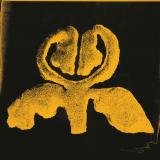
Describing his artistic practice as one of self-erasure, music instead provides Heygate with a more personal and autobiographical outlet. Where the two worlds combine is on Preludes’ striking artwork, which features paintings of 13th century stone carvings from the font of the church in the town where he grew up.

Speaking to a time where people were connected to the land in a more profound way, each symbol is assigned to a track on the album, which Heygate likens to giving them a title.

“To add that one juxtaposition might open a whole new interpretation or language that might be hard to find otherwise,” he explains.“Over time it might reveal itself to you, which is why I'm excited about it being released. To throw them out there and see what comes of it.”

pré-commande24.04.2026

il devrait être publié sur 24.04.2026

Reimaki - 妖精の通る道 / Yosei no toru michi

妖精の通る道 (The Path Where Fairies Pass) is the debut vinyl release by Reimaki, the duo of Rei Yokoyama (Triggers Flowers, Stakaidan, Lapiz Trio, 新井薬師自警団, and Fujio, Chiko Hige and Rei), and Maki Miura (Tsubamegami, Les Rallizes Dénudés, Shizuka, Fushitsusha, Ohkami No Jikan and Katsurei). The duo has been an understated presence in Tokyo, playing occasional under-the-radar shows and self- releasing a few CD-Rs, but they’ve recently started to break cover, with a recent cassette on UFO Creations, released in support of a late 2024 tour of China. It’s also a welcome reappearance on the scene for both musicians; Miura’s musical history, in particular, is being reevaluated thanks to a recent string of welcome Shizuka reissues.

But the music Reimaki make together is a different thing entirely, much as it shares some psychological and aesthetic interests with both Miura’s and Nokoyama’s other projects. Their sound is split between two main interests – an extension of glacial, deoxygenating psychedelic improvisations, and a deep interest in medieval European music. They’ve also been known to cover compositions by English prog/improv musician Fred Frith. These various elements of the Reimaki aesthetic are all present through 妖精の通る道, from the fragility of the opening “Novel Amor” through to the smeared, hazy textures of the three extended pieces that comprise the album’s flipside.

There’s a beautiful sympathy in these performances, and a generous simplicity, too; you can sense that this music is informed by decades of finding just the right way to say the right thing in the clearest manner possible. Yokoyama and Miura never overstate things; make the statement, play the song, let it hang in the air for a while, and then move on to the next essential expression. The music is unburdened by self- consciousness. Their take on medieval music cuts to the core of melody and melancholy; their psych- improv side is blurred and drifting without ever lapsing into rote generic gestures.

There’s some shared space with other artists who suspend the timeless within the kaleidoscopic possibilities of the psychedelic – Kendra Smith & The Guild of Temporal Adventurers; Emmanuelle Parrenin; Rosina de Peira – and a tangled folksiness that might put listeners in mind of Jan Dukes De Grey, Comus, Current 93, and Tower Recordings. Accompanied by beautiful photography from street photographer Takehiko Nakafuji, who was also personally chosen by Mizutani to document Les Rallizes Dénudés, 妖精の通る道 is a most unique and necessary trip.

pré-commande

Cet article n'a pas encore été publié. Vous pouvez pré-commander le produit maintenant.

Various - Tchic Tchic: French Bossa Nova 1963-1974  Colored Edition LP 2x12"
  • A1: Les Masques - Il Faut Tenir (1969)
  • A2: Isabelle Aubret - Casa Forte (1971)
  • A3: Christianne Legrand - Hlm Et Ciné Roman (1972)
  • A4: Jean Constantin - Pas Tant D'chichi Ponpon (1972)
  • A5: Billy Nencioli & Baden Powell - Si Rien Ne Va (1969)
  • B1-: Marpessa Dawn - Le Petit Cuica (1963)
  • B2: Jean-Pierre Sabar - Vai Vai (1974)
  • B3: Sophia Loren - De Jour En Jour (1963)
  • B4: Isabelle - Jusqu’à La Tombée Du Jour (1969)
  • B5: Sylvia Fels - Corto Maltesse (1974)
  • C1: Frank Gérard - Comme Une Samba (1972)
  • C2: Ann Sorel - La Poupée Des Favellas (1971)
  • C3: Charles Level - Un Enfant Café Au Lait (1971)
  • C4: Andrea Parisy - Les Mains Qui Font Du Bien (1970)
  • C5: Audrey Arno - Quand Jean-Paul Rentrera (1969)
  • C6: Aldo Frank - T’as Vu Ce Printemps (1970)
  • D1: Christianne Legrand - Cent Mille Poissons Dans Ton Filet (1972)
  • D2: Clarinha - Lemenja (1970)
  • D3: Hit Parade Des Enfants - Aquarela (1976)
  • D4: Jean-Pierre Lang - Tendresse (1965)
  • D5: Magalie Noël - Une Énorme Samba (1970)
  • D6: Françoise Legrand - La Lune

Ever since the late 1950s bossa-nova revolution, Brazil’s influence on French music has been undeniable. Pierre Barouh, Georges Moustaki and a vast array of lesser known artists, all made the Musica Popular Brasileira (MPB) an axis of promotion at the service of a cool and metaphysical, modern and mixed Brazilian lifestyle. Some were seduced by the poetic languors of the bossa, some were looking for fun, and others just loved the American hybridization of jazz-bossa, jazz-samba.


What is bossa nova? One of its creators, Joao Gilberto said: "Its style, cadence, everything is samba. At the very start, we didn't call it bossa nova, we sang a little samba made up of a single note - Samba de uma nota so .... The discussion around the origins of bossa nova is therefore useless”. It is nevertheless useful to remember that these magnificent Brazilian songs, which the guitarist describes as samba, were shifted and balanced around improbable chords. "I like things that lean, the in-betweens that limp with grace," said Pierre Barrouh, quoting Jean Cocteau.


With emotion, arrangements for violin and supple guitar licks, bossa nova rapidly changed. A transformation that can be heard in the Tchic, tchic, French Bossa Nova 1963-1974 compilation, the result of a cultural reappropriation, which traveled through the United States and supplemented itself in France.

A musical revolution that has remained significant, bossa nova was born in Rio. From 1956 to 1961, Brazil lived through its golden years. In five years, the country had invented its modernist style. Elected president in 1956, Juscelino Kubitschek de Oliveira, an elegant man with a broad forehead, brandished a promising slogan: "Fifty years of progress in five years". He quickly got to work. Not worried about increasing debt, he launched the project for a new federal capital, Brasilia, designed by the communist architect Oscar Niemeyer. Volkswagen opened state-of-the-art factories and created the “fusquinha”, the Beetle. In Rio, the Vespa made its first appearance. The Arpoador Surf Club crew run into the “girl” from Ipanema, Helô Pinheiro - the tanned garota ("chick"), between a flower and mermaid, who at 17 walked by the Veloso bar, where the fiery author and composer, Tom Jobim and Vinicius de Moraes, were getting drunk on whiskey. From then on, bossa symbolized cool.

In 1958, Joao Gilberto recorded Chega de Saudade, which the directors of Philips denied, calling it "music for fagots". The marketing director, who believed in it, secretly pressed 3000 78-inch vinyls and distributed them at schools around Rio, creating a tidal wave.

American jazzmen then took over. In particular, trumpeter Dizzy Gillespie and guitarist Charlie Byrd. In November 1962, the Brazilian Ministry of Foreign Affairs funded a "Bossa-Nova" concert at Carnegie Hall in New York, inviting the genre’s pioneers. Unprepared, the show soon turned to disaster. But the troupe was invited to the White House by Jackie Kennedy. The first lady loved "the new beat" and in particular Maria Ninguem, a song by Carlos Lyra, later covered by Brigitte Bardot.

In Brazil, the 1964 military coup quickly ended this euphoria. The destructive atmosphere that ensued pushed many Brazilian musicians to leave, if not to exile. Thus, Tom Jobim, Sergio Mendes and Joao Gilberto arrived to the United States. In New York, Joao Gilberto met saxophonist Stan Getz. At the time, he was married to the Bahianese Astrud Weinert Gilberto, who had a German father. She had never sung before, but she knew how to speak English. Getz therefore asked her to replace her husband on The Girl From Ipanema. The Getz/Gilberto record with Tom Jobim on piano, was released in March 1964. Phil Ramone, the "pope of pop" was in charge of sound.

Bossa nova arrived in Paris through the classic “guitar-voice” channel (Pierre Barouh, Baden Powell, Moustaki…) But France loved jazz and Paris had already welcomed its American contributors. All these good people were to pass through Saint-Germain-des-Prés. The cabaret l'Escale became the Mecca of Latin American sound where one could find Pierre Barrouh and his friends, such as the Camara Trio, samba-jazz aces, whose only record was published by the Saravah label. With a band strangely called Les Masques (a band that included Nicole Croisille and Pierre Vassiliu, among others), the Camara Trio recorded an interesting Brazilian Sound, including the track Il faut tenir which is present on this tasty compilation of rarities.

Other enlightened musicians can also be found on the compilation, such as Jean-Pierre Sabar (songwriter for Hardy, Auffray, Leforestier ...) and the French pop rock organist Balthazar. In 1975, Sabar recorded Aurinkoinen Musiikkimatka on a Finnish label, which featured the crazy Vai, Vai, included on this record. We are now following the footsteps of Brazilian electronic musicians such as Sergio Mendes, Eumir Deodato or Marcos Valle who created funk and disco sounds on their keyboards and synthesizers. A style that influenced Véronique Sanson when she wrote Jusqu’à la Tombée de la nuit in 1969 for Isabelle de Funès, the niece of Louis and a great friend of Michel Berger - Sanson did end up singing this track on her 1992 Sans Regret record.


The pinnacle of exoticism and travel, Sylvia Fels’ Corto Maltese includes bongos, sea mist and ocean sounds. The title was taken from Jacky Chalard’s concept album written in 1974, Je suis vivant, mais j’ai peur (I am alive, but I am scared), based on Gilbert Deflez’s science fiction novel.


However, bossa nova extended the scope of popularity. "In the 1970s, I was a fan of Sergio Mendes, Getz / Gilberto. I fell in love with this music that I knew because I had been an orchestral singer, " explained Isabelle Aubret, who in 1971 delivered a composite record of covers by the very funky Jorge Ben, Orfeu Negro, Tom Jobim, Vinicius de Morais and Jean Ferrat. "I recorded this album for Meys Records in Paris, far from Brazil, with wonderful musicians, François Raubert, Roland Vincent, Alain Goraguer...". The latter wrote the arrangements for Casa Forte, a very percussive title borrowed from Edu Lobo, one of the initiators of the bossa who spent time in California. "Jazz and bossa came together and produced very rhythmic music. I love singing, it allows me to dream, to have fun, to feel a high on stage, and these songs brought me joy, made me swing, my singing felt like a dance.”


The world tours of French singers and their desire for the tropics, often brought them to Rio with its hills, forests, caipirinhas and tanned bodies. There are surprises though, like this Iemenja (Iemenja is the goddess of the sea in the Afro-Brazilian candomblé religion). Not unlike the composer and musician Jean-Pierre Lang, based in Sao Paulo, Claire Chevalier taught Brazil to Brazil. In 1970, the singer and painter published a 45-inch vinyl, Mon mari et mes amants (My husband and my lovers), under the improbable pseudonym of Clarinha (little Claire). She was then living in Rio, with her husband, Joël Leibovitz, who founded a band called Azimuth, and who owned a record label specialized in "sambas enredos" songs for samba school parades.


For its B side, she asked Pierre Perret to come up with lyrics for a song composed by Carlos Imperial: "Oh goddess of the sea, o goddess Iemenja, I bring a white rose to adorn your long hair ..." . "Perret came to see us, and we had fun, remembers Joël Leibovitz. We wrote Lemenja for fun, we recorded it at the Havaí studio, behind the Central do Brasil the central station. Erlon Chaves, the arranger who worked with Elis Regina, joined us" adding his share of Afro-Brazilian percussions and funky brass to the mix.

There is a common misunderstanding in Franco-Brazilian history: that bossa, admittedly hedonistic, is perceived as funny, even though the poets who wrote the texts are often philosophizing on the human condition. Its French interpreters pull it towards a carnival inspired universe, far removed from its fundamental essence. Thus, Jean Constantin covered the famous Samba da minha terra, an ode to the art of samba written by the classic Bahian composer Dorival Caymmi, renaming it with the enticing title of Pas tant de tchi tchi pompon: "On your pier there is no tchi tchi / when you arch your back, you know everything is alright ”(lyrics by Gérard Calvi). This expedited bossa aims for the absurd, but retains a certain elegance.

Indeed, Jean Constantin was not an idiot, the rather large man had a huge mustache and liked fantasy, (Les pantoufles à papa, Le pacha, inspired by cha-cha-cha-cha, salsa and jazz) but he was also the lyricist of Mon manège à moi interpreted by Edith Piaf, the composer of Mon Truc en plume by Zizi Jeanmaire and the soundtrack of François Truffaut’s 400 Blows. Le Poulpe, published in 1970, from which this bossa is extract, was arranged by Jean-Claude Vannier, an accomplice of Serge Gainsbourg’s Melody Nelson. In short: "There is enough of samba / By looking at the parasol / Because my poor cabeza / Is going to die in the sun".

Even the American actress Marpessa Down, who was at the heart of the bossa nova revolution with her role as Euridyce in Marcel Camus’ film Orfeu Negro, winner of the 1959 Cannes Palme d'or, fed the clichée with Je voudrais parler au petit cuica - "Tell me how you manage to always make people want to dance / It's true, I must admit that I cannot resist your magic" - in consequence, once can hear the cuica, a little drum inherited from the Bantu.


But bossa nova had many angles. Societal, of course, pushing actresses who were symbols of women's liberation like Brigitte Bardot, Jeanne Moreau, or Sophia Loren to engage in the exercise of accelerated bossa. In February of 1963, Sophia Loren made a record in French in Rome, Je ne t'aime plus, featuring the song De jour en jour, a bossa written by two Italians, Armando Trovajoli and Tino Fornai, which was released a little later by Barclay. Bossa accompanied the 1960s, a decade of moral liberation. Ann Sorel, who interpreted La Poupée des favellas, caused a sensation with L’amour à plusieurs, a provocative song written by Frédéric Bottom and Jean-Claude Vannier. As for the actress Andrea Parisy, she displayed her bourgeois cheekiness in Marcel Carné's Les Tricheurs before interpreting Les mains qui font du bien. And Magalie Noël, the friend of Boris Vian, who sung Johnny fais-moi mal, was hired to sing Une énorme Samba, composed by Alain Goraguer (arranger to Gainsbourg, Bobby Lapointe and Jean Ferrat) with lyrics by Frédéric Botton.

But in the end, of what wood is bossa nova made of? The answer is given by Christianne Legrand, daughter of Raymond the conductor, and sister to Michel the composer: "With me, with jà" - jà means "immediately" in Portuguese. In 1972, the singer, an expert in vocal jazz and a member of the Double Six, published Le Brésil de Christianne Legrand. Two songs included on the Tchic Tchic compilation that demonstrate how bossa, jazz, funk, rock, etc. work like a swiss army knife: the music is used to denounce broken systems, or miracles, HLM et ciné roman, Cent mille poissons dans ton filet, two songs from the O Cafona soundtrack, a successful telenovela broadcast, at the time in black and white, on TV Globo. The first was adapted in French by the fighter and friend of the Legrand tribe, Agnès Varda. The second is content with a play on words, jostling them into a summer fun.


Véronique Mortaigne

pré-commande17.04.2026

il devrait être publié sur 17.04.2026

Yot Club - Simpleton LP

Yot Club

Simpleton LP

12inchYC6
Many Hats
17.04.2026
  • 1: Simpleton
  • 2: Projecting
  • 3: Bones
  • 4: Make It Easy
  • 5: Here & Now
  • 6: Romanticization
  • 7: Alien
  • 8: Honor Roll
  • 9: Serotonin
  • 10: Changes
  • 11: Okay
  • 12: Today
  • 13: Uphill Road

SIMPLETON, the third album from multi-platinum indie-rock singer/songwriter YOT CLUB, dismantles the utopian view of the American suburbs, treating finely manicured life as a mirage. Across its 13 tracks, the LP wrestles with how curated feeds and predictable routines can blur, and even erase, empathy and responsibility, creating a world where difficult questions and harsh realities are easy to ignore. In 2019, Ryan Kaiser started Y ot Club in his college dorm, crafting a lo-fi, classically cool indie rock sound grounded under a dreamlike haze. Two years later, his breakthrough single “YKWIM?” quickly reached viral status on TikTok (today, it’s been streamed more than 1 billion times) and has since taken him around the world at festivals like T reefort, Kilby Block Party and Pitchfork Paris

pré-commande17.04.2026

il devrait être publié sur 17.04.2026

Chessie + Contriva - Black Jacket LP 2x12"

Chessie + Contriva

Black Jacket LP 2x12"

2x12inchWAT09LP
Watusi
16.04.2026

“Black Jacket” is a love letter between two bands separated by continents but united by mutual admiration. Contriva, of Berlin, and Chessie of Washington, DC, first came together in 2001 when sharing a stage, sparking a deep connection over their respective takes on textural, emotive, and mostly instrumental music that merges post-rock, ambient, and experimental elements into unique visions. Fast forward two decades and many trips to their respective studios and we now have “Black Jacket”, a double LP of musical alchemy that builds upon the expressionistic, idiosyncratic sounds of these two groups. A new classic that proves far greater than the sum of its parts.

Begun in the mid 1990's, Washington DC's Chessie is Stephen Gardner (also of noisy shoegaze pioneers, Lorelei) and Ben Bailes, whose various LP's for Slumberland's Dropbeat imprint and Plug Research pair abstract electronics and melancholy post-rock in search of the sounds and feelings of railways and train travel.

Berlin's Contriva, (Monika Enterprises, Lok Musik, and Morr Music) features Masha Qrella (known for her solo works for Morr Music), Max Punktezahl (also of Munich indie legends the Notwist and Berlin's Jersey and Saroos), Hannes Lehmann and Rike Schuberty. For over a decade beginning in the mid-1990's, Contriva crafted compelling instrumentals, grafting experimental textures onto beautiful and complex indie songs.

Together, the six of them have created “Black Jacket.”

pas en stock

Commandez maintenant et nous commanderons l'article pour vous chez notre fournisseur.


Derniere entrée: 16 jours
Bleaching Agent x Miles J Paralysis - Double Vision EP

Bleaching Agent and Miles J Paralysis are two artists who operate steadily in their own lane. They collide on this release to deliver two contrasting originals, each handed to the other to be reimagined.

Both based alongside us in West Yorkshire, we are thrilled to present this shared vision in the form of the first Dream Space 12”.

Bleaching Agent’s Hollis captures the spirit of the bleeps & bass forged in the industrial north of years gone by, elevated with lush harmonies and slick vocal work. One that’s fit for late-night floors and hazy summer evenings alike.

Miles J Paralysis takes Hollis into a different space, chopping the melody into an infectious and hypnotic flow. All melded together with his signature dub-tinged, grooving percussive work.

On side two, Miles drags us into deep territory with Inhibited Orgy. Further exploring the otherworldly sound of his Paralysis moniker, that many of you will now be familiar with after a breakout year.

Bleaching Agent closes off the record with his own take, stoking the energy levels to create a stomping, anthemic chugger that is sure to ignite any dance floor.

Limited to 150 copies.

En stock du05.05.2026


Derniere entrée: 3 jours
B. Fleischmann - Music for Shared Rooms LP 2x12"

»Music for Shared Rooms« is B. Fleischmann’s eleventh solo album and his first since 2018. It is also not an album, or at least not in the conventional sense of the word. These 16 instrumental pieces provide a kaleidoscopic glimpse of a forward-thinking musician at home in many different musical worlds, including experimental and abstract music, pop and more classically-minded compositional forms. These pieces were culled from an archive of roughly 600 compositions for theatre pieces and films written throughout the past twelve years. The Österreichischer Filmpreis-awarded composer, however, aimed for more than simply documenting his extensive work in and with different media. To do so, he edited and re-mixed the individual recordings for this release, taking them out of their contexts and reworking them for an audience who can experience them in a different setting. »Music for Shared Rooms« makes it possible for its listeners to engage with the sounds and to fill the spaces they open up with their own imagination.

Roughly speaking, music for theatre or film can serve two functions: it either takes the lead, or underscores what is happening on stage or screen. The marvelous thing about these pieces is that they manage to do both. Fleischmann’s work as a prolific producer has always drawn on contrasts, at times combining pop sentiment with rigid experimentation, the seemingly naive with the intricate and complex. This approach also marks the tracks collected here: bringing together acoustic elements and electronic sounds, at times working with conventional structures but always de- and re-contextualising them, Fleischmann constructs a vivid dramaturgy out of discrete singular compositions, letting them interact across the record.

Take, for example, the opener »Träumerei« and the following »Brenne«: after the soothing acoustic sounds of the former, the latter quickly picks up speed with hard-hitting drum machine rhythms. It’s a stark contrast sonically and stylistically, however both tracks are tied together by a certain harmonic sensibility. This sort of dramaturgical interconnectedness of varied musical materials is the thread that runs through »Music for Shared Rooms«. A droney piece for string instruments like »Sehnsucht« is followed by a trip-hop beat, before »Schock« lives up to its title with skittering beats and piercing high frequencies. The differences between the pieces may be striking, but the progression from one to the other is subtle. It goes on like this through different moods and tempos. There’s soothing-yet-eerie piano pieces like the »Für Elise«-inspired »Der Lärmkrieg«, gentle house grooves, joyful synthesizer excursions and, finally, »Die Erde ist mir fremd geworden«, a collage of abstract textures and concrete sounds.

All these pieces create distinct situations through the juxtaposition of diverse musical elements, but are also bound together by a single vision. Writing music for theatre pieces or film requires a composer and his pieces to engage with people and their movements in space, which is exactly what Fleischmann offers on this record. He breaks down the fourth wall and invites his listeners into his world, a wide-ranging musical panorama. »Music for Shared Rooms« is indeed not an album in the conventional sense of the word, but more like a photo album in which each page opens up a new space to get lost in; recreates different scenes in which you can immerse yourself. These are shared rooms indeed.

pas en stock

Commandez maintenant et nous commanderons l'article pour vous chez notre fournisseur.


Derniere entrée: 16 jours
Junior Dell & The D-Lites - Whole Lotta Skankin’ LP

Let's see now – you just love that hugely fertile foundation period of Jamaican pop music from the birth of ska, through the spectacularly brief two year heyday of rocksteady up to and including the arrival of the first incarnation of reggae a.k.a. early or 'boss' reggae. But you're also aware that the pioneers of these sounds (including The Pioneers!) won't be creating music in these styles or touring forever – so what do you do?

Well, if you're Neil Anderson, owner of Original Gravity Records, the creation bit isn't a problem. You put forth period-authentic style material from a 'roster' of acts – such as Junior Dell & The D-Lites - that in reality consist mostly of yourself (you are a multi-instrumentalist and lyricist after all!) and whichever extra musicians and session singer you rope in for a given track. In the case of Junior Dell & The D-Lites that singer was Adrian Dell – soon to be dubbed (no pun intended) 'Junior' - first appearing on 2021's uptempo ska tribute to Salvadoran retro-dancing internet sensation Aranivah, entitled Miss Aranivah. And you keep putting out stuff so profusely and effectively that there are clamours for you to tour 'the band' which - er - doesn't really exist. What a botheration! Still, maybe your session singer could become – well - a permanent singer? Maybe you can rustle up assorted bredren to become the rest of the band and...you know what? That might just work!

And so, in the blink of an eye, Junior Dell & The D-Lites becomes a bona fide actual live band fronted by a young Jamaican singer playing fresh 60s/70s-style Jamaican music with an energy last seen and heard in, well, the 1960s and 70s. And it tours so effectively that there are clamours for 'the band' – or more accurately, now – the band - to release an album. Wait...what now? And, by the way, you've got a European tour coming up in April wouldn't it be great if the album was ready to tour by then? Pressure drop? Pressure rise more like!

Then again, Junior Dell & The D-Lites have done so many sure-shot singles to date that assembling them along with a new cut, an extended version of one of the singles and re-recordings of two of the label's previous singles that were originally by 'label mates' The Regulators should be a cinch. So expect all the hits: bluebeat banger 20 Flight Ska, the euphoric ska bounce of the aforementioned Miss Aranivah and the title track, a de rigueur smattering of covers (opener Jump Around, midway markers Praise You and Just Can't Get Enough, and one of the re-recordings, closer Don't Look Back In Anger), early reggae groovers Cool Right Down, Last Night Reggay, Can't Stop The Reggae (in a new extended form) and crowd-pleasing new one Mi Try along with the other Junior Dell re-recording - the gorgeous Why Why Why which nods to the period of reggae between the sound of '69 and the arrival of roots.

Don't you brag and don't you boast but that's a Whole Lotta Skankin' going on! Do the ska, do the rocksteady, do the reggay, why– it's another scorcher!

pas en stock

Commandez maintenant et nous commanderons l'article pour vous chez notre fournisseur.


Derniere entrée: 18 jours
Guilty Razors - Complete Recordings 1977 - 1978

UILTY RAZORS, BONA FIDE PUNKS.


Writings on the topic that go off in all directions, mind-numbing lectures given by academics, and testimonies, most of them heavily doctored, from those who “lived through that era”: so many people today fantasize about the early days of punk in our country… This blessed moment when no one had yet thought of flaunting a ridiculous green mohawk, taking Sid Vicious as a hero, or – even worse – making the so-called alternative scene both festive and boorish. There was no such thing in 1976 or 1977, when it wasn’t easy to get hold of the first 45s by the Pistols or the Clash. Few people were aware of what was happening on the fringes of the fringes at the time. Malcolm McLaren was virtually unknown, and having short hair made you seem strange. Who knew then that rock music, which had taken a very bad turn since the early 1970s, would once again become an essential element of liberation? That, thanks to short and fast songs, it would once again rediscover that primitive, social side that was so hated by older generations? Who knew that, besides a few loners who read the music press (it was even better if they read it in English) and frequented the right record stores? Many of these formed bands, because it was impossible to do otherwise. We quickly went from listening to the Velvet Underground to trying to play the Stooges’ intros. It’s a somewhat collective story, even though there weren’t many people to start it.
The Guilty Razors were among those who took part in this initial upheaval in Paris. They were far from being the worst. They had something special and even released a single that was well above the national average. They also had enough songs to fill an album, the one you’re holding. In everyone’s opinion, they were definitely not among the punk impostors that followed in their wake. They were, at least, genuine and credible.

Guilty Razors, Parisian punk band (1975-1978). To understand something about their somewhat linear but very energetic sound, we might need to talk about the context in which it was born and, more broadly, recall the boredom (a theme that would become capital in punk songs) coupled with the desire to blow everything off, which were the basis for the formation of bands playing a rejuvenated rock music ; about the passion for a few records by the Kinks or the early Who, by the Stooges, by the Velvet mostly, which set you apart from the crowd.
And of course, we should remember this new wave, which was promoted by a few articles in the specialized press and some cutting-edge record stores, coming from New York or London, whose small but powerful influence could be felt in Paris and in a handful of isolated places in the provinces, lulled to sleep by so many appalling things, from Tangerine Dream to President Giscard d’Estaing...
In 1975-76, French music was, as almost always, in a sorry state ; it was still dominated by Johnny Hallyday and Sylvie Vartan. Local rock music was also rather bleak, apart from Bijou and Little Bob who tried to revive this small scene with poorly sound-engineered gigs played to almost no one.
In the working class suburbs at the time, it was mainly hard rock music played to 11 that helped people forget about their gruelling shifts at the factory. Here and there, on the outskirts of major cities, you still could find a few rockers with sideburns wearing black armbands since the death of Gene Vincent, but it wasn’t a proper mass movement, just a source of real danger to anyone they came across who wasn't like them. In August 1976, a festival unlike any other took place in Mont-de-Marsan – the First European Punk Festival as the poster said – with almost as many people on stage as in the audience. Yet, on that day, a quasi historical event happened, when, under the blazing afternoon sun, a band of unknowns called The Damned made an unprecedented noise in the arena, reminiscent of the chaotic Stooges in their early adolescence. They were the first genuine punk band to perform in our country: from then on, anything was possible, almost anything seemed permissible.

It makes sense that the four+1 members of Guilty Razors, who initially amplified acoustic guitars with crappy tape recorder microphones, would adopt punk music (pronounced paink in French) naturally and instinctively, since it combines liberating noise with speed of execution and – crucially – a very healthy sense of rebellion (the protesters of May 1968 proclaimed, and it was even a slogan, that they weren’t against old people, but against what had made them grow old. In the mid-1970s, it seemed normal and obvious that old people should now ALSO be targeted!!!).
At the time, the desire to fight back, and break down authority and apathy, was either red or black, often taking the form of leafleting, tumultuous general assemblies in the schoolyard, and massive or shabby demonstrations, most of the time overflowing with an exciting vitality that sometimes turned into fights with the riot police. Indeed, soon after the end of the Vietnam War and following Pinochet’s coup in Chile, all over France, Trotskyist and anarcho-libertarian fervour was firmly entrenched among parts of the educated youth population, who were equally rebellious and troublemakers whenever they had the chance. It should also be noted that when the single "Anarchy in the UK" was first heard, even though not many of us had access to it, both the title and its explosive sound immediately resonated with some of those troublemakers crying out for ANARCHY!!! Meanwhile, the left-wing majority still equated punks with reckless young neo-Nazis. Of course, the widely circulated photos in the mainstream press of Siouxsie Sioux with her swastikas didn’t necessarily help to win over the theorists of the Great Revolution. It took Joe Strummer to introduce The Clash as an anti-racist, anti-fascist and anti-ignorance band for the rejection of old-school revolutionaries to fade a little.

The Lycée Jean-Baptiste Say at Porte d’Auteuil, despite being located in the very posh and very exclusive 16th arrondissement of Paris, didn’t escape these "committed" upheavals, which doubled as the perfect outlet for the less timid members of this generation.
“Back then, politics were fun,” says Tristam Nada, who studied there and went on to become Guilty Razors’ frontman. “Jean-Baptiste was the leftist high-school in the neighbourhood. When the far right guys from the GUD came down there, the Communist League guys from elsewhere helped us fight them off.”
Anything that could challenge authority was fair game and of course, strikes for just about any reason would lead to increasingly frequent truancy (with a definitive farewell to education that would soon follow). Tristam Nada spent his 10th and 11th unfinished grades with José Perez, who had come from Spain, where his father, a janitor, had been sentenced to death by Franco. “José steered my tastes towards solid acts such as The Who. Like most teenagers, I had previously absorbed just about everything that came my way, from Yes to Led Zeppelin to Genesis. I was exploring… And then one day, he told me that he and his brother Carlos wanted to start a rock band.” The Perez brothers already played guitar. “Of course, they were Spanish!”, jokes their singer. “Then, somewhat reluctantly, José took up the bass and we were soon joined by Jano – who called himself Jano Homicid – who took up the rhythm guitar.” Several drummers would later join this core of not easily intimidated young guys who didn’t let adversity get the better of them.

The first rehearsals of the newly named Guilty Razors took place in the bedroom of a Perez aunt. There, the three rookies tried to cover a few standards, songs that often were an integral part of their lives. During a first, short gig, in front of a bewildered audience of tough old-school rockers, they launched into a clunky version of the Velvet Underground's “Heroin”. Challenge or recklessness? A bit of both, probably… And then, step by step, their limited repertoire expanded as they decided to write their own songs, sung in a not always very accurate or academic English, but who cared about proper grammar or the right vocabulary, since what truly mattered was to make the words sound as good as possible while playing very, very fast music? And spitting out those words in a language that left no doubt as to what it conveyed mattered as well.
Trying their hand a the kind of rock music disliked by most of the neighbourhood, making noise, being fiercely provocative: they still belonged to a tiny clique who, at this very moment, had chosen to impose this difference. And there were very few places in France or elsewhere, where one could witness the first stirrings of something that wasn’t a trend yet, let alone a movement.

In the provinces, in late 1976 or early 1977, there couldn’t be more than thirty record stores that were a bit more discerning than average, where you could hear this new kind of short-haired rock music called “punk”. The old clientele, who previously had no problem coming in to buy the latest McCartney or Aerosmith LP, now felt a little less comfortable there…
In Paris, these enlightened places were quite rare and often located nex to what would become the Forum des Halles, a big shopping mall. Between three aging sex workers, a couple of second-hand clothes shops, sellers of hippie paraphernalia and small fashion designers, the good word was loudly spread in two pioneering places – propagators of what was still only a new underground movement. Historically, the first one was the Open Market, a kind of poorly, but tastefully stocked cave. Speakers blasted out the sound of sixties garage bands from the Nuggets compilation (a crucial reference for José Perez) or the badly dressed English kids of Eddie and the Hot Rods. This black-painted den was opened a few years earlier by Marc Zermati, a character who wasn’t always in a sunny disposition, but always quite radical in his (good) choices and his opinions. He founded the independent label Skydog and was one of the promoters of the Mont-de-Marsan punk festivals. Not far from there was Harry Cover, another store more in tune with the new New York scene, which was amply covered in the house fanzine, Rock News (even though it was in it that the photos of the Sex Pistols were first published in France).
It was a favorite hang-out of the Perez brothers and Tristam Nada, as the latter explained. “It’s at Harry Cover’s that we first heard the Pistols and Clash’s 45s, and after that, we decided to start writing our first songs. If they could do it, so could we!”
The sonic shocks that were “Anarchy in the UK”, “White Riot” or the Buzzcocks’s EP, “Spiral Scratch” – which Guilty Razors' sound is reminiscent of – were soon to be amplified by an unparalleled visual shock. In April 1977, right after the release of their first LP, The Clash performed at the Palais des Glaces in Paris, during a punk night organised by Marc Zermati. For many who were there, it was the gig of a lifetime…
Of course, Guilty Razors and Tristam were in the audience: “That concert was fabulous… We Parisian punks were almost all dressed in black and white, with white shirts, skinny leather ties, bikers jackets or light jackets, etc. The Clash, on the other hand, wore colourful clothes. Well, the next day, at the Gibus, you’d spot everyone who had been at this concert, but they weren’t wearing anything black, they were all wearing colours.”

It makes sense to mention the Gibus club, as Guilty Razors often played there (sometimes in front of a hostile audience). It was also the only place in Paris that regularly scheduled new Parisian or Anglo-Saxon acts, such as Generation X, Siouxsie and the Banshees, the Slits, and Johnny Thunders who would become a kind of messed-up mascot for the venue. A little later, in 1978, the Rose Bonbon – formerly the Nashville – also attracted nightly owls in search of electric thrills… In 1977, the iconic but not necessarily excellent Asphalt Jungle often played at the Gibus, sometimes sharing the bill with Metal Urbain, the only band whose aura would later transcend the French borders (“I saw them as the French Sex Pistols,” said Geoff Travis, head of their British label Rough Trade). Already established in this small scene, Metal Urbain helped the young and restless Guilty Razors who had just arrived. Guitarist for Metal Urbain Hermann Schwartz remembers it: “They were younger than us, we were a bit like their mentors even if it’s too strong a word… At least they were credible. We thought they were good, and they had good songs which reminded of the Buzzcocks that I liked a lot. But at some point, they started hanging out with the Hells Angels. That’s when we stopped following them.”

The break-up was mutual, since, Guilty Razors, for their part, were shocked when they saw a fringe element of the audience at Metal Urbain concerts who repeatedly shouted “Sieg Heil” and gave Nazi salutes. These provocations, even still minor (the bulk of the skinhead crowd would later make their presence felt during concerts), weren’t really to the liking of the Perez brothers, whose anti-fascist convictions were firmly rooted. Some things are non-negotiable.
A few months earlier (in July 1978), Guilty Razors had nevertheless opened very successfully for Metal Urbain at the Bus Palladium, a more traditonally old-school rock night-club. But, as was sometimes the case back then, the night turned into a mass brawl when suburban rockers came to “beat up punks”.

Back then, Parisian nights weren’t always sweet and serene.

So, after opening as best as they could for The Jam (their sound having been ruined by the PA system), our local heroes were – once again – met outside by a horde of greasers out to get them. “Thankfully,” says Tristam, “we were with our roadies, motorless bikers who acted as a protective barrier. We were chased in the neighbouring streets and the whole thing ended in front of a bar, with the owner coming out with a rifle…”
Although Tristam and the Perez brothers narrowly escaped various, potentially bloody, incidents, they weren’t completely innocent of wrongdoing either. They still find amusing their mugging of two strangers in the street for example (“We were broke and we simply wanted to buy tickets for the Heartbreakers concert that night,” says Tristam). It so happened that their victims were two key figures in the rock business at the time: radio presenter Alain Manneval and music publisher Philippe Constantin. They filed a complaint and sought monetary compensation, but somehow the band’s manager, the skilful but very controversial Alexis, managed to get the complaint withdrawn and Guilty Razors ended up signing with Constantin with a substantial advance.

They also signed with Polydor and the label released in 1978 their only three-track 45, featuring “I Don't Wanna be A Rich”, “Hurts and Noises” and “Provocate” (songs that exuded perpetual rebellion and an unquenchable desire for “class” confrontation). It was a very good record, but due to a lack of promotion (radio stations didn’t play French artists singing in English), it didn’t sell very well. Only 800 copies were allegedly sold and the rest of the stock was pulped… Initially, the three tracks were to be included on a LP that never came to be, since they were dropped by Polydor (“Let’s say we sometimes caused a ruckus in their offices!” laughs Tristam.) In order to perfect the long-awaited LP, the band recorded demos of other tracks. There was a cover of Pink Floyd's “Lucifer Sam” from the Syd Barrett era – proof of an enduring love for the sixties’ greats –, “Wake Up” a hangover tale and “Bad Heart” about the Baader-Meinhof gang, whose actions had a profound impact on the era and on a generation seeking extreme dissent... On the album you’re now discovering, you can also hear five previously unreleased tracks recorded a bit later during an extended and freezing stay in Madrid, in a makeshift studio with the invaluable help of a drummer also acting as sound engineer. He was both an enthusiastic old hippie and a proper whizz at sound engineering. Here too, certain influences from the fifties and sixties (Link Wray, the Troggs) are more than obvious in the band’s music.

Shortly after a final stormy and rather barbaric (on the audience’s side) “Punk night” at the Olympia in June 1978, Tristam left the band ; his bandmates continued without him for a short while.

But like most pioneering punk bands of the era, Guilty Razors eventually split up for good after three years (besides once in Spain, they’d only played in Paris). The reason for ceasing business activities were more or less the same for everyone: there were no venues outside one’s small circuit to play this kind of rock music, which was still frightening, unknown, or of little interest to most people. The chances of recording an LP were virtually null, since major labels were only signing unoriginal but reassuring sub-Téléphone clones, and the smaller ones were only interested in progressive rock or French chanson for youth clubs. And what about self-production? No one in our small safety-pinned world had thought about it yet. There wasn’t enough money to embark on that sort of venture anyway.

So yes, the early days of punk in France were truly No Future!

pas en stock

Commandez maintenant et nous commanderons l'article pour vous chez notre fournisseur.


Derniere entrée: 22 jours
Stephan Eicher - Spielt Noise Boys

2025 Reissue.


Münchenbuchsee, a suburb of Bern, Switzerland. Stephan Eicher is the youngest of three children. His father, a radio and TV repairman, is also a jazz violinist and a sound tinkerer in his spare time. In the family home's converted fallout shelter turned studio, Mr. Eicher experiments with homemade sequencers, tortures handcrafted drum machines, and abuses reel-to-reel tape recorders—all under the fascinated gaze of young Stephan.

The boy quickly develops a musical curiosity, exploring sound through various experiments and wanderings. Alongside his younger brother Martin, Stephan crafts audio plays on a homemade multi-track recorder (essentially several cassette decks hooked together!), which they write, record, add sound effects to, and perform for family and friends. Just a couple of nice kids, really...

Then comes 1972, and Lou Reed's Transformer album changes everything for the Eicher kids. For 13-year-old Stephan, it's a revelation—especially "Vicious", the opening track, which he plays on repeat for months. He convinces his father to buy him an electric guitar. Not stopping there, his father also builds him a tube amp using an old radio.

Then comes adolescence. A rough one. Stephan leaves home at 16 and moves to Zurich. With obvious artistic talent, he persuades his art teacher to help him get into F+F, a radical, alternative art school—despite his young age. Accepted, he starts learning video techniques, determined to become a filmmaker.

At F+F, Stephan organizes Dada-style happenings and concerts with a group of friends known as the Noise Boys. Among them: one of his teachers on bass, Veit Stauffer on drums (who would later found ReR/Recommended Records), his girlfriend Sacha on vocals, and Stephan on guitar. In one of their early performances, they release a remote-controlled mouse covered in dull razor blades into the audience to create panic and chaos. Keeping with this aggressive, confrontational spirit, they once played a concert while wearing headphones blasting Tristan and Isolde, trying to perform their own songs simultaneously—to maximize the cacophony. The goal was always the same: clear the room.

Their “songs,” if you can call them that, followed suit. Take "Hungeriges Afrika", for instance—performed entirely with power drills and some drum feedback.

To make ends meet, Stephan returns to Bern on weekends to work as a waiter at the Spex Club, the city’s main punk venue. On September 16, 1980, during a show by proto-electro group Starter, the police raid the club and arrest everyone. Stephan, who manages to avoid arrest, seizes the opportunity to “borrow” Starter’s gear left behind. He suddenly finds himself in possession of a Roland Promars synth, a Korg MS20, and a gorgeous CR78 drum machine, which he runs through a Big Muff distortion pedal to get that perfect gritty sound.

He then sets out to reinterpret some Noise Boys tracks, reworking them during impromptu sessions recorded on a dictaphone (yes, a dictaphone—now the lo-fi sound makes more sense, doesn’t it?). He ironically titles the resulting cassette "Stephan Eicher spielt Noise Boys" ("Stephan Eicher plays Noise Boys"). This gem features seven tracks, which are the ones reissued here.

Back in Zurich, he visits his friends Andrew Moore and Robert Vogel, who have a DIY cassette duplication setup. They make 25 copies of Stephan Eicher spielt Noise Boys for Stephan and his friends. Robert encourages him to visit Urs Steiger of Off Course Records and play him the tape.

Without much hope, Stephan shows up at Urs’s office. But Urs is instantly hooked and suggests releasing a 7” single. Due to space constraints, they reluctantly drop two of the seven tracks ("Hungeriges Afrika" and "One Second"). As for the musical score featured on the cover—it was randomly chosen and remains a mystery to this day. Calling all music theory nerds!

The 7-inch is pressed in 750 copies and released in the first week of December 1980—a date Stephan remembers well, as it’s the same week John Lennon was killed. Smartly, Urs sends a promo copy to François Murner, Switzerland’s answer to John Peel, who hosts a show on alternative station Sounds. Murner falls in love with the record and starts giving it airtime. To Stephan’s surprise, sales follow—and people actually seem interested in his music.

Even this modest underground success scares Stephan a bit. He stops making music for a year and moves to Bologna, where he works as a programmer at Radio Città, a feminist radio station.

Meanwhile, Stephan’s younger brother Martin, who’s also involved in the punk scene, joins the band Glueams as a singer and guitarist. Glueams, named after the fanzine run by two of its members (drummer Marco Repetto and bassist GT), eventually rebrands as Grauzone. Stephan is invited to their shows to project hacked Super 8 visuals live on stage.

Urs Steiger, now working on a compilation titled Swiss Wave – The Album, asks Grauzone to contribute alongside bands like Liliput, Jack and the Rippers, The Sick, and Ladyshave (Fall 1980).

For the album, Martin tasks Stephan with producing their recording sessions. Under Stephan's artistic direction, two tracks emerge: "Raum" and "Eisbär". During "Eisbär", Martin plays a minimalist bass line borrowed from post-punk band The Feelies (just an open string). Drummer Marco Repetto struggles to keep time. Later that evening, unhappy with the takes, Stephan builds a four-bar drum loop from a ¼-inch tape and uses it instead of the flawed original. He then adds bleepy synths and wind sounds to complete the track’s icy vibe before handing it over to Urs.

The Swiss Wave – The Album compilation is released quietly at first, but things snowball thanks to "Eisbär", which eventually becomes a smash hit—selling over 600,000 singles.

Meanwhile, Stephan plays in a rockabilly band called SMUV (named after Switzerland’s social security agency) and begins producing artists, including the debut album of Starter (1981), which includes a more pop-oriented version of "Minijupe".

By early 1982, Stephan starts spending time with the post-punk girl band Liliput (formerly Kleenex). They’re older than him, and he happily drives them around in his Renault Major, acting as their roadie.

By 1983, Grauzone—signed to the major label EMI, which turned out to be a misstep—is falling apart. Stephan begins to pivot toward a more mainstream pop sound with his debut solo album Les Chansons Bleues.

But that... is already another story.

pas en stock

Commandez maintenant et nous commanderons l'article pour vous chez notre fournisseur.


Derniere entrée: 3 jours
Kjell Bjørgeengen & Lasse Marhaug - Flood Coil
 
9

Some years ago, Kjell Bjørgeengen and Keith Rowe attempted to convert video signals into sound by setting up Rowe’s pickups next to an old CRT monitor, turning its magnetic field into a sound generator. Rowe further developed the system with David Jones at Alfred University, slimming down the setup using a copper coil, a circuit board, a video input, and a telephone pickup. Jones named it the »Flood Coil«, and it’s that instrument you can see on the album’s front cover and that lies at the core of these recordings, made without any physical live input from the artists themselves. In essence, it’s generative music in its purest form.

Bjørgeengen’s video feed is generated by oscillators, then routed into Marhaug’s pedals and then back into the Flood Coil, so any visual shifts alter the sound, and any modification to the sound changes the video. The duo have played this setup live many times, but for this studio version they left the system to do its thing without any intervention for two minutes at a time before moving onto the next idea. They recorded hours and hours using this process and then selected 18 highlights for this album, extracting harsh noise, power electronics, lulling feedback drone, and peculiar rhythmic snippets to show the scope of their technique.

A wall of growling, hi-octane Pulse Demon-style noise opens the set, gradually exposing us to more asymmetric textures, shifting through unstable repetitions that transform Merzbow’s metal-inspired screams into »Aaltopiiri«-era rhythmic noise. It’s remarkable, actually, how much Marhaug and Bjørgeengen can squeeze from the system, chancing on shivering, lower-case chugs and pops, galloping drums, soundsystem subs, and grinding blast beats that sound like Napalm Death’s »Scum« piped through a broken amp stack. It ain’t pretty, but noise/industrial freaks will revel in the fierce delights inside.

pré-commande10.04.2026

il devrait être publié sur 10.04.2026

Marion Brown - Awofofora

First time reissue of JP / US free jazz rarity.

The 1970s were Marion Brown’s most searching decade, a period during which he sought to move beyond the free jazz of the previous era and find more personal approaches to structuring improvisation and composition. After leaving New York for Europe in 1967, Brown began reshaping his music into what he described as “a more deliberate kind of music that had more structure to it,” pacing it so that moods and modes could develop over time. Albums such as In Sommerhausen, Afternoon of a Georgia Faun, Geechee Recollections, and Sweet Earth Flying trace this evolution: rhythmic structures moved to the foreground, harmony receded, and composition became a matter of orchestrating interlocking rhythmic parts as one would polyphonic lines.

Released in 1976, Awofofora is an overlooked but crucial entry in that sequence. At the time, its use of funk and reggae beats, electric guitars, and grooves drawn from contemporary Black popular music led some to misread it as a jazz-rock detour. In retrospect, it is entirely consistent with Brown’s methodology. As he admired in the Art Ensemble of Chicago, the stimulus comes from within the community. Here Brown filters Afro-Caribbean rhythms and funk through his own sensibility, abstracting their structural qualities rather than adopting surface style.

“La Placita,” making its first recorded appearance, layers distinct rhythmic phrases in a manner reminiscent of African drum ensembles, over which Brown and trumpeter Ambrose Jackson spin extended improvisations. The standard “Flamingo” is reshaped through diasporic rhythm and lyrical soloing, while “Pepi’s Tempo” and “Mangoes” harness crisp funk and reggae grooves to generate what Brown called a “manifestation of community” through collective improvisation. Even the overdubbed solo feature “And Then They Danced” reflects his structural thinking, ingeniously re-voicing a duet composition for two alto saxophones performed by one player.

This was the only recording by a short-lived band that briefly polarized audiences during festival appearances in 1976. Yet Brown consistently sought unity across change: different sounds, same principles — rhythm as structure, melody as architecture, collective improvisation, and above all, the primacy of tone. Awofofora stands not as a departure, but as a vivid synthesis of the elements he had been refining since the late 1960s, its grooves and golden alto lines conveying a sound drawn, in his words, “from life and from the world of experience.”

pré-commande10.04.2026

il devrait être publié sur 10.04.2026

SLUTET - Slutet LP

SLUTET

Slutet LP

12inchCRYPTMETAL038
Crypt Of The Wizard
10.04.2026
  • 1: Seven Days Of The Weak
  • 2: We Reap Our Crops
  • 3: Raped Beauty Sleep
  • 4: Old Blood Kapala
  • 5: O Ziemia!

Crypt of the Wizard is proud to make available two legendary underground albums by Slutet on vinyl and digital formats. Here we present the debut self titled LP Slutet - Slutet
Slutet originated in Uppsala well over a decade ago, first emerging as a loose idea around 2010. The original cluster of strangely like minded individuals - Dingir, Ryttersson, J.P., Sviatopolk, were equally set on starting a cult as they were a band, the former emerging as a loose collective known as The End Commune, while the latter eventually began rehearsing together as Slutet on September 1, 2013.
From this constellation three notorious demo tapes sprung which were self-released in very limited numbers, and only available by trading bodily fluids, blood, and/or hair for the cassettes. “A very loose guess but we made probably around 20-30 hand-drawn/custom demo tapes of the first three releases. We got blood and hair from many places, actually the very first offering was from INDONESIA. Slovakia, Germany, USA, Argentina, Norway, Canada, Finland followed.... if my memory serves..... hazy years indeed”
J.P. left early 2015. Later that year, after trying the band as a bass-drum-vocals outfit for a while, Fjalar joined on guitar. This is the classic constellation. Dingir, Ryttersson, Fjalar, Sviatopolk. The same troupe playing to this very day.
While the difficulty of obtaining the demos certainly added to the band’s bottomless mystique, the subsequent release of the self-titled compilation / LP secured their reputation as one of the most interesting and unorthodox bands recording under the somewhat ill-fitting moniker of ‘underground black metal’.
First released as a cassette by Berlin label Teratology Sound & Vision, and later on vinyl in an edition of 100 by Goatowarex, the self-titled LP is the definitive document of the very early and very wild years of the band as they begin to take form, fulminating against whatever was on offer.
“Between September 2013 and September 2014 we rehearsed and recorded 3 very crude demo cassettes; although sub-par in many musical and performance-wise aspects, the passion seeping through those recordings were evidently very real.”

pré-commande10.04.2026

il devrait être publié sur 10.04.2026

LUIZA - LUIZA

LUIZA

LUIZA

12inch3501066
Chapter Two
10.04.2026
  • Luiza - - Même En Hiver
  • Luiza / Carbonne - - Etincelles
  • Luiza - - La Vida Loca
  • Luiza - - Manha De Carnaval
  • Luiza - - Western Chinois
  • Bleu Soleil / Luiza - - Soleil Bleu
  • Luiza - - S'aime Encore
  • Luiza - - Ciclo
  • Luiza - - Demain Demain
  • Luiza - - Nuages
  • Luiza - - Aperta
  • Luiza - - Jet Lag
  • Luiza - - La Nuit
  • Luiza - - La Mer

Mit ihrem Debütalbum "Luiza" präsentiert die französisch-brasilianische Sängerin eine faszinierende Mischung aus World, Pop, Electronica und organischen Grooves. Aufgewachsen zwischen Jazz, Tanz, Amazonas-Reisen und Dub-Partys auf La Réunion, formt Luiza aus all diesen Einflüssen einen eigenen, sofort wiedererkennbaren Sound. Ihre Stimme nutzt sie wie ein Instrument - warm, flexibel und voller Emotion, oft mehrsprachig und manchmal sogar in ihrer eigenen Fantasiesprache. Ihr viraler Durchbruch gelang 2025 mit "Soleil bleu", einem Song, auf den sich überraschend Jugend- und Adult-Radiostationen gleichermaßen einigen konnten. Auch in Deutschland wurde der Titel zum erfolgreichsten französischsprachigen Radiosong des Jahres. Das Album "Luiza" knüpft an diesen Erfolg an: ein sonniges, energetisches Werk, das Natur, Freiheit und Lebenslust miteinander verbindet. Zwischen brasilianischen Klassikern wie "Manha de Carnaval", kraftvollen Hymnen wie "Étincelles" und internationalen Kollaborationen entsteht ein vibrierendes Klangbild, das Grenzen aufhebt und pure Lebensfreude transportiert. Luiza zeigt auf ihrem Debüt, wie moderne Global Pop Music klingen kann: farbenreich, mutig, intuitiv und voller Herz. Ein Album, das berührt - und das die außergewöhnliche Persönlichkeit dieser Künstlerin in jeder Sekunde spürbar macht.

pré-commande10.04.2026

il devrait être publié sur 10.04.2026

Bodysnatcher - Hell Is Here, Hell Is Home
  • 1: The Maker
  • 2: Writhe And Coil
  • 3: Plague Of Flies
  • 4: May Your Memory Rot
  • 5: Violent Obsession
  • 6: No Savior
  • 7: Blade Between The Teeth
  • 8: Two Empty Caskets
  • 9: Survive Or Die
  • 10: Hell Is Home

Florida deathcore heavyweights Bodysnatcher return with their most punishing and purposeful statement to date. ‘Hell Is Here, Hell Is Home’, out April 10, is not an escape record, it is a confrontation. Brutal, unrelenting, and emotionally unfiltered, the album captures a band fully locked into its identity while sharpening every weapon in its arsenal. True to their roots, Bodysnatcher deliver a sound steeped in suffocating grooves, bone-crushing breakdowns, and feral intensity. ‘Hell Is Here, Hell Is Home’ pushes beyond pure aggression. The record explores cycles of trauma, self-destruction, survival, and the uncomfortable truth that for many, suffering is not a phase, it is a place.

This is deathcore grounded in lived experience, written from inside the fire rather than in hindsight. Across the album, Bodysnatcher balance sonic violence with a disciplined sense of control. Downtuned riffs grind with oppressive weight, drums hit with mechanical precision, and vocals swing between outright hostility and grim reflection. Each track feels deliberate, built not just to hit hard, but to linger. With this release, Bodysnatcher continue to cement their position as one of modern deathcore’s most uncompromising voices. ‘Hell Is Here, Hell Is Home’ is a record built for the pit, rooted in truth, unflinching and heavy in every sense, delivered with absolute conviction.

pré-commande10.04.2026

il devrait être publié sur 10.04.2026

The Green Ray - Orchard Hosue LP

It seems almost inevitable that at some stage Blue Matter and The Green Ray would be working together, and we’re delighted to say that this is now about to happen. When Blue Matter co-boss, Nick Saloman, was living in Walthamstow, he sat in with The Green Ray many times at the late-lamented Plough Inn on Wood Street (now a mini-supermarket). In more recent times Nick’s band, The Bevis Frond has played live with them on several occasions, and without wishing to disrespect any former members, the current Green Ray line-up sounds as good as they’ve ever sounded, if not, dare we say, even better than before. The Green Ray was originally assembled in the mid-90s by Ken Whaley & Richard Treece, two key members of Walthamstow legends, Help Yourself. During the last 30 years or so, they have released 7 albums and one 12” single.

Sadly, the line-up has changed quite frequently due to the passing of several of their number. Ken & Richard passed away some years ago, and more recently bassist Jeff Gibbs departed this world. However, now under the all-seeing eye of guitarist Simon Whaley, the current line-up is continuing to fly the East London freak flag high. Not long ago Simon asked us if Blue Matter would like to issue their latest offering, and we came back with a resounding “yes please”. ‘Orchard House’ is a superb album, full of great playing and great songs. There are shades of Mighty Baby and Help Yourself (at their trippiest), plus a West Coast atmosphere which put us in mind of Quicksilver and The Grateful Dead. It’s taken some time to happen, but at last Blue Matter & The Green Ray have come together to issue an unmissable album. So don’t miss it.

pré-commande10.04.2026

il devrait être publié sur 10.04.2026

Melvins with Napalm Death - Savage Imperial Death March LP

After two co-headlining tours over the past decade, (the) Melvins are continuing their long tradition with us of teaming up with another band on an album. Next up – Napalm Death! This isn’t just some split release with the bands each getting a side. Savage Imperial Death March is a full collaboration with both Melvins & Napalm Death playing together on all the tracks.


This release originally came out on super-limited CD and vinyl via AmRep in 2025 (tour and AmRep store only). This will be an extended version with 2 extra songs, brand new artwork from Mackie Osborne, new vinyl variants, and will be the official release for the first time at record stores, DSPs and more.


Napalm Death are credited as pioneers of the grindcore genre by incorporating elements of crust punk and death metal. Even after exerting an indelible influence on the entire world of heavy music for nearly 40 years, there is still no band on Earth that sounds like Napalm Death. Not just pioneers, but an enduring benchmark for invention and fearlessness in heavy and experimental music of all kinds, the Birmingham legends are still hurtling forward at full pelt.


The Melvins are one of modern music’s most influential bands. Having formed in 1983, the group — founded by vocalist/guitarist Buzz Osborne, with drummer Dale Crover joining a year later — has been credited with merging the worlds of punk rock and heavy music, forming a new subgenre all their own. Over their 40-plus-year career, they’ve released more than 30 original albums, numerous live records, and far too many to count singles and rarities.

pas en stock

Commandez maintenant et nous commanderons l'article pour vous chez notre fournisseur.


Derniere entrée: 24 jours
Various - Soul Psychédélique (The Sounds of Psychedelic Soul & Funk 1967-2024)
  • A1: Chairman Of The Board - Life And Death In G&A (Part 2)
  • A2: Curtis Mayfield - (Don't Worry) If There Is A Hell Below, We're All Going To Go
  • A3: The Temptations - Psychedelic Shack
  • A4: The Chambers Brothers - Time Has Come Today - Single Version
  • A5: Brutal Force - The Number For Groove
  • B1: Isaac Hayes – Hyperbolicsyllabicsesquedalymistic **
  • B2: Bobby Womack - California Dreamin
  • B3: The Five Stairsteps - Dear Prudence
  • B4: Ebony Rhythm Band - Drugs Ain't Cool
  • B5: Doris - You Never Come Closer
  • C1: Terry Callier -You Goin' Miss Your Candyman
  • C2: Rodriguez - Sugar Man
  • C3: Patti Drew - Hard To Handle
  • C4: Marlena Shaw - Liberation Conversation
  • C5: El Michels Affair - Murkit Gem
  • C6: Janko Nilovic - Drug Song
  • D1: Kylie Auldist - Nothin' Else To Beat Me **
  • D2: Khruangbin - Maria También
  • D3: Christian Madden & The Enemy Chorus - Twice As Thick
  • D4: Gabriels - Love And Hate In A Different Time
  • D5: Michael Kiwanuka - Black Man In A White World
  • D6: Mrcy – Purple Canyon

‘Soul Psychédélique’, released on Two-Piers, takes you on a journey into the world of Psychedelic Soul & Funk, from its early beginnings in the 1960s and 1970s to the current crop of artists championing the more Psychedelic, Trippy end of the Soul sound today.

‘Soul Psychédélique’ brings together legends of the Soul Psych scene, such as Curtis Mayfield, The Chambers Brothers, Marlena Shaw, The Temptations, and the brilliant ‘Sugar Man’ by Rodriguez. Place alongside Soul Titans like Isaac Hayes, Bobby Womack, Chairman of the Board, Terry Callier all delivering stunning Psychedelic Nuggets for your Listening pleasure. Throw in some covers like ‘Dear Prudence’ by The Five Stairsteps, ‘Hard to Handle’ by Patti Drew and ‘California Dreamin’’ Bobby Womack and finish with some brilliant modern-day exponents of the scene like Khruangbin, Gabriels and Michael Kiwanuka. The result is a crazy ride through the world of Psychedelic Soul and Funk. If you ain’t dancing and smiling by the end - what the hell is wrong with you!

‘Soul Psychédélique (The Best of Lounge & Exotica 1954-2022)’ is the fourth instalment in the ‘Psychédélique’ Compilation series on Two-Piers, following the critically acclaimed ‘Pop Psychédélique (The Best of French Psychedelic Pop 1964-2019)’, ‘Garage Psychédélique (The Best of Garage Psych and Pzyk Rock 1965-2019)’ and ‘Lounge Psychédélique (The Best of Lounge & Exotica 1954-2022)’ and is available on 2LP Coloured Vinyl

pas en stock

Commandez maintenant et nous commanderons l'article pour vous chez notre fournisseur.


Derniere entrée: 23 jours
Genevieve Artadi & Real Bad Man - Everything Is Under Control
  • A1: I Need A Break
  • A2: Little Claws
  • A3: Kill The Lie
  • A4: Set In Motion
  • A5: Wrong Shape
  • B1: Don’t Gotta Think About U
  • B2: No Regular No Chance
  • B3: Everything’s Under Control (Feat. Pink Siifu)
  • B4: Really Really Right

LA-based producer Real Bad Man and LA musician Genevieve Artadi announce their new collaborative album Everything Is Under Control, out October 3rd via the producer’s own Real Bad Man Records. Alongside the announcement, the duo are sharing two new singles from the forthcoming album, “Don’t Gotta Think About U” and “Little Claws”. The former is an electro pop banger that propels Artadi’s intoxicating vocals to the forefront and arrives with an accompanying visual. With Everything Is Under Control, Real Bad Man is proving his versatility as a producer, crafting intricate and lively electronic-forward foundations for an old friend in Genevieve to explore an eclectic, funky approach to her vocals.

Speaking about the single, Artadi says, "'Don’t Gotta Think About U' is about a person celebrating the explosion of her most recent unhealthy romantic relationship. Her spitefulness and delusion of freedom indicate she’s still inside the pattern she hasn’t yet realized she keeps signing herself up for. The sound is melancholic pop, the thread that has always tied Adam and me together despite our musical differences."

"I love juxtaposing dense drums and a very pretty voice," Real Bad Man says of collaborating with Artadi. "That’s what 'Don’t Wanna Think About U' is. We’re also trying to make something catchy at the same time, that’s what I’ve always been drawn to musically is blending genres and moods and get them to work together. As well as pulling Genevieve away from what she does with Knower and her solo stuff.

Real Bad Man’s collaboration with Artadi is a radical shift in approach for the producer, whose previous full-length projects this year were rooted in the distinct strain of underground hip-hop that he’s amassed an extensive catalog in. Everything Is Under Control marks an entirely different, and unpredictable, sonic approach for the duo, embracing experimentation and synth-led electronica that’s reminiscent of Artadi’s work as part with Pollyn (her former band with Adam/Real Bad Man) as well as current duo KNOWER with Louis Cole. Real Bad Man’s latest project extends his prolific run of collaborations this year, embarking in a new genre and sound entirely after releasing full-length projects with ZelooperZ (Dear Psilocybin), Boldly James (Conversational Pieces) and Willie The Kid (Midnight) in the first half of 2025.

Known for her complex, yet playful writing style, Genevieve Artadi has made a name for herself through four solo albums that stretch the gambit of jazz, dream pop and dance music. The last three albums were released on iconic label Brainfeeder Records and the fourth (Another Leaf) was made as part of her being a composer-in-residence with Sweden’s Norrbotten Big Band. She’s also been an accomplished collaborator with her bands Expensive Magnets, Pollyn and KNOWER, and performing and recording with the likes of Thundercat and Snarky Puppy.

Check out “Don’t Gotta Think About U” and “Little Claws” above, see below for more details on Everything Is Under Control and stay tuned for more from Real Bad Man coming soon.

pré-commande03.04.2026

il devrait être publié sur 03.04.2026

Articles par page:
N/ABPM
Vinyl