Search:studio 54 1977

Styles
All
  • 1
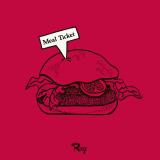
Soul City Orchestra - Meal Ticket (LP)

A great name. A great cover. And - of course - outstanding library music.

Soul City Orchestra's Meal Ticket houses titanic funk, mellow groove and symphonic disco-soul.

Released in 1977 on Rouge, a subsidiary of the prestigious and long-established British library label Music De Wolfe, Meal Ticket was crafted by the studio band Soul City Orchestra (a pseudonym for the De Wolfe in-house composers Chris Rae & Franck McDonald).

The driving instrumental funk-rock of the A Side is enhanced with strings and no little drama. However, it's undoubtedly the peerless flipside that makes this record an essential part of any collection.

Head straight to highlight "Chamber Maid"; insistent, conga-driven funky rock with lashings of string-heightened drama. It's sophisticated, classical and deeply classy.

The majestic, powerfully emotive "Sore Head" contains an excellent intro drum break and sultry slo-mo disco breaks throughout. It's low-key stunning. With a few melodic switch-ups, it's symphonic soul heaven and is comfortably the best and most beautifully crucial track on Side A.

The breezy, Philly soul-tinged "Short Change", its intense strings reminiscent of the Salsoul Orchestra and TSOP, presents an easy-glide funk that's just irresistible.

The funky, cool and slick AF "Wheeling And Dealing" is laconic flute and string-propelled sophisticated mid-tempo disco soul. It's worth the price of admission alone.

The breezy, mellowed out disco-funk workout "The Jam" is a deliciously slinky and sophisticated soul strut. Try not swaggering into the club with this in your head next time you venture into the murky world of "the night". Just ace.

The crowning glory is the sweeping, sublime symphonic disco breaks of horn-infused "Soul City Drive", an absolute monster of radiant heavy soul-funk à la Barry White with great string & brass arrangement.

Basically, this is essential for all groove-aficionados.

The audio for Meal Ticket has been meticulously remastered by Be With regular Simon Francis, ensuring this release sounds better than ever. Cicely Balston's expert skills have made sure nothing is lost in the cut whilst the records have been pressed to the highest possible standard at Record Industry in Holland. The original, iconic sleeve has been restored here at Be With HQ as the finishing touch to this long overdue re-issue.

In Stock

On Stock and ready to ship

LIVY EKEMEZIE - FRIDAY NIGHT LP

Livy Ekemezie’s Friday Night is widely recognised by DJs and afro-funk aficionados as a UFO (Unidentified Flying Object) grail record. It is one of those rare dance music albums that sounds like a record of its’ time but also has a timeless quality that makes each listen an immensely rewarding experience.

Fueled by teen spirit, every track slaps leaving little or no opportunity to skip. The song concepts circle around sweaty, afropolitan nightly excursions into the nightclubs of Aba, Port Harcourt and Lagos. But they could easily have been the soundtrack to Basquiat and Grace Jones grooving to DJ Larry Levan at Studio 54.

Digital Multitrack Sound Production combined with 80s synths and keyboards ushered in a new era. But what made this different is the bombastic but never overbearing "mélange" of slapping, funky bass lines, choppy synths, crazy, carefree vocals contributing to an intense dance-driven musical experience.

Livy and his friend Franklin Izuora teamed up with Jules Elong a seasoned keyboardist to create the LP in 1982, Franklin was a student in the US and already the experience of producing an album (Be Nice To The People, 1977, EMI) with the soundmaster, Odion Iruoje in the teenage afro-rock band, Question Mark. This gave Livy the confidence to leave most of the creative direction to him.

Livy had completed his secondary school cursus and was waiting to attend college. Jules Elong’s role was to make the record sound professional. The Quincy Jones influence created a reference point, Goddy Oku’s studio, Godiac was the mother ship for this 80s dance music masterpiece.

In Stock

On Stock and ready to ship

GRUPO UM - NINETEEN SEVENTY SEVEN

Grupo um celebrate 50 years with release of lost dictatorship-era album nineteen seventy seven!

First time release - vinyl comes with printed innersleeves

Brazilian avant-jazz vanguardists Grupo Um celebrate their 50th anniversary, sharing a second previously lost 1970s album from the vaults. Nineteen Seventy Seven (titled after the year it was recorded) is another rip-roaring instrumental fusion treasure from the band which spawned from within Hermeto Pascoal’s famed mid-1970s São Paulo collective.

Like their debut album Starting Point, Grupo Um’s Nineteen Seventy Seven was recorded when Brazil's military dictatorship was at its most repressive. “There were no open doors to those who dreamt to be protagonists in creative instrumental music”, remembers drummer Zé Eduardo Nazario, “even popular composers and singers had to submit their songs to censors and many records were banned and confiscated from the stores.”

Just like Hermeto Pascoal's Viajando Com O Som (1977) and Grupo Um's previous album Starting Point (1975), both of which remained unreleased until the 21st century, Zé Eduardo asserts that the 1977 album was flatly 'without any chance to be released at that time."

Recorded at Rogério Duprat’s Vice-Versa Studios in São Paulo, the group were under both time and space restraints, “we chose the small Studio B,” Lelo Nazario recalls, “which had a Tascam (TE AC) 12x8 console and a 4-channel AMPEX AG 440 machine. Therefore, we had to record without overdubs, everything straight to tape.”

Expanding from a trio to a quintet, original Grupo Um members Lelo Nazario (keys), Zé Eduardo Nazario (drums), and Zeca Assumpção (bass) were joined by saxophonist Roberto Sion and percussionist Carlinhos Gonçalves. Carlinhos, Zé and Zeca had already played together in the group Mandala, while brothers Lelo and Zé had just finished a stint backing Hermeto Pascoal during his years in São Paulo.

Lelo was deeply immersed in modular synthesizer experimentation during this period, working extensively with the ARP2600 and EMS Synthi AKS. These electroacoustic explorations formed the sonic foundation for "Mobile/Stabile," one of his first compositions to merge modular synthesis with Brazilian music, a fusion that would ripple throughout the Brazilian jazz scene. The piece premiered at the first São Paulo International Jazz Festival in 1978, performed by Grupo Um with guest trumpeter Márcio Montarroyos. In a shocking moment, festival organizers interrupted the show mid-performance, sparking fierce backlash from both audience members and journalists who denounced the incident as artistic censorship during Brazil's era of political and cultural repression. The version on Nineteen Seventy Seven is the first recording of the composition.

Nineteen Seventy Seven combines Afro-Brazilian rhythm, modular synthesis and a plethora of whistles, percussion and effects pedals. Album opener “Absurdo Mudo” - so titled for the absurd difficulty it poses to the musicians performing it - starts out in a cloud of mysterious dissonance, before the haze breaks for a glorious keyboard and saxophone interplay atop an uptempo samba groove. “Cortejo dos Reis Negros (Version 2)” (Procession of the Black Kings), based on the maracatu rhythm, inverts the traditional jazz song structure by beginning with improvisations, which are followed by the theme and a final coda. “The studio also had two Parasound electronic reverb units,” Lelo notes, “and the timbre is very audible on the soprano sax and percussion.”

Grupo Um’s daring music represents a manifesto of resistance during the dictatorship years, but it’s one which remains just as relevant today. As Lelo puts it: “For me, the aesthetic issue has always been about combining contemporary avant-garde languages with Brazilian music, independent of categories and commercial interests. The result of this fusion takes music to a new level.”

Recording credits (1977)
Recorded at Vice-Versa B Studio, São Paulo, November 9, 1977
Produced by Lelo Nazario and Zé Eduardo Nazario
Engineered by Ricardo “Franja” Carvalheira


Lelo Nazario – Wurlitzer electric piano, acoustic piano, signal generator, percussion

Zé Eduardo Nazario – drums, percussion

Zeca Assumpção – electric bass

Carlinhos Gonçalves – percussion

Roberto Sion – soprano sax, clarinet

Release credits (2025)
Produced by UTOPIA Studio, São Paulo
Project Coordination in Brazil by Irati Antonio (Utopia Studio)
Tape Restoration and Digital Mastering by Lelo Nazario at Utopia Studio, July 2025
Liner Notes by Lelo Nazario and Zé Eduardo Nazario
Photography by Jorge Las Heras, Lelo Nazario, and artists' personal archives
Photo Restoration by Lelo Nazario
Artwork and Design by Alessandro Renaldin

pre-order now30.01.2026

expected to be published on 30.01.2026

Penguin Cafe Orchestra - Penguin Cafe Orchestra LP

Penguin Cafe Orchestra’ is the second studio album by the Penguin Cafe Orchestra, released in 1981, and recorded between 1977 and 1980.  By this album, the line-up for the band had expanded greatly, with contribution including Simon Jeffes, Helen Leibmann, Steve Nye and Gavyn Wright of the original quartet, as well as Geoff Richardson, Peter Veitch, Braco, Giles Leamna, Julio Segovia and Neil Rennie.
All pieces were composed by Simon Jeffes, except for ‘Paul’s Dance’ (Jeffes and Nye), ‘Cutting Branches’ (traditional), and ‘Walk Don’t Run’ (by Johnny Smith).
The cover painting is by Emily Young.
‘Cutting Branches For A Temporary Shelter’ is based on the traditional Zimbabwean song, ‘Nhemamusasa’, a field recording of which can be heard played on mbira on the Nonesuch Records album ‘The Soul of the Mbira’.

The Boston Globe opined that “this is one of the most eccentric records released this or any year... It’s also one of the most delightful.”
In 2021, ‘Penguin Cafe Orchestra’ was named among The Fifty Best Albums Of 1981 by Spin.
This repress uses the 2008 remaster.

Pressed on apricot vinyl.

out of Stock

Order now and we will order the item for you at our supplier.


Last In: 10 months ago
Harry Mosco - Peace & Harmony LP

2022 repress

Official LP reissue of 'Peace & Harmony' by Nigerian funk royalty Harry Mosco, Originally released in 1979. Incl the big tracks ''Sexy Dancer'', ''Step On'' and ''Do It Together''

Isle Of Jura digs deep going back 40 years for the reissue of Harry's 1979 album which is something of an undiscovered gem that touches upon Disco, Funk, Boogie, Soul and Dub. Harry passed away in 2012 and we’ve worked closely with his son on the reissue.

Harry Mosco is best known as the founder of legendary 1970s Nigerian Afro-Funk band The Funkees. Originating as an Army band after the Nigerian Civil War they lead the wave of upbeat music produced by young artists in Nigeria in response to the darkness of the recently concluded civil conflict. Following a notable hit single ‘Akula Owu Onyeara’ the band split in 1977 and Harry pursued a solo career.

‘Peace & Harmony’ was Harry’s third LP continuing the rich vein of form found in previous albums ‘Country Boy’ and ‘Funkees’ (For You Specially). He was a visionary who wrote, arranged and produced each song on the LP assisted by Mark Lusari on engineering duties (P.I.L, Jah Wobble & Prince I), whose Reggae and Dub influence can be felt on title track ‘Peace & Harmony’ and ‘Peaceful Dub’. The LP contains two certified floorfillers of Studio 54 era Disco Funk in the shape of ‘Sexy Dancer’ & ‘Step On’ and two slow jams, the soulful ballad ‘She’s Gone’ and horn lead album closer ‘Do It Together’. Mr Funkees was printed on the cover to help record buyers make the connection between Mosco and his former band

out of Stock

Order now and we will order the item for you at our supplier.


Last In: 3 years ago
The Ethiopians - Freedom Train

The Ethiopians are one of the great vocal groups to come out of Jamaica. Singing songs of life and times as they found them, themes that resonated with the people of the Island that made them such a treasured group. Lenard Dillon (b. 9 December, 1942, Port Antonio, Jamaica) the founding member of the Ethiopians began his singing career at Clement 'Coxonne' Dodd's Studio One. Initially he recorded under the name of Jack Sparrow, and backed by the Wailers, cutting 'Ice Water' and 'Suffering In The Land'. Under The Wailers encouragement, he went on to form his
own vocal group. Recruiting singers Stephan Taylor (b.1944, Portland, Jamaica) and Aston 'Charlie' Morris to become The Ethiopians. They cut 'Live Good', 'Why You Gonna Leave Me Now' and 'Owe Me No Pay Me'. Although receiving favourable response, Aston Morris decided to leave the band and the remaining pair carried on and cut 'I'm A Free
Man' and 'Don Dead Already' and 'For You'. On meeting contract builder Leebert Robertson who had recently returned to live in Jamaica, ashad he wanted to get into the music business, a session was booked for Treasure Isle Studios. The session produced their seminal 'Train To Skaville' track, which became an immediate hit in Jamaica and in the UK, when in 1967 it reached number 40 in the charts. They also cut 'Engine 54', which became the title of their debut album. Its
follow up 'I Need You / Do It Sweet', did not fare so well and the band moved over to Sonia Pottinger's stable, where they cut 'The Whip / Cool It Amigo' which revived their fortunes and proved another big hit for the band. Two more hits followed 'Stay Loose Mama' and 'The World Goes Ska', after which the band decided to return to a trio, adding
Melvin 'Mellow' Reid to the line up. The band now hit another run of successes with producer JJ Johnson 'Everything Crash, 'Gun Man', 'Hong Kong Flu' and 'The Selah'. Many hits followed leading the band to work with a variety of Jamaican producers. Such tracks as 'I Want To Be a Better Man, ' Conquering Lion', 'Fire A Mus Mus' Tail', and the timeless 'Reggae Hit The Town' to name a few. Two albums 'Reggae Power' (1969) and 'Woman Capture Man' (1970), pulled a lot of these tunes together. Sadly Taylor was killed in 1975 after been struck by a van in a road accident. Dillon returned to Port Antonio till 1977, when he was persuaded to return to Treasure Isle studios with producer Niney The
Observer and cut the Rasta based album 'Slave Call'. Additional members who joined for this album were Bro Fatty, Bro Ewing, Bro T, Mello and Hychi Dread. An album that showed all the Ethiopians magic had not been lost.
For this release we have included the full 'Slave Call' set, 'Ethiopian National Anthem', 'Slave Call', 'Guilty Conscience', 'Hurry On', 'Mus Follow Babylon'(on CD Edition), 'Train To Skaville (1977 version, on CD Edition), 'Culture', 'Obeah Book', 'Let It Be' and 'I Love Jah'. Alongside some of the bands early hits including the original version of 'Train To Skaville', 'Engine 54', the great and poignant 'Everything Crash', 'Reggae Hit The Town' and 'The Selah'. An interesting set to remind us what a great group the Ethiopians really were.

out of Stock

Order now and we will order the item for you at our supplier.


Last In: 3 years ago
Michel Redolfi - Sonic Waters, Underwater Music 1979-1987

A work that literally immerses the listener into an acoustical substance. The sound becomes almost like matter, like jelly. Soon, you're swimming in sound, getting lost inside it.

With the Sonic Waters project initiated in 1978, my aim was to situate field of electronic music within a liberating and futuristic experience, outside the concert halls and in sync with the development of new instruments - in particular the Synclavier digital synthesizer, the first model of which I acquired in 1977. As concert space, the Pacific Ocean seemed to me to be the ideal experimental medium for both acoustic and cultural reasons. I then developed the aesthetic and technical elements that would contribute to the conception of Underwater Music. Numerous performances would follow spanning four decades, in natural sites or in large public pools such as those of Sydney, Paris or Venice during the 2006 Biennale.

Michel Redolfi (1951), French composer and sound artist, is the founder of Underwater Music. The natural elements captured and highlighted by experimental technology are a constant in Redolfi's catalogue: many compositions explore the earth environments such as in 'Pacific Tubular Waves', 'Jungles', 'Desert Tracks' (re-released on Sub Rosa records) and especially with 'Sonic Waters', a work that literally immerses the listener into an acoustical substance. During the mid-seventies Redolfi carried out his electro-acoustic research in the United States, with major electronic music centers including the California Institute of the Arts and chiefly the University of California in San Diego. As invited resident of their studios, Michel Redolfi launched the underwater music concerts, with the series 'Sonic Waters' performed in the Pacific Ocean. Michel Redolfi's underwater creations have since been regularly programmed by major international festivals, with multi-media installations held in ecological marine reserves or in historical city pools. Among them, the Sydney Festival, Paris 'Nuit Blanche', Ars Electronica in Linz, the 2006 Venice Biennale (nominated Golden Lion) and lately the 2018 Ars Musica festival in Brussels. This record presents different variations of Sonic Waters from 1980 to 1987, alternating studio mixes with their re-recordings in the depths of the Pacific. Michel Redolfi CD's and LP's are currently published by Sub Rosa, INA-GRM and Radio France.

out of Stock

Order now and we will order the item for you at our supplier.


Last In: 4 years ago
  • 1
Items per Page:
N/ABPM
Vinyl
