Reservar30.09.2026
debe ser publicado en 30.09.2026
debe ser publicado en 30.09.2026

Nollman and his cohort took a considered approach to developing sonic relationships with the orcas and other animals they encountered, always keeping a respectful distance as they found one another with their ears. Orcas' Greatest Hits collects hydrophone recordings drawn from over 60 hours of interspecies collaboration recorded between 1985 and 2002, showing the playful ways in which Nollman engaged the orcas from the portable studio floating above their home. What we hear is the focused listening by the cetaceans and humans as they search out sonic space among one another, finding in that dialogue potential common ground for deeper understanding.
debe ser publicado en 14.08.2026

Following a ten-year hiatus, multi-instrumentalists Rafael Anton Irisarri and Benoît Pioulard return with »How to Color a Thousand Mistakes«, their third LP together as Orcas. Building on the electronic minimalism of »Orcas« (2012) and the Twin Peaks-inspired haze of »Yearling« (2014), the duo have expanded their sound and vision into a full-spectrum ensemble.
In the time since their last major collaboration, Irisarri and Pioulard have done plenty on their own, while also traversing significant life changes: relocation from Seattle to New York, separation and divorce, illness, hospitalizations, and the loss of siblings, parents, and friends. Yet from these tribulations, they gleaned inspiration to reconstruct their lives, creating music with new collaborators and partners. Recorded in a variety of studios and cities including Brooklyn, Cambridge, Oxford, Seattle, and upstate New York, the resulting album, under the tutelage of UK producer James Brown (Arctic Monkeys, Kevin Shields, Nine Inch Nails), is a patiently-crafted beast, equally inspired by impressionism, British new wave, and dream pop.
With Irisarri’s guidance and Brown’s encouragement, Pioulard brings his velvety voice to its harmonized peak on songs like »Wrong Way to Fall« and the Durutti Column-indebted »Fare«. Where his most recent solo albums for Morr Music (»Sylva« and »Eidetic«) navigated foggy forests of ambient pop and stacked tape loops, here his characteristic blur shifts into focus with a unique degree of clarity and confidence. »How fare against balance do I / Navigate my errors?«, Pioulard sings in a heartbreaking tenor, echoing the album’s broader themes of introspection, grief, loss, trial and trauma.
Lead single, »Riptide«, is a summary of Pioulard’s life changes and personal upheavals in the past decade, »flitting eastward toward a yen deep in the past« and learning to glide through the tumult of ocean waves, as a metaphor for the punches one takes in pursuit of grace. Its towering, key-changing midsection arrives with the monumental drumming of Slowdive’s Simon Scott, a long-time friend and cohort who appears on most songs in the set. Scott’s quintessentially English, jazzier approach offers a balance of force and restraint as the backdrop for Irisarri’s majestic guitars, analog synth lines, and Martin Heyne’s Fender Rhodes counterpoints.
Second single, »Next Life«, began as a sketch by Scott, and reached its final form in the hands of Pioulard and Irisarri, at a point that each had endured major concurrent losses, finding a commonality in the need to gaze over the horizon while acknowledging the unavoidable bittersweetness of letting go – not only of people, but of routines, places, and expectations. It’s one of Orcas’ most nuanced pieces, with a mid-tempo, sunset glow that unfolds into a sparkling, slide-guitar finale as it disappears in the rear view.
On third-act highlight, »Bruise«, Scott is doubled on the drum kit by MONO’s Dahm Majuri Cipolla, whose Liebezeit-influenced metronomy anchors a nimble bass groove from Andrew Tasselmyer (of Hotel Neon), and some of the album's most syncopated, spaced-out interplay, courtesy of Puerto Rican guitar player Orlando Méndez (a childhood friend of Irisarri’s). Originally a droney, fingerpicked guitar demo, »Bruise« is the most storied composition here, having gone through almost a dozen versions and lyrical edits, with Brown distilling hours of improvised performances into the final arrangement.
Throughout »How to Color a Thousand Mistakes«, Irisarri uses his deep well of production experience to paint the stereo field with meticulously designed textures, exemplified on the slow burn of »Heaven’s Despite« and the heady rush of »Swells«. As a mixing and mastering engineer with Black Knoll, he has built a client list that reads as a who’s-who of modern, forward-thinking composition, including Temporary Residence, All Saints Records, and Ghostly International, among many others.
As with previous collaborations, Irisarri and Pioulard bring disparate styles and specialties to the table, but with an interpersonal dynamic that transcends friendship into brotherhood, their open-minded workflow and mutual respect are evident at every turn. »How to Color a Thousand Mistakes« brims with tight, complex art rock songwriting, masterful production, and sonic versatility, informed by a plethora of genres and tonal hues. The title might promise answers, but the gravitational center of the album is the dawning realization that, as you reckon with the infinite whims of the cosmos, there could be none.
debe ser publicado en 19.07.2024

A1 - Symbiotic Link
Kicking off another stellar, varied EP, ASC opens Symbiotic Link with an eerie introduction telling of a tense interaction between orcas in open waters before a thunderous break with immensely sharp venom-fueled snares often used by the likes of Photek back in the day aggressively seizes the attention, jolting and stabbing as the juddering bassline rumbles below - as synthy melodies provide respite in the mix.
A2 - A Single Emotion
Serving up another raucous, nostalgia-driven treat for any breakbeat fan, ASC channels his old-school mastery with a thoroughly absorbing journey through a variety of breaks, edited, chopped and filtered to perfection with dense, earthy basslines lying beneath. Lifted by a soundscape filled with light horn melodies, echoing vocal hits and washes of pads, you'll experience more than a single emotion here.
AA1 - Whirl
Time for a Hot Pants break serenade through swathes of atmospheric synths as Whirl expands ASC's diverse repertoire further still - an earworm melody at the forefront is provided by the bassline on this occasion - simple yet immensely effective. The bass intertwines with the breaks effortlessly while sci-fi effects and samples whoosh and fall with several tonal changes keeping things fresh till the curtains close.
AA2 - Frontier
A rousing cymbal kicks off a curious, deep introduction punctuated by melodic keys and a simmering undertone of suspense. Chunky old school breaks suddenly enter the mix with a continuous, enveloping bassline as the atmosphere builds steadily via micro melodies, noir vocal samples and delicate bells, as ASC closes another Spatial EP in his inimitable, unpredictable engaging style.
Words by Chris Hayes (Spatial / Red Mist)
Haga su pedido ahora y le encargaremos el artículo en nuestro proveedor.

debe ser publicado en 17.05.2024

New album by Gonçalo F Cardoso's Hannibal Chew moniker.
Tenerife, 2054: The parrots of a local zoo inexplicably go mad, spreading a deadly virus that only affects humans. Unable to contain the disease, authorities were forced to isolate the island completely, sealing its fate in a perpetual quarantine.
Over time, the island transformed into a sanctuary for wildlife that now roams freely across its territories. Orcas and dolphins claimed the surrounding waters, while gorillas found their home in the mountains around Teide, once a popular tourist destination. The population of parrots and birds multiplied, filling the air with a cacophony of colours and sounds.
The remaining humans on the island adapted to their new reality, living in isolated communities and learning to survive in a world where they are the minority. Meanwhile, the virus continues its advance in the outside world, pushing humanity to the brink of extinction.
debe ser publicado en 12.01.2024
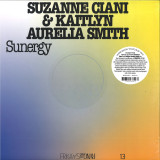
Sunergy brings together synthesists Kaitlyn Aurelia Smith and Suzanne Ciani for the thirteenth installment of FRKWYS, RVNG Intl.'s intergenerational collaboration series. For this edition, a panorama of the Pacific Coast provides the place and head space for a musical appreciation and consideration of a life-giving form vast and volatile with change. Fortuitously (as is the freaky way), Smith and Ciani were discovered to be neighbors in the small coastal community of Bolinas, California. The two had become close friends, bonding over their experience as woman musicians and, more unusually, their shared passion for the Buchla synthesizer. The music of Sunergy embraces this kinship, with Ciani and Smith respectively performing on the Buchla 200 E and the Buchla Music Easel, two modern configurations of the innovative instrument developed in the '60s by Don Buchla.
Sunergy was recorded in the Bolinas home where Ciani has lived for the last twenty-four years. Her living room overlooks the Pacific Ocean from a cliffside perch, creating an idyllic, inspired setting for music making. Setting up their synths side-by-side, Ciani and Smith took turns keeping time and freely improvising for the album sessions. As a complete piece, Sunergy is shaped by slow, pulsing forms and sinuous, melodic sequences that conjure both an oceanic world and the unlimited sound made possible by modular processing.For her part, Ciani has long been a Buchla voyager. Suzanne proselytized the potential of Don's synthesizer instruments in the '60s and '70s, performing her own compositions before introducing synthesized jingles and sound effects to household audiences. Ciani then achieved wide recognition for her debut album Seven Waves, a collection of colorful, classical song-like melodies fluidly working with harmonic textures and sounds of the ocean shore. Since its 1982 release, Seven Waves has become an important chapter of the ambient canon within which contemporary artists like Smith have developed their own synth syntax. Smith was born just a few years after the appearance of Seven Waves, growing up in Orcas Island, Washington. A place of profound natural beauty, the islands would inform Tides, her first instrumental collection from 2014. Smith composed Tides as an accompaniment for Yoga classes, ultimately freeing her from conventional songwriting into the exploratory, synth-based compositions demonstrated in ecstatic variety on 2016's Ears. Despite the serene setting where Sunergy was realized, the album does not romanticize a complete oneness with nature. Smith and Ciani use their collaborative ground to reflect on the unstable forces at play across the Bolinas horizon. Sunergy takes stock of Bolinas in the 21st century, a once-thriving artist's refuge now vulnerable to real estate pressure extending from affluent San Francisco, and more irreparably, the specter of climate change erasing its many waterfront habitats.
A diametric dynamic is present in Sunergy, a somber meditation amidst the intense cultural and solar forces transforming the landscape, and a hopeful assertion of the surviving creative culture of Bolinas. Far from rehashing the gentle grace of the artists' seminal works, Sunergy instead seeks to awaken and bear witness, employing the Buchla waveforms to mirror the infinite rhythms of the ocean and our essential relationship to it.
Kaitlyn Aurelia Smith and Suzanne Ciani's Sunergy will be released on September 16, 2016 on LP, CD, and digital formats. An accompanying documentary by Sean Hellfritsch will be offered in tandem.
Haga su pedido ahora y le encargaremos el artículo en nuestro proveedor.

The very first live stream on 9128.live broadcast from the studio of Rafael Anton Irisarri, as he and Thomas Meluch (Beno�t Pioulard) pieced together a completely live improvisation, christening the newly created 9128 airwaves and setting the bar for many more live takeovers. With one album between them as Gailes, and profound work individually (also together as Orcas), Rafael and Thomas are masters of the ambient craft, combining intricate field recordings, guitar, pedals, vocals and heady reverb across a 40-minute non-stop immersive listen, split into two 20-minute sides for the inaugural 9128 vinyl release. The 9128 label aims to document significant live performances by artists that previously performed on the 9128.live platform. With recordings initially created for a singular collective listening moment, and often as part of a festival or takeover weekend, label recordings will re-present this music for further listening across various formats that best suit each release. Gailes - Session Two, will be available as a digital download and 12", printed in a reverse-board die-cut sleeve, black vinyl.
Haga su pedido ahora y le encargaremos el artículo en nuestro proveedor.

Kaitlyn Aurelia Smith is an American composer, performer and producer, originally from Orcas Island and currently based in Los Angeles. After several self-released albums, Smith was signed to independent record label Western Vinyl in 2015, who released her first official album, Euclid, in January 2015. Her latest album, T ides: Music for the Meditation and Yoga , was released in January 2019.
Smith grew up and was home-educated on Orcas Island, Northwestern Washington. She left the island to study composition and sound engineering at Berklee College of Music in Boston, before returning to the island after her graduation.
It was after returning home that Smith discovered synthesizers, when a neighbor introduced her to the Buchla 100 Synthesizer. Having originally intended to use her voice as her primary instrument, and then moving to classical guitar and piano, Smith switched to the use of synthesizer after being leant and experimenting with the Buchla 100 for a year.
Smith formed indie-folk band Ever Isles whilst still at Berklee but left the project after discovering the Buchla 100, explaining, “I got so distracted and enamored with the process of making sounds with the Buchla’s potential that I abandoned the next Ever Isles album”.
When developing her composition skills, Smith used visual aid as inspiration for her music. She has said that she is always composing to a visual in her head, explaining, “Sometimes I let the sound create the image for me and then I build off that. Or vice versa: I come up with imagery that is inspiring to me, or I see something that is inspiring, and then create sounds that I feel match it”.
Recorded in 2013, Tides is a glimpse into the early phase of what has become Kaitlyn Aurelia Smith’s signature approach to electronic music. Composed and played on a Buchla Music Easel––the modular synthesizer that gives Smith’s music its organic feel––this collection of instrumentals is at once uplifting, transportive and meditational.
Haga su pedido ahora y le encargaremos el artículo en nuestro proveedor.
