Cerca:natural rhythm

Generi
Tutto
JUAN MANUEL CIDRÓN - SLG3  LP 2x12"

Juan Manuel Cidrón, hailing from Almeria (Andalusia), is a legendary Spanish synthesist who embarked on his musical journey in 1976. A veteran of analog electronic sounds, his early influences come from the Berlin School of the seventies (Tangerine Dream, Klaus Schulze, etc.) and American Minimal music.

Cidrón has independently released 16 albums on his label, Extrarradio, with very limited distribution. ‘Juan Manuel Cidrón has always been immersed in music. As a child, he fell in love with a radio adorned with flashing lights – radio is now one of his professions. He was equally captivated by the music that enveloped him. With whatever little money he had as a child and during his youth, he would spend all his money on records and analog machines. Music is everything to him, and that’s why we understand his compositions as a celebration of life. The vastness that his electronic keyboards offer us is akin to the immensity of the desert, snow, and wind. Albums like ‘Tau’ or ‘Sonido Para Acciones’ belong to the realm of Spanish electronic music and are cherished by enthusiasts of sonic poetry. This vinyl edition holds a special place as it marks a return to analog, a medium Cidrón reveres and continues to embrace. In this way, it becomes a classic, a testament to his unwavering commitment to the quality that arises from the harmonious blend of natural and artificial rhythms. The result is always him: a tangible presence that brings us closer to dreams and the unadorned face of the world.’ (F. Labordeta Blanco)

‘SLG3’ is a long-awaited double album with four lengthy tracks (one per side), available in a limited edition of 300 copies. It’s the first release exclusively on vinyl in over a decade (since ‘Patagón’ on Geometrik in 2012), considering that Cidrón has mainly released his recent works on CD.’The tracks S, L, and G evoke the personal perceptions that I could imagine for each of the three elements comprising our planet in all its forms, manifestations, and presences. The track ‘3’ evokes my unique interpretation of how an imaginary being from another world might perceive Earth – its discovery, journey to it, exploration filled with admiration, bewilderment, hope, and respect. However, all of this is open to free interpretation and imagination for those who listen.’ (Juan Manuel Cidrón, 2023)

All tracks were written, produced, and mixed by J.M. Cidrón between 2017-2019 at the Extrarradio Studio in Almeria.

In Stock

Disponibile in Stock e pronto per la spedizione

Various - NEXV 002

UK-based Natural Expressions latest 4 tracker offers pure primetime examples of dub and deep techno. 2 from beloved fixtures in the scene along with 2 that are on the rise. The universally recognized Gradient, gives us 'Flight Above the Fog' and like the title alludes to, it accomplishes. Known for his intricate and classic dub techno rhythms, this hypnotic standout builds the atmosphere to a goosebump crescendo. Collogne follows up with 'West District'. A mesmerizing chord anthem that hangs around in the sweet spot, never over-extending its' welcome.

The second side hosts the ever-talented veteran Merv and his wicked contribution titled 'Serpent'. This attention grabber is standout dub techno in the upmost. Elegant and tempered, it chooses the smoothest route, washing over the listener with absolute dream-like euphoria. Vapnik closes the 12" with a fantastic reinterpretation of the Marco Hessler track 'Spacewaves'. The scintillating chord work is an audible thrill while the subdued drop towards the middle is pure magic. Another strong artist who really brings the heat. NEXV002 ‎is the ideal example of a 4 track EP that features no holes. All killer and no filler.

In Stock

Disponibile in Stock e pronto per la spedizione

Lord of the Magi - Soul Exchange LP

In striking daubs of bled-out colour and finely sculpted layers of instrumentation, Lord of the Magi arrives on Tartelet Archives with an album of ambient reflections.

Copenhagen-based Theo Nicola Anker has different sides to his musical output. But on Soul Exchange, he shakes off stylistic concerns to focus on a purer emotional expression. It’s an instinctive paean to the pastoral life he grew up with, sent with love from his city-centre apartment. His chosen tools – guitars, pedals, synths – are the medium of the message. “I appreciate music with personality, character, and charisma,” Anker says, “so I always strive to create tracks that tell a story and evoke a specific atmosphere. No single idea for a track is solely melodic, rhythmic, compositional, or focused on mix techniques. It's always about the bigger picture, the overall vibe.”

On Soul Exchange, the overarching mood is an inviting, becalming one, but there’s plenty of space for melancholy and even a little friction. That’s apparent in the natural synergy of the organic and electronic elements as much as the emotional content, rounding out as a wholesome, holistic listening experience.

In Stock

Disponibile in Stock e pronto per la spedizione
Kölsch - I Talk To Water LP 2x12"

I Talk To Water, the fifth album for Kompakt by Danish producer Kölsch, is the artist’s most personal statement yet. While all the trademarks that make his music so popular and powerful are still present – lush, melodic techno; swooping, trance-like figures; sensuous, shivery texturology – I Talk To Water is also a deep and intimate rapprochement with family and history, a beautiful, finely detailed document of loss and memory, and a tracing of the long, unbroken thread of grief that runs through our lives once we’ve lost those we loved.

The emotional core of I Talk To Water, then, is a cache of recordings by Kölsch’s father, Patrick Reilly, who passed away in 2003 from brain cancer. With time rendered elastic by the pandemic and its associated lockdowns, its sudden, alienating shifts in everyday living, Kölsch found himself reflecting on his father’s passing and ongoing spiritual presence, thinking about how best to memorialise such a significant figure in his own life. Those recordings opened a gateway, of sorts, for Kölsch to move through – a way to bring past and present together and entwine them in a sensitive, poetic manner.

Kölsch’s father was a musician – “touring in the sixties and seventies, in the Middle East especially, he was doing the whole hippy trail, playing guitar, and wrote some songs over the years,” he recalls. “But all in all, he decided to focus on family rather than pursue a musical career.” Reilly kept playing and writing music over the years, though Kölsch hadn’t listened to the material for some time: “I’d never had the guts to listen to it, because I just felt too fragile listening to his voice. It’s such a tough thing to go through.”

During the pandemic, though, Kölsch listened through the fragmented body of work that his father had produced over the years. “I decided I’m gonna finally release my dad’s music twenty years after his passing,” he reflects. “This whole album is about the process of loss, and for me it’s been one of my main driving forces in my musical life, the whole emotional aspect of whatever I’ve done has been based in that feeling that he’s not there anymore.”

Recordings of Reilly appear on three songs across I Talk To Water. His guitars drift pensively across “Grape”, offering a lush thread of melody that Kölsch wraps with clicking, driftwood rhythms and droning, melancholy bass. “Tell Me” is a lovely three-minute art song, a sadly beautiful reflection, minimally adorned with gentle keys and a muted pulse. And on the closing “It Ends Where It Began”, Kölsch lets his father’s acoustic guitar take centre stage for a lament that’s unexpectedly folksy, a guitar soli dream, which Reilly originally recorded in 1996. “He actually recorded it for my first album that never came out,” Kölsch reveals, “and I had it sitting around forever. That is purely him.”

These three imagined collaborations between father and son are poised and delicate. But their relationship also marks the gorgeous music Kölsch has made across the rest of I Talk To Water, from the itchy yet lush “Pet Sound” (titled in tribute to one of Reilly’s favourite albums), the flickering synths and yearning vocal samples that slide through “Khenpo”, the ecstatic shuddering that marks “Only Get Better”, or “Implant”’s slow-motion pans and subtle reveals.

There’s also the title song, where Kölsch is joined by guest Perry Farrell (Jane’s Addiction, Porno For Pyros), singing a mantra for internal reflection: “I talk to water / Searching for myself / Looking for answers / Oceans of you.” Farrell’s appearance brings another timbre, another spirit to the album, aligning neatly with his recent interest in electronic music. “He was completely taken by this idea of talking to water,” Kölsch says, thinking about the ways we collectively lean towards the natural world as a comfort and a listener, a guide through mourning, a way to map out the terrain of the heart. This mapping is something that Kölsch has proven remarkably adept at through the years; dance music for both body and mind, but also both for the here-and-now, and for the hereafter.

“I Talk To Water”, das fünfte Album des dänischen Produzenten Kölsch für Kompakt, ist zweifellos das persönlichste Statement des Künstlers bislang. Während alle Markenzeichen, die seine Musik so beliebt und kraftvoll machen, immer noch präsent sind – üppige, melodische Techno-Tracks; schwebende, tranceartige Elemente; sinnliche, fiebrige Texturen – ist “I Talk To Water” auch eine tiefe und intime Annäherung an Familie und Geschichte. Es ist ein wunderschönes, fein ausgearbeitetes Dokument des Verlusts und der Erinnerung, und es verfolgt den langen, ungebrochenen Faden der Trauer, der durch unser Leben läuft, sobald wir diejenigen verloren haben, die wir liebten.

Der emotionale Kern von “I Talk To Water” besteht aus Aufnahmen von Kölschs Vater, Patrick Reilly, der 2003 an Hirnkrebs verstarb. Durch die Pandemie und ihre damit verbundenen Lockdowns, die plötzlichen, entfremdenden Veränderungen im Alltag, fand Kölsch sich in Gedanken an den Tod seines Vaters und seine fortwährende spirituelle Präsenz wieder. Er überlegte, wie er eine so bedeutende Figur in seinem eigenen Leben am besten verewigen könnte. Diese Aufnahmen öffneten ihm sozusagen ein Portal, um Vergangenheit und Gegenwart miteinander zu verbinden und sie auf sensible und poetische Weise zu verweben.

Kölschs Vater war Musiker – “er tourte in den sechziger und siebziger Jahren, vor allem im Nahen Osten, auf dem Hippie Trail, spielte Gitarre und schrieb im Laufe der Jahre einige Songs”, erinnert sich Kölsch. “Aber alles in allem entschied er sich, sich auf die Familie zu konzentrieren, anstatt eine musikalische Karriere zu verfolgen.” Reilly spielte und schrieb jedoch im Laufe der Jahre weiterhin Musik, obwohl Kölsch das Material lange Zeit nicht angehört hatte: “Ich hatte nie den Mut, es anzuhören, weil ich mich einfach zu zerbrechlich fühlte, seine Stimme anzuhören. Es ist so schwer, das durchzustehen.”

Während der Pandemie hörte sich Kölsch jedoch durch das fragmentierte Werk, das sein Vater im Laufe der Jahre produziert hatte. “Ich beschloss, die Musik meines Vaters zwanzig Jahre nach seinem Tod endlich zu veröffentlichen”, reflektiert er. “Dieses ganze Album handelt von dem Verlustprozess, welcher für mich generell eine der Hauptantriebskräfte in meinem musikalischen Leben ist. Der ganze emotionale Aspekt von dem, was ich getan habe, basierte auf dem Gefühl, dass er nicht mehr da ist.”

Auf “I Talk To Water” sind Aufnahmen von Reilly in drei Songs zu hören. Seine Gitarren ziehen nachdenklich durch “Grape”, bieten einen üppigen Melodiefaden, den Kölsch mit klickenden, treibenden Rhythmen und dröhnendem, melancholischem Bass umwickelt. “Tell Me” ist ein schönes dreiminütiges Kunstlied, eine traurig-schöne Reflexion, minimal geschmückt mit sanften Tasten und einem gedämpften Puls. Und auf dem Abschlusstrack “It Ends Where It Began” lässt Kölsch die akustische Gitarre seines Vaters im Mittelpunkt stehen, ein überraschend folkiger Klagegesang, den Reilly ursprünglich 1996 aufgenommen hatte. “Er hat es tatsächlich für mein erstes Album aufgenommen, das nie veröffentlicht wurde”, enthüllt Kölsch, “und ich hatte es ewig liegen.”

Diese drei erdachten Kollaborationen zwischen Vater und Sohn sind ausgewogen und zart. Aber ihre Beziehung prägt auch die wunderschöne Musik, die Kölsch im Rest von “I Talk To Water” geschaffen hat, angefangen bei dem nervösen, aber üppigen “Pet Sound” (benannt als Hommage an eines von Reillys Lieblingsalben), den flimmernden Synthesizern und sehnsüchtigen Vocal-Samples in “Khenpo”, den ekstatischen Erschütterungen in “Only Get Better” oder den langsamen Schwenks und subtilen Enthüllungen in “Implant”.

Es gibt auch den Titelsong, in dem Kölsch von Gast Perry Farrell (Jane’s Addiction, Porno For Pyros) begleitet wird, der ein Mantra für die innere Reflexion singt: “I talk to water / Searching for myself / Looking for answers / Oceans of you.” Farrells Auftritt bringt eine weitere Klangfarbe, einen weiteren Geist in das Album, der gut zu seinem jüngsten Interesse an elektronischer Musik passt. “Er war völlig fasziniert von der Idee, mit Wasser zu sprechen”, sagt Kölsch und denkt darüber nach, wie wir kollektiv zur Natur als Trost, Zuhörer, Führer durch die Trauer neigen, um die Gelände des Herzens zu kartieren. Diese Kartierung ist etwas, in dem Kölsch im Laufe der Jahre erstaunlich geschickt war; Tanzmusik für Körper und Geist, sowohl für das Hier und Jetzt, als auch für das Leben danach.

In Stock

Disponibile in Stock e pronto per la spedizione

Stephen O'Malley & Anthony Pateras - Sept duos pour guitar acoustique et piano préparé (2x12")

Sept duos pour guitar acoustique et piano préparé is the second duo recording from Stephen O'Malley and Anthony Pateras. Their first together, Rêve Noir (2018), took an electro-acoustic scalpel to a 2011 duo concert for electric guitar and piano, using Revox and digital treatments to twist and smear gig documentation into ghostly echoes and fractured drones. Here, in contrast, the music is entirely acoustic and presented as it was performed, without overdubs. Both players’ choices of instruments are notable: this is O'Malley’s most extensive recording on steel string acoustic guitar (playing an instrument whose previous owners include Marissa Nadler and Glenn Jones) and Pateras return to the prepared piano, which he has rarely employed in recent years, after spending much of the first decade of the 21st century exploring its possibilities.

Recorded during O'Malley’s residency at La Becque on Lake Geneva in the summer of 2021, from the first moments of the opening ‘déjà revé’ the music immediately establishes the distinctive landscape of chiming tones and hovering clouds of resonance explored throughout its one-hour running time. Pateras’ preparations create tolling bell-like tones alive with complex overtones, alongside which O'Malley’s open strings and natural harmonics add a sparkling clarity. While Pateras’ music often uses a densely chromatic harmonic language, these duos are remarkable for their modal simplicity. However, the interaction between the pure intervals of O'Malley’s just-intoned strings and the unstable harmonies created by the piano preparations suspends the music in an oneiric state of hazy ambiguity. Without obvious reference to tempo or meter, the music floats in what the composer Ernstalbrecht Stiebler has called a ‘bottomless sound space’, the temporal placement of events determined by bodily rhythms and the performers’ own listening to (and enjoyment of) the sounds being made.

Heard one way, this music can seem striking in its consistency, almost environmental. Attending more carefully, the listener hears the pitch sets and tunings changing throughout the album’s length. Each piece has its own character, subtly distinguished from the others through mood, pacing, and timbre. On ‘déjà voulu’, for instance, O'Malley makes prominent use of slide, the woozy, bending pitches weaving through a series of lush arpeggiated chords from the piano. ‘Déjà senti’, on the other hand, is particularly spare, the gestures spaced out to the extent that they often float in isolation against the background of fading resonance. Much of ‘déjà su’ is built around a slowly pulsing single prepared piano tone, creating an almost ominous tension, whereas the sparkling guitar harmonics and arpeggios of the closing ‘déjà raconté’ have a gently triumphal air. While the music’s calm, rippling surface is immediately entrancing, these seven duos – in the tradition of the best improvised music – also reward close listening, which reveals sonic details and focuses the listener’s attention on how the music unfolds spontaneously from decision to decision, from gesture to gesture.

Recorded during a period when O'Malley and Pateras were grieving the loss of recently departed friends and collaborators, these seven duos possess a reflective, at times almost mournful quality. More importantly, though, they are imbued with other qualities that can arise from personal loss: a clarity that allows one to clear away the inessential, to begin again, to renew one’s faith in friendship and music.

In Stock

Disponibile in Stock e pronto per la spedizione

Ammar 808 - Super Stambeli

Ammar 808

Super Stambeli

12inchSHK021
Shouka
02.10.2023

At times where technology inexorably infuses into humankind, Ammar808’s next adventures lays within the realms of Stambeli’s invisible creatures, an old genuine Tunisian tradition that has roots spreading out within the depths of the African continent.

Stambeli is a Tunisian musical therapeutic ritual that was implanted by afro-descendant communities. During the ceremonies, music, dance and chants are blended so as for some participants to reach the alternate state of trance while they are possessed by super natural entities. It is a syncretism between Islam and animist Yorisha religion’s voodoo beliefs, that has been disseminated during slave trade by Yoruba populations originating from current Benin’s gulf. Stambeli is a precious legacy the symbolizes the outstanding diversity and complexity of the North-African identity.

Using drum machines and analog synthesizers, he summons super natural creatures to visit our material world and taste human incarnations, form the audience’s collective experience. The album features vocals and gumbri from Bellassan Mihoub, who inherited his father’s knowledge and mastery, and currently embodies the avant-guarde of Stambeli’s revival. Two additional choristers round off the stage band, also playing the krekebs: these are pairs of large castagnet-like instruments oscillating in the limbo between binary and ternary rhythmic patterns. They breathe life and motion into this pagan communion, blessed by VJ Sia original visuals synchronized to the thundering music.

Super Stambeli is a contemporary interpretation of the Stambeli traditional repertoire, processed through a time-travel washing-machine, a parallel-dimension earthquake portal, that aims to echoes ancestral ceremonies through sub-harmonic speakers. It’s a dialogue between the wailing of the gombri, known to call for the spirits to descend into the bodies of the participants, but this time AMMAR808 directs them straight into the digital circuits of his clockwork-crafted machineries.

In Stock

Disponibile in Stock e pronto per la spedizione

Azu Tiwaline - The Fifth Dream LP 2x12"

What comprises a dream?

An astral plane of our own making where thoughts, love, and desires of the inner mind abound with irreverence - ripe with connection & perspective beyond constraints of time, set, and setting.

Azu Tiwaline exists within the wonders of these interstitial worlds, diving deeper towards inner sanctums of mystic imagination, sublime intrigue, & profound understanding on her second full length LP “The Fifth Dream”.

Released again through her beloved partnership with I.O.T Records, “The Fifth Dream” finds Azu painting an expansive vision towards unified multitudes, mercurial realities, & abundant inner sanctums.

Where her first album “Draw Me a Silence” was a loving ode to her family & upbringing in the form of an elegant diptych, “The Fifth Dream" is the enactment of actualizing her roots into new routes, taking her multifaceted identity into new means of communication towards herself, the world, & the cosmic unknowns that surround her.

Throughout The Fifth Dream’s 54-minute runtime, we hear all elements of the uniquely transcendental sound that Azu is beloved for worldwide. “Antennae Opening”, “Blowing Flow”, & “Amen Dub” embody her talents for tectonic, dubwise soundscapes that channel the innately maternal elements of bassweight into bold & abstracted pulsations, indebted to the most psychedelic & body activating ends of dubstep.

Still attuned to the spatial awareness of dub sonics but giving way to the hypnotic syncopation & synaptic frequencies of techno, “Reptilian Waves”, “Long Hypnosis”, & “Mei Long” bring forth her spectacular expertise for entheogenic rave rhythms - guiding us warmly towards trance-inducing hyper states of dance & delight. Fluctuating between an adventurous velocity and enveloping stasis, the expansive abyssal planes of “Golden Dawn”, “Night in Palm Tree”, & “Canope Imaginaire” conjures a wondrously invigorating rhythmic enlightenment & celestial comprehension - simultaneously moving us forward, inwards, & outwards through Azu’s uniquely omnidirectional & kaleidoscopic musical visions.

Adorned with sampled field recordings of her deeply inspiring home in the desert of El Djerid in South Tunisia, Azu opens a portal into the synergistic inner sanctums of being, self, and the world around us that’s essential to her work as an artist - from the macro levels of humanity’s naturally intimate connection to the Earth we share, down to each of our own micro levels of culture, ancestry, and belonging. All of this is alchemized through a combination of timeless Saharan knowledge & modern cybernetic tools, creating new dimensions of bewitching, euphonious sonic energy. This is music that gives back as much as the listener wants to give themselves unto it - detailed and layered, orbiting a steady core as ethereal swirls and intonations of the natural world embrace us warmly within a spellbinding journey.

8 of the album’s 9 tracks feature a deep level of collaboration from innovative Franco-Iranian percussionist Cinna Peyghamy. Cinna’s use of Tombak, the principle drum of Iranian music throughout time, is beautifully sonorous - channeling the passion of centuries of Southwest Asian rhythm & expression into his own personalized flourishes, with Azu adding her own electrifying frequencies & undiluted artistic freedom to their shared interplay. This profoundly communicative diasporic essence is transmuted between Azu & Cinna, their expression, & the listener. Both are music lovers, intimately connected to their respected Iranian and Tunisian cultures - concurrently acknowledging the wisdom of their resonant pasts, while proudly bringing the sounds of their heritage into the present & future.

“The Fifth Dream” embodies a cosmic anodyne for those feeling caught in between life’s abyssal inbetweens, whilst aiming for a consonant awareness of where our home truly lies in the swells of life’s spiritual maelstrom. This dream belongs at once to none & to many, that of a common language unified in concentric depth - finding beauty in all aspects of our world, and ultimately, within oneself.

In Stock

Disponibile in Stock e pronto per la spedizione

Low Flung - The Wheel LP

Carved out from between the cracks of life over a 2 year period, Low Flung presents his eighth full length album ‘The Wheel’. Together, the 11 tracks provide a space to process and sit with difficult change. This takes the form of microscopic minimalist landscapes. Presented in both audio and physical form as micro grooves on a 12” vinyl.

At times the sound wanders and walks, other times it remains still, clear and precise. The omni-present artifacts found in ‘The Wheel’ are left to breathe a different life during each listen. Drones act like familiar trails losing their path as space transforms like a breeze over a table of sand. Hyper focused spores evolve around blurred waves of time. Electronic tones are captured flowing to the rhythm of a decaying natural world.

‘The Wheel’ is a patchwork of sonic experiments made using modular synthesis, fixed architecture synthesis, Buchla Music Easel (replica), outboard effects, cassette manipulation techniques, samplers and field recordings taken along the texturally rich and historically questionable eastern coastline of Australia.

The tracks have been composed with a materiality that embraces the acoustics of different listening environments. Much like mood, this means each listening experience is unique due to the natural acoustics of your listening space. The sounds on this album embrace this phenomena, creating a rich, visceral listening experience that slowly scratches away at discrete moments of time

Rather than attempting to traverse new sonic fields of experimentation in ‘The Wheel’, the album touches on the various spaces Danny has explored over the past ten years as an Audio Visual artist. Although technically eighth, it would be more fitting to say this album draws a clear line from ‘Blow Waves (2018)’ to ‘Outside The Circle (2020)’ to become the third and final chapter in the expanded non linear, unintentional landscape series. Serendipitous that each was conceived over 2 year periods of time.

While the key focus is sitting with difficult change, this album is also a celebration of any moment you might find yourself in. Good, bad, easy or hard, this album is an attempt to help with feeling content wherever you are along your path. With each cycle a new context.

In Stock

Disponibile in Stock e pronto per la spedizione

Evelyn - Tremors b/w Pregunta

Evelyn spreads her wings and prepares to fly. This is her first offering for the ESP Institute. On side A, 'Tremors' slams together a plethora of seemingly disparate rhythms, organic percussion, field samples, hypnotic chants and a relentless low end punch, that when in full-swing, works some seriously deep sorcery. Contrasting her pounding kick and rolling sub combo are a softer grouping of melodies, soft mallets and muted tones that lay subtly beneath the aggression, skillfully playing with a sense of spatial depth and room size. Its the kind of track that draws you in with meditative bars, concentric cycles that sit ever so slightly off-axis, inducing the mind and body to obsess and regulating its timing, and then drops you into a very intentionally arranged soundstage giving expansive space to explore. On the flip, 'Pregunta' continues this approach of natural versus industrial instrumentation. The consistent machine kick has a powerful but playful tone, the negative space between each stroke evoking a mighty gesture as its note bends in the decay. Set in 3/4, a community of live percussion successively adds and subtracts, each player’s imperfect attack accumulating into a mechanically smeared and addictive loop that toys with peaks a handful of times yet restrains any unnecessary climax for the betterment of a driving groove. Near the end, as the kick and various players mute and the base of the track is given a moment to breathe, its apparent just how layered the production was in the moments prior, as we’re suddenly at home, smitten with the wobbly and lopsided innocence of the foundational percussion. These two songs will push you headfirst into the light.

In Stock

Disponibile in Stock e pronto per la spedizione

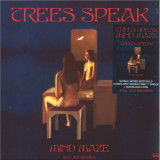
Trees Speak - Mind Maze LP 12" + 7" (NO COVER)

12" + 7" !

Mind Maze is, amazingly, Trees Speak’s fifth album to be released on Soul Jazz Records in the space of little over two years– an output matched only by the intensity of their music created during this short time.

The first pressing only of the album comes with a bonus seven-inch single containing two tracks that are not available on vinyl anywhere else.
As with all their previous releases, ‘Mind Maze’ is a mind-boggling tightrope walk across an array of musical influences that seamlessly create the unique present-day world of Trees Speak.

The band’s sound is characterized by a combination of German krautrock motoric-beat rhythms, angular New York post-punk attitude, 60s spy soundtracks, psych, rock, jazz, and 70s synthesizers and vocoders. There is also a cosmic spatial awareness to their sound; both personal inner space and galactic outer space, as well as a wilful pushing of sonic boundaries.

Trees Speak are a musical duo based in Tucson, Arizona, composed of Daniel Martin Diaz and Damian Diaz. Their music is heavily influenced by the cosmic magic of the natural desert landscapes of Arizona, creating a unique and captivating sound that is both experimental and innovative.

Here you will find the myriad sounds of 1970s German electronic music (everything from Can to Cluster, Popul Vuh to Tangerine Dream); 1980s New York post-punk and synthcore (from No Wave to Suicide); John Barry’s 1960s movies, John Carpenter’s 1970s horror. You will also hear the influences of French and Italian progressive rock (Magma, Goblin) as well as cosmic, new age and experimental space soundscapes …. an almost endless list of diverse influences that ebb and flow like an ocean of sound, in the process creating a truly unique soundscape that Trees Speak have made wholly their own.

The name Trees Speak reflects their interest in the concept of using future technologies to store information and data in trees and plants, with the idea that trees communicate collectively. This interest in nature and technology, combined with their passion for experimentation, has led Trees Speak to create a truly one-of-a-kind listening experience that is both unique and engaging.

If you ever wanted to hear Can, Neu!, Destroy All Monsters, Pere Ubu, electric eels, John Cage, Liquid Liquid, Tangerine Dream, Suicide, Laurie Spiegel, Art Ensemble of Chicago, John Barry, Mother Mallard’s Portable Masterpiece Company, Sun Ra, Stockhausen, John Carpenter, Electro-Acoustic and Musique Concrete and Mars in one band - then this is it! Trees Speak are a band that defies categorization and offer an eclectic listening experience, both exciting and memorable.

The two bonus tracks (‘Seraphim’ and ‘Orpheus’) included with the album give us a further window into the complex mind maze of the group - two stunning acoustic tracks that explore a distinct early 70s sound of Yes, Argent and other progressive rock accolytes.

In Stock

Disponibile in Stock e pronto per la spedizione
JIGGY (IT) / Reboot - Delinquentes

Jiggy(It)/Reboot

Delinquentes

exclCUEV003
CUE
13.06.2023

The third vinyl release from CUE Music invites Jiggy (IT) to deliver three fresh tracks in the form of “Delinquentes EP” alongside Reboot on remix duties. The record delivers a solid dose of tech house and minimal techno, definitely adding even more magic to the imprint’s discography, which includes titles signed by artists like Butane & Riko Forinson, Elchinsoul, Sascha Dive, Aney F., Dubphone, Christian Burkhardt, Sascha Sonido, Bee Lincoln, Danilo Schneider, Nektar Agu, Triad, CL-ljud and, of course, label head Sven Jaeger, among many others.

Jiggy (IT) started mixing in 2008, exploring various genres and slowly creating his own style. For 8 years he lived in Ibiza, going from playing at small clubs and underground villas parties to memorable performances at Space, Privilege, Sankeys and Bora Bora while hosting weekly shows at Ibiza Global Radio. Throughout time, he released some of his works with labels like Innocent Music, Psicodelica, Variety Music, Ole Rec, Eisenwaren, Moan, Play Groove Recordings, Basswalk, Pild, Quanticman, Natural Rhythm, Konzept:Musique and his own Be Water Recordings which is more than just a label, it’s also a deeply spiritual lifestyle for him.

In Stock

Disponibile in Stock e pronto per la spedizione

Maga Bo - Amor (É Revolução) LP 2x12"
 
19

"Speaker-bangin' before all else" (XLR8R) with "some of the smartest ears in the game" (Chicago Reader), "few can make a room explode like Maga Bo" (Flavorpill). A purveyor of "international sonic weaponry and rhythm knowledge" (Rough Trade), the Rio de Janeiro-based DJ/producer is a veteran pioneer of global bass music, with 20+ years of dedicated experience searching out unheralded music bumping from speaker-boxes in the world's grittiest corners, from Addis Ababa to Zanzibar.

Simultaneously, Amor (É Revolução), the new album from Maga Bo, is statement of hope through change, a call to arms, a lament, a proclamation of resistance, a shout of resilience, an exuberant yell and a deep therapeutic groove all at once. The result of a multi-decade search for rhythmic common denominators with an Afro-Brazilian-centric focus. It joins raw, natural, acoustic timbres and textures with the grit, weight and power of modern electronic production. It is where heavy dub bass pulsations sync with rhythms coaxed from drums heated over an open flame and ancestral voices rise and fall in call and response.

Recorded in Rio de Janeiro, Salvador, Recife, Arcoverde and Porto Alegre, the album counts amongst many illustrious talents from the Brazlian music scene, long time collaborators, Russo Passapusso and Roberto Barreto of Baianasystem, the legendary singer, BNegão and São Paulo based, Rosângela Macedo. Grupo Bongar and Samba de Coco Raízes de Arcoverde provide backing percussion and vocals. It also brings newer collaborators, from Recife, the amazing voice of Isaar, the fabulous guitarist, Felipe Cordeiro, as well as long-time friends, ex-Digitaldubs, Jeru Banto and Jota 3, the Mestre of Tambors de Olokun, Alexandre Garnizé, on percussion, fellow nomadic electronic roots explorer, Teleseen and the rock solid percussionist from Salvador, Icaro Sá.

In Stock

Disponibile in Stock e pronto per la spedizione

Vincentiulian - Subbass Ep

Vincentiulian is the kind of name that needs no introduction. He is one of the best-known DJs and producers from the famous Romanian scene, and his evolution throughout the years tells its own story. He has played alongside the biggest names in the industry, shared the decks with household DJs like Priku, Rhadoo, or Cezar, and played the most important festivals out there.

His Subbass EP on Vivus Records cements his aura even more as a wonderful producer.

The opening track, Works, kicks things off wonderfully and subtly. It’s certainly a perfect track for the warm-up moments in the club, but its intricate background noises add a lovely layer of complexity as the track goes on.

Then we head off in a different direction: At Chalet is a much stronger track with an imposing bassline that dominates the sound and perfectly complements the mysterious vocals.

The titular track, Subbass, has a natural futuristic vibe and feels like a
ready-made club banger. The spacey atmosphere is something that only adds charm to it. The Tobias Laun Remix is a more chill but equally powerful way to end this mesmerizing EP, with Tobias showing his prowess at adjusting the pace just at the right rhythm for the dancefloor. The strong bass complements superbly with the sublime background noises to make this the perfect last chapter.

In Stock

Disponibile in Stock e pronto per la spedizione
Sahib Shihab - Companionship LP 2x12"

Jazz music has more than its fair share of overshadowed figures that whilst contributing much to the music have little presence in its collective conscious. One such musician is the talented multi-reedist, Sahib Shihab. Born Edmond Gregory, as he was known before he adopted the Muslim faith in 1946, Sahib Shihab's music background shows a deep and significant evolution, influenced by Thelonious Monk, Dizzie Gillespie (his experience in Dizzie's band marked Sahib's switch to Baritone, the instrument he became most readily associated with), and above all by Charlie Parker's Bop. Had it not been for the post-war migration of many top American jazz musicians to Europe, it is quite likely that the legendary Clarke-Boland Big Band might never come into existence. Sahib, one of this musicians disillusioned with the politics and racism of the United States, accepted to join the band of Quincy Jones for an European tour in 1959. When the tour ended, Shihab he remained in Europe where he joined, in 1961, the Clarke-Boland Big Band. The collection 'Companionship', whose line up consists of seven elements which derives from this original band, spotlights the consummate musicianship and individuality of Sahib Shihab and is testimony to his special musical gifts - not only as a top-rank flautist and baritone saxophone but also as a composer. Furthermore, it provides a welcome reminder of the high quality of the Clarke-Boland Big Band's rhythm section, the lively style of vibraphonist Fats Sadi and the power and personality of two of the C-BBB's horn-playing stalwarts, Benny Bailey and Ake Persson. Here's a real rarity, surely a desert island disc. This double album has it all from frantic banging percussive workouts to modal numbers to beautiful ballads. It's a staggeringly good piece of music and worth every penny of the price tag it commands. Let's have a look to the most significant pieces. Francy Boland's "Om Mani Padme Hum", taken from a Tibetan prayer, shows Shihab in exuberant mood, playing against a vigorous percussion background and making dramatic use of his special technique of combining voice and flute. Boland contributes an incisive, effervescent solo. "Bohemia After Dark", a classic original by bassist Oscar Pettiford which he first recorded back in August 1955, finds Shihab in exultant form on baritone. "Companionship" has a Bossa Nova beat and features Bailey on flugelhorn and Shihab on flute, playing with a limpid, floating sound. Bailey's minor-key original, "Stoned Ghosts" was, he says, inspired by listening to some music written by Bela Bartok before he emigrated to the United States. The piece has an infectious back-beat pulse and showcases the superb walking technique of Jimmy Woode. In "Con Alma" Shihab's mellow flute set against a churning 12/8 beat in this stylish Boland arrangement. Woode's performance of the superb Mei Torme ballad, "Born To Be Blue", reveals his great affection for the song. "lt is the perfect combination," he says, "a beautiful melody married to a great lyric. I really love that tune." It is a song of rueful resignation, putting a brave face on the blues. "Balafon" is an up-tempo Francy Boland original written for the French mime artist, Marcel Marceau. The rhythm section really cooks on this track with Kenny Clarke's cymbal work outstanding. Boland's solo here is notable for its neat, left hand punctuations. "Calypso Blues" has been written by Nat King Cole and Don George. lt tells the wry and wistful tale of a Trinidadian in New York desperately homesick for the land where everything 5 so much cheaper (in New York "a dollar buy, a cup of coffee and a ham on rye") and the girls more natural than the artificial, painted beauties of New York. Woode's composition, "Sconsolato" is a haunting theme in A minor and it brings to a close a truly fascinating album. This is dynamic music played with vigour, verve and vitality - and it is an enormous pleasure to rediscover it. A shadowy fugitive from his home in the land of jazz, Sahib Shihab remains a true unsung figure, worthy of more attention. With his equally expert technique on Baritone, Flute, Alto and Soprano saxophones and his capacity to adapt easily to a variety of musical settings. His warm, individual, singsong sound in improvisation and his unusual and interesting compositions mark him out as a hidden treasure in the dusty corners of jazz archive.

In Stock

Disponibile in Stock e pronto per la spedizione

Tunico - Tunico  LP

Tunico

Tunico LP

12inchFARO236LP
FAR OUT RECORDINGS
14.04.2023

Far Out Recordings proudly presents the self-titled debut album by Rio de Janeiro born multi-instrumentalist, composer and arranger Tunico. Honing Brazilian roots rhythms like maracatu, xanadu, and samba, to combine with a global contemporary jazz outlook, the newcomer adds a modern classic to the ever rich vein of Brazilian instrumental music.

Consider it a natural evolution from the legacies of greats like Quarteto Novo, Hermeto Pascoal, Banda Black Rio, Tamba Trio, and Dom Um Romão, Tunico’s debut brings together an eye catching ensemble of talents from the Rio jazz community, with whom he performs on a weekly basis at celebrated live sessions and jam’s at venues like Macuna and Comuna Lapa, which often go on all night.

Released in 2022, the album’s rip-roaring lead single “Galope” features the effervescent vocals of Katerina Assef, as well as consummate solos from all over the band, as Sounds & Colours put it “…it exudes distinction and promise”. “Sambola” calls on the signature swagger of Far Out favourite Antonio Neves, indulging us in irresistible swinging samba-funk, undeniably reminiscent of the aforementioned Banda Black Rio in their late 70s heyday.

Born and raised in an artistic Rio household, Antonio Secchin aka Tunico’s father was the painter Guilherme Secchin, whose original work is lovingly repurposed to create the album’s cover. Antonio learned his trade on guitar from a young age, which remains his primary method for composition, but at the age of eighteen he started to gravitate towards the saxophone, and in particular the soprano sax, from which he now leads bands despite being entirely self taught. He would develop his skills busking on curbsides and metro stations before becoming a mainstay player in venues and clubs around the city.

When the pandemic struck, Antonio retreated to his family home in the Rio countryside. With time and space to breathe and reflect in a natural environment, he set to work at fleshing out the compositions he’d written throughout his musical life into full bodied works. His affinity with his rural surroundings is reflected in the luscious, blossoming feel of this groovy, mystical and poignant instrumental debut album.

Tunico will be released on vinyl, CD and digital platf

In Stock

Disponibile in Stock e pronto per la spedizione

Trees Speak - Mind Maze LP 12" + 7"

12" + 7" !

Mind Maze is, amazingly, Trees Speak’s fifth album to be released on Soul Jazz Records in the space of little over two years– an output matched only by the intensity of their music created during this short time.

The first pressing only of the album comes with a bonus seven-inch single containing two tracks that are not available on vinyl anywhere else.
As with all their previous releases, ‘Mind Maze’ is a mind-boggling tightrope walk across an array of musical influences that seamlessly create the unique present-day world of Trees Speak.

The band’s sound is characterized by a combination of German krautrock motoric-beat rhythms, angular New York post-punk attitude, 60s spy soundtracks, psych, rock, jazz, and 70s synthesizers and vocoders. There is also a cosmic spatial awareness to their sound; both personal inner space and galactic outer space, as well as a wilful pushing of sonic boundaries.

Trees Speak are a musical duo based in Tucson, Arizona, composed of Daniel Martin Diaz and Damian Diaz. Their music is heavily influenced by the cosmic magic of the natural desert landscapes of Arizona, creating a unique and captivating sound that is both experimental and innovative.

Here you will find the myriad sounds of 1970s German electronic music (everything from Can to Cluster, Popul Vuh to Tangerine Dream); 1980s New York post-punk and synthcore (from No Wave to Suicide); John Barry’s 1960s movies, John Carpenter’s 1970s horror. You will also hear the influences of French and Italian progressive rock (Magma, Goblin) as well as cosmic, new age and experimental space soundscapes …. an almost endless list of diverse influences that ebb and flow like an ocean of sound, in the process creating a truly unique soundscape that Trees Speak have made wholly their own.

The name Trees Speak reflects their interest in the concept of using future technologies to store information and data in trees and plants, with the idea that trees communicate collectively. This interest in nature and technology, combined with their passion for experimentation, has led Trees Speak to create a truly one-of-a-kind listening experience that is both unique and engaging.

If you ever wanted to hear Can, Neu!, Destroy All Monsters, Pere Ubu, electric eels, John Cage, Liquid Liquid, Tangerine Dream, Suicide, Laurie Spiegel, Art Ensemble of Chicago, John Barry, Mother Mallard’s Portable Masterpiece Company, Sun Ra, Stockhausen, John Carpenter, Electro-Acoustic and Musique Concrete and Mars in one band - then this is it! Trees Speak are a band that defies categorization and offer an eclectic listening experience, both exciting and memorable.

The two bonus tracks (‘Seraphim’ and ‘Orpheus’) included with the album give us a further window into the complex mind maze of the group - two stunning acoustic tracks that explore a distinct early 70s sound of Yes, Argent and other progressive rock accolytes.

In Stock

Disponibile in Stock e pronto per la spedizione

Holmes + atten Ash - Saturnian

The moons of Saturn are the inspiration for this brooding, often soaring and searching odyssey of dark electronica.

The second largest planet in the solar system after Jupiter, and the sixth planet from the sun, Saturn is orbited by 53 confirmed moons, with another 29 that are unnamed and still being studied.

Saturnian is a suite of thirteen choral tracks taking their names from some of Saturn's known moons; Dione, Daphnis, Phoebe, Prometheus, Rhea, Janus, Titan, Enceladus, Tethys, Telesto, Mimas, Hyperion and Iapetus, all named after figures from Greek and Roman mythology, each loaded with their own turbulent back stories. It is the debut release by Holmes + atten Ash, written, recorded and produced remotely in Edinburgh and Bristol by the duo Simon Holmes and Paul Nash.

Their project began during the 2020 lockdown. For Simon, time was spent exploring the Pentland Hills south of Edinburgh. For Paul, the Mendip Hills, south of Bristol. Both would experience the darker side of our human impact on the environment. Simon observed the wilderness as a wasteland, finding discarded, rusting metal littering the Pentland Hills while Paul witnessed the decimation of the ancient woodland of the Mendips' King's Wood due to the destructive tree fungus ash dieback.

These field trips fuelled a desire to navigate not just the landscape, but the duo's emotional place within it. Their collaboration led to a concept album that explores the outer reaches of the solar system, while simultaneously grounding them in a specific place. Looking inwards as much as outwards, theycreated soundscapes based on deeply imagined and felt connections to their surroundings.

After Simon had created a choral piece to accompany Luke Jerram's enormous, world touring artwork Museum of the Moon, Saturnian was a natural progression. When Simon was sent an initial score for the ethereal track Enceladus, composed by Paul in Bristol, he added choral arrangements recorded in Edinburgh. Their shimmering, tense opus continued to evolve from there. Just as the discarded bed springs and abandoned car parts that Simon stumbled upon in the Pentland Hills seemed to him at once "horrible but also oddly beautiful", Saturnian melds together melancholy and levity, fusing moments of dark angst with a celestial calm.

Opening with the glistening, hopeful brightness of Dione, increasingly urgent rhythms give way to digital, otherworldly calls from what might be rainforest creatures chirping into life with robotic squawks and delicate keyboard lines on Phoebe, followed by slowed down, monastic song on Rhea. Tethys is a hypnotic blur of synthesiser and soft chanting, while Rhea is a mysterious, echoing chasm, lifted by melodic, gentle male vocals. Janus has a glowing, effervescent energy, swiftly followed by a sense of tension on Titan, which throbs with driving percussive unease.

The album artwork is a pencil drawing created by Edinburgh artist Simon Kirby. It was made by a robot drawing machine, using custom algorithms that bring to life recordings of the sound of magnetic waves near Saturn's icy moon, Enceladus. The lines in the centre of the drawing are distorted by sound captured by the Cassini spacecraft which studied Saturn for over a decade.

Much like Saturn and its frozen, rocky moons, this debut album from Holmes + atten Ash is mysterious and beguiling, with a hint of foreboding in the depths of its powerful beauty and epic scale.

In Stock

Disponibile in Stock e pronto per la spedizione

Age Eternal - Be The Enemy EP

Age Eternal is the solo project of producer and visual artist Lissa Benno. She uses guitars, electronic hardware and her voice to create an hypnotic and heavy haze.

Familiar pop structures collide with organic apparitions of experimental electronic sounds. Layers of choral vocals and synthesizers move as ethereal mass through textures of heavy bass and percussive rhythms.

„Be The Enemy“ delivers an introspective view on transpersonal experiences and supra-naturalistic phenomena.

In Stock

Disponibile in Stock e pronto per la spedizione

Butane & Riko Forinson - Too Hot For Humans

The next release in CUE Music's catalogue sees Butane teaming up once more with Riko Forinson for "Brainstorm" EP alongside Nima Gorji on remix duties. The record definitely adds extra magic to the label's discography, lining up to the previous releases from Elchinsoul, Sascha Dive, Sascha Sonido, Danilo Schneider, Dubphone, Heerd and label head Sven Jaeger, among many many others.

A firm believer that the long hours of studio work keep a musician grounded, Butane boasts an impressive discography, released by some of the most highly regarded labels in the business, such as Crosstown Rebels, Sci+Tec, Hottrax, Fuse Records, Lauter and Get Physical. As a label owner, he's the founder of three influential underground dance music imprints of his own, Alphahouse, Little Helpers and Extrasketch.

Riko Forinson is an Italian artist passionate about the sound of drums and piano which he studied intensively from an early age. After a while of exploring the acoustic dimensions of music, he immersed himself in the world of digital electronica, performing as a DJ at various events and releasing with labels like Orpheus Recordings, Lucidflow, Dushe Label and Bar 25 Music. Nowadays he's an author, composer and producer who loves to play with various techniques while integrating jazz, reggae or classical aspects into his compositions or sets.

In charge of the reinterpretation of the title track, Ibiza-based Nima Gorji is well-known on the international scene, with a career that spans more than three decades. In 1999 he founded Welt Recordings followed by NG Trax and Need For Sound, relentlessly following his passion for electronic music by releasing numerous personal works as well as promoting other artists. His rich discography includes materials published through labels like Sci+Tec, Deeperfect, Fuse London, Bondage Music, Out Of Orbit, Love Letters From Oslo, Indigo Raw, Out Of Orbit, Cocoon, Murmur, Natural Rhythm, Bla Bla Records, ÉTÉ,

In Stock

Disponibile in Stock e pronto per la spedizione

Galaxian - We Are Power LP 2x12"

Galaxian

We Are Power LP 2x12"

2x12inchSHIPLP09/DOWN6
ShipWrec
27.05.2022

"We Are Power", Galaxian's first album in over a decade, cuts a new path. On this Foul-Up and Shipwrec joint release, Kastner presents a rumination on the confrontation and power clash between humankind, nature, the spiritual and mechanistic industrial growth societies. What is authentic power? What is granted power? What is innate natural power? How is power accessed, wielded, utilised, felt? On this album the blistering beats and razor-edged rhythms that characterise the Glaswegian's productions have been softened, the menace melted, the angst soothed (well almost.) Across eleven tracks, distinct audio vistas are surveyed. The human form takes centre stage from the opening monologue of "Out of Balance" with the entire record searching for balance between humankind, nature, orthodox culture & the machine. At times the machine wins. "We Are Power" is a corruption of voice, samples chopped, sliced and fed into controllers and sequencers to produce a dense decibel wall. That wall grows ever higher in the terrifying drone of "Anatomy of a Modern Lie." At other points, a perfect symmetry between artist and tool is found. The racing interchanges and pulses of "Universal Truths" give rise to dawning reprises and warmth. For those after an electro fix, Galaxian abides. The speed snares of "Messianic Delusions" or dripping drums of "Fields of Meaning" are soaked in the history of machine music, yet they are grander in their delivery and more nuanced in their composition. Fresh territories are explored, the playful solar dreams of "Without Form" or the cinematic grandeur of "In Reverse". This album is unmistakable Galaxian, it marks a high-point and brings with it a culmination of intense expression.

In Stock

Disponibile in Stock e pronto per la spedizione

Mr. K - Edits by Mr. K- Marbles / Shoot You Down

The new batch from the bottomless edit archives of Danny Krivit is an uptempo, guitar-heavy excursion into two cuts of danceable rock from opposite sides of a decade.

“Marbles” originally came out late in 1970, the result of a collaboration between the fiery British guitarist John McLaughlin and drummer Buddy Miles. Miles was hot off his time with Jimi Hendrix, and producer Alan Douglas, who’d been instrumental in putting together the Band of Gypsys group, attempted another crossover combination with a brand new, blazing guitar god. Also on the date was Larry Young, an organ player best known for his expansive jazzy albums on Blue Note, and several veterans of Buddy Miles’ funk-rock combos. The resulting mixture produced in “Marbles” a powerful, driving rhythm anchoring an addictive riff that steamrolls through the cut in a fashion not unlike the motorik sound of Velvet Underground or Can. Mr. K’s edit leans heavily on the drums, naturally, with a long, tailor-made intro and a mesmerizing focus on the main riff, extending things well past the seven-minute mark.

Ten years later, the world of music was in an entirely different place but a good guitar riff coupled with a driving beat was still powerful currency on the dancefloor. This time, the group was Scottish new wave-punk group APB, whose single “Shoot You Down” had garnered unexpected peak time play in cutting edge NYC hotspots Danceteria, the Peppermint Lounge, the Ritz and the Mudd Club. “Shoot You Down” combines the urgency of the Clash with the free for all vibe that characterized the downtown scene (and throws in a chant borrowed from P-Funk for good measure). Mr. K has created a long instrumental opening that leads into the vocals, giving the tightly-wound 7-inch single a proper extended 12-inch treatment it deserved but never had before.

The sound is crisply remastered for club play, and stretched over the breadth of a 12-inch single. Both of these tracks are appearing on the long-format player for the first time.

In Stock

Disponibile in Stock e pronto per la spedizione

Nicola Cruz - Subtropique

Rhythm Section welcomes Nicola Cruz to the fold with his debut EP on the imprint - “Subtropique”. Inspired by an Ecuadorian upbringing, percussion is at the heart of how Nicola operates. His rhythmic style finds a natural home on the London label - which presents 5 expansive efforts equally indebted to traditional drumming as they are to contemporary club sounds. Remaining sonically cohesive without feeling the need to settle into a definable style - the tracks are tied together by a lucid psychedelic thread which, despite challenging the expectations and fundamentals of electronic dance music - demand movement at a time where we yearn for it.

In Stock

Disponibile in Stock e pronto per la spedizione

Crushed Soul - Family Of Waves

Berlin-based, Dutch-born Steffi possesses near-boundless prowess. As a DJ, she’s proved her effortless mastery of disco, house, electro, and techno; as helm of labels Klakson and Dolly, she’s long maintained her status as tastemaker; as a producer, she has graced us with three solo LPs and numerous 12”s. Dark Entries is now honored to unveil the debut of her project Crushed Soul, a moniker she had used only once in 2013 for an Ostgut Ton compilation track. The mutual esteem of Steffi and DE has been previously fruitful, with Steffi providing a remix for Cute Heels’ 2016 EP on DE, but this is their first full-length collaboration.

The Family of Waves EP represents both familiar and novel pastures for Steffi. While her love of electro and classic Detroit techno have been oft-evident, here we witness the darker shades of new wave and industrial creep to the forefront. This turn for the twisted feels not just natural, but predestined, an inevitable succumbing to morbid forces. But Steffi also views Family as “a playful association...a mix of my past and new modern waves". There is a kernel of whimsy, even joy, lurking within the record’s temporal jumblings. The A-side opens with “Gravitational Field”, which juxtaposes its gnarled bassline with unearthly percussives and a recurrent resonant gong. The wild sonic palette speaks Steffi’s singular voice. “Scalar Property” continues the paranoid propulsion with an unhealthy dose of what can only be described as Metroid-funk, its staccato bass jabs interlaced with ghastly vocal pads. The B-side contains a diptych of slower tracks that juggle reference points both retro and futurist. In “Family of Waves”, a churning EBM-esque bassline battles acerbic yelps. On this track, the collision of past and present is most pronounced, as if A Split Second were covering Mike Parker. “Diffusion of Heat” closes the EP with what feels like a perfect synthesis of Steffi’s musical passions: funky, warbling chord stabs; intricate rhythmic diversions; the ecstasy of repetition. Here, disco, new wave, and techno marry harmoniously, if only to inform us of the disharmony of our present.

All songs have been mastered for vinyl by George Horn at Fantasy Studios. The sleeve and accompanying postcard were designed by Eloise Leigh using video art stills by Goldenliustra.

In Stock

Disponibile in Stock e pronto per la spedizione

Rico Puestel - Chicanery EP

Rico Puestel

Chicanery EP

12inchTAU008
TAU
01.10.2019

TAU welcomes an enigmatic, esoteric entity to the fold with this stunning release from the one and only Rico Puestel. Rico’s artisan musings and wild outlook on life has resulted in the production of a stunning back catalogue, full of unique, emotionally-charged electronica. His music has found favour with industry heavyweight Sven Väth and his Cocoon imprint, so it’s a pleasure to have three new classy cuts from this in-demand producer.

The Chicanery EP begins with ‘Plentone’, a chugging atmospheric cut with a deep pulsating low end. Bright angelic twinkles impose a contrasting layer of emotion against the dour bassline. The mood is solemn, yet optimistic, punctuated by a scintillating breakdown. After the drop, ‘Plentone’ keeps pumping along as the expertly-crafted elements combine to create a mesmerising composition.

Next up is the title track, ‘Chicanery’. This one is a little more upbeat and strident, emitting a contagious charge of energy. A symphony of sparkling melodies dance above a groovy bassline. Rico demonstrates his virtuosity with this wonderfully whimsical cut. His playful use of layered melody gives the track depth, utilising his skills to really tantalise the listener.

Track three is ‘Whether’, a bluesy, eyes-down cut with a brooding exterior. A range of organic sounding instrumentation gives this track a very natural tone and appeal. Rico carefully increases the tension, teasing the energy levels up and up and up like a form of audio foreplay, leading us into an orgasmic breakdown. After that track continues its sultry jaunt, hypnotising you with its sensual allure.
Lastly, Theus Mago delivers a simmering remix of ‘Whether’. The Mexican maestro creates a whole new piece of music, with a driving rhythm, an urgent riff and a constant flow of new sounds. Theus’s reinterpretation is dramatic, compelling and deadly. Watch the dance floors explode to this one.

In Stock

Disponibile in Stock e pronto per la spedizione

Skyy - Here’s To You

Skyy

Here’s To You

12inchBEWITH011TWELVE
Be With Records
15.07.2019

The word masterpiece gets bandied about a lot. Not least by us. But here is a release that truly befits such a lofty title.

In 1980, Randy Muller’s Skyy dropped the monumental “Here’s To You”, comfortably one of the greatest dance singles of all time. Released on Salsoul, “Here’s To You” is now exceptionally hard to find in its original form. On this special Be With double-header, we present the sought-after 12" mix and back it up with the strutting “You Got Me Up”, which has never been on a 12" before.

Naturally, both are cut loud and bumping for devastating dance floor power.

A sure-fire classic of the NYC club scene and a true block party rocker, “Here’s To You” beautifully combines sweeping synth-strings, loose cymbal hits and swaggering lyrics delivered with enviable style. But the real hero is *that* bassline. Oh, wait, no, actually, it’s *that* synth refrain halfway through. Harnessing the Oberheim Matrix 12 to emulate a horn section has provided goosebumps on discerning dance floors ever since.

As Muller expressed in his 2007 Red Bull Music Academy lecture, “It’s a very special record, it’s positive and has that spontaneous, life-giving spirit in the groove. Everything locks, just pure chemistry.”

Like we said, it’s a masterpiece.

If that wasn’t enough, over on the B-side is “You Got Me Up”, a real hidden gem from Skyy’s Skyway LP. Also released in 1980, the track is a wonderful showcase of the group’s airtight rhythm section and Muller’s uncanny ear for a groove and a melody.

In Stock

Disponibile in Stock e pronto per la spedizione

Reelow - Leave Me Alone

Having been a fan of Reelow for, well, as long as we care to remember, we are really proud to present you his new outstanding EP on Cellaa Music. Now residing on Ibiza, Reelow has enjoyed yet another successful year. With the talent taking a back seat, its the music hogging the spotlight and rightly so. Two new Tracks and two massive Remixes that look to the past whilst sitting firmly in the present.

- Leave Me Alone' riding on massive percussion and a tough house beat, with this tough Drums and drunken, wubby Sounds it is running right through its core. Plenty of sonic details flesh out the languorous but slightly groove and you'd imagine this Track is to be the sort of many Artits will love.

- Your Crowd' is again about little tiny details and how they evolve with time. This one take you on a voyage of natural rhythms and big Drums. Developing from harmonic FX Sounds and a infectious groove, the track is full of surprises as it twists and turns into different sounds that come and go to take it further than the dancefloor.

The first of the remixes comes from the in form, Massimo Cassini. He team up with a hypnotic rework of - Leave Me Alone' that demonstrates just why he is one to keep a close eye on as he gears up on the production front. Massimo is delivering a muscular house bomb, carefully placed FXs and a nice and catchy line to make this a dancefloor mover.

Next we have Cellaa Music Co Founder Martin Heyder providing a soulful tech house surrogate to the original of - Your Crowd'. His remix has a deeper houseier twist with a smooth 303 pad sound and a concrete percussive arrangement to convey a fantastic production.

We'll meet you on the Dance Floor!!!

collecting

Order now. Collecting orders for repress.


Last In: 11 years ago
Speedy J - Walkman LP 2x12"

Speedy J

Walkman LP 2x12"

2x12inchS60
STOOR
11.05.2026

Contemplating the role of the album format in an attention-deficient society, Speedy J presents Walkman -- a constantly shifting, 90-minute soundtrack to a journey of your choice. Jochem Paap's first solo album in over 20 years is a freewheeling, 20-track testament to his decades-deep studio skill and sonic versatility, running from skewed rhythmic rabbit holes to exploratory tonal abandon. For Paap, the traditional idea of the album had become obscured by listening habits and the non-stop information barrage of our digital lives. Having moved on from his breakthrough years releasing LPs and touring off the back of them, he was more inspired to develop his many-sided STOOR project and feed into a bigger artistic body of work than the temporary shelf-life of a single release. As is natural for any artist, his perspective shifted over time and he found himself drawn back to the idea of an album, realising he connected best with longer releases while he was on a walk, out for a run or generally in transit one way or another. With an endearing call back to the humble Walkman, he selected an hour and a half of material created during studio sessions at the beginning of 2025, perfectly sized to fit on two 45-minute sides of a cassette tape. As has long been the case for his studio practice, there were no fixed intentions when sitting down in the STOOR lab to start making noise -- just a wealth of experience and an expansive set of tools to start exploring with. From hours of jams Paap pulled together standout moments and moulded them into a mixtape-like narrative ranging from two-minute beat nuggets to full-tilt techno workouts and immersive ambient drops. Every sound is intentional, but the overall delivery is instinctive and curious, showing multiple new dimensions to Paap's sound and offering unpredictability at every turn. 'Arp Amp Chasm' opens the album up in a thick blanket of humming, harmonic waves with an electric emotional charge, while 'Ctrssalms17 (Cold Render)' journeys through evocative blooms of melancholic, gritty pads and rugged, half-submerged tech funk. 'Modern Birds (Origin Edit)' reaches skywards with grand sweeps of dynamic, brilliantly rendered synthesis. From the dexterous drum science of 'Drift Vector' to 'Osc Hop (Slow Collapse)'s lurching, beatless swamp of synths, on Walkman even the briefest snapshots leave an impression that lasts beyond the quick-scan cycle of the modern music experience. With his return to the album format, Paap's message is clear --put your headphones on, get outside and lose yourself in the sound of an artist constantly committed to moving forwards.

pre-ordina ora11.05.2026

dovrebbe essere pubblicato su 11.05.2026

MARC FELDMANN & DOMINIK ANDRÉ - WHITE SERIES #4 EP

‘White Series #4’ marks the debut EP of Marc Feldmann and Dominik André as a producer duo. The record opens with ‘Natural Oscillation’
, a hypnotic techno piece where flowing percussion meets subtle trance influences. ‘A Breeze of Mistral’ builds on this energy with layered repetition and a deep pulse that unfolds gradually, drawing the listener further in. On the flip side, Audrey Danza reinterprets Natural Oscillation with a direct, dancefloor-focused approach. She sharpens the groove, raises the tempo, and pushes the track forward with her signature, driving drums and a tightly locked kick, transforming the original’s hypnotic flow into a no-frills cut. The EP slows the pace with ‘Discernible Rhythms’, a reflective, 80s-influenced synth chugger that adds warmth and restraint to the record. Released as a hand-stamped white label on Subject To Restrictions Discs, White Series #4 reflects and continues the label’s contribution to the more understated forms of electronic club music.

non in magazzino

Ordina ora e ordineremo l'articolo per te presso il nostro fornitore.


Last In: 7 days ago
VLMV - THERE WILL COME SOFT RAIN
  • 1: Tribal (A Heart, Self-Taught)
  • 2: We Are All Explorers Now
  • 3: The Pilot
  • 4: Bodies Grown, Pt.1
  • 5: In Absentia
  • 6: I Am An Officer
  • 7: Philistine! (Reclaim The Sky!)
  • 8: Bodies Grown, Pt.2
  • 9: Somnolence In Reverse
disponibile anche

RAINY DAY ED.


Pete Lambrou, the visionary composer and multi-instrumentalist behind VLMV (pronounced "Alma"), is one of the most singular voices emerging from the ambient, post-rock, and experimental scenes in the UK. With a career that spans atmospheric solo work, film and television scoring, and evocative live performance, Lambrou has carved out a distinctive sonic universe he describes as "ambient-ish post-something" (Pete Lambrou) a playful yet accurate summation of a sound that is at once genre-fluid and deeply immersive. The album takes its title from Sara Teasdale's 1918 poem and Ray Bradbury's later short story, both of which imagine a world continuing quietly after humanity's disappearance. This idea became the gravitational centre around which the record formed. Written during a period of deep engagement with climate fiction and ecological thought, `There Will Come Soft Rains` reflects on humanity's legacy, its technological ambition, and its uneasy relationship with the natural world. A century on from Teasdale's poem, the balance of power feels less certain, and Lambrou's music inhabits that tension with remarkable subtlety. "The initial ideas stem mostly from chaos, randomness or sound exploration and then get shaped as I go. Typically, and certainly for this album. It's evolved since album 1, which was more song / chord based. It's a fun process of finding the sound and then working out whether it's speaking to me - or merely just a cool noise. That's fun, but it sometimes can't evolve or progress, so then begins the long journey of shaping it into some sort of song format - which doesn't have to be a-typica,l but whatever feels right to me. The subject matter and overall theme is important too - it's got to all make sense within itself. There's no point having a slowly creeping theme and then rush the music." (Pete Lambrou) VLMV embody an emotional honesty that works with patience and nuance. Whether you're encountering his music for the first time or returning to its quiet depths, VLMV offers an aural space that resonates long after the final note fades. Lambrou's singular sonic language sits at the intersection of ambient, post-rock, modern classical, and experimental electronic music, while remaining unmistakably human at its core. "Instrumentally it's far more synth based - as soon as I had the concept, I wanted to make sure technology clash and marry with traditional instruments (at different times) in a sort of slow-moving dance I suppose. One is nature, one is human development and technology. Sometimes working together and sometimes in opposition. On my previous albums I'd say that at least half of the tracks started life as songs, whereas with `There Will Come Soft Rains` I think the majority (if not all) started as experiments in sound." (Pete Lambrou) Sonically, the album is VLMV at its most cinematic and textural. Warm, intimate piano figures and elegiac string arrangements are set against unstable modular synthesis, fractured rhythms, and evolving sound design. The organic and the artificial are locked in a slow, shifting dialogue, mirroring the album's central themes. At times the music feels tender and nostalgic, at others unpredictable and mournful, yet it never tips into despair. Instead, a quiet resilience runs throughout the record. "The album is slightly unusual in that it was mixed in Dolby Atmos before being mixed down to stereo. Most, if not all, do it the other way round. That's because I got to work with a superb mix engineer who just happens to live opposite. It was extremely random and lucky, moving to a tiny hamlet in the South of England and there being a Dolby Atmos studio opposite with a genius of an engineer. We had in mind that we would do it this way round and enjoy the mix process and give everything its own space - it still had issues when folding down to stereo, but overall a more pleasurable mix!" (Pete Lambrou) There Will Come Soft Rains has a geological sense of time: themes creep, expand, erode, and reform, resisting conventional structures in favour of something more patient and immersive. Each sound exists because it needs to; they move, recede, and emerge with a three-dimensional clarity that enhances the music's cinematic quality, giving each element room to breathe while maintaining an enveloping sense of cohesion. Lambrou's unique voice is Intimate and fragile, his vocals hover above the instrumentation, a guiding thread through the expansive soundscapes, drawing listeners closer into the emotional core of each piece. "Long time vocal collaborator Anja Madhvani did lots of harmonies on the album - I wanted to include her voice as much as possible on this album. In terms of string players - 3/4 have been long term collaborators with me. Marie Schreer actually recorded all strings on my first album ALMA, and Fraser & Clodagh have worked on every album (and occasional live shows) since Stranded Not Lost. In terms of art - Joel Cammarata designed the cover, and accompanying art - he designed Sing With Abandon and I absolutely adore his work, but also - he's so great at understanding and developing and capturing the concept." (Pete Lambrou) Layered harmonies drift through the music like distant signals or half-remembered voices. Madhvani's presence adds a human fragility to the album's vast soundscapes, reinforcing the sense of memory and longing that runs beneath the surface. The strings, performed by a close circle of trusted collaborators, further ground the record in warmth and physicality, acting as a counterweight to the synthetic elements that threaten to unravel it. "Despite the heavy subject matter, I wanted to create an album that imparts hope and optimism, marrying traditional instrumentation as nostalgia, with technological innovation through the randomness of modular synths." (Pete Lambrou) The partnership with Pelagic Records feels both organic and significant. Known for championing artists who value emotional weight, sonic ambition, and artistic integrity, the label provides a natural home for VLMV's work. Lambrou's music shares Pelagic's ethos: immersive, patient, and unafraid of scale whether intimate or vast. With There Will Come Soft Rains, Pete Lambrou has crafted a work that feels timely without being didactic, expansive without being overwhelming. It stands as a quiet, but powerful statement that lingers long after the final notes fade. FOR FANS OF Sigur Ros * Olafur Arnalds * Radiohead * Keaton Henson * This Will Destroy You

pre-ordina ora08.05.2026

dovrebbe essere pubblicato su 08.05.2026

VLMV - THERE WILL COME SOFT RAIN

Pete Lambrou, the visionary composer and multi-instrumentalist behind VLMV (pronounced "Alma"), is one of the most singular voices emerging from the ambient, post-rock, and experimental scenes in the UK. With a career that spans atmospheric solo work, film and television scoring, and evocative live performance, Lambrou has carved out a distinctive sonic universe he describes as "ambient-ish post-something" (Pete Lambrou) a playful yet accurate summation of a sound that is at once genre-fluid and deeply immersive. The album takes its title from Sara Teasdale's 1918 poem and Ray Bradbury's later short story, both of which imagine a world continuing quietly after humanity's disappearance. This idea became the gravitational centre around which the record formed. Written during a period of deep engagement with climate fiction and ecological thought, `There Will Come Soft Rains` reflects on humanity's legacy, its technological ambition, and its uneasy relationship with the natural world. A century on from Teasdale's poem, the balance of power feels less certain, and Lambrou's music inhabits that tension with remarkable subtlety. "The initial ideas stem mostly from chaos, randomness or sound exploration and then get shaped as I go. Typically, and certainly for this album. It's evolved since album 1, which was more song / chord based. It's a fun process of finding the sound and then working out whether it's speaking to me - or merely just a cool noise. That's fun, but it sometimes can't evolve or progress, so then begins the long journey of shaping it into some sort of song format - which doesn't have to be a-typica,l but whatever feels right to me. The subject matter and overall theme is important too - it's got to all make sense within itself. There's no point having a slowly creeping theme and then rush the music." (Pete Lambrou) VLMV embody an emotional honesty that works with patience and nuance. Whether you're encountering his music for the first time or returning to its quiet depths, VLMV offers an aural space that resonates long after the final note fades. Lambrou's singular sonic language sits at the intersection of ambient, post-rock, modern classical, and experimental electronic music, while remaining unmistakably human at its core. "Instrumentally it's far more synth based - as soon as I had the concept, I wanted to make sure technology clash and marry with traditional instruments (at different times) in a sort of slow-moving dance I suppose. One is nature, one is human development and technology. Sometimes working together and sometimes in opposition. On my previous albums I'd say that at least half of the tracks started life as songs, whereas with `There Will Come Soft Rains` I think the majority (if not all) started as experiments in sound." (Pete Lambrou) Sonically, the album is VLMV at its most cinematic and textural. Warm, intimate piano figures and elegiac string arrangements are set against unstable modular synthesis, fractured rhythms, and evolving sound design. The organic and the artificial are locked in a slow, shifting dialogue, mirroring the album's central themes. At times the music feels tender and nostalgic, at others unpredictable and mournful, yet it never tips into despair. Instead, a quiet resilience runs throughout the record. "The album is slightly unusual in that it was mixed in Dolby Atmos before being mixed down to stereo. Most, if not all, do it the other way round. That's because I got to work with a superb mix engineer who just happens to live opposite. It was extremely random and lucky, moving to a tiny hamlet in the South of England and there being a Dolby Atmos studio opposite with a genius of an engineer. We had in mind that we would do it this way round and enjoy the mix process and give everything its own space - it still had issues when folding down to stereo, but overall a more pleasurable mix!" (Pete Lambrou) There Will Come Soft Rains has a geological sense of time: themes creep, expand, erode, and reform, resisting conventional structures in favour of something more patient and immersive. Each sound exists because it needs to; they move, recede, and emerge with a three-dimensional clarity that enhances the music's cinematic quality, giving each element room to breathe while maintaining an enveloping sense of cohesion. Lambrou's unique voice is Intimate and fragile, his vocals hover above the instrumentation, a guiding thread through the expansive soundscapes, drawing listeners closer into the emotional core of each piece. "Long time vocal collaborator Anja Madhvani did lots of harmonies on the album - I wanted to include her voice as much as possible on this album. In terms of string players - 3/4 have been long term collaborators with me. Marie Schreer actually recorded all strings on my first album ALMA, and Fraser & Clodagh have worked on every album (and occasional live shows) since Stranded Not Lost. In terms of art - Joel Cammarata designed the cover, and accompanying art - he designed Sing With Abandon and I absolutely adore his work, but also - he's so great at understanding and developing and capturing the concept." (Pete Lambrou) Layered harmonies drift through the music like distant signals or half-remembered voices. Madhvani's presence adds a human fragility to the album's vast soundscapes, reinforcing the sense of memory and longing that runs beneath the surface. The strings, performed by a close circle of trusted collaborators, further ground the record in warmth and physicality, acting as a counterweight to the synthetic elements that threaten to unravel it. "Despite the heavy subject matter, I wanted to create an album that imparts hope and optimism, marrying traditional instrumentation as nostalgia, with technological innovation through the randomness of modular synths." (Pete Lambrou) The partnership with Pelagic Records feels both organic and significant. Known for championing artists who value emotional weight, sonic ambition, and artistic integrity, the label provides a natural home for VLMV's work. Lambrou's music shares Pelagic's ethos: immersive, patient, and unafraid of scale whether intimate or vast. With There Will Come Soft Rains, Pete Lambrou has crafted a work that feels timely without being didactic, expansive without being overwhelming. It stands as a quiet, but powerful statement that lingers long after the final notes fade. FOR FANS OF Sigur Ros * Olafur Arnalds * Radiohead * Keaton Henson * This Will Destroy You

pre-ordina ora08.05.2026

dovrebbe essere pubblicato su 08.05.2026

Extrawelt - Bettermaker EP

A new EP by Extrawelt is always something special, as they continually manage to reinvent themselves while remaining unmistakably true to their sound. The a-side „Moonster“ of their latest record forms a subtle and almost magical bridge to early musical influences such as Immortal Coil, Chris & Cosey, The Cure, and Throbbing Gristle.
In doing so, they reclaim, or rather reintroduce, a powerful, mystical element into their music, one that is integrated so naturally it feels as if it has always been an essential part of Extrawelt’s sonic DNA. Beyond that, the track unfolds through numerous facets, constantly shifting and evolving. Just when you think it is settling into a familiar direction, small variations emerge, keeping the piece remarkably alive and unpredictable.
You can clearly sense how much fun Extrawelt had working on this track. It is bursting with ideas, energy, and vitality, radiating a playful confidence that makes it endlessly engaging.

The b1 track „Bettermaker“ takes a different route, dedicating itself entirely to a single mood. Through subtle pitch bending and a carefully shaped tonal palette, the track unfolds with a slightly eerie, enchanted atmosphere.
From beginning to end, „Bettermaker“ remains focused and unwavering. There are no breaks or dramatic shifts in direction, instead, the piece commits fully to its initial setting. A monolithic, almost mantra like motif forms the core, creating a distinctive ambience, mystical, shadowy and faintly oriental in character.
This atmosphere is carried and reinforced by percussive, ethno inspired drums, which add an organic, ritualistic pulse. The result is a hypnotic soundscape that draws its strength from consistency and depth rather than contrast, inviting the listener into a secluded, otherworldly space.

The final piece of the EP „Popcorn Forever“ reveals another side of Extrawelt’s thinking. The track unfolds like a curious experiment in motion. Instead of building toward a predictable climax, sounds are gradually tossed into an ever running loop fragments, textures and small rhythmic ideas appearing almost casually, as if the piece were assembling itself in real time.
At first the elements seem loosely connected, sometimes abstract, sometimes slightly mischievous in the way they twist and bend. It almost feels like an impossible construction task. But Extrawelt’s experience quietly guides the process. Bit by bit the scattered parts begin to communicate with each other.
Repetition becomes the hidden engine. With every return of the loop new details slip into the structure, and what once appeared random slowly starts forming relationships inside the listener’s mind. The track never forces a clear explanation, yet the brain begins to tie the loose ends together almost automatically.
Popcorn Forever therefore works beautifully as a kind of transit piece within the EP. It moves between ideas, linking moods rather than closing them off. In typical Extrawelt fashion, the result is playful, slightly surreal and full of subtle discoveries that reveal themselves over time.

non in magazzino

Ordina ora e ordineremo l'articolo per te presso il nostro fornitore.


Last In: 5 days ago
Atabasca - Atabasca LP
  • A1: Dune
  • A2: Kundela Mawedi
  • A3: Paco
  • A4: Cameo
  • B1: Cacopoulos
  • B2: Khettara
  • B3: Hell Dorado
  • B4: Papambra
  • B5: Porpora

Killer Groove Records proudly presents the self-titled debut album by Italian cinematic funk trio Atabasca. A sonic journey where funk, psychedelia and desert groove merge into a timeless narrative suspended between rhythm and vision.


"Atabasca" marks the debut release from the cinematic funk trio, dropping March 27th on limited edition LP, CD digipack and digital formats, the latter featuring an exclusive bonus track. This is a project built on evocative imagery: each song unfolds as an open scene, an emotional landscape where listeners can step inside and write their own ending.

Lap steel, kalimba, percussion and guitars interweave with bass and drums, striking an original balance between tradition and experimentation that evokes unwritten soundtracks for worlds at once distant and familiar. The record navigates between melancholy and irony, tension and release, with a sharp focus on dynamics and sonic narrative.


Deserts, seas, imaginary villages, getaways, pursuits and collective rituals: "Atabasca" emerges as a collection of musical landscapes that unfolds through vivid, evocative imagery.

Jazz-funk, world music, afrobeat, psychedelia and the Italian Golden Age of movie soundtracks merge into a singular emotional geography: warm, analog and deeply human.

The musical journey opens with "Dune", a melancholic statement that leaves room for imagination, before igniting with "Kundela Mawedi" and its cascading lap steel over haunting vocal chants. "Paco" tips its hat to classic westerns, tracing a bandit's trajectory, while "Cameo" drifts back to childhood through minimal rumba and shimmering kalimba. The cinematic imagery continues in "Cacopoulos", a nod to Spaghetti westerns and Eli Wallach, built on raw drum patterns and distorted guitars. Intensity builds in "Khettara", where afrobeat rhythms and Middle Eastern textures intertwine, before "Hell Dorado" tears off in pursuit of the American dream's funk-fueled mirage. "Papambra" weaves hypnotic polyrhythms between kalimba and lap steel, while "Porpora" delivers a sensual, visceral tango of passion and tension. The digital edition closes with "Reprise", a sequel that stretches the album's central theme into an expansive, meditative interpretation.

The tracks were recorded in single takes, capturing the raw energy and natural atmosphere of the performance. Artistic production was handled by the trio alongside Andrea Fabrizii (digger, musician, producer and catalogue curator for CAM Sugar), while Riccardo Ricci mastered the album at Velvet Room Mastering Studio in Brighton.

Like a desert blooming within the evergreen forests of the planet's far north, a unique, alien, disruptive environment. This is the vision behind Atabasca, the project of Luca Mongia (guitars, lap steel, keyboards, vocals), Paolo Mazziotti (bass, keyboards, vocals) and Valerio Pompei (drums, percussion, vocals).

Individually active for over twenty years on both the national and international scenes, the three Italian musicians came together in 2023 to create a project that merges experience, experimentation and creative freedom. Their music is imaginative and at times dreamlike, blending the classic concept of the instrumental trio with the worlds of film scoring and sound design.

Atabasca's sound moves through jazz-funk, world and cinematic territories, weaving together afrobeat, desert and psychedelic influences into a personal and timeless language. Each piece is a scene; each sound, a fragment of a world, a journey between reality and imagination where groove, texture and organic timbre merge into a singular sonic ecosystem: a perpetually shifting balance that generates new inner landscapes.


For fans of Khruangbin, Surprise Chef and instrumental psych-funk!

non in magazzino

Ordina ora e ordineremo l'articolo per te presso il nostro fornitore.


Last In: 3 days ago
DUB SPECIALIST - STUDIO ONE DUB (2x12")

Firstly, there is also a new special limited-edition one-off pressing edition orange-pressed CD enclosed in jewel case and slipcase. 18 years on from its original release Studio One Dub remains super-hard hitting featuring classic + rare Dub tracks from Studio One, many available on vinyl for the first time in over thirty years.

Studio One Dub includes the dubs of many classic tracks such as Horace Andy’s “Skylarkin”, Johnny Osbourne’s “Truth and Rights”, John Holt’s “Hooligan”, Freddie McGregor’s “Bobby Bobylon” plus many more rare tracks.

The album also comes with two rare interviews - one with Clement 'Sir Coxsone' Dodd about dub and dubplates and one with the sound engineer Sylvan Morris, talking about his groundbreaking period at Studio One and his many innovations that he evolved there.
In short, this is a 100% essential album!


"Almighty slab of dub featuring loads of rare and classic dub versions of Studio One's foundation tracks." Rough Trade

“Quite a treat awaiting here for the unsuspecting reggae faithful – as always with Soul jazz chock full of a bunch of big tunes – but here in version form lies some of the freshest rhythms and most radical revisions of some of the greatest Studio One music. The darkest and the absolute deepest in the series – naturally essential.” Boomkat

"Continuing the Studio 1 Series this album features classic and rare Dub tracks from Studio One, many available for the first time in over thirty years. Studio One Dub includes the dubs of many classic tracks such as Horace Andy’s “Skylarkin”, Johnny Osbourne’s “Truth and Rights”,
John Holt’s “Hooligan”, Freddie McGregor’s “Bobby
Bobylon” plus many more rare tracks. In short, this is an essential album!" Wax Museum

pre-ordina ora06.05.2026

dovrebbe essere pubblicato su 06.05.2026

Tm Shuffle, Monoder, Tapani Rinne - Soulful Dubs 03 LP

SOULFUL03 brings another deep and beautifully understated chapter from Soulful Dubs straight out of Finland with a special collaboration between Tm Shuffle, Monoder, and Tapani Rinne. warm, organic, and timeless. The record carries a quiet emotional depth, balancing hypnotic groove structures with spacious textures and subtle melodic detail. There’s a strong sense of atmosphere throughout, but always with enough movement and rhythm to keep the floor engaged. The collaboration feels natural and refined: you can hear the musical sensitivity in every layer, from the gently rolling low-end to the airy, dubwise treatment and the beautifully restrained arrangement style.

non in magazzino

Ordina ora e ordineremo l'articolo per te presso il nostro fornitore.


Last In: 6 days ago
Mecánica Clásica - Una Teoría Del Ritmo

The new album by Mecánica Clásica, Una Teoría del Ritmo, unfolds across nine tracks as an intimate and organic rhythmic landscape. Rhythm is not something to be counted or measured, it's an odd power that shapes life and nature. Embracing rhythm is a wild experience rather than a technical concept.

The album emphasizes its strong subjectivity: rhythm exists deep within the self and at the core of perceived phenomena and listening itself transforms that kaleidoscopic perception.

Moving against cold conceptualism, Una Teoría del Ritmo embraces a truly warm and intense space, seeking a path where listeners can feel a special energy through hypnotic, melodic and percussive sound waves in a cosmic and naturalistic way.

non in magazzino

Ordina ora e ordineremo l'articolo per te presso il nostro fornitore.


Last In: 12 days ago
Gaudi - Jazz Gone Dub

2026 Repress

Gaudi’s Jazz Gone Dub is a masterclass in genre fusion, seamlessly blending the improvisational essence of jazz with the heavy atmospheric grooves of dub. Known for his eclectic approach to music production, Gaudi pushes the boundaries yet again, creating a sonic landscape that feels both nostalgic and refreshingly innovative.

Four years in the making, from the opening track it’s clear that Jazz Gone Dub is more than just a mashup of styles—it's a thoughtful exploration of the intersections between two rich musical traditions.

Gaudi’s multi-instrumental talents are on full display, and the presence of reggae royalty is palpable, courtesy of rootsy melodies from David Hinds (Steel Pulse), Jah Wobble’s iconic bass grooves, Ernest Ranglin’s intricate guitar lines and Sly & Robbie’s rhythmic genius. Add Sardinia’s Train to Roots band, Manu Chao collaborator Roy Paci, veteran guitarist Marcus Upbeat, Mr Woodnote and Tim Hutton’s brass work, Gavin Tate-Lovery’s sultry sax and flute, Horseman’s percussive flair plus Colin Edwin and Vlastur’s serious basslines, and the
result is a rhythmic foundation that’s both solid and fluid, allowing the jazz elements to float freely above the dub undercurrents.

Despite this star-studded line-up, Gaudi remains the glue that holds this gem together: his production is meticulous yet organic, allowing each track to breathe and evolve naturally. The use of space, delays and reverb—a hallmark of dub music—is expertly handled, giving the album a dreamy, immersive quality. Tracks like Susceptible and Alabaster Moon showcase Gaudi’s ability to create mood and atmosphere without sacrificing melodic and rhythmic complexity.

In Jazz Gone Dub Gaudi has crafted an album that feels both timeless and forward-thinking, a celebration of musical synergy where the free-spirit of jazz meets the deep resonance of dub. Whether you’re a fan of either genre or simply appreciate masterful musicianship and innovative production, this album is a must-listen.

non in magazzino

Ordina ora e ordineremo l'articolo per te presso il nostro fornitore.


Last In: 6 days ago
Nicolas Remondino - Hìeratico LP
  • A1: Hìeratico
  • A2: Litho Non-Danse
  • A3: Blue Hymne (Feat Limpe Fuchs)
  • A4: Cuerda De Piedra
  • A5: Aranha
  • A6: Tombal (Feat Pierre Bastien, Massimo Silverio &Amp; Marco Baldini)
  • B1: Boku Ga (Feat Adele Altro)
  • B2: Meridiana (Feat Giuseppe Ielasi)
  • B3: Lode (Feat Natalia Rogantini &Amp; Jonas Torstensen)
  • B4: Sospire (Feat Roberto Musci)
  • B5: Muracetra (Feat Vipera &Amp; Dròlo Ensemble)
  • B6: Vessel (Digital Bonus Track)

Like its cover, Nicolas Remondino's Hìeratico plays in the rich shades of crepuscular spaces. A night-tuned, percussion led album where prepared drums are accompanied by flickers of spoken word, acoustic instruments and muted electronics,

The title translates to 'hieratic', for Remondino a "black and gold" term laden with dualities and complex connotations. A sense of teetering between sparkling light and richly coloured darkness imbues the music, the compositions simulating a sense of heightened acuity as they convey us through a spooky elemental soundworld. The opening title track begins with a metallic shimmer, a drum skin activated in a way that sounds like it's being smelted. A cushioned rhythm enters, a smothered timbre akin to hearing something lurking around the garden. On "litho non-danse", percussion cracks like branches and dried foliage under foot.

Remondino recorded initial outlines for the pieces at Giuseppe Ielasi's studio in Milan, before fleshing out these ideas with his own additional instrumentation and contributions from a globe-spanning network of collaborators. On "blue hymne", chiming percussion equal parts jubilant and sinister heralds spoken word from Limpe Fuchs. "Tombal" opens with Massimo Silverio whispering in the Carnic dialect, a minority language from the Carnic Alps. Around, Marco Baldini, Pierre Bastien and Remondino construct a somber soundscape that cranks and sighs in the crevices.

Hìeratico is an album of hybrids. Diverse voices, accents and dialects deliver its lyrics, the instrumentation underpinning it crosses idioms. The drumkit at its core is modified to amplify its resonant tones and harmonics. Inspired by natural substances and phenomena: stone, wood, wind, earth, metal, grass, rain, clouds and bark, Remondino explores how percussion could evoke their materiality, treating drums as lucid textural instruments as much as rhythmic timekeepers. It gives the album a finely shaded depth and clarity as it conjures the vibrancies that reside in darkened corners. Hìeratico dwells in a sensation that crosses borders, the speckles of light in the oblique night sky. Listening is an aural equivalent to stepping into a pitch black forest and waiting for your eyes to adjust, a lightless void turning into a spectacular tableau of shadows and glows. Daryl Worthington

non in magazzino

Ordina ora e ordineremo l'articolo per te presso il nostro fornitore.


Last In: 27 days ago
Guilty Razors - Complete Recordings 1977 - 1978

UILTY RAZORS, BONA FIDE PUNKS.


Writings on the topic that go off in all directions, mind-numbing lectures given by academics, and testimonies, most of them heavily doctored, from those who “lived through that era”: so many people today fantasize about the early days of punk in our country… This blessed moment when no one had yet thought of flaunting a ridiculous green mohawk, taking Sid Vicious as a hero, or – even worse – making the so-called alternative scene both festive and boorish. There was no such thing in 1976 or 1977, when it wasn’t easy to get hold of the first 45s by the Pistols or the Clash. Few people were aware of what was happening on the fringes of the fringes at the time. Malcolm McLaren was virtually unknown, and having short hair made you seem strange. Who knew then that rock music, which had taken a very bad turn since the early 1970s, would once again become an essential element of liberation? That, thanks to short and fast songs, it would once again rediscover that primitive, social side that was so hated by older generations? Who knew that, besides a few loners who read the music press (it was even better if they read it in English) and frequented the right record stores? Many of these formed bands, because it was impossible to do otherwise. We quickly went from listening to the Velvet Underground to trying to play the Stooges’ intros. It’s a somewhat collective story, even though there weren’t many people to start it.
The Guilty Razors were among those who took part in this initial upheaval in Paris. They were far from being the worst. They had something special and even released a single that was well above the national average. They also had enough songs to fill an album, the one you’re holding. In everyone’s opinion, they were definitely not among the punk impostors that followed in their wake. They were, at least, genuine and credible.

Guilty Razors, Parisian punk band (1975-1978). To understand something about their somewhat linear but very energetic sound, we might need to talk about the context in which it was born and, more broadly, recall the boredom (a theme that would become capital in punk songs) coupled with the desire to blow everything off, which were the basis for the formation of bands playing a rejuvenated rock music ; about the passion for a few records by the Kinks or the early Who, by the Stooges, by the Velvet mostly, which set you apart from the crowd.
And of course, we should remember this new wave, which was promoted by a few articles in the specialized press and some cutting-edge record stores, coming from New York or London, whose small but powerful influence could be felt in Paris and in a handful of isolated places in the provinces, lulled to sleep by so many appalling things, from Tangerine Dream to President Giscard d’Estaing...
In 1975-76, French music was, as almost always, in a sorry state ; it was still dominated by Johnny Hallyday and Sylvie Vartan. Local rock music was also rather bleak, apart from Bijou and Little Bob who tried to revive this small scene with poorly sound-engineered gigs played to almost no one.
In the working class suburbs at the time, it was mainly hard rock music played to 11 that helped people forget about their gruelling shifts at the factory. Here and there, on the outskirts of major cities, you still could find a few rockers with sideburns wearing black armbands since the death of Gene Vincent, but it wasn’t a proper mass movement, just a source of real danger to anyone they came across who wasn't like them. In August 1976, a festival unlike any other took place in Mont-de-Marsan – the First European Punk Festival as the poster said – with almost as many people on stage as in the audience. Yet, on that day, a quasi historical event happened, when, under the blazing afternoon sun, a band of unknowns called The Damned made an unprecedented noise in the arena, reminiscent of the chaotic Stooges in their early adolescence. They were the first genuine punk band to perform in our country: from then on, anything was possible, almost anything seemed permissible.

It makes sense that the four+1 members of Guilty Razors, who initially amplified acoustic guitars with crappy tape recorder microphones, would adopt punk music (pronounced paink in French) naturally and instinctively, since it combines liberating noise with speed of execution and – crucially – a very healthy sense of rebellion (the protesters of May 1968 proclaimed, and it was even a slogan, that they weren’t against old people, but against what had made them grow old. In the mid-1970s, it seemed normal and obvious that old people should now ALSO be targeted!!!).
At the time, the desire to fight back, and break down authority and apathy, was either red or black, often taking the form of leafleting, tumultuous general assemblies in the schoolyard, and massive or shabby demonstrations, most of the time overflowing with an exciting vitality that sometimes turned into fights with the riot police. Indeed, soon after the end of the Vietnam War and following Pinochet’s coup in Chile, all over France, Trotskyist and anarcho-libertarian fervour was firmly entrenched among parts of the educated youth population, who were equally rebellious and troublemakers whenever they had the chance. It should also be noted that when the single "Anarchy in the UK" was first heard, even though not many of us had access to it, both the title and its explosive sound immediately resonated with some of those troublemakers crying out for ANARCHY!!! Meanwhile, the left-wing majority still equated punks with reckless young neo-Nazis. Of course, the widely circulated photos in the mainstream press of Siouxsie Sioux with her swastikas didn’t necessarily help to win over the theorists of the Great Revolution. It took Joe Strummer to introduce The Clash as an anti-racist, anti-fascist and anti-ignorance band for the rejection of old-school revolutionaries to fade a little.

The Lycée Jean-Baptiste Say at Porte d’Auteuil, despite being located in the very posh and very exclusive 16th arrondissement of Paris, didn’t escape these "committed" upheavals, which doubled as the perfect outlet for the less timid members of this generation.
“Back then, politics were fun,” says Tristam Nada, who studied there and went on to become Guilty Razors’ frontman. “Jean-Baptiste was the leftist high-school in the neighbourhood. When the far right guys from the GUD came down there, the Communist League guys from elsewhere helped us fight them off.”
Anything that could challenge authority was fair game and of course, strikes for just about any reason would lead to increasingly frequent truancy (with a definitive farewell to education that would soon follow). Tristam Nada spent his 10th and 11th unfinished grades with José Perez, who had come from Spain, where his father, a janitor, had been sentenced to death by Franco. “José steered my tastes towards solid acts such as The Who. Like most teenagers, I had previously absorbed just about everything that came my way, from Yes to Led Zeppelin to Genesis. I was exploring… And then one day, he told me that he and his brother Carlos wanted to start a rock band.” The Perez brothers already played guitar. “Of course, they were Spanish!”, jokes their singer. “Then, somewhat reluctantly, José took up the bass and we were soon joined by Jano – who called himself Jano Homicid – who took up the rhythm guitar.” Several drummers would later join this core of not easily intimidated young guys who didn’t let adversity get the better of them.

The first rehearsals of the newly named Guilty Razors took place in the bedroom of a Perez aunt. There, the three rookies tried to cover a few standards, songs that often were an integral part of their lives. During a first, short gig, in front of a bewildered audience of tough old-school rockers, they launched into a clunky version of the Velvet Underground's “Heroin”. Challenge or recklessness? A bit of both, probably… And then, step by step, their limited repertoire expanded as they decided to write their own songs, sung in a not always very accurate or academic English, but who cared about proper grammar or the right vocabulary, since what truly mattered was to make the words sound as good as possible while playing very, very fast music? And spitting out those words in a language that left no doubt as to what it conveyed mattered as well.
Trying their hand a the kind of rock music disliked by most of the neighbourhood, making noise, being fiercely provocative: they still belonged to a tiny clique who, at this very moment, had chosen to impose this difference. And there were very few places in France or elsewhere, where one could witness the first stirrings of something that wasn’t a trend yet, let alone a movement.

In the provinces, in late 1976 or early 1977, there couldn’t be more than thirty record stores that were a bit more discerning than average, where you could hear this new kind of short-haired rock music called “punk”. The old clientele, who previously had no problem coming in to buy the latest McCartney or Aerosmith LP, now felt a little less comfortable there…
In Paris, these enlightened places were quite rare and often located nex to what would become the Forum des Halles, a big shopping mall. Between three aging sex workers, a couple of second-hand clothes shops, sellers of hippie paraphernalia and small fashion designers, the good word was loudly spread in two pioneering places – propagators of what was still only a new underground movement. Historically, the first one was the Open Market, a kind of poorly, but tastefully stocked cave. Speakers blasted out the sound of sixties garage bands from the Nuggets compilation (a crucial reference for José Perez) or the badly dressed English kids of Eddie and the Hot Rods. This black-painted den was opened a few years earlier by Marc Zermati, a character who wasn’t always in a sunny disposition, but always quite radical in his (good) choices and his opinions. He founded the independent label Skydog and was one of the promoters of the Mont-de-Marsan punk festivals. Not far from there was Harry Cover, another store more in tune with the new New York scene, which was amply covered in the house fanzine, Rock News (even though it was in it that the photos of the Sex Pistols were first published in France).
It was a favorite hang-out of the Perez brothers and Tristam Nada, as the latter explained. “It’s at Harry Cover’s that we first heard the Pistols and Clash’s 45s, and after that, we decided to start writing our first songs. If they could do it, so could we!”
The sonic shocks that were “Anarchy in the UK”, “White Riot” or the Buzzcocks’s EP, “Spiral Scratch” – which Guilty Razors' sound is reminiscent of – were soon to be amplified by an unparalleled visual shock. In April 1977, right after the release of their first LP, The Clash performed at the Palais des Glaces in Paris, during a punk night organised by Marc Zermati. For many who were there, it was the gig of a lifetime…
Of course, Guilty Razors and Tristam were in the audience: “That concert was fabulous… We Parisian punks were almost all dressed in black and white, with white shirts, skinny leather ties, bikers jackets or light jackets, etc. The Clash, on the other hand, wore colourful clothes. Well, the next day, at the Gibus, you’d spot everyone who had been at this concert, but they weren’t wearing anything black, they were all wearing colours.”

It makes sense to mention the Gibus club, as Guilty Razors often played there (sometimes in front of a hostile audience). It was also the only place in Paris that regularly scheduled new Parisian or Anglo-Saxon acts, such as Generation X, Siouxsie and the Banshees, the Slits, and Johnny Thunders who would become a kind of messed-up mascot for the venue. A little later, in 1978, the Rose Bonbon – formerly the Nashville – also attracted nightly owls in search of electric thrills… In 1977, the iconic but not necessarily excellent Asphalt Jungle often played at the Gibus, sometimes sharing the bill with Metal Urbain, the only band whose aura would later transcend the French borders (“I saw them as the French Sex Pistols,” said Geoff Travis, head of their British label Rough Trade). Already established in this small scene, Metal Urbain helped the young and restless Guilty Razors who had just arrived. Guitarist for Metal Urbain Hermann Schwartz remembers it: “They were younger than us, we were a bit like their mentors even if it’s too strong a word… At least they were credible. We thought they were good, and they had good songs which reminded of the Buzzcocks that I liked a lot. But at some point, they started hanging out with the Hells Angels. That’s when we stopped following them.”

The break-up was mutual, since, Guilty Razors, for their part, were shocked when they saw a fringe element of the audience at Metal Urbain concerts who repeatedly shouted “Sieg Heil” and gave Nazi salutes. These provocations, even still minor (the bulk of the skinhead crowd would later make their presence felt during concerts), weren’t really to the liking of the Perez brothers, whose anti-fascist convictions were firmly rooted. Some things are non-negotiable.
A few months earlier (in July 1978), Guilty Razors had nevertheless opened very successfully for Metal Urbain at the Bus Palladium, a more traditonally old-school rock night-club. But, as was sometimes the case back then, the night turned into a mass brawl when suburban rockers came to “beat up punks”.

Back then, Parisian nights weren’t always sweet and serene.

So, after opening as best as they could for The Jam (their sound having been ruined by the PA system), our local heroes were – once again – met outside by a horde of greasers out to get them. “Thankfully,” says Tristam, “we were with our roadies, motorless bikers who acted as a protective barrier. We were chased in the neighbouring streets and the whole thing ended in front of a bar, with the owner coming out with a rifle…”
Although Tristam and the Perez brothers narrowly escaped various, potentially bloody, incidents, they weren’t completely innocent of wrongdoing either. They still find amusing their mugging of two strangers in the street for example (“We were broke and we simply wanted to buy tickets for the Heartbreakers concert that night,” says Tristam). It so happened that their victims were two key figures in the rock business at the time: radio presenter Alain Manneval and music publisher Philippe Constantin. They filed a complaint and sought monetary compensation, but somehow the band’s manager, the skilful but very controversial Alexis, managed to get the complaint withdrawn and Guilty Razors ended up signing with Constantin with a substantial advance.

They also signed with Polydor and the label released in 1978 their only three-track 45, featuring “I Don't Wanna be A Rich”, “Hurts and Noises” and “Provocate” (songs that exuded perpetual rebellion and an unquenchable desire for “class” confrontation). It was a very good record, but due to a lack of promotion (radio stations didn’t play French artists singing in English), it didn’t sell very well. Only 800 copies were allegedly sold and the rest of the stock was pulped… Initially, the three tracks were to be included on a LP that never came to be, since they were dropped by Polydor (“Let’s say we sometimes caused a ruckus in their offices!” laughs Tristam.) In order to perfect the long-awaited LP, the band recorded demos of other tracks. There was a cover of Pink Floyd's “Lucifer Sam” from the Syd Barrett era – proof of an enduring love for the sixties’ greats –, “Wake Up” a hangover tale and “Bad Heart” about the Baader-Meinhof gang, whose actions had a profound impact on the era and on a generation seeking extreme dissent... On the album you’re now discovering, you can also hear five previously unreleased tracks recorded a bit later during an extended and freezing stay in Madrid, in a makeshift studio with the invaluable help of a drummer also acting as sound engineer. He was both an enthusiastic old hippie and a proper whizz at sound engineering. Here too, certain influences from the fifties and sixties (Link Wray, the Troggs) are more than obvious in the band’s music.

Shortly after a final stormy and rather barbaric (on the audience’s side) “Punk night” at the Olympia in June 1978, Tristam left the band ; his bandmates continued without him for a short while.

But like most pioneering punk bands of the era, Guilty Razors eventually split up for good after three years (besides once in Spain, they’d only played in Paris). The reason for ceasing business activities were more or less the same for everyone: there were no venues outside one’s small circuit to play this kind of rock music, which was still frightening, unknown, or of little interest to most people. The chances of recording an LP were virtually null, since major labels were only signing unoriginal but reassuring sub-Téléphone clones, and the smaller ones were only interested in progressive rock or French chanson for youth clubs. And what about self-production? No one in our small safety-pinned world had thought about it yet. There wasn’t enough money to embark on that sort of venture anyway.

So yes, the early days of punk in France were truly No Future!

non in magazzino

Ordina ora e ordineremo l'articolo per te presso il nostro fornitore.


Last In: 31 days ago
Inland Knights - Party Criminals

Andy Riley and Laurence Ritchie are Drop Music accomplices; the label is a natural outgrowth of yesterday's Smokescreen Soundsystem, one of the oldest and best-respected UK crews to endorse (sound-) systems thinking. In case you don't know, remember this: they were early 90s stanchions of pressure-dropping UK house heft. This rare new reissue hears their hugely in-demand classic 'Party Criminals' return to fully swung, gatecrashing mode. And boy, weren't they just. Their fourth ever Drop drop, it first surfaced in 1999 and turned instant heads for its crystalline blue inners and jacking, organic sound, not to mention a cameo from fellow duo Freaked on the A2's 'Rhythm By Nature'. But our favourite has to be 'Make Me Feel' with its soft-attack hi-hats, not tapping, more fizzing like metal leaf against the ears.

non in magazzino

Ordina ora e ordineremo l'articolo per te presso il nostro fornitore.


Last In: 32 days ago
Loula Yorke - Salix ft. Charlotte Jolly (TAPE)

Salix is a bold new departure for modular synthesist Loula Yorke, seen here using an antique reed organ to explore the ancient roots of willow trees in magic, myth and medicine, as well as inviting another musician into her recording studio for the first time, clarinettist Charlotte Jolly.

The EP forms a sonic archive of a singular instrument: an antique free reed organ left behind by a previous encumbent of Asylum Studios, (the artists' co-operative in Suffolk where Yorke's Truxalis labelmate and life collaborator, Seiche, has a studio space). The organ is in poor condition and fascinatingly, painfully detuned. Yorke's recordings bring out its host of unusual quirks exacerbated by age and neglect: the powerful rhythmic creaking of the wooden treadles; the bone-shaking resonance emanating from its body at specific pitches; unexpected exclamations of harmonic collision from within the carcass redolent of a human voice; the piercing, shrieking whistles of broken reeds, and the powerful timbres unlocked via Yorke's experiments with various combinations of stops.

The three tracks that form Salix are inspired by a local weeping willow tree, a constant companion photographed over the course of a year. Boughs caught in a gyre. A maiden in mourning. Branches that gesture in the wrong direction. A tree turned upside down. A hand-woven willow basket, an old technology to gather and store. The journey of a lovelorn bard through the underworld, a bundle of willow under one arm for protection.

For the opening track, The Carrier Bag Theory of Fiction, Yorke recorded herself playing a simple unaccompanied improvisation on the organ, the only ornamentation being the processed sounds of the keys being struck and returning to their positions.

For Bundle of Styx, a spell of protection is cast and then broken. Yorke invited virtuoso clarinettist Charlotte Jolly into the studio to test combining the breathy textures of both brass and natural reeds, the instruments uniting and obsuring each other in turn during this one-take improvisation. The organ's unpredictable sharpened tunings take centre stage here, with Jolly using them as a point of departure to conjure a set of peerless harmonic improvisations live in the moment. Throughout the improvisation, Yorke, a self-taught musician, unpracticed on the organ, supports and challenges, freely admitting that she's not always sure what effect her decisions to move up and down the keyboard or pull out certain stops will have. Jolly's genius lies in her ability to meet and build on every uncertain pitch thrown her way, saying of the experience, "I love that Loula isn't classically trained, I can't predict at all what she's about to do."

For the final track, With the Red Dawn, Yorke has come up with another unique combination of textures, this time bringing her own specialism in modular synthesis to the fore. A ten-minute reed organ drone characterised with ever-shifting bass swells and overtones is layered with tuned sines, often shudderingly wave-folded, that ebb and flow both in intensity and harmonic colour according to the duty cycles of eight interrelated LFOs. These recordings are collaged with Yorke's singing voice and a langorous, ascending sequence across two octaves on Jolly's clarinet, all arranged to form a cohesive whole far greater than the sum of its parts. Smatterings of untuned percussion and a fragment of a conversation between the duo left in the final mix cements Yorke's unprecious DIY aesthetic into the release.

At its heart, Salix is like watching the wind in the willows; hundreds of thousands of identical tiny leaves moving in confluence on its branches; at once one thing and many things; moment-to-moment our perception makes out different individuals parts within this expanse of texture, before sinking back into the whole.

pre-ordina ora03.04.2026

dovrebbe essere pubblicato su 03.04.2026

Articoli per pagina:
N/ABPM
Vinyl