Search:nat self

Styles
All
Beatrice M - Sinking Part C/D

Beatrice M

Sinking Part C/D

12inchTECLP028.2
Tectonic
05.06.2026

On June 5th, Tectonic Recordings will release Beatrice M.’s debut LP, Sinking, on a vinyl triple pack and digital download. The vinyl edition will be split across 3 separate 12” vinyl releases, packed in matching printed disco bags. This is part 2 of 3.
Beatrice M. pushes the needle forward for a sound and scene that nestles among a niche that blends UK dubstep, techno, and the golden era of tech house. The Paris-born artist is in their mid-20s and has been building up a grassroots following and plenty of momentum over the last few years, through their Bait label and its output of sonically resonant artists, alongside numerous remixes and collaborative and solo releases for labels such as Tectonic, Tempa, and Rinse. There are plenty of accolades coming in for Beatrice's work too, with notable DJ mixes for respected heavyweights such as Mixmag as well as featuring in Resident Advisor’s best mixes of 2025.
Beatrice is known for making deep explorations into the history of the scenes that have interested them, tracking and highlighting connections between dubstep, tech house, jungle and beyond across various self-produced, one-off radio shows, often taking a journalistic approach to subjects of true passion. They travel across Europe on a packed-out DJing schedule, avoiding air travel, and doing it mainly by train. Many of the LP's tracks started life as sketches put together on these long journeys, as the sights of different countries rolled past the window.
Having taken inspiration from Tectonic artists such as 2562, the label – a home to music that was originally placed in the dubstep-techno crossover spectrum—feels like the perfect place to host Beatrice M.'s debut album Sinking, beginning a new chapter for this kind of sound.
Given Beatrice M.’s reputation as a prolific collaborator, the LP naturally features a few heavy-hitting joint efforts. Bristol-based Sir Hiss features on the subby, 140bpm techno thumper ‘Juice’, while the LP title track, ‘Sinking’, brings forward Beatrice M.’s fresh take on influences from Tectonic’s past in a bass-driven 4/4 number that demands physical movement. ‘Dear Dubstep’ allows a moment to reflect, placing us in a spacious aqua-cave where atmospheric sounds are punctuated by wumping sub-bass, before we surface with ‘Help’ to catch our breath in the melancholy of the moment.

pre-order now05.06.2026

expected to be published on 05.06.2026


Last In: 2026 years ago
Enrico Sangiuliano & Vito Gatto - Order In Chaos EP

Chaos is fundamental for creating something powerful. It teaches us to be at ease with how things are, to listen to ourselves, and find our own order’. (Enrico Sangiuliano)

Pioneering, avant garde yet chart-storming sound designer/producer/live performer Enrico Sangiuliano drops EP ‘Order In Chaos’ as release #1 in his self-destructing countdown imprint ‘NINETOZERO’, out 20th November. The EP’s three tracks respectively represent a triptych of sound exploring tension, release, and dissolution, with violinist and composer Vito Gatto joining Italian techno/melodic maestro Sangiuliano for tracks 1 and 3. The EP blends electronic, classical and electro-acoustic genres, resulting in a fresh, unique product that defies typical techno expectation, as Sangiuliano and Gatto explore the concept of disorder as a creative playground.

‘With this chapter, we dive into chaos – something that can be uncomfortable, but is the place in which you can find unexpected or new ideas. Chaos is fundamental for creating something powerful. It teaches us to be at ease with how things are, to listen to ourselves, and find our own order’. (Sangiuliano)

The ‘Order In Chaos’ EP continues a momentous year for Enrico Sangiuliano, and heralds his upcoming all-night-long SOLO show at Nitsa in Barcelona (Nov 28th, tickets here). His highly acclaimed NINETOZERO label has also previously featured Charlotte de Witte, Antonio d’Africa, Mattia Saviolo, GMS, Alex Lentini, STOMP BOXX, Zimmz, Secret Cinema and About Sofiya.

Vito Gatto is a Milan-based violinist, composer and sound explorer. He is the founder of label/collective NeMu (‘Neutral Mutation’) producing Italian projects at the interface of electronic and organic sound. His self-description as ‘Making sounds, looking for silence’ makes him the perfect collab partner for ‘Order In Chaos’, which ‘embraces the paradox: chaos births order, and order dissolves back into chaos.’

‘Whilst classically trained, I have always been fascinated by the world of electronic music, in all its expressive forms’ Gatto says. ‘I use real instruments and natural sound sources processing them through electronics to enhance their unpredictability, always remembering that the core of music - whether classical or electronic - is communication and storytelling. This philosophy guided our creative synthesis on this release.’

The collaborative workflow combined remote and in-person studio work over roughly a year, culminating in these three key tracks reflecting different musical and conceptual layers.

‘Order In Chaos’ EP tracks:
Enrico Sangiuliano & Vito Gatto ‘Adaptation for Strings and 909’: A cinematic overture built from the raw intimacy of Vito Gatto’s violin, processed and layered with unquantized 909 drums. Out of grid, out of rules. Drama and turbulence surge until thunderous kicks strike like sudden storms. ‘This track symbolises both of us. Vito sent the strings, I added the iconic Roland 909. It has no structure and no grid, the arrangement is not precise, it’s a very pure track and a great example of disorder and freedom.’
Enrico Sangiuliano ‘Order in Chaos’: The title track is a pure techno weapon and dancefloor igniter: rolling, stripped, euphoric. A shape-shifting lead synth constantly mutates, flirting with disorder until the kick restores gravity. Chaos becomes dancefloor order.
Enrico Sangiuliano & Vito Gatto ‘Dissolution’: The closing moment. Strings and drums dissolve into a weightless drone. Beatless and infinite, it invites surrender into space. ‘This cinematic track slowly melts ‘Order in Chaos’, adding processed organic sounds and field recordings from the mountains.. coming back to nature, and silence.’ (Gatto).

Still #0 to go in the NINETOZERO countdown… And then what? With Sangiuliano, it’ll be something unexpected and brilliantly innovative.

In Stock

On Stock and ready to ship

Smile Davis - Mind Control, Modern Slavery

ULURU is a large sandstone rock formation in Australia. It's sacred to the Anangu, the local Indigenous of the area. For many years it had been deprived of its spiritual significance, due to mass tourism, capitalism, as well as greedy and selfishness of people who just want to make money out of it. However, as a result of the Anangu’s resilience, care and staunchness, huge changes took place in the national park around Uluru as well as in the broader public's consciousness, giving again to the Uluru the sacred identity that had been lost.

You might be reading and thinking now: so what's the point? Actually, there's no real point. I would rather say, there’s hope. The hope of seeing humans all around the world following the example of the Anangu. The hope of seeing humans finally stopping to treat the earth and all what’s part of it, what’s on and what’s in it, as a slave without soul. The hope of changing today, and if not today at latest by tomorrow. This system is failing. It's no longer sustainable, and there's no much time left.

So everybody, don't sleep, be critical.

In Stock

On Stock and ready to ship

Aquafaba - Plura LP 2x12"

How about a volley of hydraulic heaters from one of Denmark’s finest?

Already a man of many projects, both on the label side and in the studio, Natal Zaks has minted a brand-new alias… Enter Aquafaba, the ocean floor operator kicking it on a subaqueous tip.

Not many moving like this today. Properly submerged techno, masterful and ultra-essential by Aquafaba, self-monikered after the starchy, liquid byproduct of cooking chickpeas. Patrick Star would be proud for sure.

From Aarhus to the deepest ocean trenches in pursuit of that fathoms-below sound. Nods to the Midwest – chiefly mid-’90s Robert Hood and Cajmere’s ‘Percolator’ – felt in parts, but it’s also riddled with ultra-engrossing detail. Zaks goes heavy with the effects as tracky rollers are propelled to new mesmeric heights, even allowing for a moment of proper widescreen ascension.

Heads-down dynamixxx in full effect as we harness immense hydraulic power. Eschewing instant dancefloor gratification, Zaks emerges with tension and funk, like only the finest strains of techno can achieve.

In Stock

On Stock and ready to ship

Pedro Vian & Mana - Cascades

On 9th December Modern Obscure Music presents Cascades, the new album from Pedro Vian & Mana, which premiered during their immersive live set at the most recent Sonar Festival in Barcelona.
Cascades was recorded over a three-day studio session in Turin during the winter months, which is reflected in the musical narrative, as the eleven tracks flow gently like an icy river, filled with a mixture
of hazy melancholy, uncanny dream-states and euphoria.
Various recording techniques and instrumentation was utilised, including the Lyra-8 organismic analogue synthesiser, which takes principles from living organisms to produce sounds resembling a
conversation between nature and technology. The result is a spellbinding ambient odyssey that features a luminous synthesis of neo-classical strings and orchestral drones, together with strange
voices, and abstract passages designed to evoke Dante’s Inferno, which represent the soul’s journey.
Pedro Vian is a renowned Catalan artist who has released three solo albums (Beautiful Things You Left Us For Memories, Pedro Vian and Ibillorca) and a collection of singles on his Modern Obscure
Music imprint – a multi-disciplinary platform based on deep listening and music research. The ‘PRSNT’ compilation, which Pedro curated in 2021 and featured Laurie Spiegel, Ryuichi Sakamoto, and Visible Cloaks, received support from Pitchfork, Crack, Brooklyn Vegan, The Quietus, The Wire and Metal. Pedro has been remixed by Inga Copeland and Pye Corner Audio, and has recorded mixes for of Bleep, Self-Titled and Juno Daily.
As part of a new generation of Italian electronic music artists, Piedmont born composer and producer Mana has released two full length albums (Seven Steps Behind and Asa Nisi Masa) on Kode 9's
Hyperdub imprint, plus an EP on Nicolas Jaar's Other People label under his Vaghe Stelle alias.
Earlier in his musical journey, Mana supported Laurent Garnier, James Holden and Skream across the Torino club scene, and in 2011 teamed up with Italian friends Lorenzo Senni and A:RA to form
the experimental group One Circle.
Pedro Vian & Mana’s previous work as solo producers has pushed the limits of electronic music, and together they’ve garnered critical acclaim from the likes of Pitchfork, The Quietus, The Vinyl
Factory, Resident Advisor and more. They now join forces to traverse new sonic territories between electronica, ambient, drone, and trance-inducing soundscapes.

In Stock

On Stock and ready to ship

Scientist - Watch This Dubbing At Tuff Gong

2025 Repress

When people think of Tough Gong they usually think of Bob Marley and rightly so, as he was nicknamed and often called Tough Gong and from this his early releases which came out on the Tough Gong label. But Tough Gong was also the name of a recording complex named after Bob Marley hat included a top level recording studio, pressing plant and distribution centre that would allow reggae music to carry on many years after his sad and too early demise.

Bob Marley had take over the former residence of Island Records boss Chris Blackwell the Island House, 56 Hope Road around 1974. Just before the 'Smile Jamaica' concert on 03rd December the same year the house was ambushed by gunmen. Bob's manager Don Taylor was hit 5 times AND Bob was shot in the arm and his wife Rita Marley was hit in the head by a stray bullet. How no one was fatally injured is staggering. Immediately after the concert Bob Marley started his self imposed exile from Jamaica, settling in London, England. This would lead to the aptly named exodus album being recorded there in the summer of 1977. It would not be until the 'One Love' peace concert in Kingston's national arena on the 22nd April 1978 that would see Bob's return to the island. Marley felt is was important to show his commitment to the people of Jamaica and on his return to 56 Hope Road he began construction of his own recording studio with the help of music mogul Tommy Cowen. Unfortunately Bob Marley's short life would end on the 11th May 1981 from cancer which originated form a football injury. His passing would lead to 56 Hope Road being turned into a museum to the legend of reggae music.

A new location would have to be found to carry on Bob's work which was 220 Marcus Garvey Drive, Kingston 11. The buyer would be Rita Marley and the Tough Gong International Organisation.

Engineers working at the new facility included Errol Browne who had worked at Treasure Isle studios and Hopeton Overton Browne known as 'Scientist', named by the great producer Bunny 'Striker' Lee who worked with him previously at King Tubbie's and Channel One's studios described his ground breaking style as being like that of a scientist.

We focus for this release on the work carried out by the great Scientist on the songs of the Black Solidarity Label run by Ossie Thomas (aka Joe The Boss) recorded at Tough Gong studios. One of the foremost recording, pressing and distribution facilities on the Jamaican island set up from the work of Bob Marley to carry forward reggae music. Hope you enjoy this set......

In Stock

On Stock and ready to ship

VARIOUS - TOUGH LOVE 20: DON'T DO ANYTHING ...

After so long it becomes harder to say new things about older things you now just do. Some things you've become. Some things you simply (never simply) are. The thing becomes a slippery notion. The self slides along with it. After this long, the story is whatever are the songs. A Self-portrait at two decades. Here are 11 new ones, from the current constellation, and a future still to come. The cement is still wet on that one. From the forest near where I now live you can hear a chorus of different birds in voice at once, competing but each defined, in defence of a territory or to attract a mate. There's an app that tells you so. I wonder, too, what that app doesn't reveal, if their nature need not share those same purposes. This is simply (never simply) how it exists. If we can't speak to the mysteries of these strategies, they at least persist, regardless of who picks up the frequency. Singing to itself, and there will always be these kinds of songs. 1. Ulrika Spacek - 'Interesting Corners' 2. Empty Country - 'D3SP4IR' 3. The Reds, Pinks & Purples - 'New Market Space (Down the Stairs Ver.) 4. Cindy - 'The Thousand First' 5. April Magazine - 'U Bop' 6. Index For Working Musik - 'Going to Heaven On the End of A String' 7. Midding - 'Do As You Would' 8. Luft - 'My Third Eye' 9. Hospital - '25 Jade Place' 10. William Doyle - 'The Sun Ain't Doing It For Me Lately' 11. Daily Toll - 'Begin Again'

In Stock

On Stock and ready to ship

MADALA KUNENE & SIBUSILE XABA - KWANTU

Bringing together the elder statesman of the Zulu guitar Madala Kunene and internationally acclaimed Sibusile Xaba, kwaNTU pulls two generations of South African guitar mastery into a single point of focus. Under-represented on recordings outside of South Africa, Madala Kunene (b. 1951), the ‘King of the Zulu Guitar’, is revered as the greatest living master of the Zulu guitar tradition. Sibusile Xaba, whose collaboration with Mushroom Hour Half Hour reaches back to his first recording in 2017 (Open Letter To Adoniah/Unlearning), has garnered international acclaim for his unique voice and virtuoso guitar stylings, which bring together multiple South African guitar lineages in an original, spiritualised fusion. Collaborating with Mushroom Hour and New Soil for kwaNTU, the two players come together to weave a filigree sonic fabric which reaches down to the heartwood of Zulu guitar music but moves resolutely outward, building on the past to create a deeply rooted statement about present conditions and future travels. kwaNTU – which can be roughly translated ‘the place of the life-spirit’ – is also conclave of teacher and student, as Xaba has been taught by Kunene for the last decade. Meditative, rich and sonically sui generis, kwaNTU finds these two musicians linking up within the inimitable space of sound and spirit that they share through Kunene’s teaching.

The great masters of South African music have not all had equal exposure. For many years the generation of musicians who were exiled during apartheid took centre stage, as the regime made it very difficult for those at home to be heard. More recently, a new cohort of important voices, especially in jazz, has broken through to international consciousness. But for the generation of musicians in between – those who shone like beacons in the most difficult final years of apartheid and immediately afterward – international recognition has been slow in coming.

Madala Kunene, ‘the King of the Zulu Guitar’, is among this number. A revered figure for current generations of South African musicians, Kunene began his recording career in 1990, at the bitter end of apartheid, with a now classic self-titled LP for David Marks’ storied Third Ear imprint. Born in 1951 in Cato Manor, near Durban, he had determined to be a musician from early childhood, and by the time he first entered a recording studio he had already had a long career as a popular performer. His virtuoso absorption and transformation of the venerable Zulu maskanda guitar tradition and his richly spiritualised approach to music immediately marked him out as someone special, and in the years that followed, Kunene cemented his position as one of South Africa’s musical elders. He is without doubt the grand master of the Zulu guitar tradition, but his sound and sensibility ranges far beyond it into varied sonic terrain, and he has collaborated with a wide range of musicians both at home and abroad. Now in his mid-seventies, he remains a shining light for those that are making music in contemporary South Africa.

‘He is really an amazing person,’ says the guitarist Sibusile Xaba, who has been mentored by Kunene for over a decade, and now invites a collaboration with him on kwaNTU. ‘As a mentor, he's really powerful in showing us the way. For us to have this opportunity to make music together and have a project together is really a blessing to me.’

Xaba himself grew up in Newcastle, KwaZulu-Natal, where his mother had been in a band and his father sang in a church choir, and from early childhood Xaba played homemade tin guitars. He only later realised that music was his calling. ‘I just loved music. I was fortunate. My parents loved music. And when it was time for me to leave home and go to study outside Newcastle, I knew that music was what I wanted to do. There was no second option. It was just music.’ Moving to Pretoria to study music formally, Xaba committed himself to his craft, developing a unique style that draws on both US jazz masters such as Wes Montgomery and Jim Hall, and the rich and varied heritage of the South African guitar, from inspirational jazz players such as Allen Kwela and Enoch Mthalane, to the music of the Malombo groups and Dr. Philip Tabane (Xaba has previously collaborated with Dr. Tabane’s late son, Thabang), and the Zulu guitar tradition embodied by Kunene.

‘I was really in love with the jazz guitar, I really admired it, and I was digging a lot in that direction,’ says Xaba, recalling his first encounter with Kunene’s music, over a decade ago. ‘And then one day on my timeline, Kunene popped up, and I was like – “What's this sound?” I was so connected to it. It really touched me deep. I started checking out his records, and then I found out he's from the same region as I am, which is Zululand.’ After Kunene played a show at the Afrikan Freedom Station in Johannesburg, Xaba make contact with him, and visited him at home in Durban. They struck up a friendship, and Xaba became the elder’s student, as Kunene began to pass on his knowledge and his inimitable way of playing.

kwaNTU is a tribute to this relationship and the deep learning that has defined it. The album was recorded in Zululand in the town of Utrecht, at a cultural centre called Kwantu Village, which gives its name to the album. ‘It's such a broad word,’ Xaba says, ‘but the elders teach us that Ntu is basically an energy, almost chi, an energy, a force that all living beings have within them. It's a living energy, so kwaNTU is like, almost the place of this energy.’ The two men sequestered themselves for five days of jamming, improvising and planning, and then the session was recorded in one take over a single night, with Gontse Makhene joining on percussion and backing vocals and Fakazile on vocals. Other voices and overdubs were later added in the studio in Johannesburg.

The result is a rich and meditative recording that finds two generations in a deeply engaged dialogue. Teaching and passing on his knowledge, the elder Kunene has brought Xaba into a space of sound and knowledge that they now share; Xaba’s own practice of deep communion with nature and his dedication to his musical craft make him the perfect interlocutor for Kunene. The result is an album that foregrounds the two musicians engaged at the highest levels of responsive listening, sympathetic unity, and collaborative concentration. Bringing an elder statesman of South African music to an international listening audience for the first time in decades by pairing him with one of South Africa’s most important new voices, kwaNTU is a meeting of generations and a powerful demonstration of musical lineage and continuity.

‘Before music, there is sound,’ Xaba observes, speaking of Kunene’s unique approach to music. ‘And sound is like a common compartment…it's not restricted to particular people or particular geographic places, you know what I mean? It's sound. Everybody can hear it. So when he constructs that sound into music, I think everybody resonates with the energy behind his construction of sound into song. Here at home, we really love him for preserving our history through the guitar, through his stories as well the music, the songs that he writes. We really, really admire him.’

In Stock

On Stock and ready to ship

Milian Mori - Triality

Milian Mori

Triality

12inchR-M216-2
Raster
24.10.2025

Milian Mori shares his deep interest in combining mathematics, geometry, and data with emotion, dance, and fulfillment: technology meets nature, binary meets fluids, algorithm meets spirituality, dualism meets triality, machine meets human, randomness meets self-similarity.

His second album, »Triality«, consists of 16 tracks and is being released via raster as a double LP vinyl, CD, and digitally. Composed to be experienced seamlessly, the 53-minute-long album can be listened to from beginning to end like an audiobook, with no pauses between tracks, creating a continuous sonic experience.

Triality explores the ›unspeakable third in the second‹—a quality that is present everywhere but remains immeasurable. This concept strongly influenced Milian Mori during the composition of the album. In his live performances, he attempts to visualize this unique relationship through the strobe light, which exaggerates the interplay between light and darkness, creating a non-binary space between 0 and 1. The album can be experienced like a film without images—a film that speaks of a vision yet to unfold.

In Stock

On Stock and ready to ship

Nathan Homan - Self Calling EP

Nathan Homan

Self Calling EP

12inchBRUMMEL002
Beau Brummel
17.10.2025

After Brummel 001, the baddest boys from Roffa town strike back with Brummel 002. This time, it's an EP from Nathan Homan that delves deeper into the sonic forest than the previous release. On the flip, you'll find a track made by Nathan Homan and Mathijs Smit over six years ago. Some say Nathan bought a 303 and went straight to Mathijs' place with the machine in hand. The afternoon passed, and Apoih was born.

In Stock

On Stock and ready to ship

Hollie Cook - Shy Girl / Front Line (7")

Ahead of the release of Hollie Cook’s fifth studio album, Shy Girl, the anthemic, feel-good title track and rootsy chugging ‘Frontline’ take either side of a 7” single.
Woven with tight grooves, beautiful vocals and catchy melodies, Hollie’s forthcoming album hears her more confident and open to vulnerability than ever before. The title track of the album ‘Shy Girl’ is a buoyant and elastic slice of lovers rock. It was written in a moment of spontaneous intuition, and bubbles with a charisma and positivity that Cook radiates. “I’m not a natural show-off,” Cook explains. “The Shy Girl theme is me. It’s just about being my most vulnerable self and being as true to the music that love as possible.” Doused in Hollie’s signature “tropical pop” sound, ‘Shy Girl’ is grounded in a vibrant bassline and classic off-beat reggae guitar struts. Hollie’s dreamy vocals radiate warmth and tenderness in equal measure, adding to the song’s soft-hued embrace.
The deep roots flavour of ‘Frontline’ takes the B side. Complete with raking electric guitar lines, a dubby bassline and weighty horn section, it’s a powerful cut that’s both ethereal and empowering. Wearing her heart on her sleeve with this beautifully melancholic piece of songwriting, Hollie opens up through her lyrics with an emotional depth and striking honesty.

In Stock

On Stock and ready to ship

Thee Church Ov Acid House - Bells & Whistles Thee Remixes Ep 2

With their EP triptych "Thee Church Ov Acid House Volume 1–3," Oliver Bradford and Jörn Elling Wuttke created a holy trinity of diverse dancefloor variations, a self-contained circle of rave history.

In itself already a heavyweight statement, which they now crowned with “Bells & Whistles - Thee Remixes”. So to speak the quadrature of the circle And as with their original material, this release also reveals a profound knowledge of dance history in the selection of remixers - combined with the best of the here and now.

Vinyl EP2 featuring remixes of Man Power, As One ( Kirk Degiorgio ), HRDVSION ( Nathan Jonson ), Cosmic Cars ( Pudel Produkte, Smallville, Bureau B )

In Stock

On Stock and ready to ship

R.J.F. (ROSS J. FARRAR) - CLEANING OUT THE EMPTY ADMINISTRATION BUILDING

R.J.F. (ROSS J. FARRAR)

CLEANING OUT THE EMPTY ADMINISTRATION BUILDING

12inchDAISLP1242
Dais Records
21.08.2025

Cleaning Out The Empty Administration Building ist Ross Farrars neuestes Werk aus rohem, gesprochenem Wort und experimentellem Sounddesign, hier präsentiert unter dem Namen R.J.F.. Der Frontmann der amerikanischen Bands Ceremony und SPICE begann dieses Soloprojekt zunächst als persönliche Herausforderung: Songs von Grund auf selbst zu schreiben, sich mit Instrumenten vertraut zu machen und dabei zugleich sein Unterbewusstsein freizulegen. Dabei ging es weniger um musikalische Virtuosität als um Verletzlichkeit - darum, etwas Ehrliches aus einem ungeschützten, unbearbeiteten, unpolierten Moment zu ziehen, kompromisslos amateurhaft und rein.Diese Sammlung zeigt Farrar im offenen, poetischen Dialog: mit Drumloops und gefundenen Klängen, durchbrochen von Gitarren, Bass und Tasteninstrumenten. Nach über zwanzig Jahren in der vertrauten wie chaotischen Welt von Band-Kollaborationen, legt Farrar all das ab - als Experiment. Das Ergebnis ist unverwechselbar und bewegend.Farrars Punk-Pathos ist in Spuren vorhanden, doch seine deutlichsten Einflüsse stammen von repetitiven Musikformen: Drone, No-Wave, Avant-Jazz und darüber hinaus. Seine nüchternen Texte erinnern an Lou Reed, Rowland S. Howard und andere große Exzentriker. Farrars Texte kreisen um Liebe, Sucht, Vaterschaft und das Leben in der heutigen Welt. ,Ich wollte Bilder schaffen, die die Menschen klar vor sich sehen können", sagt er. Farrar unterrichtete früher Schreiben und Literatur - und wendet hier ein einfaches Prinzip an, das er auch seinen Schülern mitgab: Nicht zu viel nachdenken. ,Ich habe mir einfach gesagt: Diese Songs sollen Spaß machen. Sie sollen nicht stressig sein. Zwei, drei Takes aufnehmen und dann gut ist. Nicht über jedes Geräusch den Kopf zerbrechen. Mach einfach das, was natürlich aus dir herauskommt - und wenn es sich gut anfühlt, dann nimm es."Aus hunderten freier Songs, die Farrar in den letzten Jahren mit geliehenem Equipment aufgenommen hat, kristallisierte sich dieses Album langsam heraus. ,Es kam einfach immer wieder."Der Ton von Cleaning scheint die Zeit zu verbiegen, versetzt die Hörer in eine Art Gang voller Songs, bei denen jede Tür in einen neuen Raum führt - Räume, die oft auf unheimliche Weise vertraut wirken. Der gurgelnde Bass des Openers ,Advance" taucht auch in anderen Stücken wieder auf, etwa im gespenstischen ,Ovidian", benannt nach Ovids Metamorphosen, in dem Farrar über das Wunder der Veränderung sinniert - begleitet von fernen Glockenklängen. Instrumentalstücke wie ,Gravity Hill" - ein Flattern aus Synth-Brummen und statischem Rauschen - oder ,Frogs", mit Saiteninstrumenten und perkussivem Topfschlagen, wirken wie tranceartige Zwischenspiele und verstärken die Wirkung der Texte drumherum.,Exile" blickt zurück auf Verluste, die sich nicht mehr reparieren lassen: ,So much of your heart caught in my exile", singt Farrar mit sanfter Resignation - über einer einsamen Klaviermelodie und schlingernden Gitarrenakkorden. Es ist das strukturierteste Stück der Sammlung und erinnert daran, dass Farrar ein Gespür für melodische Linien besitzt.Das Album endet mit ,Traveling Light From Afar", deutlich schneller als alle vorherigen Songs. Hier, über einem stoischen Motorik-Beat, spricht Farrar das zentrale Thema des Projekts direkt an:,I've been so young in my old age / Selfish & self-pitying / But that's just narcissism - man."Genau dieser Balanceakt - zwischen schonungsloser Selbstbefragung und der Klarheit, die mit dem Älterwerden kommt - schafft Raum für Entwicklung. Farrar leert das Gebäude - Zeile für Zeile.

In Stock

On Stock and ready to ship

The Jade - Love Harder LP 2x12"

The Jade

Love Harder LP 2x12"

2x12inchLMNK86LP
Lovemonk
15.08.2025

Having carved out a place in the contemporary club scene with releases on Glitterbox/Defected, Boogie Angst & Lovemonk Records amongst others, Madrid's Casbah 73 recently shed his skin and is now ready to introduce The Jade, a live ensemble that prioritises emotion, excitement and the art of the song. Led by Oli Stewart (Casbah 73), the project brings together a remarkable group of players. At its core, this is about people: musicians in dialogue, shaping rhythms and melody, singing songs from the heart, that shared pulse based on a timeless musical vocabulary.

Opening with the exuberant 'Let The Light In', this is sizzling hi-jazz and sunny soul, shot through with a dose of funky Afro-Latin rhythms for good measure. Josh Hoyer leads the charge, delivering a powerhouse vocal performance, while Nia Martin and Deborah Ayo bring that gospel glow. As, indeed, they continue to do so throughout, especially on the deep, soulful standout 'When Love Left' or the shimmering, street soul meets Brit-funk feel of 'Change!' Experience the spontaneity and playful nature of tracks like 'Si No Me Quieres Esperar' (with Cuban maestro Ale Gutiérrez on vocals) infused with funky Latin and Brazilian rhythms, as well as sparkling, alien disco dub in the form of 'Space Lines'. There's no-holds, hands-in-the-air, fluid disco club grooves on 'What It Takes' and driving, riotous soul-jazz on 'Being Seen'. Just when you think you've got it figured out, the band change it up and stretch out with beautiful jazz-funk instrumentals like 'At The Queensboro' or lush sonic gem 'On That Strange', a track that feels like a long, blissful afternoon fading into evening, with things left unspoken in the air and mystery in its kinky grooves.

The Jade's sound is post-pout, studs up, raw soul, free from modern dancefloor tyranny.It's intimate disco, dead-selfie freedom, Afro-Latin jazz-dance and Iberian funk all rolled into one, rooted in emotion and shot through with a healthy dose of funky bad ass groovism. Genres that blend and bleed into each other following one simple idea: songs and the expressive power of live instrumentation.

In Stock

On Stock and ready to ship

Stefan Wesolowski - Song of the Night Mists LP

The writer Max Sebald often pondered over the nature of human memory, specifically, how our thoughts and desires - and their results - overlap and mutate over time. In A Place in the Country, he writes of the significance of what see as “similarities, overlaps and coincidences”. Are they the “delusions” of the self and senses, or manifestations of “an order underlying the chaos of human relationships, ... which lies beyond our comprehension”?

Song of the Night Mists, the new album by post-classical composer Stefan Wesołowski, often feels it draws on Sebald’s premise.

On a simpler plane, the one where the market dictates the neatly ordered information we consume, Song of the Night Mists can be described thus: recorded in the main by Stefan Wesołowski in Gdańsk, both in his studio and in Saint Nicholas' Basilica, the album incorporates acoustic instruments - piano, violin, double bass - and classic synthesizers such as the Roland Jupiter-8, the Soviet Polivoks. A Roland Space Echo RE-150 tape delay was also pressed into service as an instrument. We also hear the basillica’s organ and field recordings from the Tatra Mountains. Other musicians were Maja Miro, who played the flute parts on ‘Glacial Troughs’ and brother Piotr Wesołowski, who played the organ on ‘Wilhelm Tombeau’. Sound engineer was Marcin Nenko, who was also on hand to record the basilica organ parts. The album was mixed in New York by Al Carlson (Oneohtrix Point Never, Jessica Pratt, Zola Jesus, Lady Gaga, and Liturgy) and Rafael Anton Irisarri handled the mastering.

Ostensibly, Song of the Night Mists is the last in a trilogy, following on from albums Liebestod (2013) and Rite of the End (2017). All three deal with existential matters such as love, death, decay and “an ultimate end”; apocalyptic and Promethean in spirit, and betraying very human conceits. The Sebaldian nature of the new record starts to make itself felt when Wesołowski talks of how he used sampling. One element is unexpected, that of sampling himself: “I go back to dozens of my own unused sketches and recordings, treating them as raw material to cut, slow down, reverse, and transform in every possible way.” Memory as sound, to be reemployed by the listener through their own imaginings.

Another set of samples made by Wesołowski plays another role. These are field recordings, originally created for an audio illustration of the formation of the Tatra Mountains, and used in a film by sound designer Michał Fojcik. Wesołowski: “You can hear cracking ice, streams, footsteps in the snow and the wind, and a real avalanche, recorded from the inside.” The “Tatra connection” on the album is also found in samples referencing composer Karol Szymanowski. The album’s title alludes to a poem about the mountains by Polish poet, Kazimierz Przerwa-Tetmajer.

Wesołowski’s Tatra recordings are “about a world without humans - about the fact that the world existed, was beautiful, and had meaning long before people arrived, and for the vast majority of its history, it was a place without us.” Wesołowski, using one iteration of the natural world, plays out in sound Sebald’s idea of another order, underlying the chaos of human relationships lying beyond human comprehension.

These feelings play themselves out on the five album tracks. Sonorous and rich, they illustrate tectonic shifts we have no control over. Wesołowski hints that the overall sound is a “meditation on the metaphysics of the non-human set against the spirituality that human presence has brought into it.” In that light, the opening number, ‘Core’, with its slow build, and crackling and straining sound effects, create an effect of the earth groaning into life in a creation myth. Once the piano part raps out a simple melody and modulated tonguing trumpet samples add to the overall atmosphere, the listener can certainly find a cue in the “spiritual”, or “human” side of the story. Human versus nature: from the strains and harmonic muscle stretches of the second number, ‘Glacial Troughs’, through to the powerful and filmic ‘Stalagmite’ and heart-on-sleeve romance expressed in closer, ‘Wilhelm Tombeau’, we listeners are cast as Friedrich’s wanderer, looking out over a landscape that will appear only if we engage with it.

Formations of melody appear incrementally, almost appearing by chance - like hidden footings in the rock shelves to give us something to grasp onto. Rhythms are used sparsely: the prolonged percussive taps on ‘Glacial Troughs’ are an anomaly and maybe there to give pace to the album to come; essentially to keep the listener strapped in. Elsewhere, percussion is used as an aid to mood, the two thudding, timpani-style passages on ‘Peak’ there to offset the short, beautiful, kosmische passage that splits them.

Elements of the borderline religious spirit that drove German electronic music in the late 1960s and 1970s also find a place on Song of the Night Mists. The swells and recessions of the organ find their emotional climax on ‘Wilhelm Tombeau’, a track which summons up echoes of the “mountain magic” vistas created by Popol Vuh or Tangerine Dream, especially with the slightly atonal wobble of the Mellotron that counters it.

This is a dramatic album, but it does feel a strangely short, or curtailed listen on ending, evoking the feeling one gets when waking from a dream, and, for all its incipient grandeur, a track like ‘Stalagmite’, for instance, ends on a minor note. Wesołowski admits that Song of the Night Mists is born of the all too human process of temptation, doubt and recalibration - Sebaldian overlaps and coincidences forming something that must live another life, away from its creator. In Wesołowski’s words, the album is “a newborn foal must stand up and walk right after birth.” Now it is yours to ponder.

In Stock

On Stock and ready to ship

FILLE - ONLY SKIES STAY ETERNAL LP

“Only Skies Stay Eternal” is a full length album from Fille – the final chapter in a sonic trilogy that began earlier with two captivating singles. A restless explorer in the oversaturated wilderness of digital soundscapes, Fille brings her vision to a powerful conclusion.

This album dives into profound and final questions: the meaning of human existence, the nature of dreams and reality, the evolutionary mission of our species, and the fragile, intricate microcosm of the self. Fille embraces the contrasts of our new era – the tension and harmony between technology and nature, the digital and the analog. Her sound is a refreshing fusion of IDM, breakbeat, and dreamy textures, layered with extraterrestrial vocals that feel both ancient and futuristic.

In Stock

On Stock and ready to ship

Jonathan Uliel Saldanha - Surface Disorder

Multi-instrumentalist, visual artist, and scene creator, Jonathan Uliel Saldanha, has been releasing music under various guises for two decades. With the successes of his moniker HHY (Nyege Nyege Tapes) whether in symbiosis with The Kampala Unit or the syncopationophilic big band of The Macumbas, Jonathan Uliel Saldanha's sonic signature continues to grow more and more singular. Ever synthetic and digital, Uliel Saldanha's work-ethic never eases—having recently started a label of his own, Horror Vector.

Surface Disorder sees the release of the music from Jonathan Uliel Saldanha's large-scale exhibition of the same name that occurred in Porto & Lisbon, (2024-25). As with much of his work, there is a Ballardian sense of a near-future in dystopia. And since we're already living the apocalypse, there's never a hidden moral to veer away from the torment. Instead, Uliel Saldanha dives into it and catalyzes it further.

Information from Angels feels like a cunty John Dee AI (credited as The Mouth) becoming an oracle of information overload, accompanied by an instrumental bidirectionally that splits into a lush harmonic layer of blissful punctuated pads and another that is a speedy but subdued melodic bassline. The Mouth intones a 15-minute fever dream that flows through themes that have occupied Uliel Saldanha for quite some time.

On Swarming the Pit, the intricacy of Jonathan Uliel Saldanha sonic wizardry is on full display. A constantly moving swarm of granulated particulates of sonic material morph into a variety of textures: coins or gunshell casings hit the floor, engines rev their monstrosity, rubber-like pulses are splayed into spectral blurs and pops. This is clearly an update on music conrète's obsessions.

The Mouth on the closing track, Wolf & Virus Dialogues, has a completely different texture from the first, alerting the listener to the uncanny nature of its genesis. Here the instrumental sounds are all triggered by the articulations of the voice: a weird unison, it serves as its own artificial accompaniment. The reiteration of a self-model (a rabid 'my') creates a greater tension between computational self-certainty and the terror of its inevitable actualization.

In Stock

On Stock and ready to ship

Cola Boyy - Quit to Play Chess

"Quit to Play Chess" is the final studio album of Cola Boyy, who tragically passed away in March 2024 after winning the hearts of neo-disco and funk enthusiasts, from Los Angeles to Paris, from Coachella to London.


After a critically acclaimed EP (Black Boogie Neon, 2018), a debut album (Prosthetic Boombox, 2021), and collaborations with the likes of MGMT, Benny Sings and The Avalanches, the self-proclaimed Disabled Disco Innovator was able to finish his new album, groovier than ever.


Without boundaries of styles, tinted with hiphop, R'n'B and drum & bass, and faithful to his very unique flow, Cola Boyy offers one last record in his image: 12 generous, inventive, psychedelic and passionate tracks. An album painting a nuanced yet lyrical portrait of its era, drawing on the diversity of the contemporary world to offer anthems for those who are in lack of them.


The album is a work of goldsmith on the production side, with music craftsmen like Andrew VanWyngarden (MGMT), Jared Solomon (producer of SZA, Lola Young, Remi Wolf, Fousheé...), Nate Fox (Chance The Rapper, Lil Wayne) and Lewis OfMan, who build "Quit to Play Chess" as the most current and genuine project of its author...

In Stock

On Stock and ready to ship

Julien Mier - Gradually

Gradually, the latest album by Julien Mier, is a sonic journey that delves into the transitions of life, identity, and the blurred boundaries between art and personal growth. With a trilingual brain, Mier reflects on how language shifts have shaped his sense of self throughout his life and the music that he writes. Gradually is his exploration of shapelessness—an urge to break free from rigid musical genres and get closer to his most fundamental expression. The album is composed of nine tracks, each representing a distinct cultural and linguistic influence, all tied together by the theme of gradual evolution.

The first section, Ciel, Soleil, and Espace (French for Sky, Sun, and Space), draws on Mier’s French heritage, evoking the feeling of childhood memories bathed in a warm, nostalgic glow. This fluid, atmospheric section mirrors the soft, ever-changing air, symbolising a time of pure, untainted intention. It feels like a hazy, sepia-toned dream, as fleeting and elusive as the scent of an old friend. The gentle flow of the music mirrors the flow of wind, effortlessly shifting from one element to the next, a reflection of the innocence and clarity of youth.

The second section, Steen, Zee, and Zand (Dutch for Stone, Sea, and Sand), channels the influence of Mier’s childhood in a small Dutch dune village. These tracks are grounded in the hard-edged textures of electronic dance music, a genre that introduced him to a world of rhythm and movement. With a sonic palette of blues, greys, and more defined shapes, this section captures the solid, enduring forces of nature—earth, water, and stone. It’s a sonic landscape rooted in stability, a foundation from which everything can grow. The tracks build from the fluidity of the first section into more structured, rhythmic territories, mirroring the natural transition from childhood innocence to the discovery of deeper, more grounded musical influences.

The final section, Scrap (a collaborative track with the Japanese producer Daisuke Tanabe), Soil, and Spark, dives into the exploration of the world beyond familiar borders. Mier’s relocation from the Netherlands to Australia in 2016 is reflected in these pieces, which grapple with the contrast and complexity of different cultures and environments. These tracks are tinged with rust-red hues and a sense of eroded beauty, evoking a more fragmented, distorted view of the world. The music here is marked by tension, conflict, and the erosion of once-solid forms—symbolic of the digital and ecological storms that shape our modern existence. The closing piece, Spark, signals a new beginning, a hopeful initiation into the cycle of renewal.

The album artwork for Gradually is a conclusive visual representation of this journey, captured in the final frame of an analog film roll that began in the Netherlands and concluded with an image of the streets of Sydney, Australia—a perfect metaphor for the album’s narrative of gradual transition and discovery.

In Stock

On Stock and ready to ship

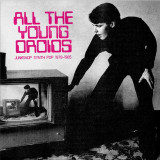
VARIOUS - ALL THE YOUNG DROIDS: JUNKSHOP SYNTH POP 1978-1985 (LP 2x12")
 
24

Compiled by Philip King
“And then came the rise of synth pop : blokes with dodgy haircuts hunched over keyboard-operated
machines stuffed with wires and do-it-yourself tone oscillators making sounds like a brood of geese
passing gas in a wind tunnel. Whoopee! This is the way the ‘70s ended : not with a blood-curdling bang
bang but with a cheap, synthesized, emasculating whimper.”
NICK KENT, NME.

All The Young Droids: Junkshop Synth Pop 1978-1985 is a new compilation that charts the
underbelly of the epoch-defining sound of the synthesiser in 80s popular music. Compiled by Philip
King (previously seen compiling All The Young Droogs, Glitterbest and Boobs - The Junkshop
Glam Discotheque), the music here connects the dots between DIY synth enthusiasts grappling with
new, cheap synthesisers at the tail-end of punk and wannabe, jobbing songwriters enthral to the new
music pioneered by Gary Numan, Depeche Mode and Daniel Miller’s Mute Records. Featuring rare
tracks of auto-didactic progressive pop music, proto-techno punk, shoot-for-the-stars-land-in-the-gutter
chart flops and heralded, underground synth classics, School Daze paints a picture of beautiful failure.
Complete with extensive sleeve notes written by King and never before seen imagery, all 24 tracks
were remastered by RPM in-house engineer Simon Murphy, many from vinyl copies due to lost master
tapes. The story told on All The Young Droids is one of the dawning opportunity presented by both the
emergence to the market of cheaper analog synthesisers and the distribution networks plus indie labels
that exploded with the advent of punk music in 1976. While the music that sprouted out all over the
globe in the wake of these factors was decried as fake, plastic, a refutation of punk’s guitar-led
revolution, it’s telling that much of the music on All The Young Droids.. was created in bedrooms,
ramshackle studios and home-made set ups with often borrowed equipment. In the era of record labels
jumping to capitalise on the success of The Sex Pistols, The Clash (both on major labels, of course)
these artists struggled to stand out from a new gold-rush with next to no budget or PR team. With radio
and labels desperate for the new Yazoo, what resulted was a testament to necessity being the mother
of invention.

At the time, the synthesiser was the music of the future, a shiny new machine that could paint like an
orchestra with a single finger and a 4-track. In the hands of Manchester avant-pranksters Gerry & The
Holograms it’s a pulsing, sardonic weapon.. the only instrument on the Messthetics classic lampooning
of New Wave fashion. In Hamburg, a 16 year old Andreas Dorau used it to write and record (with his
female classmates on vocals) a global smash in Fred Vom Jupiter (later licensed to Mute Records).
The hard-to-find English version (Fred From Jupiter, natch) is included here. Many artists with alreadystoried careers caught the bug and recorded synthesiser-fuelled peons to space, computers, the future
and, of course, love-interests. Harry Kakoulli, late of Squeeze, recorded a solo album in 1979 that
included the incredible power-synth-pop smash-that-never-smashed I’m On A Rocket. Similarly, Ian
North of Neo and American Power Pop stalwarts Milk ’n’ Cookies bought a Korg MS20 and used a
tape machine to record We’re Not Lonely, an absolute lost-classic of minimal synth pop. We’re Not
Lonely also features on the Junkshop Synth Pop sampler 7” twinned with John Howard unreleased
track You Will See, released April 12th 2025.

There are plenty of compilation debuts in evidence. Sole Sister were a mysterious trio who were
featured on the Scaling Triangles compilation of female-fronted, queer-adjacent post-punk /
underground music that also featured The Petticoats. Selwin Image were from San Francisco and
featured members of the recently defunct power pop/punk group The Pushups. Their stupidly catchy
The Unknown fizzes with New Wave energy - think XTC to Sparks but remains unreleased until now.
Dream Unit’s A Drop In The Ocean is an early synth wave cut, positively teaming with Joy Division
instrumentation, previously only released on a long-forgotten and super rare, self-released EP.
Incandescent Luminaire’s Famous Names belies an archetypal struggle of a small-town trying to
make it in a cruel industry but is a thrilling New Romantic-Synth Wave cross over with a OMD
gloominess that’s a joy to hear. Feminist Minimal Wave track I Am A Time Bomb by performance artist
Peta Lilly and Michael Chance is a revelation destined for new found cult status. It was released on 7”
and lost until now.

The flipside to the subterranean, never-made-it synth pop mentioned above are the ambitious, even
fruity attempts at success that have a perennial elegance to their confidence. New Jersey-ite Billy
London (real name Ed Barth) tried to cash in on the synth boom with Woman, released by a major
label, a lurching new wave track built on the Louie Louie rhythm and a wonderfully camp Lou Reedstyle sleazy vocal before exploding in the synthesised chorus. The song bombed but with a chorus like
this, you have to wonder why? Ex-Glitter Band member John Springate’s My Life is truly epic, with
doomed chord progressions and massive sounding drums turning into at least 3 different songs in the
course of the track. Before you wonder what’s going on the song resolves with a glorious return to the
main refrain.

The dry-ice-dressed dance floor is well catered for too. Design’s Premonition and Vision’s Lucifer’s
Friend are stone-cold minimal synth bangers, well loved but given a new lease of life here. The
Warlord’s The Ultimate Warlord was released in 1978, a homespun proto Hi NRG banger that was
later re-recorded by The Immortals in Canada who had a club hit with it. One-man- band Disco
Volante’s No Motion was re-issued by Synth wave label Medical in 2012 but makes its first vinyl
compilation appearance here. Close your eyes and you can imagine what Lawrence of Felt would have
sounded like with some cheap Korgs a little earlier in his career. Gibraltar-based trio The Microbes
imagined a computer programming people to dance - how prescient - and ended up with a propulsive,
robo-funk track with splendid rubbery bass playing over a tectonic drum machine. Previously picked up
by Belgian label Stroom TV, Dee Jay Bert & Eagle’s heavily Euro-accented I Am Your Master
demands the listener to “come to paradise!” In a frankly terrifying manner.
All The Young Droids is the first compilation to peel away from the narrative that dour, Minimal Synth
and Cold Wave were the only musical children of the first rush of synth pop. Philip King and School
Daze Records describe a much more complicated world: along with the austere, Brutalist children of
Daniel Miller (who produced Alan Burnham’s Bowie-Low-influenced Science Fiction here) was a
plethora of desperate cash-ins, accidental mainstream hits, ambitious pop dramas and major label
punts that went nowhere. Crucially, the compilation blurs the line between junk and treasure. What if the
two things are interchangeable. What if it’s all science fiction?

In Stock

On Stock and ready to ship

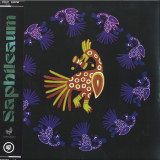
Saphileaum - Tamalungma

Saphileaum (the pseudonym of Georgian multi-media artist Andro Gogibedashvili) is inspired by Georgian myths and legends, esotericism, earth, unity, truth and the secrets of the universe.

Over the past few years, Saphileaum has released a diverse array of albums and EPs on labels such as Good Morning Tapes, Oslated, Silent Season, Mule Musiq and Slow Life, each one reflecting his unique blend of cosmic expansiveness, tribalism and meditative storytelling.

On his first collaboration with P&F Recordings, he draws inspiration from mysticism, self study, ancient civilizations and their various cultures and mysteries.

These musings unite to create an immersive sonic experience that traverses cosmic and tribal landscapes, bringing us 'TAMALUNGMA'.

Here, the listener enters a mystical realm-space, where nature's precious spirits guide you through a journey of transition. As you walk this path, their wisdom and presence illuminate the way, helping you move closer to your true purpose.

In Stock

On Stock and ready to ship

Robin Félix / Christian Pauchon - Incantation

For his second output on his own label, the Swiss electronic composer Robin Félix, takes this time the listener to West-Africa ; that said, Incantation is lightyears away from “world music”, but closer to the first “Fourth World” LP Jon Hassell recorded with Brian Eno. Moreover, Robin has teamed up with fellow Swiss sculptor, Christian Pauchon, who makes “woodoorina”, inspired by “bolis”, some rather objects used by the Bamanas in Mali and neighbouring countries, that ethnologists view as “fascinating mediators between man and his environment” ; a topic that led the Mauritanian Abderrahmane Sissako and Damon Albarn to compose the opera, The Theft of the Boli. Right from the outset of Goat Skin, one realises that Robin has applied his idiosyncratic way of (mis)treating field-recordings, to dissect and re-model an array of woodoorina calls (sometimes close to drones) entwined to a rhythmic pulse, conjuring up a starry night under which a shaman, adresses his incantations to the spirits of Nature. Robin Félix being who he is, as soon as Corten, his form of quiet electronics show that he is no stranger to Throbbing Gristle or Cosey Fanni Tutti, the self-explanatory Ritual Smoke taking it a little further. The spellbinding organic basses of Rains and Cauris, fused to textures that remind the experiments of David Toop and the electroacoustics of Pierre Henry, lead the listener even deeper into a contemporary avatar of a spiritual journey. In tune with the “call and response” mode, ubiquitous in African music, Pangi brings the EP even closer to the beating heart of the continent, the interactions of the sculptor and the composer blending to such a point that one may wonder if they have exchanged roles. As a meeting point of disciplines and art forms which are not supposed to meet, Incantation is also a convincing demonstration of what the word “inspiration” means, the superb visuals included ; of course, it requires a lot of finesse and respect on all sides

In Stock

On Stock and ready to ship

GEISTFREI & manu abeca - Eudaimonia

Eudaimonia is the outcome of a spontaneous connection between two artists, united by a shared passion for deep and emotional sounds. What began as an unplanned session evolved into a deeper exploration, flowing so naturally that it felt inevitable to create something more.

Inspired by the ancient Greek concept of Eudaimonia - a profound sense of fulfillment found through living authentically and purposefully - this EP dives into the inner world of its creators. From moments of reflection to waves of intensity -each track serves as a chapter in a journey toward inner exploration, embracing both the light and shadow within.
Eudaimonia celebrates the beauty of imperfection, the power of acceptance, and the pursuit of authentic expression. It invites listeners to lose themselves, to feel deeply, and to find meaning and healing through sound, connecting to something greater within themselves and the world around them.

In Stock

On Stock and ready to ship

Chlär - Modern Survival

2025 Repress

Chlar returns to his Primal Instinct label with 'Modern Survival'

Following the widely praised Funk Assault (Chlar & Alarico) 'Minimum One Post A Week' EP, which kicked off the Primal Instinct label last summer and won the support of the likes of Rodhad, Tasha, and Luke Slater, as well as routine plays from Sarah Story on BBC Radio 1, Chlar now returns to his imprint with solo venture 'Modern Survival'. While the first Primal Instinct release saw references to artist urges and behaviours on social media, this next instalment explores a modern recontextualisation of humanity's hierarchy of needs in yet another high-concept EP.

First up, 'Internet Soulmate' boasts a crunchy bassline as its drum work chugs along the track playfully. The groove twists and turns before the hypnotic and tribal 'Supermarket Hunting' continues with sounds of nature, loopy rhythm and syncopated bleeps.

On the B-side's 'Body Control Officer', human-made grooves intertwine with machine-like thrum, synths whirring and zapping, while 'Competitive Influencing' takes off with rolling percussion, subtle whistles and distorted vocal one-shots. Closing out another stellar offering from the Primal Instinct frontman, Chlar brings the dark 'Scout My Algorithm', a brooding slow-burner offset by smooth arpeggio snippets and warped slices of digital noise.

"In an era where technology entwines our everyday existence, where the virtual realm shapes our interactions, and where the pursuit of influence takes centre stage comes an EP that delves deep into the modern tapestry of human existence. 'Modern Survival' is not merely a collection of songs and visual clips, but a poignant reflection on the intricate dance between our primal instincts and the brave new world we navigate today. The EP invites listeners on a journey of self-discovery and reflection, prompting them to ponder the fundamental essence of our existence in an environment of fast-paced technological evolution." - Chlar

pre-order now

This item has not yet been released. You can pre-order the product now.


Last In: 2 years ago
Carly Simon - No Secrets (2x12")
  • A1: The Right Thing To Do
  • A2: The Carter Family
  • B1: You’re So Vain
  • B2: His Friends Are More Than Fond Of Robin
  • B3: We Have No Secrets
  • C1: Embrace Me, You Child
  • C2: Waited So Long
  • D1: It Was So Easy
  • D2: Night Owl
  • D3: When You Close Your Eyes

Carly Simon’s No. 1 smash “You’re So Vain” lingers as one of the most clever and famous songs ever recorded. The subject of mass speculation ever since its release, soon after which it occupied the top spot on multiple Billboard charts for weeks, the anthem kept a captive public guessing at the identity of its smug subject for decades. The question surrounding the protagonist’s identity remained perhaps the only mystery on the otherwise sexually open and autobiographically daring No Secrets, Simon’s commercial breakthrough and ‘70s singer-songwriter staple.

Sourced from the original master tapes, pressed at Fidelity Record Pressing in California, strictly limited to 3,000 numbered copies, and housed in a Stoughton gatefold jacket, Mobile Fidelity’s 180g 45RPM 2LP set affords the platinum-certified 1972 effort the finest sonic treatment it’s received on vinyl. Helmed by Richard Perry and recorded at London’s Trident Studios — where Beatles, David Bowie, and Elton John captured landmark LPs — No Secrets touts exceptional production qualities highlighted by this restorative reissue.

Audiophiles and record collectors, take note: This is the first time No Secrets has been available on 45RPM. The wider grooves and dead-quiet surfaces pay instant dividends. Simple, elegant, and disarming, songs seemingly float amid wide, deep soundstages. Simon’s voice takes on a confident, assertive tenor that emerges with accurate imaging, balanced tonality, and palpable presence. String arrangements and backing vocals come through with similar realism.

Enhanced by an all-star cast — Simon’s then-husband James Taylor, Paul and Linda McCartney, Mick Jagger, Lowell George, Klaus Voorman, Bobby Keys, Jim Keltner, Nicky Hopkins, and Bonnie Bramlett are among the renowned musicians who lend a hand — No Secrets advances Simon’s themes of personal introspectiveness, no-holds-barred reflectiveness, and feminist-inspired boldness. She makes every moment of No Secrets worth savoring. Simon invests her all in the songs, handling beautiful ballads, sassy folk-rock numbers, and bluesy fare with calm, composure, and candor.

While acknowledging her own regrets (“You’re So Vain”) and loss (“The Carter Family”), Simon champions the highs (“The Right Thing to Do”) and pains (“His Friends Are More Than Fond of Robin”) of love in a sincere manner indicative of her maturity as both an artist and singer. The New York native distinguishes “When You Close Your Eyes” with deep-rooted spirituality, recalls childhood joys via charming sentimentality on “It Was So Easy,” and and takes ownership of her persona on a cover of Taylor’s “Night Owl.”

“We have no secrets
/We tell each other everything,” Simon sings at the record’s midpoint, encapsulating both the themes and bravura of an effort that was nominated for four Grammy Awards and saw her write or co-write every song but one. Combined with Perry’s savvy instrumental arrangements, her self-assured performances and forthright lyrics grant No Secrets an edginess and relevance immune to the ravages of time.

pre-order now

This item has not yet been released. You can pre-order the product now.


Last In: 2026 years ago
gyrofield - Suspension of Belief

gyrofield

Suspension of Belief

12inchKAPS003
Kapsela
16.06.2025

gyrofield is 22-year-old, Utrecht-via-Hong-Kong producer Kiana Li, who has put out several albums and over a dozen EPs since 2018, from self-released productions to projects on Metalheadz, XL Recordings and FABRICLIVE among many others.

Their next EP is Suspension of Belief, and it arrives on Objekt's label, Kapsela. (Following last year's Ganzfeld and Chicken Garaage, it's Kapsela's first record by an artist other than Objekt himself.) In keeping with her recent releases, it shows Li continuing a creative renaissance, moving beyond the outer fringes of drum & bass to present what they call "a set of deeper, shapeshifting tracks, cross-pollinating ideas from house, free jazz and techno."

Suspension of Belief was written between June and October of 2024, inspired by a summer spent in nature and encapsulating Li's lived experiences and personal reflections in this time. "Thoughts about the boundaries between civilisation and nature began to take on a charged meaning," she says. "How can we, as people, live on the backs of others’ suffering, and see emotionally vacant newscasting on the desecration of the world around us? We ought to be angry, but we also ought to find healing and love somewhere. A representation of this thinking exists in the record."

The result is an elegant paradox. From the warm upright bass on "Vegetation Grows Thick" to the rattling, "Spastik”-esque snare rolls of “Bolete”, the record is at once steely and organic, with dreamlike states giving way to depth and intensity. It’s functional enough for rituals of escapism but determined to confront the world as it really is. As Li puts it:

"Suspension of Belief is a play on the suspension of disbelief, the common convention for us to immerse ourselves in fictional worlds. In turn, the record’s title suggests the idea of immersing in the real world, an antifiction, facing reality.”


Mastered by Beau at Ten Eight Seven

Artwork and design by Brodie Kaman

Vinyl distributed by Rubadub

In Stock

On Stock and ready to ship

Grischa Lichtenberger - Ostranenie LP

LIMITED VINYL COMES IN CARDBOARD SLEEVE WITH BOOKLET!
OSTRANENIE is a collection of digitally manipulated, impressionistic piano miniatures — each named after blockbuster films and TV series. Improvised late at night as a reaction against passive media consumption, these pieces function as both homage and critique, navigating the space between classical impressionism and contemporary digital manipulation. They don’t just deconstruct traditional piano expression; they interrogate the emotional stakes of sound in an era where immersion culture flattens meaning and algorithmic logic erodes agency.

The album’s title references the Russian formalist Viktor Shklovsky’s concept of “ostranenie” (ɐstrɐˈnjenjɪj, estrangement/defamiliarization), a term he introduced in the early 1920s to describe art’s role in resisting the indifference of habitual perception.

“And so, held accountable for nothing, life fades into nothingness. Automation eats away at things, at clothes, at furniture, at our wives, and at our fear of war.”
—Viktor Shklovsky, Theory of Prose (1925)

Shklovsky saw art as a way to break through the anesthetizing effects of routine, stripping away the layers of habit that dull our senses. By making the familiar strange, art reclaims perception from the mechanical and the automatic. His argument wasn’t just a theoretical exercise — it was a response to a world rapidly consumed by industrialization, war machines, and the alienation of a technologically dominated modern life. In this context, he positioned artistic technique as something autonomous, distinct from mere social criticism or psychological reflection. Art seeks to remove “...the crust that the world of things deposits on our senses, with routine’s unending murder of the real.” Ben Ehrenreich on Serena Vitale’s Making Strange (The Nation, 2013)

This tension—between revolutionary/artistic and industrial technologies—defined the 20th century, and it continues to resonate today. The mechanization and automation that fueled the First World War’s devastation, alongside the social and economic turbulence of the 1920s, became central to the era’s self-conception. But just as technology was a source of alienation, it was also positioned as an agent of radical change. As the shock of modernity disrupted the human condition, it also became the driving force behind an ideological utopia — one that ultimately deformed into political totalitarianism — a paradox that remains unresolved.

OSTRANENIE plays within this contradiction. The music shifts seamlessly between an uncanny black MIDI dismantling of traditional piano virtuosity and moments of raw, fragile intimacy. The result is a work that resists automatic anonymity while questioning what it means to create in an era where the technological mediation of sound — and experience itself — is unavoidable: Art in the age of its technological constructedness.

In Stock

On Stock and ready to ship

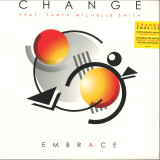
Change feat. Tanya Michelle Smith - EMBRACE LP 2x12"

Change, founded in 1980 by Mauro Malavasi, Jacques Fred Petrus, Davide Romani, and
Paolo Gianolio, is a legendary band on the interna#onal soul/disco scene, renowned for
launching iconic voices such as Luther Vandross and Jocelyn Brown.
Their debut album, The Glow of Love, was produced in 1979 between Bologna and New
York. Widely regarded as one of the greatest disco/soul/funk LPs of all #me, it achieved
enormous interna#onal success. It was the first Italian produc#on in this genre to enter the
Billboard 200 chart, peaking at #29 and earning a Gold Record. The singles “A Lover’s
Holiday” (Top 40 on the Billboard Hot 100), “Searching,” and the #tle track “The Glow of
Love” (which reached #2 in Italy) solidified the album’s global impact.
So influen#al was the record that in 2001, Janet Jackson sampled the #tle track for her hit
“All for You,” which went on to win the Grammy Award for Best R&B Recording.
Throughout the 1980s, Change released five addi#onal albums:
• Miracles (1981)
• Sharing
Your Love (1982)
• This Is Your Time (1983)
• Change of Heart (1984, produced by Jimmy
Jam & Terry Lewis)
• Turn on Your Radio (1985)
In 2010, the previously unreleased album Change Your Mind—recorded in the 1990s and
produced by Davide Romani—was finally released.
In 2018, aEer a 33-year hiatus, Love 4
Love marked the band’s comeback. Produced by Romani and Stefano Colombo, the album
introduced vocalist Tanya Michelle Smith and featured eight original tracks wriGen by
Romani, Malavasi, Colombo, and Elio Baldi Cantù. The singles included:
• “Hit or Miss” (remixed by Soulpersona)
• “Love 4 Love” (also remixed by Joey Negro)
• “Make Me (Go
Crazy)” (remixed by Opolopo)
Embrace (2025), credited to Change feat. Tanya Michelle Smith, represents the natural
musical evolu#on of Love 4 Love. Originally conceived in 2019 as Tanya Michelle Smith’s solo
album, it was later reviewed by producer Stefano Colombo together with Mauro Malavasi,
who approved the material and authorized the use of the name “Change.” Malavasi also
contributed to the cover design and selected the album #tle: Embrace.
The first single, “Sunrise Forever,” was released on January 10. The remix by Michael Gray
reached #1 on Traxsource and ranked high on the UK Soul Chart.
The album’s release was postponed when Davide Romani and Stefano Colombo decided to
complete an unfinished demo from the Love 4 Love sessions. Some original parts were lost
due to a corrupted backup, but in 2025 the track was completely rearranged with a newly
recorded bassline by Romani and fresh backing vocals.
On April 4, the single “Got 2 Get Up” was released across all digital plaOorms, receiving
strong radio airplay across Europe and entering the UK Soul Chart. On May 16, a remix by
renowned Italian duo Micky More & Andy Tee will be released in an#cipa#on of the album.
Embrace includes ten original tracks and one cover.
The album will be available on CD and vinyl, distributed by Self Distribuzione Srl. The first
500 vinyl copies will be issued as a limited “Expanded Edi&on”, including the full album plus
a bonus 12” single with Michael Gray’s remixes of “Sunrise Forever.”

In Stock

On Stock and ready to ship

Doof - The Love Mixes

Doof

The Love Mixes

12inchMYS023
MYSTICISMS
03.06.2025

Following the success of his ‘Love Dub So’ EP, Nick Barber’s Doof project returns to Mysticisms, delving back to his earliest recordings of his ground-breaking Trance project, presenting tracks from his previously cassette only release ‘The Love Mixes’.

A youth that had captured the psychedelia of Pink Floyd, Gong, Hawkwind and on to Psychic TV, as a self-taught guitarist, his first trip to India and Thailand in 1989 and witnessing the early electronic dance music at the Full Moon parties, had seemed rudimentary in nature compared to musicality of psychedelic rock.

Returning to England, the electronic / rock crossover of The Shamen’s ‘Progeny’ parties – featuring DJs like Paul Oakenfold and Mixmaster Morris with the live acts of Orbital and Ramjac Corporation – offered something new that turned his head, before finally finding his crew in the legendary squat / underground Pagan parties. There, residents Lol and Yaz first played the new electronic Trance sound, introducing Barber to the music of Eye-Q, Dance To Trance and the hugely influential Pete Namlook.

Recorded between 1990 – 1991, while living in Cambridge to study Philosophy, these are the first versions of tracks that formed the basis of his debut EP on Novamute, in 1993. Working with minimal equipment – an Akai sampler, Roland monosynth, Yamaha delay pedal, all sequenced on an Atari black and white PC and single MIDI output and then recorded straight to an 8-track Tascam cassette multitrack – the exuberance and rawness of the music are full of the excitement and naivety of youth.

Never intended for public release or initially even as a demo, Barber would play the music off the Tascam multitrack for friends at after parties. Dubbing a handful of cassettes himself and personally drawing the covers, around a dozen cassettes were handed out to mates. Eventually one copy found its way to Mute Records, who were looking to launch their dance offshoot, Novamute. Re-edited mixes of Gift Of The Gods and The Nagual appeared on his debut EP and history was made, before Doof went on to release for luminaries like TIP Records and Dragonfly and a career touring the globe was launched.

Remastered from the original tapes, this EP offers a snapshot of that time, the energy and joy of these early recordings is clear and overwhelming. Where Ambient, House and Techno met the birth of electronic Trance that truly stand up some 30 years later as originals then and now.

Trance The Mystery.

In Stock

On Stock and ready to ship

Dam Swindle - Open LP 2x12"

Dam Swindle

Open LP 2x12"

2x12inchHEISTLP03
Heist Recordings
30.05.2025

Amsterdam natives Maarten Smeets and Lars Dales, aka Dam Swindle, unveil their third long-player with the release of a new track, the first to be shared from the upcoming album, ‘Open’ - out on 30 May 2025 via Heist Recordings.

The new album sees the acclaimed duo dive far beyond the deep sonic waters they’re most known for, exploring lower tempos, synthwave, hip-house, and ambient across fourteen tracks. With a gestation period that traces back several years, ‘Open’ is their most intimate and personal body of work thus far, birthed during a time of self-reflection away from touring and personal transformation as individuals.

“We felt the need to tell a very personal story through our music as a translation of our personal development in the past years. We also wanted to make music without a specific goal in mind; We simply wanted to create. By taking away the grid of dance music and any expectations of what a Dam Swindle song should sound like, the creativity started to flow naturally with songs in many different styles and tempos. The result is an album that feels refreshing and uplifting and still very much true to the heart and soul of our sound.” - Dam Swindle, January 2025.

While the trademark Dam Swindle four-to-the-floor beats are still ever-present on tracks like ‘The Present Is Always Perfect’, ‘I Need You’, and ‘Is This Love?’, it’s the gentle waves of synths on opener ‘Home’, the contemplative piano chords of ‘Bloom’ featuring Joep Beving, and the lo-fi ambience of ‘It’s Okay, I Can Wait’ that showcase a melancholic, ethereal sensibility previously uncharted by the duo. Collaborations with vocalists such as NYC’s Haile Supreme on ‘Not Enough’ and Neo-soul singer Faye Meana on ‘Girl’ expertly find room in between the dancefloor and home listening sessions, and a clear standout on the LP is the title cut where message-heavy rapped vocals from UK artist Samson ebb and flow amongst iridescent grooves.

Under the helm of Maarten and Lars’ adept A&R, their Heist imprint has become a beloved home for house heads of both schools old and new, platforming some of dance music’s biggest names from Cinthie to DJ Sneak as well as the musical dawnings of artists such as Kassian and Makèz. The Dam Swindle alias has achieved house music royalty-like status across a storied 15-year career that includes two critically lauded full-lengths, collaborations with the likes of Tom Misch and Kerri Chandler, and a globetrotting touring schedule. This album stands as their most profoundly personal work of art to date, and they can’t wait to share it with you.

In Stock

On Stock and ready to ship

Om Unit - Acid Dub Studies

Om Unit

Acid Dub Studies

12inchADS001
Om Unit
20.05.2025

2025 Repress

Jim Coles once again turns the tide towards a new horizon and travels further into the echo chamber. Leading on from the much-lauded ‘Secret Location’ mini-album with Seekersinternational, one-offs such as ‘Open Palms dub’ (Dub Stuy) and other teasings, ‘Acid Dub Studies’ is the fully-fledged result of the merging of the calligraphic expression of the 303 Acid bassline with the stern sway of Dub Reggae and the hazier edges of Dub Techno and Ambient music.

For those who have been paying close attention, this project will come as a welcome return to the vulnerability and playfulness of early Om Unit records such as his sub-radar single from 2010 ‘Lightgrids/Lavender’ (All City Records) or the unearthed chugging ambience of ‘Friend of Day’ (Idle Hands) and indeed in some sense draws from similar wellsprings as moments on 2013’s Bass classic ‘Threads’.

Whilst being perhaps an ‘interim project’ this is still a vital and important expression of exploration and playfulness. A study in the true sense and borne out of a subtle but pervasive frustration with the rigidity found in musical words he has up to now been cohabiting, Acid Dub Studies comes from the pressing need to break with perceived expectation and to explore an honest and natural space away from the genre labels and tags that had been often lazily applied to his sizeable catalogue of music.

With no desire to reinvent the wheel, rather to paint pictures in an honest framework, the LP was crafted using a medley of classic analogue mixing techniques inspired as much by the adventurous dubbing of Adrian Sherwood as by the inward-delving haze of Scott Monteith’s Deadbeat project. Created during a period of lonely introspective walks through his home town of Bristol, the cover art is a photograph of some of the iron kerbstones that are found almost exclusively in the characterful and hardy city which were installed in the late 1800’s to protect pavements from cart wheels. Something about the permanence of those iron slabs and cobblestones inspired a sense of comfort and determination.

Acid Dub Studies is due for release as yet another self-released label-free project leading on from recent EP titles ‘Violet’ and ‘Submerged’ both of which hinted at some of the shapes found in this full length album.

Once again Jim has shown a rare convincing adaptability that few electronic artists can embody. Another step on the journey of personal and creative curiosity that fans are sure to appreciate.

In Stock

On Stock and ready to ship

Chlär - Intrinsic Drive

Chlär

Intrinsic Drive

12inchMR-015RP
Mutual Rytm
08.05.2025

2025 Repress

Mutual Rytm welcome back Swiss DJ/producer Chlär for a bustling, high-octane return as he unveils his latest six-track EP, 'Intrinsic Drive'.

Swiss artist and mastering engineer Chlär's last outing on Mutual Rytm, his 'Optimized Grooves' EP, was a standout success that made an impact far and wide across the techno realm. It was another big step for the fast-rising producer, who is also a dexterous DJ that plays across three and even four decks in the club. A craftsman of sounds, his take on techno is full throttle and has come on labels like Iceland's NIX and Stranger's Self Reflektion imprint. Always looking to improve his sounds, he hits a perfect sweet spot with a fresh and visionary approach across six fresh productions with his 'Intrinsic Drive' EP, again showcasing exemplary creative progression in his ever-impressing production skills.

Up first is 'Dopamine Rush', a quickened techno pumper with synths peeling off the straight-ahead drums and locking you into a state of hypnosis. The title track 'Intrinsic Drive' is a tightly woven mix of drums, hits and bass that never lets up, while the supple rhythm is overlaid with alien sound designs to up the intensity. 'For Marco' takes a heavier path with darkened and more weighty kick drums under eerie synth loops. There is a real swing in the drums of 'Steady Pace' as the crisp hits and vocal fragments all up the ante, before 'Greedy Man' delivers a tough panel beater with skewed synths and an industrial undertone. Digital bonus 'May I Dance?' rounds things out with raw textures and unhinged loops that take you to the heart of a strobe-lit dance floor, shaping up another
mighty fine statement of intent from the ever more vital Swiss native.

In Stock

On Stock and ready to ship

LUC-HUBERT SEJOR - MIZIK FILAMONIK: SPIRITUAL SOUND

180 G. BLACK VINYL WITH LINER NOTES IN CREOLE, FRENCH, ENGLISH

Originally released in 1979, "Spiritual Sound" lives up to its name, a soaring, triumphant album, six tracks of spirit magic from Guadeloupe.

Telluric, intense, terribly alive, the gwoka drums of Guadeloupe carry the identity of a painful and fervent island. Marked forever by the crime of slavery, Guadeloupe's créolité cherishes the ka drums and their natural environment: the low-pitched boula drum with male goatskin, the high-pitched soloist makè drum with female goatskin, the chacha, ti bwa, triangle, calabash and other percussion instruments that surround them, and the voices - the fiery, proud, timbred, urgent voices of the gwoka.


This album is also a legend for its voices: in his then dazzling youth, singer Lukuber Séjor was one of the first gwoka artists to largely feminize the chorus of répondè, who converse with his text delivered in a straight and powerful voice.

And everything here sets new standards. In 1979, Mizik Filamonik - Spiritual Sound proclaimed a spiritual patriotism of ferocious intensity. The album by Lukuber Séjor - whose spelling alone is a battle - sets out to give Guadeloupe the intangible weapons of self-respect and self-knowledge, through a singular practice of traditional music.

The genesis of gwoka music is less straightforward than one might imagine... The drums performed the servile task of accompanying the work of slaves in the fields and during the “corvées” imposed by the administration, before being freely practiced by the common people after the abolition of 1848. At the heart of the conviviality of the Guadeloupeans furthest from the cities - geographically and socially - the gwoka drums come out for carnival, funeral wakes and neighborhood celebrations, but also during strikes, fits of anger and armed vigils of the riots and revolts that have punctuated the island's history. For generations, governors of the colony and then the prefects of the overseas department of Guadeloupe have been viewing the gwoka as a potential for turbulence and a threat to public order.

But as the Beatlesmania, “chanson engagée” and rock revolutions unfolded in Europe, young people turned to the drums of mizik a vié nèg (“bad negro music”, in Creole), which Guadeloupeans had learned to despise by following the “assimilation” process advocated by the school system and most of the political class. At the end of the sixties, in a Guadeloupe mourning the deadly repression of the May 1967 social movement, they played traditional music, refusing to wrap it up in tourist prettiness and madras folk costumes. Instinctively, they played a rough and contemporary gwoka, led by the incendiary Guy Konkèt. This was the era of decisive 45 rpm records such as Robert Loyson's Kann a la richès, which brought to light the fieriest words of union rallies.

At his home in Sainte-Anne, Lukuber Séjor played with flautist Olivier Vamur and his brother Claude Vamur, who cobbled together a drum kit from tin crockery and became, a few years later, the most influential drummer in Kassav'.

These were the years of the Bumidom program, when young Guadeloupeans were encouraged to emigrate to mainland France. At the age of twenty, Lukuber Séjor embarked on the liner Irpinia, disembarking at Le Havre and taking the train to the Gare Saint-Lazare - the route taken by thousands of young West Indians who went on to study or looked for work, all the while trying to maintain a link with their homeland. In this case, it's at the Antony university residence, where Lukuber played the drum and participated in a thousand gwoka updates and aggiornamentos, while exile reinforced the need for a spiritual link with the native land.

In 1978, Guy Konkèt played at the Salle Wagram, a historic event for West Indian music. After serving as répondè - i.e. backing vocalist - on one of his home-recorded albums, Lukuber joined his live band. Little by little, he became one of the key artists on a circuit parallel to French show business. At a student party in Caen, he met a young woman from Martinique who, at the time, was more motivated by her ambitions as a visual artist than by her vocation as a musician. Her name was Jocelyne Béroard and, a few years before she plunged into the Kassav' adventure and became the greatest West Indian singer of her generation, she designed the cover of Lukuber Séjor's LP.

This ambition was obvious and imposed its will. A more or less regular band was formed, with Roger Raspail, Rudy Mompière and Éric Danquin on ka drums, Claude Vamur on ti bwa, Olivier Vamur and Françoise Lancréot on flutes and Annick Noël on keyboards. Lukuber Séjor is set on wanting to extend the gwoka palette to other instruments, as the jazz-rock revolution opens a thousand new doors. Annick Noël will play a wide range of timbres and textures on electric piano and synthesizer. Another novelty: the répondè are two men and two women, Roger Raspail, Olivier Vamur, Françoise Lancréot and Maryann Mathéus ...

Mizik Filamonik - Spiritual Sound is a self-production in which the singer and leader sank all his savings, allowing him no more than a single day in the studio. The first side is more of a musical manifesto, with the first two tracks, Éritage and Penn é plézi, being instrumentals. The third, Son, forcefully celebrates the need for Guadeloupeans to connect with the gwoka. In fact, Jocelyne Béroard's cover shows a tambouyé in the shadow of a cloudy sky, against which a radiant sun is rising and whose light will soon flood the entire landscape. The silhouette and face of this man strongly evoke the immense Vélo, master of the ka, rejected at the time on the fringes of society.

The second side of the LP is surprising. Formally, three tracks are explicitly linked like the three parts of a triptych. Primyé voyaj evokes the appalling tribulation of Africans deported as slaves to Guadeloupe; dézyèm voyaj speaks of the Bumidom program and the economic, political and social forces driving young Guadeloupeans towards the mirage of prosperity in France; twazyèm voyaj closes the cycle with the emigrants' return from Europe after years away from their island...

This gwoka, obsessed with the need to save Guadeloupe spiritually, appeals far beyond the politicized audience. Mizik Filamonik - Spiritual Sound instantly became a classic, although Lukuber Séjor never really made a career for himself as a musician.

After all, the album was released in 1980, with no promotional resources in France or Guadeloupe - and therefore no concerts. The thirty-two-year-old author, composer and performer made his own third trip back to Guadeloupe. He set up a small woodworking business, which he lost in Hurricane Hugo in 1989. His other activity, teaching in a medical-educational institute, became the core of his professional life. He continued to be an active campaigner - a campaigner for the Creole language, a campaigner for the reawakening of identity, a campaigner for special education, a campaigner for a thousand causes that he ignited with his generous and perceptive enthusiasm, such as the defense of breadfruit fries...

The echoes of his 1979 album have not died down. Of course, the use of Penn é plézi as the theme tune for Radio Guadeloupe's funeral notices from 1980 to 1992 kept him in the collective memory, but he continues to sing and compose sporadically, as with his all-female

vocal group Vwapoulouéka... Still convinced that music is a means of liberating the spirit, he continues the journey of a young man eager to deploy the power of Creole music and language.

Bertrand Dicale

In Stock

On Stock and ready to ship

Various - ECHOES OF ITALY – THE BIRDS OF PARADISE – EARLY 90S HOUSE VIBES VOL.2 (2x12")

Googling “paradise house”, the first results to pop up are an endless list of European b&b’s with whitewashed lime façades, all of them promising “…an unmatched travel experience a few steps from the sea”. Next, a little further down, are the institutional websites of a few select semi-luxury retirement homes (no photos shown, but lots of stock images of smiling nurses with reassuring looks). To find the “paradise house” we’re after, we have to scroll even further down. Much further down.

It feels like yesterday, and at the same time it seems like a million years ago. The Eighties had just ended, and it was still unclear what to expect from the Nineties. Mobile phones that were not the size of a briefcase and did not cost as much as a car? A frightening economic crisis? The guitar-rock revival?! Certainly, the best place to observe that moment of transition was the dancefloor. Truly epochal transformations were happening there. From America, within a short distance one from the other, two revolutionary new musical styles had arrived: the first one sounded a bit like an “on a budget” version of the best Seventies disco-music – Philly sound made with a set of piano-bar keyboards! – the other was even more sparse, futuristic and extraterrestrial. It was a music with a quite distinct “physical” component, which at the same time, to be fully grasped, seemed to call for the knotty theories of certain French post-modern philosophers: Gilles Deleuze, Félix Guattari, Paul Virilio... Both those genres – we would learn shortly after – were born in the black communities of Chicago and Detroit, although listening to those vinyl 12” (often wrapped in generic white covers, and with little indication in the label) you could not easily guess whether behind them there was a black boy from somewhere in the Usa, or a girl from Berlin, or a pale kid from a Cornish coastal town.

Quickly, similar sounds began to show up from all corners of Europe. A thousand variations of the same intuition: leaner, less lean, happier, slightly less intoxicated, more broken, slower, faster, much faster... Boom! From the dancefloors – the London ones at least, whose chronicles we eagerly read every month in the pages of The Face and i-D – came tales of a new generation of clubbers who had completely stopped “dressing up” to go dancing; of hot tempered hooligans bursting into tears and hugging everyone under the strobe lights as the notes of Strings of Life rose up through the fumes of dry ice (certain “smiling” pills were also involved, sure). At this point, however, we must move on to Switzerland.

In Switzerland, in the quiet and diligent town of Lugano, between the 1980s and 1990s there was a club called “Morandi”. Its hot night was on Wednesdays, when the audience also came from Milan, Como, Varese and Zurich. Legend goes that, one night, none less than Prince and Sheila E were spotted hiding among the sofas, on a day-off of the Italian dates of the Nude Tour… The Wednesday resident and superstar was an Italian dj with an exotic name: Don Carlos. The soundtrack he devised was a mixture of Chicago, Detroit, the most progressive R&B and certain forgotten classics of old disco music: practically, what the Paradise Garage in New York might have sounded like had it not closed in 1987. In between, Don Carlos also managed to squeeze in some tracks he had worked on in his studio on Lago Maggiore. One in particular: a track that was rather slow compared to the BPM in fashion at the time, but which was a perfect bridge between house and R&B. The title was Alone: Don Carlos would explain years later that it had to be intended both in the English meaning of “by itself” and like the Italian word meaning “halo”. That wasn’t the only double entendre about the song, anyway. Its own very deep nature was, indeed, double. On the one hand, Alone was built around an angelic keyboard pattern and a romantic piano riff that took you straight to heaven; on the other, it showcased enough electronic squelches (plus a sax part that sounded like it had been dissolved by acid rain) to pigeonhole the tune into the “junk modernity” section, aka the hallmark of all the most innovative sounds of the time: music that sounded like it was hand-crafted from the scraps of glittering overground pop.

No one knows who was the first to call it “paradise house”, nor when it happened. Alternative definitions on the same topic one happened to hear included “ambient house”, “dream house”, “Mediterranean progressive”… but of course none were as good (and alluring) as “paradise house”. What is certain is that such inclination for sounds that were in equal measure angelic and neurotic, romantic and unaffective, quickly became the trademark of the second generation of Italian house. Music that seemed shyly equidistant from all the rhythmic and electronic revolutions that had happened up to that moment (“Music perfectly adept at going nowhere slowly” as noted by English journalist Craig McLean in a legendary field report for Blah Blah Blah magazine). Music that to a inattentive ear might have sounded as anonymous as a snapshot of a random group of passers-by at 10AM in the centre of any major city, but perfectly described the (slow) awakening in the real world after the universal love binge of the so-called Second Summer of Love.

For a brief but unforgettable season, in Italy “paradise house” was the official soundtrack of interminable weekends spent inside the car, darting from one club to another, cutting the peninsula from North to centre, from East to West coast in pursuit of the latest after-hours disco, trading kilometres per hour with beats per minute: practically, a new New Year’s Eve every Friday and Saturday night. This too was no small transformation, as well as a shock for an adult Italy that was encountering for the first time – thanks to its sons and daughters – the wild side of industrial modernity. The clubbers of the so-called “fuoriorario” scene were the balls gone mad in the pinball machine most feared by newspapers, magazines and TV pundits. What they did each and every weekend, apart from going crazy to the sound of the current white labels, was linking distant geographical points and non-places (thank you Marc Augé!) – old dance halls, farmhouses and business centres – transformed for one night into house music heaven. As Marco D’Eramo wrote in his 1995 essay on Chicago, Il maiale e il grattacielo: “Four-wheeled capitalism distorts our age-old image of the city, it allows the suburbs to be connected to each other, whereas before they were connected only by the centre (…) It makes possible a metropolitan area without a metropolis, without a city centre, without downtown. The periphery is no longer a periphery of any centre, but is self-centred”.

“Paradise house” perfectly understood all of this and turned it into a sort of cyber-blues that didn’t even need words, and unexpectedly brought back a drop of melancholic (post?)-humanity within a world that by then – as we would wholly realise in the decades to come – was fully inhuman and heartless. A world where we were all alone, and surrounded by a sinister yellowish halo, like a neon at the end of its life cycle. But, for one night at least, happy."

In Stock

On Stock and ready to ship

YAZZ AHMED - A Paradise To Hold LP 2x12"

A Paradise In The Hold is an album of yearning. It’s about Ivor Novello Award winning Yazz Ahmed’s dual heritage, drawing on traditional music and folklore as well as her own personal experience as a British-Bahraini woman. A sweeping epic where tradition meets innovation, she melds ancient rhythms with contemporary musicianship. The record is a tribute to the sorrowful songs of Bahrain’s pearl divers, the strength of Arab women, and the celebratory rhythms of women's traditional drumming circles, while also telling the story of Yazz’s own decade-long voyage of selfdiscovery. The album also marks Yazz’s first foray into writing lyrics, in both English and Arabic, bringing a new dimension to her expansive sound. The project features an impressive roster of collaborators, including vocalists Natacha Atlas, Brigitte Beraha, and percussionist Corrina Silvester. With A Paradise In The Hold, Ahmed delivers a groundbreaking fusion of tradition and innovation, creating a contemporary jazz project that is set to make a lasting impact on the genre

In Stock

On Stock and ready to ship

Edictum - A Cosmic Scale

The album’s title deftly gestures to the sheer vastness of astronomical dimensions, while simultaneously capturing the musical breadth within, where the eight planets are imagined as the eight notes of an octave. The work draws inspiration not only from earlier compositions —most notably Gustav Holst’s The Planets—but also from the rich astronomical and cultural contexts surrounding these celestial bodies. Here, the focus transcends direct citation of melodic motifs, instead embracing an intriguing conceptual approach on a meta level, unfolding in a series of vividly contrasting soundscapes. These contrasts shape a sweeping sonic journey, one that fully embraces the album format with both arms, inviting the listener to venture into realms both strange and wondrous, feeling the immensity of the interstellar space that lies between them. Contrast, after all, is the brushstroke that enriches our world.

Embarking on an auditory voyage, "Astral Guide" establishes the sonic framework that propels us into the boundless expanses of the cosmos. Its ethereal tones evoke the vastness of space, crafting a mood ripe for exploration within the realms of sci-fi. The subsequent tracks unfold like constellations, weaving a rich tapestry of sound that seamlessly marries cinematic soundscapes with pulsating, club-oriented rhythms. This album invites listeners to traverse its immersive landscapes, whether nestled in the comfort of home or dancing under the starlit sky, each note a guide through the transcendent experience of a nocturnal journey.

"Solar Flares" draws its inspiration from the awe-inspiring expanse of solar phenomena, capturing the majestic power of the sun as it reaches into the cosmos. This track resonates with the idea that energy, while vital, can also be a force of destruction when unleashed with overwhelming intensity. The composition beautifully mirrors the sun’s duality, where brilliance and devastation coexist, inviting listeners to reflect on the delicate balance between creation and annihilation. Through its rich textures and dynamic shifts, "Solar Flares" serves as both a homage to the celestial and a poignant reminder of nature's formidable power.

"Mercury – The Winged Messenger" embodies a meticulously crafted soundscape where artistry meets astronomy. The tempo of 173.6 BPM, derived from precise astronomical data, propels the composition into a vibrant realm that resonates with cosmic energy. Synthwave sound design intertwines seamlessly with the fluid rhythms of Drum’n’Bass, imbuing the piece with an uplifting dynamism that evokes the ethereal grace of Mercury itself. In this sonic exploration, listeners are invited to ascend on wings of sound, navigating the celestial tapestry of the universe with each invigorating beat.

"Venus, The Bringer of Peace" strikes a decidedly cozy note, presenting a poignant contrast to the more tempestuous themes often found in cosmic narratives. This composition evokes a nostalgic vision of an optimistic era, one in which humanity transcended borders and embraced the infinite possibilities of space exploration, where no destination felt too distant. The dense, languid atmosphere envelops the listener, creating a tangible sense of serenity that unfolds gradually, allowing for a meditative journey through sound. Each note serves as an invitation to linger in this tranquil embrace, reflecting on the harmonious potential of our collective aspirations and the beauty of connection in a vast universe.

The central theme of „Gaia, The Bringer of Life“ —originally not part of the planetary cycle— is the profound enabler of life on Earth. The arrangement delicately mirrors the slow, tentative unfolding of this potential, marked by an initially sparse orchestration that gradually builds in momentum. This progression crescendos, embodying the explosive dynamism of the Cambrian burst of life, ultimately culminating in a euphoric fanfare—a triumphant, celebratory flourish echoing life’s victorious emergence.

"Blue Moon" unfolds as a contemplative reverie on the tranquil clarity of a night sky, now seldom glimpsed in its natural purity, unclouded by the relentless haze of urban light. The listener is drawn into the vast embrace of the star-strewn firmament, a journey that sways between euphoric awe at nature’s sublime beauty and a profound melancholy for its fragile and imperiled state. Musically, this duality finds expression in the delicate interplay of modal mixtures, while an ever-shifting triplet groove, poised at the intersection of Outrun and melodic house, lends a pulse that is both nostalgic and forward-looking—echoing the beauty and transience of a world on the brink.

Rather than replicating the original composition of „Mars, The Bringer of War“, this interpretation seeks to evoke its profound, foreboding atmosphere. Cyberpunk emerges here as an ideal genre, channeling the dark, relentless march synonymous with Mars, the ancient god of war. The piece reverberates with intensity, as distorted vocalizations rise, embodying the anguish and visceral torment that shadow war’s violent crescendo. This auditory descent into conflict captures the relentless pulse of warfare, where sound itself becomes an embodiment of suffering and fury.

Majestically, "Jupiter, the Bringer of Jollity" emerges on the celestial stage, sweeping away the somber tones with its radiant vigor. Drawing inspiration from the triumphant strains of the original, and borrowing a melodic motif in the refrain, the piece expresses joy and buoyancy through a shift to a major key and the lilting sway of a danceable 12/8 meter. Spirited and exuberant, it leaps boldly from major to minor and back again, playfully shifting time signatures to capture a mood of unbridled festivity and jollity.

Here, a more conciliatory concept is chosen than in the original inspiration. „Saturn“ aligns with the number six, being the sixth planet from the Sun and bearing the iconic hexagonal pattern at its northern pole. What, then, could be more fitting than to render this piece in a 6/8 time signature? The arrangement unfolds with a multifaceted richness, mirroring the countless stones and ice fragments that form the foundations of Saturn’s majestic rings.

„Uranus“ adopts the theme of a light-footed, dancing instrumentation, giving the impression of perpetual motion, never quite settling. This musical choice harmonizes with the planet’s own orbit, as it spins with breathtaking velocity, teetering and swaying, seemingly unable to attain rest or stability.

The chill and vastness of the cosmos find expression in „Neptune, The Mystic“. At its core, an electronic soundscape envelops a classical arrangement, its unreachability intensified by an ethereal, otherworldly choir. Hovering at the outermost boundaries of the solar system, where warmth is but a distant memory, the composition lingers in a slow, contemplative tempo, evoking a realm where space for speculation stretches wide and silence reigns supreme.

Though Pluto may have lost its planetary status, and its companion Charon never achieved one, this shift in classification subtly aligns with the cosmic scale invoked here—one that mirrors the musical tradition of an eight-note sequence. Fittingly, the album closes with „Kuiper Belt“, a composition emblematic of the turbulence and vitality of countless smaller

celestial bodies that, though diminutive, find their rightful place within the vast architecture of the solar system.

They say nature is the greatest composer, shaping the universe with a symphony of chaos and order, beauty and danger. It is this duality that fuels the artistic vision of Edictum—a producer who, armed with a doctorate in chemistry, delves as deeply into the mysteries of molecules as he does into the depths of sound. In the tension between the vastness of the cosmos and the microscopic processes that dictate life’s rhythm, Edictum creates sonic landscapes that dissolve the boundaries between science and art.

His music is a story of contrasts—a sonic tale where the raw forces of nature clash with the intricate structures of human culture. Opposites intertwine to form a harmonious whole: the primal rhythms of the earth meet the celestial melodies of the cosmos, the rigid laws of physics blend with the boundless freedom of art. Edictum explores these polarities with meticulous devotion, each composition an expedition into uncharted soundscapes—a quest to give voice to the unfathomable.

With over 20 years immersed in the realms of electronic music, Edictum has honed a keen sense for rhythm and movement. His driving beats compel both body and mind into a hypnotic flow. Yet beyond the pulse of dance lies a complex framework of conceptual thought. Today, his creative focus revolves around holistic album projects—self-contained worlds with overarching narratives that embrace contrast and complexity. Each track stands alone as a fragment of the whole, but together, they weave a cohesive tapestry, much like the chapters of a novel that guide the listener on an emotional and sonic journey.

Edictum’s distinctive musical signature has earned him international recognition. With over 150 releases, many on prestigious platforms like the iconic *NewRetroWave* label, and collaborations with artists such as Jan Johnston, Azumi Inoue, Powernerd, and Turbo Knight, he has solidified his place in the global electronic music scene. His latest work, *A Cosmic Scale*, marks his seventh vinyl album and is released under his own label, *Echoes of Expanse*. The label’s name is no coincidence—it captures the essence of his art: echoes of infinity, the vibrations of the universe distilled into a singular sonic experience that carries the listener ever further into the boundless expanse of sound and space.

In Stock

On Stock and ready to ship

Jerzy Mączyński - DO 555ps

Jerzy Mączyński

DO 555ps

12inchVIB002
VIBRASJON
05.03.2025

Polish saxophonist, producer and composer Jerzy Mączyński fuses utopian electronics and organic improvisation on sci-fi jazz odyssey, DO 555ps. Building on his 2023 collaboration with Jamal Moss aka Hieroglyphic Being, DO 555ps is Mączyński’s first self-produced album – a tour de force of spacious, galactic sound design that leans into drone, minimalism and the rich history of sci-fi soundtracks for a 10-track suite of astral proportions.

Mączyński’s sound is both maximalist and restrained, sensitive to detail and atmosphere, defying categorisation and swirling in an orbit of its own making.

Set to be released on Eivind Vullum’s Vibrasjon label in Norway, DO 555ps follows the 2023’s TUNE IN, made under Mączyński and Hieroglyphic Being’s Universal Harmonies & Frequencies moniker.

Described by The Quietus as one of the most interesting records of the year (“as bold as it is massive”), TUNE IN laid the foundations for Mączyński to strike out alone on DO 555PS, inspired by Moss’s skewed production and arrangements to striking and unique effect. - Anton Spice

In Stock

On Stock and ready to ship

So-Do - Studio Works '83-'85

The story of So-Do is both familiar and completely unique. A classically trained multi-instrumentalist with a poet’s sensibility and a passion for folk music meets a worldly bar owner with a love for psychedelia, post-punk and dub in the small town neither could bring themselves to leave. Over two years, they play dozens of shows in independent live houses across Japan, cut and self-release three singles – two 7”s and a 12” – and leave behind just eight tracks, all of which are set to be reissued for the first time forty years on.

So-Do’s Studio Works ’83-’85 collects the full output of this iconoclastic post-punk phenomenon, whose sparse, syncopated arrangements were infused with a dubbed-out flair that owed more to Dennis Bovell’s productions of Orange Juice, the Jah Wobble basslines of Public Image Limited or Adrian Sherwood’s live dubs of Mark Stewart than even they knew at the time.

Because for lead songwriter Hideshi Akuta, music offered an escape from the existential malaise of small-town life, folding a melancholy nihilism into tracks like ‘Kakashi’ and ‘Hashiru’ (which translates as ‘run’), or taking aim at the inequalities and creeping apathies of the middle classes, as he does on ‘Get Away’ and ‘Nothing’.

And if Talking Heads had CBGBs, Sex Pistols had the Roxy, then So-Do had Buddha. Influenced by Buddha venue owner and amateur producer Atsuo Takeuchi, Akuta turned So-Do’s sound towards dub, crafting playful, ironic and funky compositions that crackle with live energy at the vanguard of Japan’s nascent independent music scene.“So-Do is hard to explain,” Takeuchi says. “It’s been a struggle for years to try to find the words for our music.” The answer perhaps, is just to listen.

Both familiar and completely unique, So-Do extend Time Capsule’s genre-defining exposition of Japan’s reggae-inspired music of the ‘70s and ‘80s, as collected on the label’s two critically acclaimed Tokyo Riddim compilations, and London-based live outfit Tokyo Riddim Band.

Embracing the rip-it-up-and-start-again ethos of the early ‘80s, So-Do burned bright for a short time and then burned out. Their legacy is about to be reignited. Expect it to catch alight once more.


All songs are written & composed by Hideshi Akuta

Produced by Atsuo Takeuchi

Artwork by Ben Arfur
Liner Notes by Anton Spice, Ayana Honma, Kay Suzuki

Curated by Kay Suzuki

Licensed from Atsuo Takeuchi (Oregano Cafe)

Tape Restoration and Mastered by Mike Hillier at Metropolis Studios, London, UK

Time Capsule | TIME023 | 1983-1985 → 2025

In Stock

On Stock and ready to ship

Samantha Fox - Touch Me

Samantha Fox

Touch Me

Pict-VinylDEMREC1271PD
Demon Records
14.02.2025

The first-ever vinyl reissue of the classic 1986 debut album from perennial pop icon and pin-up Samantha Fox. The only British female solo artist to score three Top Ten hits on both sides of the Atlantic in the 1980s, Samantha made her name as the nation’s favourite Page Three girl before launching an enviable music career.

Touch Me features four hit singles: the international smash ‘Touch Me (I Want Your Body)’ (#3 UK and #4 US), ‘Do Ya Do Ya (Wanna Please Me)’ (#10 UK), ‘Hold On Tight’ and ‘I’m All You Need’. Immediately establishing Samantha’s signature pop-rock sound, on its original release the album hit #17 in the UK, going silver, before reaching #24 in the US with a gold certification. Pressed on striking black vinyl with white and pink splatters to complement the original aesthetic, this edition boasts painstakingly rebuilt artwork and a newly designed inner bag featuring full lyrics. A strictly limited-edition picture disc is also available. Touch Me is reissued alongside Samantha’s self-titled second album and 1989’s I Wanna Have Some Fun.

In Stock

On Stock and ready to ship

ALEX KOO - BLAME IT ON MY CHROMOSOMES

‘Belgium is too small for pianist Alex Koo’ – De Tijd

‘Stunningly original’ – Downbeat Jazz Magazine

‘Fabulous technique, sounding downright genius at times.’ – London Jazz News

‘When listening, Keith Jarrett’s name came to mind several times. Not because Koo’s playing is similar to that of the American master, but because it is of the same exceptionally high level.’ – Trouw

‘Koo’s compositions and playing are absolutely world class.’ – Written in Music

The son of a Belgian missionary sent to Japan in the seventies and a Japanese peace activist, pianist and composer Alex Koo refuses to be boxed into any traditional category. As the renowned German Jazzthetik magazine put it, "Alex Koo defies categorization."

With ten uniquely personal tracks, Blame It on My Chromosomes is more than a musical statement; it is a form of self-therapy. "The only way not to spiral into depression as a jazz musician nowadays is to vent and lose yourself in the music," Koo shares. "Music needs a purpose beyond self-promotion. For me, it's about accepting who I am and letting go of anything else."

Featuring celebrated trumpeter Ambrose Akinmusire on two tracks, Blame It on My Chromosomes highlights Koo's fearless versatility. One of these tracks, "Jonass," is dedicated to Koo's childhood friend who tragically passed away, adding a deeply personal layer to the album. "When we were kids, we would skate and do stupid things with shopping carts, inspired by Jackass," Koo recalls. "That's why we called Jonas 'Jonass'-he had the biggest smile you could imagine, his laugh was contagious, yet he also was the most reckless one among us."

Koo, praised as "stunningly original" (Downbeat Jazz Magazine), is known for creating music that transcends genre boundaries, blending jazz, indie, contemporary classical and film music with innovative freedom. A native of rural West-Flanders, Belgium, he began his musical journey as a classical piano prodigy at the age of five. In his teens, he developed a passion for jazz and improvisation, earning praise from jazz legends such as Kurt Elling, Kenny Werner, and Brad Mehldau. Koo has even been described as "of the same rare high level as Keith Jarrett" (Trouw). His 2019 album, Appleblueseagreen, featuring Mark Turner and Ralph Alessi, was included in Downbeat's Best Albums of the Year.

Alongside Koo, Blame It on My Chromosomes features his longstanding trio, whose fearless interplay brings the album's narrative to life. The trio, with Koo on piano, Dré Pallemaerts on drums, and Lennart Heyndels on bass, represents the very best of the Belgian jazz scene. Their intuitive chemistry and artistry are the driving force behind the album's emotive power, with special guest Ambrose Akinmusire adding a transcendent layer on two standout tracks.

In Stock

On Stock and ready to ship

Items per Page:
N/ABPM
Vinyl