Cerca:main source

Generi
Tutto
USEIN BEKIROV - SATO LP 2x12"

Usein Bekirov

SATO LP 2x12"

2x12inchUPC197189749667
Tlsg Digital
25.02.2025

The album SATO was made by the Ukrainian Crimean Tatar pianist and composer Usein Bekirov.
SATO was created during the difficult wartime for Usein’s motherland Ukraine and for the author himself.
Despite circumstances, the compositions of SATO express the ideas of the beauty and revival of Ukrainian music, a part of which is Crimean Tatar folklore.
The uniqueness of the release is caused both by the concept of the album and by the performers' star crew.

The jazz sound of the compositions of SATO is directed to the stylistic course of ethno-jazz and world music.
Rhythms and melodies of colorful Crimean Tatar folk music became the main source of inspiration in the creation of the album.
We can find both Usein's original author's themes, skillfully stylized to the oriental sound,
and referenced to the classic jazz vocabulary in its juicy riffs and grooves with features of fusion and funk music.

The name of the album reflected the inheritance of generations through music.
Sato is not only a folk instrument but also the name of the first Crimean Tatar jazz band, which made the first jazz arrangements of Crimean Tatar songs.
The music of this band became the basic musical experience of Usein Bekirov, because one of the members of the group was his father Riza Bekirov, to whom the album is dedicated.

The author and producer of the album is Usein Bekirov - Ukrainian pianist, composer, arranger, sound producer, and author of music for a number of films and theater performances.
Usein Bekirov cooperates with both foreign and Ukrainian musicians of the highest rank.
This is evidenced by the participants of the album Sato: Dennis Chambers, Randy Brecker, James Genus, Mike Stern, Ada Rovatti (USA), Hadrien Feraud (France), and Cenk Erdogan (Turkey).
Each performer reinterprets the author's material of Usein Bekirov through the prism of his own experience, character, and manner of performance, which was expressed in the daring stylistic combinations within a jazz style.

A special role in the creation of the album was taken by the participants of the recordings, especially, legendary jazzmen Dennis Chambers, Randy Brecker, James Genus, Mike Stern.
Their ideological and creative support became an important part of the creativity process.
Musicians expressed their impressions in small addresses for the audience.
One of the reviews of the musicians:
"The process of recording compositions was really exciting! This music reflects Usein's national origin and sense of his native culture.
It is full of real emotions. Actually, this music is quite difficult, but it is very well written and produced!
I sincerely hope you will notice this album, which also took part in Dennis Chambers, James Genus, Mike Stern, Ada Rovatti, and others.
I think it's going to be a really special album, can't wait to hear the final version.
When you hear about the premiere, I highly recommend listening to this new album created by Usein Bekirov.
It will be great!" Randy Brecker

In Stock

Disponibile in Stock e pronto per la spedizione

Last In: 19 months ago
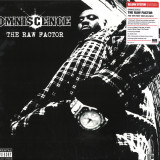
Omniscence - The Raw Factor LP 2x12"

Originally scheduled for release way back in March 1996, "The Raw Factor" by North Carolina native Omniscence is one of the last of the unreleased mid-90's albums to see the light of day. Despite being awarded The Source's coveted "Hip Hop Quotable" and dropping two well-received singles ("Amazin" and "Touch Y'all"), record label politics meant the full-length "The Raw Factor" album was never released and fans were left wondering what might have been.

28 years later, "The Raw Factor" is finally being released on vinyl, CD and digital stores. Featuring punchline-driven lyrics from Omniscence delivered in his unmistakable cadence, and backed by head-nodding production from Fanatic, the album is a must-own for fans of 90's Hip Hop.

Omniscence haunted the same early 90's cyphers and stages that many lyrical greats from the era had to cross. With a gruff delivery and equal adeptness with punchlines and metaphors, his high finish at the 1994 edition Battle For World Supremacy at the New Music Seminar assured heads across the culture were watching. After this, Omniscence locked in with producer Fanatic (who also laced tracks for Notorious B.I.G., Ma$e and Michael Jackson). The result was "The Raw Factor" album, fifteen plus tracks of jazzed out boom-bap, replete with crackin' drums.

Now Below System Records has not only given the album its first deluxe physical release (including 2xLP, CD and digital) as well as a slew of bonus/unreleased tracks.


p Touch Y'all (Remix) feat. Sadat X


p Touch Y'all (Remix) feat. Sadat X


p Touch Y'all (Remix) [feat. Sadat X]

In Stock

Disponibile in Stock e pronto per la spedizione

Last In: 21 months ago
Rotary Mixer - OMNITRONIC TRM-222 (2-Channel)

Rotary mixer with 3-band frequency isolator, VCR filter and FX loop

Filter section with resonance and sweep control for creative sound shaping 3-band master frequency isolator with vintage ALPS potentiometers (Blue Velvet RK27) Kill cut feature allows DJs to completely remove low, mid and high frequencies for amazing mixing

2 stereo input channels with gain control, clip LED, 3-way equalizer, FX Send and phono/line switching
2 microphone input channels with gain control, 2-way equalizer on air switch
2 effects send/return paths
Dual analog VU meter
Direct outputs for Timecode applications
High-grade components ensure long life and excellent sound quality
Booth output with separate 2-way equalizer and level control
Record output, independent of the master
Fully assignable VCA crossfader with adjustable curve
Outputs: master and booth (XLR/RCA L/R), record (RCA L/R), master insert send/return (RCA L/R), FX in/out (stereo jack)
Desktop console housing

TECHNICAL SPECIFICATIONS
Power supply: 100-240 V AC, 50/60 Hz
Power consumption: 15 W
Protection class: Protection class I
Power connection: Mains input via IEC connector (M) mounting version power supply cord with safety plug (provided)
Frequency range: 20 - 20000 Hz
S/N ratio: >100 dB
THD: 100 dB
Klirrfaktor: <0,05 % bei 1 kHz
Gain: Line -12 dB bis +12 dB
Phono -40 dB bis +5 dB
FX 20 dB
Mikrofon 55 dB
DJ Filter: Zuweisbar: LPF, HPF,
Isolator: Master Gain:- ∞ bis +9
Low/Mid 300 Hz, 18db/Okt , Butterworth
Mid/High 4000 Hz, 18db/Okt , Butterworth
Steuerelemente: Netzschalter, Quellen-Umschalter, Crossfader, Crossfader-Wahlschalter, Crossfade-Curve Schalter; Cue-Mix-Split-Funktion, Klangregelung
Status LED: Power, Masterpegelanzeige, Clip, CUE
Anschlüsse: Eingang: Line über 2 x Stereo-Cinch
Eingang: Line/Phono über 2 x Stereo-Cinch
Eingang: Mikrofon über 1 x 3-pol XLR/6,35mm Klinke (W) Kombibuchse Einbauversion
Eingang: AUX Returns über 2 x 6,3-mm-Klinke (sym.)
Ausgang: Timecode über 2 x Stereo-Cinch
Ausgang: Kopfhörer über 2 x 6,3 mm Klinkenbuchse (stereo) Einbauversion
Ausgang: Kopfhörer über 1 x 3,5 mm Klinkenbuchse (stereo) Einbauversion
Ausgang: Rec. über 1 x Stereo-Cinch
Ausgang: Booth über 2 x 3-pol XLR
Ausgang: Booth über 1 x Stereo-Cinch
Ausgang: Master über 2 x 3-pol XLR
Ausgang: Master über 1 x Stereo-Cinch
Ausgang: AUX sends über 2 x 6,3-mm-Klinke (sym.)
Kanäle: Eingangskanal: 2 x Stereo mit Line-Line/Phono Schalter über Cinch, Kanalregelung über Rotary-Drehregler, Regler 3-Band EQ, Quellen-Umschalter, Gainregler, CUE-Schalter, FX Routing Schalter
Mikrofonkanal: 1 x Mono über Kombibuchse (XLR/KLINKE), Kanalregelung über Rotary-Drehregler, Regler 2-Band EQ, ON AIR Schalter
Master-Ausgang: 1 x Stereo über XLR oder Cinch, Kanalregelung über Rotary-Drehregler
Booth-Ausgang: 1 x Stereo über XLR oder Cinch, Kanalregelung über Rotary-Drehregler, Regler 2-Band EQ
Rec. Ausgang: 1 x Stereo über Cinch, Kanalregelung über Rotary-Drehregler
Kopfhörer-Ausgang: Stereo über Klinke, Kanalregelung über Rotary-Drehregler
Max. Pegel: Ausgang: +21 dBu
Material: Metall; Aluminium
Gehäusebauform: Tischpultgehäuse
Maße: Breite: 45 cm
Tiefe: 26 cm
Höhe: 16 cm
Gewicht: 5,50 kg

In Stock

Disponibile in Stock e pronto per la spedizione

Last In: 56 days ago
Chrissy feat. Carrie Wilds - Things Can’t Go On Like This Forever

Maximum vocal power and prime time dramatics by Chrissy and Carrie Wilds. The San Francisco based DJ and producer shows his stylistic versatility and technical capability to work with vocals, melodies and sound sources. Like a facsimile of the late 1980s house/freestyle record that you never owned, Things Can’t Go On Like This Forever ticks all the right boxes. Heartfelt vocals (by the great Carrie Wilds): check! Timely social message: check! Melodic euphoria: check! Old school house and true school freestyle flavor: check! Comes in various mixes and with a freestyle bonus beat special.

Additional airtime is given to the now classic Chrissy production So I Go Dancing. Done in a traditional remix fashion by Gerd Janson it highlights all the features of the original and again Carrie‘s enchanting voice, extends the included hysteria and adds a few snare rolls. Let‘s go dancing to brighten the darkness. Dance music in its purest and maybe most US-American form.

In Stock

Disponibile in Stock e pronto per la spedizione

Last In: 7 months ago
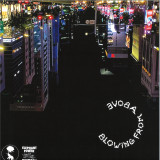
Dj Elephant Power - Blowing From Above EP

DJ Elephant Power (Nicolas Baudoux) based in Brussels, Les Octaves de la Musique awarded musician, is returning with his new EP ‘Blowing From Above’ on May 2024 with limited edition vinyls. The abundantly creative producer never tires of exploring the possibility of new sounds and rhythms. This time he delves deep into numerous genres from breakbeat to bass and he added more colours on each track which composed, performed and produced by himself. Mastering was done by Beau of Ten Eight Seven Mastering in UK. This new EP will be the first page of the upcoming album in June 2024.

‘Blowing From Above’ feat Eunsol

Now you entered the city where you can feel the atmosphere of heat with full of energy. Under the welcome sign of breakbeat and bass, you breathe the dopamine of electronic dance deeply. Alongside baseline skyscrapers covering the sound of this city, mysterious Korean words lead you to hyper pop buildings. Across the traffic lights with barking dog and staccato synth arpeggio on the road, you reach the futuristic bridge between jungle and grime.

‘I Got You’

Under the repeated street lights of ‘I Got You’ scratch samples, you are in the car passing through continuous cowbel 808 sounds on the techno road. In front of the funk graffiti wall, a powerful metal guitar sprays the paint with no compromise. Buildings of synth grab you to follow the new banging club anthem.

‘Shades’

Curly hair architect, who is well known for perfectionism of repeated linear, built a new Mantronix satellite laboratory. This is located on the mountain of Detroit and built on the solid ground of analogue synth signals. Filtered synth and bassline are the main columns of the building. In the main lab, the next satellite has been developing on woah woah sound mattress. Visitors can experience zero gravity in the room in the middle of kick and snare which provides perfect unbalance.

‘Infinity’

A colourful new dish is ready for you. You will feel beautifully balanced and harmonious tastes of progressive techno, trap and bass. This astonished dish was sourced the very best of heavy bass and synth melody for well balanced scent with thoughtful contacts. Geomungo, a traditional Korean string instrument, enhances and amplifies stunning ingredients and it makes a highlight with amazing pairings.

In Stock

Disponibile in Stock e pronto per la spedizione

Last In: 2 years ago
Tilman - We Gotta Do It

Tilman is back on Off Track with a four tracker for your
dance§oor pleasure. Raw and ready, these cuts will take you
back to the good ol’ days. The Mainz based producer has
been on ¦re with a string of 90’s Italo-House styled records
on his Pleasant Systems imprint and they just keep getting
better and better.

In Stock

Disponibile in Stock e pronto per la spedizione

Last In: 5 months ago
EABS - SLAVIC SPIRITS

Polish septet EABS apply an innovatve approach to jazz, distlling it
through the prism of hip-hop, blending it with elements of soul, funk and electronic music. ‘Slavic Spirits’ was 2 years in the making and contains 100% original material. They are joined by 22a head-honcho Tenderlonious who lends his exceptonal soprano saxophone and flute playing to all seven tracks.
Afer their very well-received 2017 debut album ‘Repettons (Leters to Krzysztof Komeda)’, focusing on the lesser-known works of the legendary Polish composer, the Wroclaw-based EABS decided to further expand this lead and released two more vinyl records, ‘Live At Jazz Club Hipnoza (Katowice)’ and ‘Kraksa / Svantetc’, the later recorded directly on tape and released via 22a, which crowned the “Kom eda triptych”. The astounding recepton of these releases built up loyal following outside of their natve Poland and whet listeners’ appette for completely new recordings.
For this LP the musicians turned to Slavic mythology and Polish demonology, while pondering upon the contemporary spiritual conditon of Poles. The enigmatc “Slavic melancholy” remains the main inspiraton, as the band tried to extract it from their own DNA. ‘Slavic Spirits’ is an endeavour to get in touch with the world of a long and brutally lost culture which, due to lack of sources, will never be thoroughly explored.
Personnel: Marek Pedziwiatr (piano, synths & vocal), Vojto Monteur (guitar), Pawel Stachowiak (bass), Jakub Kurek (trumpet), Olaf Wegier (tenor saxophone), Marcin Rak (drums), Spisek Jednego (samples, sound fx & percussion), special guest: Tenderlonious (soprano saxophone & flute)

In Stock

Disponibile in Stock e pronto per la spedizione

Last In: 2 years ago
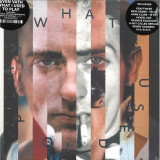
Sven Väth - What I Used To Play (12x12" boxset)
 
36

For this uniquely personal retrospective spread over twelve vinyl discs, Sven Väth takes us back to the early days of his DJ career. On What I Used To Play we meet great pioneers of electronic music, gifted percussionists, obscure wave bands, and innovative producers of a bygone 'new electronic' era. Rough beats and irresistible grooves from the identification stage of house, techno, and acid remind us not just how far electronic music has evolved over the past four decades, but how great it was to dance to EBM, techno, and house for the very first time.

If there is one protagonist of the electronic music scene who has remained curious, innovative and at the very cutting edge of music for over four decades, it's Sven Väth. His multi-layered artist albums and Sound of the Season mix compilations have been defining the genre for over two decades, and even today, he is constantly on the lookout for the next top tune to add to the highlights of his next set. At least, that's the case when he's not producing them himself as an artist or remixer. "Actually, it's always been part of my DNA to think ahead," and nothing had been further from his mind than looking back at his past, but when in spring of 2020 the international DJ circuit had to be scaled down to virtually zero, the 'restless traveler' suddenly had time. Time to stop and reflect on "how it actually was back then, at the very beginning of my career..."

"It was a great trip and with every track, beautiful memories came flooding back".
In the London apartment, he had just moved into, Sven has set up a "little music room", where he cocooned himself for several days, "to look way back for the first time and review my musical journey through the eighties, so to speak."

The interim result was six thematically oriented playlists with a grand total of 120 tracks from 'early 80s' to 'Balearic late 80s', together with excursions into afrobeat, European new wave, and EBM sounds and a few epochal techno/house tracks from the USA in between. From these 'Best of Sven Väth's favorites', the project What I Used To Play crystallized. Sven remembers how the Cocoon team reacted to his proposal: "They found the idea of making a compilation out of it MEGA from the beginning and everyone said 'Sven, go for it', but then, of course, the work really started, namely, to clear the rights and to get clean sounding masters of the up to 40-year-old tracks. There was also disappointment, of course. We couldn't clear certain titles because the rights holders in the USA had fallen out with each other or simply disappeared from the scene. In short, it wasn't easy, but now I can safely say we got the most important tracks."

Finally, after two years of research, curation, design, and administrative fine-tuning, the "little retrospective" from 1981 to 1990 is available. The exquisitely packaged, and three-kilo heavy box set is not only physically impressive, WIUTP is also the definitive record of Sven Väth's musical development. On each of the twenty-four sides of vinyl, you can trace track by track, what influenced him during which phase, and how he took off as a DJ from his parents' Queen's Pub straight into the spotlight at Dorian Gray. There and at Vogue (later OMEN), Sven became the style-defining player in the DJ booth that he still is today.


1981 - 1990: Future Sounds of Now

In the early eighties, the crowd in clubs like Vogue and Dorian Gray danced to what nowadays we call 'dance classics' - mainly disco, funk, soul, and chart pop. It was up to a new generation of DJs, including Sven Väth, the youngest protagonist in the Rhine-Main area at the time, to create their own club-ready music mix. Good new tracks and potential floor-fillers were rarities that had to be sought out and found, in order to prove oneself worthy.
Without MP3s, internet streaming, or other digital download possibilities, music didn't just gravitate to the DJ, instead, it had to be tracked down. In well-stocked record stores in Frankfurt and Wiesbaden or even in Amsterdam, London, or New York, Sven and friends sourced the material for countless magical nights. On WIUTP we can follow Sven's very personal journey through this wild, innovative era in which synth-pop, funk, hip-hop, and disco were successively replaced as 'club music' by house, techno, acid, and breakbeat. By the end of the decade, it was clear to see that these once exotic 'fringe' phenomena would soon become 'mass' phenomena.


Early 80s

Dirty Talk by the Italian-American duo Klein & M.B.O. represents the most innovative phase of the Italo-disco genre in the early eighties like no other track. Mario Boncaldo (I) and Tony Carrasco relied entirely on the original synthetic drum and percussion sounds of the Roland TR-808, coupled with the raunchy vocals of Rossana Casale and guitar accents of Davide Piatto. Of course, other tracks from this period were also influential in style, most notably Unit by Logic System, which worked as the perfect soundtrack to the laser lighting system at the legendary Dorian Gray club. With stomping beats and robotic rap interludes, Bostich by Yello also belongs on Sven's eternal playlist - after all, it caught the attention of Afrikaa Bambaataa, who invited the Swiss duo to perform at the Roxy in New York in 1983.


EBM Wave - Mid 80s

From today's point of view, the almost ten-minute-long, downtempo track Giant by Matt Johnson's band project The The, would probably not be considered an obvious club classic. However, a closer (re)listen reveals the rhythmic intricacies of the percussion overdubs by JG Thirlwell (aka Foetus) on Johnson's composition, and it becomes clear why this exceptional piece of music is one of Sven's absolute favorites. Other classics from this phase include Kaw-Liga by the mysterious The Residents, the hypnotic-synthetic Our Darkness by Anne Clark (and David Harrow), and last but not least, the somber, monotonous anthem Where Are You? by 16Bit, one of Sven Väth's projects together with Michael Münzing, Luca Anzilotti from 1986.


US House - Late 80s

You certainly can't talk about Chicago house without mentioning Frankie Knuckles. The resident DJ at the Warehouse not only gave the name to an entire genre, but also produced epochal floor fillers on the Trax label like the timeless Your Love, sung (and moaned) by Jamie Principle. Acid house protagonists Phuture also hail from Chicago, and on We Are Phuture (also released on Trax) we hear the chirping acid sounds of the legendary Roland TB-303 in full effect. Another featured classic is No UFO's by Detroit's Model 500 aka Juan Atkins, who is rightly considered the 'Godfather of Techno' even if the genre-defining track from 1985 still breathes with the spirit of hip-hop and electro from the first breakdance era.


Afrobeat

Le Serpent, by Algerian-born Abdelmadjid Guemguem, is a track that sounds completely different from everything else on WIUTP. Made in 1978, it's a monumental, rousing groove created without bass or synths, just with five congas! Even though Guem sadly passed away in 2021, his immortal, acoustic beats are understood all over the world and will continue to enrich many thousands of DJ sets for years to come. Another classic that not only Sven appreciates beyond measure is Hugh Masekela's Don't Go Lose it, Baby. In addition to being one of the most important jazz pioneers, the trumpeter and freedom fighter from Johannesburg was very experimental, integrating electronic sounds into his music in later years, in a similar vein to Miles Davis and Herbie Hancock. Dutch jazz pianist Jasper van't Hof's afrobeat project Pili Pili has also aged well. The trance-like, almost sixteen-minute-long track of the same name, manages to fill a whole side on the seventh of twelve vinyl discs in the WIUTP box.


UK-US-Euro - Late 80s

Time for a change of scene, in the truest sense of the word, and from a musical perspective, this section is like landing on another planet. First up is Andrew Weatherall's classic remix of Primal Scream's Loaded, featuring the iconic Peter Fonda sample (lifted from the 1966 biker film Wild Angels) that came to personify the mood triggered by the British Second Summer of Love in the late eighties: "We wanna be free to do what we wanna do, and we wanna get loaded...". This period also saw the emergence of M/A/R/R/S whose only single, 1987's Pump Up The Volume, became a club classic with support from DJ legend CJ Mackintosh. In this most eclectic of sections, we also encounter New York house and reggae producer Bobby Konders and his seminal Nervous Acid.


Balearic - Late 80s

Those who know him, know that Sven had already lost his heart to the 'magic island' of Ibiza as a teenager, so with that in mind, the WIUTP project couldn't end without a Balearic chapter. Inspired by Manuel Göttsching's E2-E4, the immortal, eponymously titled Sueño Latino belongs in there without question. Equally popular on the island was, and still is Break 4 Love by Raze, which thinking about it, would also fit perfectly into the house chapter. Last, but not least, there's an overdue reunion with Sven Väth himself, in his role as frontman of the successful Frankfurt trio OFF. Together with Michael Münzing and Luca Anzilotti (later of Snap!) this 'Organization For Fun' created the off-the-wall club hit Electric Salsa in 1986 which incidentally turned into an international chart smash, putting Sven in the enviable position of having to decide between pop stardom and a DJ career. Well, we all know how that decision turned out and the rest, as they say, is history. A not insignificant part of his story is What I Used To Play. Enjoy!

In Stock

Disponibile in Stock e pronto per la spedizione

Last In: 28 days ago
Lex (de Kahlex) - Rogue Hill LP

Lex(De Kahlex)

Rogue Hill LP

12inchMNC010
Menace
18.10.2022

I’ve started to work on this album before I knew it.

During June 2018, I was in Japan for a month to release my previous album "Cairn" as well as my first solo exhibition of drawings in Tokyo.

Everyday on my way to the gallery I passed in front of the same building, its name kept haunting me : Rogue Hill.

Back then I was digging for cheap 80’s Japanese CD’s (Balearic, New Age, Ambient,...) in second hand stores. Most of them set the tone of this album and the direction I wanted to follow. I feel there’s a direct connection between these original sources and the sound I pursue by their meditative aspect.

Most of the demo songs were done before my daughter’s birth on August 2019 and were finalized since then. Many of the titles refer to this main event and relate to how it changed my position in life : being a link through time by becoming a father.

In Stock

Disponibile in Stock e pronto per la spedizione

Last In: 3 years ago
Dialog - Dialog 2x12"

Dialog

Dialog 2x12"

2x12inchAI-31
Astral Industries
26.08.2022

AI-31 sees the debut release from a new collaboration between Samuel van Dijk (Netherlands) and Rasmus Hedlund (Finland). Both key proponents to the scene in Northern Europe, they come together with mutual understanding and a common vision to sound. Dialog acts as a conversational exchange that sees the interplay of dynamic frequencies, evocative imagery and contemporary sonic art. Spread across four sides, the album as a whole exists as a kind of metaphysical process, eternally growing and contracting — change is the only constant, marked by a continuous progression of sound and space.  

Expansive, deep, and at moments arresting, Dialog unfolds with sweeping soundscapes and shimmers with tactile sonic details. A chasmic rift of scintillating drone structures, each layer exposes a series of ever-deeper shades. In a play of dynamic dualities, the pair harnesses both earthly materials as well as access to more ethereal dimensions in the music. Side A begins with sub-terrestrial ruptures, gestating in a process of constant elemental changes. Rattling hits sputter amongst a state of nascent chaos, yet continues to be maintained in self-regulating stasis. Side B sets a more introspective tone, whispering with ghostly artefacts and bubbling synth lines, before building into a driving energy of layered field recordings and mechanistic timbres. The essence of form continues to be contested, until it subsides into momentary calm on side C. A cleansing period of soft drones float into the space and the pace slows, washing away remnants of past. The journey continues with side D’s conclusion - a solemn contour that reaches its internal extent, to then finally return to its source. 

In Stock

Disponibile in Stock e pronto per la spedizione

Last In: 8 months ago
Biosphere - Patashnik LP (reissue) 2x12"

Biosphere is the main recording name of Geir Jenssen (born 30 May 1962),(1) a Norwegian musician who has released a notable catalogue of ambient electronic music. He is well known for his works on ambient techno and arctic themed pieces, his use of music loops, and peculiar samples from sci-fi sources. His 1997 album Substrata was voted by the users of the Hyperreal website in 2001 as the best all-time classic ambient album.

Patashnik was originally released by R&S Records/Apollo in 1994. It was number 1 in NME´s Independent Chart in March 1994 and reached number 50 in the UK official album chart.

The track Novelty Waves was used in Michel Gondry's Levi's 501 Jeans "Drugstore" spot, and holds - according to the Guinness World Records 2004, the record for "Most awards won by a TV commercial".

One reason why Jenssen's work stands out from the flood of early '90s ambient/techno releases is his strong sense of the quirkily creepy -- not in an Aphex Twin mode, but in his own particular way. The contrasting samples of a child quaveringly saying, "We had a dream last night," followed by a rougher sample saying, "We had the same dream," gives opening number "Phantasm" an unsettling feeling. Intensified by the, on the one hand, pretty, on the other, disturbing music, buried synth strings and a soft pulse accentuated by clattering noises deep in the mix, it kicks off the striking Patashnik very well. Though not as openly dark as acts like Lull, for instance, Biosphere still has an edge which isn't just melancholic, it's downright ominous at point. There's the slow crawl of "Startoucher," for instance, with its buried vocal snippets and deep bass drone, or the blend of the space signal atmospheres of "Mir" into the low, brooding intro to "The Shield." Not everything is so shadowy, though, Patashnik is primarily a relax and chill listening experience, but not without its gentle high points. "Novelty Waves," which became a crossover single in some quarters, has a good dancefloor sharpness to it even as Jenssen slyly sneaks in odd drones and samples through the mix. The opening snippet talking about an extraterrestrial disc jockey on "SETI Project" is good for a smile, as well as acting as a sharp lead-in to a fast rhythm track. Mostly, though, things continue on a deliciously unnerving pace throughout, gentle enough to go down easy but still just off enough to ensure you can't call this new age folderol for the rave generation.

In Stock

Disponibile in Stock e pronto per la spedizione

Last In: 63 days ago
Raphael Loher - Figuren LP

Radically exploratory, Raphael Loher’s Figuren is an album shaped by process and experimentation. Guided by intuition, listening, and a deliberate distancing from his primary instrument—the piano—, the LP marks a decisive step in the Swiss pianist and composer’s artistic development, expanding his sonic vocabulary while maintaining a distinct and personal language.

Figuren draws on ten intimate concert recordings from Keemuun—Loher’s debut for Three:four Records—created during the pandemic and performed in his studio for just one or two listeners. This source material was subsequently developed during a residency in the Blenio Valley, where Loher deconstructed melodic elements, isolated individual tones, and extracted resonances, reassembling them into new configurations. The process generated around 30 initial pieces and also informed his sophomore album, Hug of Gravity, released by Hallow Ground in 2025.

In a further stage of transformation, Loher processed these fragments through a Revox B77 tape machine, subtly altering their pitch before digitizing and reshaping them once again. This iterative cycle of manipulation and recombination forms the core of Figuren’s sonic language.

Departing from the more structured frameworks of his earlier work, Figuren foregrounds experimentation as both method and aesthetic. The compositions range from finely layered rhythmic microstructures to sparse, evolving melodic fragments, each unfolding with a precise sense of restraint.

pre-ordina ora25.09.2026

dovrebbe essere pubblicato su 25.09.2026

Pouya - The South Got Something To Say LP 2x12"
  • A1: Cruisin' in The MIA
  • A2: I'm Alive
  • A3: FIVE SIX
  • A4: 95
  • A5: Superman Is Dead
  • B1: Mood Swing Misery (feat. Rocci)
  • B2: Settle Down (feat. Midnight Rush)
  • B3: Florida Thang
  • B4: Talk to Me Before I Die (feat. Cuco)
  • B5: SUCK MY DICK
  • C1: Run It Down (feat. Rocci)
  • C2: BULLETPROOF SHOWER CAP (feat. City Morgue, ZillaKami & SosMula)
  • C3: Cyanide (feat. Ghostemane)
  • C4: Six Speed (feat. Juicy J)
  • C5: When Will I See You?
  • D1: throw away garbage bullshit
  • D2: whatever mane (feat. Xavier Wulf)
  • D3: 50 Reasons Why (feat. Boobie Lootaveli)
  • D4: life? ... lol (feat. Rocci)

When Pouya dropped The South Got Something To Say in the summer of 2019, it wasn’t just a title—it was a definitive statement of growth. Nodding to André 3000’s iconic 1995 Source Awards declaration, the Miami pioneer used his third studio album to prove that his raw, independent formula had mutated into something deeper, more mature, and entirely unmatched in the underground rap landscape. Now, for the first time since its digital release, this pivotal moment in Florida hip-hop history is finally available on wax, offering listeners something tangible they have been anticipating for years.

The South Got Something To Say captures Pouya at a lyrical and sonic turning point. While maintaining the blistering flows, heavy bass, and visceral Florida energy that initially put him on the map, the album opens the door to intense themes of mortality, legacy, and the heavy toll of independent success. It bridges the gap between the frantic energy of the SoundCloud era and a mastery of songwriting, offering fans a remarkably transparent look into the mind of an artist surviving the very chaos that birthed him. Standouts like "Cruisin' in the MIA" and "Florida Thang" showcase his signature rapid-fire delivery, perfectly balancing the record's darker, more introspective moments.

The sonic diversity of the project is anchored by a stellar lineup of collaborators who push Pouya into new creative territory. He enlists Three 6 Mafia royalty Juicy J alongside heavy-hitting underground peers like Ghostemane and City Morgue, while seamlessly pivoting into the melodic, hazy soundscapes of indie-pop artist Cuco and longtime producer Rocci on tracks like "Talk to Me Before I Die" and "Mood Swing Misery." This striking balance of aggressive phonk and melodic vulnerability solidifies the album as a cohesive, genre-bending journey rather than a mere collection of singles.

For years, vinyl collectors and die-hard fans have begged for this underground masterpiece to be immortalized on wax. This first-ever vinyl pressing delivers the booming low-ends and intricate, therapeutic bars exactly how they were meant to be experienced. From the opening nostalgic chords to the final fading beats, this release stands as an essential artifact of the modern underground rap movement, finally giving a landmark Southern album the premium physical presentation it deserves.

pre-ordina ora18.09.2026

dovrebbe essere pubblicato su 18.09.2026

TELECTU - OFF OFF LP 2x12"

TELECTU

OFF OFF LP 2x12"

2x12inchZAM012
Holuzam
18.09.2026

Remastered limited edition double vinyl with double-sided screenprinted poster-cover (sleeve folds out to be one huge poster). A real collectors item!

When Off Off came out around June 1984, one couldn’t speak of an independent music scene in Portugal. Warm Records’ vague existence didn’t have any impact and Dansa do Som’s inaugural release appeared only in December. 10 years after the revolution, after two IMF interventions, a lot of political instability (not to say turmoil, in the first couple of years) and the natural excesses of a sudden burst of freedom, the Portuguese consumer had more choices but a generally poor standard of living. There was no entrepreneurial culture and serious second thoughts about investing private money in risky ventures.

After many complaints about the whole music scene (institutions, critics and record label executives, popular and classical music alike), something that would continue well beyond the end of the decade, Telectu decided to finance, record, produce, release and sell an album with complete independence from outside structures. Their karmic reward was profit. According to Vítor Rua, Off Off was the only album fully payed by the duo and the only one that really payed off. Not an easy accomplishment for a double LP housed in a large (also double-sided) screenprint with complicated cuts and folds. The artwork was conceived by António Palolo, a friend and multidisciplinary artist. It was based on a collage of heavily saturated and xeroxed polaroids framed in shocking pink and green. Palolo was considered the third member of Telectu, regularly producing slides, video and other visual support for their shows. The inspiration for the type of cover came from GRM’s Gramme series.

Off Off is divided in four distinct sides, each one corresponding to a “theme” or “function” related to Telectu’s manifold artistic interests and interactions. The titles are also gateways to influences and a small portion of Portuguese cultural life:

- Side 1 / “Diagonale” is dedicated to Egídio Álvaro, art critic and gallery director (he opened Diagonale in Paris). Performance art was arguably his main artistic concern over the years, so the music on this side is suggested for use by one or more performers in live or playback situations. The three tracks segue into each other, linked by a synth arpeggio much in the same way as Telectu’s previous “Belzebu” álbum (1983);

- Side 2 / “Anarké” is dedicated to the composer Filipe Pires, one of Jorge Lima Barreto’s recurring invocations when asked about worthwhile contemporary music in Portugal. It is subtitled “concert music”, proposing «a new form of listening». Three tracks also, and these are separated by “clap interludes”, which basically consisted in the following: JLB and VR each had a pair of headphones on, and they clapped their hands according to the rhythm of the music each one was listening. Both musicians were interacting with a different Steve Reich piece: Vítor with “Music for Mallet Instruments”, Jorge with “Six Pianos”. The result is disjointed clapping, an awkwardly deliberate celebration of their own music. Telectu applauded themselves.

- Side 3 / “Cornucópia” is subtitled “music for theatre” and dedicated to Luís Miguel Cintra and Luís Lima Barreto (JLB’s brother), both connected to the Cornucópia theatre company. The side consists of several short pieces previously used as interludes in the Cornucópia staging of “Mariana Espera Casamento” (1983). Field recordings, mood pieces, ambience and a numeric poem (“Soneto Soma 14x”, by E.M. de Melo e Castro) read by João Perry, a quite well-known stage actor. His voice is treated with a flanger effect;

- Side 4 / “Palolo” is “video music”. It’s a one-take mix recorded from cassette sources (Telectu studio experiences) and done live while watching António Palolo’s Om film (1978) projected on the living room wall. It’s a deep, immersive, quasi-mystical 20-minute piece perfectly suiting the meditative, abstract, fluid images created by Palolo by mixing paint and water inside a bathtub. One imagines the Cosmos, hardly suspecting the technique. The film is 90 minutes long, so the music on the LP is of course edited.

The six titles on sides 1 and 2 evoke demons, all of them with conflicting symbolism, since it varies from culture to culture, religion to religion. No explanation is given and Vítor Rua has no idea where this imagery comes from. During virtually the whole stretch of the 1980s, Jorge was the one in charge of titles and concepts, and Vítor didn’t bother too much even reading the liner notes :) In any case, when you synchronize the listening experience with the imagery, a powerful impression emerges, a feeling of being in the presence of these entities while placing yourself inside the sonic narrative.

Off Off is undoubtedly a seminal album in the history of electronic music, as much Heldon as Fripp & Eno, jazz and American minimalism, cosmic out-thereness, mantric miniatures. Telectu at the height of their powers, still very early on, delivering an album-manifesto advocating intermedia art and the fierce independence of Portuguese musicians «from the scum of capitalist music industry monopolies. It’s a path to follow, albeit one that requires enduring hardships and retaliation from music industry gangsters.» Despite a few journalists deemed «capable of being free», the media are «enslaved by the dominant and fascist imbecility of the speculators of light music.» Off Off is addressed to those journalists «and to an audience angry at the cultural misery imposed upon us ..., certain that this music will open new horizons of musical pleasure in the conception of Portuguese avant-garde music, and in the open consciousness of us all. OFF OFF repeats Freedom.»

Those two words are a direct lift from Alberto Arbasino’s 1968 book Off Off, the basis of which is a critical analysis of Theodor Adorno’s and Dwight MacDonald’s ideas concerning the stratification of culture in different levels (high, mid and low) and the pervasiveness of mass culture in the form of a culture industry. In very simplistic terms, and that is precisely the point that inspired Jorge, Arbasino argued that it was possible and desirable to effect a revolution from below, cultivating alternative circuits completely cut-off from what he termed the in-in reality. Telectu’s record was a deliberate demonstration that it could be done, displaying Freedom in the face of all the gatekeepers and other human obstacles.

pre-ordina ora18.09.2026

dovrebbe essere pubblicato su 18.09.2026

DIMA - Salva LP

DIMA

Salva LP

12inchCHANTSL9921
99CHANTS
17.07.2026
  • 1: SOELAR
  • 2: APOGEO
  • 3: QUANTUM
  • 4: FOLDING INWARD
  • 5: REACH
  • 6: IT HAD TO BURN
  • 7: INKED

´Salva´ unfolds as a slow-moving sonic passage, suspended between stillness and transformation. Rooted in a deeply personal lineage, the album reimagines a long-standing family wound through the lens of myth, with the intention of altering its direction. Rather than recounting events, DIMA constructs a parallel narrative, one where sound becomes a means of reconfiguring what was once haunted.

Emerging from an intuitive and studio-centered process, Salva is shaped through experimentation, co-creation, and temporal patience. Working primarily with the computer as her main instrument, DIMA assembles fragments of sound, plugins, sampled material, improvised gestures, and stems drawn from cinematic sources into a porous and evolving sonic architecture. Composition here is accumulative, guided by sensation. Within this framework, certain tracks introduce restrained pop sensibilities, glimpses of melody, song structure, and tonal clarity that surface briefly before dissolving back into the broader sonic language.

´Salva´ is a passage. A listening experience that invites the audience to inhabit uncertainty, to stay with sensation, and to consider how sound can hold stories that language alone can´t resolve.

pre-ordina ora17.07.2026

dovrebbe essere pubblicato su 17.07.2026

DAVUS - DAVUS

DAVUS

DAVUS

12inchLBR163
LITTLE BUTTERFLY RECORDS
15.05.2026
  • 1: EUTANASIA
  • 2: CERRá LA BOCA
  • 3: RICKY
  • 4: LA MOTO
  • 5: EL CRUSH DE TU BAE
  • 6: PAPU
  • 7: TANQUE AFULL
  • 8: FE Y AUTOTUNE
  • 9: MALA MíA
  • 10: COMO TP
  • 11: CHAPóN RMX
  • 12: QUE SEA SOLO RAP RMX
  • 13: COUNTER STRIKE
  • 14: UN PAR DE SECUENCIAS
  • 15: GUITA
  • 1694: 0

A sharp, genre-blurring portrait of Uruguay's most creative and profound voice of the new urban generation. Ironic, witty, and relentlessly current, Davus blends trap, plug, drill, and hip hop into a bold statement of cultural leadership-now captured on vinyl for the first time. Davus is one of the defining figures of Uruguay's contemporary urban movement. Known for his sharp lyricism, forward-thinking sound, and constant reinvention, he has become both a reference point and a source of inspiration for emerging and mainstream artists alike. Emerging from Montevideo's fast-evolving underground scene, Davus built his career by fusing irony, emotional honesty, and street-level storytelling with a sound rooted in trap and its subgenres-plug, Detroit, and sexy drill. From early independent releases to major collaborations with leading figures of the Latin American urban movement, his work has consistently pushed beyond trends while remaining deeply connected to the pulse of his generation. This recopilatory vinyl brings together key moments from across his catalog-songs that trace his evolution from underground innovator to a defining voice of contemporary South American urban music. More than a collection, it stands as a cultural snapshot of a generation that found its sound, its language, and its attitude through Davus's ever-evolving artistry-while simultaneously opening the door to a new chapter shaped by bold collaborations and cross-border creative exchange.

pre-ordina ora15.05.2026

dovrebbe essere pubblicato su 15.05.2026

Dub Specialists - Dubplate #11 : Beat To Beat

Mysticisms’ returns to the music of the Conscious Sounds label and their short-lived but highly prized Dub meets Funk project, Dub Specialists. Created by label head Dougie Waldrop and Chris Petter (Love Grocer) to explore their interest in samplers and a love of Funk and Jazz.

A hugely respected “Digital” and “Roots Reggae” label, Conscious Sounds has been a mainstay of the East London digidub sound for over 30 years. Dub Specialists released 3 albums on the Crispy Music sub label, they have recently gained considerable interest in digger circles, with rising prices to match.

As with their first Dubplate outing, the release features extended re-edits by the label and friends, this time featuring versions by Lexx, Miles J Paralysis, Chuggy and Vanity Project. Working with the simplicity and skill of his studio craft, Dougie utilised the Atari 1040, Cubase and Soundcraft mixer to effect. Petters’ chords sit atop reggae basslines, funk samples, loops and this time, a heavy dose of cut up vocals in to the mix.

While the first EP came from their debut album, Breat To Break, here the source material for the re-edits comes, in the main, from their second outing “Dub To Dub Beat To Beat”. A more expansive album that also dipped in to 4/4 rhythms and touches of House / Techno.

Opening track Dynamic Duo is a 4/4 stepper bomb – with samples from Adam West’s iconic interpretation of Batman – expertly extended by long-standing DJ, producer and edit master, Zurich’s own Alex Storrer aka Lexx, who dials things to max for a club stop. A new name on many lips, Miles J Paralysis takes it all back down with a beautifully drawn out, acid-tinged tripper. Bumpin’, the mid-tempo groove sucks you in, psychedelic and mind expanding.

The flip returns to the more traditional Dub Specialist vibes of Breaks’n’Funk’ cut ups, first with (co-)label head Chuggy’s faithful extension of Heavy Dub. Featuring the classic Ijahman Levi’s vocal, the breaks flow and piano / horns stab, a dance floor shaker for the discerning. To close, secret studio fixer to many, Matt Bruce again dons his Vanity Project moniker to perfectly tease and live dub (out) the half-stepper, Reality Dub and close this latest in the Dubplate series.

Beat The Mystery.

non in magazzino

Ordina ora e ordineremo l'articolo per te presso il nostro fornitore.

Last In: 26 days ago
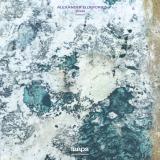
Alexander Eldefors - Vivel

Alexander Eldefors

Vivel

12inchLAAPS051LP
LAAPS
10.04.2026

Vivel is Alexander Eldefors’ second release under his own name. Built around eurorack and field recordings, many captured during still moments while traveling to visit family and friends. The album was created during a period of transition. It functions as an anchor in a time of change, representing a sense of home, safety, and stillness.

Alexander Eldefors is a producer, composer, and mixing engineer based in the countryside outside of Stockholm, Sweden. With a background as both a sound engineer and musician, he has spent years recording, mixing and playing in a wide range of bands and solo projects. In 2019, he consciously slowed down and returned to a more intimate and quiet musical expression, leading to the release of his debut album Bergen in 2020 under his own name. Bergen is the Swedish word for mountains and reflects the fact that Alexander grew up in the north of Sweden close to the mountains.

His music is minimalistic, melodic, and embracing, shaped by a deep connection to nature. Natural environments are a constant presence in his work, serving both as inspiration and as a sound source. Alongside this, he is drawn to the raw textures of everyday objects, working with foley sounds and field recordings. His arrangements unfold as organic sound collages, where elements blend freely and imperfections are preserved to maintain a natural, human feel.

pre-ordina ora10.04.2026

dovrebbe essere pubblicato su 10.04.2026

Guilty Razors - Complete Recordings 1977 - 1978

UILTY RAZORS, BONA FIDE PUNKS.


Writings on the topic that go off in all directions, mind-numbing lectures given by academics, and testimonies, most of them heavily doctored, from those who “lived through that era”: so many people today fantasize about the early days of punk in our country… This blessed moment when no one had yet thought of flaunting a ridiculous green mohawk, taking Sid Vicious as a hero, or – even worse – making the so-called alternative scene both festive and boorish. There was no such thing in 1976 or 1977, when it wasn’t easy to get hold of the first 45s by the Pistols or the Clash. Few people were aware of what was happening on the fringes of the fringes at the time. Malcolm McLaren was virtually unknown, and having short hair made you seem strange. Who knew then that rock music, which had taken a very bad turn since the early 1970s, would once again become an essential element of liberation? That, thanks to short and fast songs, it would once again rediscover that primitive, social side that was so hated by older generations? Who knew that, besides a few loners who read the music press (it was even better if they read it in English) and frequented the right record stores? Many of these formed bands, because it was impossible to do otherwise. We quickly went from listening to the Velvet Underground to trying to play the Stooges’ intros. It’s a somewhat collective story, even though there weren’t many people to start it.
The Guilty Razors were among those who took part in this initial upheaval in Paris. They were far from being the worst. They had something special and even released a single that was well above the national average. They also had enough songs to fill an album, the one you’re holding. In everyone’s opinion, they were definitely not among the punk impostors that followed in their wake. They were, at least, genuine and credible.

Guilty Razors, Parisian punk band (1975-1978). To understand something about their somewhat linear but very energetic sound, we might need to talk about the context in which it was born and, more broadly, recall the boredom (a theme that would become capital in punk songs) coupled with the desire to blow everything off, which were the basis for the formation of bands playing a rejuvenated rock music ; about the passion for a few records by the Kinks or the early Who, by the Stooges, by the Velvet mostly, which set you apart from the crowd.
And of course, we should remember this new wave, which was promoted by a few articles in the specialized press and some cutting-edge record stores, coming from New York or London, whose small but powerful influence could be felt in Paris and in a handful of isolated places in the provinces, lulled to sleep by so many appalling things, from Tangerine Dream to President Giscard d’Estaing...
In 1975-76, French music was, as almost always, in a sorry state ; it was still dominated by Johnny Hallyday and Sylvie Vartan. Local rock music was also rather bleak, apart from Bijou and Little Bob who tried to revive this small scene with poorly sound-engineered gigs played to almost no one.
In the working class suburbs at the time, it was mainly hard rock music played to 11 that helped people forget about their gruelling shifts at the factory. Here and there, on the outskirts of major cities, you still could find a few rockers with sideburns wearing black armbands since the death of Gene Vincent, but it wasn’t a proper mass movement, just a source of real danger to anyone they came across who wasn't like them. In August 1976, a festival unlike any other took place in Mont-de-Marsan – the First European Punk Festival as the poster said – with almost as many people on stage as in the audience. Yet, on that day, a quasi historical event happened, when, under the blazing afternoon sun, a band of unknowns called The Damned made an unprecedented noise in the arena, reminiscent of the chaotic Stooges in their early adolescence. They were the first genuine punk band to perform in our country: from then on, anything was possible, almost anything seemed permissible.

It makes sense that the four+1 members of Guilty Razors, who initially amplified acoustic guitars with crappy tape recorder microphones, would adopt punk music (pronounced paink in French) naturally and instinctively, since it combines liberating noise with speed of execution and – crucially – a very healthy sense of rebellion (the protesters of May 1968 proclaimed, and it was even a slogan, that they weren’t against old people, but against what had made them grow old. In the mid-1970s, it seemed normal and obvious that old people should now ALSO be targeted!!!).
At the time, the desire to fight back, and break down authority and apathy, was either red or black, often taking the form of leafleting, tumultuous general assemblies in the schoolyard, and massive or shabby demonstrations, most of the time overflowing with an exciting vitality that sometimes turned into fights with the riot police. Indeed, soon after the end of the Vietnam War and following Pinochet’s coup in Chile, all over France, Trotskyist and anarcho-libertarian fervour was firmly entrenched among parts of the educated youth population, who were equally rebellious and troublemakers whenever they had the chance. It should also be noted that when the single "Anarchy in the UK" was first heard, even though not many of us had access to it, both the title and its explosive sound immediately resonated with some of those troublemakers crying out for ANARCHY!!! Meanwhile, the left-wing majority still equated punks with reckless young neo-Nazis. Of course, the widely circulated photos in the mainstream press of Siouxsie Sioux with her swastikas didn’t necessarily help to win over the theorists of the Great Revolution. It took Joe Strummer to introduce The Clash as an anti-racist, anti-fascist and anti-ignorance band for the rejection of old-school revolutionaries to fade a little.

The Lycée Jean-Baptiste Say at Porte d’Auteuil, despite being located in the very posh and very exclusive 16th arrondissement of Paris, didn’t escape these "committed" upheavals, which doubled as the perfect outlet for the less timid members of this generation.
“Back then, politics were fun,” says Tristam Nada, who studied there and went on to become Guilty Razors’ frontman. “Jean-Baptiste was the leftist high-school in the neighbourhood. When the far right guys from the GUD came down there, the Communist League guys from elsewhere helped us fight them off.”
Anything that could challenge authority was fair game and of course, strikes for just about any reason would lead to increasingly frequent truancy (with a definitive farewell to education that would soon follow). Tristam Nada spent his 10th and 11th unfinished grades with José Perez, who had come from Spain, where his father, a janitor, had been sentenced to death by Franco. “José steered my tastes towards solid acts such as The Who. Like most teenagers, I had previously absorbed just about everything that came my way, from Yes to Led Zeppelin to Genesis. I was exploring… And then one day, he told me that he and his brother Carlos wanted to start a rock band.” The Perez brothers already played guitar. “Of course, they were Spanish!”, jokes their singer. “Then, somewhat reluctantly, José took up the bass and we were soon joined by Jano – who called himself Jano Homicid – who took up the rhythm guitar.” Several drummers would later join this core of not easily intimidated young guys who didn’t let adversity get the better of them.

The first rehearsals of the newly named Guilty Razors took place in the bedroom of a Perez aunt. There, the three rookies tried to cover a few standards, songs that often were an integral part of their lives. During a first, short gig, in front of a bewildered audience of tough old-school rockers, they launched into a clunky version of the Velvet Underground's “Heroin”. Challenge or recklessness? A bit of both, probably… And then, step by step, their limited repertoire expanded as they decided to write their own songs, sung in a not always very accurate or academic English, but who cared about proper grammar or the right vocabulary, since what truly mattered was to make the words sound as good as possible while playing very, very fast music? And spitting out those words in a language that left no doubt as to what it conveyed mattered as well.
Trying their hand a the kind of rock music disliked by most of the neighbourhood, making noise, being fiercely provocative: they still belonged to a tiny clique who, at this very moment, had chosen to impose this difference. And there were very few places in France or elsewhere, where one could witness the first stirrings of something that wasn’t a trend yet, let alone a movement.

In the provinces, in late 1976 or early 1977, there couldn’t be more than thirty record stores that were a bit more discerning than average, where you could hear this new kind of short-haired rock music called “punk”. The old clientele, who previously had no problem coming in to buy the latest McCartney or Aerosmith LP, now felt a little less comfortable there…
In Paris, these enlightened places were quite rare and often located nex to what would become the Forum des Halles, a big shopping mall. Between three aging sex workers, a couple of second-hand clothes shops, sellers of hippie paraphernalia and small fashion designers, the good word was loudly spread in two pioneering places – propagators of what was still only a new underground movement. Historically, the first one was the Open Market, a kind of poorly, but tastefully stocked cave. Speakers blasted out the sound of sixties garage bands from the Nuggets compilation (a crucial reference for José Perez) or the badly dressed English kids of Eddie and the Hot Rods. This black-painted den was opened a few years earlier by Marc Zermati, a character who wasn’t always in a sunny disposition, but always quite radical in his (good) choices and his opinions. He founded the independent label Skydog and was one of the promoters of the Mont-de-Marsan punk festivals. Not far from there was Harry Cover, another store more in tune with the new New York scene, which was amply covered in the house fanzine, Rock News (even though it was in it that the photos of the Sex Pistols were first published in France).
It was a favorite hang-out of the Perez brothers and Tristam Nada, as the latter explained. “It’s at Harry Cover’s that we first heard the Pistols and Clash’s 45s, and after that, we decided to start writing our first songs. If they could do it, so could we!”
The sonic shocks that were “Anarchy in the UK”, “White Riot” or the Buzzcocks’s EP, “Spiral Scratch” – which Guilty Razors' sound is reminiscent of – were soon to be amplified by an unparalleled visual shock. In April 1977, right after the release of their first LP, The Clash performed at the Palais des Glaces in Paris, during a punk night organised by Marc Zermati. For many who were there, it was the gig of a lifetime…
Of course, Guilty Razors and Tristam were in the audience: “That concert was fabulous… We Parisian punks were almost all dressed in black and white, with white shirts, skinny leather ties, bikers jackets or light jackets, etc. The Clash, on the other hand, wore colourful clothes. Well, the next day, at the Gibus, you’d spot everyone who had been at this concert, but they weren’t wearing anything black, they were all wearing colours.”

It makes sense to mention the Gibus club, as Guilty Razors often played there (sometimes in front of a hostile audience). It was also the only place in Paris that regularly scheduled new Parisian or Anglo-Saxon acts, such as Generation X, Siouxsie and the Banshees, the Slits, and Johnny Thunders who would become a kind of messed-up mascot for the venue. A little later, in 1978, the Rose Bonbon – formerly the Nashville – also attracted nightly owls in search of electric thrills… In 1977, the iconic but not necessarily excellent Asphalt Jungle often played at the Gibus, sometimes sharing the bill with Metal Urbain, the only band whose aura would later transcend the French borders (“I saw them as the French Sex Pistols,” said Geoff Travis, head of their British label Rough Trade). Already established in this small scene, Metal Urbain helped the young and restless Guilty Razors who had just arrived. Guitarist for Metal Urbain Hermann Schwartz remembers it: “They were younger than us, we were a bit like their mentors even if it’s too strong a word… At least they were credible. We thought they were good, and they had good songs which reminded of the Buzzcocks that I liked a lot. But at some point, they started hanging out with the Hells Angels. That’s when we stopped following them.”

The break-up was mutual, since, Guilty Razors, for their part, were shocked when they saw a fringe element of the audience at Metal Urbain concerts who repeatedly shouted “Sieg Heil” and gave Nazi salutes. These provocations, even still minor (the bulk of the skinhead crowd would later make their presence felt during concerts), weren’t really to the liking of the Perez brothers, whose anti-fascist convictions were firmly rooted. Some things are non-negotiable.
A few months earlier (in July 1978), Guilty Razors had nevertheless opened very successfully for Metal Urbain at the Bus Palladium, a more traditonally old-school rock night-club. But, as was sometimes the case back then, the night turned into a mass brawl when suburban rockers came to “beat up punks”.

Back then, Parisian nights weren’t always sweet and serene.

So, after opening as best as they could for The Jam (their sound having been ruined by the PA system), our local heroes were – once again – met outside by a horde of greasers out to get them. “Thankfully,” says Tristam, “we were with our roadies, motorless bikers who acted as a protective barrier. We were chased in the neighbouring streets and the whole thing ended in front of a bar, with the owner coming out with a rifle…”
Although Tristam and the Perez brothers narrowly escaped various, potentially bloody, incidents, they weren’t completely innocent of wrongdoing either. They still find amusing their mugging of two strangers in the street for example (“We were broke and we simply wanted to buy tickets for the Heartbreakers concert that night,” says Tristam). It so happened that their victims were two key figures in the rock business at the time: radio presenter Alain Manneval and music publisher Philippe Constantin. They filed a complaint and sought monetary compensation, but somehow the band’s manager, the skilful but very controversial Alexis, managed to get the complaint withdrawn and Guilty Razors ended up signing with Constantin with a substantial advance.

They also signed with Polydor and the label released in 1978 their only three-track 45, featuring “I Don't Wanna be A Rich”, “Hurts and Noises” and “Provocate” (songs that exuded perpetual rebellion and an unquenchable desire for “class” confrontation). It was a very good record, but due to a lack of promotion (radio stations didn’t play French artists singing in English), it didn’t sell very well. Only 800 copies were allegedly sold and the rest of the stock was pulped… Initially, the three tracks were to be included on a LP that never came to be, since they were dropped by Polydor (“Let’s say we sometimes caused a ruckus in their offices!” laughs Tristam.) In order to perfect the long-awaited LP, the band recorded demos of other tracks. There was a cover of Pink Floyd's “Lucifer Sam” from the Syd Barrett era – proof of an enduring love for the sixties’ greats –, “Wake Up” a hangover tale and “Bad Heart” about the Baader-Meinhof gang, whose actions had a profound impact on the era and on a generation seeking extreme dissent... On the album you’re now discovering, you can also hear five previously unreleased tracks recorded a bit later during an extended and freezing stay in Madrid, in a makeshift studio with the invaluable help of a drummer also acting as sound engineer. He was both an enthusiastic old hippie and a proper whizz at sound engineering. Here too, certain influences from the fifties and sixties (Link Wray, the Troggs) are more than obvious in the band’s music.

Shortly after a final stormy and rather barbaric (on the audience’s side) “Punk night” at the Olympia in June 1978, Tristam left the band ; his bandmates continued without him for a short while.

But like most pioneering punk bands of the era, Guilty Razors eventually split up for good after three years (besides once in Spain, they’d only played in Paris). The reason for ceasing business activities were more or less the same for everyone: there were no venues outside one’s small circuit to play this kind of rock music, which was still frightening, unknown, or of little interest to most people. The chances of recording an LP were virtually null, since major labels were only signing unoriginal but reassuring sub-Téléphone clones, and the smaller ones were only interested in progressive rock or French chanson for youth clubs. And what about self-production? No one in our small safety-pinned world had thought about it yet. There wasn’t enough money to embark on that sort of venture anyway.

So yes, the early days of punk in France were truly No Future!

non in magazzino

Ordina ora e ordineremo l'articolo per te presso il nostro fornitore.

Last In: 5 months ago
Mono Junk - Mars 31 Heaven Collected Works '93 - '95

Kim Rapatti (Mono Junk) is a long-running Finnish electronic music producer and the operator behind DUM Records. In the early 1990s, releasing across multiple aliases was a practical way to keep output organized and to present a broader label roster. Mars 31 Heaven was one of Rapatti's period-specific side names, used to separate a more inward strand of work from the main Mono Junk line.

Mono Junk presents Mars 31 Heaven: Collected Works '93–'95 is the first time these recordings have been compiled onto a single release. The tracks were previously scattered across various compilations, with "Little Elephant" later reappearing on a Mono Junk release. Audio was sourced from the original DAT tapes and remastered by Michael Diekmann. "Osaka House Remix" and "World of Isolation" originally appeared on the B-side of DUM Records' Blue File Compilation (1993). "Violins" and "Abyss" appear on vinyl for the first time after CD-only appearances ("Violins" on Dum Trax, 1995, and "Abyss" on Unitunes and Came From Outer Space I), and the original mix of "Osaka House" is previously unreleased. Housed in full-colour sleeves designed by Ed Cheverton.

non in magazzino

Ordina ora e ordineremo l'articolo per te presso il nostro fornitore.

Last In: 5 months ago
Rick James - Street Songs LP 2x12"
  • A1: Give It to Me Baby
  • A2: Ghetto Life
  • B1: Make Love to Me
  • B2: Mr. Policeman
  • C1: Super Freak
  • C2: Fire and Desire
  • D1: Call Me Up
  • D2: Below the Funk (Pass the J)

Rick James Blends Brazen Attitude, Fearless Sexuality, and Shrewd Charisma on Street Songs:

Punk-Funk Album Aims for the Hips and Head, Includes the Timeless Hit “Super Freak”
Sourced from the Original Master Tapes and Strictly Limited to 4,000 Numbered Copies:

Mobile Fidelity’s 180g 45RPM 2LP Set Presents 1981 Smash in Audiophile Sound for the First Time
1/4” / 30 IPS analogue master to DSD 256 to analogue console to lathe


“Punk funk” was a relatively unknown concept before 1981. But once Street Songs took the charts by storm that year, the world soon knew about what became Rick James’ signature style. And how. True to its name, Street Songs blends outspoken sexuality, brazen attitude, and edgy commentary amid contagious R&B-fueled arrangements that simultaneously aim for the hips, head, and various nether regions. And it’s never sounded better.

Sourced from the original master tapes, strictly limited to 4,000 numbered copies, pressed at Fidelity Record Pressing, and housed in a Stoughton gatefold jacket, Mobile Fidelity’s 180g 45RPM 2LP set presents James’ platinum-certified effort in audiophile quality for the first time. Playing with crisp dynamics, lively textures, airy headroom, and revealing clarity, this collectible edition of the record that stayed at the No. 1 spot on the R&B Album Charts for 20 weeks invites you to get closer to music that beckons you to turn your space into a private dance floor.

Then again, you’ll likely be so taken by how the taut bass lines, snappy rhythms, and four-on-the-floor beats — all rendered in stunning detail and with full-bodied architecture — come across with such accuracy and presence, you might stay pinned to your seat. On this pressing, the soundstaging, imaging, and lit-fuse energy of Street Songs reach new heights. Everything from the rubbery feel of the guitar lines to the depth of James’ temperature-raising vocals to the scale of the horn charts emerges as if James and his ace session crew set up in your room.

The Buffalo native and his ensemble waste no time getting their message across. On the album-opening “Give It to Me Baby,” James and company lay down a mix of sleek funk and pulsing disco that practically activates the bright lights of a discotheque and stimulates the libido of anyone within earshot. Having reached No. 1 on the Billboard Hot Soul charts, the song is pure sex — and just one of the carnal delights on a record that embraces the subject as fearlessly as James does his identity.

Of course, the most famous of James’ erotic excursions — the timeless “Super Freak” — hit No. 1 on Hot Dance Club Play charts, No. 16 on the Hot 100, and, later, No. 153 on Rolling Stone’s list of the Top 500 Songs of All Time. Bolstered by a quavering keyboard theme and electro riffs, the much-sampled track worms itself inside your muscles with smile-inducing subject matter, gliding vocals, nimble movements, a hot tenor-saxophone solo, and backing vocals by the Temptations.

The iconic Motown group isn’t the only celebrated guest artist on the Grammy-nominated Street Songs. James’ then-labelmate, Stevie Wonder, lends harmonica to the frank sociopolitical narrative on “Mr. Policeman,” a protest tune that also manages to stroll ’n’ strut via simmering organ, staggering brass accents, and James’ gritty vocal performance. In addition to contributing backing vocals on several cuts, Teena Marie turns in one of the album’s signature moments on “Fire and Desire,” a romantic old-school duet with James that impresses with smoothness, sensitivity, and smokiness.

High-profile colleagues aside, James remains the undisputed star, a figure whose leather-and-latex attire, braided hair, and natural swagger made him misunderstood by some in the mainstream and embraced by everyone in the know as a true original. As a testament to his magnetism and skills, his charisma and rawness seemingly seep through every note, whether on the balladic sweep of the risqué “Make Love to Me” or strident, poke-and-prod persuasion of the moonwalking “Call Me Up.”

On the closing “Below the Funk (Pass the J),” an uptempo autobiographical tale that addresses the visionary musician’s second-favorite love, the singer acknowledges his upbringing and inseparable connection with his roots — an homage to where he began and a toast to where he’s gone.

Rick James, keepin’ it real on Street Songs, still as real as it gets.

non in magazzino

Ordina ora e ordineremo l'articolo per te presso il nostro fornitore.

Last In: 7 months ago
Helviofox - Rodeado de Batida

At 19, Helviofox adds his signature to the batida template that by now seems to have been in existence since forever. Such is the strength of this primordial fountain, a source of rejuvenation. Also within the literal family: Helvio cites brothers Dadifox and Erycox as main influences.

Curiosity for the sound made him go into production by the time he was 13. A couple of years later (2020) he became co-founder of TLS with E8Prod, Alberfox, DiionyG and other mates. His talent fully developed since then, opening a slight detour that became a new path parallel to the main road.

Lively basslines anchor the beat directly lifted from tradition and clearly channeled to the dancefloor. Strong, well rounded grooves, a spot-on sense of timing and tempo, elegant atmospheres, all part of Helvio's notion of arrangement and his perception of dance music boundaries, stretching them just enough to present a challenge but not as far as to disconnect head and feet and risk losing the floor.

This liminal space between experimentation and popularity is both dangerous and attractive. There is no one formula. Precisely why it still retains plenty of fuel for current and future generations to contribute personal visions.

Lisboa, 2025

non in magazzino

Ordina ora e ordineremo l'articolo per te presso il nostro fornitore.

Last In: 7 months ago
Placid Angles - A Detroit Summer EP

Straight from the pantheon of techno greats, John Beltran’s Placid Angles project enters Kalarahi orbit.

Revived after a 22 year hiatus, PA has since become our main source for new Beltran material. Buy-on-sight stuff for those seeking ambient techno of a rarified calibre. There’s an inevitable pinch-me moment whenever a producer of undeniable influence jumps on the label, and safe to say, this is one of those moments.

Expect sun-kissed Balearica and sublime, acid-fuelled romance. Sometimes we levitate, bathing in the glow of JB’s beatific harmony and sanguine tenderness. The slow-burn simmer of 303, the lithe gliding of his breaks; all of it demonstrating effortlessness of execution.

Choral vocals ascend, vistas pristine and closer listens reveal even greater levels of detail. You might say it’s the gift that keeps on giving.

non in magazzino

Ordina ora e ordineremo l'articolo per te presso il nostro fornitore.

Last In: 6 months ago
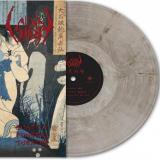
SIGH - GHASTLY FUNERAL THEATRE (LP)
  • A1: Intro: Soushiki (01:26)
  • A2: Shingontachikawa (05:27)
  • A3: Doman Seman (05:33)
  • B1: Imiuta (03:14)
  • B2: Shikigami (06:22)
  • B3: Outro: Higeki (01:31)
disponibile anche

Marble Vinyl


Japanese black metal legends Sigh formed in 1989/1990. The genre-classic debut ‘Scorn Defeat’ followed on Euronymous’ Deathlike Silence Productions in 1993 & with each subsequent release, Sigh grew to become one of the country’s greatest & most revered metal exports. With a journey through the strange & the psychedelic, incorporating a whole eclectic mix of genre styles & experimentation throughout their career, Sigh has remained a vital creative force in the avantgarde field whilst maintaining their old school roots, as witnessed with the stellar 2022 album, ‘Shiki’. 2025 also saw Sigh reimagining their ‘Hangman’s Hymn’ album for a release on Peaceville as part of the band’s 35th anniversary celebrations, in the shape of ‘I Saw The World’s End: Hangman’s Hymn MMXXV’.

Maintaining the core trio of Mirai Kawashima, Shinichi Ishikawa & Satoshi Fujinami & on the back of the epic & darkly symphonic opus ‘Infidel Art’ (1995), Sigh adopted a more boundary-defying approach to their writing, whilst still keeping the dark foundations & traits of the band’s fundamental sound. The result was ‘Ghastly Funeral Theatre’ which surfaced in 1997 & draped in Eastern & horror-based atmospherics, the band also embraced elements outside of metal with what was their most experimental offering to date; utilising instruments such as the saxophone as well as acoustic passages & notoriously drawing comparisons to the moods of bands such as The Beatles at times, featuring catchy hooks & structures in line with the rock music genre, but masterfully woven into Sigh’s unique blackened metal tapestry.

Continuing with Peaceville’s re-issues of Sigh’s classic early ( & until now, hard to find) works, this edition of ‘Ghastly Funeral Theatre’ contains a new master created by Patrick Engel at Temple of Disharmony, featuring a new transfer from the original DAT source.

The release also includes a new interview with main-man Mirai Kawashima conducted by Dayal Patterson of Cult Never Dies, delving into the history & inspirations behind ‘Ghastly Funeral Theatre’.

This edition of ‘Ghastly Funeral Theatre’ is presented on black vinyl.

pre-ordina ora23.01.2026

dovrebbe essere pubblicato su 23.01.2026

SIGH - GHASTLY FUNERAL THEATRE (LP)
  • A1: Intro: Soushiki (01:26)
  • A2: Shingontachikawa (05:27)
  • A3: Doman Seman (05:33)
  • B1: Imiuta (03:14)
  • B2: Shikigami (06:22)
  • B3: Outro: Higeki (01:31)
disponibile anche

Black Vinyl


Japanese black metal legends Sigh formed in 1989/1990. The genre-classic debut ‘Scorn Defeat’ followed on Euronymous’ Deathlike Silence Productions in 1993 & with each subsequent release, Sigh grew to become one of the country’s greatest & most revered metal exports. With a journey through the strange & the psychedelic, incorporating a whole eclectic mix of genre styles & experimentation throughout their career, Sigh has remained a vital creative force in the avantgarde field whilst maintaining their old school roots, as witnessed with the stellar 2022 album, ‘Shiki’. 2025 also saw Sigh reimagining their ‘Hangman’s Hymn’ album for a release on Peaceville as part of the band’s 35th anniversary celebrations, in the shape of ‘I Saw The World’s End: Hangman’s Hymn MMXXV’.

Maintaining the core trio of Mirai Kawashima, Shinichi Ishikawa & Satoshi Fujinami & on the back of the epic & darkly symphonic opus ‘Infidel Art’ (1995), Sigh adopted a more boundary-defying approach to their writing, whilst still keeping the dark foundations & traits of the band’s fundamental sound. The result was ‘Ghastly Funeral Theatre’ which surfaced in 1997 & draped in Eastern & horror-based atmospherics, the band also embraced elements outside of metal with what was their most experimental offering to date; utilising instruments such as the saxophone as well as acoustic passages & notoriously drawing comparisons to the moods of bands such as The Beatles at times, featuring catchy hooks & structures in line with the rock music genre, but masterfully woven into Sigh’s unique blackened metal tapestry.

Continuing with Peaceville’s re-issues of Sigh’s classic early ( & until now, hard to find) works, this edition of ‘Ghastly Funeral Theatre’ contains a new master created by Patrick Engel at Temple of Disharmony, featuring a new transfer from the original DAT source.

The release also includes a new interview with main-man Mirai Kawashima conducted by Dayal Patterson of Cult Never Dies, delving into the history & inspirations behind ‘Ghastly Funeral Theatre’.

This edition of ‘Ghastly Funeral Theatre’ is presented on black vinyl.

pre-ordina ora23.01.2026

dovrebbe essere pubblicato su 23.01.2026

BURT BACHARACH - CASINO ROYALE (2x12")
  • A1: Herb Alpert & The Tijuana Brass - Casino Royale (Main Title)
  • A2: Dusty Springfield - The Look Of Love
  • A3: Moneypenny Goes For Broke
  • A4: Le Chiffre's Torture Of Mind
  • A5: Home James, Don't Spare The Horses
  • A6: Sir James' Trip To Find Mata
  • B1: The Look Of Love (Instrumental)
  • B2: Hi There Miss Goodthighs
  • B3: Little French Boy
  • B4: Flying Saucer/First Stop Berlin
  • B5: The Venerable Sir James Bond
  • B6: Dream On James, You're Winning
  • B7: Herb Alpert & The Tijuana Brass - The Big Cowboys & Indians Fight At Casino Royale/Casino Royale Theme (Reprise)
  • C1: Herb Alpert & The Tijuana Brass - Casino Royale (Main Title)
  • C2: Opening Cars Converging/To The Bond Chateau
  • C3: The Black Rose/James Bond In Scotland
  • C4: The Widow Duty Of Lady Fiona/Wassail
  • C5: The Grouse Shoot/Mimi's Lament
  • C6: Gymnasium Training
  • C7: Proposals, Super 8 & Costumes
  • C8: Sir James' Trip To Find Mata/Temple Dance
  • C9: Mike Redway - Have No Fear Bond Is Here (Single Version)
  • D1: Dusty Springfield - The Look Of Love (Film Version)
  • D2: Sitar Background/Old Berlin House/Mata Hari School For Spies
  • D5: Vesper's Kidnapping/End Of Torture Sequence
  • D6: Fight In Casino Manager's Office/Dr Noah's Headquarters/The Lsd Room
  • D7: Mike Redway - The Big Fight At Casino Royale/Even Bond In Heaven/End Title (Have No Fear Bond Is Here)
  • D3: Bond Arrival In France/Vesper In The Shower
  • D4: Le Chiffre's Magic Act

Quartet Records and MGM present the re-issue of the first official complete vinyl edition of Burt Bacharach’s timeless classic soundtrack for the 1967 James Bond spoof Casino Royale.

The infectious main theme performed by Herb Alpert and the Tijuana Brass is just the starting point of an epic comedy ride that includes such highlights as the unforgettable “The Look of Love,” sung by Dusty Springfield, or the epic fight music at the end of the film. Produced by record industry legend Phil Ramone, the original soundtrack LP offered selected highlights, expertly edited to showcase the best parts of the entire score. Thanks to the legendary sound quality of the stereo copies, this record became one of the most highly sought-after collectibles in the industry.

This straight re-issue of our 2019 vinyl edition was produced, restored and mastered by Chris Malone, rebuilding the score from the ground up. The soundtrack album has long been considered a cornerstone of an audiophile’s collection. Lauded by The Absolute Sound, the original Colgems release continues to remain in pole position as the best sounding “popular” LP vinyl disc of all time.

Malone’s work was focused on addressing unintended technical anomalies (such as filling dropouts and covering analogue splices) rather than broadly applying a modern sound palette. He has eschewed dynamic range compression and retained the brilliance of the original recording. The first LP is a fully remastered reissue of the iconic original stereo vinyl, playing in all its splendor. The second LP contains all the unreleased material, in mono, which are still the only available source to date.

This special 2xlp is a limited edition pressed on 180-gram black vinyl, all of it housed in a gatefold jacket, retaining the iconic original cover art by Robert McGinnis

pre-ordina ora16.01.2026

dovrebbe essere pubblicato su 16.01.2026

Jinjé & A. Montane - Neon Garden EP

Jinjé & A. Montane

Neon Garden EP

12inchMESH0111V
Mesh Records
07.01.2026

Mesh-mainstay Jinjé teams up with A. Montane for a collaborative EP born out of live improvised sessions, and composed over the period of a year.

Taking a slowed approach to the production of Neon Garden EP, the two hardware aficionados met sporadically for live jam sessions - an homage to the importance of not rushing the process, and letting ideas build over time. Each session consisted of an intense burst of musical propositions followed by a careful editing framework, giving space for each moment to flourish. Oscillating between moments of catharsis and intense rhythmic play, the EP merges disparate musical sources into exciting new structures.

‘Ikeya Seki’ launches with glistening arpeggiations and subaquatic frequencies that interact over UKG-adjacent drums. ‘Vrem’ marches to a slow-stepping half time beat, building through yearning vocals before breaking down into a storm of pointillistic percussion. On ‘Yū’, rich melodies and bouncy, bass-led rhythms dance below chopped up vocals. Closing things off, ‘Velvet People’ builds a spatial setting with bells ricocheting through malfunctioning flutters.

A nod to the joys of improvisation, Neon Garden EP takes the spirit of spontaneity and lays out new structures for its ideas to grow.

non in magazzino

Ordina ora e ordineremo l'articolo per te presso il nostro fornitore.

Last In: 8 months ago
Judy meets Piña - It's Been a Man's World

This record is a tribute to one of the greatest funk and soul singers of all time: James Brown, also known as “The Godfather of Soul.” Undoubtedly, he was a true icon of African-American music in the 1960s and 70s.

As the leader of bands like The Famous Flames and The J.B.’s, Brown was renowned for his electrifying energy on stage.

This song moves between soul and reggae, keeping the pulse of both genres alive. It features a heavy groove full of rhythmic and melodic arrangements, with strings as the main source of color and a vocal performance charged with power and charisma.

Finally, the lyrics have been adapted to better reflect our current reality, while preserving the spirit of homage and renewal.

pre-ordina ora12.12.2025

dovrebbe essere pubblicato su 12.12.2025

Biosphere - Cirque LP 3x12"

Biosphere

Cirque LP 3x12"

3x12inchBIO26LP
Biophon Records
14.10.2025

Repress!

Biosphere is the main recording name of Geir Jenssen (born 30 May 1962), a Norwegian musician who has released a notable catalogue of ambient electronic music. He is well known for his works on ambient techno and arctic themed pieces, his use of music loops, and peculiar samples from sci-fi sources. His 1997 album Substrata was voted by the users of the Hyperreal website in 2001 as the best all-time classic ambient album.


Cirque - originally released in 2000 - was Biosphere's first album for the UK label Touch. This new re-issue comes with a 6-track bonus album and new artwork.


Mojo (UK): Fourth full album from ambient pioneer. Coming to prominence with 1992's Microgravity - which along with the first couple of Aphex/Polygon Window CDs, defined the genre ambient - Geir Jenssen as Biosphere has made three of the '90s' best albums, culminating with last year's near beatless Substrata. The idea - as it always was thanks to Eno's On Land - is music as environment (reflecting, creating): working from his base in Tromso, Arctic Norway, Jenssen offers a polar, Apollonian exploration of the human psyche. Cirque is a perfectly constructed 47-minute sequence: cold clarity up against real depth of field, synth cycles dissolving into sudden moments of sonic revelation that sound like a waking dream - try the first 20 seconds of Black Lamb and Grey Falcon. (And if you think that's pretentious - your loss). Inspired by the story of a young American, Chris McCandless, who walked alone into the Alaskan wilderness and perished, Cirque balances the tightrope between warmth and unease, resolving into a moon melody that leaves you a peace. What a good record! Jon Savage.

non in magazzino

Ordina ora e ordineremo l'articolo per te presso il nostro fornitore.

Last In: 4 months ago
RABBATH ELECTRIC ORCHESTRA - AMALL

François and Sylvain Rabbath have turned six years of touring into a joint album that patiently and intensely distills a variety of musical flavors gathered from around the world.

Since the early 1960s, François Rabbath's double bass has resonated through enough landmark recordings to fill several shelves in a record collection. As an arranger, composer, and musician, his imprint on music goes far beyond his collaborations with Barbara, Paco Ibáñez, Charles Aznavour, or Édith Piaf. Aspiring double bassists owe him a groundbreaking method for learning the instrument. Born into a lush musical universe that quickly became his own, his son Sylvain first accompanied him on his travels before settling at the piano and sharing stages around the world at his side.

Those years of accumulating visas in their passports were put to good use by father and son. The continents, countries, and cities they passed through became a rich source of inspiration for composing Amall, the album by the Rabbath Electric Orchestra.

Long hours spent in the air or on the road, watching passing landscapes that never stayed the same, were transformed into compositions imbued with the atmospheres of the places they crossed or visited. Inspiration sometimes struck with force, like a green oasis appearing in a desert of stone—unexpectedly, as glowing red rocks suddenly dominated an otherwise open landscape with an endless horizon, while the mind wandered into a state between meditation and introspection.
Born from these travels, the pieces took on their final colors once brought into the studio, refined, and finally arranged to welcome the guitars of Keziah Jones and Matthieu Chedid, the piano of Laurent de Wilde, the bass of Victor Wooten, the saxophone of Raphaël Imbert, and the percussion of Minino Garay. Enhanced by the scale of the jazz-soul orchestrations, by the richness of arrangements bursting from strings, brass, rhythms, or keyboards, the epic breath of vast plains became ingrained. The urban tension of funk, echoing their movements, found its place—alongside more electric expressions or the ambience of a darkened room.
Melancholic and melodious, expressive and edgy, the bowed double bass—played in the high register where few dare to go—emerged as the musical guide. One that draws a path between Seville and Minneapolis, connects François Rabbath's native Syria to France, and bridges South America to Europe. It sets the tone to follow—the emotion that will carry the piece, and if not filled with light, will carry it there nonetheless.
Musical visions packed in luggage, transported in cargo holds, or imprinted in their minds just long enough to cover the distances to the next stop—father and son deepened their bond, beyond family and art. And their hands have never held each other more tightly.

François et Sylvain Rabbath ont fait fructifier six ans de tournées pour un album commun distillant patiemment et intensément la variété de parfums musicaux récoltés autour du monde.
Depuis le début des 60’s, la contrebasse de François Rabbath résonne dans assez de références pour combler plusieurs étagères d’une collection de disques. Arrangeur, compositeur, musicien, l'empreinte laissée dans la musique va bien au-delà de ses collaborations avec Barbara, Paco Ibanez, Charles Aznavour, ou Edith Piaf. C’est à lui que les
apprentis contrebassistes doivent une méthode novatrice pour apprendre l’instrument.

Né dans un univers musical luxuriant qui est vite devenu aussi le sien, c’est d’abord dans ses voyages que son fils Sylvain l’a accompagné, avant de s’installer au piano, et parcourir les scènes du monde à ses côtés. Ces années où les visas se sont entassés sur leurs passeports, père et fils les ont mises à profit. Continents, pays, et villes qui se sont succédés sont devenues un gisement pour composer Amall, l’album du Rabbath Electric Orchestra.

Les longs moments passés dans les airs ou sur la route à contempler un paysage qui défile sans pour autant rester le même, se sont convertis en compositions habitées par les ambiances de ces endroits traversés ou visités. Là où l’inspiration s’est imposée parfois brutalement, sous
la forme d’un oasis de verdure surgissant au milieu d’un désert de pierres. Au hasard d’imposantes roches rougeoyantes s’invitant dans un paysage jusqu’alors dégagé sur un horizon sans fin, quand l’esprit se laisse aller à un mélange de méditation et d'introspection.

Nés de ces pérégrinations, les titres ont pris leurs couleurs définitives une fois ramenés en studio, peaufinés puis, enfin, pensés pour y inviter les guitares de Keziah Jones et de Matthieu Chedid, le piano de Laurent de Wilde, la basse de Victor Wooten, le saxophone de Raphaël Imbert, les percussions de Minino Garay. Sublimé par la dimension des orchestrations jazz-soul, par la richesse des arrangements jaillissant des cordes, des cuivres, des rythmiques ou des claviers, le souffle épique des plaines immenses s’est imprimé.
La nervosité citadine du funk rythmant les déplacements a trouvé sa place, non loin d’une expression plus électrique ou d’une atmosphère de salle obscure.

Mélancolique et mélodieuse, expressive et nerveuse, la contrebasse jouée à l’archet, dans les notes hautes du manche où peu s’aventurent, s’est érigée en guide musical. Celui qui trace le chemin entre Séville et Minneapolis, relie la Syrie natale de François Rabbath à la France,
réduit la distance entre l’Amérique du Sud et l’Europe. Donne la note à suivre, l’émotion qui traversera le morceau qui, s’il n’est pas habité par la lumière, le portera néanmoins jusque là.

Visions musicales mises dans le coffre, transportées en soute ou imprimées dans l’esprit le temps de couvrir les distances qui les mèneront aux prochaines, c’est côte à côte que père et fils ont prolongé leur lien par delà des seules limites familiales et artistiques. Et leurs mains ne se sont jamais serrées aussi fort.
credits

pre-ordina ora19.09.2025

dovrebbe essere pubblicato su 19.09.2025

Mr.  Theolonius - Clap Ya Hands /WEB Edits rework 7"

Give It Up Or Turnit a Loose (Edit) by James Brown b/w Web (Edit) by Hampton Hughes / Give It Up or Turnit a Loose (Bonus Breaks) by James Brown| Galaxy Sound Company — GSC45-044, test pressing | The long-running @galaxy_sound_company imprint has been responsible for some superb re-edits over the years, most of which are pleasingly purist in tone — meaning they are pro rearrangements with no added effects but & needless new beats or cheap trickery like so many out there— making any of their releases cop-on-site. & as you can hear from the test pressing, the 44th in the stellar series delivers yet again.

Side A is a masterclass in breakbeat editing of a b-boy classic sample source. Yes, there are many killer JB edits out in the universe, but when you see that the legendary Black Cash & Theo AKA Thelonious Beats take a turn, you know you gotta cop this mutha on site. Here the edit master bravely returns to one of the main sources of the dawn of hip-hop — JB’s comp “In The Jungle Groove” which was released in 1986 to capitalize on it’s popularity in the genre at the time. The comp is named for a breakdown section that appears in “Give It Up Or Turnit a Loose” which is the workout we have here. JB quiets the band down to handclaps, footstomps & congas played by Johnny Griggs. After he raps a little, JB cues legendary drummer Clyde Stubblefield back in, followed by bassist Bootsy Collins & the rest of the band. JB wasn’t intentionally trying to create a perfect batch of hip-hop samples in the late 60s & early 70s, but he couldn’t have succeeded any better if he had been. This edit may enter well-worn territory but he uniquely delivers an edit that showcases why it inspired so many & still delivers the goods to help you get your party started off right & quickly.

Next up on the flipside we are treated to an edit of “Web” by Hampton Hughes, from his 1974 David Axelrod produced & arranged album “Northern Windows”. Heads will recall it as the core sample for “Off the Record” by Hieroglyphics, from the 1998 LP “3rd Eye Vision”. This jazz-funk burner features a stellar line-up:
Piano/keyboards = Hawes
Trumpet = Allen DeRienzo, Snooky Young
Trombone = George Bohanon
Sax/flute = Jackie Kelso, Jay Migliori, William Green
Electric Bass = Carol Kaye
Drums = Spider Webb

But wait, GSC ain’t done yet! We get some bonus beats from the A-side. Another reason why doubles are highly recommended when you need assistance in your set.

non in magazzino

Ordina ora e ordineremo l'articolo per te presso il nostro fornitore.

Last In: 12 months ago
Various - Maybe I'm Dreaming LP 2x12"

‘Maybe I’m Dreaming’ is the latest collection selected by Mikey Young (Total Control, EddyCurrent Suppression Ring) and Keith Abrahamsson (Founder and Head of A&R at AnthologyRecordings), the mangled minds behind the beloved ‘Follow the Sun’, ‘Sad About the Times’,and ‘…Still Sad’ compilations. The twenty tracks of ‘Maybe I’m Dreaming’ make a conscious(and unconscious) detour from its predecessors, sourced entirely from private press releases,spanning new decades and production modes within homespun folk, soft rock and otherwise70s and 80s FM radio adjacent music.  The magic of ‘Maybe I’m Dreaming’ is the untold story of the artists behind these songs; thosewho missed the big time, but whose song craft and unrequited care hit the right notes, bothhigh and low.
Where ‘Follow the Sun’ and ‘Sad About the Times’ introduced us to the fame chasing, ambitioncrashing crooners who missed their shot in the mainstream, ‘Maybe I’m Dreaming’ delvesdeeper into the isolated wilds - a private world where production quirks, late-night tape hiss andone-man studio dreams were not necessarily a choice but the hand that was dealt.
With the parameters set to ‘private press only’, Young and Abrahamsson follow a circuitous trailof invention and emotion, documenting a spirit that’s more homespun, sometimes lonelier andoften a little weirder. The guitars still strum, but the keyboards’ hum is more prevalent andprecious; wistful harmonies brush up against lo-fi drum machines; a bittersweet fog lingeringover even the brightest melodies.
As with their previous collaborations, Young and Abrahamsson weren’t interested inconstructing a museum or drafting a historical survey. ‘Maybe I’m Dreaming’ is a sentimentalmixtape, assembled late at night when the mind wanders and old memories blur with imaginedfutures, those within reach and those far too mysterious to ever encounter. Songs wereunearthed in personal collections, deep YouTube burrows, dilapidated web archives and thedim corners of Discogs, with many selections tied not only to intuition but to personalconnection.  Some tracks arrived via friends - Kelley Stoltz, a frequent guide for Young, tipped him off toboth Peter Kraemer’s lost gem ‘Let the Light Slip’ and Awakening’s revelatory closer - addingan unseen but deeply felt thread of camaraderie to the compilation.
The journey takes in a wide, strange sweep: The Watson Brothers Band’s ‘Just Whistle’ opensthe collection with a sigh and a shrug, a song that feels like it’s been waiting for decades to beheard again. Jim Huxley’s ‘Tessa on a Magazine’, rediscovered after a long and winding searchby Young, shimmers with a distinctly Australian melancholia. The heartbreak of Rick Penta’s‘My Story Changes’ and Twice As Nice’s delicate ‘Thoughts of You’ float easily alongside themore buoyant, radio-dream sheen of Barracuda’s ‘Baby I Love You’ and MAK’s sunshinedappled ‘That’s Life’.
Widening the aperture to the late 1970s and early 1980s allows for a deeper exploration intoevolving production techniques and musical technologies. The Squad’s ‘D.L.M.H.I.M.A.’ andChristoph Spendel Group’s ‘Forever’ crackle with the kind of bedroom synth warmth that couldonly come from the analogue age, while the soulful, yearning undercurrent of Awakening’s‘Gotta Do Somethin / Might As Well Cultivate’ caps the collection with a call for action - ormaybe just acceptance - in an accidental Brian Eno ‘Here Come the Warm Jets’ parroting.
While ‘Maybe I’m Dreaming’ moves away from the ‘sad man with guitar’ archetype that hoveredover its predecessors, it remains tethered to a familiar emotional gravity - a balance of longingand lightness that defines this corner of the musical universe. Each track shuffles gentlybetween resignation and hope, sadness and serenity, as if the artists themselves were chasinga dream just beyond reach, recording not for fame but for the simple act of getting it, thatprimal, creative itch, out into the world.
Available on CD and 2LP, featuring the third eye-opening artwork of Dang Wayne Olsen. Thedouble LP set arrives in an outrageous double-wide spine jacket with printed inners and adream journal entry by Pacific Northwest artifactual authority Josh Lewellen.

non in magazzino

Ordina ora e ordineremo l'articolo per te presso il nostro fornitore.

Last In: 13 months ago
New York Dolls - New York Dolls
  • Personality Crisis
  • Looking for a Kiss
  • Vietnamese Baby
  • Lonely Planet Boy
  • Frankenstein (Orig.)
  • Trash
  • Bad Girl
  • Subway Train
  • Pills
  • Private World
  • Jet Boy

The extroverted blend of attitude, energy, and ostentatiousness that spills from the New York Dolls’ self-titled debut can be seen in full view on the album cover. Depicting the quintet in its hallmark flash-and-trash apparel and in drag appearance, the 1973 album scared away a considerable amount of potential listeners while capturing the attention of a sizable audience that recognized the band for what it was: zeitgeist pioneers who helped develop the punk and glam rock movements.

Named by Rolling Stone the 301st Greatest Album of All Time and by Mojo the 49th greatest album of all time, New York Dolls receives long-overdue audiophile treatment on Mobile Fidelity’s numbered-edition 180g 45RPM 2LP set. Sourced from the original master tapes, pressed at Fidelity Record Pressing in California, and housed in a Stoughton gatefold jacket, this collectible version marks the first time the group’s career-making statement is available to be experienced in audiophile quality.

Far from harboring the crude elements that became associated with the punk scene, New York Dolls benefits from keen production overseen by none other than Todd Rundgren. Though more accustomed to working far higher-caliber musicians, Rundgren — taken by the New York Dolls’ charisma and cool, if not their instrumental approach — fully understood the ensemble’s aesthetic. He captured what went down at New York City’s Record Plant with an astute blend of live-on-the-floor feel, raw authenticity, and professional acumen.

On Mobile Fidelity’s definitive-sounding reissue, you can hear those facets as well as key details, dynamics, and textures with previously unimaginable insight. Rundgren preserved generous degrees of grit, grime, and grease while bestowing the raucous music with elevated levels of separation, solidity, and impact every landmark recording deserves. His vision extends to introducing choice accents — barroom piano notes, Moog synthesizer passages, Buddy Bowser’s honking saxophones — that add to the songs’ appeal without interfering with the primary architecture.

Afforded extra groove space on this pressing, the tenor, presentation, and attack of both vocalist David Johansen and now-iconic guitarists Johnny Thunders and Sylvain Sylvain come across with stunning vibrancy and vitality. The New York Dolls often seem headed off the rails and into the red, but somehow, the strut, swagger, and sloppiness — and the associated sleaze and scruff, scrape and snarl, frenzy and feverishness those characteristics entail — remain together as a whole that shakes its collective fist at the frustrations, isolation, disarray, and disillusionment of youth chaos and urban decay.

Kicking off its debut with “Personality Crisis,” cited by Rolling Stone as one of the 500 Greatest Songs of All Time, the band makes obvious its grasp of alienation, deviance, displacement, and suburban disaffection — as well as its capacity to play hanging-by-a-thread boogie, noisy rock ‘n’ roll, and Brill Building-inspired pop. The lipstick-kissed New York Dolls possesses traits many of its harsher predecessors would overlook: joyfulness and melody, topped with a knack for knowing how and where to take a song inside of three-and-a-half minutes.

Dive and dash with the belligerent “Looking for a Kiss”; stomp your feet and clap your hands to the big choruses of “Jet Boy”; surrender to the demands and provocations of the coded “Vietnamese Baby”; decide whether “Bad Girl” yearns to explode or implode. It’s one of several tunes here that allude to the world coming to end. Of course, that doesn’t mean there isn’t time for a fling before everything burns. “There’s no place I gotta go,” yowls Johansen. And he means it.

Adorned with tonal crunch, glitter, and gristle, New York Dolls takes pride in its brashness and brattiness. The rambunctious effort, which earned the band the distinction of being voted both “Best New Group of the Year” and “Worst New Group of the Year” in the pages of Creem, displays knowing reverence for the blues without calling attention to the style. The folk-laden “Lonely Planet Boy” is nothing if not a collision of heart-on-the-sleeve emotions and the desire in the face of challenges to maintain a tough-skinned exterior. An interpretation of Bo Diddley’s “Pills,” complete with shivering harmonica and clattering rhythms, announces there’s no cure for what infects this band. It’s that contagious. And how.

His deliveries gushing with campy fun, playful irreverence, and sheer decadence, Johansen doubles as the equivalent of an open fire hydrant that spouts at will. He’s at once tender and vicious, serious and tongue-in-cheek. On arguably his finest hour on the album, Johansen’s phrasing, passion, and lyrical ambiguity alone turn “Trash” into an insistent glam-rock gem whose echoing harmonies and girl-group references stamp it a pop classic.

Too much, too soon? Only for those averse to some of the finest rock ‘n’ roll ever put on tape.

pre-ordina ora31.07.2025

dovrebbe essere pubblicato su 31.07.2025

Alanis Morissette - Supposed Former Infatuation Junkie LP 2x12"

Alanis Morissette Delivers the Equivalent of a Spiritual Awakening on Supposed Former Infatuation Junkie:
Introspective Themes and Compassionate Emotions on Eastern-Tinged Album Have Grown More Relevant
1998 Smash Plays with Enhanced Detail, Rich Textures, and Sharp Focus on Mobile Fidelity’s 180g 33RPM 2LP Set:
First-Ever Audiophile Edition Strictly Limited to 3,000 Numbered Copies
1/2" / 30 IPS analogue master to DSD 256 to analogue console to lathe

Alanis Morissette refuses to adhere to convention on Supposed Former Infatuation Junkie. While most artists follow-up their breakthrough with an album that closely parallels the approaches that helped make them famous, the maverick singer-songwriter stayed true to herself and drew inspiration from travel to India before she began the recording sessions. As much as the preceding Jagged Little Pill put her on the global radar, Supposed Former Infatuation Junkie confirmed her role as a vital generational voice — and proved her blockbuster success was no fluke. Having set a mark for most sales of an LP in its debut week by a female artist, the 1998 smash remains a pop-rock staple.

Sourced from the original master tapes, strictly limited to 3,000 numbered copies, housed in a Stoughton jacket, and pressed at Fidelity Record Pressing, Mobile Fidelity’s 180g 33RPM 2LP set of Supposed Former Infatuation Junkie presents the triple-platinum LP in audiophile sound for the first time. Benefitting from defined grooves that befit the album’s nearly 72-minute length, this pressing plays with enhanced detail, refined clarity, sharper focus, and broader dynamics than prior versions.

Those traits are key given Morissette’s use of more textured and atmospheric soundscapes, not to mention her evolution into a more nuanced and controlled singer. Similarly, the scale and reach of David Campbell’s string arrangements come across as orchestrations should. Ditto the synth-based architecture shaped by producer and principal Morissette collaborator Glen Ballard. All in all, Mobile Fidelity’s collectible edition simply delivers more information via transparent means.

Notable for its balance, sophistication, and richness, Supposed Former Infatuation Junkie at heart finds Morissette pausing, taking a breath, and learning how to navigate life in a healthy manner after enduring one of the most exhausting and rocket-to-fame stretches any musician ever experienced. It’s the sonic equivalent of a spiritual awakening, a call to betterment, a brave assessment of the self and humanity as a whole. As such, the tunes on her second international (and fourth Canadian) release teem with gratitude, compassion, love, empathy — emotions that lend themselves to the largely mellow, contoured scope and Eastern-tinged melodies of the songs themselves.

“How ‘bout how good it feels to finally forgive you,” Morissette sings on the lead single “Thank U.” “How ‘bout grieving it all one at a time.” Those sentiments, and the vocalist’s embrace of concepts such as divinity and acceptance, not only provide a foundation on which Supposed Former Infatuation Junkie rests. They also reflect the personal maturation she gained from her embrace of Buddhist culture in India and a mindset bent toward notions of reconciliation, peace, and sensuality that were nearly absent in popular music in the late ‘90s.

Those themes continue on “That I Would Be Good,” a confident reflection that takes stock of one’s mental, physical, and emotional state in the face of both changing and unpleasant circumstances — and concludes with Morissette performing a flute solo, further exposing the raw intimacy of the introspective tune. She channels relatable simplicity and joy on “So Pure,” with her invocations of “dance” and “freestyle” speaking to the freedom of expression that courses throughout Supposed Former Infatuation Junkie. And perhaps no song finds Morissette showcasing her refreshed attitude toward life and opening up more than the relationship-themed “Unsent,” whose unconventional structures and lack of a chorus only add to its directness.

Akin to many albums that were ahead of their time, and despite the critical and commercial accolades afforded it upon release, Supposed Former Infatuation Junkie attracted new appreciation and perspective as it got older. Issued during an era where its ideas of serenity, absolution, tranquility, and contentment seemed largely alien, the record — akin to the ways its predecessor foreshadowed a movement — now functions as a visionary beacon that foretells of way to maintain sanity, dignity, and goodness amid a contemporary landscape filled with constant distractions, polarizing views, and incessant calls to purchase, promote, and produce without questioning the what-for purpose.

Supposed Former Infatuation Junkie dares to ask the questions and, at its best, supplies meaningful answers and alternatives that lead to longed-for enlightenment, healing, and laughter. For these reasons alone, it’s a record that never goes out of style.

pre-ordina ora31.07.2025

dovrebbe essere pubblicato su 31.07.2025

MAYSSA JALLAD - MARJAA: THE BATTLE OF THE HOTELS
  • ETE
  • KHARITA
  • BAYNANA
  • MUDUN
  • HAIGAZIAN (OCTOBER 22)
  • BURJ AL MURR (OCTOBER 25 TO 27)
  • MARKAZ AZRAQ (DECEMBER 6)
  • MARKAZ AHMAR (DECEMBER 6 SUITE)
  • AL HISAR (DECEMBER 8)
  • HOLIDAY INN (JANUARY TO MARCH)
  • HOLIDAY INN (MARCH 21 TO 29)
  • AL IRTH

Mayssa Jallad is a Beirut-based bilingual singer-songwriter, architectural researcher and teacher. Her work deals with the highly personal as well as the political, as with her first solo album "Marjaa: The Battle of the Hotels", which explores the histories of urban battles that occurred before she was born, during the Lebanese Civil War, through a collaborative musical and architectural lens. "(Marjaa) is, as one might expect, a sombre affair largely comprised of Jallad's delicate vocals backed by acoustic guitar and ethereal synthesizer. Elsewhere, co-composer and producer Fadi Tabbal adds the crackle of distant artillery and a ghostly wind between the high-rise blocks." - Daniel Spicer, Songlines, April 2023 "Historical trauma, strings, drones, metallophones and buzuks wrap around powerful stories and gossamer vocals on Lebanese singer's tender, intimate debut. With shades of Nico, Jarboe and Elizabeth Fraser, '80s' 4AD fans will rejoice." - Andy Cowan, MOJO `Marjaa_' (tr. `reference') combined Mayssa Jallad's two main vocations: music and urban research/architectural history. The album was co-written with Fadi Tabbal and based on Mayssa's Historic Preservation master's thesis (`Beirut's Civil War Hotel District: Preserving the World's First High-Rise Urban Battlefield'). The thesis examined a 5-month conflict that took place within Beirut's skyscraper-laden luxury hotel district of Minet El Husn near the start of the Lebanese Civil War. Addressing a post-war generation who have never been taught this difficult history, `Marjaa_' was an attempt to process trauma, and "a call to protest for the renewal, rather than the recycling of the political class that once destroyed the country and holds us, to this day, hostage of its violence". In 2013, Mayssa founded indie-pop band Safar with guitarist Elie Abdelnour, releasing debut album In Transit with Lebanese indie label Ruptured in 2017, and follow-up EP Studies of an Unknown Lover in 2019. Both albums were produced by Lebanese producer Fadi Tabbal at Tunefork Studios in Beirut. Mayssa's most recent multi-genre collaborations include "Madina min Baeed" (2022) with electronic musician/producer Khaled Allaf; "Bi Kheir" and "Fil Aatma" (2022) with indie supergroup Baada Ab (Dani Shukri, Ezra Tenenbaum and Omaya Malaeb), released by Thawra records and Found Sound Nation. Next is the Versions version of Marjaa, which sees Civilistjävel! (aka Swedish producer Tomas Bodén) apply a stripped, dub methodology to Mayssa's original rich stems, refracting the Arabic source through the hazy prism of Northern European electronica. 140gsm vinyl, jacket printed on 20pt board with aqueous gloss coating, with a 3.5mm spine and a black paper inner dust sleeve.

pre-ordina ora11.07.2025

dovrebbe essere pubblicato su 11.07.2025

ALANIS MORISSETTE - Jagged Little Pill 2x12"
  • All I Really Want
  • You Oughta Know
  • Perfect
  • Hand In My Pocket
  • Right Through You
  • Forgiven
  • You Learn
  • Head Over Feet
  • Mary Jane
  • Ironic
  • Not The Doctor
  • Wake Up

When Alanis Morissette took direct aim at an ex who wronged her on the eviscerating “You Oughta Know” in 1995, everything about the Top 10 song communicated it wasn’t the usual narrative about love gone south. Or the typical wounded singer wallowing in self pity. Morissette, and both the lead single from and her entire American major-label debut — the profoundly personal Jagged Little Pill — represented a sea change. They kickstarted a movement, one whose impact continues to echo throughout the mainstream nearly three decades later.

Ranked the 69th Greatest Album of All Time by Rolling Stone, included on the Rock and Roll Hall of Fame’s list of 200 Definitive Albums, and featured in several books about essential albums, Jagged Little Pill remains more than a blockbuster that has sold more than 17 million copies in the U.S. and 33 million units worldwide. It’s a statement, an attitude, a soundtrack for anyone seeking inspiration, an outlet, or permission to be themselves.

Sourced from the original master tapes, pressed at Fidelity Record Pressing on MoFi SuperVinyl, and strictly limited to 4,000 numbered copies, Mobile Fidelity’s UltraDisc One-Step 180g 45RPM 2LP box set of Jagged Little Pill presents the landmark effort in audiophile-grade sound for the first time. A key part of the record’s appeal and accessibility — Glen Ballard’s smooth production, touches that help Morissette’s exposed-nerve fare seem more accessible and melodic — comes through on this special 30th anniversary edition with an openness, presence, and dynamic explosiveness that make the vocalist’s songs that much more real and visceral.

The singer’s distinctive mezzo-soprano deliveries — the octave-rippling highs, dark-hued lows, dramatic crescendos, belted choruses, wispy reflections, occasional yodels — resonate with full-range ardor and depth. As crucial as anything on the record, Morissette’s confessional words take center stage like never before. Ditto the instrumentation and atmospherics that form the magnetic backgrounds of the songs. Key in on the contributions from Red Hot Chili Peppers Dave Navarro and Flea on “You Oughta Know” to Tom Petty & the Heartbreakers' co-founder Benmont Tench’s organ playing on six tracks.

The deluxe packaging of Mobile Fidelity’s Jagged Little Pill UD1S set underscores the work’s distinguished status. Housed in a slipcase, the LPs come in special foil-stamped jackets with faithful-to-the-original graphics that illuminate the splendor of the recording. Benefitting from an ultra-low noise floor, superior groove definition, and dead-quiet surfaces, this UD1S reissue is for listeners who prize sound quality and desire to engage themselves in everything involved with the album, including the now-iconic cover art that juxtaposes two portraits of the then-21-year-old singer-songwriter and features typewriter font.

That script — which suggests a raw, blood-on-the-floor document created without modern aids like spell check or language correction — hints at the heightened level of unvarnished intimacy, honesty, and catharsis Morissette offers throughout Jagged Little Pill. Named after a phrase uttered on the astute “You Learn,” the album explores the frank emotions, inherent contradictions, and wishful desires people feel everyday but are often too afraid to express. Morissette displays no such fear or shyness.

Akin to a woman reading from a diary, Morissette leaves nothing to the imagination as she skewers hypocrisy during the poignant “Forgiven,” seeks recompense on the vengeful “You Oughta Know,” and spills her guts on the soul-purging “All I Really Want.” For all the anger and bile ascribed to the singer and record, Jagged Little Pill is incredibly healthy and upbeat. Morissette uses the catchy pop-rock frameworks and moody ambience to suss out situations, to learn, to give hope. There’s the clever yearning of “Hand in My Pocket”; wry contrarianism of “Ironic”; kind-heartedness of “Hand over Feet”; the live-and-let-live spirit of “You Learn” – all positive and amiable.

Throughout Jagged Little Pill, the ever-approachable Morissette connects with listeners who recognize themselves in her — and has an intelligent conversation with anyone who wants to participate. It seemed almost everyone did. In addition to the mammoth sales that make the effort the 17th-best-selling album in American history, Jagged Little Pill collected four Grammy Awards, two American Music Awards, three Billboard Music Awards, and eight Juno Awards. In 2018, the record became the basis for a musical that netted 15 Tony nominations on Broadway.

Ironic? Anything but. Jagged Little Pill transcends generations, gender, and trends. As Morissette sings on the opening “All I Really Want,”, the album represents “deliverance” — “a place to find common ground.”

pre-ordina ora03.07.2025

dovrebbe essere pubblicato su 03.07.2025

Civilistjävel! x Mayssa Jallad - Marjaa: The Battle of the Hotels (Versions)

Civilistjävel! x Mayssa Jallad’s ‘Marjaa: The Battle of the Hotels (Versions)’ is a radical response to Mayssa Jallad’s 2023 original LP, a lyrical account of epochal events in Beirut at the dawn of Lebanon's civil war. ‘…(Versions)’ sees Civilistjävel! (aka Swedish producer Tomas Bodén) apply a stripped, dub methodology to Mayssa's rich stems, refracting the Arabic source through the hazy prism of Northern European electronica. Retaining ‘Marjaa…’s deep spatial framing and vaporous, shifting nature, traces are lifted and set down in a new landscape: a ghost of a ghost. Informed by Tomas' singular strand of ambient, minimalist, dub techno, ‘… (Versions)’ recalls the reductive, shimmering pulse of pioneering Berlin-based practitioners Basic Channel/Chain Reaction, but with the parameters stretched into the ether. Where versions typically focus on a rhythm, here the anchor is the tone and texture of Mayssa’s voice, around which a new world has been constructed. Disembodied and liminal, it conjures an eerie panorama that feels like a postscript to the original, further emphasizing the geopolitical events that have had such devastating effect in Mayssa’s homeland of Lebanon since that record’s release. ‘Marjaa…’ (tr. ‘reference’) combined Mayssa Jallad’s two main vocations: music and urban research/architectural history. The album was co-written with Fadi Tabbal and based on Mayssa's Historic Preservation master's thesis (‘Beirut’s Civil War Hotel District: Preserving the World’s First High-Rise Urban Battlefield’). The thesis examined a 5-month conflict that took place within Beirut's skyscraper-laden luxury hotel district of Minet El Husn near the start of the Lebanese Civil War. Addressing a post-war generation who have never been taught this difficult history, ‘Marjaa…’ was an attempt to process trauma, and “a call to protest for the renewal, rather than the recycling of the political class that once destroyed the country and holds us, to this day, hostage of its violence.” Often perceived as a mysterious, shadowy presence, Civilistjävel! has come increasingly to the fore in recent years through a consistently dazzling stream of records, released both anonymously and via Fergus Jones’ FELT imprint, often appearing with scant information and tracks for the most part untitled. Having featured tracks from ‘Marjaa…’ on mixes, and included the album in his picks of 2023, in early 2024 Tomas asked Mayssa to provide vocals for a track on his album ‘Brödföda’. Mayssa remembers, “Tomas asked me to choose one of the tracks he was working on. I was in Boston at the time, so I took a walk and chose a track. I wrote the lyrics at the public park, wondering if I was the only one around that was losing sleep over the genocide in Palestine and the war in South Lebanon. I went back to the apartment and recorded the vocals on my phone, while listening to the track on headphones. Tomas reworked it with the voice and sent it back. I liked it immediately.” Despite the geographical distance from Beirut to Uppsala, Sweden, where Tomas resides, Mayssa’s contribution sounds very much at home in Civilistjävel!’s atmospheric, contemplative sound-world. Tomas’ request was reciprocated by Mayssa soon after, resulting in the spectral, glassy ambience of ‘Etel, Kharita (Version)’. This was followed by an invitation to work on more tracks, which Tomas immediately embraced, intensively jamming out versions live to two-track tape in downtime between travelling. If not entirely dissimilar to his regular working practice, the immediacy of it was unusual. Much was improvised live with just a keyboard (not tethered to a grid), and a restricted set-up that largely forbade later edits - only the rhythm tracks are programmed. A sharp conceptual thinker and composer, Tomas takes creative liberties with Mayssa’s songs in a way that is deeply felt and sympathetically aligned, whilst unashamedly outside of the original context of the record. The voice is leaned into as an instrument, without the clear, specific details of language, and this axis provides an uncertain, amorphous footing - structure is often suggested or hinted at, before disappearing or collapsing into fog, and folding back into the message within the song. A somewhat unprecedented source for an album of versions, even those familiar with ‘Marjaa: The Battle of the Hotels’ may at points struggle to hear the songs these versions are rebuilt from, despite the vocal narratives remaining virtually intact. The light has shifted; eroded buildings are foregrounded; fragments of memories appear in chiaroscuro. Signs and signifiers have been replaced. Shorn of the original's warm guitar, ‘Baynana (Version)’ feels like an ominous visitation, the sun no longer visible. ‘Holiday Inn (March 21 to 29) (Version)’ is a molten, clattering invocation. The beat-less tracks nod towards the cold, otherworldly sound-scaping of late '90s isolationism. More propulsive and embodied, ‘Holiday Inn (January to March) (Version)’ and ‘Kharita (Dub)’ are strobing, iridescent techno - lithe, shifting and mutating with almost implausible finesse. A stunning addition to Civilistjävel!’s growing catalogue, ‘…(Versions)’ is a luminous counterpoint to ‘Marjaa…’, and a welcome reminder of how incredible that record remains.

non in magazzino

Ordina ora e ordineremo l'articolo per te presso il nostro fornitore.

Last In: 14 months ago
BLACK HELIUM - The Animals Are Coming
  • A1: Return The Curse
  • A2: Saviour Destroyer
  • A3: Worm Vision
  • B1: They Have Bodies
  • B2: On A Hill
  • B3: Inside The Horror Mask

With this, their fourth album Black Helium find themselves widening the parameters of their take on heavy psychedelic rock, with probably their most baked and hook-laden material to date.

From the no-safety-net freak out of ‘Return the Curse’, to the sawtooth groove of ‘Up on a Hill’, ‘The Animals Are Coming’ LP is Black Helium at their most exploratory and focused.

Recorded one sun-drenched week in late June 2024, this time at Axe and Trap Studios with Ben Turner (Hey Colossus, Part Chimp). ‘The Animals Are Coming’ is the band sweating it out in a room, fueled by “party foods “and vintage amps. Digging deeper towards the source, no matter how transcendent, no matter how dark.

Black Helium are a psychedelic power trio, based in London. Never afraid to stray from the beaten path, they traverse aural hallucinatory soundscapes; from detuned Neanderthal rock to deep oceans of introspective blissed out psychedelia.

The band consistently gig across the UK (including a two week tour with Japanese label mates Hibushibire late 2024), and have recently started ventures into mainland Europe. And plan to continue throughout 2025.

pre-ordina ora20.06.2025

dovrebbe essere pubblicato su 20.06.2025

TRIGGER - SECOND ROUND LP

Trigger

SECOND ROUND LP

12inchBING217LP
Ba Da Bing
30.05.2025

After 45 years, Trigger’s never-released second album, Second Round, invites listeners to rediscover the hard rock sound that made the band a standout act of the 1970s. In early 1979, Trigger walked out of Electric Ladyland Studios with a completed second album. Mere months had passed since their self-titled debut came out on Casablanca Records, home to KISS and Parliament. The band had toured with Cheap Trick and The Godz, met Bruce Springsteen and Joni Mitchell, and things were looking bright. But Casablanca unexpectedly went bankrupt, and the label’s artists went into freefall. Trigger unsuccessfully sought interested parties, shelved the recordings and disbanded; a disappointing end for a band who dominated the Jersey Shore club scene on their way up with fiery, kick ass live shows. RIP Trigger: 1973-1979. Jump to 2024. Guitarist Richie House is living in Northern New Jersey with his wife, enjoying a relaxing afternoon at the community pool with neighbors. One of them, Andrew Wexler is shocked to discover his friend had a band in the ’70s. He listens to their recordings, and as an avid record collector, assumes the mission of getting that unheard second album released. He writes to Ba Da Bing, a label with Jersey roots. Much excitement ensues. Second Round’s long-awaited release will now be available. All original members—Derek Remington (vocals/drums), Jimmy Duggan (guitar/vocals), Tom Nigra (bass guitar/backing vocals), and Richie House (lead guitar/vocals)—are present on the recordings. Sadly, Duggan and Nigra have passed away, but Remington and House have overseen this reissue, with songs sourced directly from the analog masters.. The Trigger of today maintains a high level of quality, albeit with a bit less flair, and even less hair. And there’s more going on here than at first listen. While the band carries the earmarks of their era—melodic hard-rock fashioned for Saturday night parties—they override the cliché with incredibly catchy songs. How would a ripping song like “Back Talk” have been received in 1979? It’s a question we’ll never be able to answer, but the raw energy of the track spans generations. “One In A Million,” however, with its full harmonies and forceful chorus, could have easily made the soundtrack for Fast Times. Celebrate the discovery of this lost gem by giving it a listen. You’ll be Trigger happy…

pre-ordina ora30.05.2025

dovrebbe essere pubblicato su 30.05.2025

RNGD - Direct Source EP

Eleven is a magic number in many cultures, for us maybe it is… or not, anyway our eleventh release is going to be something special with vinyl again as the main format after some only digital releases.

The man in charge of production duties is well known for crafting merciless techno exercises all over the place, RNGD is not a newcomer at all, his roots come from the late nineties and you can somehow feel that into his modern tunes.

These four cuts have a strong link with the classic Birmingham school, Regis,
Downwards, Female, Surgeon… but with a personal and unique twist.

Direct Source is a clear example of what I mentioned before, a few elements are enough to make the funk happen: a solid sequence, proper drums and a hypnotic arrangement.

Same approach on 037, proper neural funk with basic elements administered properly. B side opens with Degradation, again with the same mantra, anabolic, gymnastic and physical.

To close the release Diabólica, providing the mental slice of the pie with the
occasional pad and vocal samples but yet energetic and direct to the floor.

This is the true spirit of techno, don’t be fooled for the new trends. Timeless is the word here.

Text by Luis Rozalén / Hd Substance

non in magazzino

Ordina ora e ordineremo l'articolo per te presso il nostro fornitore.

Last In: 11 months ago
Articoli per pagina:

Language

N/ABPM
Vinyl