Search:jus bus

Styles
All
Spill Tab - Angie LP

Spill Tab

Angie LP

12inchBEC5615585
Because Music
20.05.2025

Claire Chicha aka Spill Tab is feeling more free than ever before. The LA-based, French-Korean songwriter and producer,has spent the past five years as spill tab honing a sound that is as raw-edged as it is refined, channelling low-slung guitar-strumming confessionals as well as the earworming melodic hooks of anthemic pop to produce a heady and distinctive mix.

Following the 2019 release of her intimate and infectious debut single “Decompose”, Spill Tab has evolved her spill tab project through three EPs: 2020’s synth-pop influenced Oatmilk, 2021’s playful, uptempo Bonnie, featuring Gus Dapperton and Tommy Genesis, and 2023’s co-produced, sonically-intricate Klepto, which gleefully meanders from the Hiatus Kaiyote-influenced jazz freakouts of “CRÈME BRÛLÉE!” to the guitar-chugging thump of “Splinter”. Live, meanwhile, Spill Tab has been tapped for her explosively energetic presence to open the North American leg of popstar Sabrina Carpenter’s tour, as well as touring through Australia with alt-rock trio Wallows.
With “PINK LEMONADE”, opening single from her forthcoming debut album “ANGIE” , spill tab’s freewheeling sound finds its fullest expression, harnessing this onstage experience and recorded experimentation with her bass-weight and pitched-up vocals. Here we find Chicha only ever chasing that “weird thing”, fizzing with an infectious enthusiasm and intricate musicianship. “The best songs come from writing the main idea in a day, as it’s so instinctual,” she says, such as “PINK LEMONADE” recorded “from a clip taken out of a 40-minute jam that we then chopped and spliced”.
Born to her French Algerian composer father and Korean pianist mother, Claire Chicha spent her early childhood in the mixing room of her parents’ LA post-production studio, bringing coffees to artists as they tracked scores for exciting new projects. “I hung out in that studio all the time until I was around 10 years old, absorbing jazz music my dad was into and classical music that my mom loved,” Chicha says. “My mom had a big hand in making me an adventurous kid, always trying new things from piano to harp and violin, forever soaking up new sounds.”

At 12, Chicha’s life was uprooted as she relocated to Thailand to live with her mother’s family following the collapse of her parents’ business after the 2008 recession. What followed was an unstable and formative few years of early teenagedom, navigating new cultures and life changes. In Thailand, Chicha began learning guitar to cover the Paramore and Green Day tracks she had grown to love while also becoming immersed in Thai traditional music. After a year, she moved once more to live with her aunt in Paris and there she was introduced to the classic sound of Serge Gainsbourg and Édith Piaf before ultimately returning to LA following the untimely death of her father.

“I had to become a real people person to fit in everywhere I was moving, and it immersed me into so many different styles of music,” she says. “I went from listening to the nasal singing of Thai traditional music at muay thai fights in Bangkok, to emotive classic French songs. It definitely informed the need to experiment with my sound as I became more interested in making music.”

At high school in LA, Chicha joined one of the country’s foremost show choirs and realised a natural aptitude for stagecraft and performance as she sang medleys in competitions throughout the US. Going on to study Music Business at NYU, Chicha found a love for the alternative soul and singer-songwriting of the likes of Moses Sumney and Bon Iver, as well as developing her own sound while spending summers interning as an A&R at Atlantic Records and being exposed to the gamut of New York’s live music scene.

“I was going to so many shows as an A&R intern and seeing just how much a lot of music sounded alike,” she says. “It made me realise I wanted my music to feel different, to cut through the noise but still make something that felt honest to me.”

Beginning to independently release tracks, Soill Tab gradually built a loyal fanbase with the release of wistful early numbers “Calvaire” and “Cotton Candy” and soon found herself signed to a major label. Yet, as her career progressed through the COVID pandemic the demands of a corporate major began to conflict with her own searching style. “My last two EPs were under contract and it felt like I was always chasing the carrot,” she says, “I felt a certain pressure to put out tracks quickly and find that ‘hit’. It wasn’t the right environment to truly make what I wanted.”

Ultimately parting ways with her label, Chicha began work on a new album, exploring new sounds and ideas with her LA-based community of collaborators like producer David Marinelli, Solomonophonic, Wyatt and Austin and John DeBold, without expectation. “It became this beautiful experience of only following ideas that I really believed in and exploring all the musical avenues I hadn’t before,” she says. “I’ve never been more excited about songs and I’ve never felt like a project is more mine.”

Writing and recording while touring with Sabrina Carpenter and Wallows, Chicha road-tested her new tracks to see what might land best with an audience who had likely never heard her music before. “You have to win people’s hearts as an opener and you can see what resonates and what doesn’t,” she says. “I would watch people fall in love or not and it’s usually always the song you’re having the most fun with that does the best. That’s what I put on the record.”

« Angie », Spill’s Tab debut album is relased on because Music and expected for May 16th release.

out of Stock

Order now and we will order the item for you at our supplier.

Last In: 16 months ago
Jane Weaver - The Silver Globe LP

In the madrigal-strewn world of neo folk-psychedelia, the queen of drones holds court…In this late teen decade, as green men are burnt, resources dwindle and naturalists plunder for authentic Englishness, the hunt for the grail-like Silver Globe continues. Back in 2014, the story was first whispered; A mythical jaunt set to a motorik rhythm, played out in an overgrown forest of ideas: Jane Weaver’s ‘The Silver Globe’ was a conceptual delicacy – “a synth-ridden post-apocalyptic prog-pop opus based on tightly embroidered, non-linear recurring themes inspired by esoteric stories, cosmic imagery and re-filtered past experiences”. Since those heady beginnings, our heroine has time travelled to darker times and been celebrated for her glorious ‘Modern Kosmology’ (top album of 2017, here, there, everywhere).
“A full-scale leap into the cosmic void of contemporary space rock” The Quietus

“As a child of the 1970’s I can thank my friends’ brothers for their space rock record collections and concept album sleeves that I would spend hours looking at, then my first love for Kate Bush followed by a heavy dose of disco and synth pop. I guess ‘The Silver Globe’ is just a subconscious inspired imprint of those things that have never left me, married with an accidental viewing of a vintage Polish sci-fi film that was so bizarre I couldn’t stop thinking about it and so it became my muse...” Jane Weaver. Set the controls…

pre-order now10.05.2025

expected to be published on 10.05.2025

Akiyo - Excursions In Gwoka Vol 2

Repress!

Excursions in Gwoka vol. 2 is another adventurous outing for the Beauty & the Beat label that takes them ever deeper into the gwoka scene of Guadeloupe. it is the celebrated carnival outfit Akiyo who are in focus here with two tracks taken from second and supremely hard-to-find long player, Mouvman, in 1993. 'Deboule' is a real heater with bustling drum funk and chatting tribal vocals all run through with synth wizardry from Marie-Galante Jacques-Marie Basses. 'Blo' is just as steamy and intern with percussion, whistles and big beats all making quite the impact. Breakplus adds a London twist to 'Deboule' while CW adds a cosmic air to 'Blo.'

out of Stock

Order now and we will order the item for you at our supplier.

Last In: 16 months ago
Kabaka Pyramid - Kontraband LP 2x12"
  • A1: Make Way (feat. Pressure Busspipe)
  • A2: My Time
  • A3: Kontraband (feat. Damian "Jr. Gong" Marley)
  • A4: Can't Breathe
  • B1: Well Done
  • B2: Reggae Music
  • B3: Kaught Up
  • B4: Lyrics Deity
  • C1: Borders (feat. Stonebwoy)
  • C2: Africans Arise (feat. Akon)
  • C3: Meaning Of Life
  • C4: Everywhere I Go (feat. Protoje)
  • D1: Blessed Is The Man (feat. Chronixx)
  • D2: Natural Woman
  • D3: I'm Just A Man
  • D4: All I Need (feat. Nattali Rize)

Reissue des Debütalbums "Kontraband" (2019) des mittlerweile mit einem Grammy ausgezeichneten, jamaikanischen Reggae-Künstlers Kabaka Pyramid, der mit seinem unverwechselbaren Musikstil die Kraft, Energie und Melodie des Reggae mit der Lyrik des Hip-Hop verbindet. "Kontraband" wurde von Damian "Jr Gong" Marley produziert, der selbst - neben Akon, Chronixx, Protoje, u.a. - mit einem Feature vertreten ist.

pre-order now25.04.2025

expected to be published on 25.04.2025

Danny Howells - Magic Black Plastic Vol 7

Selador’s Magic Black Plastic series returns with our seventh instalment and this one is all about one of our most treasured artists here at Selador, the one and only Danny Howells.

Long time friend of the label, DJ extraordinaire and one of the nicest guys in the business, Danny has been flexing his production muscle again much more frequently over the last 12 months and we’re delighted to be hosting two brand new tracks from him on this vinyl release.

The lead track ‘Powershow’ features here as a ‘vinyl only’ version, a 12+ minute extravaganza of authentic house vibes. Oozing class and quality from every groove. Just beautiful.

Following in its considerable slipstream like a season wingman, for the first time on vinyl, comes Danny’s first release for the label from 2018, one of our best selling digital releases, the classic ‘Earthlings X’, still sounding as fresh as the day it was made.

And finally, another fresh for 2025 Production, the majestic ‘Stereodrama’ picks up the pace for a driving, rumbunctious workout, that once again has Danny’s stamp written all over it.

Three absolute pearlers then from a man who can.

Get’ em down ya!

out of Stock

Order now and we will order the item for you at our supplier.

Last In: 23 days ago
Ibex Band - Stereo Instrumental Music LP 2x12"

The Ibex Band, with Giovanni Rico and Selam Woldemariam at the creative helm, provided the musical backbone for legends like Aster Aweke, Girma Beyene, Tilahun Gessesse, Mulatu Astatke, and Mahmoud Ahmed, including the iconic album Ere Mela Mela, shaping modern Ethiopian music as we know it today. This 1976 album (Ge’ez Year 1968) played a pivotal role in that legacy and has now resurfaced to set the record straight.

There’s a tendency to talk about the seventies as a golden age of Ethiopian music. There are good reasons for that, and just as good reasons against it. However, the notion of a golden past privileges the role of Western explorers and suggests that the pinnacle of Ethiopia’s musical culture is something only a foreigner can appreciate and unearth. It downplays the complexities of Ethiopia’s culture and history, creating an artificial divide between then and now. And it underestimates the constantly evolving sound that has followed.

The legendary musical outfit The Ibex Band, later metamorphosed into The Roha Band, has played a central role in defining the sound of many of the greatest stars on the music scene of Ethiopia from the mid-seventies onwards–but their golden output has never really waned. The story of the origins of the band that provided the musical backbone for greats such as Aster Aweke, Girma Beyene, Tilahun Gessesse, backing the solo career of group member Mahmoud Ahmed as well as backing Mulatu Astatke and many others has yet to be properly told.

Two misconceptions plague the image of Ethiopian music, one is that the music is pure because it is, by some notion, unexploited, the other is that it is all traditional. To begin with, a combination of political changes between the late sixties and the mid-nineties created an environment where only the most dedicated and skilled musicians struggled on and pursued a musical career against fierce odds. The whole Ibex Band, with Giovanni Rico and Selam “Selamino” Seyoum Woldermarian at the creative helm, are arguably the origo of the vibrant scene in the mid-seventies, and the said pair are foremost responsible for not only navigating the band through troubled times, but also modernizing the 6/8 chickchicka rhythm to a contemporary form. Giovanni laid the rhythmic foundation with heavy looped basslines that reinvented traditional melodies as dance music, and with Selamino’s innovative guitar work they influenced scores of musicians from Abegaz Kibrework Shiota to Henock Temesgen. Even Giovanni’s Fender bass and Selamino’s Gibson guitar inspired younger musicians in their choice of instruments. Not only in choice of instruments but also in sound–even as the digital revolution hit Ethiopian music, a lot of popular music still took its cue from the masters from Ibex and Roha.

Ibex emerged out of the ashes of the sixties group the Soul Echos band, adding Giovanni and Selamino to their ranks and taking their cues from a slew of influences, such as Motown and The Beatles, fused with traditional music. A tighter-knit unit than most bands at the time – Ibex has remained six to seven members throughout their whole career, compared to many bands that were as large as fifteen or sixteen men strong when Ibex set out. Their playing has been viciously focused, economical yet heavy. Just a year before the recording sessions of the album in your hands, Giovanni and Selamino made a contribution to the popular musical lexicon of Ethiopia that was simply defining the popular sound: their arrangement and recording of bandmate Mahmoud Ahmed’s solo effort and real commercial breakthrough tune and eponymous album, Ere Mela Mela, from 1975.

Selamino has never limited himself to being an adroit lead guitarist, but has always been a scholar of history, and as such he has probably contributed as much to modern Ethiopian music with his guitar playing and compositions as with a deepened understanding of modern or contemporary – Zemenawi – Ethiopian music. Selamino’s contributions serve as a metaphor for those of the whole band, at one and the same time creating and defining a new, danceable and updated sound anchored in Giovanni’s bass, whilst also elevating the broader scene through their support for others on the scene and on top of that, increasing the understanding of the music.

There is an understandable desire to romanticize the musical heyday Ibex and Roha were at the forefront of, because so much of the output is sorrowfully hard to come by. Ibex creativity was nothing short of ridiculously fierce compared to many of their Western contemporaries. Based on their sheer recorded output alone they could have usurped the title “hardest working in show business” from James Brown, recording more than 250 albums or 2500 songs in the seventies and eighties. Some only surface as cassettes today, others were never given full LP release, and some are simply impossible to find today. In the light of that, it’s nothing short of a miracle that the recording Stereo Instrumental Music from 1976 (Ge’ez Year 1968) has resurfaced. Unearthed in perfect condition on a chrome cassette, this is musical history comes alive–to set the future straight. Stereo Instrumental Music was recorded in collaboration with Karl-Gustav Lundgren, a Swedish national working for the Radio Voice of the Gospel. It took two sessions at the Ras Hotel ballroom in Addis Ababa. The Ibex Band was the first band in Ethiopia to employ a four-track recorder for their recording (the first available in the country, lent by Karl-Gustav). Later the same week, Giovanni and Selamino realized that, lengthwise, the recorded material fell short of what they wished for, so they recorded four more tracks in one more session on a single-track recorder. The Ras Hotel and Ghion Hotel, where the Ibex Band held musical residencies were to Ethiopia in general and Addis Ababa in particular what Motown was to the USA and Detroit a few years earlier – a hotbed of musical creativity and showmanship.

The most astonishing thing about Ethiopian music of the last half century is how tradition and modernity are intertwined. Because of this feature, it’s kind of hard to tell when there ever was or when we are in a “golden age”. So much of music from the past has been criminally neglected, but because of the hardships in the past, it would be an oversimplification to say that said past was a golden age. Probably, the golden age is what we are approaching, because for the first time both the past and future are accessible, and the monumental contributions from before can lay a firm foundation for a thriving music scene today. The Ibex Band stands firmly in the past, present and the future. That, if anything, is golden.

The detailed history of Stereo Instrumental Music is in many ways unique. To begin with, it couldn’t have been recorded earlier (there were no four-track recorders available) and it really couldn’t have been recorded afterwards either, at least not in the years directly following, because of the toll the musical scene took from the unfavorable political climate that followed when the nascent Derg regime and rival groups tried to assert themselves, the musical equipment lent from The Voice of Gospel Radio simply disappeared from Ethiopia when the radio station folded in 1977. Karl-Gustav Lundgren,
the Swedish foreign national who assisted during the recording, worked with the Ethiopian Evangelical Church Mekane Yesus at the time, recalls how they only had about fifteen minutes to get the microphones in place for the recording as to not alert neither the management at Ras Hotel nor the authorities and most importantly, to complete the recording before the curfew came into effect at midnight. In leaping to the opportunity to use previously unavailable equipment to push their sound forward and improvising to meet the logistical challenges, the Ibex Band displayed the very avant-gardism and adaptability that explains their longevity as a band through the years. The recording of Stereo Instrumental Music is from a given time in history, but it sounds as beyond time.
Much of the energy that burst out of the scene that Stereo Instrumental Music came out of dissipated or got sidetracked during the societal changes Ethiopia went through in the 1970s and 80s. Whilst leaders might have professed to be revolutionary, the work ethic of the Ibex Band can truly be described as that. They never called it quits, but adapted, toured extensively abroad in Africa, Europe, and the Middle East, and found ways to work even in the face of the curfew that curtailed a lot of musical life. They even played major arenas in the nineteen eighties, despite said curfew and restrictions. The whole extent of their legacy has never been told, but their music speaks louder than words, so therefore… tune in to the Ibex Band’s Stereo Instrumental Music.

out of Stock

Order now and we will order the item for you at our supplier.

Last In: 15 months ago
Various - orn in the City of Tanta: Lower Egyptian Urban Folklore and Bedouin Shaabi from Libya's Bourini Reco
  • A1: Basis Rahouma - بسيس رحومة,- Yana Alla Nafsa Masouda يانا اللي نفسي مسدوده (Blocked from What I Want)
  • A2: Sheikh Amin Abde -l Qader الشيخ أمين عبد القادر, Mould fi Madina Tanta مولد في مدينة طنطا (Born in the City of Tanta)
  • A3: Samah سماح, - Shawish Aldawriat شاويش الدورية, (Patrol Sargeant)
  • A4: Mahmoud al-Sandidi محمود الصنديدي, - Ana Mish Hafwatak (Part 2) انا مش حفوتك, (I Don’t Miss Your Love)
  • B1: Abu Bakr Abdel Aziz (aka Abu Abab) أبو بكر عبد العزيز,- Al Bint al Libya أل بينت أل ليبيا (The Girl from Libya)
  • B2: Sheikh Amin Abdel Qader الشيخ أمين عبد القادر, - Mawal Al Layl Kolo Makasib موال الليل كله مكاسب (Mawaal: The Spoils of an All-Nighter)
  • B3: Abu Saber أبو صابر, - Ya Allah Ank Zinat يا الله انك زينة (Oh, God, You Are Beautiful)
  • B4: Reem Kamal ريم كمال, - Baed Al Yas Yjini بعد اليأس يجيني (After Hopelessness, He Comes to Me)

“Egypt’s “official” popular music throughout much of the 20th Century was a complex form of art song steeped in tradition, well-loved by the middle and upper classes, and even accommodating to certain non-Arabic influences. It was highly structured by professional musicians working an established industry centered in the capitol, Cairo. However, far from the bustling cosmopolitan center of Cairo, north and northwest, in towns like Tanta and Alexandria and extending across the Saharan Desert to the Libyan border, dozens of fully marginalized artists were developing a raw, hybrid shaabi/al-musiqa al-shabiya style of music, supported by smaller upstart, independent labels, including the short-lived but deeply resonant Bourini Records. Launched in the late 1960s in Benghazi, Libya, Astuanat al-Bourini اسطوانات البوريني (Bourini Records) published some 40 to 50 titles from 1968 to 1975. Bourini released 7-inch 45 RPM singles by 15 artists, all but one of them Egyptian, igniting brief careers for Alexandrian singer Sheikh Amin Abdel Qader and the blind Bedouin legend Abu Bakr Abdel Aziz (aka Abu Abab). The tracks compiled here comprise a full range of styles covered by the label, while highlighting some of its most gobsmacking moments, from Basis Rahouma’s beastly transformation into a growling and barking man-lion by the end of “Yana Alla Nafsa Masouda,” to Reem Kamal’s hopeful-if-bitter handclapping party pivot “Baed Al Yas Yjini,” which descends into an almost Velvet Underground outro-groove of nihilistic dissonance. All the tracks on this compilation were laid down in stark divergence from the mainstream Egyptian popular music topography of heightened emotions buoyed by lush arrangements. The contrast is most evident in Mahmoud al-Sandidi’s “Ana Mish Hafwatak,” wherein his voice weaves heavily but deftly through a constant accordion drone, and Abu Abab’s “Al Bint al Libya,” a sparse, slow-burning lament with minimal percussion, violin, and Abab’s nephew Hamed Abdel Muna'im Mursi on lyre. Whereas the Egyptian mainstream was aspirational, attempting to reflect Egyptian culture at its most refined, the performances captured by Bourini were manifestations of everyday life lived by the mostly otherwise ignored masses. More than half century old, this music has lost none of its urgency, presence, or relevance. We hear these artists as if they’d just joined us in our living room, and not on a stage decades ago surrounded by tens of thousands of long-forgotten acolytes.

pre-order now18.04.2025

expected to be published on 18.04.2025

Cypress Hill - Cypress Hill LP 2x12"
  • A1: Pigs
  • A2: How I Could Just Kill A Man
  • A3: Hand On The Pump
  • A4: Hole In The Head
  • A5: Ultraviolet Dreams
  • A6: Light Another
  • A7: The Phuncky Feel One
  • A8: Break It Up
  • B1: Real Estate
  • B2: Stoned Is The Way Of The Walk
  • B3: Psycobetabuckdown
  • B4: Something For The Blunted
  • B5: Latin Lingo
  • B6: The Funky Cypress Hill Shit
  • B7: Tres Equis
  • B8: Born To Get Busy

30th Anniversary Vinyl Re-issue of Debut Album on limited-edition translucent green vinyl.

pre-order now11.04.2025

expected to be published on 11.04.2025

DJ Slugo - Gourmet Ratchet
  • WooSah ft Lana Je' (Slug-Dub Mix)
  • Drop It Low 112707
  • Juke That Back Low (JukeStruMental)
  • Bust It Down Shorty
  • Back Da Fuck Up (Remix) ft Missy
  • Pussy Pop
  • Fuck These Hoes

Chitown's DJ SLUGO, self proclaimed "king of ghetto house" drops this 7 track album of "some of the best ghetto house music coming out of Chicago!" If hip house and Miami bass had a bastard lovechild it might sound just like this. Released in time for Record Store Day 2025

pre-order now11.04.2025

expected to be published on 11.04.2025

Hair & Treasure - Disc Rot

Hair&Treasure

Disc Rot

12inchCREP115
Discrepant
04.04.2025

Long and intermittent running duo of Discrepant head honcho Gonçalo F Cardoso and Angela Valid's Alex Jones, with sometime collaborator Phil Laney aka Kenny Hosepipe joining in somewhere along the way, Hair & Treasure crossover from Sucata Tapes to Discrepant wax via 'Disc Rot'. Described by the duo, in their cryptic and scatological fashion, as "a fetid spread from the buttery catacombs of Hair & Treasure", one can only speculate on the mindset, if not for the scenario, for these file swap recording sessions. As if decaying throughout this back & forth process, the synthscapes, field recordings, voices from who knows where? and subliminal pulses assembled in these 11 pieces all coalesce into this out-there murk where invocations of "a" real are mangled into unhinged, squinting eyes moments of near- consciousness.

Compared to previous Hair & Treasure ventures like 'Two Fucking Tapes' or 'Forked Piss Blues', 'Disc Rot' forgoes side-long tapestries by focusing on shorter and clearer transmissions from the netherworld. Still, the feeling of pieces of discarded hardware and sound hubris lying around and turned music of the duo remains unscathed, filtered through a newfound precision. After the opening feverish threat of 'Warm Night', the suspended synth pads and working machinery of 'Byzantine Turd Skirt' actually comes as a relief, pulling away (a bit) of the dread to resurface with the Texas Chainsaw Massacre OST ambience of 'Amateur Depravity' and 2004-ish Midwest noise stylings of 'Busy Hubby's Flight to Gstaad' and 'Tit Ale'. 'Roads Gonad Today' and 'Just Jerkers' are not that far removed from a lower fidelity take on Black Dice circa 'Creature Comforts', while -'Professional Babies' goes back a couple of years to their collabs with Wolf Eyes, bust mostly, all of this sounds like nothing but Hair & Treasure themselves. If you know, you know.

pre-order now04.04.2025

expected to be published on 04.04.2025

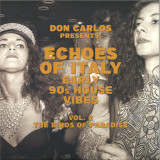
Various - ECHOES OF ITALY – THE BIRDS OF PARADISE – EARLY 90S HOUSE VIBES VOL.2 (2x12")

Googling “paradise house”, the first results to pop up are an endless list of European b&b’s with whitewashed lime façades, all of them promising “…an unmatched travel experience a few steps from the sea”. Next, a little further down, are the institutional websites of a few select semi-luxury retirement homes (no photos shown, but lots of stock images of smiling nurses with reassuring looks). To find the “paradise house” we’re after, we have to scroll even further down. Much further down.

It feels like yesterday, and at the same time it seems like a million years ago. The Eighties had just ended, and it was still unclear what to expect from the Nineties. Mobile phones that were not the size of a briefcase and did not cost as much as a car? A frightening economic crisis? The guitar-rock revival?! Certainly, the best place to observe that moment of transition was the dancefloor. Truly epochal transformations were happening there. From America, within a short distance one from the other, two revolutionary new musical styles had arrived: the first one sounded a bit like an “on a budget” version of the best Seventies disco-music – Philly sound made with a set of piano-bar keyboards! – the other was even more sparse, futuristic and extraterrestrial. It was a music with a quite distinct “physical” component, which at the same time, to be fully grasped, seemed to call for the knotty theories of certain French post-modern philosophers: Gilles Deleuze, Félix Guattari, Paul Virilio... Both those genres – we would learn shortly after – were born in the black communities of Chicago and Detroit, although listening to those vinyl 12” (often wrapped in generic white covers, and with little indication in the label) you could not easily guess whether behind them there was a black boy from somewhere in the Usa, or a girl from Berlin, or a pale kid from a Cornish coastal town.

Quickly, similar sounds began to show up from all corners of Europe. A thousand variations of the same intuition: leaner, less lean, happier, slightly less intoxicated, more broken, slower, faster, much faster... Boom! From the dancefloors – the London ones at least, whose chronicles we eagerly read every month in the pages of The Face and i-D – came tales of a new generation of clubbers who had completely stopped “dressing up” to go dancing; of hot tempered hooligans bursting into tears and hugging everyone under the strobe lights as the notes of Strings of Life rose up through the fumes of dry ice (certain “smiling” pills were also involved, sure). At this point, however, we must move on to Switzerland.

In Switzerland, in the quiet and diligent town of Lugano, between the 1980s and 1990s there was a club called “Morandi”. Its hot night was on Wednesdays, when the audience also came from Milan, Como, Varese and Zurich. Legend goes that, one night, none less than Prince and Sheila E were spotted hiding among the sofas, on a day-off of the Italian dates of the Nude Tour… The Wednesday resident and superstar was an Italian dj with an exotic name: Don Carlos. The soundtrack he devised was a mixture of Chicago, Detroit, the most progressive R&B and certain forgotten classics of old disco music: practically, what the Paradise Garage in New York might have sounded like had it not closed in 1987. In between, Don Carlos also managed to squeeze in some tracks he had worked on in his studio on Lago Maggiore. One in particular: a track that was rather slow compared to the BPM in fashion at the time, but which was a perfect bridge between house and R&B. The title was Alone: Don Carlos would explain years later that it had to be intended both in the English meaning of “by itself” and like the Italian word meaning “halo”. That wasn’t the only double entendre about the song, anyway. Its own very deep nature was, indeed, double. On the one hand, Alone was built around an angelic keyboard pattern and a romantic piano riff that took you straight to heaven; on the other, it showcased enough electronic squelches (plus a sax part that sounded like it had been dissolved by acid rain) to pigeonhole the tune into the “junk modernity” section, aka the hallmark of all the most innovative sounds of the time: music that sounded like it was hand-crafted from the scraps of glittering overground pop.

No one knows who was the first to call it “paradise house”, nor when it happened. Alternative definitions on the same topic one happened to hear included “ambient house”, “dream house”, “Mediterranean progressive”… but of course none were as good (and alluring) as “paradise house”. What is certain is that such inclination for sounds that were in equal measure angelic and neurotic, romantic and unaffective, quickly became the trademark of the second generation of Italian house. Music that seemed shyly equidistant from all the rhythmic and electronic revolutions that had happened up to that moment (“Music perfectly adept at going nowhere slowly” as noted by English journalist Craig McLean in a legendary field report for Blah Blah Blah magazine). Music that to a inattentive ear might have sounded as anonymous as a snapshot of a random group of passers-by at 10AM in the centre of any major city, but perfectly described the (slow) awakening in the real world after the universal love binge of the so-called Second Summer of Love.

For a brief but unforgettable season, in Italy “paradise house” was the official soundtrack of interminable weekends spent inside the car, darting from one club to another, cutting the peninsula from North to centre, from East to West coast in pursuit of the latest after-hours disco, trading kilometres per hour with beats per minute: practically, a new New Year’s Eve every Friday and Saturday night. This too was no small transformation, as well as a shock for an adult Italy that was encountering for the first time – thanks to its sons and daughters – the wild side of industrial modernity. The clubbers of the so-called “fuoriorario” scene were the balls gone mad in the pinball machine most feared by newspapers, magazines and TV pundits. What they did each and every weekend, apart from going crazy to the sound of the current white labels, was linking distant geographical points and non-places (thank you Marc Augé!) – old dance halls, farmhouses and business centres – transformed for one night into house music heaven. As Marco D’Eramo wrote in his 1995 essay on Chicago, Il maiale e il grattacielo: “Four-wheeled capitalism distorts our age-old image of the city, it allows the suburbs to be connected to each other, whereas before they were connected only by the centre (…) It makes possible a metropolitan area without a metropolis, without a city centre, without downtown. The periphery is no longer a periphery of any centre, but is self-centred”.

“Paradise house” perfectly understood all of this and turned it into a sort of cyber-blues that didn’t even need words, and unexpectedly brought back a drop of melancholic (post?)-humanity within a world that by then – as we would wholly realise in the decades to come – was fully inhuman and heartless. A world where we were all alone, and surrounded by a sinister yellowish halo, like a neon at the end of its life cycle. But, for one night at least, happy."

out of Stock

Order now and we will order the item for you at our supplier.

Last In: 3 months ago
ZOMBIE ZOMBIE - FUNK KRAUT
  • NO CRUISE CONTROL
  • DENSITE
  • JUNGLE THE JUNGLE
  • HELIX
  • AURILLAC ACCIDENT
  • DOUBLE Z
  • DODORIAN
  • FUNK KRAUT
  • SNARE ATTACK
  • MAGNAVOX ODYSSEY

Some record crates deserve a sub-category called 'play it again, Sam'. tracks that spin on the turntables without a push. Funk Kraut, Zombie Zombie's second LP on Born Bad, is of this kind. This well-proportioned classic is a fine example of the style the trio has been embodying: instrumental for synths and drums music played live. This time it was a quick affair, recorded by Laurent Deboisgisson in the studio of Cheveu's singer. A pretty straightforward job, and a far cry from their previous concept album. Let us praise Krikor Kouchian's mix: drums have been resampled with some restraint, and that Linn Drum kick lightens up the overall mix. It marks a notable evolution in the band's sound, and adds some dynamic. The album kicks off with 'No cruise control', a big bad sedan that effortlessly eats up the distance at 120 BPM. Kraut as can be, with a twist. And as far as funk goes, it's not Bootsy Collins, but there's a whiff. Space is structured by synth patterns, for optimized drumming : forward, straight and fluid, top-notch suspension (Cosmic Neman / Dr Scho?nberg take care of business on drums). They treat themselves to a diversion via Darmstadt to take some musique concrete on board : mechanical birds chirp, the odd atonal piano here and there. Nerds will appreciate liner notes detailing the equipment used : about twenty synths and they still describe it as minimal. With 'Densite?', we've just passed a polyphonic milestone: outright chords ! Long, suspended pads, pierced only by fat claps. Clapping hands are not far off. The band shows it has mastered concise pop formats. That same vibe can be found in 'Jungle the Jungle', paradoxical tune, catchy and moody at once. You'll get some brass riffs in 'Helix', which takes off on a synth moving from one speaker to another to herald the crash of syncopated drums to come.Zombie Zombie sounds ready to write themes for niche TV series.'Aurillac Accident' documents a haphazard soundcheck which, once in the studio, became a bitter ballad, breaking apart into dubby gravy. Live with two drummers performing, this aspect showcases in 'Snare Attack' and 'Double Z', with its jogging hi-hats and creepy little toy piano motifs. Cardio levels are high on 'Dodorian', perfect track for depraved spinning classes, with its moving filter, disco arpeggios and flashes of synthetic brass. 'Magnavox Odyssey', a nostalgic but bouncy synth lasagna, brings this album to a majestic close. The cover by Dddixie sets the tone with its 'Motorik Vibes & Stereo Grooves' sticker. Motorik, absolutely, it's autobahn time for 45 minutes. And when it comes to stereo grooving, the acoustic image is as wide as the canyons of Mars. DO NOT MISS THIS ALBUM (or the previous Vae Vobis)!

pre-order now28.03.2025

expected to be published on 28.03.2025

Abstract Orchestra & Ghostlife - Madvillain Remixes

Abstract Orchestra's composer, leader, arranger and producer Rob Mitchell has now added remixing to his already notable list of credits, in this case turning his hand to Abstract's MADVILLAIN project. Rob has worked with many artists during his busy career; The Haggis Horns, Rag 'n' Bone Man, Sharon Jones and the Dap–Kings, Brand New Heavies, and Slum Village, alongside many others but it was the orchestra's work he wanted to revisit. Seeing the pandemic as an opportunity to spend more time in the studio, Rob spent several months polishing his production skills before embarking on this remix project, he wanted to make sure he did it justice. Working under the moniker Ghostlife, a nod to the fabled anonymity of rapper MF DOOM, Rob has reworked the big band orchestration of Abstract, creating a beat led affair with greater dance floor appeal.

For Abstract Orchestra MADVILLAIN REMIXES, Ghostlife cherry picked ten tracks from Abstract's two-album project and plays with a higher BPM count within the hip hop aesthetic of the original. The tracks include "Raid", "Fancy Clown", "Curls", and "Figaro" and in this case Ghostlife has forgone the big arrangements Abstract is known for, rather he has coaxed out hooks and samples from their tracks and produced something he hope will appeal to a different crowd. There is dancefloor potential in "Eye","Accordian" and bass heavy "Borrowed Time" while the reworks of 'Fancy Clown" and "Curls" would fit well into any radio show.

out of Stock

Order now and we will order the item for you at our supplier.

Last In: 28 days ago
SHARP PINS - RADIO DDR

Sharp Pins

RADIO DDR

12inchKLPLP301
K Records
21.03.2025

Geniusz, Minor Talent, Generational Talent. Let the old folks fight it out. Sharp Pins are too busy staying up late watching vampire movies. Fathers and Children of the Revolution. Finally cartographed and designed by the actual Youth in Revolt "Nothing Stands in their way, they ARE the face of today". How can you tell you've been in the presence of the Sharp Pins? You see their sticker on yr phone, yr car, yr guitar, yr drums, yr bass, yr clarinet, yr flugelhorn, yr tuba, yr dog - its a MOD MOD WORLD, we're just living in it. 14 tracks 33RPM. Sharp Pins is the super solid lo-fi noise pop project of talented Chicago musician Kai Slater of Lifeguard and Dwaal Troupe."Radio DDR" originally released at home as a Hallogallo tape. "Youth Revolution Now".

pre-order now21.03.2025

expected to be published on 21.03.2025

David Ramirez - All The Not So Gentle Reminders 2x12"
  • 1: Maybe It Was All A Dream
  • 2: Waiting On The Dust To Settle
  • 3: The Music Man
  • 4: Dirty Martini
  • 5: I Got People
  • 6: Twin Sized Beds
  • 7: Deja Voodoo
  • 8: A Bigger World
  • 9: Holiday (Crush)
  • 10: Nobody Meant To Slow You Down
  • 11: Do Not Disturb Me
  • 12: Dreams Come True

The Austin, TX-based singer-songwriter—whose decades-long career has seen six full-length studio albums, three EPs, countless collaborations, and an illustrious supergroup project in Glorietta—spent a season of rest away from his focus on writing songs. In the wake of the end of a long relationship, he wanted to prioritize processing his grief as a human, not as an artist bleeding on the page. “I love all the records I’ve made in the past. But in making them, there was always the thought in the back of my mind of where and what it could get me. I made both creative and business decisions with a goal in mind... a goal that often never came. This time it was all about just the joy of making it, about having fun with it.”

pre-order now21.03.2025

expected to be published on 21.03.2025

Weatherday - Hornet Disaster MC (TAPE)
  • A1: Hornet Disaster
  • A2: Meanie
  • A3: Angel
  • A4: Take Care Of Yourself (Paper - Like Nests)
  • A5: Hug
  • A6: Radar Ballet
  • A7: Green Tea Seaweed Sea
  • A8: Blood Online
  • A9: Blanket
  • A10: Pulka
  • B1: Heartbeats
  • B2: Chopland Sedans
  • B3: Cooperative Calligraphy
  • B4: Ripped Apart By Hands
  • B5: Nostalgia Drive Avatar
  • B6: Aldehydes
  • B7: Tiara
  • B8: Agatha's Goldfish (Sparkling Water)
  • B9: Heaven Smile
also available

2LP


"“It clicked for me one day, that the album was going to be about hornets,” explains Sputnik, the mononymous songwriter behind the noise-pop project Weatherday.

“It just made sense to me.” Hornet Disaster, Weatherday’s follow-up to their 2019 debut Come in, and spiritual successor to 2022’s collab release Weatherglow, is their most expansive work to date. In Weatherday’s initial bout of inspired writing and recording, they produced over 70 songs for the record, but not before they had a complete, overarching narrative that was coherently tied back to Sputnik’s previous work.

It’s a bustling record with disparate songs each vying for space like wasps in a swarm. It can inspire caution and chaos, but there’s wonder, purpose, and a certain familiarity there, too. Weatherday has extended the knotted, thrashing maximalism of Come in by doubling down with the uncompromised, no-stone-unturned nature of Hornet Disaster. Where Come in was the product of an artist searching for their voice, Hornet Disaster represents the joyful abandon that comes from having found it."

pre-order now21.03.2025

expected to be published on 21.03.2025

Weatherday - Hornet Disaster LP 2x12"

"“It clicked for me one day, that the album was going to be about hornets,” explains Sputnik, the mononymous songwriter behind the noise-pop project Weatherday.

“It just made sense to me.” Hornet Disaster, Weatherday’s follow-up to their 2019 debut Come in, and spiritual successor to 2022’s collab release Weatherglow, is their most expansive work to date. In Weatherday’s initial bout of inspired writing and recording, they produced over 70 songs for the record, but not before they had a complete, overarching narrative that was coherently tied back to Sputnik’s previous work.

It’s a bustling record with disparate songs each vying for space like wasps in a swarm. It can inspire caution and chaos, but there’s wonder, purpose, and a certain familiarity there, too. Weatherday has extended the knotted, thrashing maximalism of Come in by doubling down with the uncompromised, no-stone-unturned nature of Hornet Disaster. Where Come in was the product of an artist searching for their voice, Hornet Disaster represents the joyful abandon that comes from having found it."

pre-order now21.03.2025

expected to be published on 21.03.2025

Demdike Stare & Kristen Pilon - To Cut and Shoot

On their most explicit venture into music for moving image, Miles Whittaker & Sean Canty rudely fracture piano and vocal recordings by US filmmaker-musician Kristen Pilon in a short-circuiting of style and pattern.

Shredding up definitions of electro-acoustic opera, spectralist chamber musique and concrète rave, Demdike hit square between the eyes/ears of film music vernaculars on a startlingly strong addition to their unique oeuvre, now in its 16th year of elusive psychoacoustic strafes and jump-cuts across putative borders. The 13-part, hour-long album dislodges source material made for the experimental film ‘To Cut and Shoot’, by Kristen Pilon, an NYC-based musician and filmmaker, to farther refract the film’s themes of serendipity and the nature of ghosts and dreams with a flickering flux of sound-imagery and aleatoric weirdness appropriate to her original meditations, but also freely messing with their forms.

Situated just a few miles north of Houston, Cut and Shoot is a relatively insignificant Texas town with an unforgettably bizarre name. Pilon grew up not far from Cut and Shoot, and it's there where she ran into 65-year-old machinist and motorcyclist Robert Lewis Stevenson, better known as Bobbo, who's pictured on the album's cover. The meeting occurred a few months after Pilon recorded her improvisations on piano, strings and voice in the basement cellar of the Halle in Manchester, with Bobbo providing the necessary narrative heft the trio needed to inspire an experimental film and its accompanying soundtrack.

Responding to Kristen’s initial piano and operatic vocal recordings, Demdike return a volley of discrete parts tilting from typically cantankerous mayhem to quieter, more clandestine buzzes sliced with crazed interstices of the imagination, all marbled with the plasmic contrails of the paranormal which have long been peculiar to their work. With a poetic flair reflecting Pilon’s own phrasing and melding of mediums, Demdike unfold and expand her melodic fragments into temporal mazes, variously resembling the most messed-up ends of The Caretaker in ‘A Grave Fall (January)’, but also liable to skew into buckshot club turbulence, as with ‘Belly Up’, or the bittersweet bruk contortions of ‘Twist’.

The storyline wickedly frays and loops into itself with a non-linearity that recalls the mid-to-latter stages of Lynch’s ‘Mulholland Drive’ or waking from a sweaty fever dream only to pitch back into its thorny bush of ghosts, often within the space of one track. It’s testament to the ever-tighter binds of Demdike’s symbiotic vision that the results nevertheless hold a thread of logic that weaves in everything from their Jon Collin jams to reams of mixes and Gruppo edits with an unresolved, open-ended quality that still keeps us on our toes, perhaps more so than ever here.

out of Stock

Order now and we will order the item for you at our supplier.

Last In: 18 months ago
Sordid Sound System - Gimme Fever

It’s a decidedly busy time at INVINC HQ at the moment with the 10-year anniversary looming in May.
The six months preceding this date are peppered with a flurry of releases every couple of months, which started with the Mondo Ritmo EP that came in October, the Gamma Knife LP in December and now this brand new album by Sordid Sound System, which lands early March before a rather promising sounding 2xLP compilation lands in May to mark the occasion. 


It’s been a good few years since something by Sordid Sound System aka Stuart Evans has been released on the label and it’s a welcome return. In our opinion it's some of Evans’ best work and so it’s a pleasure to have him back on board the good ship Inc. 


Remarkably, this music is even harder to pigeon-hole than usual...even for Stu, who’s known for his raw, analogue, live takes that veer between dub and post-kraut this is definitely quite "different": part surf acid, part dub, part psych-exotica, part motorik...and that's just the A-side. The B-side leans more towards ambience but of the oddball experimental soundtrack variety...a thoroughly enjoyable ride.
Enjoy the trip.

out of Stock

Order now and we will order the item for you at our supplier.

Last In: 8 months ago
Elvis Presley - Debut Album
  • Blue Suede Shoes
  • I'm Counting On You
  • I Got A Woman
  • One-Sided Love Affair
  • I Love You Because
  • Just Because
  • Don't Be Cruel
  • Heartbreak Hotel
  • Tutti Frutti
  • Trying To Get To You
  • I'm Gonna Sit Right Down And Cry (Over You)
  • I'll Never Let You Go (Little Darlin')
  • Blue Moon
  • Money Honey
  • Shake, Rattle & Roll
  • I Want You, I Need You, I Love You

21 tracks - pressed on limited edition 180g vinyl.This special LP edition showcases all of Elvis Presley's 1957 rock & roll studio sides

The core group backing him on all sides are Scotty Moore on guitar, Bill Black on bass, and D. J. Fontana on drums, plus The Jordanaireson backing vocals.

All tracks recorded at Radio Recorders, Hollywood between January and September 1957. Additional musicians to core group: Gordon Stoker (piano) Tiny Timbrell guitar), Dudley Brooks (piano).

When I first heard Elvis' voice, I just knew that I wasn't going to work for anybody; and nobody was going to be my boss. Hearing him for the first time was like busting out of ail." - Bob Dylan

Elvis was a unique artist... an original in an area of imitators." - Mick Jagger

pre-order now14.03.2025

expected to be published on 14.03.2025

George Kooymans - Jojo

George Kooymans

Jojo

12inchMOVLP3865
Music On Vinyl
14.03.2025
  • South Side Lady
  • Day and Night
  • Lay It On Me
  • For Gail
  • Lovin' and Hurtin
  • Low Rider
  • We're Just Marking Time
  • A Drifter's Love
  • Spending All My Time With You
  • Don't Be Lonely

In between the Golden Earring albums 'Seven Tears' and 'Together', both guitarist George Kooymans and singer Barry Hay worked on solo material. Kooymans’ album 'Jojo' was released in December 1971 and was the result of a sparkling and short period of recording sessions at the Phonogram Studio in Hilversum, where he recorded a collection of songs with some of the best Dutch session musicians – among guitarists Eelco Gelling (Cuby + Blizzards) and Hans Hollestelle and saxophone player Bertus Borgers (Sweet d’Buster). Thanks to the spontaneous recordings, the personal lyrics - with help from George’s friends Bruce Kirkman and Jerry Voisin - and Harry van Hoof’s string arrangements, 'Jojo' achieved a cult status and became a collectors' item soon after release.

The album has been remastered from the original Phonogram Studio master tapes and includes a recent interview with George Kooymans about the making of 'Jojo'.

'Jojo' is available as a limited numbered edition of 750 copies on light green coloured vinyl and includes an insert.

pre-order now14.03.2025

expected to be published on 14.03.2025

Jimi Tenor & Cold Diamond & Mink - Summer Of Synesthesia

The single release from Jimi Tenor's second thematic album on Timmion Records offers two very different moods. "Summer of Synesthesia" takes us back to those dreamy summer days, a natural overpour of sensations mixing together, sounds becoming colors before turning into flavors. Synthesizers grow into delicate layers over Cold Diamond & Mink's rhythm, and when your heart can hardly bear the beauty of it all, Tenor's soft lyric places the cherry on top. "Tsicroxe" on the flipside couldn't be more different, kicking into gear with a demonic organ arpeggio that sounds like you've just been dropped into a Dario Argento scene. Even though the familiar funk from Cold Diamond & Mink eases the dread a bit, when Tenor busts in with the eerie flute solo, the ritual closes in on its conclusion.

The contents of the backwards vocal bits at the end shall be saved for your turntable so make sure to rewind that track, selector! Also Available From Jimi Tenor & Cold Diamond & Mink: Is There Love In Outer Space? 7", Gaia Sunset 7", Is There Love In Outer Space? LP / CD. The single takes listeners on a sonic journey: “Summer of Synesthesia” flows with warm, dreamlike beauty, while “Tsicroxe” dives into intense, mysterious depths, showcasing Tenor’s dynamic range. Blending synth layers with Cold Diamond & Mink’s classic funk rhythms, both tracks bring elements of 70s soundtrack-style tension and ethereal soul, appealing to fans of both cosmic grooves and suspenseful soundscapes. Tenor’s layered synthesizers, haunting flute, and even backward vocal elements add a captivating texture, making “Summer of Synesthesia” b/w “Tsicroxe” a must-have for fans of genre-blending, atmospheric music.

out of Stock

Order now and we will order the item for you at our supplier.

Last In: 3 months ago
Stiff Richards - State Of Mind

Stiff Richards

State Of Mind

12inchDRUNKENSAILOR134
Drunken Sailor
04.03.2025

First things first - you don’t need me to tell you about the significance of Australia in the history of punk. I mean, what am I, Jon Savage? Google it yourself, FFS. Instead, let’s just agree that the speedy, feral racket thrown together by the likes of The Saints, Radio Birdman and The Scientists in the mid-late ‘70s is AT LEAST as deliriously entertaining as anything concocted by their UK/US counterparts, sowing the seeds for seemingly endless garage-inflected noisemakers in the land down under. No one likes using words like ‘tradition’ or ‘heritage’ here - the punk rock clusterbomb is far too messy for any of that business - but also emerging from Australian rock’s primordial soup is the addictive sneer of Stiff Richards. Like their predecessors, the band are a gleefully wracked mess of full throttle energy and barrelling power chords, with songs like ‘Kids Out On The Grass’ and ‘Point of You’ proving at least the equal of ‘(I’m) Stranded’ or ‘Aloha Steve And Danno’. Nine tracks in less than 30 minutes, all winners and all determined to leave you flipping over couches and smashing your TV set. And let’s face it, you may as well; there’s nothing good on. It all builds towards frantic closer ‘Fill In The Blanks’, which rattles around your speakers like the UK Subs trying to play Ed Kuepper riffs at the centre of an earthquake, before grinding to a halt as a voice says, “That’s the one.” Does it sound self-satisfied? Hey, it’s got good reason to - this is the best no-frills garage rock party since Gino & The Goons’ ‘Do The Get Around’, and the only appropriate response is to declare yourself betrothed to Stiff Richards because you can’t imagine your life without ‘em. Don’t believe me? Sort out your ears and get ‘State Of Mind’ in ‘em. Rock’n’roll as it’s supposed to be played.

out of Stock

Order now and we will order the item for you at our supplier.
Last In: 18 months ago
Los Dexter's De Uchiza - Fiesta en La Jungla
  • A1: Fiesta En La Jungla
  • A2: Fuga En La Selva
  • A3: Tu Partida
  • A4: Agua De Cachilde
  • A5: La Chicharra
  • A6: Dolor Y Pena
  • B1: Izango
  • B2: El Shiringuero
  • B3: A Jenny
  • B4: Linda Tocachina
  • B5: Para Mi Gente
  • B6: Tragedia En Uchiza

Carrying the torch of psychedelic cumbia, with a healthy dose
of surf guitar and Amazonian dancefloor flourishes from Peru
and Brazil alike, Fiesta en la Jungla by Los Dexter’s de Uchiza
is the first release from the newly formed London-label Ritmo
del Barrio. Originally released in 1982, it captures the finest
cumbia being made in Peru at the time, decked out with
frenetic surf-rock guitar riffs, rhythms floating on crisp
cumbia percussion and occasionally punctuated by carimbó
breakdowns native to the Pará region of north-eastern Brazil.
The album is filled with energy, a gem that was always
intended to animate any dancefloor. Peruvian cumbia came to national attention in the late 60s
through the recordings of Juaneco y su Combo, Los Destellos
and Los Wembler’s de Iquitos, but it’s had many revivals, and
Fiesta en la Jungla arrived when the style was going through a
major transition. In 1977, a passenger plane carrying most of
the members of Juaneco y su Combo crashed, killing everyone
on board. In 1980, Los Destellos retired, and Los Wembler’s
released their tenth and final record, they were ready for a
break. This left a big void in Peruvian music. Wasting no time,
Los Dexter’s Emerson Ruiz Mosquera took the opportunity and
gave his band new life, filling the band’s ranks with young and
energetic musicians who were hungry for success. He built the
new band around a solid base of dexterous guitars, a dynamite
rhythm section, and added oodles of percussion and an electric
organ, giving them a powerful psychedelic sound that called
back to the sounds of the original chichamasters, but added a
new sheen. Along with bands like Los Shapis and Los Walkers
de Huánuco, Peruvian cumbia was reborn as chicha in the
1980s, and was now the sound of Peru’s barrios up and down
the country.
Based in the city of Uchiza, on the edges of the Amazon basin,
Los Dexter’s were uniquely located in central Peru, closer to the
largest urban centres of the country than Amazonian outposts
like Pucallpa or Iquitos, and therefore better positioned to
travel to the furthest reaches of the country with ease. In a
sense, Los Dexter’s were a bridge between the Amazon and the
rest of Peru, a bridge over which the sounds of Amazonian
cumbia could travel to the rest of the country on their way to
becoming one of the most ubiquitous elements of Peru’s musical
identity. Fiesta en la Jungla represents Los Dexter’s in their third
iteration. Led by Emerson Ruiz Mosquera, who was just a
young boy in 1970 when his older brother founded the group
with four of his friends, the ensemble by the time of Fiesta en la
Jungla included Orlando Abad on the timbales and lead vocals,
Lucho Bendezú on lead guitar, Javier Quiroz as second
guitarist, Alejandro Almeira on bass, Rufino Bustamante on
keyboard, Ramon Siu on bongos and bells, Ivan Rios on conga,
and Emerson as musical director and composer. Remarkably,
most of the group’s members helped to write at least one
track, Los Dexter’s were a collective endeavour.
Reissued on vinyl for the first time by Ritmo del Barrio, this
record is essential for any collector of Peruvian cumbia.
Showcasing the unique sound of Los Dexter’s, it carries hits
like “Fuga en la Selva” and “El Shiringuero”, which are sure to
set any dancefloor on fire, combined with slower, carimbó-
infused cumbias like “Fiesta en la Jungla,”and “Agua de
Cachilde.” Its closing track, “Tragedia en Uchiza'', is a key
piece of local history and tells of the flooding of the
Chontayacu River in 1982, a mortal tragedy that affected
thousands of people. Despite the subject matter, the album
maintains a joyful vibe throughout, with high energy riffs and
irresistible rhythms, contrasted with terse love ballads, like “A
Jhenny.” It is both a piece of musical history, and a sure-fire
tool for the dance floor.
Los Dexter’s became a fixture of festivals and celebrations in
the provinces of San Martin and Huánuco, and from expanded
across the country, taking Amazonian cumbia from the
Peruvian Amazon, to the heights of the Peruvian sierra, the
coastal plains, and the capital city of Lima.

pre-order now28.02.2025

expected to be published on 28.02.2025

Jimi Tenor & Cold Diamond & Mink - Summer Of Synesthesia

The single release from Jimi Tenor's second thematic album on Timmion Records offers two very different moods. "Summer of Synesthesia" takes us back to those dreamy summer days, a natural overpour of sensations mixing together, sounds becoming colors before turning into flavors. Synthesizers grow into delicate layers over Cold Diamond & Mink's rhythm, and when your heart can hardly bear the beauty of it all, Tenor's soft lyric places the cherry on top. "Tsicroxe" on the flipside couldn't be more different, kicking into gear with a demonic organ arpeggio that sounds like you've just been dropped into a Dario Argento scene. Even though the familiar funk from Cold Diamond & Mink eases the dread a bit, when Tenor busts in with the eerie flute solo, the ritual closes in on its conclusion.

The contents of the backwards vocal bits at the end shall be saved for your turntable so make sure to rewind that track, selector! Also Available From Jimi Tenor & Cold Diamond & Mink: Is There Love In Outer Space? 7", Gaia Sunset 7", Is There Love In Outer Space? LP / CD. The single takes listeners on a sonic journey: “Summer of Synesthesia” flows with warm, dreamlike beauty, while “Tsicroxe” dives into intense, mysterious depths, showcasing Tenor’s dynamic range. Blending synth layers with Cold Diamond & Mink’s classic funk rhythms, both tracks bring elements of 70s soundtrack-style tension and ethereal soul, appealing to fans of both cosmic grooves and suspenseful soundscapes. Tenor’s layered synthesizers, haunting flute, and even backward vocal elements add a captivating texture, making “Summer of Synesthesia” b/w “Tsicroxe” a must-have for fans of genre-blending, atmospheric music.

pre-order now28.02.2025

expected to be published on 28.02.2025

DANIEL VILLARREAL - LADOS B

On October 15th & 16th 2020, drummed Daniel Villarreal was joined by guitarist Jeff Parker and bassist Anna Butterss for two afternoons of recording in the backyard of Chicali Outpost in Los Angeles. For all three musicians, it was the first ensemble recording session they"d done in-person since the pandemic locked the world down just seven months prior. Some choice moments from the sessions made it onto Villarreal"s critically-acclaimed 2022 album Panamá 77, bust most of the music remained unreleased. Lados B is a deep dive into the high-level spontaneous music made by Villarreal, Parker and Butterss across those two days in 2020. Villarreal is heard leading the group through various rhythmic modes and structures for improvisation - flow as informed by the Latin soul of Fania Records as it is by the otherworldly trance of Brain Records - while Parker and Butterss draw on their extensive experience playing free together (as heard on Parker"s recently-released Mondays at the Enfield Tennis Academy, and the LA side of Makaya McCraven"s 2018 LP Universal Beings) to build harmonic buoys for their spontaneous melodicism. The result is a beautifully vivid illustration of context, creativity, and collective composition from a particularly rich moment in history.

out of Stock

Order now and we will order the item for you at our supplier.

Last In: 19 months ago
Loyle Carner - Not Waving, But Drowning LP

Loyle Carner will release his highly anticipated sophomore record, 'Not Waving, But Drowning' on 19 April via AMF Records.

'Not Waving, But Drowning' follows Loyle's BRIT (Best Male, Best Newcomer) and Mercury Prize nominated, top 20 debut 'Yesterday's Gone'. The bedrock of honest and raw sentimentality that you heard on 'Yesterday's Gone' left an inextinguishable mark on music in general and UK Hip Hop in particular, standing out as an ageless, bulletproof debut.

'Not Waving, But Drowning', Loyle's new album, gives yet more evidence - as if it were needed - of his razor-sharp flow and his unique storytelling ability. Yes, he can rap, but he allies that with the sensitivity of a poet, the observational skills of a novelist, and warmth of your best friend. The album opens with 'Dear Jean', a letter to his mother in which he's telling her that he has found the love of his life, 'a woman from the skies', and he's moving out.

It goes without saying that Loyle's music is hard to categorise, but what is even more impressive is that for someone who grew up listening to Mos Def, Biggie Smalls, Roots Manuva, and Wu Tang Clan, he doesn't sound like any of them. Although he might from time to time give lyrical nods to them, he's no imitator.

Loyle loves cooking. There are two tracks on this album named after chefs. The British-Israeli chef Yotam Ottolenghi, and the now deceased Italian chef Antonio Carluccio. 'Ottolenghi' the first single from the album was featured on the BBC Radio 1 B-list, BBC 6 Music A-list and has already been streamed over 5 million times.

Loyle refers to real life for everything, the title of 'Yesterday's Gone' came from a song of his step father, the title of his new album 'Not Waving, But Drowning' comes from a poem by his grandfather, which in turn came from a Stevie Smith poem. What you hear on the track 'Krispy' is real. He is pouring his heart out to his best friend Rebel Kleff after their relationship went downhill, he invites him on the track to say his piece but he doesn't turn up, so we get a flugel solo instead.

Loyle also has his own personal black consciousness movement. When he refers to his 'fathers' in the track 'Looking Back' he really is referring to two fathers. His biological father, a black man who he knows, but knows very little of, and his step father, a poet and musician who happens to be a white man but died a sudden unexpected death from epilepsy (SUDEP). With no real emotional ties to his biological father, but a deep connection with a deceased step-father, where does a young child turn He succinctly captures many of the great, unspoken, cultural and historical paradoxes of multicultural Britain on 'Looking Back'.

An album like this is hard to find. It is for those who like their Hip Hop to have soul, and their soul to have spirit. This is because it works on so many levels, but it is reflecting the personality of its creator. There are a host of collaborators here, Jorja Smith, Rebel Kleff, Kiko Bun, Kwes, Jordan Rakei, Sampha, Tom Misch and more, but none are overpowering. They blend righteously into place.
Loyle is not bitter with people who have let him down, or a society that lets so many down, but the combination of anger and love he has gives his voice the perfect blend of strength and vulnerability. This might be a coming of age album, but it's also a coming of ageless album. Loyle's 2019 Spring tour - which includes London's Roundhouse - sold out within 20 minutes of being on sale.

Not Waving, But Drowning


A rapper that raps about family is hard to find. The boys in the 'hood' tend not to be that interested in how much a 'brother' loves his mother, or how much he misses his dad, or even how much he misses his best friend. The boys in the 'hood' tend to be obsessed with the size of their cars, girls, bank accounts, and other personal 'possessions'. Loyle Carner's Mercury and BRIT Prize nominated debut 'Yesterday's Gone' (Released 2017), made it clear that he wasn't that kind of rapper. In fact, every time I talk to him about his work we talk about the world, and we tended to confuse ourselves by calling his work rap, poems, or songs, sometimes in the same sentence. They are in truth all of these things.


Here's some poetry.


Honestly I need them.

I hate them but I grieve them

I think I've finally found the reason

Trust

Like the fire needs the air.

I won't burn unless you're there.


'Not Waving, But Drowning', Loyle's forthcoming new album, gives us yet more evidence, (if it were needed), that he still has what rappers call, flow, but he hasn't lost any of his story telling qualities. Yes, the boy can rap, but a rapper with the sensitivity of a true poet, the observational skills of a novelist, and warmth of your best friend. The album opens with 'Dear Jean', a letter to his mother in which he's telling her that he has found the love of his life, (a woman from the skies), and he's moving out. He really loves the woman from the skies, but he still loves his mum, and so he reassures her that there is no competition, and tells her that 'She's not behind me or behind you, but beside we and beside two', his words. Or to put it another way, moving out without moving out. My words.


It goes without saying that Loyle's music is hard to categorise, but what is even more impressive is that for someone who grew up listening to Mos Def, Biggie Smalls, Roots Manuva, and Wu Tang Clan, he doesn't sound like any of them. Although he might from time to time give lyrical nods to them, he's no imitator. He says finding his own voice was something he always found easy. Although young, (in terms of a musical career), he has confidence in his own words and his own voice, and has never been tempted to sound like he's been hanging out in the USA, or rolling in 'Grime' on the mean streets of East London. And so when it comes to the creative process he doesn't simply find a beat to jump on and ride. Beats are important, but they are tenderly layered with samples, keyboards, or live drums, all imaginatively assembled for the laying on of words. Some tracks start with the idea, some with poetry, and some with a verse from a singer or some other melodic inspiration, but there is no formula.


Here's some poetry.


Don't hold any memories of us

Rather hold you everyday until the memories are dust

Yo we only caught the train

Cos you know I hate the bus


A prolific reader, who has dyslexia is hard to find. Add ADHD (Attention deficit hyperactivity disorder) to that and life should become even more difficult. To deal with your difficulties you devise coping strategies, which can differ from person to person. Loyle loves cooking. There are two tracks on this album named after chefs. The British-Israeli chef Ottolenghi, and the now deceased Italian chef Antonio Carluccio. Loyle describes himself as 'weird' because he is happy to read a cookbook as if he was reading a novel or a book of poetry. He has opened a cookery school for young adults not just because he loves food and wants to make more of it, but because it is one of the few things that can focus the ADHD mind. And when it comes to his other love, football, his approach is the same. Focus. He wanted to be a striker he says, up front scoring goals, but found his best position was in midfield because he was able to focus, check options, and see passes ahead of time, providing passes for other players just when they needed them. He says, 'You don't grow out of ADHD, you grow into it.' Loyle is also working with Levi's® on their music project where he is mentoring young musicians over a six month period, culminating at Liverpool Sound City festival.


More poetry.


When the going is tough

I wait till it falls on deaf ears

Hearsay

Without the boundaries of love


He also said, 'Ask most people and they will say that they love their mothers, but most are not going to rap about her'. On his first album Loyle's mum Jean wrote about the 'scribble of a boy' that growing up would take things apart to see how they worked. On this album she speaks with pride about a man who has found his place in the world.


Yes, poetry.


I'm still looking for the answers

Trying to find the right questions

Still waiting for my fathers

But can't break them in to sections


This poetry is serious. Loyle has his own personal black consciousness movement. He told me that he always felt safe at home, and being the darkest one in the family never meant a thing, but then when he had to face the outside world he felt hostility. It shook him up. Now he had to start asking questions, but what were the questions. This is serious. When he refers to his 'fathers' in the verse above taken from the track 'Looking Back' he really is referring to two fathers. His biological father, a black man who he knows, but knows very little of, and his step father, a poet and musician who happens to be a white man but died a sudden unexpected death from epilepsy (SUDEP). So to whom would a young black (or mixed race) kid turn He succinctly captures many of the great, unspoken, cultural and historical paradoxes of multicultural Britain when he says, 'My great grandfather could of owned my other one.' We are a people descended from enslaved people on one hand, and enslavers on the other, something we are still struggling to come to terms with, and this can be apparent in one family. A big book could have told you that, but here we get it in one line on the track, Looking Back.


Loyle refers to real life for everything. The album is peppered with captured moments that he records on his phone. These moments can range from conversations with taxi drivers, to capturing the moment when England scores a goal in the world cup. The title of 'Yesterday's Gone' came from a song of his step father, the title of his new album 'Not Waving but Drowning' comes from a poem by his grandfather, which in turn came from a Stevie Smith poem. What you hear on the track 'Krispy' is real. He is pouring his heart out to his best friend after their relationship went downhill, he invites him on the track to say his piece but he doesn't turn up, so we get a flugel solo instead. Yes people, this is real.


An album like this is hard to find. It is for those who like their Hip Hop to have soul, and their soul to have spirit, this is an album for those who have, (I'm sorry, I'm going to say it), emotional intelligence. This is because it works on so many levels, but it is reflecting the personality of its creator. There are a host of collaborators here, Jorja Smith, Rebel Kleff, Kiko Bun, Jordan Rakei, Sampha, Tom Misch and more, but none are overpowering. They blend righteously into place. Loyle is not bitter with people who have let him down, or the society that has let him down, but the combination of anger and love he has gives his voice the perfect blend of strength and vulnerability. This might be a coming of age album, but it's also a coming of ageless album. His first album worked, and this second album is a continuation of that work. Not creating a form, but being formless, as someone like Bruce Lee once said.

And here's some poetry from mum.


We talked long in to the darkest hours

Until we saw the burnished sky

And our eyes stung

As our words blurred and became thoughts

As we were silenced by the dawn

We clung to each other like sailors in a storm

out of Stock

Order now and we will order the item for you at our supplier.

Last In: 19 months ago
Boban Petrovic - Zur LP 2x12"

Boban Petrovic

Zur LP 2x12"

2x12inchEVERLAND-YU08LP
Everland
15.02.2025
  • 1: Prepad
  • 2: Svetski Osmeh
  • 3: Daj Mi Sansu
  • 4: Progresio Sam
  • 5: Djuskaj
  • 6: Kupatilo Je Shvatilo
  • 7: Meterology
  • 8: Otisli Smo
also available

Original


ŽUR (‘Zhure’, party) is absolute cult and one of the most rare Yugoslavian disco funk albums, originally recorded in 1981, reissued on Everland Music for the first time since the original vinyl came out more than 40 years ago. The album was carefully and brilliantly remastered by grammy nominated sound engineer Jessica Thomson.

Boban Petrović is a legend of Belgrade's sophisticated disco funk scene from the late 70s and early 80s.
Back in the second half of the 70s Boban started one of the first disco clubs in Belgrade and he was one of the biggest organizers of private house parties.

The finest balance between Boban Petrović's big-hearted party-maker-turned-philanthropist personality and his hustler one was achieved on Žur.
On Žur, he is at home, in his safe place, since the parties, the music and the people are the first out of many things he had completely figured out in his life. He is at the top of his game, occasionally bothered by a casual heartbreak, but always feeling himself, coming out playful and fundamentally peaceful, satisfied and ready to transcend himself in order to put the rest of the world in the limelight. In fact, Žur isn’t about the party, music, lyrics or its, hands down, beautifully balanced sonics. It’s about Boban and the funk he lived thoroughly. The funk before, but the funk he lived after this album even more so. All the ups and downs that he faced since the moment the first needle dropped on a Žur record to this very day are on this album as the unwritten destiny of that lighthearted character he played.

In short, ŽUR represents the essence of underground club life in Belgrade from the late 70s, when the album was recorded.
The quality of this trust is confirmed by the fact that Boban Petrovic's music is still actively listened to today, not just anywhere, but at the finest club events.
High end production and extremely authentic arrangements outside the mold of classic disco music, and lyrics that literally convey the vibe of his already jet-set lifestyle in Belgrade at the time.

Shortly after his musical career, Boban Petrovic became a businessman of the conscious class. He was living in Spain on his own luxury yacht for years, he had a private airplane, a car park. But all this time living on highest class level he never lost his identity. In all his offices, yacht, airplane and everywhere was playing loud funk music and he was dressed like a musician who just finished or need to start a gig.
Along the way Boban also wrote two books: Rokanje 1 & 2 describing the time when the album ŽUR was created.

The ŽUR album is one of the the holy grails of disco funk music releases on a global level.

pre-order now15.02.2025

expected to be published on 15.02.2025

Boban Petrovic - Zur LP

Boban Petrovic

Zur LP

12inchEVERLAND-YU07LP
Everland
15.02.2025

ŽUR (‘Zhure’, party) is absolute cult and one of the most rare Yugoslavian disco funk albums, originally recorded in 1981, reissued on Everland Music for the first time since the original vinyl came out more than 40 years ago. The album was carefully and brilliantly remastered by grammy nominated sound engineer Jessica Thomson.

Boban Petrović is a legend of Belgrade's sophisticated disco funk scene from the late 70s and early 80s.
Back in the second half of the 70s Boban started one of the first disco clubs in Belgrade and he was one of the biggest organizers of private house parties.

The finest balance between Boban Petrović's big-hearted party-maker-turned-philanthropist personality and his hustler one was achieved on Žur.
On Žur, he is at home, in his safe place, since the parties, the music and the people are the first out of many things he had completely figured out in his life. He is at the top of his game, occasionally bothered by a casual heartbreak, but always feeling himself, coming out playful and fundamentally peaceful, satisfied and ready to transcend himself in order to put the rest of the world in the limelight. In fact, Žur isn’t about the party, music, lyrics or its, hands down, beautifully balanced sonics. It’s about Boban and the funk he lived thoroughly. The funk before, but the funk he lived after this album even more so. All the ups and downs that he faced since the moment the first needle dropped on a Žur record to this very day are on this album as the unwritten destiny of that lighthearted character he played.

In short, ŽUR represents the essence of underground club life in Belgrade from the late 70s, when the album was recorded.
The quality of this trust is confirmed by the fact that Boban Petrovic's music is still actively listened to today, not just anywhere, but at the finest club events.
High end production and extremely authentic arrangements outside the mold of classic disco music, and lyrics that literally convey the vibe of his already jet-set lifestyle in Belgrade at the time.

Shortly after his musical career, Boban Petrovic became a businessman of the conscious class. He was living in Spain on his own luxury yacht for years, he had a private airplane, a car park. But all this time living on highest class level he never lost his identity. In all his offices, yacht, airplane and everywhere was playing loud funk music and he was dressed like a musician who just finished or need to start a gig.
Along the way Boban also wrote two books: Rokanje 1 & 2 describing the time when the album ŽUR was created.

The ŽUR album is one of the the holy grails of disco funk music releases on a global level.

out of Stock

Order now and we will order the item for you at our supplier.

Last In: 18 months ago
Tape-Off - Fort Sensible

Tape-Off

Fort Sensible

12inchLPCBSC017
COOLIN BY SOUNDS
14.02.2025
also available

Coloured Vinyl


The third album Fort Sensible by Brisbane alt-rockers Tape/Off is a genuine labour of love, a passionate dose of opinionated heart-on-sleeve rock’n’roll representing not just a place but a time with its cache of meticulously-crafted guitars, robust rhythms and socially-conscious lyrics mining both the personal and the political.

While musically they veer seamlessly between intricacy and intensity their words cut straight to the quick, the songs caustic and catchy in equal measure, making Fort Sensible by far the most ambitious and accessible album in the band’s storied decade-plus history.

Tape/Off’s first two albums - Chipper (2014) and Broadcast Park (2018) - were both longlisted for the prestigious Australian Music Prize, yet Fort Sensible takes the tried and tested Tape/Off aesthetic to a whole new level as the band seek to both share the creative load and fully harness their innate collective chemistry.

The guitars of Nathan Pickels and Ben Green weave together like an electric tapestry, the resultant soundscapes both intricate and ambitious whilst still entirely capable of busting out massive riffs with the best of them, their inherent simpatico now built upon by years of experience playing off each other. From a rhythmic perspective Tape/Off's propulsive drummer Branko Cosic's immense power and Cameron Smith's robust, expressive basslines combine to provide the perfect rhythmic bottom-end throughout the record.

Excitingly Tape/Off's sonic palette has been broadened substantially on the new album, with Pickels' angry and angst-laden diatribes throughout Fort Sensible now augmented by Green and Smith taking vocal turns at junctures, adding a whole new dynamic and dimension to proceedings.

At a time when our leaders seem lacking and the world needs the redemptive powers of art and music more than ever, Tape/Off announce themselves as a serious force to be reckoned with the uncompromising power and beauty of Fort Sensible!

pre-order now14.02.2025

expected to be published on 14.02.2025

Deft & Manni Dee - Swamp Season

Two sought after artists, Deft and Manni Dee, combine their uniquely eclectic sounds on collaborative EP ‘Swamp Season’ arriving on Hooversound in March 2025.

Deft, a familiar favourite within the Hooversound family having released two EP’s on the label, is no stranger to breaking boundaries when it comes to sonic stereotypes. Enter: Manni Dee. Another equally exciting name on the London circuit who is an advocate for non-conformism. Between them they have released on Exit, 1985 Music, Critical and Fabric Originals - their style has been recognised globally and continues to grow. Both creatives bring something refreshingly new to the table, whether it’s with their amalgam style of music making, their esteemed record platforms (Silk + Steel, B4 Music) or their DJ sets - it makes perfect sense for the duo to unite on their vision.

Their latest offering combines their boundaryless artistic style of forward-thinking atmospheric production on an EP named ‘Swamp Season’. The two producers play with different elements of club music and hip hop by blurring genres and throwing the rule book out of the window. The end result highlights how Deft and Manni Dee have excelled once again across five bass-fuelled tracks which will expand your perspective on electronic music.

On their single, the duo said “‘Charged’ was the last track we wrote for the EP. Rooted in the simplicity of 00's hip hop instrumentals, on steroids, adapted with the wider electronic sphere in mind. Inspired by the past and present, facing the future.”

Deft and Manni Dee also explained how they came to collaborate; “We've always shared the same taste in hip hop and electronic music, and also share a studio together underneath FOLD in Canning Town, so it just made sense for us to make a record together. Our process was creatively free with no preconceptions, having worked together remotely and together across multiple studios around the world. The result has created a new and exciting avenue for us both, opening the floodgates to eliminate boundaries. It's Swamp Season.”

out of Stock

Order now and we will order the item for you at our supplier.

Last In: 17 months ago
DJ Romain - The Lost D.A.T.S. Part 2 - Unreleased House Music 1997

Last May, Hard Times captivated us with The Lost D.A.T.S (Part One)—a remarkable collection of unreleased and freshly unearthed gems from the vaults of NYC legend DJ Romain. But the story didn’t end there. To our surprise and delight, Romain had delivered an even larger treasure trove of beats—too many to reveal all at once.

Now, Hard Times is proud to present the next chapter: DJ Romain – The Lost D.A.T.S (Part Two).

"1996-97? Yeah, that’s when New York was still NEW YORK!

That was around the time we really started to get hold of exotic herbs. Copper Haze, hydroponic! The vibes in the studio were always lovely. I had hair at the time! Dread-Locs down to my shoulders... I was still rockin’ the Wallabees, or British Walkers as we called them - representing for Brooklyn and my West Indian roots!

There was no social media, no supervision, nobody all up in our business… It was classic "mind your own business" NYC Vibes! I was DJing at a lot of the hot clubs and THE hottest afterhours in the city. There were nights when I saw Micheal Douglas roll into the afters with Grace Jones - they were there to party and unwind and I was there dropping the dope tracks for the people.

When it was studio time, with my homie Matt Echols...I was probably setting things off with some quality herbage, a big ass bag of Funyuns and my trusty SP-1200, lol. I had picked up some tips and tricks from Todd Terry and by '96-'97 I was a Shaolin with it myself! This was around the time tracks like "Flowers" and "Only Love Can Break Your Heart (Dub)" were tearing up the clubs. I wanted to be able to get my ideas out with no problem, and by then I had a lot of confidence...

Being able to Dj in some of the hottest NY hot spots at the time, I was able to really see what worked and what didn't on the dancefloor. The best House Dancers from around the world and around the Tri-State area would be at my jams. I'm talking Ejoe, Voodoo Ray, maybe kids from the Mop-Top Crew... I was definitely taking note of the kind of rhythms and sounds that would make them go crazy on the dancefloor!

And that's how we went about it - I laid down the rhythms that made it happen in my sets and translated the vibes I was picking up from NYC itself. Matt threw down musically and we were just being as creative and inventive as possible! But we always kept in mind that our job was to make the people on the dancefloor jump!

A lot of the jams from those days got signed to various record labels, we dropped a lot of them on our own label...and some of them ended up in the archives - until now!"

out of Stock

Order now and we will order the item for you at our supplier.

Last In: 26 days ago
Synaptic Voyager - Dawn Til Dusk EP

The influence of the UK’s Steel City on electronic music is well documented and undisputed and continues to push the envelope with key figures such as Winston Hazel (Forgemasters, The Step), DJ Parrot/Crooked Man, Richard Benson (RAC, SWAG, Altern 8), Chris Duckenfield (RAC, Popular Peoples Front, SWAG, All Ears Distribution), a thriving underground club scene and the likes of Synaptic Voyager reinforcing the city’s rich musical legacy.

Matt White and Paul Baines have been making off-kilter, emotive, late night electronic jams since meeting in the early 90’s and while life took them on different paths for a while, they have recently blown the thick layer of dust from their synths and drum machines and got busy in the studio to create some amazing new music which draws influence from that classic UK techno sound which played such an important part in the development of dance music culture around the world. With recent releases on Frame Of Mind, Acquit and Telomere Plastic the duo are clearly on a roll, wearing the heritage of their city on their sleeve and delivering what can only be described as heartfelt, authentic machine music made with love and soul.

From the opening beats of lead track Dawn Till Dusk we are drawn in to another place which feels comfortably familiar yet organic, fluid and loose in a way that tugs on the heartstrings. A million miles from cookie-cutter tech house, this is two guys in a bedroom studio, digging deep on hardware machines to create a sound to get completely lost in. Lonely Promontory takes things deeper still with immersive pads, taught electro beats and blissed-out melodic lines which give just hint of optimism and recall those beloved sounds of B12, Redcell and Likemind.

Flipping over we have Stellar Engine which goes a littler heavier on the beats and bass whilst still retaining a floating quality, once again highlighting the hardware jam workflow that Synaptic Voyager utilise in their studio. Once Exposed takes us back to those heady days of the early 90’s when techno, house and ambient electronics combined to create a heady blend of deep atmospherics and driving beats which could work on both dance floors and car stereos alike. Rounding off the EP we have Cognitive Network which goes for a straighter four on the floor techno groove and a killer bassline to lose yourself in. These recordings were delivered to the label in unedited long form (some tracks totalling 15 minutes or more in length!) which Jimpster lovingly edited into the versions which you hear on this release.

out of Stock

Order now and we will order the item for you at our supplier.

Last In: 19 months ago
Various - ECHOES OF ITALY - ARTISTS IN WONDERLAND – EARLY 90S HOUSE VIBES VOL.1 LP 2x12"

Volume 1 of this expertly curated project of 90s Italian House - put together by Don Carlos.

If Paradise was half as nice… by Fabio De Luca.

Googling “paradise house”, the first results to pop up are an endless list of European b&b’s with whitewashed lime façades, all of them promising “…an unmatched travel experience a few steps from the sea”. Next, a little further down, are the institutional websites of a few select semi-luxury retirement homes (no photos shown, but lots of stock images of smiling nurses with reassuring looks). To find the “paradise house” we’re after, we have to scroll even further down. Much further down.

It feels like yesterday, and at the same time it seems like a million years ago. The Eighties had just ended, and it was still unclear what to expect from the Nineties. Mobile phones that were not the size of a briefcase and did not cost as much as a car? A frightening economic crisis? The guitar-rock revival?! Certainly, the best place to observe that moment of transition was the dancefloor. Truly epochal transformations were happening there. From America, within a short distance one from the other, two revolutionary new musical styles had arrived: the first one sounded a bit like an “on a budget” version of the best Seventies disco-music – Philly sound made with a set of piano-bar keyboards! – the other was even more sparse, futuristic and extraterrestrial. It was a music with a quite distinct “physical” component, which at the same time, to be fully grasped, seemed to call for the knotty theories of certain French post-modern philosophers: Gilles Deleuze, Félix Guattari, Paul Virilio... Both those genres – we would learn shortly after – were born in the black communities of Chicago and Detroit, although listening to those vinyl 12” (often wrapped in generic white covers, and with little indication in the label) you could not easily guess whether behind them there was a black boy from somewhere in the Usa, or a girl from Berlin, or a pale kid from a Cornish coastal town.

Quickly, similar sounds began to show up from all corners of Europe. A thousand variations of the same intuition: leaner, less lean, happier, slightly less intoxicated, more broken, slower, faster, much faster... Boom! From the dancefloors – the London ones at least, whose chronicles we eagerly read every month in the pages of The Face and i-D – came tales of a new generation of clubbers who had completely stopped “dressing up” to go dancing; of hot tempered hooligans bursting into tears and hugging everyone under the strobe lights as the notes of Strings of Life rose up through the fumes of dry ice (certain “smiling” pills were also involved, sure). At this point, however, we must move on to Switzerland.

In Switzerland, in the quiet and diligent town of Lugano, between the 1980s and 1990s there was a club called “Morandi”. Its hot night was on Wednesdays, when the audience also came from Milan, Como, Varese and Zurich. Legend goes that, one night, none less than Prince and Sheila E were spotted hiding among the sofas, on a day-off of the Italian dates of the Nude Tour… The Wednesday resident and superstar was an Italian dj with an exotic name: Don Carlos. The soundtrack he devised was a mixture of Chicago, Detroit, the most progressive R&B and certain forgotten classics of old disco music: practically, what the Paradise Garage in New York might have sounded like had it not closed in 1987. In between, Don Carlos also managed to squeeze in some tracks he had worked on in his studio on Lago Maggiore. One in particular: a track that was rather slow compared to the BPM in fashion at the time, but which was a perfect bridge between house and R&B. The title was Alone: Don Carlos would explain years later that it had to be intended both in the English meaning of “by itself” and like the Italian word meaning “halo”. That wasn’t the only double entendre about the song, anyway. Its own very deep nature was, indeed, double. On the one hand, Alone was built around an angelic keyboard pattern and a romantic piano riff that took you straight to heaven; on the other, it showcased enough electronic squelches (plus a sax part that sounded like it had been dissolved by acid rain) to pigeonhole the tune into the “junk modernity” section, aka the hallmark of all the most innovative sounds of the time: music that sounded like it was hand-crafted from the scraps of glittering overground pop.

No one knows who was the first to call it “paradise house”, nor when it happened. Alternative definitions on the same topic one happened to hear included “ambient house”, “dream house”, “Mediterranean progressive”… but of course none were as good (and alluring) as “paradise house”. What is certain is that such inclination for sounds that were in equal measure angelic and neurotic, romantic and unaffective, quickly became the trademark of the second generation of Italian house. Music that seemed shyly equidistant from all the rhythmic and electronic revolutions that had happened up to that moment (“Music perfectly adept at going nowhere slowly” as noted by English journalist Craig McLean in a legendary field report for Blah Blah Blah magazine). Music that to a inattentive ear might have sounded as anonymous as a snapshot of a random group of passers-by at 10AM in the centre of any major city, but perfectly described the (slow) awakening in the real world after the universal love binge of the so-called Second Summer of Love.

For a brief but unforgettable season, in Italy “paradise house” was the official soundtrack of interminable weekends spent inside the car, darting from one club to another, cutting the peninsula from North to centre, from East to West coast in pursuit of the latest after-hours disco, trading kilometres per hour with beats per minute: practically, a new New Year’s Eve every Friday and Saturday night. This too was no small transformation, as well as a shock for an adult Italy that was encountering for the first time – thanks to its sons and daughters – the wild side of industrial modernity. The clubbers of the so-called “fuoriorario” scene were the balls gone mad in the pinball machine most feared by newspapers, magazines and TV pundits. What they did each and every weekend, apart from going crazy to the sound of the current white labels, was linking distant geographical points and non-places (thank you Marc Augé!) – old dance halls, farmhouses and business centres – transformed for one night into house music heaven. As Marco D’Eramo wrote in his 1995 essay on Chicago, Il maiale e il grattacielo: “Four-wheeled capitalism distorts our age-old image of the city, it allows the suburbs to be connected to each other, whereas before they were connected only by the centre (…) It makes possible a metropolitan area without a metropolis, without a city centre, without downtown. The periphery is no longer a periphery of any centre, but is self-centred”.

“Paradise house” perfectly understood all of this and turned it into a sort of cyber-blues that didn’t even need words, and unexpectedly brought back a drop of melancholic (post?)-humanity within a world that by then – as we would wholly realise in the decades to come – was fully inhuman and heartless. A world where we were all alone, and surrounded by a sinister yellowish halo, like a neon at the end of its life cycle. But, for one night at least, happy.

out of Stock

Order now and we will order the item for you at our supplier.

Last In: 68 days ago
VARIOUS - ECCENTRIC SOUL: THE COBRA LABEL LP 2x12"
  • WOOLEH BOOLEH
  • BUSCANDO (SEARCHIN')
  • MY BABY CARES FOR ME
  • JUST A MATTER OF TIME
  • I DON'T WANT NO WOMAN
  • HEY BABE
  • GOLLY GEE
  • STAND-BY LOVE
  • FUNNY FUNNY FUNNY
  • IS THAT GOOD ENOUGH FOR YOU?
  • COMBO
  • WARM AND TENDER LOVE
  • IF I CRY A LITTLE MORE
  • JUST ME AND YOU
  • LOVE ME
  • JUST A MOMENT
  • SLOWLY BUT SURELY
  • THE BEST MAN CRIED
  • SOMEONE WHO CARES
  • TOO LATE TO FORGIVE
  • SUMMER IS HERE
  • I WANT TO BE LOVED
  • FEVER
  • IF IT'S LOVIN' YOU WANT
  • BREAK IT TO ME NOW
  • SHE'S MINE
  • STICKS AND STONES
  • WORKOUT
  • SUMMER RAIN
also available

COLOR VINYL


Bösartiger Tex-Mex-R&B und früher Rock'n'Roll aus San Antonios West Side-Szene. Von 1961 bis '67 hat der Königsmacher von Bexar County, Abe Epstein jede Teenie-Combo aufgenommen, die die Bühne des Patio Andaluz betrat, und begründete die Karrieren von Doug Sahm, The Royal Jesters, Sonny Ace, The Dreamliners und Hunderten mehr im Laufe des Jahrzehnts. Verteilt auf zwei luxuriöse Platten kompiliert The Cobra Label 28 neurotoxische Seiten von Epsteins Start ins Musikbiz.

pre-order now31.01.2025

expected to be published on 31.01.2025

VARIOUS - ECCENTRIC SOUL: THE COBRA LABEL LP 2x12"

Westside Sound Horns Opaque Gold Colored Vinyl. Bösartiger Tex-Mex-R&B und früher Rock'n'Roll aus San Antonios West Side-Szene. Von 1961 bis '67 hat der Königsmacher von Bexar County, Abe Epstein jede Teenie-Combo aufgenommen, die die Bühne des Patio Andaluz betrat, und begründete die Karrieren von Doug Sahm, The Royal Jesters, Sonny Ace, The Dreamliners und Hunderten mehr im Laufe des Jahrzehnts. Verteilt auf zwei luxuriöse Platten kompiliert The Cobra Label 28 neurotoxische Seiten von Epsteins Start ins Musikbiz.

pre-order now31.01.2025

expected to be published on 31.01.2025

49 Winchester - 49 Winchester

Hailing from the tiny town of Castlewood, Virginia, 49 Winchester take their name from the street address of the childhood home of lead vocalist/guitarist Isaac Gibson. He and neighbor Chase Chafin formed the group after graduating high school in 2013, adding guitarist Bus Shelton soon afterward; drummer Justin Louthian, keyboardist Tim Hall, and pedal steel guitarist Noah Patrick later rounded out the lineup. 49 Winchester released their eponymous debut album in 2014, a record anchored by ten original songs from Gibson. The group then set out on the road, supporting the album and building an audience through constant roadwork. Now, for the first time on vinyl, 49 Winchesters debut album is available on standard black vinyl. ”…Country Music’s Buzziest of Buzz Bands”

pre-order now17.01.2025

expected to be published on 17.01.2025

49 Winchester - The Wind

49 Winchester

The Wind

12inchLPNW5837
New West Records
17.01.2025

Hailing from the tiny town of Castlewood, Virginia, 49 Winchester take their name from the street address of the childhood home of lead vocalist/guitarist Isaac Gibson. He and neighbor Chase Chafin formed the group after graduating high school in 2013, adding guitarist Bus Shelton soon afterward; drummer Justin Louthian, keyboardist Tim Hall, and pedal steel guitarist Noah Patrick later rounded out the lineup. In 2018 the band released their second album titled, The Wind. The band continued to tour on the road with crowds growing along the way. The Wind features such hits as, “So Damn Sweet” and “Veruca Salt.” Now, for the first time on vinyl, 49 Winchesters sophomore album is available on standard black vinyl.

pre-order now17.01.2025

expected to be published on 17.01.2025

These Wicked Rivers - Eden LP 2x12"

Established in 2014, These Wicked Rivers are Derby’s entry to the new wave of rock and roll that is sweeping across the United Kingdom. Drawing influence from the well of rock legends and blues greats, the band have made quite an impact since their inception with their unique brand of blues-infused modern rock steadily picking up plaudits for their gutsy live performances across the UK and beyond.

The ensemble received a slew of positive reviews for their debut EP ‘The Enemy’ back in 2015 and followed it up with 2017’s ‘II’, gaining them attention within the emerging UK rock scene as well as airplay on Planet Rock radio. Debut album ‘Eden’ was released in May 2020 and brought new levels of critical acclaim, including a Classic Rock Magazine ‘High Hopes’ feature as well as a coveted ‘Track of the Week’ accolade.

On the live circuit the lads have forged an ever-growing fan base through supports with the likes of Massive Wagons, Those Damn Crows, Kris Barras and Hayseed Dixie, as well playing stand-out performances at festivals such as Planet Rockstock, Steelhouse Festival, Stonedead Festival and Giants of Rock. 2024 has proven to be their busiest year yet, kicking off in January with a hometown show that sold out in just 5 hours. Eden's highly anticipated follow up, 'Force of Nature' dropped 1st March 2024 via Fat Earth Records, reaching no. 3 in the UK Rock Charts which called for an almighty (sold out) celebration at Matlock Bath's Grand Pavilion. The band ventured to Europe for the first time in April, delivering 'Peace, Love & Lampshades' to sell-out crowds across France, Germany and The Netherlands before another successful UK tour in May which saw the 'Rivers "Family" of fans continue to grow

pre-order now17.01.2025

expected to be published on 17.01.2025

Secret Boyfriend - Listener's Guide LP

Secret Boyfriend

Listener's Guide LP

12inchENMB-16
enmossed
Release unknown

“My introduction to “noise” came from a record shop in Lake Worth, Florida ran by a musician named Kenny 5. Kenny had left Detroit sometime in the mid nineties and had begun selling used records and CD’s from the downtown strip of this tiny southern Florida city in a humble shop sandwiched between a deli and a dog grooming business. Kenny previously was on labels like Amphetamine Reptile and timeSTEREO, and the records and videotapes that would be on repeat at his shop were a vast sonic expanse that spoke to the eclecticism of his experience as a touring musician participating and adjacent to American noise culture through the early to late 90’s. In 1998, I was eleven years old and I would order a pizza with him and watch VHS tapes of Japanese noise and deathmatch bootlegs, as well as any other sonic and subcultural rarities that far outstripped my age to comprehend (notably the RRR “Journey Into Pain” compilation and various Vanilla Tapes videos). This widecast net of information formed an introduction to a reality that did not fall deaf on me, but it took many years later for me to reorient the specific freedoms of what this dense and cathartic sound culture had imparted on my life and would continue onward to.

What does this have to do with this selection of choice recordings from the Secret Boyfriend catalog for the enmossed label? For the uninitiated, Secret Boyfriend is the long running moniker of Ryan Martin, North Carolina musician and label proprietor of the Hot Releases imprint. For over a decade from this writing I have watched Secret Boyfriend, and Hot Releases by extension as a curatorial and archival effort, embodying the multiplanal capacity that noise loosely functions from as an umbrella ideology and formalist avenue for sound creation. For anecdotal purposes, from (before) 2006 until roughly 2023 the East Coast of the United States showcased a vibrant network of eclectic regional festivals that saw wide swaths of artists addressing and negotiating the notion of what qualified “noise” from a conceptual and ideological perspective. Some festivals honed in on particularities in aesthetics and tropes, and others had a kind of “catch-all” implementation that allowed for a salvation of the sort of alienated and singular artistry that was amassing throughout these territories. While clear guidelines had been set from regional predecessors as to how noise with a capital “N” should maneuver, Secret Boyfriend is emblematic in the spirit of fluidity that was either implicitly coupled to the notion of the genre, or grew to evolve towards or devolve from.

Within Secret Boyfriend performances, I have seen and admired a mirroring from a ravenous appreciator of this culture at large back towards itself. Typical of a Secret Boyfriend set is an interchangeable narrative arc wherein blistering feedback laden scrap metal improvisations are forayed into naive ambient or “pop” songs, or skipping CDs, or mixer feedback play, or delayed Roland 707 drum workouts all at once and in a unique hegemony. Secret Boyfriend's stylistic mastery of each endeavor is at once an homage to a history of loving listening and enacting, while a brave step into the realm of actualizing the unique fluidity of his own practice. In performance and the action of network engagement, Secret Boyfriend operates a survey of that which he sought to hear and that which he cultivates around his work. His operations are mirrors, and the project (alongside his other peers) is a reflection on the ethos of his time.

Conversely his recording practice narrows in on these moments and allows for a different kind of intimacy or alienation for the non live listener. This record of selected “pop songs” (let's call them that) is particularly poignant at a time when the culture Martin mirrors is at a strange crossroads with itself. The aforementioned festival networks necessarily change and shift. The onlookers become the artists, the artists find new horizons, and the spaces for these cycles fade into locales of a distant memory. It seems, from my perspective, that audiences currently yearn for a more bottlenecked experience, searching for some ontologically vetted manifestation of an idea, of a sound and less for an experience that functions in opposition to our collective banalities. This makes sense in the face of general global catastrophism that plagues us. We need certainty of what something is somewhere, don’t we? Noise as an idea has expanded and contracted to so many iterations of itself it is hard to tell what it even is, and it is particularly difficult to identify in the absence of solid network activations a moment to reflect on its own complexities and nuances. In the face of so much change, I argue that the language of noise culture at large has on one hand become increasingly didactic and predictable, and laughably inclusive and non linear on the other. Probably has always been this way, but now we are in the midst of a moment of extreme access and indexicality, which somehow cauterizes expansion and naivety and chance.

This record highlights the Secret Boyfriend that obscures didacticism by highlighting output that opens up for more challenging catharsis and emotive signal processing. It provides an entry to the materialism of a cultural field full of ecstatic complexity and beautiful inconsistency. In these muted moments Secret Boyfriend has given us over his career we have an argument for evolving languages that further challenge our notions of what is supposed to happen and how it is supposed to be presented. In his more song oriented expansiveness, we can punctuate the ability to think in new modalities. Listening to these recordings reminds me of the polarity of sitting in the record store as a kid and understanding that His Name Is Alive is on 4AD and (gasp!) timeSTEREO. This trite early impression that nothing is really as different as our imaginations might want them to be, and that we can do whatever we want mostly within the creative realms we work through is an important filter to look through Secret Boyfriend as a project and a vessel. If we can achieve abandon and vulnerability through our artistic endeavors, then we have a sound model for, maybe, new potentialities. If that’s too much projection, or just complete liberal bullshit, I am fine with that. Secret Boyfriend's oeuvre at best offers us moments of reprieve to ponder these complexities, or at least a moment to zone out on a drive through North Carolina Highway 54.

You have one pocket of life that you must do whatever you want to inside of. Secret Boyfriend does it affectionately, in a variety of forms, and always with deep sentimentality. These recordings are a wonderful set of songs to begin further investigation from. Thank you Ryan for allowing as many avenues as possible to continue a broad cultural exchange and conversation that intersect and refract while being the kind of artist that is brave enough to not phone in the effort.”

- Nick Klein , May 2024

pre-order now

This item has not yet been released. You can pre-order the product now.

Items per Page:

Language

N/ABPM
Vinyl