Suche:images of a revolution

Styles
Alle
  • 1
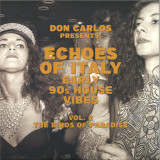
Various - ECHOES OF ITALY – THE BIRDS OF PARADISE – EARLY 90S HOUSE VIBES VOL.2 (2x12")

Googling “paradise house”, the first results to pop up are an endless list of European b&b’s with whitewashed lime façades, all of them promising “…an unmatched travel experience a few steps from the sea”. Next, a little further down, are the institutional websites of a few select semi-luxury retirement homes (no photos shown, but lots of stock images of smiling nurses with reassuring looks). To find the “paradise house” we’re after, we have to scroll even further down. Much further down.

It feels like yesterday, and at the same time it seems like a million years ago. The Eighties had just ended, and it was still unclear what to expect from the Nineties. Mobile phones that were not the size of a briefcase and did not cost as much as a car? A frightening economic crisis? The guitar-rock revival?! Certainly, the best place to observe that moment of transition was the dancefloor. Truly epochal transformations were happening there. From America, within a short distance one from the other, two revolutionary new musical styles had arrived: the first one sounded a bit like an “on a budget” version of the best Seventies disco-music – Philly sound made with a set of piano-bar keyboards! – the other was even more sparse, futuristic and extraterrestrial. It was a music with a quite distinct “physical” component, which at the same time, to be fully grasped, seemed to call for the knotty theories of certain French post-modern philosophers: Gilles Deleuze, Félix Guattari, Paul Virilio... Both those genres – we would learn shortly after – were born in the black communities of Chicago and Detroit, although listening to those vinyl 12” (often wrapped in generic white covers, and with little indication in the label) you could not easily guess whether behind them there was a black boy from somewhere in the Usa, or a girl from Berlin, or a pale kid from a Cornish coastal town.

Quickly, similar sounds began to show up from all corners of Europe. A thousand variations of the same intuition: leaner, less lean, happier, slightly less intoxicated, more broken, slower, faster, much faster... Boom! From the dancefloors – the London ones at least, whose chronicles we eagerly read every month in the pages of The Face and i-D – came tales of a new generation of clubbers who had completely stopped “dressing up” to go dancing; of hot tempered hooligans bursting into tears and hugging everyone under the strobe lights as the notes of Strings of Life rose up through the fumes of dry ice (certain “smiling” pills were also involved, sure). At this point, however, we must move on to Switzerland.

In Switzerland, in the quiet and diligent town of Lugano, between the 1980s and 1990s there was a club called “Morandi”. Its hot night was on Wednesdays, when the audience also came from Milan, Como, Varese and Zurich. Legend goes that, one night, none less than Prince and Sheila E were spotted hiding among the sofas, on a day-off of the Italian dates of the Nude Tour… The Wednesday resident and superstar was an Italian dj with an exotic name: Don Carlos. The soundtrack he devised was a mixture of Chicago, Detroit, the most progressive R&B and certain forgotten classics of old disco music: practically, what the Paradise Garage in New York might have sounded like had it not closed in 1987. In between, Don Carlos also managed to squeeze in some tracks he had worked on in his studio on Lago Maggiore. One in particular: a track that was rather slow compared to the BPM in fashion at the time, but which was a perfect bridge between house and R&B. The title was Alone: Don Carlos would explain years later that it had to be intended both in the English meaning of “by itself” and like the Italian word meaning “halo”. That wasn’t the only double entendre about the song, anyway. Its own very deep nature was, indeed, double. On the one hand, Alone was built around an angelic keyboard pattern and a romantic piano riff that took you straight to heaven; on the other, it showcased enough electronic squelches (plus a sax part that sounded like it had been dissolved by acid rain) to pigeonhole the tune into the “junk modernity” section, aka the hallmark of all the most innovative sounds of the time: music that sounded like it was hand-crafted from the scraps of glittering overground pop.

No one knows who was the first to call it “paradise house”, nor when it happened. Alternative definitions on the same topic one happened to hear included “ambient house”, “dream house”, “Mediterranean progressive”… but of course none were as good (and alluring) as “paradise house”. What is certain is that such inclination for sounds that were in equal measure angelic and neurotic, romantic and unaffective, quickly became the trademark of the second generation of Italian house. Music that seemed shyly equidistant from all the rhythmic and electronic revolutions that had happened up to that moment (“Music perfectly adept at going nowhere slowly” as noted by English journalist Craig McLean in a legendary field report for Blah Blah Blah magazine). Music that to a inattentive ear might have sounded as anonymous as a snapshot of a random group of passers-by at 10AM in the centre of any major city, but perfectly described the (slow) awakening in the real world after the universal love binge of the so-called Second Summer of Love.

For a brief but unforgettable season, in Italy “paradise house” was the official soundtrack of interminable weekends spent inside the car, darting from one club to another, cutting the peninsula from North to centre, from East to West coast in pursuit of the latest after-hours disco, trading kilometres per hour with beats per minute: practically, a new New Year’s Eve every Friday and Saturday night. This too was no small transformation, as well as a shock for an adult Italy that was encountering for the first time – thanks to its sons and daughters – the wild side of industrial modernity. The clubbers of the so-called “fuoriorario” scene were the balls gone mad in the pinball machine most feared by newspapers, magazines and TV pundits. What they did each and every weekend, apart from going crazy to the sound of the current white labels, was linking distant geographical points and non-places (thank you Marc Augé!) – old dance halls, farmhouses and business centres – transformed for one night into house music heaven. As Marco D’Eramo wrote in his 1995 essay on Chicago, Il maiale e il grattacielo: “Four-wheeled capitalism distorts our age-old image of the city, it allows the suburbs to be connected to each other, whereas before they were connected only by the centre (…) It makes possible a metropolitan area without a metropolis, without a city centre, without downtown. The periphery is no longer a periphery of any centre, but is self-centred”.

“Paradise house” perfectly understood all of this and turned it into a sort of cyber-blues that didn’t even need words, and unexpectedly brought back a drop of melancholic (post?)-humanity within a world that by then – as we would wholly realise in the decades to come – was fully inhuman and heartless. A world where we were all alone, and surrounded by a sinister yellowish halo, like a neon at the end of its life cycle. But, for one night at least, happy."

Auf Lager

Bei uns am Lager und sofort versandfertig

Unspecified Enemies - Romance in the Age of Adaptive Feedback

Unspecified Enemies, the project led by Louis Digital (Numbers, Counterattack, Arcola) present their debut album Romance in the Age of Adaptive Feedback.

Written and produced by Louis Digital, the album incorporates fragments of music data generated by long-time collaborator CiM (Ann Aimee, Delsin). Describing the title track, Louis Digital states:

“It’s the microelectronic sound of a city playing strange light games with itself, evoking bitcrushed desires and floating images, an urban phantasy stored on the broken circuits of an Ensoniq ASR-10.”

The origins of Romance in the Age of Adaptive Feedback trace back to 2006, when Louis Digital launched Diamond Sea, a series of events at London’s ICA that introduced the Unspecified Enemies project and a label called City of Quartz. The vision was to merge the hi-tech electronic textures of contemporary R&B with the sampling and sequencing techniques of pioneers like Anthony Shakir and Soundhack. However, the music was lost in time, and City of Quartz never released a single record.

Yet, the story took an unexpected turn. At one of these events, Spencer from Numbers received a CD containing early recordings. Years later, Numbers encouraged Louis Digital to reconstruct the lost music for an album. The result is a work resurrected from the past and reimagined for the future—retrieved in fragments from a broken Iomega Jazz SCSI Drive.

Expanding on the album’s themes, Louis Digital reflects:

“By the late ’90s the cinematic image of Los Angeles and the sound of Detroit techno had crystallised a new style of living in time and space. In 1997 Mike Davis — the political activist, urbanist, writer and historian of Los Angeles — suggested that it all had “something to do with a microelectronic aesthetic of very transient and decaying states”. It was a romantic vision — one where the city’s glass surfaces reflected a musical desire for futurity not yet dominated by data-driven corporate life. These were strange days to live through. This album evokes the embers of this fibre-optic moment, when urban revolution in an age of digital reification still felt possible.”

The album features full sleeve artwork and a poster designed by Ben Drury. In support of the release, an NTS show titled Romance and Reification will explore the cinematic and electronic music influences behind the album.

Auf Lager

Bei uns am Lager und sofort versandfertig

ARPANET - WIRELESS INTERNET (2002) 2x12"

Repress!

(Deluxe edition with printed inner sleeves + insert) Repress of this 2002 electro classic! Arpanet aka Dopplereffekt with nine classic tracks, a co-release in conjunction with Paris based Record Makers label,devoted to the revolutionary technologies of Japan's leading telecommunication company NTT DoCoMo.

Auf Lager

Bei uns am Lager und sofort versandfertig

Scerida - By Night

Four Flies Records is proud to present its brand new imprint Edizioni Della Notte, which expands the label's musical range. The sound of Edizioni Della Notte is a sound of twilight atmospheres and moonlit nights, traversing genres from disco-funk to soft rock, jazz-fusion and city pop. It's the music that creeps out of smoky nightclubs and car cassette radios, breaking the silence of empty streets and offering an escape from metropolitan reality into cosmic-exotic dreamlands.

Quite fittingly, the first official release on Edizioni Della Notte is called By Night. It's the debut EP of Scerida, a solo project of musician and singer-songwriter Daniela Resconi, and a perfect match for the sound that the new imprint intends to represent.

Its four tracks explore the idea of night as a time of ecstasy and torment, as a land of freedom and imagination but also of delusion, as an accomplice, a friend and an enemy described through feelings and mental states that range from expectation and euphoria to disillusionment and resignation.

Resconi, who hails from Brescia, northern Italy, formerly released music under the moniker Cara and as part of the duo The Loud Vice. Her new alias Scerida, which combines the French term chérie with the Spanish word querida, signals both a revolution and an evolution. "Scerida is a dive into the exotic side of my imagination, into mischevious thoughts, into a crazy night where I lost and found myself again," she explains. "She is still me, Daniela, but she keeps her eyes wide open on this restless, troubled world to write songs that try to ward off the horror vacui of everyday life."

By Night celebrates the dark hours as magical and mesmerizing, even when mysterious or dangerous. It evokes images and scenarios cinematically – a taxi passing by and fading into the distance, ice-cold Martinis during a party, whirlwinds of emotion, psychedelic sunrises and neon sunsets – through a stream of consciousness filled with noir-inflected pop, lo-fi vibes, slow hypnotic rhythms, suspended grooves and swelling atmospheres.

Auf Lager

Bei uns am Lager und sofort versandfertig

NO WAY BACK MAGAZINE - BETTER WAYS FORWARD THROUGH MUSIC AND SUBCULTURE STORIES, 1979-1994 - LEARNING FROM, NOT LONGING FOR

After all of the fun had - and, if we may brag a bit - the acclaim for NWB001, we're back with a follow-up.

So here's NWB002. Our start and end points shift this time (1979–1997 vs 1977-1989) but again the focus is on revolutionary moments in music and subculture.

We've got pieces from The Face, i-D, Time Out, Village Voice, Rolling Stone, Mixmag, The Observer and - a particularly big pleasure - Collusion magazine. We've got brilliant photography, too, documenting seminal afterdark moments. And we've put it all together with much love, craft and attention to detail.

This is material that lets us experience culture in its rawest form. In-the-moment and before endless layers of post-rationalisation have kicked in. Breakthrough events in dance music, hip-hop and pop – and parallel shifts in art, design and fashion. Inspirational, ground-level creativity and enterprise that set the scene(s) for subsequent decades.

We hope you enjoy reading NWB002 as much as we enjoyed bringing it together.

Inside No Way Back 002

Behind The Groove - the epic 1983 feature by Steven Harvey in David Toop's Collusion magazine, charting the NYC disco underground

Photographer Steve Eichner documenting the club kids scene at The Limelight, Palladium, Tunnel and Club USA

Year zero reporting as The Face's Sheryl Garratt visits Chicago in 1986, witnessing the emergent house sound

The Mudd Club - 'disco for punks' as Rolling Stone put it; the Lower East Side party which arguably spawned a thousand indie discos

In the 'socialist city' of Sheffield, meanwhile, Jon Savage heads for a night of sharp clothes and even sharper moves at Jive Turkey

Paul Morley writing in Time Out in 1988 on the tension materialising between glossy style mags and the the monochrome music press

The House That Rap Built - Village Voice celebrates the short but sweet glory years of hip-house

Mixmag in 1992 on the 'return of sex' to clubs like Roxy and the Sound Factory

Images and commentary from Eddie Otchere, rewinding to jungle's halcyon days

Kodwo Eshun reporting on jungle's full-throttle ascent for i-D in 1994

+ Editor’s notes, supporting commentary, playlists, and covers, spreads and imagery from original titles

ISSN - 2977-8530

vorbestellen24.04.2026

erscheint voraussichtlich am 24.04.2026

Braen / Peymont - Paese Sotto Inchiesta

At the end of the Sixties, the production of soundtracks for small and big classics of Italian cinema is now joined by another business which has proved to be less profitable but more creative and, in best case, free from the constraints imposed by clients on duty: the composition of music libraries. Almost all of the artists for the eighth art have finalized at least one or more music libraries. Names famous and not, old and young composers, real outsiders and meteors, usually hidden behind pseudonyms: this is the case, for example, of Braen and Peymont. The first needs no introduction, it was the one adopted by the former arranger, multi- instrumentalist, singer and composer Alessandro Alessandroni. The second is closely linked to the mysterious American composer, but resident in Italy, David Hoyt Kimball. The two are authors in different measure of an interesting album with an experimental background, “Paese Sotto Inchiesta” (1971), originally published by Flirt Records.

The titles of the tracks appear in connection with the socio-cultural climate of Italy after 1968 and can be relocated as a background for journalistic-like images. The latter is a hypothesis not supported by facts, but some titles seem to be referred to the perception of a subsisting economic backwardness of the southern regions compared to the other ones; to a situation of collective tension, thanks to the global revolutions; in addition to the new concerns with an ecological background. Overall, the seventeen tracks on the album are mostly 'dirty', characterized by an even atonal setting, with long repetitions in a noisy key, more fundamental reverbs and echoes for the different keyboard instruments. In a few words, abstract sounds, some guitar notes, echoes of Gruppo Di Improvvisazione Nuova Consonanza, flute melodies and proto- ambient intuitions. Composers like Alessandro Alessandroni and David Hoyt Kimball deserve to be rediscovered.

*Following the essence of the work, for this press, MPI release a 100% recycled vinyl that reduce waste, minimize environmental impact and support the planet*

nicht am Lager

Bestelle jetzt und wir bestellen den Artikel für dich beim Lieferanten.


Last In: vor 4 Monaten
E. Lundquist - Art Between Minds LP

LA-based composer/arranger E. Lundquist (aka Eric Borders) returns with ‘Art Between Minds’. Having cut his teeth in the LA hip-hop and beats scene and explored realms of cosmic-funk under previous monikers, E. Lundquist’s music displays a rich tapestry of influences including the cinematic & experimental jazz-infused library music that influenced his previous LP ‘Multiple Images’. Now he is back with another ample helping of his hallucinogenic sonics, utilizing a bevy of vintage gear to replicate that warm glow of ’70s jazz-funk. From the Fender Rhodes MKI to the ARP Odyssey, to the Mellotron, the keys and synths he employs on these tracks display a genuine appreciation for the groove-driven music of The ‘Me” Decade.

The album plays like the score to a cult classic B-movie. The sun-drenched haze of “Soliloquy” could easily be what you hear during the calm before the storm in a Blaxploitation flick and the laidback crawl of “Euphoria” seems ripped right out of a fuzzy ‘70s blue movie. But there is a certain sophistication here, like the way the horn section, slinky guitar, and trippy synths combine on “Escape” to sound like liquid one moment and like a summer breeze the next.

While E. Lundquist’s artistry will eventually take him to new plateaus of sound, where he is right now is undoubtedly a high watermark in his career. He has become a torchbearer for jazz-funk in a new jazz revolution, updating the sub-genre with his delicate balance of digital and analog elements that will easily appeal to fans of Kamaal Williams, Surprise Chef, BADBADNOTGOOD, Khurangbin, Robohands and similar.

nicht am Lager

Bestelle jetzt und wir bestellen den Artikel für dich beim Lieferanten.


Last In: vor 9 Monaten
Various - ECHOES OF ITALY - ARTISTS IN WONDERLAND – EARLY 90S HOUSE VIBES VOL.1 LP 2x12"

Volume 1 of this expertly curated project of 90s Italian House - put together by Don Carlos.

If Paradise was half as nice… by Fabio De Luca.

Googling “paradise house”, the first results to pop up are an endless list of European b&b’s with whitewashed lime façades, all of them promising “…an unmatched travel experience a few steps from the sea”. Next, a little further down, are the institutional websites of a few select semi-luxury retirement homes (no photos shown, but lots of stock images of smiling nurses with reassuring looks). To find the “paradise house” we’re after, we have to scroll even further down. Much further down.

It feels like yesterday, and at the same time it seems like a million years ago. The Eighties had just ended, and it was still unclear what to expect from the Nineties. Mobile phones that were not the size of a briefcase and did not cost as much as a car? A frightening economic crisis? The guitar-rock revival?! Certainly, the best place to observe that moment of transition was the dancefloor. Truly epochal transformations were happening there. From America, within a short distance one from the other, two revolutionary new musical styles had arrived: the first one sounded a bit like an “on a budget” version of the best Seventies disco-music – Philly sound made with a set of piano-bar keyboards! – the other was even more sparse, futuristic and extraterrestrial. It was a music with a quite distinct “physical” component, which at the same time, to be fully grasped, seemed to call for the knotty theories of certain French post-modern philosophers: Gilles Deleuze, Félix Guattari, Paul Virilio... Both those genres – we would learn shortly after – were born in the black communities of Chicago and Detroit, although listening to those vinyl 12” (often wrapped in generic white covers, and with little indication in the label) you could not easily guess whether behind them there was a black boy from somewhere in the Usa, or a girl from Berlin, or a pale kid from a Cornish coastal town.

Quickly, similar sounds began to show up from all corners of Europe. A thousand variations of the same intuition: leaner, less lean, happier, slightly less intoxicated, more broken, slower, faster, much faster... Boom! From the dancefloors – the London ones at least, whose chronicles we eagerly read every month in the pages of The Face and i-D – came tales of a new generation of clubbers who had completely stopped “dressing up” to go dancing; of hot tempered hooligans bursting into tears and hugging everyone under the strobe lights as the notes of Strings of Life rose up through the fumes of dry ice (certain “smiling” pills were also involved, sure). At this point, however, we must move on to Switzerland.

In Switzerland, in the quiet and diligent town of Lugano, between the 1980s and 1990s there was a club called “Morandi”. Its hot night was on Wednesdays, when the audience also came from Milan, Como, Varese and Zurich. Legend goes that, one night, none less than Prince and Sheila E were spotted hiding among the sofas, on a day-off of the Italian dates of the Nude Tour… The Wednesday resident and superstar was an Italian dj with an exotic name: Don Carlos. The soundtrack he devised was a mixture of Chicago, Detroit, the most progressive R&B and certain forgotten classics of old disco music: practically, what the Paradise Garage in New York might have sounded like had it not closed in 1987. In between, Don Carlos also managed to squeeze in some tracks he had worked on in his studio on Lago Maggiore. One in particular: a track that was rather slow compared to the BPM in fashion at the time, but which was a perfect bridge between house and R&B. The title was Alone: Don Carlos would explain years later that it had to be intended both in the English meaning of “by itself” and like the Italian word meaning “halo”. That wasn’t the only double entendre about the song, anyway. Its own very deep nature was, indeed, double. On the one hand, Alone was built around an angelic keyboard pattern and a romantic piano riff that took you straight to heaven; on the other, it showcased enough electronic squelches (plus a sax part that sounded like it had been dissolved by acid rain) to pigeonhole the tune into the “junk modernity” section, aka the hallmark of all the most innovative sounds of the time: music that sounded like it was hand-crafted from the scraps of glittering overground pop.

No one knows who was the first to call it “paradise house”, nor when it happened. Alternative definitions on the same topic one happened to hear included “ambient house”, “dream house”, “Mediterranean progressive”… but of course none were as good (and alluring) as “paradise house”. What is certain is that such inclination for sounds that were in equal measure angelic and neurotic, romantic and unaffective, quickly became the trademark of the second generation of Italian house. Music that seemed shyly equidistant from all the rhythmic and electronic revolutions that had happened up to that moment (“Music perfectly adept at going nowhere slowly” as noted by English journalist Craig McLean in a legendary field report for Blah Blah Blah magazine). Music that to a inattentive ear might have sounded as anonymous as a snapshot of a random group of passers-by at 10AM in the centre of any major city, but perfectly described the (slow) awakening in the real world after the universal love binge of the so-called Second Summer of Love.

For a brief but unforgettable season, in Italy “paradise house” was the official soundtrack of interminable weekends spent inside the car, darting from one club to another, cutting the peninsula from North to centre, from East to West coast in pursuit of the latest after-hours disco, trading kilometres per hour with beats per minute: practically, a new New Year’s Eve every Friday and Saturday night. This too was no small transformation, as well as a shock for an adult Italy that was encountering for the first time – thanks to its sons and daughters – the wild side of industrial modernity. The clubbers of the so-called “fuoriorario” scene were the balls gone mad in the pinball machine most feared by newspapers, magazines and TV pundits. What they did each and every weekend, apart from going crazy to the sound of the current white labels, was linking distant geographical points and non-places (thank you Marc Augé!) – old dance halls, farmhouses and business centres – transformed for one night into house music heaven. As Marco D’Eramo wrote in his 1995 essay on Chicago, Il maiale e il grattacielo: “Four-wheeled capitalism distorts our age-old image of the city, it allows the suburbs to be connected to each other, whereas before they were connected only by the centre (…) It makes possible a metropolitan area without a metropolis, without a city centre, without downtown. The periphery is no longer a periphery of any centre, but is self-centred”.

“Paradise house” perfectly understood all of this and turned it into a sort of cyber-blues that didn’t even need words, and unexpectedly brought back a drop of melancholic (post?)-humanity within a world that by then – as we would wholly realise in the decades to come – was fully inhuman and heartless. A world where we were all alone, and surrounded by a sinister yellowish halo, like a neon at the end of its life cycle. But, for one night at least, happy.

nicht am Lager

Bestelle jetzt und wir bestellen den Artikel für dich beim Lieferanten.


Last In: vor 28 Tagen
Ian Carr’s Nucleus - Roots

Ian Carr’s Nucleus

Roots

12inchBEWITH102LP
Be With Records
20.09.2024

What an unbelievable record. From the wild cover to the iconic breakbeats, Roots from Ian Carr’s Nucleus is one of the dopest albums we know. This is seriously thick, funky-prog jazz-rock heaven. Originally released on Vertigo in 1973, other than a couple of versions at the time for other territories, Roots was never re-pressed since so it’s gone on to become another one of those impossible to find records.

Maybe it was a little too out there for the time, but it’s aged very, very well indeed and this Be With re-issue, re-mastered from the original analogue tapes, shows off just why this deserves to be back in press.

Genius trumpeter and visionary composer Ian Carr was one of the most respected British musicians of his era. He was a true pioneer and saw the potential in fusing the worlds of jazz with rock, just as Miles Davis and The Tony Williams Lifetime did in the US. In late 1969, following the demise of the Rendell-Carr quintet, and tiring of British jazz, Carr assembled the legendary Nucleus. Regarding music as a continuous process, Nucleus refused to “recognise rigid boundaries” and worked on delivering what they saw as a “total musical experience”. We can get behind that.

Under bandleader Carr, Nucleus existed as a fluid line-up of inventive, skilled musicians. This constant evolution and revolution was all part of the continuous musical exploration and discovery that took jazz to new levels.

Working together with producer Fritz Fryer and engineer Roger Wake, the seven compositions by Carr, Brian Smith and Dave MacRae that make up Roots flirt with perfection, and Nucleus at that time made up of the cream of 1970s UK jazz with Brian Smith on tenor saxophones and flutes, Dave MacRae on piano and electric piano, Jocelyn Pitchen on guitar, Roger Sutton on bass, both Clive Thacker and Aureo De Souza on drums and percussion, Joy Yates delivering the vocals and of course Carr on trumpet.

The spellbinding title track immediately renders the album indispensable. Riding the illest of loping breakbeats, “Roots” is low-slung, doped-out heist-funk. An absolute monster. If it sounds familiar then that’s likely down to it being sampled by Madlib for Lootpack and Quasimoto’s “Loop Digga”, as well as by a whole host of beat manipulators. “Roots” conjures prime instrumental hip-hop / beat music, only 20 years ahead of its time. Truly, these are the roots. Through sinuous bass, twinkling keys and a hypnotic guitar riff, a smoky brass motif weaves its way into a gloriously deep haze around Carr’s solos. “Roots” is over 9 minutes long, but there’s not a single wasted second, not surprising given that this is a condensed version of an originally 40 minute long commissioned composition.

The soothing vocal fusion delight of “Images” follows. Meticulously constructed, with gorgeous flute work from Brian Smith, with Joy Yates’ silky vocals and Dave MacRae’s Rhodes never sounding better. The cool, driving “Caliban” closes out the first side. Originally the third movement in a four part commission to celebrate Shakespeare’s birthday it stands up on its own, all robust rhythms and blended brass. Keyboard colour and Carr’s trumpet are splashed across the funk drums and basslines (and there’s even some bamboo flute). This really is fusion: the elements of jazz and rock coming together in beautifully synthesis.

Side two opens in riotous fashion with the short, thrilling samba of “Wapatiti”. Next up, “Capricorn” forms a smoothed-out, jazzy constellation. Mellow and dreamy, its twinkling percussion and languid horns slowly build the vibe before head-nod drums and a killer bassline enter the fray. With a distinct heaviness that Black Sabbath would’ve envied, “Odokamona” is a venomous slice of riff-soaked jazz metal (yes, you read that right), elevated by Carr’s wah-wah horns.

The album closes with MacRae’s exceptionally cosmic “Southern Roots and Celebration”. Very much in conversation with Weather Report, it opens as a languorous, spiritual jazz of chiming keys and serene guitar that turns slowly, gorgeously into a mid-paced, brass-laced banger. It’s another sure-fire party starter and the sound of the band having a righteous blast, building an ecstatic chaos that ends with Yates screaming.

And of course we need to talk about Keith Davis’ cover for Roots. Perhaps the coolest record cover of all time? Certainly one of the most bonkers. Just your run-of-the-mill high-gloss, acid-tinged airbrush dystopian/utopian living-room party scene. Consider this your chemical flashback trigger warning.

Front-and-centre the hip-to-death green robot holds court with their giant ball of yellow barbwire wool, hooked up to… something(?) being teased out from under the stairs (probably best not to ask). A thoroughly zoned-out, long-legged Pop Art party-goer lounges half-plugged in to the painting behind her as a pair of legs flail into shot from the the top of the stairs opposite. We won’t even begin to guess what the chap’s up to in the middle, but the view out of the windows is rather nice, and someone’s already got the hoover out ready to tidy up. All of the Nucleus sleeves are something special, but this particular one? Crikey.

This Be With edition of Roots has been re-mastered from the original Vertigo master tapes, Simon Francis’ mastering working together with Pete Norman’s cut to weave their usual magic with these wonderful recordings. The crazy cover has been restored at Be With HQ as the finishing touch to this long overdue re-issue.

nicht am Lager

Bestelle jetzt und wir bestellen den Artikel für dich beim Lieferanten.


Last In: vor 4 Jahren
E. Lundquist - Art Between Minds LP

LA-based composer/arranger E. Lundquist (aka Eric Borders) returns with ‘Art Between Minds’. Having cut his teeth in the LA hip-hop and beats scene and explored realms of cosmic-funk under previous monikers, E. Lundquist’s music displays a rich tapestry of influences including the cinematic & experimental jazz-infused library music that influenced his previous LP ‘Multiple Images’. Now he is back with another ample helping of his hallucinogenic sonics, utilizing a bevy of vintage gear to replicate that warm glow of ’70s jazz-funk. From the Fender Rhodes MKI to the ARP Odyssey, to the Mellotron, the keys and synths he employs on these tracks display a genuine appreciation for the groove-driven music of The ‘Me” Decade.

The album plays like the score to a cult classic B-movie. The sun-drenched haze of “Soliloquy” could easily be what you hear during the calm before the storm in a Blaxploitation flick and the laidback crawl of “Euphoria” seems ripped right out of a fuzzy ‘70s blue movie. But there is a certain sophistication here, like the way the horn section, slinky guitar, and trippy synths combine on “Escape” to sound like liquid one moment and like a summer breeze the next.

While E. Lundquist’s artistry will eventually take him to new plateaus of sound, where he is right now is undoubtedly a high watermark in his career. He has become a torchbearer for jazz-funk in a new jazz revolution, updating the sub-genre with his delicate balance of digital and analog elements that will easily appeal to fans of Kamaal Williams, Surprise Chef, BADBADNOTGOOD, Khurangbin, Robohands and similar.

vorbestellen19.01.2024

erscheint voraussichtlich am 19.01.2024

Various - Produced By Tony Visconti LP 2x12"
  • 1: The Tickle – Subway (Smokey Pokey World)
  • 2: The Move – Mist On A Monday Morning
  • 3: Tyrannosaurus Rex – Debora
  • 4: Junior's Eyes – Black Snake
  • 5: Procol Harum – Magdalene (My Regal Zonophone)
  • 6: The Iveys – Maybe Tomorrow
  • 7: Tucker Zimmerman – Bird Lives
  • 8: Gentle Giant – Pantagruel's Nativity
  • Side B
  • 1: Strawbs – Witchwood
  • 2: Mary Hopkin – Streets Of London
  • 3: T. Rex – Children Of The Revolution
  • 4: Sparks – Under The Table With Her
  • 5: Thin Lizzy – Dancing In The Moonlight (It's Caught Me In Its Spotlight)
  • 6: Hazel O'connor – Will You?
  • 7: The Boomtown Rats – Fall Down
  • 8: Dexys Midnight Runners & Kevin Rowland – Show Me
  • LP 2:
  • Side A
  • 1: Modern Romance – Best Years Of Our Lives
  • 2: Altered Images – Bring Me Closer
  • 3: Difford & Tilbrook – The Apple Tree
  • 4: Adam Ant – Apollo 9
  • 5: U2 – A Sort Of Homecoming
  • Side B
  • 1: Luscious Jackson – Fantastic Fabulous
  • 2: The Dandy Warhols – Hit Rock Bottom
  • 3: Manic Street Preachers – Cardiff Afterlife
  • 4: Kashmir – Kalifornia
  • 5: Kristeen Young – Pearl Of A Girl
  • 6: Stephen Emmer – Untouchable (Feat. Glenn Gregory)
  • 7: The Good, The Bad & The Queen – Lady Boston
  • 6: The Moody Blues – Your Wildest Dreams
  • 7: The Seahorses – Blinded By The Sun

Demon Records is proud to present ‘Produced by Tony Visconti’, a new definitive retrospective compilation assembled with the assistance of legendary record producer Tony Visconti.
“This boxset covers five and a half decades of my efforts in the art of making iconic recordings. Some of it is familiar and some will have a eureka moment, ‘I didn’t know Visconti produced that one!’
I am honoured that Demon Records took on this enormous task.”
– Tony Visconti

Often described as one of the most important
producers in rock, Tony Visconti has helped create
countless classic musical moments. His work can be
heard on celebrated albums by artists such as T. Rex,
Procol Harum, The Moody Blues and Thin Lizzy to
name but a few.
• This new collection features 30 tracks personally
curated by Visconti, gathering together some of his
favourite production work from across his career.
• Includes tracks by T. Rex, Sparks, Thin Lizzy, U2,
Dexys Midnight Runners, Gentle Giant, The
Boomtown Rats, Manic Street Preachers, The Good,
The Bad & The Queen, and many more.
• Pressed on 2 x 140g LPs, mastered by Phil Kinrade at
AIR Mastering, approved by Tony Visconti. Artwork
designed by Grammy-winning creative studio
Barnbrook.
• Includes a 12-page booklet with previously unseen
photographs, and extensive track-by-track liner
notes by Mojo writer Mark Paytress based on new
interviews with Tony Visconti.


x 5. U2 – A Sort Of Homecoming Live

vorbestellen20.10.2023

erscheint voraussichtlich am 20.10.2023

T. Rex - Children of the Revolution E.P

• Strictly Limited to 450 copies of each format • All of these versions recorded 3rd August 1972 at Strawberry Studios, Chateau d’Hérouville, France and are different recordings to those released at the time. • Images on the picture disc taken from ‘top of the pops’ performance of children of the revolution including the rehearsal • Image on the picture sleeve is backstage at ‘top of the pops’ for the recording of children of the revolution • These are the very last in the highly successful series of ‘alternative singles’ • Taken from returned tapes to the Bolan family with all royalties going to The Light of Love Foundation for the Marc Bolan School of Music & FilmA

nicht am Lager

Bestelle jetzt und wir bestellen den Artikel für dich beim Lieferanten.


Last In: vor 4 Jahren
T. Rex - Children of the Revolution E.P

• Strictly Limited to 450 copies of each format • All of these versions recorded 3rd August 1972 at Strawberry Studios, Chateau d’Hérouville, France and are different recordings to those released at the time. • Images on the picture disc taken from ‘top of the pops’ performance of children of the revolution including the rehearsal • Image on the picture sleeve is backstage at ‘top of the pops’ for the recording of children of the revolution • These are the very last in the highly successful series of ‘alternative singles’ • Taken from returned tapes to the Bolan family with all royalties going to The Light of Love Foundation for the Marc Bolan School of Music & FilmA

vorbestellen17.12.2021

erscheint voraussichtlich am 17.12.2021

Al Quetz - Habanologia 2x12"

Al Quetz

Habanologia 2x12"

2x12inchSTILL006LP
Still Muzik
15.11.2021

You have to know how to move away from the rich, strong and noisy streets, if you want to discover another Havana. A Havana far from the tourist circuits and preconceived images. A Havana where one discovers bucolic, but hard and stripped too after slow journeys in the crowded buses, a Havana with which Al Quetz maintains a passionate history since more than fourteen years.
Installed in one of those neighborhoods that can only be reached by going deeper into the alleys, from the open window of the studio comes the sound of banging drums and thumping bass. The sound reaches the streets on which the day rises.
The place wakes up in a growing tumult, with some rare engines coughing, conversations under the windows, songs of the street vendors , an urban ballet sets up as the sun darts its rays.
Far from the musical clichés with percussions and horns, Cuba is an island bombarded with influences that one discovers.
An island which vibrated for the jazz, the soul, the psychedelic rock , from the waves coming from the Caribbean to those of the bulky neighboring ogre.
A musical flowering as varied as abundant that the glorious post-revolutionary label Areito has on thousands of recordings,
and that Al Quetz has designated as the sole source of his samples to compose Habanologia.
From the ambiences that punctuate the local daily life caught by his samplers, he let the melancholy infiltrate his hip hop beats, the nostalgia melting in the depths of his grooves. Nostalgia in the Cuban air, even during moments of intense laughter, which never totally disappears.
Habanologia restores these moments when the song of the birds has extinguished those of the cars. Where, sitting on a doorstep, we comment on the life of the neighborhood, we watch the women's swaying at eye level. The whole day if necessary, the coffee at one peso, after a certain hour, which leaves its place to the Planchao rum. Wandering through its streets where a chance encounter can itself bring others and lead to the essence of the habanera life. From Regla, after a short trip on the bus-boat that crosses the bay, savor the end of the day, observe the capital from afar, let the nocturnal insects ensure some arrangements and drift towards mysterious horizons, bringing to the contemplation of the place and the moment.
A flute, a keyboard, percussions or a voice. Al Quetz also invited his friends from the island or elsewhere to decorate his productions with their live touch. To share with him this Havana for which he covered his tracks, mixed times and distorted space-time to make it timeless.
To write with Habanalogia, a declaration of love to the Cuban capital, to make Havana, His Havana.

nicht am Lager

Bestelle jetzt und wir bestellen den Artikel für dich beim Lieferanten.


Last In: vor 4 Jahren
The Durutti Column - Circuses and Bread 2x12"

Clear / Orange Vinyl
Factory Benelux presents a remastered 2xLP coloured vinyl edition of Circuses and Bread, the seventh studio album by Manchester ensemble The Durutti Column. Originally released by Factory Benelux and Factory in 1986, the original 9 tracks have now been expanded with 6 bonus pieces.

The cover art retains the original design by 8vo. The remastered limited edition CLEAR+ORANGE vinyl set is housed in gatefold sleeve, with liner notes and rare band images. A CD version is also available (FBN 154 CD).

Self-produced by Vini Reilly at Strawberry and Revolution studios, the album saw Durutti playing as a quartet, with Reilly on guitar, vocals and keyboards, Bruce Mitchell in drums and percussion, John Metcalfe (viola) and Tim Kellett (trumpet).

‘The music ends up being very simple,’ Vini told NME. ‘People can dismiss it as being very simplistic, easy listening or whatever. It’s very honest, it’s very personal. People say it’s ambient, and it’s like Eno. I don’t like that, because the music’s made to be listened to, it’s not wallpaper.’

Of extended piece Blind Elevator Girl – Osaka, Vini adds: ‘The music really writes itself. For example, we’re in Osaka, in Japan, getting in this elevator. It’s very crowded with all these Japanese businessmen talking about distribution deals, and going on and on. On this lift was a beautiful Japanese girl, in an immaculate uniform. Each floor we arrived at, she’s starting talking Japanese, obviously saying what was on each floor. We went higher and higher, and finally we get to the top. And then, sort of walking out of the elevator, I suddenly realised she was blind... It got to me, this girl. It was incredible. So maybe a day later, I was thinking about that, and the whole tune came out. And every single piece of music is like that.’

Bonus tracks include Italian-only EP Greetings Three, scarce compilation track The Aftermath, and a previously unreleased working version of 1987 single Our Lady of the Angels produced by the late Stuart ‘Jammer’ James.

nicht am Lager

Bestelle jetzt und wir bestellen den Artikel für dich beim Lieferanten.


Last In: vor 4 Jahren
HAROLD FALTERMEYER - THE RUNNING MAN (ORIGINAL MOTION PICTURE SOUNDTRACK)
 
31

The Running Man’, was composed by Harold Faltermeyer (Beverly Hills Cop, Top Gun, Cop Out, and the upcoming film Top Gun, Maverick).

The original (1987) 17 track album has been expanded to 35 tracks for this deluxe edition, which includes additional music and unreleased and alternate cues. The album was remastered by Chas Ferry from the original Paramount Pictures sources. The 2 LP gatefold package features original artwork created by Florian Mihr and includes images from the film and extensive liner notes by Daniel Schweiger on the inner sleeves.

In the year 2019, America is a totalitarian state where the favorite television program is The Running Man - a game show in which prisoners must run to freedom to avoid a brutal death. Having been made a scapegoat by the government, an imprisoned Ben Richards (Arnold Schwarzenegger) has the opportunity to make it back to the outside again by being a contestant on the deadly show, although the twisted host, Damon Killian (Richard Dawson) has no intention of letting him escape.

nicht am Lager

Bestelle jetzt und wir bestellen den Artikel für dich beim Lieferanten.


Last In: vor 5 Jahren
The Last Poets - Understand What Dub Is

Last year saw The Last Poets celebrate their 50-year anniversary with the righteous, politically-charged poetic record, "Understand What Black Is". Now to continue the party, Brighton production-maestro Prince Fatty has reworked the album with a fresh twist and blend of smooth, dub-delights. Set to land on the 29th March, the revolution marches on - this is "Understand What Dub Is".

After Prince Fatty's involvement in the production of the original project, he was the perfect person to help update the record with five decades of experience for a new audience to enjoy. The ten tracks of "Understand What Black Is" depict a relevant, historical philosophy of identity and race that has followed The Poets over the last 50 years. Since the origins of the civil rights movements back in the late 60's, Abiodun Oyewole and Umar Bin Hassan (two of the longest-standing group members) have provided social commentaries and a voice to African-American consciousness that has now been heard on a global scale.

Their raps, exploitations and insights quickly evolved into the origins of hip-hop in Harlem, New York back in 1968, and now in 2019 they continue to voice their dedication to the cause with the backing of slick rock-steady infused beats to keep things moving. Having had their work sampled by the likes of NWA, Dr Dre, Kanye West, Snoop Dogg and countless others is just a testament to the timeless sounds and prophecy they have created, and now Prince Fatty has stepped up to put his stamp on it.

Prince Fatty's ever-reliable work gives "Understand What Black Is" another lease of life as he maintains an undeniably slick groove throughout. Both therapeutic and warm, the soulful rhythms of "Understand What Dub Is" provide the perfect platform for The Last Poets to delve into everything from Trump's inauguration, nods to Biggie Smalls and respect to Prince. The calm, collective and downright thought-provoking words go hand-in-hand with the roots-driven reggae medleys with ease - this is dub in its rawest form.

Not only do these songs explore personal struggles and individual endeavours, they also represent a collective of deprived aspects of humanity and socialism, that perhaps now need to be pointed out more than ever. Although there is a variation of sound, the overlying topics remain a constant - it is time to "Understand What Black Is" once more.

nicht am Lager

Bestelle jetzt und wir bestellen den Artikel für dich beim Lieferanten.


Last In: vor 7 Jahren
The Last Poets - Understand What Black Is

On The 50th Anniversary Of The Band's Inception At An Event In Harlem, Ny To Commemorate Malcolm X's Birthday On 19 May 1968, Influential Spoken Word Artists, Poets And Commentators The Last Poets Are Set To Make A Glorious And Relevant Return With Their First Album In Over 20 Years, 'understand What Black Is'.

Produced By Ben Lamdin (nostaglia 77) And Brighton Legend Prince Fatty, Whose Speciality Is Traditional Reggae And Dub Production's, 'understand What Black Is' Is A Ten-track Album Which Speaks Of A Revolutionary Struggle Defined By Both Race And Identity, That Has Never Sounded More Relevant. Released On Studio Rockers, There Will Also Be An Accompanying Single Featuring Remixes Of The Title Track "understand What Black Is" By Mala (south London Collective Digital Mystikz) And Uk Dance Music Innovators Dego And Kaidi.

Since The Initial Line-up Of Dahveed Nelson, Gylan Kain And Felipe Luciano Formed In East Harlem's Marcus Garvey Park, The Last Poets Have Produced Under Various Guises Over The Subsequent Years. However, It Was Their Seminal Output, Namely 1970's 'the Last Poets' Under Both Umar Bin Hassan And Abiodun Oyewole That Secured Their Legacy, Becoming One Of The Most Important Influences In Early Hip Hop.

Throughout The Last 20 Years, The Band Have Remained Largely On Hiatus. But Their Influence Could Still Be Felt With Their Tracks Being Sampled By The Notorious B.i.g, Nwa, A Tribe Called Quest, Dr.dre And Snoop Dogg. Umar Has Recorded Various Solo Albums And Featured On Common And Kanye West's Grammy Nominated 'the Corner'. Abiodun Appeared On The Red Hot Organization's Album, Stolen Moments Which Was Named "album Of The Year" By Time. He Also Conducts Weekly Open House Poetry Readings, Where He Constructively Critiques Upcoming Poets, Helping To Nurture Them. He Has Also Conducted Classes At Columbia University, Where He Teaches Creative Writing.

The Inauguration Of Donald Trump As Us President In 2016 Inspired Hassan And Oyewole To Resurrect The Group To Create A Brand New Record, Modern And Edgy, And Deeply Relevant And Reflective Of Our Times.

Tracks On 'understand What Black Is' Include 'how Many Bullets', Which Bridles With Defiance As Oyewole Works Through A Litany Of Injustices Suffered By Black People In The Us: " You've Tried

To Blow My Brains Out With Bigotry, Chopped Off My Wings, So I Couldn't Fly Free, And Dared Me To Be Me, Took My Drum, Broke My Hands, Yanked My Roots Right Up Out Of The Land, And Riddled My Soul With Jesus" 'what I Want To See' Describes A Utopia - A Refuge From Hurt And Those Who'd Make "our Vision Blurred, And Our Faith Obscure", Whilst The Title Track 'understand What Black Is' Aims To Transcend Ethnicity: "understand What Black Is....it's The Source From Which All Things Come...black Is A Hero, Not A Villain."

The Album Even Takes Reference From Prince's 2003 Album Of Instrumentals, 'news', Which Hassan Drew Comparisons From With His Own Childhood Experiences: "that Poem Took Me About A Year To Write....i Just Kept Writing And Writing But Not Getting Too Far And Then I Heard That Album And The Musicianship Was Amazing. I Was Left Wondering If It Was Jazz, Classical, Rock Or Maybe Something New But All Those Images That I Write About Came To Me From Listening To That Album. I Loved Prince In That Movie Purple Rain Because My Father Was A Talented Musician But He Was Into Brutalising Mama At Times And In The Movie There's A Jerome And My Name Is Jerome, So It Was Like He Was Telling My Life Story As Well."

The Album Acts As A Body Of Work Between Individual Members Each Speaking Of Their Own Personal Journeys, But Feeding Into The Much Larger Narrative Of Struggle And Oppression, Alongside A Fervent Hunger For Social Change. These Are Struggles And Tests Of Personal Resolve That Have Directly Shaped And Moulded The Bands' Unique Sound Over The Course Of An Impressive 50 Years, And Their Powerful And Influential Commentary Remains As Relevant As Ever.

nicht am Lager

Bestelle jetzt und wir bestellen den Artikel für dich beim Lieferanten.


Last In: vor 8 Jahren
Boxia - Education Ep

Boxia

Education Ep

12inchDC186
Drumcode
17.05.2018

One of the most exciting artists to emerge in techno circles in recent times, Drumcode is excited to present the label's first EP from Boxia. Over the last 12 months the UK artist has impressed with his classy take on techno that mines two decades of rave.

Last year's 'Colour Sequence' EP on We Are The Brave marked one of 2017's standout releases, before being tapped by Maya Jane Coles to remix a track from her latest album 'Take Flight', while B.Traits also shone the spotlight on him for a Future 12 residency on BBC Radio 1 throughout September.

Boxia first came into contact with Adam Beyer when he opened the Car Park at Tobacco Dock for LWE's NYD event in 2016, and since then the pair have spoken regularly sharing similar tastes in music and DJing. He dropped his first cut on DC during the summer of '16, with 'Revolution' that featured on A-Sides Vol. 5, making him primed and ready for his first full length EP in 2018.

The four-track work lives up to his growing reputation for crafting beautiful, nuanced and ultimately very powerful electronic music. The EP opens with 'No World Order', a deep transcendental slice of techno propelled by a wicked acid line and vocal that leads to a galloping finish.

'Only Human' is drenched in atmosphere and old skool wonder, a brilliant composition of punchy multi-layered drum work, catchy synth lines and cutting acid that reveals its tender side with emotive broken beat interludes. 'Unreal' is a big peak time belter, raising the tempo to sweaty palms level, as a propulsion of acid and a memorable riff fill the techno sphere.

The title track 'Ethereal Education' closes out the work, a beautiful chord-driven vocal cut that evokes images of the classic dance that characterised Boxia's earlier years and makes a fitting outro to this outstanding EP.

nicht am Lager

Bestelle jetzt und wir bestellen den Artikel für dich beim Lieferanten.


Last In: vor 19 Monaten
  • 1
Artikel pro Seite:
N/ABPM
Vinyl

