Search:ice project

Styles
All
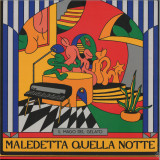
Il Mago Del Gelato - Maledetta Quella Notte

“Maledetta Quella Notte” is the first EP by Il Mago del Gelato, a new band from Milan (IT) with a strong Mediterranean imprint.

This first release runs through funk, afrobeat and jazz, where all the different souls that make up the project converge and blend in a perfect balance.

The EP ranges between more energetic moments, strongly characterized by Afro-beat and Funk influences to introspective atmospheres, where the reminiscence of a warm, sensual jazz rings out loud.

All held together by a full sound, the unique and recognizable mark of the Il Mago del Gelato: vocoder, percussion, 80's synthesizers, roots guitars and a rhythmic section of drum and bass which drags you in a wild and sweaty dance.

Before being a record product, Maledetta Quella Notte is a project human, in which the concept of union, exchange, positive vibes is summarized in six tracks with taste of your favorite ice cream.

stock from29.05.2026


Last In: 4 months ago
King Canyon - King Canyon

King Canyon

King Canyon

12inchMR133
Mixto Music
06.10.2023

Eric Krasno is a two-time GRAMMY winning guitarist, musician and producer best known for his work with Soulive, Lettuce, Tedeschi Trucks Band & Pretty Lights. Krasno has been nominated for a GRAMMY a total of seven times for Best Blues Album, Best Contemporary Blues, Best R&B, and Best Electronic Album.

Otis McDonald is a producer/multi-instrumentalist best known for his copyright free music released exclusively through the YouTube audio library, amassing over 5 million downloads and over 25 million streams.

Mike Chiavaro is a Brooklyn based electric and upright bass player with an impressive history.

Combined they form King Canyon, blending their unique styles into an infectious groove filled project with healthy doses of R&B/Soul and funk. The vibe will resonate with fans of Khruangbin, Bobby Caldwell, Allman Brothers, Soulive, Lettuce, El Michels Affair, Unknown Mortal Orchestra, Menahan Street Band, Durand Jones and the Indications, and Son Little (who's featured on one of the tracks).

In the perfect quarantine story the trio forged a relationship and has yet to meet in person. In April of 2020 in the midst of quarantine, Eric Krasno came across Otis McDonald’s music on Instagram and immediately became a fan. Months later, McDonald who had been working on music with his longtime friend, Mike Chiavaro, enlisted Krasno to add in some guitar to the mix and before they knew it, the trio had an album's worth of material and thus King Canyon was born.

The guys have still yet to meet in person, but despite this, the grooves are insatiable. The writing and feel are unlike any other projects these musicians have been involved with previously.

pre-order now06.10.2023

expected to be published on 06.10.2023

Metro Riders - Lost In Reality LP

A pungent ooze emanates from the subway. As a sticky drum machine sequence rolls out like thick dark fog, ice cold synth swirls rise from the depths.

Since the debut album Europe By Night, one of the main references associated with Henrik Stelzer and his Metro Riders project has been that of cinema, and particularly the European genre films of the 1980s. With its seedy subject matters manifesting both in visual style and music, the vibe of that era has crystallized over time. Passed down to us from deteriorating video cassettes, it became an invaluable key to decoding our present day reality.

And this is true for this album as well; Stelzer does not hide the fact that he builds heavily on that vibe; referencing it through track titles and utilizing a particular recording setup consisting of a Fostex and a reel to reel in order to achieve and recreate the feeling of those soundtracks — as heard on magnetic tape rather than vinyl.

The motion picture soundtrack as an arbitrary genre definition becomes, in the hands of Stelzer, a pair of X-ray specs for him to envision a kind of music that deals in grains and contrasts rath- er than hooks and choruses. And like Roddy Piper in John Carpenter's 1988 film They Live, he hands those glasses over for us to see the true face of our times.

On Lost In Reality Metro Riders maps out an emotional geography of the cities at night, wherein the cinematic haze becomes a tool by which we can view the cities with new eyes. Not steering away from the darker alleys nor the harsh realities of modern day politics masquerading as progress. Yet escapism, in the end, seems the only viable option. But not as an endgame, but rather a stepping stone for building a new vocabulary for an utopian language.

pre-order now01.10.2023

expected to be published on 01.10.2023

Slum Village - Fantastic Vol. 2 LP (2x12")

The contributions of the late Detroit producer James DeWitt Yancey -better known to the world as J Dilla- to the world of hip-hop can't be overstated, and nowhere is his legacy more apparent than his work as a member of Slum Village. A founding member of the trio, (Alongside rappers T3 and Baatin) Dilla provided the group's distinctly esoteric, free-wheeling sound, built around winding basslines, quirky drumbeats, subtle low-end frequencies, and classic jazz & soul samples. Against the backdrop of Dilla's rich production, T3 and Baatin's free-flowing style of rhyming would also earn wide critical praise, leading to comparisons as the successors to A Tribe Called Quest. (A label they themselves have rejected.) After the success of Slum's 1997 studio debut, Fan-Tas-Tic Vol. 1, the group went to work on their follow up. Though the project was completed in '98, label turmoil kept the project on ice until 2000. By the time Fantastic Volume II hit Dilla was well on his way to his status as a hip hop legend having produced cuts for Common, Busta Rhymes, Erykah Badu, A Tribe Called Quest and many more. Later works from Slum Village may have had more of an impact sales-wise (in the immediate) but Fantastic Vol. 2 had fans and many critics saying that Slum Village, and Dilla in particular, may single-handedly save rap music.' Perhaps that statement is hyperbole but many consider Fantastic Volume II to be Slum Village's finest work ever to this day. Ne'Astra Media Group now presents the album reissued on vinyl, for the first time in several years. Every wobbling bass note of J Dilla's production has been preserved to maintain the legacy of this hip hop rap classic and maintain the legend of one of hip-hop's greatest beatsmiths.

out of Stock

Order now and we will order the item for you at our supplier.


Last In: 3 years ago
CATO - THE WIND THAT WAS BLOWN LP

After catching the attention of Label boss Bradley Zero as a runner up for the Fred Perry x Nicolas Daley prize in 2020, CATO releases his debut project "The Wind That Was Blown" with Rhythm Section International.

out of Stock

Order now and we will order the item for you at our supplier.


Last In: 2 years ago
Fat Tony & Taydex - I Will Make a Baby in this Damn Economy

With I Will Make a Baby in this Damn Economy, Fat Tony embodies the kind of quixotic figure he would rap about; a singular entity who’s motivated, confident, and hungry; a perpetual-motion-machine locked in a staring contest with his country. It’s the latest album in his catalog produced entirely by L.A-based producer Taydex since 2020’s Wake Up. Later that same year Fat Tony released Exotica, and ever since he’s demonstrated he is in his own lane as a professional rapper with the mind of a magician, as quick to conjure an image as pull it out from under you, deftly manoeuvring through so many details and references a listener feels as if they have witnessed the work of an illusionist. He paints these canvases inside of songs that rarely spill past three minutes; they’re pocket-sized diaries replete with acute observations, character studies, microdoses of storytelling, and single-minded ruminations on a topic that bud, blossom, and fade before too long. Fat Tony & Taydex’s I Will Make a Baby in this Damn Economy cements Tony’s status as someone whose albums are not so much lyrically-lyrical as they are picaresque.
As with any Fat Tony project, the bars are tight as ever, but are so fluid for the 34-year-old it’s almost easy to take for granted the details, warmth, and humanity inside his free-associative tales of day-one friends who’ve passed, edgelord grifters who want to spit game, and nights on ketamine. Taydex’s production sprints through disparate yet simpatico styles, dipping its toes into Pi’erre Bourne-esque bass (see lead single “Spectacular”), house (“Loosen Up”), and even hyperpop. Meditations on loss and grief are woven throughout, but Tony throws a few curveballs as well: Consider “Alexis,” which sweetly reflects on a long-term platonic friendship. Taydex finds a Teddy Riley-indebted New Jack Swing groove just deep enough for the feeling to land and underlines the song’s sincere candor. This is the appeal of Fat Tony writ-large: his boisterous voice and genial personality invite you to the party, then you stick around to hear what he’s saying, which is frequently more introspective and complex than one assumes.
Written and recorded in Taydex’s new studio in North Hollywood, Tony says, “We had much more freedom and flexibility in making this album and you can hear it. It felt like a family project.” If the album is comfortable and loose, it is also dense and substantial. The album’s final two tracks contextualize the immediacy of what came before it—the mezcal with ices drank, Paul Wall swangin’ through to drop knowledge, the Polaris Prize-winning rapper Cadence Weapon providing a vibe check. “Make a Baby” accounts for Tony who’s seen everything, and knows he’s met the one to be a father with, and yet chooses to take his time to get it done. Taydex’s beat recalls turn-of-the-century R&B and the millennial promise of an endless good time. Sombre closer “Jasper, TX” is Tony coming to grips with the story of James Byrd, Jr., a Black man from East Texas dragged to his death by three white supremacists in 1998. These songs are not only trademarks of Tony’s fastidious rapping—they are deeply personal examples of his approach to artistry and life itself, where every decision is made in the shadow of history.
It’s here the mission statement of I Will Make a Baby in this Damn Economy comes into focus—you get the sense he means it, he’s ready for it, he’ll fight for it. He’s waiting to take the world at its word.

pre-order now25.08.2023

expected to be published on 25.08.2023

Co-Pilot - Rotate LP

Co-Pilot

Rotate LP

12inchEDDA62LP
Dell’Orso
03.08.2023

After taking time out from working together to focus on separate musical projects, maverick composer Alan Roberts (Jim Noir) and crowd-rousing vocalist Leonore Wheatley (International Teachers of Pop / The Soundcarriers) have re-joined forces to introduce Co-Pilot. Each the other’s wing person, they’re plotting an escape through Manchester’s claustrophobic grey skies with the pencil case colour of a hand-sewn multi-coloured primary school patchwork quilt. “We are both the creators in charge of navigating Co-Pilot’s overall sound which changes from track to track,” Leonore hints at what to expect. “There are about 6 different genres on one album, it's a pick n mix record!”


Happy in the haze of many boozy hours the album was recorded over just a few months whilst holed up and hanging out in Al’s city centre Dookstereo studio. The former Mill allowed the pair to relax, laugh and create without constraint. Armed with their original demos and vocal recordings from Al’s flat, they’d nip by the offie to pick up some Dutch courage before setting to work: building arrangements from a drum beat and basic chord pattern, the pair were so in tune they rarely spoke, allowing only the music to lead the way. “We’d communicate through nods of agreement or grimaces of dismay,” Leonore recalls. “Using the instruments with Al in production mode, we let the sound dictate the process whilst being drunk enough to follow it.”
The sound of life coming full circle after honing their separate crafts, Leonore had previously played keys and vocals in Jim Noir’s live band before moving on to front International Teachers of Pop for two critically lauded albums of joyous dancefloor filling bangers - their self-titled debut (2019) and Pop Gossip (2020). During that time Al would further expand Jim Noir’s universe with AM Jazz, which was celebrated as the no.1 album in Piccadilly Records’ ‘End of Year Review’ (2020), followed by the Deep View Blue E.P. (2021) cementing his status as one of Manchester’s finest songwriters.
As Leonore added her vocal magic to Al’s early demos of what would eventually become Co-Pilot’s ‘Spring Beach’ and a crooked original version of closing track ‘Corner House’, the vibe was prophetic “like the ending of Grease as Danny and Sandy take flight through the clouds”, letting their imaginations fly. The songs were the catalyst to spark a new phase of the pair working together, picking up where they left off. “From messing about with sounds during rehearsals in the very beginning it was always clear we liked the combination of sounds we made,” Leonore recalls.
Powered by a ‘try anything’ approach, Co-Pilot blends the musical DNA of what you’ve come to expect from each of the pair’s previous flight paths. “Whatever is switched on or nearby gets used. There's no 'correct' for us. If it sounds good, record it,” Al tells. United through typically turbulent wonky pop and lurking samples, whether culled from 70s TV themes or recreations of past and found sounds (see Al’s 60s tropicalia guitar on ‘Brick’, or the innocent ‘Swim to Sweden’ which opens with an ice cream van jingle Al recorded from his bedroom window) their process offers up a bucket load of Easter eggs. The album even features snippets from dearly departed pal Batfinks whilst ‘Motosaka’ is perhaps the most expensive 2-minutes on the album, featuring a Columbia Records Japan-cleared sample of Ryuichi Sakamoto’s ‘Thousand Knives’. Its synth squelches and Tom Tom Club funk also received the blessing of Haroumi Hosono, Godfather of Japanese Electronica, who agreed to being sampled in an original version of the song. “We just kept listening back and hitting gold,” Al recalls. “I was thinking ‘yeah, not sure what this is but I like it! We were buzzing with what we had made.”
But the sound wouldn’t come without self-imposed instrumental challenges. Thanks to an old mellotron sample on ‘Move To It,’ the moog riff and nautical accordion breaks on ‘Swim To Sweden’ and the 6/8 and 7/8 jaunt of ‘Brick’, time signatures were lovingly skewed to create Co-Pilot’s unique mood. “It was a bastard getting the drums right,” Leonore reveals, “but I like the wonkiness”. Levelling up through the lyrics, the words of smoky and evocative ‘She Walks In Beauty’ are based on a Lord Byron poem, with the sentiment of remembering Leonore’s late grandparents. “I wanted to see how much I could get away with just singing on one note, and how I could harmonically change everything else around it vocally,” she says. Elsewhere ‘Can You See’ was written from the perspective of a concerned sister to a brother which tells of keeping someone safe. “The lyrics are quite metaphorical about day-to-day happenings, people loved and lost. Others are rhythmic nonsense! It’s up to the listener to figure out what’s true.”
It’s clear from Al’s productive production techniques and Leonore’s knack for vocals and lyricism, Co-Pilot’s course is engineered by two aeronautically adept sonic storytellers. “We share a pretty similar sense of humour,” Al tells, “It is funny listening to this quite serious album but knowing we were giggling as we recorded it all. It’s been great to have another brain to bounce off.” Their destination might be unknown, but the clouds are about to part for a sound that is light years ahead. “You'll like at least one song,” Leonore suggests, “and hopefully them all.”

out of Stock

Order now and we will order the item for you at our supplier.


Last In: 2 years ago
OST/HÖGNI - MUSIC FOR KATLA

Ost/Högni

MUSIC FOR KATLA

12inchERATPLP158
Erased Tapes
28.07.2023

Icelandic composer Högni"s score for the much-acclaimed Netflix"s series Katla will see its full release on July 28. The series takes place in Iceland, after the subglacial volcano Katla has been erupting constantly for a whole year, Gríma is still looking for her missing sister who disappeared the day the eruption started. As her hope of ever finding her body is fading, the residents of the surrounding area start to have visits from unexpected guests. There might be something hidden under the glacier no one could ever have foreseen. Speaking about the score, Högni says: "when I was asked by Baltasar Kormákur - the director and show creator - I started writing so when the filming was finished, I had already written a number of pieces for the show. As relatively in-experienced in the field I imagined that my work was finished and the rest was a matter of post-production and music editing. However it immediately became clear that my ambitions and the nature of the project called for second, third and fourth wind in order to fulfil the auditory architecture that needed to be built". Realising it was a monumental task, Högni kept a strict schedule every day, starting by writing and arranging in the morning, recording and mixing in the afternoon and presenting to the producer each evening. The score was recorded in Högni"s own studio, where him and his collaborators consisting of Tóti Gudnason, Inga Magnes, Petter Ekman, _órunn Osk and Sigurgeir found themselves working in a completely different way than they"ve done before, due to the nature of the project - "we worked the music out of my studio in Reykjavik, where a healthy number of musicians rotated through at the pace of an average ice cream parlour on a long summers evening in Reykjavik. The urgency of delivering cues and material left one in the state of instinctual execution at all hours without hesitation".

pre-order now28.07.2023

expected to be published on 28.07.2023

HÖGNI - MUSIC FOR KATLA

Högni

MUSIC FOR KATLA

12inchERATPLE158
Erased Tapes
28.07.2023

Icelandic composer Högni"s score for the much-acclaimed Netflix"s series Katla will see its full release on July 28. The series takes place in Iceland, after the subglacial volcano Katla has been erupting constantly for a whole year, Gríma is still looking for her missing sister who disappeared the day the eruption started. As her hope of ever finding her body is fading, the residents of the surrounding area start to have visits from unexpected guests. There might be something hidden under the glacier no one could ever have foreseen. Speaking about the score, Högni says: "when I was asked by Baltasar Kormákur - the director and show creator - I started writing so when the filming was finished, I had already written a number of pieces for the show. As relatively in-experienced in the field I imagined that my work was finished and the rest was a matter of post-production and music editing. However it immediately became clear that my ambitions and the nature of the project called for second, third and fourth wind in order to fulfil the auditory architecture that needed to be built". Realising it was a monumental task, Högni kept a strict schedule every day, starting by writing and arranging in the morning, recording and mixing in the afternoon and presenting to the producer each evening. The score was recorded in Högni"s own studio, where him and his collaborators consisting of Tóti Gudnason, Inga Magnes, Petter Ekman, _órunn Osk and Sigurgeir found themselves working in a completely different way than they"ve done before, due to the nature of the project - "we worked the music out of my studio in Reykjavik, where a healthy number of musicians rotated through at the pace of an average ice cream parlour on a long summers evening in Reykjavik. The urgency of delivering cues and material left one in the state of instinctual execution at all hours without hesitation".

out of Stock

Order now and we will order the item for you at our supplier.


Last In: 2 years ago
Hania Rani - On Giacometti

Hania Rani

On Giacometti

12inchGONDLP059
Gondwana Records
22.05.2023

Hania Rani announces "On Giacometti" a tender meditation on the life and art of Alberto Giacometti and family. "On Giacometti" is a collection of beautiful recordings inspired by the renowned artist and family and features some of Rani's most profoundly delicate compositions to date. Invited by film director Susanna Fanzun, to score her forthcoming documentary on the legendary artist Alberto Giacometti, Hania Rani took herself to the Swiss mountains to compose in blissful isolation. As Rani explains eloquently below the compositions are based on improvised melodies, simple harmonies and structures and inspired by the silence of the mountains as Rani returns to her main instrument, the piano. The results are beguilingly reminiscent of her beloved debut album Esja, but with subtle extra layers of synthesiser, and on two tracks cello from friend and long-running collaborator Dobrawa Czocher.

'On Giacometti' is presented as a limited edition LP with bespoke packaging featuring Les Naturals - Chocolat (Gmund) sustainable recycled paperboard made from 100 % recovered paper with Foil Artwork by Łukasz Pałczyński. Plus Double sided printed insert and download code inside.

Hania Rani "On Giacometti":
‘When I was asked to compose a soundtrack for a movie about the family of Giacometti I didn't think twice.

Alberto Giacometti, a Swiss artist, who worked mainly as painter and sculptor has been one of my favourite artists for a long time. His individual style, aesthetics and the character of his creative process is still fascinating to me on many levels, so being able to dive even deeper into his universe, getting to know not only him but also his family was an opportunity that I couldn't miss. Little did I know how far this "yes" will take me - not only mentally and on a creative level but also physically. Thanks to the director of the documentary - Susanna Fanzun and by a stroke of luck and a couple of extra questions I decided to move for a couple of months to the Swiss mountains, not far away from the place where Giacometti was born and where the place he called home was, although he didn't live there. Susanna showed me a place close to her hometown where I could rent a studio and work on the soundtrack but also for my other projects. It was the middle of a winter, the area was full of ice and snow, just like only it can happen still in the mountains. The residency house was located in a valley surrounded by high mountains and the sun in the winter season was not coming up for too long during the day. I remember she told me about it and added "that not everyone is feeling well there, but I hope you will". I did.

Being almost separated from reality, the city and its entertainments, people rushing and everything that usually takes my attention I could fully concentrate on the music and soundtrack, spending most of the day with my own thoughts and having enough space to experiment and be free in a creative process. This soundtrack would probably be a very different thing if composed in a place that I am usually living in. I took this a chance to explore something new about myself as a composer and human being, taking the opposite direction that I would usually choose for myself.

The album "On Giacometti" includes the excerpts from the soundtrack, the most representative tracks and those which became a strong voice itself. Based a lot on improvised melodies, simple harmonies, structures and silence it reminds me of my debut album "Esja" which was partly composed and recorded in another chilly place - Iceland. All these components, both mental and physical, guided me back to my main instrument - piano, which I tried to redefine again with a language of the space that I was working in. The space is usually the key element that gives me the answer about the arrangement or character of the project. Space seems to be the first to appear and music is the invisible power which is changing its angels.’ Living surrounded by mountains makes you change the perspective and understanding of scale as Alberto Giacometti once famously wrote in a letter: It gives an impression that things that are actually far away, like mountains, are close and the other ones that are not so far away, like people, seem small, watched from a distance. You feel like touching the mountain top with your finger could be as easy as touching the tip of your nose. The snow additionally protects the whole area from the noise, each sound lands softly on the ground accompanied by echoes of immeasurable space. Each scratch or whisper is becoming an autonomic entity, opening the gate to the world of ghosts and lost spirits. It's easy to think that time stands still there, while nothing is moving and changing at the first sight. But the ubiquitous ice and snow reveal the passage of time, transforming frozen paysage into the wild stream of water - each day, hour and second. Melting and vanishing, clearing the space from white powder and noise consuming surface. Invisible process for a one night traveller, becomes painfully real for longer time settlers. Time flows with each new wave of sound coming through the river, reminding us that we are part of the cycle, which endlessly repeats itself.

out of Stock

Order now and we will order the item for you at our supplier.


Last In: 2 years ago
ZONDERWERK - Babel LP

Zonderwerk

Babel LP

12inchDAUWLP28
Dauw
21.04.2023

Dauw presents 'babel', the debut album from Belgian duo ZONDERWERK. The duo’s name means ‘’without work’’, but it also comes from “bijzonder werk”, where bijzonder is particular, special, unique. They like to work with images/paintings that are “bijzondere werken”, odd works.

babel is an ambitious exercise in translating images into sound. babel was initially created for the eponymous theatre piece by architect and artist Steve Salembier. Inspired by the biblical legend, Salembier envisions the legendary city as an abstract, sprawling modern metropolis in continuous flux. Its steel and glass skeleton is a representation of both an accumulation of overlapping contemporary cityscapes and a metaphor for the anonymous repetitiveness of our daily routines mirrored by the architecture. Subway lines, sky scrapers and whirling highways converge into a megalopolis of monstrous proportions. Despite the composition’s initial context as soundtrack for a theatre play, for the band this album is seen as a standalone work, whose complex sonic material can be appreciated without having seen the piece.

Their score focuses on fleshing out the imposing imaginary universe both in terms of scale and meaning. One of their biggest inspirations were Michael Woolf’s photographs, which served as the basis for the original theatre piece. His use of grey and repetition is translated into looped harmonies and fine-grained drones that progressively open up like blooming ice flowers.

With sounds of bells and metal as their primary materials, Carrijn and Sanders build soundscapes that are at once seductive and unsettling. The atmosphere on tracks like “DreamArp4Kort4” make for majestic, mysterious synths conjuring otherworldly visions, while the angelic glockenspiel set against subtle explosions in “VuurFeest” suggest a serene yet potentially dangerous place. Other tracks like “RoomCarousselTapeLoop5” create multi- layered textured drones through the process of tape decay, a commentary on the cannibalistic nature of the city.

Resulting from an arduous improvisational processusingold samplers with elements such as the Beam harp, a self-made metal instrument with piano strings, reel to reel tape recorders, field recordings and violin, babel perfectly captures the oxymoron of the man-made concrete jungle that is at once inhospitable yet endlessly awe-inducing.

ZONDERWERK is a duo consisting of Linde Carrijn and Dijf Sanders who started this project during the pandemic as a way of exploring their relationship as creative partners. Carrijn has a background in acting but recently came more to the fore as composer/performer with original scores for theatre and her other band Brik Tu-Tok founded with multi-disciplinary artist Maxim Storms. Sanders is a composer and gear enthusiast, more well-known for his eclectic works that draw from a wide-array of non-Western music. His milestone-album Moonlit Planetarium paved to way to a broader audience and recognition from major press in Belgium. In 2021, his work as a producer was recognized with a nomination at the Music Industry Awards.

pre-order now21.04.2023

expected to be published on 21.04.2023

Bjarki - Look At Yourself

Bjarki

Look At Yourself

12inchDIE001
Differance
17.04.2023

Bjarki launches creative hub Differance Engine with new four-track EP, ‘Look At Yourself Pt.1’

The project sees the founder combine with creative Thomas Harrington-Rawle, building on the pair's recent AV show ‘Look At Yourself’ with a wealth of new projects and releases slated for 2023.

DJ, producer, live artist and label owner Bjarki, full name Bjarki Rúnar Sigurðarson, launches his latest creative project Differance Engine and label Differance with a brand new EP in February. Welcoming a new home for the Icelandic favourite to release and showcase audio-visual projects, the creation of Differance Engine sees him reunite with London-based creative and partner-in-crime Thomas Harrington-Rawle - the creator of Care More, featured on Nowness, ARTE and more.

Set to become the central focus for all things creative, Difference Engine will serve as a diverse ‘mother hub’ for a myriad of new projects from the pair, including GUM Magazine - an experimental print publication set to challenge existing publications and zines with a focus real conversations and forward-thinking audiovisual work - while also absorbing Bjarki’s longstanding imprint bbbbbb recors next year. The launch arrives on the heels of the duo's recent conceptual audiovisual show ‘Look At Yourself’ exploring and experimenting with ‘AI’ technology during ADE at Amsterdam’s renowned Nxt Museum, with forthcoming appearances in Foligno, Italy on 29th December and in London in the New Year.

Opening 2023, the label boss unveils the first EP in a three-part series, ‘Look At Yourself Part 1’. Comprised of four expansive originals, the release welcomes a first look at the new audiovisual direction crafted and shaped by Sigurðarson and Harrington-Rawle, featuring his recently released single ‘Do You Like Yourself’, and new single ‘I Wish I Was A Mode’ - out 9th December..

“Differance Engine is mine and Thomas’ new platform where we will be testing out all kinds of material. It will also operate as a label and an engine which will run both bbbbbb records and GUM Magazine. There are a lot of magazines dying out and having a hard time surviving. Thomas and I want to show some depth into the hearts and minds of individuals through music, visuals and with words. 2023 will be the year of vulnerability and real talks.” - Bjarki.

Wandering the line between perceived and actual reality, the four productions balance playful AI-generated voices with darker sonics, deconstructing societal issues and exploring human-to-human interaction within cyberspace. Accompanied by a warping video, B2 ‘I Wish I Was a Model’ is a trippy dive into Harrington-Rawle’s ever-evolving world as he warps and twists human subjects amongst their surroundings.

out of Stock

Order now and we will order the item for you at our supplier.


Last In: 6 months ago
Yagya - Faded Photographs LP 2x12"

It seems like an age since Icelandic producer Adalsteinn Gudmundsson's last album as Yagya, 2020's "Old Dreams and Memories." The first album to be released on his own label Small Plastic Animals it was followed by the four-track "Always Maybe Tomorrow" EP in 2021. "Faded Photographs" is his ninth studio album, the most involved and time-consuming project to date and collaborative on a scale not seen since 2012's "The Inescapable Decay of My Heart." It also marks an exceptionally confident return to the art of song-writing, but where that earlier album was a more upbeat dub techno-pop affair, "Faded Photographs" is nostalgic, wistful, reflective and steeped in poetic romanticism. Gudmundsson's love of the art of the album is also more pronounced here than ever before, almost every single track tied together by the particularly unifying use of triplet rhythms in combination with 4/4 beats, beguiling hushed vocals and enveloping, molten dub bass tones. Combined with a typical dedication to sound design and production, "Faded Photographs" is rendered an utterly seamless experience, demanding to be heard as a whole. Written and produced when we had become more distant and disconnected from one another than ever before, "Faded Photographs" brings together and showcases an ensemble of artists in a spirit of collaboration that flies in the face of adversity, a true product of its time.

out of Stock

Order now and we will order the item for you at our supplier.


Last In: 17 months ago
Emilíana Torrini & The Colorist Orchestra - Racing The Storm LP

There’s something almost magical about a great
collaboration. When two artists are able to
synchronize on an infinitesimal level, where each
note and breath and strum aligns to create a
perfect whole. The Colorist Orchestra know how to
do this - in fact, they’ve made it their speciality. Since 2013, the Belgian duo (comprised of multiinstrumentalists and long-time friends Aarich Jespers and Kobe Proesmans) have made a
career out of reimagining the discographies of a wide array of artists, using their background in
pop, electronic, and world music to transform the songs. Recently, they have reconnected with acclaimed
Icelandic singer-songwriter Emilíana Torrini, with whom they first collaborated in 2018, on the album, ‘The Colorist Orchestra & Emilíana Torrini’. This time, however, the project exceeded even
their own expectations. In 2023, The Colorist Orchestra and Emilíana
release ‘Racing The Storm’, a joint record tha takes both artists to towering new heights. An album of all original material, it melds The Colorist Orchestra’s classical chamber pop roots with the
power and fragility of Emilíana’s understated
songwriting. LP pressed on 140g white vinyl in 350gsm spined
sleeve on silver foil board with 200gsm reverse
board inner sleeve

pre-order now17.03.2023

expected to be published on 17.03.2023

DUSTY PATCHES - NEWTOK

Dusty Patches

NEWTOK

12inchSRLPC152
Sooper Records
17.02.2023

160-gram heavyweight Vinyl LP with gatefold jacket displaying the painting series that inspired the music, and the story of Newtok. Newtok is a remote Alaska Native village situated on the Ningliq River, near the west coast of Alaska. Although a very remote and quiet place, Newtok has come face-to-face with climate change. Due to a combination of thawing permafrost, low levels of sea ice, and strong storms, the coastal land of Newtok is eroding dramatically. In 2016, Chicago visual artist Jennifer Cronin embarked on a trip to Newtok to document this changing environment. Upon returning, she spent the next several years developing a series of paintings and screen prints titled Seen and Unseen that captured this eroding landscape. In 2019, Cronin and musical Artist Patrick Mitchell (a/k/a Dusty Patches) began discussing the project after Cronin asked him to perform at the Gallery opening for the series. As a result, Mitchell created this album, Newtok - inspired by Cronin's Seen and Unseen series and the story of Newtok, Alaska. Mitchell is a multi-instrumentalist songwriter and producer from Chicago who has led numerous past projects in the Chicago DIY community including De Triomphe, New Color, and Whiskey Wise. He dove headfirst into synths in 2017 and adopted the electronic alias Dusty Patches. Dusty Patches released his debut project Filthy Four Track Machine: Volumes I & II (2018, Sooper Records), largely made with the Teenage Engineering Pocket Operators and OP-1. In 2020, he released Nocturnal Emissions from the Dablatory, his first project fully realized with modular synthesis. In approaching Newtok, Mitchell composed all of the constituent musical elements of the work and then recorded and live mixed the album during a single live performance on modular synthesizer. The album draws heavily on sprawling ambient synths, electric and acoustic post-punk guitar motifs, cryptic vocal sampling, vintage drum machines, and modular patches that often sound like birds or the sea. The subject matter of the album, the complexity of its arrangement, and its execution as a single live recorded performance makes Newtok a unique musical experience. About Newtok, Mitchell says: This record was an exploration of themes. When faced with the immense canvases Jen Cronin produced upon her return from the village of Newtok, one can't help but feel awe. With the sheer size of the works towering above you, you are compelled. There is overwhelming beauty, desolation, a sense of urgency, and a sense that it is, in fact, far too late. These visual themes, and the emotions they evoke, were connected to the sounds and compositions of this record. There is a coldness to the digital soundscape, but organic sounds of nature and humans tether and steer the album through a journey of musical storytelling. Newtok is a journey of musical storytelling about the tragedy of the Anthropocene in the age of climate change. FOR FANS OF: Mother Earth's Plantasia, Black Moth Super Rainbow, Boards of Canada, Bibio

pre-order now17.02.2023

expected to be published on 17.02.2023

The Notwist - Vertigo Days 2x12"

The Notwist

Vertigo Days 2x12"

2x12inchMORR180-LP
Morr Music
10.02.2023

2023 Repress On Vertigo Days, the first album in seven years for The Notwist, one of Germany’s most iconic independent groups are alive to the possibilities of the moment. Their music has long been open-minded and exploratory, but from its engrossing structure, through its combination of melancholy pop, clangorous electronics, hypnotic Krautrock and driftwork ballads, to its international musical guests, Vertigo Days is both a new step for The Notwist, and a reminder of just how singular they’ve always been. Most importantly, the core trio of Markus and Micha Acher and Cico Beck are reaching out: as Markus reflects, “we wanted to question the concept of a band by adding other voices and ideas, other languages, and also question or blur the idea of national identity.”

It’s been seven years since The Notwist’s last album, Close To The Glass, and in that time the various members of the group have been busy with side projects (Spirit Fest, Hochzeitskapelle, Alien Ensemble, Joasihno), guest appearances, a record label (Alien Transistor), movie scoring, helping organise the Minna Miteru compilation of Japanese indie pop & running a festival (Alien Disko). Those divergent paths feed back into Vertigo Days in surprising ways, from its structure, built from group improvisations, with songs flowing and melting into one another in a collective haze, to its spirit, which feels refreshed and alive. There’s something cinematic about Vertigo Days too, reflective of the group’s time working on soundtracks, and reflected in the rich, moody photographic artwork by Lieko Shiga that adorns the cover.

The first sign of this newfound openness was the album’s lead single, “Ship”, where the group were joined by Saya of Japanese pop duo Tenniscoats, her disarmingly hymnal voice sighing over a propulsive, Krautrocking beat. Elsewhere, American multi-instrumentalist Ben LaMar Gay sings on “Oh Sweet Fire”, also contributing “a love lyric for these times, imagining two lovers in an uprising hand in hand.” American jazz clarinettist and composer Angel Bat Dawid adds clarinet to the spaced-out dream-pop of “Into The Ice Age”, while Argentinian electronica songwriter Juana Molina gifts some gorgeous singing and electronics to “Al Sur”. Saya also reappears as a member of Japanese brass band Zayaendo, who guest on the album. Throughout, The Notwist also capture the openness of their live performances, too, where they mix and link their songs in unexpected ways.

Indeed, what’s most impressive about Vertigo Days is the way it sits together as one long, flowing suite, the album conceptualised as a whole entity – it’s perfect for the long-distance, dedicated listening experience. This is also captured by the album’s lyrics, which Markus states, “feel more like one long poem.” The dimensions of that poem are multi-faceted, something intensified by the geopolitical weirdness of its times: “As the situation changed so dramatically, while we were working on the record, the theme of ‘the impossible can happen anytime,’ more about personal relationships in the beginning, became a global and political story.” But it also works at a level of poetic abstraction, such that each song gestures in multiple directions – the deeply private pans out to the global. The one certainty is that there is no certainty. “It’s maybe mostly about learning and how you never arrive anywhere,” Markus concurs. To sit within uncertainty is brave, but it’s also where we feel most alive, and Vertigo Days is an album that is brimming with life, with enthusiasm and love for music and for community, all wide-eyed and dreaming.

out of Stock

Order now and we will order the item for you at our supplier.


Last In: 5 years ago
The Notwist - Vertigo Days 2x12"

The Notwist

Vertigo Days 2x12"

2x12inchMORR180-LPSUN
Morr Music
10.02.2023

2023 Repress on Yellow Vinyl

On Vertigo Days, the first album in seven years for The Notwist, one of Germany’s most iconic independent groups are alive to the possibilities of the moment. Their music has long been open-minded and exploratory, but from its engrossing structure, through its combination of melancholy pop, clangorous electronics, hypnotic Krautrock and driftwork ballads, to its international musical guests, Vertigo Days is both a new step for The Notwist, and a reminder of just how singular they’ve always been. Most importantly, the core trio of Markus and Micha Acher and Cico Beck are reaching out: as Markus reflects, “we wanted to question the concept of a band by adding other voices and ideas, other languages, and also question or blur the idea of national identity.”

It’s been seven years since The Notwist’s last album, Close To The Glass, and in that time the various members of the group have been busy with side projects (Spirit Fest, Hochzeitskapelle, Alien Ensemble, Joasihno), guest appearances, a record label (Alien Transistor), movie scoring, helping organise the Minna Miteru compilation of Japanese indie pop & running a festival (Alien Disko). Those divergent paths feed back into Vertigo Days in surprising ways, from its structure, built from group improvisations, with songs flowing and melting into one another in a collective haze, to its spirit, which feels refreshed and alive. There’s something cinematic about Vertigo Days too, reflective of the group’s time working on soundtracks, and reflected in the rich, moody photographic artwork by Lieko Shiga that adorns the cover.

The first sign of this newfound openness was the album’s lead single, “Ship”, where the group were joined by Saya of Japanese pop duo Tenniscoats, her disarmingly hymnal voice sighing over a propulsive, Krautrocking beat. Elsewhere, American multi-instrumentalist Ben LaMar Gay sings on “Oh Sweet Fire”, also contributing “a love lyric for these times, imagining two lovers in an uprising hand in hand.” American jazz clarinettist and composer Angel Bat Dawid adds clarinet to the spaced-out dream-pop of “Into The Ice Age”, while Argentinian electronica songwriter Juana Molina gifts some gorgeous singing and electronics to “Al Sur”. Saya also reappears as a member of Japanese brass band Zayaendo, who guest on the album. Throughout, The Notwist also capture the openness of their live performances, too, where they mix and link their songs in unexpected ways.

Indeed, what’s most impressive about Vertigo Days is the way it sits together as one long, flowing suite, the album conceptualised as a whole entity – it’s perfect for the long-distance, dedicated listening experience. This is also captured by the album’s lyrics, which Markus states, “feel more like one long poem.” The dimensions of that poem are multi-faceted, something intensified by the geopolitical weirdness of its times: “As the situation changed so dramatically, while we were working on the record, the theme of ‘the impossible can happen anytime,’ more about personal relationships in the beginning, became a global and political story.” But it also works at a level of poetic abstraction, such that each song gestures in multiple directions – the deeply private pans out to the global. The one certainty is that there is no certainty. “It’s maybe mostly about learning and how you never arrive anywhere,” Markus concurs. To sit within uncertainty is brave, but it’s also where we feel most alive, and Vertigo Days is an album that is brimming with life, with enthusiasm and love for music and for community, all wide-eyed and dreaming.

pre-order now10.02.2023

expected to be published on 10.02.2023

HANSON - Red Green Blue 3x12"

The RED GREEN BLUE album will be released via 3CG Records on May 1320 The new Red Green Blue album brings together the band's three unique creative voices like never before with a third of the album written and produced by each brother (Taylor’s Red, Isaac’s Green and Zac’s Blue). The project brings together a team of collaborators, with the album co-produced by Grammy Award-winning Producer, Engineer and Mixer Jim Scott (Tom Petty, Red Hot Chili Peppers, Wilco), and Grammy Award-winning Artist and Producer David Garza (Fiona Apple, Midland, Sharon Van Etten). Beginning in June in Europe, the RED GREEN BLUE WORLD TOUR will bring HANSON to the US and Canada from July-September, Latin America in September and Australia & New Zealand in November. The band’s first major tour since their String Theory album & tour in 2018/2019, fans will be in store for a tour which not only features the premiere of 15 songs from the new project but will also be the first tour to include live performances of 2020’s Against The World as well as career spanning set lists of fan favorites. Fresh off of the release of Against The World, featuring seven songs released consecutively each month, the prolific band of brothers are reinforcing their deep musicality and credibility as writers, performers and producers with the new project. Leading up to May’s full album release of RED GREEN BLUE, fans will get a taste of the trifecta of sound, with a single featuring each of the brothers. Coming February 11 Taylor’s earnest and dynamic “Child At Heart”, March 11 will see the release of Isaac's organic and heartwarming “Write You A Song” and April 15 will feature the rock infused pop of Zac’s “Don’t Let Me Down”.

pre-order now10.02.2023

expected to be published on 10.02.2023

SOEN - COGNITIVE LP 2x12"

Soen

COGNITIVE LP 2x12"

2x12inch5054197414619
Warner UK
24.01.2023

Originally released in February 2012 and receiving positive critical reception, COGNITIVE is SOEN’s phenomenal debut album. The project features co-founding members, drummer Martin Lopez (OPETH, AMON AMARTH) and vocalist Joel Ekelöf (WILLOWTREE), Steve DiGiorgio (SADUS, TESTAMENT, DEATH, ICED EARTH) on bass and Kim Platbarzdis on guitars. The album was mixed by the Grammy Award-winning Canadian producer David Bottrill, who has worked with PETER GABRIEL, TOOL, SMASHING PUMPKINS and MUSE.

Described by Lopez himself as “melodic, heavy and intricate”, COGNITIVE, through its beautiful melodies, not only displays the performers’ superb technical proficiency, it also showcases the impressive and mysteriously warm vocals of Ekelöf.

Due to great public demand, SOEN will release COGNITIVE for the very first time on vinyl on January 27, 2023 via Silver Lining Music. This official SOEN-endorsed double vinyl release is complete with the bonus track “Writhen” and all of the album lyrics.

pre-order now24.01.2023

expected to be published on 24.01.2023

TRIBAL EARTH - INTERACTION/REACTION

Tribal Earth is an ongoing project created by Canadian artist Michael Bennett. Tribal Earth's 1983 recording “Interaction/Reaction'' features a fusion of post-punk, DIY mutant wave and minimal synth-pop that is backed by infectious funk and dub elements alongside Linn Drum machine rhythms. Heavy basslines and synths swirl, stab, and ring alongside Bennett’s smooth vocal delivery into 3 timeless art-avant pop gems “Interaction/Reaction,” “Got to Move,” and “Who Are You (In the Movies).” This 40th anniversary edition is remastered directly from the master tapes and is a collaboration between Invisible City Editions and Michael Bennett. For fans of 99 Records, This Heat, and Lifetones. An underrated one of a kind IC fave. Limited Pressing.

pre-order now07.01.2023

expected to be published on 07.01.2023

tobi lou - Non-Perishable

Tobi Lou

Non-Perishable

12inchERE807
EMPIRE
06.01.2023

tobi lou cements a connection to countless listeners through his creativity. The Nigeria-born, Chicago-raised, and Los Angeles-based rapper and producer builds music meant to last with unpredictable flare and inimitable spirit. As the story goes, tobi lou flourished as a football player and baseball player until undergoing a dream-ending injury and jumping from a semi-pro career to the mic. A series of buzzing EPs—tobi lou and the Moon, tobi lou and The Loop, and tobi lou and The Juice—paved the way for his 2019 mixtape, Live on Ice. The latter included “I Was Sad Last Night I’m OK Now,” which racked up 42.9 million Spotify streams. Earning widespread acclaim, Pitchfork hailed 2020’s “Student Loans” as “a refreshing dose of joy.” Meanwhile, Lyrical Lemonade christened him, “Chicago’s Rising Superhero.” Along the way, he headlined shows coast-to-coast and shut down festival stages at Lollapalooza and beyond. He also collaborated with everyone from Smino to Dreezy. Throughout 2021, he assembled Non-Perishable out of his East Los Angeles apartment. He notably produced on every track, lending his touch to the entirety of the project. After amassing hundreds of millions of streams, packing shows, and receiving acclaim from GQ, W Magazine, and more, he architects an immersive experience on his second full-length project and the first installment of a 2022 trilogy, Non-Perishable.

pre-order now06.01.2023

expected to be published on 06.01.2023

RIVAL CONSOLES - NOW IS LP 2x12"

Rival Consoles

NOW IS LP 2x12"

2x12inchERATP153LP
Erased Tapes
15.11.2022

*Ltd Coloured Vinyl on Transparent Blue Vinyl* London-based musician and producer Ryan Lee West, aka Rival Consoles, creates driving, experimental electronic music that makes synthesisers sound human. His consistent desire to create a more organic, living sound, sees him forming pieces that capture a sense of songwriting behind the machines.

‘Now Is’ marks a new chapter in an ongoing quest for refinement and evolution. More playful and melodic, the album draws from much experimentation in minimalist songwriting and seamlessly blends synthesisers and acoustic instruments. “There are some pieces that are influenced quite strongly by the isolation and anxiety of these times. There are also pieces which are more optimistic and vibrant, which I think is a consistent attitude of my records, as I want art to express many aspects of life.”

From the elevating arrangements of ‘Beginnings’ and motorik beats of ‘World Turns’, to the isolation of ‘Frontiers’, influenced by the barren landscapes of Iceland, Rival Consoles’ eighth studio album subtly morphs and evolves. “The title of the record ‘Now Is’ interests me because it is the beginning of a statement, but it is incomplete. I like art that is open and suggestive of ideas even if they are inspired by very specific things. With my previous record ‘Overflow’ being very dark, heavy and almost dystopian, I wanted to escape into a different world with this music and ended up creating a record which is a lot more colourful and euphoric.”

For the sonic ‘Vision of Self’, West looked to create the kind of movement and colour a string section in an orchestra would construct, but with synthesisers. “I think there’s a lot of synergy between the two worlds. I wanted to create a hypnotic journey, where the synths and sounds weave in and out of each other, so you get lost in the music and don’t know where one sound starts or another ends.” This “journey” West refers to is symbiotic of the way he has approached music throughout a progressive career – an ongoing project that is never static and always moving forward.

A sense of euphoria is reached with the pulsating title track which bursts into colour like the appearance of the summer sun, while ‘Echoes’ is a vivid exploration of rhythm and sound for summer nights. The track starts with a dense collage of modular synths, fragmented metallic tones, broken sounding drums and a downcast melodic synth line. “This is a piece where the main melody has been in my head for a long time and was just waiting to come out. I kind of think of it as the sonic equivalent to an impressionist painting in that I wanted to explore the sensation of lots of small layers of different colours and textures that are constantly moving around each other.”

Rival Consoles is set to appear at festivals across Europe this summer, with headline shows expected to follow in the autumn.

out of Stock

Order now and we will order the item for you at our supplier.


Last In: 3 years ago
Conflux Coldwell - The Phantomatic Coast

The East Coast of England is a land living on borrowed time. Time we borrowed from the North Sea, reclaimed a thousand years ago. But now it seems that sea has come to claim it all back. Michael C Coldwell spent three years travelling up and down this rapidly disappearing shoreline, collecting ghost stories, photographing the roads to nowhere, the monumental sound mirrors and pillboxes teetering on the edges of cliffs, making field recordings of the waves and fog signals, and writing mournful electronic music from static caravans. This hauntological project finally culminated in a short essay film entitled Views from Sunk Island - and this new Conflux Coldwell album. More than just a film score, The Phantomatic Coast stretches beyond the original aims of the documentary, to evoke something deeper about our troubled relationship with the sea – the many towns and ships lost beneath the waves, and ancient forgotten lands lying out beyond the windfarms like some Yorkshire Atlantis. Memory and mythology became obvious themes in the work, as did the ruins and remains of the world wars, now slipping beneath shifting sands forever. The Phantomatic Coast will be released via digital platforms and limited edition pressed vinyl in a deluxe gatefold sleeve.

out of Stock

Order now and we will order the item for you at our supplier.


Last In: 3 years ago
Under the Surface - Miin Triuwa LP

Improvisation, composition, language and culture meet, merge and
influence each other
Under The Surface knows no boundaries. On their extraordinary third album, the
group reflects on their own background and finds their own "folk".After the
group's first two completely free-improvisation albums, Under The Surface (2017)
and Trinity(2019), both nominated for an Edison, the nextstep for Under The
Surface is a fully composed album: Miin Triuwa.
Under The Surface was formed in 2015 and since then the band has enjoyed a
great deal of international success. Drummer Joost Lijbaart recognised the
group's potential early on and organized more than 200 concerts in 25 countries
on 4 continents: from Africa to South America, Asia, the Middle East and Europe.
Inspired by their many travels and the cultures they encountered, the group
developed a unique improvisation language thatcombines jazz, folk, ethnic and
electronic music.
With Miin Triuwa, Under The Surface embarks on a new musical journey with
compositions by guitarist Bram Stadhouders. He wrote a suite of eightpieces in
which the characters and qualities of the band members are transcendent. The
constantly changing improvisations that are so characteristic of the band are now
captured in a powerful musical statement that showcases what the band stands
for. Instead of traveling to other worlds, in this project the group looks inward and
explores how their own roots influence their music.
Under The Surface has a common drive to find the universal essence of different
cultures. Thus, for this album the connection was made with theband's own
"forgotten" language, Old Dutch. With the help of historical linguist PeterAlexander Kerkhof and the Dutch Language Institute, Sanne Rambags carried out
research and wrote beautiful lyrics for the album in Old Dutch. This is the
language that was spoken in the Netherlands from circa 600 to 1150 CE and
sounds similar to Gaelic and Icelandic. Below is a short excerpt from Track 3,
"Fear and Trembling," from the album Miin Triuwa.

pre-order now30.10.2022

expected to be published on 30.10.2022

Lee Tracy & Isaac Manning - Is it What You Want

As the sun sets on a quaint East Nashville house, a young man bares a piece of his soul. Facing the camera, sporting a silky suit jacket/shirt/slacks/fingerless gloves ensemble that announces "singer" before he's even opened his mouth, Lee Tracy Johnson settles onto his stage, the front yard. He sways to the dirge-like drum machine pulse of a synth-soaked slow jam, extends his arms as if gaining his balance, and croons in affecting, fragile earnest, "I need your love… oh baby…"

Dogs in the yard next door begin barking. A mysterious cardboard robot figure, beamed in from galaxies unknown and affixed to a tree, is less vocal. Lee doesn't acknowledge either's presence. He's busy feeling it, arms and hands gesticulating. His voice rises in falsetto over the now-quiet dogs, over the ambient noise from the street that seeps into the handheld camcorder's microphone, over the recording of his own voice played back from a boombox off-camera. After six minutes the single, continuous shot ends. In this intimate creative universe there are no re-takes. There are many more music videos to shoot, and as Lee later puts it, "The first time you do it is actually the best. Because you can never get that again. You expressing yourself from within."

"I Need Your Love" dates from a lost heyday. From some time in the '80s or early '90s, when Lee Tracy (as he was known in performance) and his music partner/producer/manager Isaac Manning committed hours upon hours of their sonic and visual ideas to tape. Embracing drum machines and synthesizers – electronics that made their personal futurism palpable – they recorded exclusively at home, live in a room into a simple cassette deck. Soul, funk, electro and new wave informed their songs, yet Lee and Isaac eschewed the confinement of conventional categories and genres, preferring to let experimentation guide them.

"Anytime somebody put out a new record they had the same instruments or the same sound," explains Isaac. "So I basically wanted to find something that's really gonna stand out away from all of the rest of 'em." Their ethos meant that every idea they came up with was at least worth trying: echoed out half-rapped exhortations over frantic techno-style beats, gospel synth soul, modal electro-funk, oddball pop reinterpretations, emo AOR balladry, nods to Prince and the Fat Boys, or arrangements that might collapse mid-song into a mess of arcade game-ish blips before rallying to reach the finish line. All of it conjoined by consistent tape hiss, and most vitally, Lee's chameleonic voice, which managed to wildly shape shift and still evoke something sincere – whether toggling between falsetto and tenor exalting Jesus's return, or punctuating a melismatic romantic adlib with a succinct, "We all know how it feels to be alone."

"People think we went to a studio," says Isaac derisively. "We never went to no studio. We didn't have the money to go to no studio! We did this stuff at home. I shot videos in my front yard with whatever we could to get things together." Sometimes Isaac would just put on an instrumental record, be it "Planet Rock" or "Don't Cry For Me Argentina" (from Evita), press "record," and let Lee improvise over it, yielding peculiar love songs, would-be patriotic anthems, or Elvis Presley or Marilyn Monroe tributes. Technical limitations and a lack of professional polish never dissuaded them. They believed they were onto something.

"That struggle," Isaac says, "made that sound sound good to me."

In the parlance of modern music criticism Lee and Isaac's dizzying DIY efforts would inevitably be described as "outsider." But "outsider" carries the burden of untold additional layers of meaning if you're Black and from the South, creating on a budget, and trying to get someone, anyone within the country music capital of the world to take your vision seriously. "What category should we put it in?" Isaac asks rhetorically. "I don't know. All I know is feeling. I ain't gonna name it nothing. It's music. If it grabs your soul and touch your heart that's what it basically is supposed to do."

=

Born in 1963, the baby boy of nine siblings, Lee Tracy spent his earliest years living amidst the shotgun houses on Nashville's south side. "We was poor, man!" he says, recalling the outhouse his family used for a bathroom and the blocks of ice they kept in the kitchen to chill perishables. "But I actually don't think I really realized I was in poverty until I got grown and started thinking about it." Lee's mom worked at the Holiday Inn; his dad did whatever he had to do, from selling fruit from a horse drawn cart to bootlegging. "We didn't have much," Lee continues, "but my mother and my father got us the things we needed, the clothes on our back." By the end of the decade with the city's urban renewal programs razing entire neighborhoods to accommodate construction of the Interstate, the family moved to Edgehill Projects. Lee remembers music and art as a constant source of inspiration for he and his brothers and sisters – especially after seeing the Jackson 5 perform on Ed Sullivan. "As a small child I just knew that was what I wanted to do."

His older brother Don began musically mentoring him, introducing Lee to a variety of instruments and sounds. "He would never play one particular type of music, like R&B," says Lee. "I was surrounded by jazz, hard rock and roll, easy listening, gospel, reggae, country music; I mean I was a sponge absorbing all of that." Lee taught himself to play drums by beating on cardboard boxes, gaining a rep around the way for his timekeeping, and his singing voice. Emulating his favorites, Earth Wind & Fire and Cameo, he formed groups with other kids with era-evocative band names like Concept and TNT Connection, and emerged as the leader of disciplined rehearsals. "I made them practice," says Lee. "We practiced and practiced and practiced. Because I wanted that perfection." By high school the most accomplished of these bands would take top prize in a prominent local talent show. It was a big moment for Lee, and he felt ready to take things to the next level. But his band-mates had other ideas.

"I don't know what happened," he says, still miffed at the memory. "It must have blew they mind after we won and people started showing notice, because it's like everybody quit! I was like, where the hell did everybody go?" Lee had always made a point of interrogating prospective musicians about their intentions before joining his groups: were they really serious or just looking for a way to pick up girls? Now he understood even more the importance of finding a collaborator just as committed to the music as he was.

=

Isaac Manning had spent much of his life immersed in music and the arts – singing in the church choir with his family on Nashville's north side, writing, painting, dancing, and working various gigs within the entertainment industry. After serving in the armed forces, in the early '70s he ran The Teenage Place, a music and performance venue that catered to the local youth. But he was forced out of town when word of one of his recreational routines created a stir beyond the safe haven of his bohemian circles.

"I was growing marijuana," Isaac explains. "It wasn't no business, I was smoking it myself… I would put marijuana in scrambled eggs, cornbread and stuff." His weed use originated as a form of self-medication to combat severe tooth pain. But when he began sharing it with some of the other young people he hung out with, some of who just so happened to be the kids of Nashville politicians, the cops came calling. "When I got busted," he remembers, "they were talking about how they were gonna get rid of me because they didn't want me saying nothing about they children because of the politics and stuff. So I got my family, took two raggedy cars, and left Nashville and went to Vegas."

Out in the desert, Isaac happened to meet Chubby Checker of "The Twist" fame while the singer was gigging at The Flamingo. Impressed by Isaac's zeal, Checker invited him to go on the road with him as his tour manager/roadie/valet. The experience gave Isaac a window into a part of the entertainment world he'd never encountered – a glimpse of what a true pop act's audience looked like. "Chubby Checker, none of his shows were played for Black folks," he remembers. "All his gigs were done at high-class white people areas." Returning home after a few years with Chubby, Isaac was properly motivated to make it in Music City. He began writing songs and scouting around Nashville for local talent anywhere he could find it with an expressed goal: "Find someone who can deliver your songs the way you want 'em delivered and make people feel what you want them to feel."

One day while walking through Edgehill Projects Isaac heard someone playing the drums in a way that made him stop and take notice. "The music was so tight, just the drums made me feel like, oh I'm-a find this person," he recalls. "So I circled through the projects until I found who it was.

"That's how I met him – Lee Tracy. When I found him and he started singing and stuff, I said, ohhh, this is somebody different."

=

Theirs was a true complementary partnership: young Lee possessed the raw talent, the older Isaac the belief. "He's really the only one besides my brother and my family that really seen the potential in me," says Lee. "He made me see that I could do it."

Isaac long being a night owl, his house also made for a fertile collaborative environment – a space where there always seemed to be a new piece of his visual art on display: paintings, illustrations, and dolls and figures (including an enigmatic cardboard robot). Lee and Issac would hang out together and talk, listen to music, conjure ideas, and smoke the herb Isaac had resumed growing in his yard. "It got to where I could trust him, he could trust me," Isaac says of their bond. They also worked together for hours on drawings, spreading larges rolls of paper on the walls and sketching faces with abstract patterns and imagery: alien-like beings, tri-horned horse heads, inverted Janus-like characters where one visage blurred into the other.

Soon it became apparent that they didn't need other collaborators; self-sufficiency was the natural way forward. At Isaac's behest Lee, already fed up with dealing with band musicians, began playing around with a poly-sonic Yamaha keyboard at the local music store. "It had everything on it – trumpet, bass, drums, organ," remembers Lee. "And that's when I started recording my own stuff."

The technology afforded Lee the flexibility and independence he craved, setting him on a path other bedroom musicians and producers around the world were simultaneously following through the '80s into the early '90s. Saving up money from day jobs, he eventually supplemented the Yamaha Isaac had gotten him with Roland and Casio drum machines and a Moog. Lee was living in an apartment in Hillside at that point caring for his dad, who'd been partially paralyzed since early in life. In the evenings up in his second floor room, the music put him in a zone where he could tune out everything and lose himself in his ideas.

"Oh I loved it," he recalls. "I would really experiment with the instruments and use a lot of different sound effects. I was looking for something nobody else had. I wanted something totally different. And once I found the sound I was looking for, I would just smoke me a good joint and just let it go, hit the record button." More potent a creative stimulant than even Isaac's weed was the holistic flow and spontaneity of recording. Between sessions at Isaac's place and Lee's apartment, their volume of output quickly ballooned.

"We was always recording," says Lee. "That's why we have so much music. Even when I went to Isaac's and we start creating, I get home, my mind is racing, I gotta start creating, creating, creating. I remember there were times when I took a 90-minute tape from front to back and just filled it up."

"We never practiced," says Isaac. "See, that was just so odd about the whole thing. I could relate to him, and tell him about the songs I had ideas for and everything and stuff. And then he would bring it back or whatever, and we'd get together and put it down." Once the taskmaster hell bent on rehearsing, Lee had flipped a full 180. Perfection was no longer an aspiration, but the enemy of inspiration.

"I seen where practicing and practicing got me," says Lee. "A lot of musicians you get to playing and they gotta stop, they have to analyze the music. But while you analyzing you losing a lot of the greatness of what you creating. Stop analyzing what you play, just play! And it'll all take shape."

=

"I hope you understood the beginning of the record because this was invented from a dream I had today… (You tell me, I'll tell you, we'll figure it out together)" – Lee Tracy and Isaac Manning, "Hope You Understand"

Lee lets loose a maniacal cackle when he acknowledges that the material that he and Isaac recorded was by anyone's estimation pretty out there. It's the same laugh that commences "Hope You Understand" – a chaotic transmission that encapsulates the duality at the heart of their music: a stated desire to reach people and a compulsion to go as leftfield as they saw fit.

"We just did it," says Lee. "We cut the music on and cut loose. I don't sit around and write. I do it by listening, get a feeling, play the music, and the lyrics and stuff just come out of me."

The approach proved adaptable to interpreting other artists' material. While recording a cover of Whitney Houston's pop ballad "Saving All My Love For You," Lee played Whitney's version in his headphones as he laid down his own vocals – partially following the lyrics, partially using them as a departure point. The end result is barely recognizable compared with the original, Lee and Isaac having switched up the time signature and reinvented the melody along the way towards morphing a slick mainstream radio standard into something that sounds solely their own.

"I really used that song to get me started," says Lee. "Then I said, well I need something else, something is missing. Something just came over me. That's when I came up with 'Is It What You Want.'"

The song would become the centerpiece of Lee and Isaac's repertoire. Pushed along by a percolating metronomic Rhythm King style beat somewhere between a military march and a samba, "Is It What You Want" finds Lee pleading the sincerity of his commitment to a potential love interest embellished by vocal tics and hiccups subtlely reminiscent of his childhood hero MJ. Absent chord changes, only synth riffs gliding in and out like apparitions, the song achieves a lingering lo-fi power that leaves you feeling like it's still playing, somewhere, even after the fade out.

"I don't know, it's like a real spiritual song," Lee reflects. "But it's not just spiritual. To me the more I listen to it it's like about everything that you do in your everyday life, period. Is it what you want? Do you want a car or you don't want a car? Do you want Jesus or do you want the Devil? It's basically asking you the question. Can't nobody answer the question but you yourself."

In 1989 Lee won a lawsuit stemming from injuries sustained from a fight he'd gotten into. He took part of the settlement money and with Isaac pressed up "Saving All My Love For You" b/w "Is It What You Want" as a 45 single. Isaac christened the label One Chance Records. "Because that's all we wanted," he says with a laugh, "one chance."

Isaac sent the record out to radio stations and major labels, hoping for it to make enough noise to get picked up nationally. But the response he and Lee were hoping for never materialized. According to Isaac the closest the single got to getting played on the radio is when a disk jock from a local station made a highly unusual announcement on air: "The dude said on the radio, 107.5 – 'We are not gonna play 'Is It What You Want.' We cracked up! Wow, that's deep.

"It was a whole racist thing that was going on," he reflects. "So we just looked over and kept on going. That was it. That was about the way it goes… If you were Black and you were living in Nashville and stuff, that's the way you got treated." Isaac already knew as much from all the times he'd brought he and Lee's tapes (even their cache of country music tunes) over to Music Row to try to drum up interest to no avail.

"Isaac, he really worked his ass off," says Lee. "He probably been to every record place down on Music Row." Nashville's famed recording and music business corridor wasn't but a few blocks from where Lee grew up. Close enough, he remembers, for him to ride his bike along its back alleys and stumble upon the occasional random treasure, like a discarded box of harmonicas. Getting in through the front door, however, still felt a world away.

"I just don't think at the time our music fell into a category for them," he concedes. "It was before its time."

=

Lee stopped making music some time in the latter part of the '90s, around the time his mom passed away and life became increasingly tough to manage. "When my mother died I had a nervous breakdown," he says, "So I shut down for a long time. I was in such a sadness frame of mind. That's why nobody seen me. I had just disappeared off the map." He fell out of touch with Isaac, and in an indication of just how bad things had gotten for him, lost track of all the recordings they'd made together. Music became a distant memory.

Fortunately, Isaac kept the faith. In a self-published collection of his poetry – paeans to some of his favorite entertainment and public figures entitled Friends and Dick Clark – he'd written that he believed "music has a life of its own." But his prescience and presence of mind were truly manifested in the fact that he kept an archive of he and Lee's work. As perfectly imperfect as "Is It What You Want" now sounds in a post-Personal Space world, Lee and Isaac's lone official release was in fact just a taste. The bulk of the Is It What You Want album is culled from the pair's essentially unheard home recordings – complete songs, half-realized experiments, Isaac's blue monologues and pronouncements et al – compiled, mixed and programmed in the loose and impulsive creative spirit of their regular get-togethers from decades ago. The rest of us, it seems, may have finally caught up to them.

On the prospect of at long last reaching a wider audience, Isaac says simply, "I been trying for a long time, it feels good." Ever the survivor, he adds, "The only way I know how to make it to the top is to keep climbing. If one leg break on the ladder, hey, you gotta fix it and keep on going… That's where I be at. I'll kill death to make it out there."

For Lee it all feels akin to a personal resurrection: "It's like I was in a tomb and the tomb was opened and I'm back… Man, it feels so great. I feel like I'm gonna jump out of my skin." Success at this stage of his life, he realizes, probably means something different than what it did back when he was singing and dancing in Isaac's front yard. "What I really mean by 'making it,'" he explains isn't just the music being heard but, "the story being told."

Occasionally Lee will pull up "Is It What You Want" on YouTube on his phone, put on his headphones, and listen. He remembers the first time he heard his recorded voice. How surreal it was, how he thought to himself, "Is that really me?" What would he say to that younger version of himself now?

"I would probably tell myself, hang in there, don't give up. Keep striving for the goal. And everything will work out."

Despite what's printed on the record label, sometimes you do get more than one chance.
out of Stock

Order now and we will order the item for you at our supplier.


Last In: 3 years ago
Raekwon - Only Built 4 Cuban Linx LP 2x12"
 
17

Re-pressed at last!! Limited purple vinyl. The cultural phenomenon that is the Wu-Tang cannot accurately be described without referencing one of the pillars in the Clan's discography, Chef Raekwon's Only Built 4 Cuban Linx remains firmly planted as one of the defining triumphs in their artistic legacy. The oft referred "Purple Tape", has been cited and debated by many as the greatest Wu-Tang solo project to date and a remains a bullet point in any discussion involving the greatest "Cocaine Rap" or "Street Hop" albums of all time. Raekwon's narrative, plays out like a movie script from the violent, drug fueled, underbelly of New York City's criminal landscape, intricately woven over instrumentals from the legendary mastermind behind the Wu-Tang Clan, The RZA. Even the album's main feature "Tony Starks aka Ghostface Killer", referred to as such rather described as a "guest star" appearing on 12 of the albums 18 tracks. It should be noted that while the Only Built 4 Cuban Linx did produce a string of successful singles, such as "Ice Cream", "Incarcerated Scarfaces", and "Criminology", like all classic cinema, the album was intentionally engineered to be appreciated in one sitting, played from beginning to end. In continuing with it's proud tradition of honoring historically significant hip hop albums, Get On Down is honored to present Raekwon's "Only Built 4 Cuban Linx" for the first time ever on double translucent purple vinyl housed in a high density resealable poly bag. This edition features for the first time ever on vinyl, the formerly CD only bonus track, "North Star (Jewels)". And if that wasn't enough, the entire album also features completely enhanced and painstakingly remastered audio. This is the definitive must-own vinyl edition of Raekwon's masterpiece.

out of Stock

Order now and we will order the item for you at our supplier.


Last In: 3 years ago
Grotto Terrazza - Kalte Köstlichkeiten LP

Add color, reframe, follow the prism, head to the beach. Not sure we’d ever be talking about Grotto Terrazza, the Munich based art/music/life project of Thomas Schamann, in these terms, but here we are, adjusting to his ever evolving collage of life in the form of his new album ‘Kalte Köstlichkeiten’, an ecstatic uptempo, punchy mitteleuropa celebration of punks in the city.

If his 2019 debut ‘Stumpfer Gegenstand’ (also co-released by Cut Surface and Maple Death) introduced us to Grotto Terrazza’s beautiful intimate translucent dark beat poetry set over art-punk ritmik, foggy nightclubs and musk-induced industrial malaise, Kalte Köstlichkeiten sets the record straight by adding a whole new dimension. Cold Delicacies (the literal translation) delivers so much more, 12 melting popsicles that furiously jump from dancefloor post-punk, brazen EBM, funk sleaze and smoked out cold-wave.

out of Stock

Order now and we will order the item for you at our supplier.


Last In: 2 years ago
Lee Tracy & Isaac Manning - Is it What You Want LP

As the sun sets on a quaint East Nashville house, a young man bares a piece of his soul. Facing the camera, sporting a silky suit jacket/shirt/slacks/fingerless gloves ensemble that announces "singer" before he's even opened his mouth, Lee Tracy Johnson settles onto his stage, the front yard. He sways to the dirge-like drum machine pulse of a synth-soaked slow jam, extends his arms as if gaining his balance, and croons in affecting, fragile earnest, "I need your love… oh baby…"

Dogs in the yard next door begin barking. A mysterious cardboard robot figure, beamed in from galaxies unknown and affixed to a tree, is less vocal. Lee doesn't acknowledge either's presence. He's busy feeling it, arms and hands gesticulating. His voice rises in falsetto over the now-quiet dogs, over the ambient noise from the street that seeps into the handheld camcorder's microphone, over the recording of his own voice played back from a boombox off-camera. After six minutes the single, continuous shot ends. In this intimate creative universe there are no re-takes. There are many more music videos to shoot, and as Lee later puts it, "The first time you do it is actually the best. Because you can never get that again. You expressing yourself from within."

"I Need Your Love" dates from a lost heyday. From some time in the '80s or early '90s, when Lee Tracy (as he was known in performance) and his music partner/producer/manager Isaac Manning committed hours upon hours of their sonic and visual ideas to tape. Embracing drum machines and synthesizers – electronics that made their personal futurism palpable – they recorded exclusively at home, live in a room into a simple cassette deck. Soul, funk, electro and new wave informed their songs, yet Lee and Isaac eschewed the confinement of conventional categories and genres, preferring to let experimentation guide them.

"Anytime somebody put out a new record they had the same instruments or the same sound," explains Isaac. "So I basically wanted to find something that's really gonna stand out away from all of the rest of 'em." Their ethos meant that every idea they came up with was at least worth trying: echoed out half-rapped exhortations over frantic techno-style beats, gospel synth soul, modal electro-funk, oddball pop reinterpretations, emo AOR balladry, nods to Prince and the Fat Boys, or arrangements that might collapse mid-song into a mess of arcade game-ish blips before rallying to reach the finish line. All of it conjoined by consistent tape hiss, and most vitally, Lee's chameleonic voice, which managed to wildly shape shift and still evoke something sincere – whether toggling between falsetto and tenor exalting Jesus's return, or punctuating a melismatic romantic adlib with a succinct, "We all know how it feels to be alone."

"People think we went to a studio," says Isaac derisively. "We never went to no studio. We didn't have the money to go to no studio! We did this stuff at home. I shot videos in my front yard with whatever we could to get things together." Sometimes Isaac would just put on an instrumental record, be it "Planet Rock" or "Don't Cry For Me Argentina" (from Evita), press "record," and let Lee improvise over it, yielding peculiar love songs, would-be patriotic anthems, or Elvis Presley or Marilyn Monroe tributes. Technical limitations and a lack of professional polish never dissuaded them. They believed they were onto something.

"That struggle," Isaac says, "made that sound sound good to me."

In the parlance of modern music criticism Lee and Isaac's dizzying DIY efforts would inevitably be described as "outsider." But "outsider" carries the burden of untold additional layers of meaning if you're Black and from the South, creating on a budget, and trying to get someone, anyone within the country music capital of the world to take your vision seriously. "What category should we put it in?" Isaac asks rhetorically. "I don't know. All I know is feeling. I ain't gonna name it nothing. It's music. If it grabs your soul and touch your heart that's what it basically is supposed to do."

=

Born in 1963, the baby boy of nine siblings, Lee Tracy spent his earliest years living amidst the shotgun houses on Nashville's south side. "We was poor, man!" he says, recalling the outhouse his family used for a bathroom and the blocks of ice they kept in the kitchen to chill perishables. "But I actually don't think I really realized I was in poverty until I got grown and started thinking about it." Lee's mom worked at the Holiday Inn; his dad did whatever he had to do, from selling fruit from a horse drawn cart to bootlegging. "We didn't have much," Lee continues, "but my mother and my father got us the things we needed, the clothes on our back." By the end of the decade with the city's urban renewal programs razing entire neighborhoods to accommodate construction of the Interstate, the family moved to Edgehill Projects. Lee remembers music and art as a constant source of inspiration for he and his brothers and sisters – especially after seeing the Jackson 5 perform on Ed Sullivan. "As a small child I just knew that was what I wanted to do."

His older brother Don began musically mentoring him, introducing Lee to a variety of instruments and sounds. "He would never play one particular type of music, like R&B," says Lee. "I was surrounded by jazz, hard rock and roll, easy listening, gospel, reggae, country music; I mean I was a sponge absorbing all of that." Lee taught himself to play drums by beating on cardboard boxes, gaining a rep around the way for his timekeeping, and his singing voice. Emulating his favorites, Earth Wind & Fire and Cameo, he formed groups with other kids with era-evocative band names like Concept and TNT Connection, and emerged as the leader of disciplined rehearsals. "I made them practice," says Lee. "We practiced and practiced and practiced. Because I wanted that perfection." By high school the most accomplished of these bands would take top prize in a prominent local talent show. It was a big moment for Lee, and he felt ready to take things to the next level. But his band-mates had other ideas.

"I don't know what happened," he says, still miffed at the memory. "It must have blew they mind after we won and people started showing notice, because it's like everybody quit! I was like, where the hell did everybody go?" Lee had always made a point of interrogating prospective musicians about their intentions before joining his groups: were they really serious or just looking for a way to pick up girls? Now he understood even more the importance of finding a collaborator just as committed to the music as he was.

=

Isaac Manning had spent much of his life immersed in music and the arts – singing in the church choir with his family on Nashville's north side, writing, painting, dancing, and working various gigs within the entertainment industry. After serving in the armed forces, in the early '70s he ran The Teenage Place, a music and performance venue that catered to the local youth. But he was forced out of town when word of one of his recreational routines created a stir beyond the safe haven of his bohemian circles.

"I was growing marijuana," Isaac explains. "It wasn't no business, I was smoking it myself… I would put marijuana in scrambled eggs, cornbread and stuff." His weed use originated as a form of self-medication to combat severe tooth pain. But when he began sharing it with some of the other young people he hung out with, some of who just so happened to be the kids of Nashville politicians, the cops came calling. "When I got busted," he remembers, "they were talking about how they were gonna get rid of me because they didn't want me saying nothing about they children because of the politics and stuff. So I got my family, took two raggedy cars, and left Nashville and went to Vegas."

Out in the desert, Isaac happened to meet Chubby Checker of "The Twist" fame while the singer was gigging at The Flamingo. Impressed by Isaac's zeal, Checker invited him to go on the road with him as his tour manager/roadie/valet. The experience gave Isaac a window into a part of the entertainment world he'd never encountered – a glimpse of what a true pop act's audience looked like. "Chubby Checker, none of his shows were played for Black folks," he remembers. "All his gigs were done at high-class white people areas." Returning home after a few years with Chubby, Isaac was properly motivated to make it in Music City. He began writing songs and scouting around Nashville for local talent anywhere he could find it with an expressed goal: "Find someone who can deliver your songs the way you want 'em delivered and make people feel what you want them to feel."

One day while walking through Edgehill Projects Isaac heard someone playing the drums in a way that made him stop and take notice. "The music was so tight, just the drums made me feel like, oh I'm-a find this person," he recalls. "So I circled through the projects until I found who it was.

"That's how I met him – Lee Tracy. When I found him and he started singing and stuff, I said, ohhh, this is somebody different."

=

Theirs was a true complementary partnership: young Lee possessed the raw talent, the older Isaac the belief. "He's really the only one besides my brother and my family that really seen the potential in me," says Lee. "He made me see that I could do it."

Isaac long being a night owl, his house also made for a fertile collaborative environment – a space where there always seemed to be a new piece of his visual art on display: paintings, illustrations, and dolls and figures (including an enigmatic cardboard robot). Lee and Issac would hang out together and talk, listen to music, conjure ideas, and smoke the herb Isaac had resumed growing in his yard. "It got to where I could trust him, he could trust me," Isaac says of their bond. They also worked together for hours on drawings, spreading larges rolls of paper on the walls and sketching faces with abstract patterns and imagery: alien-like beings, tri-horned horse heads, inverted Janus-like characters where one visage blurred into the other.

Soon it became apparent that they didn't need other collaborators; self-sufficiency was the natural way forward. At Isaac's behest Lee, already fed up with dealing with band musicians, began playing around with a poly-sonic Yamaha keyboard at the local music store. "It had everything on it – trumpet, bass, drums, organ," remembers Lee. "And that's when I started recording my own stuff."

The technology afforded Lee the flexibility and independence he craved, setting him on a path other bedroom musicians and producers around the world were simultaneously following through the '80s into the early '90s. Saving up money from day jobs, he eventually supplemented the Yamaha Isaac had gotten him with Roland and Casio drum machines and a Moog. Lee was living in an apartment in Hillside at that point caring for his dad, who'd been partially paralyzed since early in life. In the evenings up in his second floor room, the music put him in a zone where he could tune out everything and lose himself in his ideas.

"Oh I loved it," he recalls. "I would really experiment with the instruments and use a lot of different sound effects. I was looking for something nobody else had. I wanted something totally different. And once I found the sound I was looking for, I would just smoke me a good joint and just let it go, hit the record button." More potent a creative stimulant than even Isaac's weed was the holistic flow and spontaneity of recording. Between sessions at Isaac's place and Lee's apartment, their volume of output quickly ballooned.

"We was always recording," says Lee. "That's why we have so much music. Even when I went to Isaac's and we start creating, I get home, my mind is racing, I gotta start creating, creating, creating. I remember there were times when I took a 90-minute tape from front to back and just filled it up."

"We never practiced," says Isaac. "See, that was just so odd about the whole thing. I could relate to him, and tell him about the songs I had ideas for and everything and stuff. And then he would bring it back or whatever, and we'd get together and put it down." Once the taskmaster hell bent on rehearsing, Lee had flipped a full 180. Perfection was no longer an aspiration, but the enemy of inspiration.

"I seen where practicing and practicing got me," says Lee. "A lot of musicians you get to playing and they gotta stop, they have to analyze the music. But while you analyzing you losing a lot of the greatness of what you creating. Stop analyzing what you play, just play! And it'll all take shape."

=

"I hope you understood the beginning of the record because this was invented from a dream I had today… (You tell me, I'll tell you, we'll figure it out together)" – Lee Tracy and Isaac Manning, "Hope You Understand"

Lee lets loose a maniacal cackle when he acknowledges that the material that he and Isaac recorded was by anyone's estimation pretty out there. It's the same laugh that commences "Hope You Understand" – a chaotic transmission that encapsulates the duality at the heart of their music: a stated desire to reach people and a compulsion to go as leftfield as they saw fit.

"We just did it," says Lee. "We cut the music on and cut loose. I don't sit around and write. I do it by listening, get a feeling, play the music, and the lyrics and stuff just come out of me."

The approach proved adaptable to interpreting other artists' material. While recording a cover of Whitney Houston's pop ballad "Saving All My Love For You," Lee played Whitney's version in his headphones as he laid down his own vocals – partially following the lyrics, partially using them as a departure point. The end result is barely recognizable compared with the original, Lee and Isaac having switched up the time signature and reinvented the melody along the way towards morphing a slick mainstream radio standard into something that sounds solely their own.

"I really used that song to get me started," says Lee. "Then I said, well I need something else, something is missing. Something just came over me. That's when I came up with 'Is It What You Want.'"

The song would become the centerpiece of Lee and Isaac's repertoire. Pushed along by a percolating metronomic Rhythm King style beat somewhere between a military march and a samba, "Is It What You Want" finds Lee pleading the sincerity of his commitment to a potential love interest embellished by vocal tics and hiccups subtlely reminiscent of his childhood hero MJ. Absent chord changes, only synth riffs gliding in and out like apparitions, the song achieves a lingering lo-fi power that leaves you feeling like it's still playing, somewhere, even after the fade out.

"I don't know, it's like a real spiritual song," Lee reflects. "But it's not just spiritual. To me the more I listen to it it's like about everything that you do in your everyday life, period. Is it what you want? Do you want a car or you don't want a car? Do you want Jesus or do you want the Devil? It's basically asking you the question. Can't nobody answer the question but you yourself."

In 1989 Lee won a lawsuit stemming from injuries sustained from a fight he'd gotten into. He took part of the settlement money and with Isaac pressed up "Saving All My Love For You" b/w "Is It What You Want" as a 45 single. Isaac christened the label One Chance Records. "Because that's all we wanted," he says with a laugh, "one chance."

Isaac sent the record out to radio stations and major labels, hoping for it to make enough noise to get picked up nationally. But the response he and Lee were hoping for never materialized. According to Isaac the closest the single got to getting played on the radio is when a disk jock from a local station made a highly unusual announcement on air: "The dude said on the radio, 107.5 – 'We are not gonna play 'Is It What You Want.' We cracked up! Wow, that's deep.

"It was a whole racist thing that was going on," he reflects. "So we just looked over and kept on going. That was it. That was about the way it goes… If you were Black and you were living in Nashville and stuff, that's the way you got treated." Isaac already knew as much from all the times he'd brought he and Lee's tapes (even their cache of country music tunes) over to Music Row to try to drum up interest to no avail.

"Isaac, he really worked his ass off," says Lee. "He probably been to every record place down on Music Row." Nashville's famed recording and music business corridor wasn't but a few blocks from where Lee grew up. Close enough, he remembers, for him to ride his bike along its back alleys and stumble upon the occasional random treasure, like a discarded box of harmonicas. Getting in through the front door, however, still felt a world away.

"I just don't think at the time our music fell into a category for them," he concedes. "It was before its time."

=

Lee stopped making music some time in the latter part of the '90s, around the time his mom passed away and life became increasingly tough to manage. "When my mother died I had a nervous breakdown," he says, "So I shut down for a long time. I was in such a sadness frame of mind. That's why nobody seen me. I had just disappeared off the map." He fell out of touch with Isaac, and in an indication of just how bad things had gotten for him, lost track of all the recordings they'd made together. Music became a distant memory.

Fortunately, Isaac kept the faith. In a self-published collection of his poetry – paeans to some of his favorite entertainment and public figures entitled Friends and Dick Clark – he'd written that he believed "music has a life of its own." But his prescience and presence of mind were truly manifested in the fact that he kept an archive of he and Lee's work. As perfectly imperfect as "Is It What You Want" now sounds in a post-Personal Space world, Lee and Isaac's lone official release was in fact just a taste. The bulk of the Is It What You Want album is culled from the pair's essentially unheard home recordings – complete songs, half-realized experiments, Isaac's blue monologues and pronouncements et al – compiled, mixed and programmed in the loose and impulsive creative spirit of their regular get-togethers from decades ago. The rest of us, it seems, may have finally caught up to them.

On the prospect of at long last reaching a wider audience, Isaac says simply, "I been trying for a long time, it feels good." Ever the survivor, he adds, "The only way I know how to make it to the top is to keep climbing. If one leg break on the ladder, hey, you gotta fix it and keep on going… That's where I be at. I'll kill death to make it out there."

For Lee it all feels akin to a personal resurrection: "It's like I was in a tomb and the tomb was opened and I'm back… Man, it feels so great. I feel like I'm gonna jump out of my skin." Success at this stage of his life, he realizes, probably means something different than what it did back when he was singing and dancing in Isaac's front yard. "What I really mean by 'making it,'" he explains isn't just the music being heard but, "the story being told."

Occasionally Lee will pull up "Is It What You Want" on YouTube on his phone, put on his headphones, and listen. He remembers the first time he heard his recorded voice. How surreal it was, how he thought to himself, "Is that really me?" What would he say to that younger version of himself now?

"I would probably tell myself, hang in there, don't give up. Keep striving for the goal. And everything will work out."

Despite what's printed on the record label, sometimes you do get more than one chance.

out of Stock

Order now and we will order the item for you at our supplier.


Last In: 3 years ago
Dani Labb / Ali Demir - 42/66

Vinyl Only

Following his maiden collaboration project with the immensely talented Furz, Ali Demir is not looking to slow things down any time soon with his record label. The Iceland-based label is not only carrying the aesthetic set in this debut but delving further into it. Distrakt Audio proudly presents the secret ingredient, the multi-talented Patagonian soul and Pryma Records co-owner, Dani Labb!

Up first is Dani Labb's mind-bending, bass-driven groove, "Atemporal" that builds through signature drums and dystopic pads. It's an absolute club cut. Followed by a darker one, "Adori Vita Vis" is a perfect sound for that meditative, hazy, late morning mood.

Much like the previous release, Ali provides the pleasure of his calm and refreshing, yet unique take of dancefloor heaters. "Rewind the Mind" is a hypnotic bass jam, tightened with deeply atmospheric pads and sparkled with floating synth lines. It's a must-have opener. "Trip to Andes" is a subtle club cut offering a juicy sub bassline that propels the track forward and balances it with dreamy melodic elements. This post-pandemic masterpiece is a surefire filled with instant all-timer dancefloor hitters.

out of Stock

Order now and we will order the item for you at our supplier.


Last In: 14 months ago
Motte - Cold + Liquid

Motte

Cold + Liquid

12inchBING173LP
Ba Da Bing
16.09.2022

Anita Clark’s new Motte album, »Cold + Liquid«, builds glacial atmospheres, frozen moods and isolated impressions. Portraying New Zealand through socio-geological sound, breathing in Christchurch cultures and locales, the album embodies an artistic simulation of the Kiwi environment. Motte borrows from an array of sound sources to create an immense entity, with each piece situated precisely along the path. »Cold + Liquid« offers this rich sensory experience, transporting the listener into a world of Clark’s imagination.

As a master violinist, Clark is a favorite of the NZ music scene. She’s been employed by Nadia Reid, Marlon Williams, Lawrence Arabia and Maryrose Crook of The Renderers for her skills. Currently, she plays with The Phoenix Foundation, Luke Buda and Don McGlashan and The Others. Her skillful reach across genres fuels her popularity both with the rock under and overground, and she has also built a rich CV of film soundtracks and contemporary dance compositions.

With such a powerful musical force behind it, Cold + Liquid germinated as a result of a prolonged silence. Clark was suffering from vocal cord paralysis, leaving her with a culminating sense of frustration which could only be released through songwriting . The album’s early life was purely instrumental. But as she prepared for the studio and was searching old voice memos hoping to find vocal tracks, her voice returned. A fervent week followed, where she reimagined the entire album, now with singing. She aimed to make something colossal, and set about finding the right textures to add. A friend who works at Oamaru Freezing Works gave her field recordings of the temperature control room, a vast cold space of isolated machinery, where ice grows and dissolves in ever-evolving sculptures. Getting her hands on shortwave/longwave radios, she incorporated frequency sweeps. Another friend provided her with the mechanical drones underneath the deck of a cement cargo ship, as it lay docked in Lyttelton Harbor. Still more sources came from Sign of the Bellbird, an historic environmental site in South Christchurch, where Clark and Thomas Lambert recorded bellbirds, rolling boulders, snapping sticks, thrown dirt and the papery sound of the native harakeke plant.

While violin dominates the first Motte album, Clark sought to expand instrumentation. She was gifted a handmade Pūrerehua puoro, a traditional Māori instrument that sounds similar to the whirling and hovering of a moth (which is “motte” in German). A reacquaintance to the guitar occurred after developing an alter ego project entitled 'Sex Den,' with sleazy noir-esque guitar riffs in response to a failed rumour from a local drug-addled dive bar. Guitar and synth allowed for a broader songwriting palette along with a sometimes Dadaist approach to lyric writing. These new tools accent the extreme ambiences of »Cold + Liquid«, while additional work was provided by Ben Woods on synth and bowed guitar.

pre-order now16.09.2022

expected to be published on 16.09.2022

First Hate - Cotton Candy

First Hate

Cotton Candy

12inchESC163
Escho
09.09.2022

Opening with the buzz of a smartphone on vibrate, First Hate’s sophomore album Cotton Candy launches to life with “Someone New,” a synth-driven statement of intent. The Danish duo’s charged songs are rooted in a recognizable universe, but traverse a wide array of genre experiments and pop detours. Cotton Candy follows the quest of its protagonist stumbling through a crumbling world, winning and losing lovers, swinging from extreme highs to hopeless lows. The title alludes to transience and ecstasy, the surge of a sugar rush before nausea sets in, the way cotton candy dissolves into nothingness leaving only sticky fingers. Throughout, the productions glitter with synthetic detail and hypermodern finesse, effervescent but elusive. “Life is a rollercoaster and we’ve ridden the ups and downs.” During the recording sessions, a collage of Copenhagen musicians flowed through the studio. First Hate is a fixture of the city’s creative community, but ultimately exists in their own sphere, carving a niche as parallel universe pop stars, embracing sweet and bitter, risk and reward: “Sometimes the ones who love you most are the ones who hold you back.” Anton and Joakim grew up in Copenhagen and met when they were 15 through common friends on the street where they lived. “I didn’t enjoy being home so I used to stay at my friend Jakob's basement in an old church on Willemoesgade street,” says Wei. “His mom was the priest. She baptized Anton at age eight during his Jesus phase when he demanded a late baptism from his atheist parents. Jakob was friends with Elias who lived up in Anton’s end and they introduced us to each other. One summer my parents finally married after 20 years of dating. Joakim moved in for two weeks and we accidentally trashed the apartment while they were on their honeymoon. Later on Jakob, Elias, and two other friends, Dan and Johan, formed the band Iceage. Watching our friends’ growing success was a catalyst in creating our own project. At that point everybody in our friend group was making punk music, so the most punk thing we could think to do was start a pop duo.” The First Hate catalog comprises more than nine years of work, including their 2017 cult classic, A Prayer For The Unemployed, a collaborative album Dittes Bog, two EPs and several singles. All of the recordings are self-produced, until they are ready to be finished in the studio. “We have sort of a twin alliance. Like couples finishing each other’s spaghetti at restaurants, we finish each other’s music. Having people enter this sacred mix has been such a pleasure.” On stage Anton and Joakim embody the contrasting yet complimentary energies of yin and yang: Joakim pushing buttons, steering the ship, working synths and samplers with harmonious calm, while Anton’s body bullets around the stage, pounding out his kinetic dance moves. The name Anton means fragile flower, an apt metaphor for his stage presence. A fragile flower shooting through concrete. To behold a performer who consistently delivers such intense live performances is a rare pleasure. “Live means love. When everything is right. When we meet the audience heart to heart. Then the planet spins even faster.” First Hate has performed over a hundred shows across Europe, Asia, the U.S., and Russia, both as headliners and alongside fellow Copenhagen acts Iceage, Lust For Youth, Communions, Soho Rezanejad, Trentemøller and Grand Prix. “We are on a quest of love, yes it’s as cheesy as that.”

pre-order now09.09.2022

expected to be published on 09.09.2022

The Black Queen - Fever Daydream

5 Year Anniversary Repress of the seminal debut album, on Black Ice vinyl with special Black Foil Gatefold packaging. Original Sales Text Below: The new project from The Dillinger Escape Plan's Greg Puciato, Telefon Tel Aviv/Nine Inch Nails's Josh Eustis and programmer Steven Alexander, The Black Queen have announced details of their debut album. 'Fever Daydream' will be released on 5th Feb, supported by a couple of new live dates: one on the day at Complex LA in Glendale, California and one on 5th February at Oslo in Hackney, London. The band have also unveiled a video for featured track 'Maybe We Should' Setting down somewhere between goth soaked synth pop, shoegaze and the neon bathed desolation of the Blade Runner soundtrack, Fever Daydream showcases frontman Greg Puciato's unquaestionable artistic talent. An album of Raw Nerves, dense textures and confessional fervour for fans of Depeche Mode, Nine Inch Nails and Joy Divison. The ten song Fever Daydream was written, recorded and produced by the band themselves, with Justin Meldal-Johnsen (Beck, M83, The Naked and Famous) executive producing and offering insight along the way. With the level of talent, innovation, and the air of mystery that surrounds the band, it is an unexpected journey through sound merging the past and laying groundwork for a hauntingly beautiful future. Band Members: Greg Puciato Josh Eustis Steven Alexander

out of Stock

Order now and we will order the item for you at our supplier.


Last In: 3 years ago
The A’s - Fruit

The A’s

Fruit

12inchPSY018LP
PSYCHIC HOTLINE
29.08.2022

Alexandra Sauser-Monnig and Amelia Meath have been yodeling together for upwards of fifteen years – in the backseat of a Prius while on their first cross-country tour, on back porches and backstages. It’s what led them to Fruit, their debut release as The A’s – a joyous ten-song collection spanning genre and decades, with interpretations of traditionals, lullabies, and an original song, it weaves between the weird and the wonderful. “Why I’m Grieving,” originally recorded by the DeZurik Sisters, was the inspiration for the A’s existence. The A’s reach into the past to hold hands with the DeZurik Sisters, two farm girls from rural Minnesota who taught themselves to yodel amongst all their animals, in a continuing celebration of the tradition of folk eccentricity and whimsy. The A’s played their first show together in 2013 after Sauser-Monnig first moved to North Carolina, where Meath had been living at the time, but it wasn’t until summer 2021 that they thought seriously about making Fruit. They decamped to Sylvan Esso’s Chapel Hill studio, Betty’s, for two weeks in the midst of a balmy and blooming Carolinian summer. They rehearsed during the day, deconstructing yodeling parts phonetically and staring absurdly into each other’s eyes as they practiced tongue twisting harmonies - and recorded in the nighttime, candles lit, a flickering glow against the windows framing the violet twilight outside. “There was a lot of giggling during the session,” Sauser-Monnig explains. “At one point I was getting a tangle out of my hair and was like, oh, my God, that sounds really cool – the sound of my hands in my hair. And then I thought, what if we recorded hair for a percussion track? And then it just sort of snowballed.” Across the record, the A’s employ a bizarre-o ghost orchestra of strange noises that are percussive and melodic. The credits include nylon shorts, string (singular), hair, shoes, ice chunk, gravel, frog sample, and shoelace, among other unexpected makeshift instrumentation. The backing band is built out by a more traditional group of players: saxophone from Sam Gendel on “Copper Kettle,” backing vocals from Jenn Wasner (Flock of Dimes, Wye Oak) on “When I Die,” string arrangements from Gabriel Kahane on “He Needs Me,” and more. Fruit is made up simply of songs the A’s love to sing – there are lullabies and love songs; “He Needs Me,” written by Harry Nilsson and first released by Shelley Duvall in the 1980 Popeye film; traditional ballads like “Swing and Turn Jubilee,” “Copper Kettle” and closer “Buckeye Jim,” a multiplying song about frogs and nature. The sole original track to appear on the album is the penultimate “When I Die,” written by Meath. It contains both wishes and instructions for the celebration of her death, a low synth bubbling beneath Sauser-Monnig and Meath’s voices. It’s a collection of ten seemingly incongruous songs, but with the throughline of Sauser-Monnig and Meath’s vocals and sense of humor working in tandem, they fit together into a cosmic yodeling-folk masterpiece. Fruit feels like blowing the dust off a precious artifact of decades past, but also winking and modern. Sauser-Monnig sums up their ethos on the project succinctly: “If it doesn’t make you cackle or cry, it doesn’t belong.”
pre-order now29.08.2022

expected to be published on 29.08.2022

Mice Parade - lapapọ

Mice Parade

lapapọ

12inchBBC0077LPC1
Bubble Core Records
22.08.2022

Mice Parade returns from a decade of silence to release lapapọ, an album that spans the many styles of their storied career,and features guest singer appearances by Angel Deradoorian (Dirty Projectors) and Arone Dyer (Buke & Gase). The rock is louder; the West-African-inspired highlife breaks are chubbier; the dueling drumkits are more complex, the instrumental passages more serene. What started as a home recording project in the late 90s soon morphed into a formidable and completely unique live band of incredible musicians from around the globe, all live-mixed and effected by legendary UK engineer Brandon Knights (aka Dub Warrior), the longtime sound engineer for Lee Scratch Perry, Soul II Soul, Gladiators and others. After 9 albums and nearly 15 years years of worldwide touring, including festivals across the UK, Iceland, mainland Europe, Turkey and Japan, and supporting Stereolab across the US, Mice Parade fans can finally hear some new music, and the live band hopes to safely reunite later this year. Throughout it all, Adam has mostly recorded with same ethos: allowing only one take for each track, forcing him to either leave in mistakes or address them with mutes or distractions, and embracing the Bob Ross concept of 'happy accidents.' This was a strict rule for the first several albums, and while he eventually became less strict about it, it's still a goal that is achieved more often than not. Perfection is not the goal - indeed, there should be no such thing in music. Most songs are not even written before pressing the record button, but instead are built piece by piece in improvised fashion. lapapọ is a Yoruba word meaning something akin to "totally" or "altogether."

out of Stock

Order now and we will order the item for you at our supplier.


Last In: 3 years ago
Strapping Young Lad - Heavy as a Really Heavy thing

Strapping Young Lad was a Canadian extreme metal band formed by Devin Townsend in Vancouver in 1994. The band started as a one-man studio project; Devin Townsend played most of the instruments on the 1995 debut album, Heavy as a Really Heavy Thing. By 1997, he had recruited permanent members; this line-up, which consisted of Townsend on vocals and guitar, Jed Simon on guitar, Byron Stroud on bass, and Gene Hoglan on drums, lasted until the band's dissolution. Strapping Young Lad's music was characterized by the use of polyrhythmic guitar riffing and drumming, blast beats and wall of sound production. band leader Devin Townsend was also noted for his eccentric appearance and on-stage behaviour, which greatly contributed to the band's intense live performances. The band gained critical success and a growing underground fan base from their 1997 album City. After a hiatus between 1999 and 2002, the band released three more albums, reaching their commercial peak with the 2006 effort, The New Black. Townsend disbanded Strapping Young Lad in May 2007, announcing his decision to retreat from public view while continuing to record solo albums. Listenable has been delighted to reissue All Strapping Young Lad Legendary studio albums on De Luxe Limited Edition Vinyls. A brand new vinyl master has been made for each album. This is the last one of the series and what an incredible debut album , Sheer Madness ! Grab it now !.Strapping Young Lad was a Canadian extreme metal band formed by Devin Townsend in Vancouver in 1994. The band started as a one-man studio project; Devin Townsend played most of the instruments on the 1995 debut album, Heavy as a Really Heavy Thing. By 1997, he had recruited permanent members; this line-up, which consisted of Townsend on vocals and guitar, Jed Simon on guitar, Byron Stroud on bass, and Gene Hoglan on drums, lasted until the band's dissolution. Strapping Young Lad's music was characterized by the use of polyrhythmic guitar riffing and drumming, blast beats and wall of sound production. band leader Devin Townsend was also noted for his eccentric appearance and on-stage behaviour, which greatly contributed to the band's intense live performances.

pre-order now19.08.2022

expected to be published on 19.08.2022

Justin SIMMONS / KATE & JOAN / OH MAMA - 66Degrees12

After 20 years of a restful sleep, the legendary Icelandic house label has been resurrected. Three deep cuts exhibiting what is in store for the year 2022.

It begins with "Can Ride", a neo-disco anthem from former resident Justin Simmons. Nifty groove with an acid-bassline - topped with all the razzle and dazzle that is needed to get the dancefloor moving.

The flipside starts with a proper minimal percussion-driven groove from Kate & Joan, a side-project of Dole & Kom from the renowned label BCC music. The Detroit-influenced dub house anthem will, without a doubt, be a useful tool for any DJs to get the crowd going.

The second cut on the B-side is from a Reykjavik-based beatmakers Oh Mama. Its wild style sample-based approach caught the label's attention and the result is a worthy debut vinyl release. Hypnotic, sexy and groovy - with a big and dirty bassline.

DJ Feedback

Raresh:
"Super thanks for this! Will play again the Kate & Joan track, so nice to hear it remastered! Much love from Bucharest."

Roger Gerressen:
"Great quality as always :) thanks for sharing."

Andrei Tripmastaz:
"The tribe is my fave"

Rick Hopkins:
"Once again thank you for the promo. Love it. All 3 cuts essential for any discerning lover of sounds from the deep!"

Andy Green:
"Thanks for sharing - this is a sweet versatile VA EP. The Kate & Joan track chugs sweetly along underneath the skippy percussion. Good tool to bridge house and techno vibes. I'm especially fond of the Laugardalur track Oh Mama with its wobbly, slightly sinister bassline that still works at both ends of the pitch fader."

Ben Btndk:
"Oh yes!! That B1 has been on my wish-list for ages!!"

Dotan Bibi:
"Really good house vibes over here! My favorite is the A2 thanks a lot for sending."

out of Stock

Order now and we will order the item for you at our supplier.


Last In: 3 years ago
LYNYN - LEXICON LP

Lynyn

LEXICON LP

12inchSRLP51
Sooper Records
15.07.2022

lynyn sounds like if Aphex Twin or Autechre could compose for symphony and shred jazz. Though lynyn is a new Artist, his debut LP lexicon is essential listening for anyone interested in the compositional heights of electronic, synth, and modular music. So, who is lynyn? lynyn is the moniker of Chicago artist Conor Mackey, a working symphonic composer who has scored for institutions including the Illinois Philharmonic Orchestra and Brain.fm (the neuroscience driven musical platform where he is currently lead composer on staff). He is also a guitarist / composer in the Chicago jazz fusion quintet Monobody. After years of quietly mastering the creation of electronic music in his home, Mackey first introduced his electronic alias lynyn as producer of NNAMDI's Are You Happy EP in the Fall of 2021 (Pitchfork described his production on that project as "a novel intersection of IDM" and contemporary pop). lynyn now offers up his debut electronic oevure lexicon via Chicago label Sooper Records. lexicon displays a mastery of both musical composition and sound design, as well as a deep appreciation of the vocabulary and history of the electronic genre_ with particular emphasis on the 90s IDM movement. Throughout lexicon we are propelled through the sounds of musique concrete, footwork, hip-hop, ambience, glitch-core, IDM, drum and bass, dub, break beats, and so much more. These influences work in tandem to produce a linear experience that can be spellbinding, euphoric, and sometimes destabilizing, but without ever feeling listless or wandering. The dense arrangements of lexicon are intentionally constructed with a painstaking attention to the most minute detail, and also with a masterful awareness of the macroscopic sound design profile of the entire work. Synth sequences and modular tones merge with sounds that seem wholly organic to create a series of purposeful movements from start to finish. Mackey is particularly adept at taking disparate, often difficult to control elements and introducing them harmoniously. He is a fastidious architect and designer of sound tinkering away in his modular laboratory. lexicon is an innovative entrant into the history of IDM and electronica with all the makings of an essential contribution. What Mackey accomplishes with lexicon is a progression; he's taking the sum articulation of a genre and attempting to carry it forward by imbuing it with his own unique language as a symphonic composer. His melting together of genres and techniques is a gateway into a more wide-ranging expression of the artform, particularly with respect to the sophistication of melodic composition. The result is arguably a landmark. While rightfully positioning the lynyn moniker as an electronic alias, lexicon leaves no doubt that Mackey is a composer above all else.

out of Stock

Order now and we will order the item for you at our supplier.


Last In: 3 years ago
LYNYN - LEXICON

Lynyn

LEXICON

CassetteSRCASS51
Sooper Records
15.07.2022

lynyn sounds like if Aphex Twin or Autechre could compose for symphony and shred jazz. Though lynyn is a new Artist, his debut LP lexicon is essential listening for anyone interested in the compositional heights of electronic, synth, and modular music. So, who is lynyn? lynyn is the moniker of Chicago artist Conor Mackey, a working symphonic composer who has scored for institutions including the Illinois Philharmonic Orchestra and Brain.fm (the neuroscience driven musical platform where he is currently lead composer on staff). He is also a guitarist / composer in the Chicago jazz fusion quintet Monobody. After years of quietly mastering the creation of electronic music in his home, Mackey first introduced his electronic alias lynyn as producer of NNAMDI's Are You Happy EP in the Fall of 2021 (Pitchfork described his production on that project as "a novel intersection of IDM" and contemporary pop). lynyn now offers up his debut electronic oevure lexicon via Chicago label Sooper Records. lexicon displays a mastery of both musical composition and sound design, as well as a deep appreciation of the vocabulary and history of the electronic genre_ with particular emphasis on the 90s IDM movement. Throughout lexicon we are propelled through the sounds of musique concrete, footwork, hip-hop, ambience, glitch-core, IDM, drum and bass, dub, break beats, and so much more. These influences work in tandem to produce a linear experience that can be spellbinding, euphoric, and sometimes destabilizing, but without ever feeling listless or wandering. The dense arrangements of lexicon are intentionally constructed with a painstaking attention to the most minute detail, and also with a masterful awareness of the macroscopic sound design profile of the entire work. Synth sequences and modular tones merge with sounds that seem wholly organic to create a series of purposeful movements from start to finish. Mackey is particularly adept at taking disparate, often difficult to control elements and introducing them harmoniously. He is a fastidious architect and designer of sound tinkering away in his modular laboratory. lexicon is an innovative entrant into the history of IDM and electronica with all the makings of an essential contribution. What Mackey accomplishes with lexicon is a progression; he's taking the sum articulation of a genre and attempting to carry it forward by imbuing it with his own unique language as a symphonic composer. His melting together of genres and techniques is a gateway into a more wide-ranging expression of the artform, particularly with respect to the sophistication of melodic composition. The result is arguably a landmark. While rightfully positioning the lynyn moniker as an electronic alias, lexicon leaves no doubt that Mackey is a composer above all else.

pre-order now15.07.2022

expected to be published on 15.07.2022

Items per Page:
N/ABPM
Vinyl
