
non in magazzino
Ordina ora e ordineremo l'articolo per te presso il nostro fornitore.
Ordina ora e ordineremo l'articolo per te presso il nostro fornitore.

Ordina ora e ordineremo l'articolo per te presso il nostro fornitore.

Jessica93, prodigal bastard of our glorious french squat scene, relocated on Born Bad : this is no picnic. Geoffroy Laporte, alone against all odds, alternates bass and guitar to build harsh loops with a drum machine spitting pre-Gulf War patterns. That’s where it gets tricky : every musical posse claims him. Grunge, sure, but Jessica doesn’t indulge in necrophilia. His circuit is punk, he doesn’t dress the part though. Cold wave, the atmosphere fits somehow, but the gear does not. The self-confident rock horde saw him playing with hair in his eyes… but he never joined the Party. Metal had something to say but sadly, nobody listened. Maybe it's time to give it a rest and let Jessica93 cook his great misery broth on her own, called « 666 tours de périph’ » (666 laps on the beltway). Witnessing Jessica93 live makes you dread that he'll get up the next morning, drive 200 miles and one nap later kick it again, when it takes us a good week to recover from the bad half of that same evening. Like so many other unknown soldiers during our very own world war of music, he patrols small venues relentlessly.
At the heart of this cultural pentacle painted by french weirdos Bryan's Magic Tears, and Carine Krinator, Jessica93 has built a sound validated by years of chosen vagrancy, birthing bands with joyously stupid monikers, in the humid jungle of small labels. Jessica93's debut album had a track celebrating Omar Little, HBO’s gay bandit from Baltimore. This story begins on the beltway, where Florence Rey, accidental copkiller turned to political icon of the 90’s. Geoffroy offers his brilliant analysis : " C’est la police qui nous tire d’ssus / C’est mon trou d’balle qui leur chie d’ssus « (Police shoots us down / my dripping asshole gets the job done).
A previous album was haunted by bedbugs, this one is essentially about love, a delicious scourge just as hard to eradicate. Two black diamonds peek out of the LP : ’’La colline du crack’’, heartbreak song about the ultimate temptation of violent delights, located on crackhead central in Paris. The brilliant chorus, ‘Take my hand and come with me to Crack Hill’ will put an end to the rumours, almost everything was really false. And Bébé Requin, alternative obituary that’ll make you shiver, where our nice couple states ‘’on kiffe la drogue dure et les ptits chiens’ (‘we love hard drugs and little dogs’). And that is the reason we face the wall of sound jostled by unnecessary shoulder thrusts: those nice fat chunks of charcoal poetry, hidden under light sarcasm.
The rest of the record demonstrates the know-how acquired in loop-by-loop construction of ruins that are pleasant to squat in together. There’s your classic doom delicatessen, with bits of heavy metal inside, crafted with the manic care typical of hard wankers. Arthur Satàn, who produced and mixed the album at home in Bordeaux, helped him get his head out of the reverb safe house. And Jessica93 took the opportunity to switch to the dark side of the language : french at last. Worth the wait ! Sing along : « nique sa mère / nique sa grosse mère » (translate that yourself).
dovrebbe essere pubblicato su 10.10.2025

'It begins with a shoebox of mysterious provenance, full of recordings from the Vendée department on France’s western seaboard: songs of love and war, life and death, played out on land and sea. Songs passed down and sung by ordinary men and women, gracefully delivered with the poetic economy which unites the folk song of all peoples.
Next it takes a group of contemporary musicians to make selections from this treasure trove and sing these old songs anew; to sing them for their beauty, of course, and to reclaim the people’s tradition from those who would seek to exploit it for nefarious political ends. Who better for this task than Tartine de Clous, a singing trio from Vendée’s neighbouring department of Charente-Maritime, who burst into national and international consciousness with their debut album "Sans Folklore" in 2015? The result of their shoebox rummagings, the new album "Compter les dents", recorded in 2019 and finally seeing the light of day, is bound to delight old fans and win them many new ones.
Time makes many’s the alteration, and "Compter les dents" finds 'les garçons' - Geoffroy Dudouit, Thomas Georget and Guillaume Maupin - in a different state of being from their debut release. The trio, friends since youth, have certainly matured between albums, as one would expect; consequently the newer performances are more considered and poised, unfolding with a patient confidence. A relaxed domesticity prevails, something to do with the fact that the album was entirely recorded chez les amis, in contrast to the first album, which was mostly recorded at live performances in bars and night-spots across France.
Lending gravitas to the grain of their voices we mark a deepened richness, doubtless born of the various vicissitudes of daily existence which these gentlemen - and we too as citizens of this turmoiled globe - have weathered in the intervening years. Not too dissimilar, in fact,
from some of the vicissitudes detailed in those old Vendée songs. Plus 'ça change', right?
There’s a greater complexity and subtlety to their unique three-part harmonising, too. Their voices mesh in even stronger - almost telepathic - 'fraternité' than ever before: now commanding and mighty as a full-rigged counter-vessel, now gentle and lulling as a mother’s
cradle-croon, or as the whisper in a lover’s ear.
Three legendary figures of French traditional music, now sadly departed, preside as tutelary spirits over Compter les dents. They are: the late Claude Flagel, musician and ethnomusicologist; and the late Jean-Loup Baly of the well-known 1970s band Mélusine. Most of the album was recorded by Claude in the Brussels home he shared with his late wife Lou Flagel. The album is dedicated to the memory of Jean-Loup, Claude and Lou.
For the first time there are several guest instrumentalists working their magic to expand the Tartine de Clous sound. Jean-Loup plays a characterful accordéon on the song ‘La Veuve'. The other guests are: Maurice Artus (voice), Robert Thébaut (violin), Quentin Manfroy (piccolo, contrabassoon), Marceau Portron (cigar box guitar). Their contributions add even more conviviality to that which the trio of singers already share, a sensation which will doubtless be shared by those who happen to find a place in their lives for "Compter les dents".'
Liner notes by Alasdair Roberts.
dovrebbe essere pubblicato su 30.03.2025

After a triptych released by Un je-ne-sais-quoi, in barely 3 years, under the name Tachycardie, Jean-Baptiste Geoffroy, musician, composer but also visual artist, continues his very singular journey to the heart of sound matter, with an album composed on Baschet sound structures.
From the 1950s, the Baschet brothers created a truly innovative set of instruments which has since fascinated musicians seeking new sound experiences.
Both sculptures of glass, metal and instruments of great acoustic sharpness, these sound structures have made rare but remarkable forays into recordings of contemporary music (Bernard Baschet, Jacques Lasry, Luc Ferrari, Toru Takemitsu, Jonathan Fitoussi…).
The Baschet brothers were also keen to use these instruments for educational purposes in the form of workshops, cultural action projects or simply by inviting the public to try these instruments at the end of concerts. It is in the Ateliers Baschet, a place aimed at preserving and transmitting the work of the brothers (workshops, conferences, residencies) that Tachycardie recorded this new album.
After having combined on his previous albums, analog synthesis, audio-naturalism and percussion in an overwhelming balance, he explored here all the sonic variety of Baschet structures. He then just sculpted this sound material in his studio, using simple effects: editing and pitch.
The result is a new path to explore in Tachycardie’s world, made of subtle percussive crackles, beneficial chaos and restorative oscillations.
dovrebbe essere pubblicato su 04.10.2024
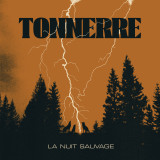
Schwerer, auf Blues basierender Rock, zu dem man sogar tanzen kann! Die Quebecer Rocker Tonnerre spielen kräftigen, von den 1970ern inspirierten Rock, der sich an AC/DC und Blue Öyster Cult orientiert - komplett mit französisch gesungenen Texten! Das Album wurde bemerkenswerte sechs Monate nach der ersten Jam-Session der Band aufgenommen und vermittelt die Art von unbestreitbarem, lockeren Hardrock, der erstmals in den 1970er Jahren aufkam. Und hinter Sängerin Annick französischem Gesang fängt das Album perfekt das Gefühl und den Geist von 'eine Nacht in der Wildnis' ein, denn das ist die Titel-Übersetzung. Es symbolisiert Nächte, wilde Geister, Tiere, die nachts jagen, die Nordlichter, die Sterne und die langen Schatten, die das Feuer wirft.
Rock Hard:
"Die Kanadier fingen erst richtig an, als Arnaud Geoffroy sich hinters Schlagzeug klemmte, ein Bierbrauer im Brotberuf. Die Einstellung stimmt also. Und ihre Musik passt dazu. Die Gitarristen spielen trockene AC/DC-Riffs, aber nicht mit der wilden Unbedingtheit der Australier, sondern eher mit der Contenance und harmonischen Akribie des Siebziger-AOR. Sie selbst zählen noch Blue Öyster Cult zu ihre Vorbildern, und tatsächlich besitzt die Melodieführung von Sängerin Annick mitunter einen leichten BÖC-Vibe (etwa bei ´Ceux Qui Sommeillent´). TONNERRE gehören zur französischsprachigen Minderheit Torontos, und so kommen auch noch ein paar Trust-Reminiszenzen hinzu. Ganz schöne Mischung. Etwas energischer könnten sie hin und wieder zur Sache gehen, aber sie wollen sich wohl ihren Pegel nicht wegschwitzen."
dovrebbe essere pubblicato su 26.04.2024

"For a long time, I'd come across these discs without really understanding what connected them, apart from a button and that famous logo designed by René Dessirier. Then, with a little more digging, I discovered the "self-production" link. For choirs, schools, folk singers, young pop groups, popular homes and even great composers who engraved unique copies of certain recording sessions...
The French equivalent of the English "Derby Service", the Kiosque d'Orphée, formerly at 7 Rue Grégoire de Tours in the 6th arrondissement, was taken over by Georges Batard in 1967 and moved to 20 Rue des Tournelles in the 4th arrondissement of Paris. The adventure lasted until 1991. Georges Batard was a sound engineer who used a Neumann tube engraver to engrave acetates from the tapes he received, before printing the precious vinyls in the press factories of the day, where he was able to produce very small runs of between 50 and 500 copies.
Of course, there were other structures for releasing his records, such as Voxigrave or, later, FLVM, but none of them had so many records in their catalog. Le Kiosque d'Orphée was neither a label nor a publisher, but a structure that allowed you to press your own vinyl, at a time when it was quite an adventure to get your first 45 rpm or 33 rpm album released!
Georges Batard was described as passionate and conscientious. His son, bassist Didier Batard, wrote of him:
"Georges was passionate about recording and reproducing the stereo sound of his great passion, music. He paid close attention to distortion rates, signal-to-noise ratios, response curves, rise times and other damping factors in audio equipment. He was looking for the exact reproduction of concert hall sound in his living room (with the same sound level, if possible...). In the late '50s/early '60s, he found other sound enthusiasts in AFDERS (Association Française pour le Développement de l'Enregistrement et de la Reproduction Sonores). He became its honorary president. Every Saturday afternoon, its members met to test au- dio equipment. Their opinions were published in the monthly Revue du Son.
All you had to do was send in your tapes and choose the number of record copies you'd like to take home with you, so you could finally share your creations and, in a way, exist. You could opt for a generic sleeve, available in several colors, directly customizable with your name and credits, or you could design your dream sleeve yourself in your living room or at a printer's.
This "Do It Yourself" temple gave birth to some superb pouches. Stencilled, hand-written, illustrated with paintings, drawings, illustrations by friends or girlfriends of the time, photo prints hastily stuck in the middle of a blank, white sleeve, on which the traces of time would leave their imprints, so that collectors and the curious would come and buy them decades later, with the promise of a musical discovery, unfortunately not always fulfilled...
What most of these records have in common is the youth of their songwriters, whether or not they've had a career. Stories of buddies, of getting by and dreams of glory made up this catalog. Most of them were amateur productions, both in terms of the level of the musicians and the quality of the recordings, made on a two-track or, the ultimate luxury, a 4-track in a teenager's bedroom or parents' living room.
It was the beginning of the home studio, thanks to the advent of the Revox portable tape recorder. A bit of a shaky DIY system, but, in return, the luxury of setting no limits: one-sided tracks, no outside censorship, no artistic director, no manager, no Barclay or EMI/Pathé Marconi logos...
When you finally had your own record, you could give it away or sell it to friends, family or after concerts. You could also drop it off at the nearest record shop, with undisguised pride.
It was also a calling card that could be sent to radio stations or music labels, in the hope of launching a career...
Many of the protagonists in this story tried to sign with labels, but in those days, bridges were not so easy to build between one's hometown, or even one's village, and the major or more specialized label that might have released these records. At the time, the advertisements published in the press by the Kiosque d'Orphée opened up the field of possibilities for provincial composers. It was now possible to make their own record, without having to go through the process of signing with a label.
Some of the composers who have gone on to make a career have used this channel to release their first record or parallel projects (Claude Engel, Dominique A, Andy Emler, Michel Deneuve, Claude Mairet, Mick Piellard, Tristan Mu- rail...) and sometimes even single or very limited pressings of work or promotional copies (Bernard Parmegiani, Jef Gilson...).
This album is the conclusion of a long investigation, begun six years ago. It took a long time to find the records, scattered all over the place, in the homes of collectors and sometimes the musicians themselves, and then to listen to them, sometimes painstakingly, to unearth these moments of grace.
From this work, 23 tracks remain, but there are dozens of others that could have been included, so we had to choose, and the choice had to be as universal as possible. This selection is obviously not objective, but I hope you'll like it.
Today's music is raw, touching and powerful. "
Jean-Baptiste Guillot - Born Bad Records
dovrebbe essere pubblicato su 15.03.2024

Belgian DJ & producer Mugwump performs an about-face with a new sound and live show and unveils the first extract of his second album 'Drape' and it's first extract,'No Trepidation', a fast-paced postpunk/electronic hybrid and a punch in the face of conformity, formatting and self-censorship.
Borrowing his name from a character from William Burroughs' famed novel Naked Lunch, Mugwump is an elusive presence, a reputation preceded by infamous DJ residencies at Belgian clubs and a longstanding recording relation with Cologne's Kompakt records, ongoing DJ support from Andrew Weatherall as well as a large catalogue of electronic 'disco-techno' records, released on leading labels R&S, Gigolo, Cocoon, Endless Flight, Eskimo, Permanent Vacation or International Feel. Mugwump is also well known for running the Leftorium clubnight in Brussels where like-minded DJ guests such as Ivan Smagghe, Andrew Weatherall, Superpitcher, Matias Aguayo, Optimo, Prins Thomas, Sascha Funke, Gerd Janson, Ata or Roman Flügel share decks leftorium
'Drape' is the follow-up to 2015's debut studio album 'Unspell', which boasted many guest vocalists, garnered media plaudits across the board internationally and was supported with live appearances at Benelux, French, UK and Dutch festivals & venues.Taking it further and morphing into a full live band with new members, Mugwump released the 'Metempsycho EP' in November 2016 on which Geoffroy made his singing debut. Driven by this live band experience, Mugwump's new album 'Drape' will release May 4th 2018
Ordina ora e ordineremo l'articolo per te presso il nostro fornitore.
