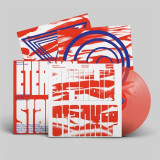
Oliver Ho under his Broken English Club Moniker - EBM Techno Industrial Cut Up Vocals Noise,
Commandez maintenant et nous commanderons l'article pour vous chez notre fournisseur.
Last In: 2 years ago
Oliver Ho under his Broken English Club Moniker - EBM Techno Industrial Cut Up Vocals Noise,
Commandez maintenant et nous commanderons l'article pour vous chez notre fournisseur.
Content:
- Softcover: 300g/m² raw cardboard, granular lamination, open spine binding
- 352 pages: Neon CMYK print on Lessebo Smooth Natural 90g/m² and Galaxi ArtSamt 115g/m²
- Dimensions: 22,0 x 30 x 2,2cm (1,4kg)
Tresor: True Stories is the first printed excavation of Tresor’s legendary history. Digging deeply into its rich
archives, the venerable institution has unearthed countless treasures from its over three-decade old history.
Over 400 never before seen photographs, flyers, faxes and other artefacts illustrate a story that intersects
with the most important social and musical trend in the modern history of Berlin. The story is told with the
voices of those that were there - over 40 protagonists share their first-hand reminiscences of the ‘big bang’
that launched techno into the world. Through the story of Tresor, the book charts the heady days of 80s West
Berlin through to the explosion of new energy that midwifed in the new social reality of reunified Germany.
This is a unique and essential printed monument to the institution that changed electronic music forever,
and the city that allowed it to exist.
Chapters:
I. Dada at the End of the World
II. The Wild Years
III. Tresor Never Sleeps
Editors:
Harry Glass, Paul Reachi, Sven von Thülen
Authors:
Dimitri Hegemann, Paul Hockenos, Regina Baer
Interviews and transcriptions:
Felix Denk, Jeannette Goddar, Jürgen Laarmann, Ruro Efue
Digitization:
Felix Moser, Rüdiger Müller
Translations, proofreading and copyediting:
Edessa Malke, Paul Fleischmann, Paul Sabine
Photography:
Gustav Volker Horst
Oliver Wia
Tilman Brembs
Wolfgang Brückner
Additional photography:
Anja Rosendahl
Carlos Alberto Heinz
Carola Stoiber
Daffy
Eberle & Eisfeld
Ernst Stratmann
Jan Hillebrecht
Jo?rg Blank
Helge Birkelbach
Helge Mundt
Marie Staggat
Martin Holkamp
Norbert Smuda
Susanna Kubernus
Susanne Deeken
Uwe Reineke
Concept, layout and design: onlab
Vanja Golubovic, Matthieu Huegi, Thibaud Tissot
8 rue des Vieux Grenadiers, 1205 Geneva, Switzerland
Lithography, printing and binding: Druckerei zu Altenburg GmbH
Gutenbergstrasse 1, 04600 Altenburg, Germany
Commandez maintenant et nous commanderons l'article pour vous chez notre fournisseur.
On their first official collaboration, Japanese noise pioneer Masami Akita aka Merzbow and Australian sound sculptor Lawrence English present a harrowing, surrealist portrait of nocturnal industrial activity, spawned by field recordings made in a sprawling factory complex seven hours north of English's home in Brisbane. He characterizes the area as "uneasy and unsettling," awash in the sickly glow of smelters and refinement machinery, somehow not of this world - a liminal quality vividly captured in Andrei Tarkovsky's sprawling purgatorial opus, Stalker, to which the title alludes. Akita, too, described early drafts of Eternal Stalker as feeling "like the soundtrack to a dystopian science fiction opera." A mood of mechanical dread and ruined futures permeates each of the album's seven potent compositions. Opener "The Long Dream" sets the stage with steady rain on sheet metal, punctured by thunder and metallic echoes, reverberating to the rafters in a collapsing warehouse. Quickly the tempest rises. "A Gate Of Light" and "Magnetic Traps" both convulse in churning furies of electric demolition and rattling chains, roaring and relentless. "The Visit" and "Black Thicket" operate more at a distance, surveying the topography of steam, rust, and liquid metal from above, their flickers of violence swallowed by blankets of darkness. This is noise at its most elemental and unknowable: brooding, bristling, and opaque, stalking forbidden peripheries of chaos and creation. Discussing Akita's music, English refers to its "intense substrata that is purely psychedelic; it consumes and confounds." The seasick swells of friction and fracture subsume the listener, forcing an auditory surrender: "this saturation of the senses can be a euphoria." Proof comes halfway through "The Golden Sphere," when the howling mayhem subtly recedes, revealing an eerie siren drone hovering in the void, like the resonance of a dead star galaxies away. Slowly a seething, venomous wall of volume returns, shredding the signal until its frequencies fray, whipping away into the eye of the storm. The combined effect merges obliteration and liberation, rapture and ravagement; it's the sound of dissolution as resolution, uprooted and unmoored, finally freed from form.
il devrait être publié sur 03.06.2022
On their first official collaboration, Japanese noise pioneer Masami Akita aka Merzbow and Australian sound sculptor Lawrence English present a harrowing, surrealist portrait of nocturnal industrial activity, spawned by field recordings made in a sprawling factory complex seven hours north of English's home in Brisbane. He characterizes the area as "uneasy and unsettling," awash in the sickly glow of smelters and refinement machinery, somehow not of this world - a liminal quality vividly captured in Andrei Tarkovsky's sprawling purgatorial opus, Stalker, to which the title alludes. Akita, too, described early drafts of Eternal Stalker as feeling "like the soundtrack to a dystopian science fiction opera." A mood of mechanical dread and ruined futures permeates each of the album's seven potent compositions. Opener "The Long Dream" sets the stage with steady rain on sheet metal, punctured by thunder and metallic echoes, reverberating to the rafters in a collapsing warehouse. Quickly the tempest rises. "A Gate Of Light" and "Magnetic Traps" both convulse in churning furies of electric demolition and rattling chains, roaring and relentless. "The Visit" and "Black Thicket" operate more at a distance, surveying the topography of steam, rust, and liquid metal from above, their flickers of violence swallowed by blankets of darkness. This is noise at its most elemental and unknowable: brooding, bristling, and opaque, stalking forbidden peripheries of chaos and creation. Discussing Akita's music, English refers to its "intense substrata that is purely psychedelic; it consumes and confounds." The seasick swells of friction and fracture subsume the listener, forcing an auditory surrender: "this saturation of the senses can be a euphoria." Proof comes halfway through "The Golden Sphere," when the howling mayhem subtly recedes, revealing an eerie siren drone hovering in the void, like the resonance of a dead star galaxies away. Slowly a seething, venomous wall of volume returns, shredding the signal until its frequencies fray, whipping away into the eye of the storm. The combined effect merges obliteration and liberation, rapture and ravagement; it's the sound of dissolution as resolution, uprooted and unmoored, finally freed from form.
il devrait être publié sur 03.06.2022
il devrait être publié sur 13.05.2022
il devrait être publié sur 18.02.2022
With the release of their new single ‘R&B’, the ever-exciting
English Teacher prove they could be your new favourite band.
As far as Northern cities go, Leeds probably isn’t the first place
you’d think of as a burgeoning hotbed of fiercely independent
and DIY bands. Often overshadowed by its neighbours further
along the M62, it’s precisely because of this that Leeds’ music
scene is as vehemently independent and self-sufficient as it is.
The latest band to emerge from the city are four-piece English
Teacher. Keeping Leeds’ longstanding tradition of
uncompromising post-punk alive, the quartet’s latest single
‘R&B’ is three minutes of clattering bass and crisp percussion,
sporadic guitar occasionally punctuating the tension as
frontwoman Lily Fontaine explores ideas of imposter syndrome
and lethargy throughout the creative process.
Lethargic is one thing ‘R&B’ isn’t, however. Fraught and frantic
perhaps. Imbued with a dry wit and self-awareness certainly,
but no one’s about to level any accusations of indifference at
English Teacher. The band explain, “the song is about the
cyclical, productivity-diminishing paradox of low self-esteem and
imposter syndrome-induced writer’s block that then fuels low
self-esteem and imposter syndrome. It’s also about racial
identity and putting the love that you have to offer a potential
romantic partner back into yourself.”
Harbouring a cloying sense of paranoia that only increases as
the track progresses, there are elements of bands such as Slint
and Sonic Youth at play. Rather than feel like a ‘90s throwback,
however, ‘R&B’ succeeds feeling not just contemporary but vital.
Providing both a short, sharp gut punch and insight into Leeds’
ever-growing indie scene.
Recently supported Sports Team on tour.
Dan Carey is set to produce a forthcoming album and also
plans to release a single on Speedy Wundergound.
il devrait être publié sur 05.11.2021
Manchester reggae band X-O-Dus are best known for their single English Black Boys, produced by Dennis ‘Blackbeard’ Bovell and released on Factory Records (Fac 11) in February 1980. This remastered compilation collects together 7 of their best tracks and is limited to 500 copies on 180 gsm vinyl (plus digital copy)
Talent-spotted by Joy Division manager Rob Gretton, X-O-Dus performed at live events such as Zoo Meets Factory Halfway (August 1979) and Factory By Moonlight (April 1980). In time-honoured Factory fashion Fac 11 was released almost a year late, being the only reggae record to appear in a sleeve designed by Peter Saville.
Digitally remastered by Peter Beckmann in 2021, this 7 track vinyl edition includes both sides of the Factory single as well as 5 album demos recorded in 1980. For optimum sound quality the album is pressed on 180 gsm vinyl.
The vinyl inner bag contains sleeve notes by former manager Martin Dunlop, along with archive images including previously unseen shots from the Moonlight Club show on 4 April 1980 by Peter Anderson.
il devrait être publié sur 15.10.2021
Having released 10 albums since their debut in 2008, it’s hard to believe that ‘Crystal Bullets b/w King Tears’ is the first ever 12” single from “The last great Rock’n’Roll band” (The Guardian).
Containing White Denim’s first new music since the lockdown 30-day-album project ‘World As A Waiting Room’.
‘Crystal Bullets’ was inspired by the groove of the great Bernard Purdie and the signature chopped and screwed production techniques of Houston, Texas’ late great DJ Screw. The final minute features the most sublime harmonised sax solo you’ll ever hear, leaving you wishing this was more than just a 2 track 12”…
White Denim have long pulled hard at the parameters of rock & roll, admitting garage punk, soul, psychedelic boogie, prog, jazz and country blues while holding onto its vital goodtime core, and their up-tempo drive has produced a body of work defined as much by stellar musicianship as off-the-chain exhilaration. Energy and adventurism have always been paramount.
Commandez maintenant et nous commanderons l'article pour vous chez notre fournisseur.
Danny Krivit is currently known as one of the music community’s greatest purveyors of top quality disco & house as he continues to perform regularly before sold-out audiences around the world. With his unique ear for what works on the dancefloor he has also become known as “King of the Re-edit.”
Danny has a deep connection to Kim English’s “It Makes A Difference” release on Nervous Records from 2006. Krivit worked with writer Kyle Smith on the remixes that originally made this tune an anthem at his 718 Sessions parties as well as one of the highlights of club nights from Tokyo to New York to London that appreciate quality soulful house. The B-side is Danny’s re-edit of one of the most famed dubs from the Nervous catalogue
as well as for the producers Mood II Swing. Upon its release in 1993 this dub emerged as one of the defining sounds of summer 1993 at Ministry Of Sound which had just recently opened the year before. The “rushing rushing rushing” hook is well knownby golden era of house afficianados around the world and he does an amazing job bringing this essential hook.
Commandez maintenant et nous commanderons l'article pour vous chez notre fournisseur.
New collaborative album from two of the world's most revered sound artists. 'At its best, William Basinski's music inspires the sort of rapturous testimony usually reserved for peak experiences, cult leaders and the dead.' Pitchfork // 'Awe-inspiring: strange, elemental, and profound.' AllMusic // For over half a decade, William Basinski and Lawrence English have been in regular contact with one another. During that time their paths have crossed repeatedly in various cities; Zagreb, Los Angeles, Hobart and more, in a variety situations. It was from these chance encounters - and the strange familiar of lives lived in transit - that their first collaboration, Selva Oscura, was seeded. The phrase Selva Oscura draws its root from Dante's Inferno. Literally translated as 'twilight forest,' it metaphorically speaks to both those who find themselves on the unfamiliar path and more explicitly the nature of losing one's way in place and time. Each of the extended pieces on this record maps an acoustic topography that draws on the concept of drifting into the strange familiar. The works each dwell in an ever shifting, yet fundamentally constant state of unfolding. As one sound fades away, another is revealed in its place, creating a sense of an eternal reveal. Selva Oscura was recorded in Brisbane and Los Angeles simultaneously. The compositions were each created through a process of iteration and rearrangement that inverted the micro and macro characteristics of the raw sonic materials. Dynamics and density were chiselled with restraint and at other times intensely reductionist approaches to create a limitlessly deep, but open sound field - as rich as the suggested place from which its title is drawn.
Commandez maintenant et nous commanderons l'article pour vous chez notre fournisseur.
* London based electronic music label Khemia Records announces its seventh split release vinyl Ep.
* The third edition of the Magnum Opus Series features Thee Art Ov Metals, a raw, menacing, post-punk inflected cut, drenched in reverb over an insistent ebm groove from Broken English Club alongside the pristine cardio bleeps and rave hypnosis of Claus Fuss' Static Ace.
* Together they form the Citrinitas Edition.
Commandez maintenant et nous commanderons l'article pour vous chez notre fournisseur.
American experimental musican Shane English continues in a long tradition of outsider electronics as he's been humbly prolific in his output though the years involving himself in numerous recording projects.Collaborating with Jonah Lange in their group Corporate Park as well as an ongoing collab with Beau Wanzer (seeing a release last year under the CP/BW name), English now commits his second full length solo offering to vinyl in the form of the General Dimensions lp.Sparse machine driven electronics dominate the recording providing a back drop for the occasional pulsating rhythm, metallic clank or floating obscured vocal. While it is a dark and sparse affair there is a quiet downtrodden beauty throughout giving the recording a sense of uncertain serenity in an almost shoegazey way. Highly recommended for those into early electronics.
Commandez maintenant et nous commanderons l'article pour vous chez notre fournisseur.
Heidi Lord Wife of Rephlex/WeMe artist Jodey Kendrick 3 of Heidi's tracks are featured on the famous "EDM" Compilation Albums This is the Debut album from Heidi Using a unique pallet of sounds from MRI machines to modular synthersizers to conversations in a super market to her own processed voice Co produced by her Husband "I could describe what the album means to me, But i would much rather leave it to listener to experience and feel and to interpret how they see fit"
Commandez maintenant et nous commanderons l'article pour vous chez notre fournisseur.
The short, mysterious career of the female French duo Deux Filles is bookended by tragedy. Gemini Forque and Claudine Coule met as teenagers at a holiday pilgrimage to Lourdes, during which Coule's mother died of an incurable lung disease and Forque's mother was killed and her father paralyzed in an auto accident. The two teens bonded over their shared grief and worked through their bereavement with music. However, after recording two critically acclaimed albums and playing throughout Europe and North America, Forque and Coule disappeared without a trace in North Africa in 1984 during a trip to visit Algiers. The short and terribly unhappy lives of Forque and Coule are at the root of the small but fervent cult following the mysterious duo have gained since their disappearance, not least because the placid, largely instrumental music on the duo's albums betrays no hint of the sorrow that framed their personal lives.
This would be a terribly sad story if a word of it were true. In reality, Deux Filles were Simon Fisher Turner, former child star/teen idol and future soundtrack composer, and his mate Colin Lloyd Tucker. Turner and Tucker left an early incarnation of The The in 1981 to pursue another musical direction. Turner claims that the idea of Deux Filles came to him in a dream, and he and Tucker strictly maintained the fiction throughout the duo's career. Not only did they pose in drag for the album covers, the duo once even played live without the audience realizing that the tragic French girls on-stage were actually a pair of blokes from south London. Deux Filles released two albums through Turner and Tucker's Papier Mache label, 1982's Silence & Wisdom' and 1983's Double Happiness'. Both albums are included here and blend watery piano, occasionally ghostly vocals, sheets of synthesizers, heavily processed guitars and the barest minimum of percussion. Drifting and wistful, they're a pair of lost ambient gems from a time when the genre had yet to mature, an excellent example of post-Eno, pre-Orb ambient music.
All songs have been remastered for vinyl by George Horn at Fantasy Studios in Berkeley. The vinyl comes housed in gatefold sleeve with original front covers of both albums, and a centerfold of archive images and the original liner notes. Each LP includes a sticker of the Lino cuts by Adrian Gill that was included with the original pressing.
"Like an early French film soundtrack with melodramatic overtones, the sound is jagged and disjointed but never harsh. Lilting guitars and ample use of echo smack of Vini Reilly, relying on the hypnotic qualities of the sound rather than abrasive noise" (Sounds, 03/1983)
Disponible en stock et prêt pour l'expédition
Commandez maintenant et nous commanderons l'article pour vous chez notre fournisseur.
Das Soloalbum des Black Uhuru-Gründungsmitglieds von 1982 im Originalcover als LP neu aufgelegt! Der Longplayer wurde mit den Roots Radics und dem Bläsersatz von Dean Fraser & Nambo Robinson im Channel One Studio von Soldgie und Scientist aufgenommen und abgemischt, als Produzent zeichnete Henry 'Junjo' Lawes verantwortlich.
Commandez maintenant et nous commanderons l'article pour vous chez notre fournisseur.
il devrait être publié sur 22.04.2022
Color Vinyl
'This is the story of a man, marked by an image from his
childhood.' Thus begins, with deceptive simplicity, Chris
Marker's La Jetée (1962). The film, by far Marker's bestknown
work, synthesizes many of the elusive filmmaker's
central preoccupations - time and memory, power and resistance,
the ephemerality and resilience of love - yet it also
undermines the very idea of film. Composed almost entirely
of still photographs, La Jetée quite literally pieces together
the tale of an unnamed, forsaken protagonist, drafted into a
series of time travel experiments in post-apocalyptic Paris.
While Marker creates some of the most hauntingly beautiful
imagery in cinema, what animates La Jetée's frozen
pictures is its sparse and unsettling soundscape. Whispers,
breaths and heartbeats offer an unnerving reminder of
bodily rhythms that, inside the film and out, will inevitably
cease. Fragments of symphonic music at once capture a
love affair and underscore the tragedy awaiting it. The poetic
momentum of the narrator's voice, our only guide: 'On
the tenth day, images begin to ooze, like confessions.'
Superior Viaduct is honored to present the first-time release
of the soundtrack from La Jetée. This vinyl album
features both French and English voiceover narrations,
along with organic textures and Trevor Duncan's impressionistic
score. More than half a century has passed since
La Jetée's theatrical release - now is the time to travel back
to the 'sudden roar' of this masterpiece in a completely
different light.
il devrait être publié sur 26.11.2021
30th anniversary pressing limited to 1000 copies. With the 2016 Roots
mini-series such a success, there is new interest in Quincy Jones’ original
soundtrack to the ground-breaking 1977 mini-series.
Highlights include the “Roots Mural Theme,” composed by Gerald Fried, and
the 28 minute, ‘Roots Suite,’ with Letta Mbulu as the featured vocalist. Plus
the stunning “Main Title: Mama Aifambeni” as sampled by Moodymann and Andrés.
Also included are snippets of dialogue from Roots actor Lou Gossett. Featured
players include: Shelly Manne, Victor Feldman, Ernie Watts and Lee Ritenour.
Commandez maintenant et nous commanderons l'article pour vous chez notre fournisseur.
Eno Williams, frontwoman of Ibibio Sound Machine, uses both English and the Nigerian language from which her band's name is derived for the dazzling new album Doko Mien. Long lauded for jubilant, explosive live shows, Ibibio Sound Machine fully capture that energy on Doko Mien, the followup to their Merge debut Uyai.
In a glowing piece in the New York Times, those songs were praised for following 'in the tradition of much African music, [making] themselves the conscience of a community.' By pulsing the mystic shapes of Williams' lines through further inventive, glittering collages of genre, Ibibio Sound Machine crack apart the horizon separating cultures, between nature and technology, between joy and pain, between tradition and future. That propensity for duality and paradox seems common in people whose lives span continents.
Williams was born in the UK, but grew up in Nigeria, always steeped in her family heritage. She obsessed over West African electronic music, highlife, and the like, but was equally empowered by Western genres such as post-punk, disco, and funk. The London octet have enveloped themselves in that maximalist quilt proudly since their 2013 formation. Though it can often bring with it news of stress and uncertainty, the modern world further brings all these disparate traditions into connection.
'Everyone has everything now,' says multi-instrumentalist Max Grunhard. 'Everyone has immediate access to every genre, picking things up from everywhere—like magpies.' And while they haven't suddenly left their African roots behind, Doko Mien does find increased representation of English lyrics in the ratio. By sharing more directly with more universal lyrics, the record feels more anthemic, reaching for grander heights.
'We wanted to give people a reason to sing along, to find their soundtrack every day,' Williams says. 'We wanted everyone to feel as if they're part of the music as well.'
Late album highlight 'Guess We Found a Way' addresses the change with a coy smile. 'Guess we found a way to speak to you/ Guess we found a way to say what's true/ To say what's real,' Williams coos over glistening chains of reverberant synth and diamond dust percussion, before returning to Ibibio in the chorus. Perhaps the best example of the group's ability to convey meaning across language and tradition, to blend past and future into a singular present comes on 'She Work Very Hard'. The traditional Ibibio folk tale bobs over the waves of tuned percussion, chunky synth, and pinprick highlife-esque guitar, while Jose Joyette's drums and Derrick McIntyre's bass funk groove bring everyone to the dance floor. 'These stories won't be forgotten. Feel the music: it speaks to everybody,' Williams says. 'We can travel back in time together, while convening on a futuristic, present tense. We hope that we can give people that reason to wake up, that one song to sing and dance and be happy.'
Doko Mien: Tell me everything. On their new album, Ibibio Sound Machine provide the perfect companion, ready to digest as much as possible and then further unfurl beauty and hope. They remember and honor the past and charge forward toward the future, all while intensely expanding the present.
Commandez maintenant et nous commanderons l'article pour vous chez notre fournisseur.
Mesmerizing electronic music with a bit of EBM echoes, including a stunning remix by Broken English Club.
Commandez maintenant et nous commanderons l'article pour vous chez notre fournisseur.
The last in the Rommek 'Set in Stone Trilogy' with 'Metamorphic'.
Various established Blueprint artists transform the atmospheric and intense industrial soundscapes into with their own gripping interpretations.
Commandez maintenant et nous commanderons l'article pour vous chez notre fournisseur.
Bottom dwellers rising to the top a little taste of who's who in the current Brooklyn underbelly, L.I.E.S. links up with like minded misfits from the Primitive Languages crew to present a six track comp 12 exploring freeform electronics of varying shapes and tempos from brutal to beautiful club to gutter it's all here...get in or get out. Picture cover by Matthew Bellosi! No Payments Rejected!
Commandez maintenant et nous commanderons l'article pour vous chez notre fournisseur.
Blood Debts' is the compulsive debut album from Years Of Denial, the alter-face of London-based French musician/producer and DJ, Jerome Tcherneyan.
Though his formulative Marseille youth was spent exploring the darkest corners of post-punk, New Wave, not to mention Public Enemy and the inspirational Mille Plateaux and Basic Channel labels, Tcherneyan, already an extremely capable drummer, quickly extended his sonic palate toward and beyond the bass-heavy electronic isolationism, insistent beats and drone experimentation that's still very much prevalent in his work today.
One should not either pass over his integral contribution to the much-lauded, though stolidly underground "ghost-rock" unit, Piano Magic, which engineered sublime collaborations with Brendan Perry (Dead Can Dance), Simon Raymonde (Cocteau Twins/This Mortal Coil) and Alan Sparhawk (Low). Tcherneyan, always prolific, can also lay claim to impressive collusions with Bonjo Iyabinghi Noah (African Head Charge), Damo Suzuki (Can), 70's psych folk legend, Mark Fry to name but a few.
In 2005, Jerome founded and promoted the infamous 'Flesh' parties; guests including Andy Stott /Claro Intelecto/Edit-Select/James Ruskin/Kirk Degiorgio/Mark Broom/Oliver Ho/Sigha/Steve Bicknell and many more. These nights served as an invaluable education in Techno and Dubmixology; marathon sets played deep into the sunrise.
Skip forward a decade and the DJ bug is even deeper embedded, with Tcherneyan sharing the booth with, amongst many others, Orphx/Phase Fatale/Joefarr and London Modular Alliance.
Tcherneyan's muse and foil on 'Blood Debts,' his first for Oliver Ho's splendid and already essential new Death & Leisure imprint, is Maya Petrovna, an entrancing London-based vocalist, film composer and performance/physical theatre artist, whose voice perfectly evokes Billie Holliday, Diamanda Galas and all stations between.
There's a black neon heart at the centre of 'Blood Debts,' a fetishtic ritual of contorted flesh and altered states; a feverish, infectious paradox of primitivism and modernity. Years of Denial is the ghost in the machine.
Commandez maintenant et nous commanderons l'article pour vous chez notre fournisseur.
Bursting into the 1980s on a new label (the then-upstart, now-legendary Rough Trade) and with an augmented, audibly panicked lineup, The Fall's Grotesque is the true pure-bred Fall release from the Marc Riley era. Released in the immediate wake of The Fall's most beloved single (Totally Wired), the album carries over that righteously famed teeth-chattering, bolstered in no small part by the drumming of new addition Paul Hanley, brother of bassist Steve Hanley and aged only 15 at the time of recording
il devrait être publié sur 28.10.2016
The album opens with the ominous guitar-driven Hollow Sky, accompanied by its haunting music video's verdant vistas. The song, with Iceglass ghostly vocals, shimmers with that sounds like an Omnichord flittering like sonic firefly lights and brooding bass. This perfectly scores the less traveled wanderings through the dark wooden path of Dante's perdition, leading to the titular well that graces the album cover. The Crater opens with an unsettling riff and bass, with low, repetitive frequencies on the synth create a sense of unease. Here, Iceglass recounts a fatalistic requiem for the king of romance that is cataclysmic and leaves a scar upon the earth. With Fall Industrial Wall, once again, Iceglass channels a silky and Nico-like emotive deadpan; against a dirgelike melody backed by minimal synth, bass, and drum. Almost medieval and plaintive, with its folk droning horns, deep and shallow in their resonance. This song is anachronistic, setting the scene of ruins centuries-old with crumbling edifices strewn about like memories lost in time. With the poetic lyrics of The Chamber do we find the eponymous abyss. Here, dualities are laid bare; besides love, there is heartbreak, and without this sorrow, what meaning would there be to love if one knows not what it is to lose? This song encapsulates the idea that love is heartbreak, and love lost is reaching the deepest chamber of the heart. This is carried through a sombre horn, minimalist drum machine, and deliberate bassline overlaid with Iceglass german and english lyrics. The Well is led in with a softly distorted bassline overlaid with eerie banshee howls give way to Iceglass otherworld vocal refrain, echoing through time as if emanating from a hole in the ground, and encircling that hole is a garden of woe and despair. The sinfully seductive song The Moor features a captivating SAX SOLO courtesy of Perseas; a welcome shift in tone, juxtaposed well with the intensity of Iceglass tenebrous vocal purr. This hitherto unexplored foray into dark sensuality takes the song into sordid mid 80s territory, bringing to mind a dusky drive along a serpentine road, with equally haunting instrumentations straddling time with icy fire. Broken Characters is an acoustic folk interlude featuring Selofan's Dimitris Pavlidis on guitar. Here we find a more gentle approach with its earnest and romantic lyrics. The song's melodic hook is a soft caress along with the forlorn horn elements highlighting Iceglass at her most Nico-sounding vocal yet, singing the sorrowful truth that most artists are indeed broken characters. Chimerical opens with dirgelike synth organs. The chill of winter has befallen the lamentations sung by Iceglass carried by haunting chord progressions and minimal percussion, plaintively beseeching the song's subject to remain elusive, idealistic, and a dreamer. After an album highlighting more Jill than Jack, our male protagonist finally makes his ascent in the sonorous and breathtaking Dark Hill, a masterful march of sweeping synth horns, and trepidatious drum machine with William Maybelline's bellowing voice cracking like thunder, rattling the atmosphere like his heart against his ribs. Spirals swirls in a cautionary knell of cathedral-esque droning synth dirge, with Icarian lyrics shining like a sombre ray of hope; like the sun's rays creeping into the darkest of places. The song, minimalist in its tight percussion, echoes with the solace of Larissa Iceglass vocal litany; invoking elements of the supernatural, almost like a Casio preset sequenced to the beating of an angel's wings.
il devrait être publié sur 27.03.2026
Repress.
Step into a journey through time with Lapa Dula's debut album "Agua", proudly presented by the Early Sounds team. “Agua” is a sonic and aesthetic collage, a tribute to the sounds and memories of Naples and its surroundings in the vibrant cultural and social scene of the mid 1980s, not just a reflection of producer’s Alessandro La Padula childhood memories, but also a nod to the myths and legends of Partenope. Written between Rome and Naples and co-produced by label head Pellegrino, "Agua" is the latest addition to the imprint’s distinctive "Mediterranean sound" blending funk, Latin, world music, and disco, with songs like the balearic title track "Agua" and the nostalgic ode to rural life "Sibilla", also inspired by the myth of the Sibyl of Cumae, this album takes you on a journey of emotions and experiences.
From vernacular "Scemanfu", a fun play on the French expression "je m'en fous" (I don't care), to the contemplative "Navigante", dedicated to those who have found solace in the sea or in the virtual world, and the final track "Baibai", inspired by the adventurous and licentious affairs of English nobleman Sir Nathaniel Thorold, who lived on the island of Capri, each song tells a story and adds a piece to this mosaic of sounds, images, and places.
il devrait être publié sur 27.03.2026
An assorted mixtape-style collection of recordings from Constantin Brăiloiu's World Collection of Folk Music archive, originally broadcast on NTS Radio in July 2017, issued as part of DINTE's 10th anniversary series.
Comprising field recordings made by the pioneering Romanian ethnomusicologist of English, Irish, Gaelic, Norwegian, Breton, Japanese, Italian, Swiss, Basque, Fulah, Sardinian, Estonian, Georgian, Greek, Turkish, Judaeo-Spanish, Portuguese, French, Chinese, Russian, Hausa, Tuareg, Indian, Corsican, Ethiopian, Romanian, Walloon, Flemish, German, Kabyle, Bulgarian, Macedonian, Bosnian and Caribou Eskimo folk songs & dances.
il devrait être publié sur 27.03.2026
Originally released on CD in Japan in 2003, as a love letter & thank you to his Japanese fans. Recorded at home, produced, engineered & mixed by Matthew Sweet (bass, guirars & vocals) with the classic ‘Girlfriend’ era lineup of Ric Menck (drums), Greg Leisz (guitars) and the genius electric lead guitar of Television’s Richard Lloyd. The sleeve art is by renowned artist Yoshimoto Nara. In the liner notes, Sweet describes the album's title as an attempt at reverse English: "If I did it correctly, the title should seem a little strange or wrong, but still meaningful! The true definition is supposed to be a 'love you' life, one devoted to loving someone or something, even life itself!"
“an excellent modern guitar pop album, filled with great hooks and harmonies and irresistible ringing six-strings”
Allmusic
“Kimi crackles with Girlfriend‘s energy, as Lloyd and Sweet’s guitars provide antagonistic foils as they did more than a decade before on cuts like “Tonight We Ride.”
Rolling Stone
il devrait être publié sur 27.03.2026
Despite its tragic breakup, Yugoslavia as a political, social and cultural phenomenon still inspires generations, especially those who were born or lived at the time of this utopian land of South Slavs. Those who didn’t enjoy the privilege are still amazed by its 1970s and ’80s music scene and the number of very modern, high quality acts that were so often ahead of their time. Two such acts were Data and The Master Scratch Band, both founded by Zoran Jevtic and Zoran Vracevic, who introduced synth-pop, breakbeat, and hip-hop music in Yugoslavia in 1984 with their releases: SP Neka Ti Se Dese Prave Stvari/Ne Zovi To Ljubavlju and miniLP Deogut (Jugoton). Our latest release, “It Was Ridiculous, It Was Amazing!” gathers their earliest unreleased material from 1981-1983, showcasing a broader range of genres – alongside synth-pop and breakbeat/hip-hop, they also experimented with industrial, EBM, minimal synth, and electro-funk!
The whole record is divided into two parts: on A side there are 7 previously unpublished songs by group DATA, and on B side there are 4 previously unreleased recordings by The Master Scratch Band.
The Data side opens with two unexpected “shocker” tracks: Ja Nisam Kao Ti” (eng. I am Not Like You) and “Izumi” (eng. “Inventions”) from 1981, where they sound like early Deutsch-Amerikanische Freundschaft with unusual vocal pan sound effects on Serbian lyrics and uncompromising synth-based sound. Equally unpredictable are the next two songs: atmospheric “España” and dusty “Damage In My Head,” where Zoran Jevtić boldly steps into the lead vocal role. But the surprises don’t end there. The next two songs, France and Strahovi (eng. “Fears”), bring a mysterious and nostalgic atmosphere, elevated by the irreplaceable sound of the modular Roland System-100M. At the end comes the greatest surprise of all: Data covers YMO-Ballet in a song called Ne Zelim Da Tako Zive (eng, I Don’t Want Them Living Like That) and puts some extra energy in rhythm without losing the original song’s sensibility. Like in the original, the lyrics are tender and yet mysterious and provocative.
The Master Scratch Band side contains the very first versions of the songs Break War, Jailbreak, and Computer Break, originally recorded in studio Druga Maca in Belgrade in 1983. These versions were not released on their mini-LP album Dégout (Jugoton, 1984), and they are actually the first ever hip-hop/Breakbeat recordings in Yugoslavia. With great enthusiasm, every sound was uniquely crafted from scratch using the finest analog gear available in the early ’80s. The two young artists, aiming for international success, chose to write their lyrics in English. The album’s final track, “Mad Scratch,” showcases their talent for creating impressive sound effects, which would be a delight for contemporary DJs and producers who specialize in sampling and scratching old-school hip-hop.
This release is truly a “100% digger’s gem” – 11 previously unreleased tracks from legendary pioneers of electronic, hip-hop, and breakbeat. A collection to discover, enjoy, play, and treasure forever!
il devrait être publié sur 27.03.2026
There’s no direct English translation for the word “hiraeth”. In the Welsh language, it describes a form of longing for an intangible something, somewhere or someone that no longer exists. Sofie Birch and Antonina Nowacka draw on the concept to guide their second collaborative album, a suite of vulnerable, open-hearted improvisations and reflections that attempt to grasp an image of the past that’s chimeric, dissolving almost as soon as it materializes. The duo’s process follows the same distant beacon; unlike Languoria, their critically acclaimed debut, Hiraeth is, at heart, an acoustic record, informed by in-person improvisations with voices and string instruments that gesture to an era before computers, AI and DAWs. It’s just as lush, but Hiraeth is warmer and more muted than its predecessor.
Nowacka and Birch conceived the album in the wake of a slew of collaborative live concerts, spurred on by serendipitous improvisations and an interest in paring down their setup. Unsound arranged a retreat in Sokołowsko, an idyllic village nestled in the verdant hills of Southern Poland, close to the Czech border. Sokołowsko surrounds a large ruined sanatorium that’s rumored to have inspired Thomas Mann’s 1924 novel The Magic Mountain, and has long been a magnet for artists. The two took the opportunity to rethink their approach completely, arriving with just a guitar, a zither and a portable Nagra reel-to-reel machine. Recording directly to tape, they sketched out ideas with just their voices and instruments, reflecting their surroundings without being distracted or mediated by modern technology.
“We wanted to get away from screens as much as possible,” says Birch, “to bring to the world something vulnerable and honest. Without advance preparation, every day we went out into the open air, finding places to sit, during sunset or the midday sun. We discovered new tunings on our instruments, picked up a melody, and started the machine, playing over
and over till we got a take.” In the autumn, they met again in a Copenhagen studio, sparingly and carefully layering old synths and organs to add more depth without muddying the mix.
Both Nowacka and Birch sing throughout, their voices threading the acoustic instruments and tangling with each other, almost becoming one. But it’s the environment of Sokołowsko, “the birds and the light, even the wind playing against the harps,” that’s woven into the music’s lining. Affected by time spent meditating and in nature, as well as the fact that Birch was pregnant whilst recording, the album feels alive and remarkably present. Even the sound quality of the tape machine gives Hiraeth a tactile, organic quality, as Nowacka puts it, “like being in a warm bath.”
They still have the raw recordings from Sokołowsko on old reels, physical souvenirs of their time spent making music in a “habitat for intuitive songs, a little ecosystem, alive and spirited.” The outmoded gear and remote setting helped the duo disengage from the modern world for a few moments and imagine an existence that’s been lost to time and nominal progress. With digital technology receding into the background, Nowacka and Birch had space to make “intuitive connections with frequencies and people,” as Birch explains. Hiraeth is a testament not to nostalgia, but to the power of kinship.
il devrait être publié sur 27.03.2026
Mysticisms’ Dubplate series reaches number 10 with the first in a series of specials, taking the genre blurring music of Persian and presenting updated remixes and versions by up-and-coming producers, as well as friends and family of the label.
Started as a sporadic offshoot of Mysticisms’ main releases, with the idea to highlight the wonderful sounds of dub influenced dance music, Dubplate has now become an integral part of the mission.
To start, South London’s Picasso joins the label, showcasing his declared abstract grooves and an EP of Dub and Tech House movers. While his productions aim for the dance floor, they are often characterized by complex rhythms and unconventional structures, prioritizing atmosphere and texture over traditional melodies.
Drawing inspiration from ambient, jazz, experimental influences and the heavy hand of dub, Sam “Andrews” McKay has crafted an EP of immersive “soundscapes”. Joining the legendary Persian (Peter Reilly) as co-selector, his retakes are all warped grooves, wide bass and dubby atmospherics.
Opening with Space Within Art, the street soul meets reggae rhythms are jettisoned, and a Dub House swing drives the track. The love, homage and vibration for Sound System culture remains, enchanting trippy reggae sampledelic vocals weaving in the brain.
Dunya 2 sees a shift, minds expanding. A jazz influenced breakbeat, harp, strings, building to a psychedelic swirl, driven by a dub bass in a clash, morph and glow.
The deep Digi Dub of D Dub Twist grows, warping the ‘JA riddim meets English hedonism’ in true Soundclash style. Touches of drone underlay, highlighting Sam’s experimental leaning, utilising Persian’s love of Eastern mystical samples to marry perfectly for a deep dub excursion.
The self-prescribed “odd-fellow” completes his versions, exploring his love of depth and abstract sound in closer, Jacob’s Dub. The warm roots vibrations in original form develop into a scatter gun House bumper. Dubwise, Lovers, Stepper, all merge around shuffling, trippy beats and skippy hats, Picasso’s groove is laid bare, driving the EP to finale.
Abstract the Mystery.
il devrait être publié sur 27.03.2026
The Fall were an English post-punk band, formed in Manchester in 1976. The band existed in some form ever since, and was essentially built around its founder and only constant member Mark E. Smith. Initially associated with the punk movement of the late 1970s, the group's music went through several stylistic changes over the years, but is often characterised by an abrasive guitar-driven sound and frequent use of repetition, and was always underpinned by Smith's distinctive vocals and often cryptic lyrics. The band was noted for its prolific output: and released over 25 studio albums, and more than triple that counting live albums and other releases. They have never achieved widespread public success beyond a handful of minor hit singles in the late 1980s, but maintained a strong cult following. The band were long-associated with BBC disc jockey John Peel, who championed them from early on in their career and cited The Fall as his favourite band, famously explaining, "They are always different; they are always the same.
il devrait être publié sur 27.03.2026