Cerca:curfew

Generi
Tutto
BITTER END - THE FIRST NARCISSUS / JEALOUS GROOVE

It's only fair - in terms of universal balance - that stratospheric pop success should be countered with some gutter realism.

When you live round the Bitter Ends, a year of enforced curfew is the least of your worries.
That said, it speaks volumes that even the folder marked 'Alternative versions' is light years ahead of most of what passes for dance music in 2021.

Majestic, soaring, sonic sensations.

Dependably unbendable !

As always, limited and LOUD

non in magazzino

Ordina ora e ordineremo l'articolo per te presso il nostro fornitore.

Last In: 4 years ago
EDIKANFO - The Pace Setters

In 1981, London-based E.G. Records released the debut album from a young Ghanaian group called Edikanfo. Edikanfo quickly rose to international notoriety following the release of “The Pace Setters” because of the infectious, forward-looking highlife meets afro-funk synthesis the band committed to tape. But the album also caught an additional wind of publicity due to its producer, the already legendary British musician and sound conceptualist Brian Eno. During that time, Eno was researching and openly propagating West African musics. He often mentioned his love of Fela Kuti and called his own rhythm-driven experiments the search for a “vision of a psychedelic Africa.” He had recently been collaborating with The Talking Heads on their Avant-funk masterpiece “Remain in Light” and with The Talking Heads frontman David Byrne on “My Life in the Bush of Ghosts,” an album which foretold the sort of cross-pollination and global music interconnectivity that today we take for granted. Eno and Edikanfo’s work together at Studio One in Accra (Ghana) was yet another inspired morphing of soundworlds and processes and a significant touchstone for both artists. As Brian Eno recently noted: “the actual recording sessions were joyful - the band played with such verve that you couldn't resist.”


But just when the sky seemed the limit for Edikanfo, the coup d’état in Ghana on the last day of 1981, tragically put the brakes on the band’s quickly developing fortunes. For years after that, the country endured enforced curfews at night, which of course ultimately gutted the live music scene in Accra and elsewhere. Because of this and other financial setbacks, the band ceased activity and its members spread out in exile, all over the world. It clearly seemed as though the story of Edikanfo, one of Ghana’s greatest bands of that era, had come to a premature end.


Now, almost four decades later, Edikanfo has returned. And with its surviving members gearing up to reissue and tour their classic 1981 album, “The Pace Setters,” the band is once again excitedly pointed towards the future.

non in magazzino

Ordina ora e ordineremo l'articolo per te presso il nostro fornitore.

Last In: 6 years ago
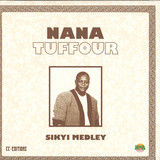
Nana Tuffour - Sikyi Medley

Nana Tuffour

Sikyi Medley

12inchKALITA12006/CC12001
Kalita
23.10.2018

Kalita Records and CC:EDITIONS (a new venture by
Australia's CC:DISCO) jointly announce a 12' EP
comprised of four of Nana Tuffour's greatest electronic
burger highlife tracks, accompanied by interview-based liner
notes. Here, in partnership with Nana, we select two highly
sought-after songs from his 1993 release 'Genesis', namely
'Sikyi Medley' and 'M'Anu Me Ho', and pair them his with two
lesser known yet equally deserving tracks 'Asamando' and
'Jesus' from his 1997 CD-only release 'Highlife Tropicana'.
Hailing from Kumasi, the capital of the Ashanti region in Ghana,
Nana Tuffour is by far one of the most important exponents of
modern highlife music. He studied piano at college and cut his
teeth in the '70s as an organist and vocalist for the incomparable
Kyeremanteng Atwede and Dr. K Gyasi's Noble Kings Band.
Fast forward to 1981 and Ghana was at the apex of its golden age
of music. This era was brought to an abrupt end by political
upheaval when the military took over the government and as a
result a restrictive dusk to dawn curfew was imposed between
1982 and 1984. This resulted in a total obliteration of the country's
night life, and Nana just like many other prominent musicians
including Pat Thomas and George Darko left Ghana for greener
pastures, the most popular destinations being Nigeria and
Germany. The Rheinklang Studio in Düsseldorf run by a young
inimitable German sound engineer Bodo Staiger and another
'exiled' Ghanaian musician Charles Amoah played a crucial role
for those musicians who had chosen Germany. This studio
became the focal point for Ghanaian musicians and the birthplace
of a new sound, now known as 'Burger highlife' - traditional
Ghanaian highlife infused with the more up to date electronic and
disco sounds of the West. It is arguable that Nana has played a
crucial role in Burger highlife and developing the sound of
traditional Ghanaian highlife more widely to what it is today, with
his innovative use of electronic accompaniment pushing its
boundaries to its creative extremes.
It is Burger highlife's transcendence of traditional musical
boundaries that helps make it so accessible to listeners,
appealing not only to Ghanaians back home but now highly
regarded and sought-after by those in the West interested in
more occidental disco and electronic sounds. We hope that you
enjoy the four songs offered here, each chosen to demonstrate
Nana's singular influence on the development of Burger highlife.

non in magazzino

Ordina ora e ordineremo l'articolo per te presso il nostro fornitore.

Mattes Schwarz - I Don't Know

Mattes Schwarz

I Don't Know

12inchMAGAZINE017
Magazine
01.09.2017

The first time I heard of Mattes Schwarz, someone called him 'Stecken-Mattes'. Stecken was a defining, if almost secret, Cologne dance music venue of the 2000s and early 2010s, a minuscule basement without curfew and seemingly any other restrictions, where the up to twelve hour long DJ-sets felt like a tightly knit circle of friends just playing records to each other: The selectors from the night before and the one after reliably sitting right in front of the just over one meter long stretch of the bar that formed its booth, never missing out on a chance to see their mates play, heads nodding and hands clapping through the smoke-filled air, until someone started to sing along, and eventually everyone got up for a few hours of moves on the 15 square meter dancefloor, on a grey Wednesday or Saturday morning at 7 or just as well 10 am.
Mattes Schwarz started DJing in 1982 at age twelve, inspired by, as many West-German kids, the GI-DJs of the roller skating rinks around US army bases. While he got heavily involved in Cologne's BMX scene of the 90s, he never really stopped, and during the main years of being known as Stecken-Mattes and playing there each Friday night, he coincidently lived in Magazine record's homebase, North- Eastern Cologne's old harbour.
One day after Stecken's closure had sent restructuring ripples through the city - I imagine him getting up in the morning and taking a deep breath - he decided to send Magazine a few tracks.
'I Don't Know' is Mattes Schwarz' first release.

non in magazzino

Ordina ora e ordineremo l'articolo per te presso il nostro fornitore.

Articoli per pagina:

Language

N/ABPM
Vinyl